In France, nuclear industry manages to cancel a film showing, about Fukushima nuclear disaster
 France TV Info 6th March 2019 A film about the Fukushima disaster censored in a commune that houses a
nuclear power plant. The Nuclear Exit Association planned a projection
eight years after the Fukushima accident in Japan. But the event was
canceled after the nearby nuclear plant contacted the town hall.
Many infringements found in Orano’s (formerly Areva) uclear site at Tricastin, France
 Sortir du Nucleaire 5th March 2019 , As part of ASN’s duties concerning the control of basic nuclear
installations (BNIs), an unannounced inspection was carried out on 6 March
2018 on the W and TU5 installations (BNI No. 155), operated by Orano Cycle
on the nuclear site Tricastin, on the theme “waste management”. As this
inspection revealed numerous infringements, the “Quit Nuclear” Network
filed a direct summons against Orano.
https://www.sortirdunucleaire.org/Tricastin-dechets-Orano
New defects, after a series of problems and delays, in France’s supposed “nuclear flagship” Flamanville
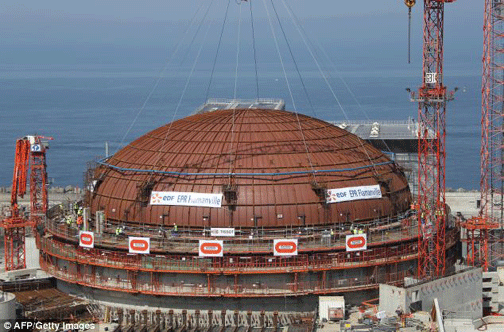 France Info 1st March 2019 Machine Translation] Cracks, failed welds … How the site of the EPR Flamanville has turned into a fiasco to nearly 11 billion euros.
The third generation nuclear reactor, which was to take office in 2012, will finally be operational only in 2020 after the discovery of new defects. Back on those days when the yard slipped. It was to be the flagship of the French nuclear industry, the EPR of Flamanville (Manche) is today its ball.
The construction site of the European Pressurized Reactor (EPR) experienced numerous delays, the last of which occurred on July 25, 2018, after the discovery of poorly made welds. Originally scheduled for 2012, its entry into service is (for the moment) postponed to 2020. And nothing says that the yard will be spared by new counter-time. The Nuclear Safety Authority (ASN) thus pinned EDF on Wednesday (February 27th) for a lack of “traceability” of certain equipment qualification operations on the EPR.
Huge workforce at Flamanville nuclear reactor, employed to fix unsafe welds
**Flamanville* Tendance Ouest 1st March 2019 EDF announced that “500 people will intervene to take over twenty welds” non-compliant on the site of the nuclear reactor. A team that will add to
the current workforce of the site, already 3800 people. The operation
should take place in the fall, “after our hot tests , ” said Bertrand
Michoud, director of facilities at the EPR Flamanville.
France’s nuclear corporation, EDF, faces the first of many mammoth nuclear plant burials
L’Express 22nd Feb 2019 , Sooner or later, EDF will have to close power plants. Facing the corporation is a vast building project with many unknowns. And in the middle flows the Meuse.
Nestled in one of its loops, a few kilometers from the Belgian border, the two cooling towers of the Chooz nuclear power  plant spew their plumes of white smoke. On the other side of the river, under the wooded hillside that has taken the colors of autumn, EDF is leading the dismantling of Chooz A.
Shut down since 1991 this reactor, installed in an\ artificial cavern, saw its installations gradually dismantled and
evacuated. Still to settle the fate of the tank. Perched on a metal bridge over a deep pool where she was dipped, a handful of Swedish engineers from the American company Westinghouse remotely maneuver the articulated arms of a robot that cut it. A long work, which must last until 2022. After which, the cave Chooz A will be filled with sand, for eternity.
France considers fully nationalising EDF nuclear energy company
Last November, Macron said EDF would halt up to 14 reactors by 2035, with the aim of reducing nuclear power to 50 percent of the electricity mix from 72 percent currently. He delayed a decision to build new atomic plants until at least 2021 and presented plans to boost wind and solar. The president also called for a new regulation of EDF’s nuclear power prices to keep electricity bills under control amid weekly protests against energy costs and taxes.
By Francois De Beaupuy, Geraldine Amiel , and Helene Fouquet February 14, 2019,-
Utility needs funds to maintain or replace aging reactors
-
Restructuring could help EDF to meet long-term challenges
The French government is considering buying out minority shareholders of Electricite de France SA, the first step in a corporate restructuring to address the challenge of replacing the country’s nuclear-power backbone, people familiar with the matter said.
The government has asked EDF, of which it owns 84 percent, to propose changes in its structure. The utility’s cash flows are vulnerable to volatile power prices and intensifying competition, and it’s already struggling to fund billions of euros of investments to maintain or replace its aging reactors.
Nuclear dominates French electricity supply, but the government wants a change
EDF is likely to be be taken into full state ownership, with nuclear operations being placed in a parent company and other businesses such as renewables placed in units, said one person at the utility, who asked not to be identified because the deliberations are private. Nationalization could help the utility cope with the state’s plan to reduce France’s dependence on nuclear power by phasing out some reactors, while also giving it the means to participate in the development of renewable energy, said a person familiar with the government’s thinking.
EDF is likely to be be taken into full state ownership, with nuclear operations being placed in a parent company and other businesses such as renewables placed in units, said one person at the utility, who asked not to be identified because the deliberations are private. Nationalization could help the utility cope with the state’s plan to reduce France’s dependence on nuclear power by phasing out some reactors, while also giving it the means to participate in the development of renewable energy, said a person familiar with the government’s thinking.
This was already looking like being a significant year for EDF after President Emmanuel Macron outlined his vision for French energy policy to shift in favor of renewable energy. From the point of view of investors, re-regulating and restructuring the company’s reactor fleet could be a big value driver, Vincent Ayral, an analyst at JPMorgan Chase & Co, said in Jan. 30 research note.
If the government opts for nationalization, the process would be long and require the approval of European antitrust authorities, the person said. France would at the same time have to get the region’s regulator to approve new rules for nuclear power because the current system, designed to boost competition in the French electricity market, expires at the end of 2025, the person added.
Last November, Macron said EDF would halt up to 14 reactors by 2035, with the aim of reducing nuclear power to 50 percent of the electricity mix from 72 percent currently. He delayed a decision to build new atomic plants until at least 2021 and presented plans to boost wind and solar. The president also called for a new regulation of EDF’s nuclear power prices to keep electricity bills under control amid weekly protests against energy costs and taxes.
This was already looking like being a significant year for EDF after President Emmanuel Macron outlined his vision for French energy policy to shift in favor of renewable energy. From the point of view of investors, re-regulating and restructuring the company’s reactor fleet could be a big value driver, Vincent Ayral, an analyst at JPMorgan Chase & Co, said in Jan. 30 research note.
If the government opts for nationalization, the process would be long and require the approval of European antitrust authorities, the person said. France would at the same time have to get the region’s regulator to approve new rules for nuclear power because the current system, designed to boost competition in the French electricity market, expires at the end of 2025, the person added.
Last November, Macron said EDF would halt up to 14 reactors by 2035, with the aim of reducing nuclear power to 50 percent of the electricity mix from 72 percent currently. He delayed a decision to build new atomic plants until at least 2021 and presented plans to boost wind and solar. The president also called for a new regulation of EDF’s nuclear power prices to keep electricity bills under control amid weekly protests against energy costs and taxes
France to build hypersonic nuclear weapons
WW3: France to build ‘unstoppable’ HYPERSONIC NUKES to replace ageing nuclear armoury
FRANCE is set to build a state-of-the-art armoury of hypersonic weapons capable of travelling more than 3,800mph, in a bid to upgrade their ageing nuclear arsenal as they fall behind other world military powers., By THOMAS MACKIE, Express UK :11, Sat, Feb 9, 2019 The French Defence Ministry has promised to test a prototype hypersonic glider missile device in just two years time. “We have decided to issue a contract for a hypersonic glider demonstrator,” Defense Minister Florence Parly said during the unveiling of the V-MaX project. France has already carried out studies on propulsion systems for hypersonic flights as part of a £32 billion overhaul of its nuclear arsenal.
Hypersonic gliders would be carried to the edge of the earth’s atmosphere by a launch vehicle and would then “glide” back to a target on the ground.
France’s main nuclear-tipped air-to-surface cruise missile, the ASMP, is capable of flying up to Mach 3, which is 2,300 mph.
To be deemed hypersonic, the new device must be capable of flying at least five times the speed of sound (3,800mph).
However many hypersonic weapons can travel much faster, with Russia’s latest glider reaching speeds of 20,700mph.
The French Directorate General of Armaments (DGA) admitted the country had “relatively little experience” in the hypersonic field.
Hypersonic weaponry is fast becoming the nuclear weapon of choice among the world superpowers.
In March last year Russia unveiled a new range of weapons, including two hypersonic devices, the Kinzhal air-launched missile and the Avangard hypersonic glide vehicle.
The Avangard hypersonic glide vehicle is capable of flying at least 10 times faster than sound and has been already deployed to the Russian Air Force……….https://www.express.co.uk/news/world/1084928/world-war-3-france-news-hypersonic-nukes-nuclear-weapon-defence-ministry
France to discuss the recycled use of nuclear wastes
France Info 3rd Feb 2019 France Info 3rd Feb 2019 Will we end up with recycled nuclear waste in our everyday objects? The State will raise the issue of the recycling of low-level radioactive nuclear waste during a new public consultation in March.
https://www.francetvinfo.fr/societe/nucleaire/va-t-on-se-retrouver-avec-des-dechets-nucleaires-recycles-dans-nos-objets-du-quotidien_3172553.htm
Pump malfunction causes shutdown at Flamanville nuclear reactor
EDF said the reactor was disconnected safely in order to allow technical teams to carry out repair works on one of the two pumps supplying water to the secondary circuit.
The reactor in the north of France restarted production on Jan. 27 after a prolonged outage for its third 10-year overhaul since April 2018.
EDF said it informed nuclear safety authority ASN about the incident which had no impact on other facilities.
The reactor is expected to resume electricity production on Feb. 8
Power production was halted at the Flamanville 2 reactor, which has a similar capacity, on January 10 for its third decennial upgrade. The reactor is expected back online on July 10.
(Reporting by Bate Felix; Editing by Sudip Kar-Gupta
Protests over inaction on climate change – in Belgium and France
“Young people have set a good example,” protester Henny Claassen said amid banners urging better renewable energy use and improved air quality.
“This is for our children, for our grandchildren, and to send a message to politicians.”
The march ended at the headquarters of the European Union. The 28-nation bloc has been leading global efforts to counter climate change but still came in for the protesters’ criticism.
“Society as a whole could do a lot more because they’re saying ‘Yes, we’re doing a lot,’ but they’re doing not that much. They could do a lot more,” demonstrator Pieter Van Der Donckt said.
Citizen activism on climate change Sunday was not limited to Belgium.
Thousands of people made human chains or held other climate events around France.
In Paris, there was a debate inspired by a recent petition for legal action to force the government to set more ambitious goals for reducing carbon emissions that create global warming.
President Emmanuel Macron sees himself as a climate crusader, but suffered a serious setback when fuel tax increases meant to help wean France off fossil fuels backfired dramatically, unleashing the country’s yellow vest protests now in their third month.
France’s new president of the Nuclear Safety Authority concerned on safety of aging nuclear reactors
president of the Nuclear Safety Authority. The new president of the Nuclear
Safety Authority, Bernard Doroszczuk, is worried about the aging of the
park and the loss of skills.
https://www.lemonde.fr/planete/article/2019/01/29/l-etat-des-installations-est-un-vrai-sujet-de-preoccupation-selon-le-president-de-l-autorite-de-surete-nucleaire_5416128_3244.html
France’s government snidely changes law to avoid paying compensation to Polynesian victims of atomic bomb testing
 Dismay in Tahiti over changed nuclear compensation law https://www.radionz.co.nz/international/pacific-news/381065/dismay-in-tahiti-over-changed-nuclear-compensation-law French Polynesia’s nuclear test veterans organisations are dismayed to find out that a planned change to the compensation law for test victims was quietly altered last year.
It emerged that in the finance act passed in France in the week before Christmas, a provision of negligible exposure for compensation claimants was included.
This was against the recommendation of a commission set up in 2017 which advised for the reference to negligible risk to be removed as a way to improve the 2010 compensation law.
There had been widespread clamour to change the law because most applications had been thrown out.
The head of the Moruroa e tatou organisation Roland Oldham told the public broadcaster that the situation was simple.
He said the French state refused to compensate the test victims by playing for time.
Father Auguste Uebe-Carlson of the Association 193 also condemned this change, saying the fight was continuing.
The 12-member commission which advised the French legislature was headed by a French Polynesian Senator Lana Tetuanui, who is yet to comment.
France tested 193 nuclear weapons in the South Pacific over a 30-year period, with some of the atmospheric blasts irradiating most islands.
French nuclear company EDF considering retreating from operations in UK
year”, according to one senior figure, but it is being approached with caution by EDF’s Paris head office amid concern over the political implications.
another two nuclear power projects with support from China. EDF is locked in negotiations with the Government over plans to fund its plans for a reactor at Sizewell C. Discussions about a step back from the energy-supply
market began after the departure of long-serving boss Vincent De Rivaz in 2017.
Gas has confirmed plans to sell its 20pc stake in the reactors and industry sources say EDF hopes to sell another 29pc from its share within the same transaction. The deal is understood to have caught the eye of a consortium
of pension funds which would hold a minority share of the business while EDF remains the operator of the nuclear reactors.
https://www.telegraph.co.uk/business/2019/01/26/edf-weighing-retreat-energy-market-uk/
France to replace Fessenheim nuclear plant with solar power project
EU approves France’s plan to replace nuclear plant with 300 MW of PV https://www.pv-magazine.com/2019/01/21/eu-approves-frances-plan-to-replace-nuclear-plant-with-300-mw-of-pv/
The commission said the project selected through the tender will receive a premium tariff under a 20-year contract, and the tender’s budget is approximately €250 million.
“The aid will be granted by the French state and will contribute to the French and European objectives of energy efficiency and energy production from renewable sources, in line with the EU’s environmental objectives, with possible distortions of competition state support being reduced to a minimum,” the commission stated.
The tender was announced by the French government in April. In July, France’s Directorate General for Energy and Climate – part of the Ministry for the Ecological and Inclusive Transition – revealed details of the tendering scheme. According to that announcement, 200 MW of the tendered capacity will be for ground-mounted PV ranging in size from 500 kW up to 30 MW, with the remaining 100 MW accounted for by rooftop projects larger than 8 MW in scale.
Potential tariffs estimated
The tender was to be implemented in three phases, starting late last year and continuing in the middle and latter stages of this year, and was set to comprise three groups of installations: the ground-mounted PV; rooftop systems on buildings, greenhouses, carports or agricultural buildings with an output of 500 kW to 8 MW; and rooftops with a capacity of 100-500 kW.
Projects selected among the first two categories will be entitled to a premium feed-in tariff while installations of the third and smallest category will have access to a regular FIT. The premium tariff for ground-mounted PV is expected to be €50-70/MWh, and that for larger rooftops €70-100/MWh. Smaller rooftop projects are expected to be granted €80-110/MWh.
The 40-year-old Fessenheim nuclear site, in the Haut-Rhin department of Alsace in northeastern France, is set to be decommissioned by next year. The plant has seen more than one temporary shutdown due to safety issues. One of the most high-profile issues occurred in April 2014, when Reactor 1 was shuttered. The French Nuclear Safety Authority reported at the time that internal flooding in the non-nuclear part of the reactor had damaged safety electrical systems. After being repaired, the reactor was reconnected to the grid in May the same year.
Further tests to be made on Flamanville nuclear reactor’s faulty weldings
Reuters 21st Jan 2019 French state-owned power company EDF said it would make further tests next
month on faulty weldings at its Flamanville nuclear reactor plant, which
has been plagued by technical problems. “EDF actively continues to
implement the action plan on welds of the main secondary system announced
on 25 July 2018. The ‘hot tests’ are now scheduled to commence during
the second half of February,” EDF said in a statement. EDF said it would
keep the targeted construction costs for Flamanville at 10.9 billion euros
($12.4 billion).
https://uk.reuters.com/article/uk-edf-flamanville/french-utility-edf-to-make-further-tests-on-faulty-flamanville-weldings-idUKKCN1PF0JB?rpc=401&
1 This Month

of the week – Shut Down Drone Warfare!


Tell the Ukrainian Government to Drop Prosecution of Peace Activist Yurii Sheliazhenko

Petition to revoke the licensing of the Near Surface Nuclear Disposal Facility (NSDF) at Chalk River. https://www.ourcommons.ca/petitions/en/Petition/Details?Petition=e-7247
To see nuclear-related stories in greater depth and intensity – go to https://nuclearinformation.wordpress.com
-
Archives
- April 2026 (44)
- March 2026 (251)
- February 2026 (268)
- January 2026 (308)
- December 2025 (358)
- November 2025 (359)
- October 2025 (376)
- September 2025 (257)
- August 2025 (319)
- July 2025 (230)
- June 2025 (348)
- May 2025 (261)
-
Categories
- 1
- 1 NUCLEAR ISSUES
- business and costs
- climate change
- culture and arts
- ENERGY
- environment
- health
- history
- indigenous issues
- Legal
- marketing of nuclear
- media
- opposition to nuclear
- PERSONAL STORIES
- politics
- politics international
- Religion and ethics
- safety
- secrets,lies and civil liberties
- spinbuster
- technology
- Uranium
- wastes
- weapons and war
- Women
- 2 WORLD
- ACTION
- AFRICA
- Atrocities
- AUSTRALIA
- Christina's notes
- Christina's themes
- culture and arts
- Events
- Fuk 2022
- Fuk 2023
- Fukushima 2017
- Fukushima 2018
- fukushima 2019
- Fukushima 2020
- Fukushima 2021
- general
- global warming
- Humour (God we need it)
- Nuclear
- RARE EARTHS
- Reference
- resources – print
- Resources -audiovicual
- Weekly Newsletter
- World
- World Nuclear
- YouTube
-
RSS
Entries RSS
Comments RSS
 nuclear-news