
French energy group EDF reviews costs of delayed nuclear project https://www.ft.com/content/c6bc1884-9343-11e9-b7ea-60e35ef678d2 Flamanville plant’s faulty weldings must be fixed, says watchdog David Keohane in Paris JUNE 20, 2019
French energy group EDF says it is reviewing the start-up schedule and costs of its flagship Flamanville nuclear project after the regulator said it would have to fix faulty weldings, which have already delayed the project.
ASN, the nuclear watchdog, said on Wednesday that nuclear-focused EDF needs to repair eight of the joins at Flamanville in northern France.
“EDF is currently analysing the impact of this decision on the Flamanville EPR [nuclear reactor] schedule and cost, and, in the upcoming weeks, it will give a detailed update on the next steps in the project,” said the company in a statement on Thursday.
“This is negative news but it does not come as a surprise,” said analysts at Société Générale, since EDF had already flagged the likelihood of a delay. EDF’s shares fell 1.8 per cent by midday in Paris.
The ASN said in October that the weldings were being reviewed. While, in July, EDF said there would be further delays and cost overruns due to problems with the connections. It pushed back the loading of nuclear fuel and the target construction costs at the late and over-budget plant.
EDF had said the loading of nuclear fuel was scheduled for the end of 2019 with commercial activity starting in 2020 and costs revised up again from €10.5bn to €10.9bn. Initially, Flamanville was expected to cost €3.3bn and start operations in 2012. ASN suggested in its communication to EDF that the plant would not be operational before 2022.
The Flamanville plant in France is one of three being built in Europe using the next-generation European Pressurised Reactor technology. The other two projects are the Olkiluoto project in Finland, which is more than a decade late, and the UK’s Hinkley Point, which is mired in controversy over the high cost of the project.
More broadly, EDF is expected to brief trade unions on Thursday about plans to reorganise the company. The plan, codenamed Hercules, say people familiar with the matter, would involve a holding company 100 per cent-owned by the state and two subsidiaries sitting beneath it. EDF Bleu, or EDF Blue, would house all nuclear and hydroelectric assets and EDF Vert, or EDF Green, would hold the renewables, services and network assets.
EDF Vert would then be floated to raise funds.
The company will also propose a regulated pricing mechanism for 100 per cent of France’s nuclear production to replace the current mechanism, said analysts at Bernstein. The plan to split the company stems from this move since, as Bernstein add, a “100 per cent regulated price for nuclear production in France would likely be considered state aid by the EU”.
The plan thus still has to clear the European Commission as well as probable public pushback to higher regulated prices and heavy union opposition. French trade unions remain particularly powerful within EDF and has used threats of power cuts in the past.
In a joint statement this week, the unions said they “oppose a strictly financial reorganisation that would lose sight of the industrial project, the social ambition and the general interest” of the group.
June 22, 2019
Posted by Christina Macpherson |
business and costs, France, safety |
Leave a comment
French ASN orders EDF to fix weldings on Flamanville nuclear reactor https://www.euronews.com/2019/06/19/french-asn-orders-edf-to-fix-weldings-on-flamanville-nuclear-reactor
19/06/2019 PARIS (Reuters) – French nuclear regulator ASN said in a statement on Wednesday that utility EDF will have to repair eight faulty weldings that traverse the containment vessel at the nuclear reactor EDF is building in Flamanville, northern France.
In April, IRSN – ASN’s technical arm – had already recommended that EDF repair the eight weldings, which are hard to reach and hard to repair. EDF had hoped to convince ASN that the flaws in the weldings were not a threat to the reactor’s safety and wanted to leave them in place.
The ASN was due to rule on the recommendation this month. Its statement gave no further details.
EDFCEO Jean-Bernard Levy said on Tuesday that repairing the weldings would cause further delays to the reactor, which is already years behind schedule and billions of euros over budget.
Following the discovery of the problems with the weldings, EDF in July 2018 delayed the scheduled loading of nuclear fuel by a year to the fourth quarter of 2019.
(Reporting by Geert De Clercq; Editing by Leigh Thomas)
|
|
|
June 20, 2019
Posted by Christina Macpherson |
France, safety |
Leave a comment
|
 French Nuclear Power Producer EDF Plans a Turnaround, CFO Xavier Girre is selling assets and trailing new financing tools ahead of a potential reorganization of the company. WSJ By Nina Trentmann June 14, 2019 French Nuclear Power Producer EDF Plans a Turnaround, CFO Xavier Girre is selling assets and trailing new financing tools ahead of a potential reorganization of the company. WSJ By Nina Trentmann June 14, 2019
Aging nuclear reactors, soaring debt and large capital-spending commitments that generate are just some of the problems facing Xavier Girre, the chief financial officer of French electricity supplier Electricité de France SA .
The room to maneuver is limited: Key operating decisions must be taken in conjunction with the French government, EDF’s largest shareholder.
“We are not the decision makers,” Mr. Girre told CFO Journal. “With regards to regulation, the state is.”……..
France’s largest energy producer has also sold assets worth €10 billion ($11.24 billion), and assets worth a further €2 billion to €3 billion are to be divested by 2021. The government recently allowed EDF to give shareholders new shares instead of a cash dividend
A planned restructuring of the company’s assets and a new pricing structure for the French energy market could help Mr. Girre make further improvements, said Claire Mauduit-Le Clercq, analyst at S&P Global Inc.
The plan could allow EDF to separate its nuclear plants—it currently operates 58—from the rest of the business, a move that would enable the company to focus on investments in renewable energy. A large part of the company’s energy production comes from nuclear reactors…….
Analysts say the challenge for EDF will be to fund the turnaround given its hefty debt load. EDF’s net debt—a measure of total loans and financial liabilities less cash and liquid assets—was €33.38 billion at the end of 2018, up from €33.01 billion at the end of 2017.
Further complicating the picture is EDF’s large capital spending program. The company committed in 2014 to spending up to €45 billion by 2025 to extend the lifespan of its nuclear reactors fleet from around 40 to 50 years. The average age of an EDF nuclear power plant currently stands at 33 years.
New plants under construction, for example in Britain’s Hinkley Point, are adding to that cost burden. Total capital expenditures were about €14 billion in 2018. “EDF would not have to sell business after business to fund new investments if this was a viable business model,” AB Bernstein’s Ms. Becker said.
Meanwhile, the company’s net income slumped to €1.17 billion in 2018 from €3.17 billion a year earlier. Fluctuating energy prices, mean “the company lacks visibility into its future earnings,” said Ms. Mauduit-Le Clercq.
“You have a company that faces major investment needs, that has a negative cash flow equation and that has high debt levels—this creates tension in the balance sheet,” she said.
But the company’s financial standing is more vulnerable when other obligations, such as pension liabilities, future obligations to retire certain assets and costs for managing nuclear waste, are factored in. Adjusted net debt was €70 billion at the end of 2018, S&P Global said. https://www.wsj.com/articles/french-nuclear-power-producer-edf-plans-a-turnaround-11560526991
|
|
June 17, 2019
Posted by Christina Macpherson |
business and costs, France, politics, renewable |
Leave a comment
|
Renews Biz 14th June 2019 , French environment minister Francois de Rugy has outlined today how France
intends to meet its new 10GW offshore wind target by 2028. A 1GW
fixed-bottom project to be built off Normandy will soon be open to public
consultation, he said. Tenders will also be launched in the near future for
three 250MW floating offshore wind farms and an up to 1GW fixed-bottom
development off the island of Oleron. One 250MW floating project,
comprising about 20 turbines, will be allocated to the south of Brittany in
2021, with the other two will be located in the Mediterranean in the
Occitanie and PACA regions, De Rugy said.
https://renews.biz/53745/france-maps-offshore-future/
|
|
June 17, 2019
Posted by Christina Macpherson |
France, renewable |
Leave a comment
|
Together Against Sizewell C accuse EDF Boss of Schoolboy Errors in his Defence of Nuclear Power, http://www.tasizewellc.org.uk/index.php/news/271-together-against-sizewell-c-accuse-edf-boss-of-schoolboy-errors-in-his-defence-of-nuclear-power 30th May 2019
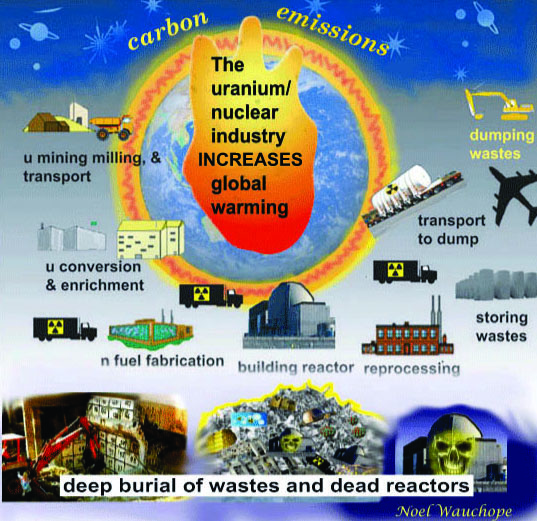
Together Against Sizewell C chairman, Pete Wilkinson, claims that EDF CEO Jean-Bernard Lévy makes some schoolboy errors in his fatuous defence of nuclear power in his IEA February 25th speech, this having been recently reported by World Nuclear News, 20 May 2019. Pete Wilkinson says “M. Lévy is careful to use the word ‘direct’ when claiming that nuclear power produces electricity without emissions; by this, he presumably means that the only part of the nuclear fuel cycle that can even come close to being ‘low carbon’ is that which ‘burns’ uranium in the reactor. Of course, he knows, as do we all, that across the entire fuel cycle, nuclear requires an acceptance of a carbon footprint from uranium mining, milling, enrichment, fuel production, transport, nuclear plant construction, storage and the still-unknown CO2 burdens created by final spent fuel and waste management conundrums. To claim otherwise is disingenuous, especially from someone in such a position of responsibility.
It is true that the fight against climate change is challenging, but to conclude that nuclear power is essential to winning that fight is wrong and designed to defend a technology which is antiquated, costly, polluting and presents us with a wealth of unresolved health issues related to childhood leukaemia. Sixty studies, including the seminal German government-sponsored KiKK Report indicate elevated rates of leukaemia and other cancers as a result of exposure to ionising radiation.
The Oxford Research Group produced a report some years ago which clearly demonstrated that, given the global nature of the problem of climate change, it would require the building of at least 3000 nuclear plants to have a noticeable impact on the problem – that’s one new plant a week for 60 years. Impossible, yes, but wholly undesirable as well since the nuclear waste legacy that scale of programme would create is unthinkable: we can’t even deal with the 500,000 cubic metres of legacy waste in the UK after 60 years of merrily creating it without a thought about how to manage it safely. Even after ten years of the Nuclear Decommissioning Authority, the UK is still no closer to a universally safe and secure means of dealing with the legacy waste, let alone the hotter and more radioactive waste which M. Levy’s reactors will leave us over the next few decades in return for huge amounts of UK tax payers’ cash should the plant at Hinkley ever be finished and should Sizewell become more than an EdF aspiration.
A further reason why nuclear power cannot hope to have more than a minor role to play in the fight against the climate emergency, is the fact that the plants take so long to build. The ‘nuclear renaissance’ in the UK was mooted on the back of energy security and low carbon. The lights in the UK were, at the time of Blair’s announcement in 2005, predicted to go out in 2017. It is now 2019, the lights didn’t go out and no new nuclear is contributing electricity to the national grid in the UK and is unlikely to be doing so for at least another six or seven years – probably longer, given the historic over-runs of time and budget which accompany nuclear plant. Nuclear is an option for the future, not an imperative: that much has been shown time and again with analyses from highly reputable and responsible green and academic groups. Nuclear just can’t contribute fast enough and even if and when it does, its contribution will be only marginal at best, negative at worst.
By definition, renewables are potentially endless. They rely on the Sun, the wind, the tides and ambient energy. Moreover, the source of the energy arrives free-of-charge, without mining for rare, unstable and potentially lethal metals or digging for fossil fuels to burn, releasing their carbon back into the atmosphere. Combined with efficiency measures, decentralised electricity generation, smart grids and conservation measures which have already seen electricity demand fall in the UK by some 16% in the last decade, we can meet all our climate change, cost and demand targets without nuclear. This has been demonstrated time and time again: nuclear is an option, not an imperative, and it is an option we should refuse.
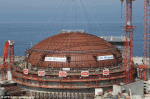 Quite apart from the fact that EdF’s flagship EPR Flamanville plant is facing a further two year delay as a result of ASN’s likely demands that reactor core welds are repaired, it is appropriate to remind M. Lévy that EdF is hugely in debt, that its board of Directors are not united in their view of the company’s new build programme and that the victim communities around the proposed sites for new build are fearful of the wholesale disruption to their lives, the environment and the tranquility they currently enjoy in these largely remote and isolated sites”. Quite apart from the fact that EdF’s flagship EPR Flamanville plant is facing a further two year delay as a result of ASN’s likely demands that reactor core welds are repaired, it is appropriate to remind M. Lévy that EdF is hugely in debt, that its board of Directors are not united in their view of the company’s new build programme and that the victim communities around the proposed sites for new build are fearful of the wholesale disruption to their lives, the environment and the tranquility they currently enjoy in these largely remote and isolated sites”.
|
|
June 3, 2019
Posted by Christina Macpherson |
France, spinbuster |
Leave a comment
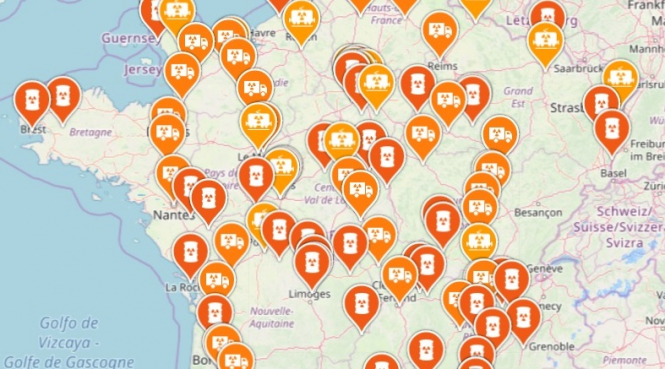
Nuclear waste map of France published by Greenpeace, https://www.connexionfrance.com/French-news/Nuclear-waste-map-of-France-published-by-environmental-activists-Greenpeace-on-issue 29 May, 19, Nuclear waste is becoming a hot topic of discussion, as Greenpeace publishes a map of waste across France
A new interactive map showing the locations of nuclear waste across France has been published by environmental group Greenpeace, as part of its forthcoming campaign on the issue.
The map was published online this week, with the NGO aiming to “compile in a single place” all of the information it has on the location of radioactive material, to let people know how close they may be living to the waste.
The map categories include storage centres (at which the waste will be stored for 300 years minimum); nuclear centres that generate all forms of nuclear waste; more than 200 old uranium mines, operational up to 2001; factories and other plants; and radioactive waste from more than 70 military sites.
The data was collected from records of radioactive waste agency l’Agence Nationale pour la Gestion des Déchets Radioactifs (Andra).
The map does not include waste from medical use or research.
The map allows you to search by post code (Greenpeace.fr / Screenshot)Greenpeace is hoping to raise awareness and prompt debate over the extent of nuclear waste, and ask questions on the potential impact it may have. This also includes the impact of transporting nuclear waste by road or rail.
The group is also seeking to gather signatures and support for its national campaign on the issue, which it will later address to French ecology minister François de Rugy.
The map features a button saying “Agir! (Act!)”, allowing members of the public to add their support.
A public debate is set to be held on September 25 on this exact question – the issue of nuclear waste in France. It will be held on a platform via which the public will be able to ask for further information and have their say.
Nuclear waste disposal is also expected to be on the agenda at the G20 summit being held in Japan next month.
May 30, 2019
Posted by Christina Macpherson |
France, wastes |
Leave a comment
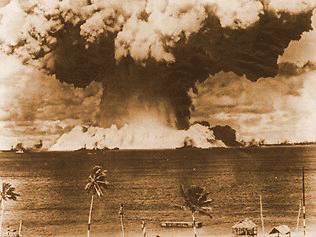
France acknowledges Polynesian islands ‘strong-armed’ into dangerous nuclear tests, Telegraph UK Henry Samuel, Paris, 24 MAY 2019 France has officially acknowledged for the first time that French Polynesians were effectively forced into accepting almost 200 nuclear tests conducted over a 30-year period, and that it is responsible for compensating them for the illnesses caused by the fallout.
The French parliament issued the much-awaited admission in a bill reforming the status of the collectivity of 118 islands in the South Pacific, with MPs saying the change should make it easier for the local population to request compensation for cancer and other illnesses linked to radioactivity.
From 1966 to 1996, France carried out 193 nuclear tests around the paradise islands, including Bora Bora and Tahiti, immortalised by Paul Gauguin. Images of a mushroom cloud over the Moruroa atoll, one of two used as test sites along with Fangataufa, provoked international protests.
Charles De Gaulle and subsequent presidents had thanked French Polynesians for their role in assuring the grandeur of France by allowing it to conduct the tests.
But in the parliamentary bill, France acknowledges that the islands were “called upon” – effectively strong-armed – into accepting the tests for the purposes of “building (its) nuclear deterrent and national defence”.
It also stipulates that the French state will “ensure the maintenance and surveillance of the sites concerned” and “support the economic and structural reconversion of French Polynesia following the cessation of nuclear tests”.
Patrice Bouveret of the Observatoire des armements (Armaments Observatory), an independent organisation that has been assessing the impacts of French nuclear testing in Polynesia since 1984, welcomed the reform.
“It recognises the fact that local people’s health could have been affected and thus the French state’s responsibility in compensating them for such damage. Until now, the entire French discourse was that the tests were ‘clean’ – that was the actual word used – and that they had taken all due precautions for staff and locals.”
However, he said it was a “scandal” that it had taken 23 years for France to officially recognise its responsibility, and said there was nothing in the law on the ill-effects on future generations……. https://www.telegraph.co.uk/news/2019/05/24/france-acknowledges-polynesian-islands-strong-armed-dangerous/
|
|
|
May 25, 2019
Posted by Christina Macpherson |
France, indigenous issues, OCEANIA, weapons and war |
1 Comment
Times 20th May 2019 , France will enter new democratic territory next month when 150 randomly selected citizens will be asked to overhaul the country’s environmental policies, President Macron’s government announced yesterday.
The group will draw up plans on issues ranging from global warming to biodiversity which Mr Macron has pledged to implement, to put to a referendum or to turn into legislation that will go before parliament. The Citizens’ Convention
for the Climate is being organised in an attempt to meet yellow-vest protesters’ demands for MPs to be bypassed in a move towards direct democracy.
Yet the initiative is fraught with dangers for Mr Macron, who risks losing control of the political agenda. Some of his supporters fear that far from appeasing the campaigners, the process could inflame their anger by reintroducing the fuel duty rises that ignited the protest movement in November.
May 21, 2019
Posted by Christina Macpherson |
climate change, France, politics |
Leave a comment
Montel News 17th May 2019 EDF must repair welds or reinforce new reactor – ASN. French utility EDF
must repair faulty welds on its new generation European pressurised reactor
(EPR) Flamanville or reinforce the under construction plant, the ASN
nuclear safety authority said.
These were the “two options currently on
the table”, said ASN president Bernard Doroszczuk during a presentation
of the watchdog’s annual safety report to parliamentarians on Thursday.
The ASN would announce a final decision on which course to take next month,
he added, with Montel having reported earlier this week that this would
happen once its group of experts had met on 6 June.
While repairing the
welds was “quite feasible”, reinforcing the 1.6 GW plant could be a
“complex operation” for which the unit was not necessarily conceived,
said Doroszczuk. However, the “French nuclear industry is currently
facing a skills shortage”, which could complicate things, he added.
Repairing the welds could push back the planned start-up of the reactor
early next year by two years to 2022, sources told Montel last month. Last
July, EDF delayed the 1.6 GW EPR launch by yet another year due to the
defective welds. It also raised the total estimated cost of construction by
EUR 400m to EUR 10.9bn.
May 20, 2019
Posted by Christina Macpherson |
France, safety |
1 Comment
|
French watchdog investigates potential nuclear safety fraud https://www.reuters.com/article/france-nuclear-fraud/update-1-french-watchdog-investigates-potential-nuclear-safety-fraud-idUSL5N22P2X6 (Adds detail on falsification of identities)PARIS, May 13 (Reuters) – French nuclear regulator ASN said it had launched an investigation into elements of fraud and falsification regarding nuclear safety, after receiving several warnings from whistleblowers.
Last November, the ASN launched a website where the public can highlight irregularities regarding nuclear safety, which followed a 2016 scandal over falsified manufacturing documents at former nuclear reactor maker Areva and a string of problems with weldings and components at EDF nuclear reactors. Areva is now part of state-owned utility EDF and renamed Framatome.
The ASN said in a statement on Monday that since then it had received 22 warnings and had launched an investigation into a small number of these as they had the characteristics of potential fraud cases.
It also said it had already referred four cases to the criminal court. It declined to give more details about them.
The regulator did not identify any companies involved in the investigation.
EDF – which operates the 58 nuclear reactors that generate some three quarters of French electricity – said it could not immediately comment on ASN’s statement.
The ASN said that initial investigations had revealed several problems, such as the use of inappropriate materials, certain activities, such as welding, carried out by people who did not have the necessary skills, and safety controls that were either missing or executed by internal staff only.
The regulator said this could have a number of implications, such as modification of test results, falsification of the identity of staff having and the non-execution of certain operations such as the replacement of components. (Reporting by Geert De Clercq; Editing by Sudip Kar-Gupta and Jane Merriman)
|
|
May 14, 2019
Posted by Christina Macpherson |
France, secrets,lies and civil liberties |
Leave a comment
Le Monde 15th April 2019 For several weeks, EDF’s management and the executive have been
preparing a plan to separate nuclear activities from the rest of the group.
A high-risk issue for the government.
https://www.lemonde.fr/economie/article/2019/04/15/les-pistes-du-gouvernement-pour-decouper-edf_5450313_3234.html
Le Monde 15th April 2019 The CGT secretary of the EDF works council, François Dos Santos, protested against the government’s desire to divide the group into two separate
subsidiaries.
https://www.lemonde.fr/economie/article/2019/04/15/edf-modifier-le-perimetre-du-groupe-est-inacceptable_5450416_3234.html
April 18, 2019
Posted by Christina Macpherson |
business and costs, France, politics |
Leave a comment
 Times 16th April 2019 A row erupted in France yesterday after it emerged that EDF’s board will discuss plans to renationalise the group’s nuclear activities and split them from the rest of its business. Unions reacted with anger to what they depicted as the first step towards the dismantling of the energy group that is building Britain’s new reactors at Hinkley Point in Somerset.
The board is due to review the restructuring plan next month before presenting it to senior managers and union representatives in June, according to a source. The scheme involves the creation of a parent company to run the group’s 58 reactors in France, as well as new ones that it may build.
This part of the group could be renationalised, rolling back the partial privatisation of EDF in 2004, which left the state with an 83.7 per cent stake. Most of the rest of the group’s activities then would be placed in a subsidiary that would continue to seek private investors under the plan, which has been codenamed Project Hercules, according to the newspaper Le Parisien.
People close to President Macron, who has the final say, claim that he broadly supports the idea, but may backtrack if the price of compensating shareholders proves to be beyond the means of France’s hard-pressed state budget. A fierce union reaction also could prompt him to retreat,
commentators said.
Although a source insisted that the restructuring would have no direct impact on Hinkley Point, it is likely to create short-term uncertainty for EDF Energy, the group’s British division.
EDF is struggling to meet the cost of renovating its ageing French nuclear fleet, which is estimated at between €55 billion and €75 billion. In addition, the group, which has a debt of €33 billion, is facing several other difficulties, not least that it is committed to funding two thirds of the estimated £22.3 billion cost of the new-generation European pressurised reactors being built at Hinkley Point.
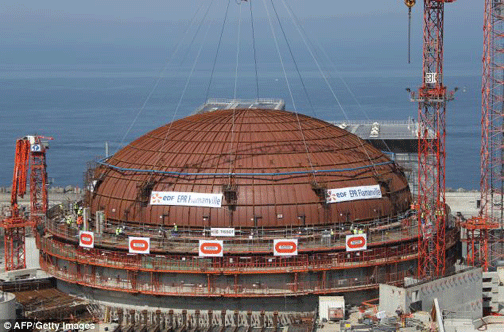
A similar reactor at Flamanville in northern France was meant to cost €3 billion and come on stream in 2012. The reactor is still not operating and the budget has reached €10.9 billion. Last week, it emerged that experts had advised that EDF should repair faulty weldings at Flamanville, which would add hundreds of millions of euros to the bill and lead to a further delay.
April 18, 2019
Posted by Christina Macpherson |
business and costs, France, politics |
Leave a comment
|
 France’s ASN regulator keeps enhanced monitoring of EDF’s Belleville nuclear power plant https://uk.reuters.com/article/france-nuclearpower-safety/frances-asn-regulator-keeps-enhanced-monitoring-of-edfs-belleville-nuclear-power-plant-idUKL5N21Z2CQ, PARIS, April 17 (Reuters) – France’s ASN nuclear regulator said on Wednesday it was maintaining its close supervision of utility EDF’s 2,600 MW Belleville nuclear power plant, due to the need to continue to monitor safety practices despite some improvements. France’s ASN regulator keeps enhanced monitoring of EDF’s Belleville nuclear power plant https://uk.reuters.com/article/france-nuclearpower-safety/frances-asn-regulator-keeps-enhanced-monitoring-of-edfs-belleville-nuclear-power-plant-idUKL5N21Z2CQ, PARIS, April 17 (Reuters) – France’s ASN nuclear regulator said on Wednesday it was maintaining its close supervision of utility EDF’s 2,600 MW Belleville nuclear power plant, due to the need to continue to monitor safety practices despite some improvements.
The regulator placed the plant under enhanced supervision in September 2017, citing failures in safety standards.
It noted that the state of the plant’s installations and safety practices had generally improved in 2018, but there was still work to do.
“However… the progress noted remains to be consolidated and that the performance of the facilities must still improve,” the ASN said in a statement.
The ASN also said it will carry out additional inspections and checks to documentation, while keeping track of EDF’s action plan to fix the issues. (Reporting by Bate Felix; Editing by Sudip Kar-Gupta) |
|
April 18, 2019
Posted by Christina Macpherson |
France, safety |
Leave a comment
Liberation 11th April 2019 The Flamanville EPR risks a new catastrophic delay for EDF. The group ofexperts of the Nuclear Safety Authority considers that the electrician must
“repair” eight large defective welds on the Flamanville reactor. The work
could last until 2022 at the risk of ruining the reputation of the EPR,
which is already years behind schedule.
https://www.liberation.fr/france/2019/04/11/l-epr-de-flamanville-risque-d-accuser-un-nouveau-retard-catastrophique-pour-edf_1720782
April 13, 2019
Posted by Christina Macpherson |
business and costs, France |
Leave a comment

ICIS 5th April 2019 The commissioning of France’s long-overdue 1.65GW Flamanville 3 nuclear project could face further delays, according to industry stakeholders. A group of experts from French nuclear authority ASN, nuclear safety institute IRSN and utility EDF are set to meet on 9 April to discuss what to do about the welds of the plant’s EPR reactor, IRSN’s director Jean Cristophe-Niel said at a conference in Paris on Thursday.
At the meeting ASN could communicate to EDF whether it would want the welds to be entirely rebuilt or just repaired. If ASN does order the welds to be rebuilt this could significantly delay the commissioning of the plant which was previously set for winter 2019-2020.
The project has already faced delays spanning seven years. ASN will have to communicate its final decision on
Flamanville’s welds in May. The director of energy think-tank WISE-paris Yves Marignac also said at the conference that it was possible Flamanville 3 would be delayed further with no clear timeframe in sight. A number of
traders present at the conference said they were not surprised by this possibility given the project’s track record.
https://www.icis.com/explore/resources/news/2019/04/05/10345828/another-flamanville-3-nuclear-plant-delay-increasingly-likely/
April 8, 2019
Posted by Christina Macpherson |
France, safety |
Leave a comment







 nuclear-news