
South Korean Catholics take the lead in protesting against nuclear power, PRI, May 11, 2017, By Matthew Bell Standing up to his own government is nothing new for Moon Kyu-hyun. The 70-year-old Jesuit priest from South Korea made international news back in 1989, when he crossed the border into North Korea illegally.
The Catholic priest’s unsanctioned trip was a political act of defiance against South Korea’s strict National Security Law, which prohibited people in the South from almost any contact with North Korea.
The Rev. Moon was promptly arrested when he returned to the South. And he ended up spending three and a half years in prison.
“Peace and hope is what life is all about,” Moon says, reflecting on lessons learned during his time in jail.
In that same spirit, Moon — whose Christian name is Paul — is part of a group of Catholic clergy taking the lead in a growing anti-nuclear movement in South Korea. Moon says he is opposed to nuclear weapons, including the North Korean nuclear program that’s been a big part of rising tensions in northeast Asia. But he’s also against recent US actions on the Korean peninsula.
“THAAD is a weapon of war. You can’t be for peace if you’re preparing for war,” Moon says, referring to the anti-missile system recently deployed by the US military in South Korea.
Beyond the nuclear security issue though, Moon and other Catholic leaders are pressuring the South Korean government to rethink the country’s dependence on nuclear power. That is no small order, as this is a country that relies on more than two dozen nuclear power plants for about a third of its electricity.
“Getting rid of nuclear power is the only way to survive, to save ourselves, and save the world,” Moon says during a recent anti-nuclear demonstration in downtown Seoul, where Catholic priests and nuns announced an effort to collect a million signatures in support of their campaign…….
“It’s directly against God’s intention,” Cho says. All Christians, he adds, “believe that God created the universe, and there is the divine order.” Cho says the threat posed by nuclear energy goes against that divine order……..
Catholics here have also forged a somewhat surprising alliance. Japan and Korea have a long and troubled history, to put it mildly. But every year since 2012, Kim Hyun-joo has been part of a group of Korean Catholics who meet up with Japanese Catholics to work together on anti-nuclear protest activities. Kim is an anti-nuclear activist with the Society of Jesus in Seoul……..
Catholic leaders in Korea are following the example of Pope Francis. They say the environment is now a top priority, although they acknowledge the campaign against nuclear power is a going to be a long, uphill struggle……..
the best news for Catholic anti-nuclear activists came when Moon, during the campaign, pledged to cut back drastically on the government’s plans to expand the nuclear power industry. https://www.pri.org/stories/2017-05-11/south-korean-catholics-take-lead-protesting-against-nuclear-power
May 12, 2017
Posted by Christina Macpherson |
opposition to nuclear, Religion and ethics, South Korea |
Leave a comment

 China, South Korea seek to steer North from nuclear path, DW 11 May 17 The presidents of China and South Korea have agreed they want North Korea to move away from its agenda of atomic antagonism. A US missile-defense system deployed on the peninsula was also a topic of conversation. In his first talk with Chinese President Xi Jinping since being sworn in as South Korea’s president, South Korea’s Moon Jae-in sought common ground with China on North Korea’s nuclear program.
“The resolution of the North Korean nuclear issue must be comprehensive and sequential, with pressure and sanctions used in parallel with negotiations,” Moon’s spokesman, Yoon Young-chan, said the president had told Xi. “Sanctions against North Korea are also a means to bring the North to the negotiating table.”
The presidents also discussed the contentious Terminal High Altitude Area Defense (THAAD) anti-missile system the United States installed in South Korea to Beijing’s chagrin…….http://www.dw.com/en/china-south-korea-seek-to-steer-north-from-nuclear-path/a-38794619
May 12, 2017
Posted by Christina Macpherson |
China, politics international, South Korea |
Leave a comment
THAAD Rocket Fuel: Likely Ground Water Contamination Coming to Seongju, South Korea http://www.globalresearch.ca/thaad-rocket-fuel-likely-ground-water-contamination-coming-to-seongju-south-korea/5589018, By Bruce Gagnon, May 07, 2017 Space4Peace The unwelcome US deployment of the THAAD (Terminal High Altitude Area Defense) missile defense (MD) system in Seongju, South Korea is not only a significant threat to regional peace but is also a major environmental catastrophe waiting to happen.

May 10, 2017
Posted by Christina Macpherson |
environment, South Korea, weapons and war |
Leave a comment
 A North Korean Nuclear EMP Attack? … Unlikely, http://38north.org/2017/05/jliu050517/ By Jack Liu
05 May 2017, Recent press articles warn about the possibility of the North Koreans launching an electromagnetic pulse (EMP) attack on the United States, and there are even suggestions that the recent missile test failures may represent a thinly veiled EMP threat. However, such an attack from North Korea is unlikely, as it would require the North to have much larger nuclear weapons and the missile capability to deliver them.
EMP Concerns
The Report of the Commission to Assess the Threat to the US from EMP Attack[1] states:
When a nuclear explosion occurs at high altitude, the EMP signal it produces will cover the wide geographic region within the line of sight of the detonation. This broad band, high amplitude EMP, when coupled into sensitive electronics, has the capability to produce widespread and long lasting disruption and damage to the critical infrastructures that underpin the fabric of U.S. society.
The effects of the pulse can be transferred directly to sensitive devices or as an electrical surge over power lines.
The generic diagram below [on original] shows an EMP to consist of three phases (E1, E2 and E3) occurring over vastly different time scales.[2] Of these, E1 is the most damaging. The others are 100 times (at minimum) less damaging than the first.
The E1 component of an EMP is a very brief but powerful electromagnetic field that can induce very high voltages in electrical conductors. Damage occurs by causing voltage limits in equipment to be exceeded and happens so fast that ordinary surge protectors cannot effectively protect computers and communications equipment. However, special transient protectors fast enough to suppress this part of an EMP exist and there has been significant progress in hardening critical systems against EMP.
The E1 component is produced when gamma radiation during the first 10 nanoseconds (1 nanosecond = 1 billionth of a second) from the nuclear detonation rips electrons out of the atoms in the atmosphere. The electrons travel at relativistic speeds (more than 90 percent of the speed of light) to illuminate the area beneath the blast. The Earth’s magnetic field acts on these electrons to change the direction of electron flow to a right angle to the geomagnetic field that may cause downward electron flow to produce a very large, but quick, electromagnetic pulse over the affected area.
The E2 component is generated by scattered gamma rays and gamma emissions produced by neutron collisions from the explosion. This component lasts from about one microsecond to one second after the beginning of the electromagnetic pulse and is similar to the electromagnetic pulse produced by lightning. Because of the similarities to lightning-caused pulses and the widespread use of lightning protection technology, the E2 pulse is generally considered to be the easiest to protect against.[3]
The E3 component of the pulse is a slow pulse, lasting tens to hundreds of seconds. It results from the nuclear detonation distorting the Earth’s magnetic field, followed by its restoration. This component is quite similar to a geomagnetic storm caused by a very severe solar flare. Like a geomagnetic storm, it can induce currents in long electrical conductors, with the potential to damage power line components.
Size Matters
This is an instance where size does matter: the larger the nuclear explosion, the larger the affected area. While technical reports and papers on EMP from nuclear detonations are mostly classified, there is a paper by D. Hafemeister of California Polytechnic Institute that provides sufficient detail to derive a simple rule of thumb on the relationship between affected distance and nuclear device yield. The paper makes some simplifying assumptions:
- The detonation is spherically symmetric (which may not always be the case);
- The Earth’s magnetic field is not accounted for;
- Prompt gamma rays account for 0.3 percent of the total energy of the explosion and are emitted within the first 10 nanoseconds of detonation;
- About 0.6 percent of the prompt gamma rays produce relativistic electrons that constitute the E1 component of the EMP; and
- The electric field damage threshold is 15,000 volts/meter or higher in the E1 component.
Plugging in the numbers and presuming these assumptions are appropriate, the rule of thumb is surprisingly simple: D = Y, where D is the maximum damage distance expressed in kilometers and Y is the yield of the blast in kilotons. So, a 20 KT bomb detonated at optimum height would have a maximum EMP damage distance of 20 km; a 1 MT (1,000 KT) bomb would damage out to 1,000 km. The largest North Korean test to date has been estimated to be about 20 KT.
Conclusions
Considering the physics behind EMP and the status of North Korea’s nuclear program to date, doomsday headlines in the press regarding the North’s potential EMP threat are grossly overstated.[4] North Korea’s nuclear tests have not yet demonstrated sufficient yield to cause damage to large areas through EMP. Moreover, with only a limited arsenal, it would not make sense for the North Koreans to conduct nuclear tests simply to develop EMP weapons.
[1] John Foster, et al., Report of the Commission to Assess the Threat to the United States from Electromagnetic Pulse (EMP) Attack—Critical National Infrastructures, April 2008.
[2] Edward Savage, James Gilbert, William Radasky. The Early-Time (E1) High-Altitude Electromagnetic Pulse (HEMP) and Its Impact on the U.S. Power Grid, Meta-R-320, Prepared for Oak Ridge National Lab., Jan 2010.
[3] According to the US EMP Commission, “In general, it would not be an issue for critical infrastructure systems since they have existing protective measures for defense against occasional lightning strikes. The most significant risk is synergistic, because the E2 component follows a small fraction of a second after the first component’s insult, which has the ability to impair or destroy many protective and control features. The energy associated with the second component thus may be allowed to pass into and damage systems.”
[4] In the early 1950s, above ground nuclear tests of a size similar to what the North Koreans have demonstrated were conducted at the Nevada Test Site just 65 miles from Las Vegas. There were no reports of power outages. The casinos continued to operate. Nuclear fallout was the bigger issue.
May 6, 2017
Posted by Christina Macpherson |
Reference, South Korea, weapons and war |
Leave a comment
 Future of nuclear energy bleak in Korea All major candidates vow to stop building new reactors, Korea Times, By Jung Min-ho, 21 Apr 17, The future of nuclear energy looks bleak in Korea for whoever becomes the next president.
All major candidates have vowed to stop building new nuclear reactors and close down older ones in an effort to reduce the country’s dependence on nuclear energy.
Left-leaning Democratic Party of Korea (DPK) candidate Moon Jae-in, the frontrunner in the race, promised to cancel construction plans for two additional nuclear reactors ― Shin Kori 5 and 6. He believes Korea will have to phase out all of its remaining nuclear power plants over the next 40 years.
Ahn Cheol-soo of the People’s Party, the runner-up, also made the same promises, though he did not mention specifically by when he plans to remove all nuclear reactors. Korea has 23 nuclear reactors in operation, from which it gets about 30 percent of its power. Five more reactors are under construction.
Sim Sang-jeung of the minor Justice Party is taking the strongest stance against nuclear energy. She said she will immediately close down all the reactors under construction and rid the country of nuclear reactors by 2040.
The two right-wing candidates ― Yoo Seong-min of the Bareun Party and Hong Joon-pyo of the Liberty Korea Party ― are more cautious about the idea of removing all the nuclear reactors, but still, they are not far apart on the issue compared to other candidates.
Four of the candidates have also vowed to reduce the country’s dependence on coal power plants as well to resolve the issue of fine dust, which has become worse in recent years. Hong alone remains skeptical of doing so, but he said he will regulate their operations more strictly instead…….
Meanwhile, all the candidates vowed to increase investment into developing renewable energy sources. The two leading candidates said they will initiate the project to increase the country’s reliance on renewable energy to 20 percent by 2030.
“Compared with the previous presidential election, candidates have taken more progressive approaches over the issue,” said Kim Mi-kyung, a climate change activist at the environmental group Greenpeace. “We expect Korea to follow the global trends of nuclear-free, coal-free and more renewable energy.”
April 24, 2017
Posted by Christina Macpherson |
politics, South Korea |
Leave a comment
 South Korea coal, nuclear power targeted for cuts by presidential candidates http://www.channelnewsasia.com/news/asiapacific/south-korea-coal-nuclear-power-targeted-for-cuts-by-presidentia/3672862.html12 Apr 2017 SEOUL: No matter who is elected as South Korea’s new leader next month it is clear that coal and nuclear power generation will likely be scaled back, with most of the candidates laying out plans on Wednesday to address public concerns over pollution and safety.
Less than a month from a May 9 election to replace impeached president Park Geun-hye, policy experts outlined in a forum the energy proposals of four of the five contenders.
The two leading candidates, liberal front-runner Moon Jae-In and centrist Ahn Cheol-soo, both plan to lower South Korea’s reliance on coal and nuclear power, pointing to a need to shift to renewable energy, according to their policy advisors. In the latest poll by Gallup Korea, Moon got the support of 38 percent of respondents, and Ahn got 35 percent.
South Korea, Asia’s fourth-largest economy, gets 40 percent of its electricity from coal, 30 percent from nuclear, 20 percent from natural gas, and the rest from oil and renewables.
But policy changes are expected amid growing concerns over pollution and the safety of nuclear energy, and Moon and Ahn appear determined to help drive them.
“We should move away from coal and nuclear power, and shift to clean or renewable energy-based platforms,” said Kim Jwa-kwan, head of Moon’s energy policy team. Kim said his team planned for nuclear and coal power to account for 18 percent and 15 percent respectively of power supply by 2030, while the contribution of liquefied natural gas (LNG) would increase to 37 percent to support the rise of renewables.
If elected, Moon also “would scrap a plan to build Shin Kori No.5 and Shin Kori No.6 nuclear reactors on which construction began last year and revamp the country’s nuclear power expansion scheme,” Kim said.
That means South Korea’s plan to build 11 nuclear reactors by 2029 could be under threat.
Ahn would similarly shelve a plan to construct four coal-fired power plants and not extend the lifespan of ageing coal and nuclear power stations, said Oh Jeong-Rye, deputy director of Ahn’s People Party.
Both candidates target a 20 percent renewable energy share by 2030 as part of efforts to cut carbon emissions.
Under the current power supply plan, in addition to building 11 nuclear reactors by 2029 – three of which are already under construction – South Korea plans to add 20 more coal-fired power plants by 2022.
Policy experts for two other candidates – the conservative Bareun Party’s Yoo Seong-min and the left-wing Justice Party’s Sim Sang-jung – also said they would overhaul South Korea’s coal and nuclear energy policy.
Sim would cut nuclear power to zero by 2040 and phase out coal by 2060, according to her energy advisor.
(Reporting By Jane Chung; Additional reporting by Heekyong Yang; Editing by Tom Hogue)
April 15, 2017
Posted by Christina Macpherson |
politics, South Korea |
Leave a comment
 South Korea Seeks to Assure Citizens U.S. Won’t Strike North Pre-emptively By CHOE SANG-HUN NYT, APRIL 11, 2017 SEOUL, South Korea — Reacting to worries and conjecture spreading in South Korea of a possible pre-emptive American military strike on nuclear-armed North Korea, the government sought to reassure citizens on Tuesday that there would be no such attack without its consent.
April 14, 2017
Posted by Christina Macpherson |
politics international, South Korea, weapons and war |
Leave a comment
 Trump’s Options for North Korea Include Placing Nukes in South Korea, NBC News 7 Apr 17 by WILLIAM M. ARKIN, CYNTHIA MCFADDEN, KEVIN MONAHAN and ROBERT WINDREM
 The National Security Council has presented President Donald Trump with options to respond to
North Korea’s nuclear program — including putting American nukes in South Korea or killing dictator Kim Jong-un, multiple top-ranking intelligence and military officials told NBC News.
Both scenarios are part of an accelerated review of North Korea policy prepared in advance of Trump’s meeting with Chinese President Xi Jinping this week.
The White House hopes the Chinese will do more to influence Pyongyang through diplomacy and enhanced sanctions. But if that fails, and North Korea continues its development of nuclear weapons, there are other options on the table that would significantly alter U.S. policy.
The first and most controversial course of action under consideration is placing U.S. nuclear weapons in South Korea. The U.S. withdrew all nuclear weapons from South Korea 25 years ago. Bringing back bombs — likely to Osan Air Base, less than 50 miles south of the capital of Seoul — would mark the first overseas nuclear deployment since the end of the Cold War, an unquestionably provocative move.
“We have 20 years of diplomacy and sanctions under our belt that has failed to stop the North Korean program,” one senior intelligence official involved in the review told NBC News. “I’m not advocating pre-emptive war, nor do I think that the deployment of nuclear weapons buys more for us than it costs,” but he stressed that the U.S. was dealing with a “war today” situation. He doubted that Chinese and American interests coincided closely enough to find a diplomatic solution………http://www.nbcnews.com/news/us-news/trump-s-options-north-korea-include-placing-nukes-south-korea-n743571
April 10, 2017
Posted by Christina Macpherson |
politics international, South Korea, USA, weapons and war |
Leave a comment

The projected spread of radioactive cesium-137 from a disaster at the No. 3 reactor’s spent fuel pool of the Kori nuclear plant in Busan, South Korea (Provided by Kang Jung-min)
A serious nuclear accident in South Korea could force the evacuation of more than 28 million people in Japan, compared with around 24 million in the home country of the disaster.
Japan would also be hit harder by radioactive fallout than South Korea in such a disaster, particularly if it occurred in winter, when strong westerly winds would blow radioactive substances across the Sea of Japan, according to a simulation by the Natural Resources Defense Council, a Washington-based think tank.
The simulation, based on a scenario of an unfolding crisis at the Kori nuclear power plant in Busan, South Korea, was led by Kang Jung-min, a South Korean senior researcher of nuclear physics, and his colleagues.
At events in Japan and South Korea, Kang, 51, has repeatedly warned about East Asia’s vulnerability to a severe nuclear accident, saying the region shares the “same destiny” regardless of the location of such a disaster.
The Kori nuclear complex is home to seven of the country’s 25 commercial reactors, making it one of the largest in South Korea. Its oldest reactor–and the first in the country–went online in 1978.
Spent nuclear fuel at the Kori plant is cooled in on-site storage pools next to reactors.
But the operator of the plant has ended up storing spent fuel in more cramped conditions than in the past because waste keeps accumulating from the many years of operations.
An estimated 818 tons of spent fuel was being stored at the pool of the Kori No. 3 reactor as of the end of 2015, the most at any reactor in the country.
That is because the No. 3 pool has also been holding spent fuel from the No. 1 and No. 2 reactors since their fuel pools became too crowded.
Storing spent fuel in such a manner greatly increases the risk of a nuclear accident, Kang warned.
Kang’s team simulated the series of likely events that would follow if the No. 3 reactor lost power in a natural disaster or an act of terrorism.
With no power, the spent fuel at the No. 3 reactor could not be cooled. The cooling water would evaporate, exposing the fuel rods to air, generating intensive heat and causing a fire.
Hydrogen gas would then fill up the fuel storage building, leading to an explosion that would result in the release of a large amount of vaporized cesium-137 from the spent fuel.
Assuming that the catastrophe occurred on Jan. 1, 2015, the researchers determined how highly radioactive cesium-137 would spread and fall to the ground based on the actual weather conditions over the following week, as well as the direction and velocity of winds.
To gauge the size of the area and population that would be forced to evacuate in such a disaster, the team took into account recommendations by the International Commission on Radiological Protection, a private entity, and other organizations.
The results showed that up to 67,000 square kilometers of land in Japan–or much of the western part of the country–would fall under the evacuation zone, displacing a maximum of 28.3 million people.
In South Korea, up to 54,000 square kilometers would need to be vacated, affecting up to 24.3 million people.
The simulation also found that 18.4 million Japanese and 19 million Koreans would remain displaced for even after 30 years, the half-life of cesium-137, in a worst-case scenario.
Radioactive materials from South Korea would also pollute North Korea and China, according to the study.
Nineteen reactors in South Korea are located in the coastal area facing the Sea of Japan, including those at the Kori nuclear power plant.
Kang said the public should be alerted to the dangers of highly toxic spent fuel, an inevitable byproduct of nuclear power generation.
One ton of spent fuel contains 100,000 curies of cesium-137, meaning that 20 tons of spent fuel would be enough to match the estimated 2 million curies of cesium-137 released in the 1986 Chernobyl disaster.
An average-size light-water reactor produces about 20 tons of spent fuel in one year of operation.
East Asia is home to one of the world’s largest congestions of nuclear facilities, Kang said.
Japan, China and South Korea, which have all promoted nuclear energy as state policy for decades, together host about 100 commercial reactors.
A number of nuclear-related facilities are also concentrated in North Korea, particularly in Yongbyon, north of Pyongyang.
If a severe accident were to occur in China, the pollution would inevitably spill over to South Korea and then to Japan.
“That is why people should take serious interest in not just their own country’s nuclear issues, but also in neighboring countries,” Kang said. “Japan, China and South Korea should cooperate with each other to ensure the safety and security of spent fuel and nuclear facilities.”
He said the risks of a fire would be reduced if spent fuel were placed at greater intervals in storage pools.
“Ideally, spent fuel should be moved to sealed dry casks and cooled with air after it is cooled in a pool for about five years,” he said.
http://www.asahi.com/ajw/articles/AJ201703300001.html
March 31, 2017
Posted by dunrenard |
South Korea | Nuclear Disaster, Projection, Study |
Leave a comment
South Korea’s Kori No. 4 nuclear reactor shut due to water level rise, http://www.reuters.com/article/us-southkorea-nuclear-idUSKBN16Y2N6 South Korea’s Kori No. 4 nuclear reactor was manually shut down after the water level in a collection tank rose due to a coolant leak, a spokesman at the reactor’s operator said on Tuesday.
“We estimate the water level of the reactor’s collection tank increased after coolant was leaked,” said Lim Dae-hyun, the spokesman at Korea Hydro & Nuclear Power Co Ltd (KHNP).
Lim added that there was no release of radioactivity and that the cause of the water level increase was being investigated.
The 950-megawatt Kori No. 4 reactor is near Busan, a city more than 300 km (190 miles) southeast of the capital, Seoul.
KHNP, fully owned by state-run utility Korea Electric Power Corp (KEPCO), runs the country’s 25 nuclear reactors, which supply about a third of South Korea’s electricity. (Reporting by Jane Chung; Editing by Jonathan Oatis)
March 29, 2017
Posted by Christina Macpherson |
incidents, South Korea |
Leave a comment
North Korea’s nuclear EMP attack to ‘plunge US into DARK APOCALYPSE’ http://www.dailystar.co.uk/news/latest-news/596437/Kim-Jong-un-Donald-Trump-World-War-3-Nuclear-War-North-Korea-US-EMP-Pyongyang

KIM Jong-un could send the US back to the Stone Age by unleashing a devastating Cold War-style attack on its power grid, a former CIA boss has warned. By Jamie Micklethwaite / Published 14th March 2017 North Korea and the US have been at loggerheads recently, with the tubby tyrant threatening to launch a devastating nuclear assault on US heartland.
Donald Trump has responded by promising repercussions for the hermit state and deploying anti-missile systems on their border.
But a former head of the country’s intelligence agency has warned The Donald that Kim could detonate a nuclear missile into the atmosphere, unleashing a terrifying “electromagnetic pulse” attack.
This would knock out the US’ energy infrastructure, unleashing a doomsday apocalypse scenario.
Former CIA chief chief James Woolsey said: “I think this is the principal, the most important and dangerous, threat to the United States.
“If you look at the electric grid and what it’s susceptible to, we would be moving into a world with no food delivery, no water purification, no banking, no telecommunications, no medicine.
“All of these things depend on electricity in one way or another.”
EMPs can naturally occur – but can also be created with nuclear weapons in the atmosphere.
During the Cold War, the US experimented with this, exploding a nuclear weapon above the Pacific, that knocked out lights and telephone wires in Hawaii. Ex-CIA worker Peter Vincent Pry revealed even a small nuclear bomb could cause a devastating EMP attack.
He said: “One of the myths out there is that you need a high-yield weapon to do an EMP attack.
“Even a low-yield, primitive weapon like the bomb used in Hiroshima will produce a potentially catastrophic EMP field because it’s simply attacking things that are not hardened.”
Terror expert Scott Stewart added that the US grid was very vulnerable, and any EMP attack could trigger a nuclear war.
He said: “Nuclear weapons give (Kim) a deterrent.
“That you can draw a nuke on Seoul very easily is far more of a deterrent than an EMP strike against the United States. “Nothing would take his government down quicker than an actual war against the US.”
The North has launched five missiles this year in a chilling warning to the US.
US troops, including elite marines who killed Osama bin Laden and nuclear bombers are currently taking part in military exercises on the North Korean border with South Korea.
http://www.dailystar.co.uk/news/latest-news/596437/Kim-Jong-un-Donald-Trump-World-War-3-Nuclear-War-North-Korea-US-EMP-Pyongyang
March 15, 2017
Posted by Christina Macpherson |
South Korea, USA, weapons and war |
Leave a comment
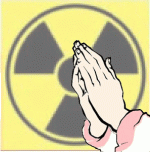 Catholics plan for a future free from nuclear threats http://www.ucanews.com/news/catholics-plan-for-a-future-free-from-nuclear-threats/78620 Civil society groups have delivered a non-nuclear road map to Korea’s presidential candidates March 13, 2017
Anti-nuclear groups in Korea will send their draft for a non-nuclear road map to all major presidential candidates ahead of upcoming elections following news of President Park Geun-hye’s ouster.
The Catholic Solidarity Against Nuclear Energy together with Energy Justice Action, a civic environment group, announced a plan for a “nuclear energy-free Korea.”
They proposed 10 short-term tasks to the next government, including the establishment of a National Energy Commission, no new nuclear power plants, suspension of aged nuclear reactors and reshuffling the power grid in favor of reusable energy.
They also picked five mid and long-term tasks including new management guidelines for nuclear waste, stopping the export of nuclear power and reaffirming principles against nuclear weapons.
The two groups will finalize a road map based on the draft after an activist and public survey, explanation sessions and meeting with experts.
March 15, 2017
Posted by Christina Macpherson |
opposition to nuclear, Religion and ethics, South Korea |
Leave a comment
Donald Trump says nuclear threat from North Korea has entered ‘new phase’
US president told Japanese PM he is ‘100%’ with Tokyo as US moves Thaad missile defence system into South Korea following Pyongyang missile launches, Guardian, Justin McCurry The threat posed by North Korea to the US and its allies has entered a “new phase”, Donald Trump said on Tuesday, a day after the regime test-launched four ballistic missiles towards Japan.
In phone talks on Tuesday, Trump told Japan’s prime minister, Shinzo Abe, that the US stood “100%” with Tokyo after three of the intermediate-range missiles landed in the sea off Japan’s north-west coast.
“President Trump told me that the United States was with Japan 100%, and that he wanted his comments to be communicated to the Japanese people,” Abe told reporters at his residence. “He said he wanted us to trust him as well as the United States 100%.
“Japan and the United States confirmed that the latest missile firing by North Korea … is a clear challenge to the region and the international community, and that its threat has entered a new phase.”
The comments came as the US said the “first elements” of its controversial missile defence system had arrived in South Korea on Tuesday. The Terminal High Altitude Area Defense (Thaad) anti-missile system is meant to intercept and destroy short- and medium-range ballistic missiles during the last part of their flights, the US Pacific Command said in a statement.
“Continued provocative actions by North Korea, to include yesterday’s launch of multiple missiles, only confirm the prudence of our alliance decision last year to deploy Thaad to South Korea,” US Pacific Commander Admiral Harry Harris said.
China has denounced Thaad’s deployment, saying its powerful radar would compromise its security.
South Korea’s Yonhap news agency, citing military sources, said the system could be operational as early as April, well ahead of schedule.
Trump and Abe spoke as the North Korean leader, Kim Jong-un, declared the launches a success and warned that they were part of a training exercise for an attack on US military bases in Japan, home to almost 50,000 American troops.
“The four ballistic rockets launched simultaneously are so accurate that they look like acrobatic flying corps in formation,” the state-run Korean Central News Agency quoted Kim as saying. The regime also released images of the missile launches, with a smiling Kim in attendance.
The launches were seen as a protest against the start of joint military exercises involving South Korea and the US that Pyongyang regards as a rehearsal for an invasion of North Korea.
A day after operation Foal Eagle began last Wednesday, North Korea’s army, deploying the same vitriolic language it reserves for the annual drills, warned that it was ready to “immediately launch its merciless military counteractions” if South Korean or US forces fired “even a single shell” into waters near the divided Korean peninsula…….
Trump has yet to state how he intends to address the growing North Korean threat from ballistic missiles, amid evidence that the regime is edging closer to acquiring the ability to marry a miniaturised nuclear warhead with a long-range missile capable of striking the US mainland.
The UN has imposed six rounds of sanctions since the North conducted its first nuclear test in 2006, but they have failed to dent the regime’s quest to build what it claims is a “defensive” nuclear arsenal.
Trump has not publicly commented on Monday’s missile launch, but his ambassador to the UN, Nikki Haley, said on Twitter that the world “won’t allow” North Korea to continue on its “destructive path”.
Choi Kang, an analyst at the Seoul-based Asan Institute for Policy Studies, said the launch was a warning to Tokyo. “North Korea is demonstrating that its target is not just limited to the Korean peninsula any more but can extend to Japan at any time and even the US,” he said. https://www.theguardian.com/world/2017/mar/07/donald-trump-threat-north-korea-new-phase
March 8, 2017
Posted by Christina Macpherson |
North Korea, politics international, South Korea, USA, weapons and war |
Leave a comment
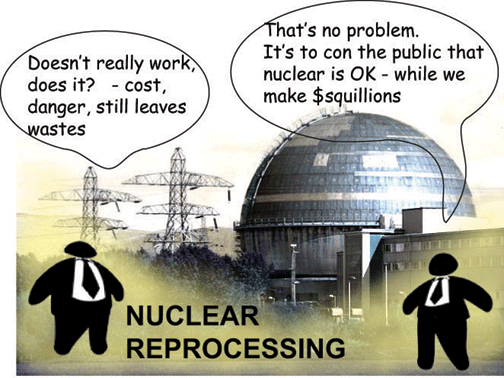
| US expert: uranium price falling, why is S. Korea seeking expensive spent fuel processing facilities? The Hankyoreh, 7 Mar 17 |
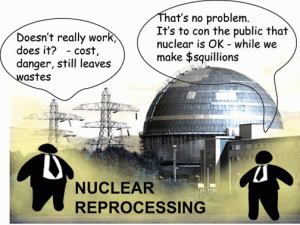 Frank von Hippel says South Korea is trying to develop two kinds of technology other countries have failed at
“The price of uranium is gradually falling, and it costs twice as much to acquire spent fuel processing facilities for running a fast reactor. I don’t understand why [South Korea] is trying to acquire such expensive facilities,” said Frank von Hippel, 80, a professor at Princeton University, during a lecture at a seminar called “Truth and Lies about Pyroprocessing” that was held at the Daejeon Youth We Can Center on Feb. 28. Von Hippel is the American nuclear expert who first proposed the term “proliferation resistance.”
“The Korea Atomic Energy Research Institute is trying to develop the two technologies that all other advanced countries have failed to develop, which is to say reprocessing spent nuclear fuel and liquid sodium-cooled fast reactors. While they claim to be pursuing nuclear fuel reprocessing as a way to manage nuclear waste, this doesn’t improve the problem but only makes it worse while incurring tremendous costs,” von Hippel warned.
“I don’t think the Trump administration and the Republicans are going to change the Obama administration’s nuclear policy [of non-proliferation],” he said. …..
“The Idaho National Laboratory promised to process 25 tons of spent nuclear fuel using pyroprocessing in five years, but they only processed five tons in 16 years, which cost a huge amount of money,” he went on to say.
The plan to reprocess spent nuclear fuel and to build fast reactors derives from false predictions about the future, von Hippel explains. In the 1950s, Americans expected that energy demand would double every decade, but the current energy demand is only twice what it was in the 1960s. The American nuclear energy establishment projected in the 1960s that nuclear energy would cover 100% of future energy demand, but at present nuclear power only provides 20% of energy in the US and just 10% of energy worldwide.
The plan to reprocess spent nuclear fuel for use also derived from concerns about the depletion of uranium reserves and rising prices. But the dreaded rise in prices never materialized because predictions about the rate of increase of nuclear plants were way off and because the output of uranium mines has not decreased. “Currently, the cost of uranium only accounts for 1% of the cost that goes into producing electricity at nuclear plants. Even if spent nuclear fuel is reprocessed and used at fast reactors, it will only be about 2%. Not only is this a small percentage of the total cost, but it will only make the cost of generation more expensive. I don‘t know if it’s necessary to acquire high-cost facilities,” van Hippel said.
Along with the high cost, there are high risks, which means that hardly any countries are interested in building fast reactors, von Hippel contends. France’s fast reactor Superphenix cost 100 trillion won to develop but only operated at 8% before being decommissioned, and Japan’s Monju nuclear plant operated at just 1% for 20 years before it was decided last year to shut it down. The UK is also planning to end operations in 2018. China operated a pilot fast reactor in 2011, but after producing 20kg of plutonium, a small amount, it concluded that the benefits were marginal and suspended the program. Russia continues to operate these reactors, but there have reportedly been 15 fires at sodium fast reactors……
In von Hippel’s view, the most affordable policy for managing spent nuclear fuel is first storing nuclear waste in dry casks and then burying those casks deep underground in disposal sites that have been prudently designed with engineered barriers.http://english.hani.co.kr/arti/english_edition/e_international/785468.html
March 8, 2017
Posted by Christina Macpherson |
reprocessing, South Korea |
Leave a comment
 Kepco seen as potential buyer for Toshiba’s ailing nuclear unit, Ft.com 5 Mar 17 South Korean group, in contrast to rivals, is willing to look at Westinghouse deal, by: Kana Inagaki in Tokyo, Song Jung-a in Seoul When Toshiba won a fierce battle in 2006 for control of Westinghouse, a US designer of nuclear power plants, it was a victory against its local rival Mitsubishi Heavy Industries.
The two Japanese companies engaged in a bidding war that inflated the acquisition price of Westinghouse from $2bn to $5.4bn — a process that left other would-be buyers of the US company in shock, including South Korea’s Doosan Heavy Industries. A little more than a decade later, another Korean company — state-controlled Korea Electric Power Corporation — has emerged as a possible buyer for Westinghouse, which is reeling from large cost overruns on two US nuclear power plants. Moreover, Kepco may well be the only potential acquirer of Westinghouse that is acceptable to western countries, above all the US.
Toshiba is suffering the worst financial crisis in its history because of Westinghouse’s troubles, and last month said it was willing to sell its controlling shareholding in the US company, as well as reduce its 60 per cent stake in a consortium called NuGen, which is planning to build a new nuclear plant in the UK. South Korea has ambitions to become a leading player in the global nuclear industry, and officials at the country’s energy ministry, and Kepco, are keen to secure work on new power plants following a drought in overseas deals since the company landed a breakthrough $20bn export deal in 2009 to supply the United Arab Emirates with four reactors. Kepco has been in negotiations for months about investing in NuGen, according to people involved in the process, although the scale of the Korean company’s participation has not been finalised. The attraction of the UK, however, is clear: Britain has become an important market for the nuclear industry given that other countries, such as Germany, are phasing out reactors……..
Another Korean government official says there could be an industrial logic to Kepco buying Westinghouse, or establishing some kind of partnership with the US company, because this would provide a means to accelerate the country’s expansion in the global nuclear market. Kepco’s participation in both Westinghouse and NuGen could be essential, say several nuclear experts, because other potential bids from China and Russia risk being blocked by the US and the UK over national security concerns. There are few other obvious bidders for Westinghouse……….
A deal between Kepco and Westinghouse could help propel South Korea towards its goal of becoming an important player in the global nuclear industry. Both companies are on an export drive. On top of the UAE deal, Kepco is aiming to sell six more reactors by 2020. Meanwhile, Westinghouse is trying to drum up sales of the AP1000, its latest reactor design, which is currently only being installed in new power plants in the US and China……..
But bankers say Toshiba may find it hard to sell Westinghouse now — having tried several times already. The four reactors being built in the US using Westinghouse’s AP1000 design are already more than three years behind schedule and, on a combined basis, more than $10bn over their original budgets. These problems were the main factors behind Toshiba’s announcement last month of a $6.3bn writedown on its US nuclear business. Some experts say that, with reduced demand for nuclear power following the 2011 Fukushima disaster, it is questionable whether Kepco would gain anything from buying Westinghouse. “Why should [Kepco] take such big financial risks by taking over a troubled business amid the gloomy industry outlook?” asks Suh Kyun-ryul, professor of atomic engineering at Seoul National University…….
https://www.ft.com/content/32f14d76-f8e6-11e6-9516-2d969e0d3b65
March 6, 2017
Posted by Christina Macpherson |
business and costs, South Korea |
2 Comments











 nuclear-news