Dire problems at Turkey’s Akkuyu nuclear Project
Yesil Gazette 27th Jan 2021, Problems around Akkuyu NPP are so dire that, even the supporters of nuclearenergy must object’ If Such accidents occur during the construction phase
of nuclear facilities that require maximum safety, it means that risks of
Akkuyu Project are beyond general nuclear risks. When we see that facts are
hidden from public it is obvious that problems around Akkuyu NPP is so dire
that even the advocates of nuclear energy must object ‘says nukleersiz.org
Coordinator Pinar Demircan. The uncertainty about the explosion that broke
the windows of the houses and cars in the surrounding, which took place in
the evening of Tuesday, January 19 at the Akkuyu Nuclear Power Plant (NPP)
* – which is under construction in the Gulnar district of Mersin –
continues.
Buddhist leader urges international co-operation in further steps on the Nuclear Ban Treaty
 Buddhist Leader Welcomes Entry into Force of Nuclear Ban Treaty, Urges
  International Cooperation to CombatPandemic in 39th Annual Peace Proposal, Soka Gakkai , Jan 26, 2021, TOKYO, Jan. 26, 2021 /PRNewswire/ — On January 26, 2021, the 39th annual peace proposal by Daisaku Ikeda, president of the Soka Gakkai International (SGI) Buddhist association, titled “Value Creation in a Time of Crisis” was released, marking the anniversary of the founding of the SGI.
Ikeda calls for further global cooperation to address the key issues of our time: the COVID-19 pandemic, the climate crisis, and the need to rid the world of nuclear weapons. These issues are not constrained by national borders and cannot be solved by any one government or organization alone……….
Consistent with his decades of action toward the abolition of nuclear weapons, Ikeda welcomes the UN Treaty on the Prohibition of Nuclear Weapons (TPNW), which entered into force on January 22, 2021, as a “pivotal event ushering in a new era” that will spur a paradigm shift in approaches to security. He calls on Japan to participate in the first meeting of the States Parties to the TPNW, to begin to create the conditions in which future ratification can become possible.
He proposes that a forum for discussing the relationship between nuclear weapons and the UN Sustainable Development Goals (SDGs) be held during the first meeting of States Parties to the TPNW.
At the Nuclear Non-Proliferation Treaty (NPT) Review Conference scheduled for August 2021, Ikeda also urges discussion on the true meaning of security in the light of crises such as the climate emergency and the pandemic.
He calls for the final document of the Review Conference to include a pledge of non-use of nuclear weapons and the freezing of all nuclear weapon development until 2025.
A statement from Soka Gakkai President Minoru Harada welcoming the entry into force of the TPNW issued on January 22 can be found at: https://www.sokaglobal.org/contact-us/media-room/statements/tpnw-entry-into-force.html. The SGI has also cosigned an interfaith statement together with more than 170 other religious groups. See: https://sgi-ouna.org/tpnw-eif-interfaith-statement ………..https://www.prnewswire.com/news-releases/buddhist-leader-welcomes-entry-into-force-of-nuclear-ban-treaty-urges-international-cooperation-to-combat-pandemic-in-39th-annual-peace-proposal-301214677.html
Local governments growing more reliant on nuclear taxes
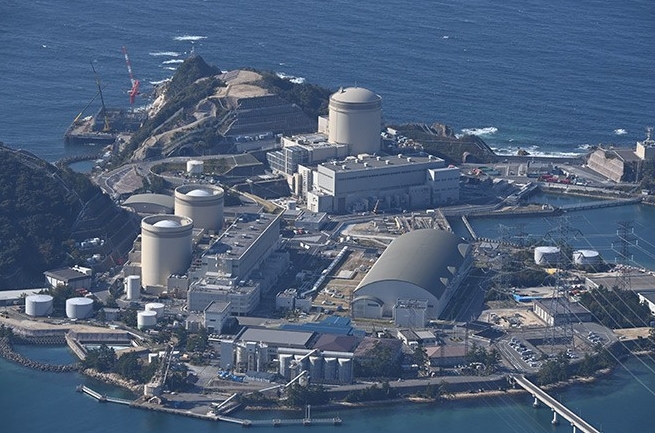
Kansai Electric Power Co.’s Mihama nuclear power plant in Mihama, Fukui Prefecture
January 20, 2021
Local governments are increasingly depending on tax revenues from the nuclear plants they host, a relationship that has deepened over the 10 years since the Fukushima nuclear disaster, an analysis by The Asahi Shimbun shows.
That follows the introduction of new tax regimes that ensure a steady flow of nuclear-related tax yields–even when reactors are idle or in the process of being decommissioned. They were brought about largely through increasing existing taxes on nuclear fuels and levying new taxes on spent nuclear fuels kept at the plants.
In fiscal 2011, right after the triple meltdown at the Fukushima No. 1 nuclear power plant, jurisdictions home to nuclear plants and related facilities yielded some 20.1 billion yen ($193.7 million) in taxes. The bulk of that came from taxes on nuclear fuel; many local governments only began collecting spent fuel taxes years after the accident.
But then the figure more than doubled to an estimated 46.7 billion yen in fiscal 2020, ending in March, despite the nuclear plants being offline.
The Asahi Shimbun studied nuclear-related tax revenues received by host municipalities and the 13 prefectures where those municipalities are located.
Local governments can impose taxes on nuclear fuel and spent nuclear fuel at plants and related facilities through approving ordinances to do so.
Of all the jurisdictions examined, Aomori Prefecture, where nuclear fuel cycle facilities are concentrated, and Fukui Prefecture, which hosts 15 reactors, the most in Japan, account for more than 60 percent earned through those taxes.
The amount for fiscal 2020 is larger than the 40.3 billion yen brought in during fiscal 2010, when the plants were operating.
Nuclear fuel taxes were originally based on the value of reactor fuel.
But all the nuclear plants went offline following the Fukushima disaster in March 2011.
As a result, six prefectures housing nuclear plants reported no tax revenues from nuclear fuel taxes in fiscal 2011.
Desperate to secure income sources even during plant closures, Fukui Prefecture introduced in autumn 2011 a new fuel-tax system based on reactor output capacity–meaning the reactors can be taxed even when shut down.
Other jurisdictions home to nuclear plants followed suit.
In 2014, Ehime Prefecture devised a tax on output capacity that can still be applied when the reactor is undergoing decommissioning. Soon after, Saga Prefecture introduced a similar system.
Nuclear plant operators must pay taxes on spent nuclear fuel to the local government as well as to the prefectural government if ordinances requiring the payment were enacted at both levels.
Ehime and Saga prefectures began taxing spent nuclear fuel in 2019.
Ikata, home to the Ikata nuclear plant in Ehime Prefecture, introduced a tax on spent nuclear fuels in fiscal 2018, after Genakai, which hosts the Genkai nuclear plant in Saga Prefecture, did the same in fiscal 2017.
Mutsu, located in Aomori Prefecture, is ready to capitalize on playing host to an interim storage facility for spent nuclear fuel, which is expected to go into operation in fiscal 2021.
The Mutsu city government established new rules in March last year so it can levy tax on spent nuclear fuels. The tax is projected to bring 9.3 billion yen to the city over five years.
Fukui Prefecture introduced a tax regime for nuclear fuels in 1976, ahead of any other local governments with nuclear facilities in the country.
Since then, tax revenues from nuclear fuels and spent fuels brought in by all jurisdictions totaled more than 1 trillion yen through fiscal 2020. And the figure is projected to grow in the years to come.
The driving force behind these local governments expanding their nuclear taxes in new and creative ways is a decline in tax revenues from fixed assets on nuclear facilities, and fewer grants and subsidies coming in from the national coffers to promote nuclear energy.
Many host communities have underlined the need to secure income from hosting nuclear plants, operating or not, to finance new roads and other infrastructure that would be used to evacuate residents in the event of a serious accident.
But a significant number of local governments used tax revenues derived from nuclear plants to cover upkeep of hot spring resorts and other seemingly unrelated facilities, the study shows.
Regional utilities added the amount of taxes on nuclear fuels and spent nuclear fuels they will pay into the electricity rates that consumers paid until 2016, when the retail electricity market became fully liberalized.
Even after the market liberalization, they can do the same to come up with funds to pay nuclear fuel and spent nuclear fuel taxes.
Tokyo High Court holds TEPCO responsible for Fukushima nuclear crisis

No wonder that the global nuclear industry is hellbent on nationalising itself – so that the taxpayer is responsible. Nobody will want to invest in private nuclear companies after this.
High court denies government responsibility for Fukushima nuclear crisis, Japan Times, 22 Jan 21, The Tokyo High Court on Thursday ordered the operator of the crippled Fukushima No. 1 nuclear power plant to pay damages to evacuated residents, but it overturned an earlier ruling by Maebashi District Court that had also acknowledged the central government’s responsibility over the 2011 nuclear crisis.
Among around 30 such lawsuits across the country, the decision of the Tokyo High Court was the first high court ruling absolving the state of responsibility, contradicting an earlier decision of the Sendai High Court in September that ordered both the state and Tokyo Electric Power Company Holdings Inc. to pay damages.
The government’s failure to instruct Tepco to take measures against tsunamis “is not found to be significantly unreasonable,” Presiding Judge Akira Adachi said in handing down the ruling.
The lawsuit focused on the reliability of an official long-term quake assessment made in 2002, which has been used in previous rulings to determine the liability of the state and Tepco for their failure to prevent the nuclear disaster.
Adachi noted the assessment had caused a debate since its release, and that the government was unable to predict a huge tsunami.
Implementing measures such as constructing seawalls would not have prevented the tide from entering the nuclear plant, he added.
Thursday’s ruling instead ordered Tepco to pay a total ¥119.72 million to 90 plaintiffs, more than triple the amount awarded in the lower court ruling. ………..https://www.japantimes.co.jp/news/2021/01/21/national/crime-legal/government-denies-fukushima-responsibility/
Fukushima’s former residents demand stricter decontamination of radiation before they would return
One condition that stands out among the list, though, is a further reduction in the amount of radiation, which 1 in 3 residents raised as an important issue. The government has been decontaminating specially designated areas, where it was once thought that settlement was limited for good but which can be reopened for residents. It has set the annual radiation exposure limit to be lower than 20 millisieverts as one of the standards to lift the evacuation orders.
Now that nearly 10 years have passed since the nuclear crisis at the Fukushima No. 1 plant, Kamata stressed the need for the government to decontaminate the area under stricter standards so that residents will feel safer returning to their hometown.
“In order to maintain people’s feelings for their hometowns, I want (the government) to stick to the stance of rebuilding our Tomioka in the form that we all want, including restoring the (basic living) environment.”……..
The lifting of the evacuation order in the specially designated area is expected in the spring of 2023, 12 years after the order was first issued.
“Without tackling issues such as restoring the living environment and infrastructure, as well as decommissioning of the Fukushima No.1 plant in a diligent manner, people won’t come back,” said Kamata. …https://www.japantimes.co.jp/news/2021/01/22/national/fukushima-decontaminating-town/
Taiwan. Nuclear power plant referendum set to take place in August
Nuclear power plant referendum set to take place in August, Taipei, Jan. 22 (CNA) A national referendum on activating the long-mothballed Fourth Nuclear Power Plant in New Taipei will be held on Aug. 28, after the Central Election Commission (CEC) confirmed the date that was already set in stone in the Referendum Act.
The Referendum Act stipulates that national referendums can only be held once every two years starting from 2021 and only on the fourth Saturday of August during those years.
The CEC said in a statement Friday that polling stations will be open on Aug. 28 from 8 a.m. to 4 p.m………
Critics….. have warned of the safety hazards of the plant in particular and nuclear power in general, citing the 2011 Fukushima Dai-ichi nuclear power plant meltdown in Japan. ……… https://focustaiwan.tw/politics/202101220020
Japanese govt plans to extend nuclear funding to communities, but there is public opposition

Funding law for areas home to nuclear plants eyed for renewal http://www.asahi.com/ajw/articles/14119178, By NORIYOSHI OHTSUKI/ Senior Staff Writer, January 19, 2021 The central government plans to extend by 10 years a soon-to-sunset law that allows extra financial assistance to jurisdictions housing nuclear power plants–its first time up for renewal since the 2011 Fukushima disaster.
The potentially controversial move could likely spark debate in the Diet due to widespread opposition to nuclear energy following the accident, triggered by the Great East Japan Earthquake and tsunami.
The law was originally enacted in 2000 as a temporary measure and set to expire after a decade. A group of pro-nuclear power lawmakers had sponsored it to ease the concerns of jurisdictions home to nuclear plants.
Those local governments had become increasingly wary about adding more reactors at the existing plants in their communities after a critical accident occurred in 1999 at a facility operated by JCO Co., a nuclear-fuel processing company, in Tokai, Ibaraki Prefecture.
Two workers died and hundreds of residents were exposed to radiation in the accident.
The law was designed to provide public funds to local jurisdictions hosting nuclear plants so that their governments could build new roads and ports, and lure in businesses to their areas through tax breaks.
The law was revised to add another decade to its lifespan right before the triple meltdown at the Fukushima No. 1 nuclear plant in March 2011, when the Democratic Party of Japan was in power.
But the law is set to expire at the end of March this year.
The central government plans to submit a revision bill to extend the funding mechanism by another 10 years during the current Diet session, after gaining Cabinet approval as early as this month.
The government has decided to extend it given that many localities with nuclear plants proceeded with their public works projects while counting on an extension, according to central government officials.
In fiscal 2019, a total of 14.4 billion yen ($138.7 million) was injected into local communities through the funding provisions, according to the Cabinet Office.
But the soundness of renewing the life of the special temporary law has only rarely been publicly debated.
Critics say there is room to question whether the extension can be justified.
Apart from the temporary law, local governments with nuclear facilities have received a large amount of grants and subsidies from the national coffers to help develop their communities since the mid-1970s. The source of that funding is ultimately the electricity charges that users pay.
The proposed extension follows a pledge by the central government to reduce the country’s reliance on nuclear energy in response to growing public opposition to nuclear power.
Pakistan test-fires nuclear-capable surface-to-surface ballistic missile
The missile is capable of carrying nuclear and conventional warheads to a range of 2,750 kms, the statement said.
ISLAMABAD: Pakistan said on Wednesday that it successfully test-fired a nuclear-capable surface-to-surface ballistic missile which can strike targets up to 2,750 kilometres. …… https://www.newindianexpress.com/world/2021/jan/20/pakistan-test-fires-nuclear-capable-surface-to-surface-ballistic-missile-2252773.html
Hiroshima ‘peace clock’ reset to 49 days following US nuclear test
|
Hiroshima ‘peace clock’ reset to 49 days following US nuclear test https://mainichi.jp/english/articles/20210119/p2a/00m/0na/004000c January 19, 2021 (Mainichi Japan) HIROSHIMA –– A clock located in the Hiroshima Peace Memorial Museum in this western Japan city was reset from 705 to 49, indicating the number of days that have passed since the latest nuclear test took place — a subcritical one carried out by the United States in November 2020. The adjustment was made on Jan. 18, after it was revealed in a U.S. national laboratory document that a subcritical nuclear experiment was held in November under the administration of U.S. President Donald Trump. The “Chikyu Heiwa Kanshi Dokei (Peace Watch Tower)” had previously displayed the number “705” to mark the number of days that had passed since the subcritical nuclear experiment conducted by the U.S. in February 2019. As the exact date of the latest test in November is unknown, the clock is currently set at “49 days,” under the assumption that the nuclear test was held on the last day of the month. On Jan. 17, the Hiroshima Municipal Government sent a letter of protest addressed to President Trump to the U.S. Embassy in Japan. On the following day, some 35 people, including hibakusha, or A-bomb survivors, gathered at the Hiroshima Peace Memorial Park in the city’s Naka Ward, which includes the peace memorial museum, and staged a sit-in protest. President-elect Joe Biden, who will be inaugurated on Jan. 20, issued a statement vowing to “work to bring us closer to a world without nuclear weapons,” on Aug. 6, 2020, which marked the 75th anniversary of the U.S. atomic bombing of Hiroshima. (Japanese original by Isamu Gari, Hiroshima Bureau) |
|
Local governments in Japan growing more reliant on nuclear taxes
|
Local governments growing more reliant on nuclear taxes, THE ASAHI SHIMBUN, by Hideki Muroya and Takuho Shiraki.January 20, 2021 Local governments are increasingly depending on tax revenues from the nuclear plants they host, a relationship that has deepened over the 10 years since the Fukushima nuclear disaster, an analysis by The Asahi Shimbun shows.That follows the introduction of new tax regimes that ensure a steady flow of nuclear-related tax yields–even when reactors are idle or in the process of being decommissioned. They were brought about largely through increasing existing taxes on nuclear fuels and levying new taxes on spent nuclear fuels kept at the plants.
In fiscal 2011, right after the triple meltdown at the Fukushima No. 1 nuclear power plant, jurisdictions home to nuclear plants and related facilities yielded some 20.1 billion yen ($193.7 million) in taxes. The bulk of that came from taxes on nuclear fuel; many local governments only began collecting spent fuel taxes years after the accident. But then the figure more than doubled to an estimated 46.7 billion yen in fiscal 2020, ending in March, despite the nuclear plants being offline. The Asahi Shimbun studied nuclear-related tax revenues received by host municipalities and the 13 prefectures where those municipalities are located. Local governments can impose taxes on nuclear fuel and spent nuclear fuel at plants and related facilities through approving ordinances to do so. Of all the jurisdictions examined, Aomori Prefecture, where nuclear fuel cycle facilities are concentrated, and Fukui Prefecture, which hosts 15 reactors, the most in Japan, account for more than 60 percent earned through those taxes. The amount for fiscal 2020 is larger than the 40.3 billion yen brought in during fiscal 2010, when the plants were operating. Nuclear fuel taxes were originally based on the value of reactor fuel. As a result, six prefectures housing nuclear plants reported no tax revenues from nuclear fuel taxes in fiscal 2011. Desperate to secure income sources even during plant closures, Fukui Prefecture introduced in autumn 2011 a new fuel-tax system based on reactor output capacity–meaning the reactors can be taxed even when shut down. Other jurisdictions home to nuclear plants followed suit. ….. http://www.asahi.com/ajw/articles/14121969 |
|
|
UK govt and Japan’s TEPCO to work together on robots to clean up Sellafield an Fukushima’s nuclear pollution
Professional Engineering, Dangerous radioactive material from Fukushima and Sellafield will be retrieved by robots thanks to a new collaboration between the UK and Japan.
The £12m LongOps project is also aimed at automating aspects of nuclear fusion energy production, alongside decommissioning goals.
The four-year research collaboration will use long-reach robotic arms to make decommissioning faster and safer at Tepco’s Fukushima Daiichi reactors in Japan and at Sellafield in the UK.
The Fukushima Daiichi nuclear disaster saw a triple meltdown, three hydrogen explosions and the release of radioactive material after the loss of reactor core cooling following the 2011 earthquake and tsunami.
The Sellafield site in Cumbria is used for nuclear fuel reprocessing and storage, as well as ongoing decommissioning of previous reactors and facilities. There were 21 serious incidents of off-site radiological releases at Sellafield between 1950 and 2000, according to a paper in the Journal of Radiological Protection.
The new project will be led by the UK Atomic Energy Authority’s Remote Applications in Challenging Environments (Race) facility. It will be funded equally by UK Research and Innovation (UKRI), the UK Nuclear Decommissioning Authority (NDA) and Japan’s Tokyo Electric Power Company (Tepco). ….
The decommissioning of legacy nuclear facilities and fusion facilities are complex large-scale projects that are time-intensive to accomplish safely. Using robotics allows teams to keep human workers out of danger. …… https://www.imeche.org/news/news-article/uk-and-japan-tackle-legacy-of-fukushima-and-sellafield-with-robotic-collaboration
India must oppose dumping of radioactive waste into the Pacific, but IAEA and Indian govt downplay the dangers
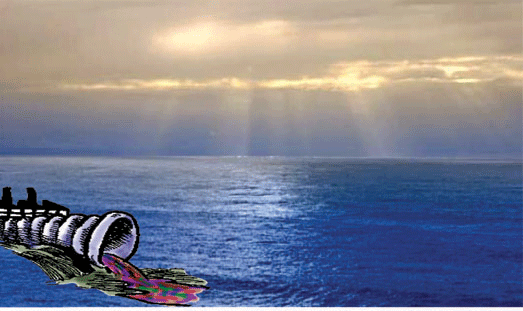 Silence on Fukushima Disaster Exposes our Approach to Nuclear Safety and Why India must Oppose Dumping of Radioactive Water Into the Pacific, BYSONALI HURIA, JANUARY 17, 2021 Next year, the operator of the tsunami-hit Fukushima nuclear plant would start releasing radioactive water into the Pacific Ocean. A number of nations are up in arms against it, but Indian authorities are not rising to the occasion to protect its most vulnerable against the impending disaster.
SONALI HURIA explains what is at stake for people and the environment.
THE new year has begun on a grim note with a toxic gas leak at the Rourkela Steel Plant in Odisha on 6 January, which claimed the lives of four contractual workers. This is the latest in a disconcerting string of industrial accidents in India over the last few years, which have remained peripheral to the mainstream media narrative.
It appears that India has learned precious little from the Bhopal gas disaster, which has ebbed from public memory even as the accident site remains contaminated and survivors continue to await an elusive justice.
Against this backdrop, as we approach the tenth anniversary of the Fukushima nuclear disaster, it may be pertinent to think of what a nuclear accident might mean for the country’s already shoddy industrial safety record and systemic inadequacies, especially as the Fukushima disaster now poses a formidable new challenge to which India’s response, so far, has been active denial and muted silence.
“Fukushima” has become synonymous with the devastating and ongoing nuclear accident that occurred off the eastern Pacific coast of Japan in 2011.
Japan’s nuclear regulator, the Nuclear Regulation Authority (NRA) reportedly stated as recently as in December 2020 that the reactor buildings of the Fukushima Daiichi nuclear power plant continue to record “lethal” levels of radiation, thus posing a “serious challenge” to decommissioning efforts.
DISPOSING CONTAMINATED WATER
Among the many vexing problems precipitated by the accident is the disposal of the contaminated water from the beleaguered nuclear plant.
The acerbic debate within Japan on the disposal of this radioactive water came to a head recently when the Japanese government made it clear that beginning 2022, the operator of the Fukushima plant, the Tokyo Electric Power Company (TEPCO), would start releasing radioactive water from the wrecked plant into the Pacific Ocean—a task envisaged to be accomplished over the next several years as part of larger decommissioning efforts.
Since the devastating earthquake and tsunami off the Pacific coast of Tōhoku triggered a meltdown at the three units of the nuclear plant in March 2011, cleanup efforts have required, among other things, the pumping of tens of thousands of tons of water to cool the smouldering reactor fuel cores.
However, this has led to a steady on-site accumulation of heavily contaminated water—as of 2020, TEPCO has nearly 1.23 million metric tons (and counting) of highly radioactive wastewater on its hands that has been stored in nearly 1,044 tanks…………
LOOMING DANGERS
Greenpeace International has warned that carbon-14, which TEPCO affirmed is present in the contaminated tank-water for the first time in August 2020, has the “potential to damage human DNA”.
Tokyo’s decision has understandably ruffled feathers globally.
The Republic of Korea, China, and Chile, state parties to the London Convention on the Prevention of Marine Pollution by Dumping of Wastes and Other Matter, have repeatedly called for international deliberation and resolution of the problem, even as South Korea, which has banned all seafood imports from the region since the accident, has formally called upon the International Atomic Energy Agency (IAEA) to dissuade Japan. While the North Korean state media described the proposed discharge as a “criminal act”, a coalition of environmental and citizens’ groups from Taiwan petitioned the Japanese government in November 2020, expressing their objections.
The IAEA has confined itself to assisting the Japanese government rather than question or evaluates the proposed water disposal plan. It has demonstrated yet again that it is not the international nuclear watchdog many believe it to be.
UN Special Rapporteurs on hazardous wastes, right to food, rights to assembly and association, and the rights of indigenous people have also urged Japan not to use the present pandemic as a “sleight of hand” to release the radioactive water without any credible consultation within and outside Japan regarding a decision that will have a long-lasting impact on the environment and human health.
DANGERS FOR INDIA
The stakes for India cannot be overstated either.
In an unanticipated moment of candidness, nuclear health scientists from within the Indian establishment—the Defence Research Development Organisation (DRDO) and the All India Institute of Medical Sciences (AIIMS)—have warned that the release of the Fukushima wastewater containing “radioactive isotopes such as cesium, tritium, cobalt and carbon-12” will prove disastrous for human and aquatic health across the world’s coastal belts by crippling fishing economies and causing a “spectrum of diseases, including cancer”……..
the Indian government, in particular, its nuclear establishment, has consistently downplayed the risks associated with nuclear energy to public and environmental health, even labelling public concerns surrounding radiation “myths”, and whose first reactions to the Fukushima nuclear accident were of impudent denial.
… EAS Sarma, former Union Power Secretary to the Government of India, has exhorted the Department of Atomic Energy (DAE) to apprise the Prime Minister’s Office of the “far-reaching implications” of the proposed release of the radioactive Fukushima water, and for India to take a firm stand at the IAEA against this unilateral decision of the Japanese government.
TEPCO has reportedly already been draining hundreds of tonnes of contaminated water into the Pacific Ocean. Noting with dismay the abject silence of the DAE and India’s Environment Ministry in this regard, Sarma identifies the lack of a robust nuclear regulatory body or mechanism in India as responsible for this lack lustre approach to an issue of great import for the health of the people of the country and the larger marine ecology of the region.
Domestically, it is time to pause and think whether India is equipped to handle an accident of the scale of Fukushima—a nuclear Bhopal?
Sarma’s letter to the Cabinet Secretary also underscores the need for the government to recognise the magnitude of the devastation wrought by nuclear accidents, the inability of TEPCO to handle the disaster even a decade since its occurrence, and thus to pause its own plans “to import reactors on a large scale and enlarge nuclear power generation capacity”.
…..…DOWNPLAYING THE DANGERS
In effect, therefore, the IAEA has demonstrated yet again that it is not the international nuclear watchdog many believe it to be. In her fascinating new account of the Chernobyl nuclear accident, Manual for Survival, the environmental historian, Kate Brown, explores the IAEA’s complicity in downplaying the accident and denying radiation impacts in exposed Chernobyl children and even asserting that “radiation anxiety” stems from “irrational fears”, as nuclear technocrats across the globe are prone to doing.
In the tenth year of the ongoing Fukushima accident, therefore, it is imperative that a dialogue be initiated on the need for an effective international nuclear monitoring regime that isn’t also tasked with the responsibility of promoting nuclear energy.
Domestically, it is time to pause and think whether India is equipped to handle an accident of the scale of Fukushima—a nuclear Bhopal?
At the very least, it is time India’s government demonstrates that it is willing and able to deploy its purportedly surging international stature and influence under Prime Minister Narendra Modi to protect the country’s environment and the health of its vulnerable communities against the Fukushima water release, which appears a near certainty now. https://www.theleaflet.in/silence-on-fukushima-disaster-exposes-our-approach-to-nuclear-safety-and-why-india-must-oppose-dumping-of-radioactive-water-into-the-pacific/#
Thyroid cancer at ages 0 and 2 at the time of the nuclear accident-Health survey in Fukushima Prefecture January 2021
Thyroid cancer at ages 0 and 2 at the time of the nuclear accident-Health survey in Fukushima  Prefecture Posted by: ourplanet Posted on: Thu, 01/14/2021 –00:46 http://ourplanet-tv.org/?q=node/2537 (Japanese only)
(Translated from Google) The “Prefectural Health Survey” Review Committee was held in Fukushima City on the 15th to discuss the health survey of Fukushima citizens following the accident at the Fukushima Daiichi Nuclear Power Plant. For the first time, it was discovered that two infants, a 0-year-old girl and a 2-year-old girl at the time of the accident, were diagnosed with thyroid cancer.
Material https://www.pref.fukushima.lg.jp/site/portal/kenkocyosa-kentoiinkai-40.html

This time, the result of the fourth round of thyroid examination until June last year was newly announced. The number of children diagnosed with suspected thyroid cancer by fine needle cytology increased by 6 from the previous time to 27, and the number of children who underwent thyroidectomy increased by 3 from the previous time to 16 children. Up to now, 252 patients have been diagnosed with thyroid cancer or suspected thyroid cancer from prior examination, of which 203 have undergone thyroid surgery. 202 people, excluding one, were confirmed to have thyroid cancer.
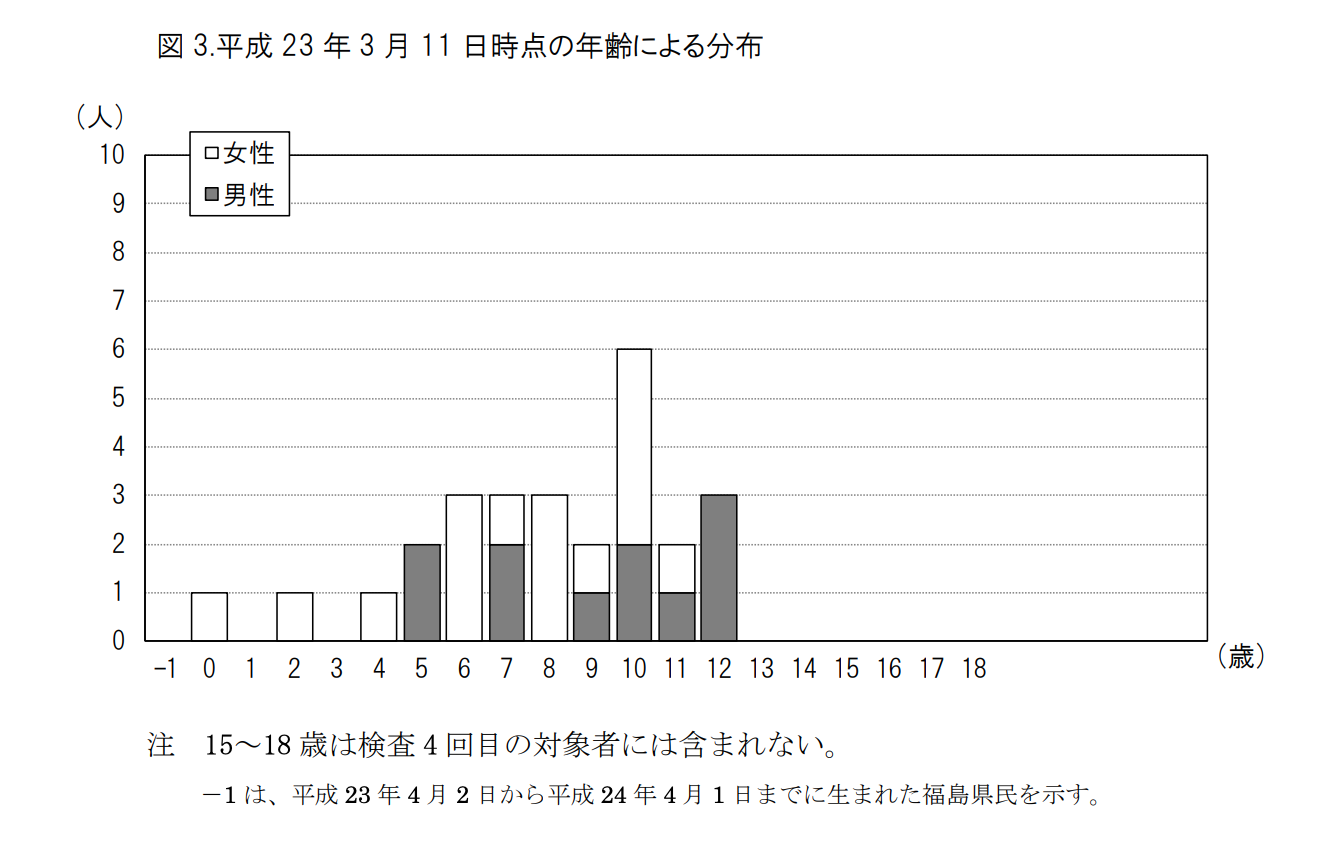
In the fourth round of examination, it was found for the first time that a girl who was 0 years old and a girl who was 2 years old at the time of the accident were diagnosed with thyroid cancer. Since the age of the examination is not the actual age but the grade, the ages at the time of the examination are 9 years old (3rd grade of elementary school) and 11 years old (5th grade of elementary school), respectively. According to the previous test results of 27 patients, 5 patients had “A1 judgement” without nodules or tumors, and 16 people had “A2 judgement” with nodules of 5 mm or less or cysts of 2 cm or less, 5 mm or more. 5 people had a “B-judgement” with nodules or cysts of 2 cm or more, and 1 had not been examined. He had the smallest tumor size of 6.1 mm and the largest tumor was 29.4 mm.
What stands out in the results of the fourth round of examination is the high dose of radiation for people diagnosed with thyroid cancer. Of the 27 patients diagnosed as suspected of being malignant by fine needle cytology, 11 patients (40.7%) who submitted the basic survey questionnaire had an exposure dose of less than 1 mSv in 2 patients (18.1%) 4 months after the accident. The number of children exposed to 2mSv or more was the highest, with 4 (36.3%) from 1mSv to 2mSv and 5 (45.5%) from 2mSv to 5mSv. In particular, the two boys who were five years old at the time of the accident were both over 2mSv.
According to the results of the basic survey of all Fukushima residents, 62.2% are less than 1mSv, 31.6% are from 1mSv to 2mSv, and 5.5% are from 2mSv to 3mSv. Very different.

To review the mass examination at school At this review committee, a major shift was made to reviewing simultaneous examinations at schools. The test, which has found more than 200 people with thyroid cancer, raises the theory of “overdiagnosis” among experts who deny the effects of radiation exposure, saying that they are finding thyroid cancer that they do not have to find. There is a growing opinion that the mass examination at school should be reviewed.
Based on these opinions, the review committee decided to conduct an interview survey at schools in the prefecture on August 31st last time. This time, there was a report on the results of a survey conducted by the prefecture at 26 elementary and junior high schools and high schools in the prefecture.
At many schools, thyroid examinations were performed during class hours, criticized by Shoichiro Tsugane, a member of the National Cancer Center, saying, “You can’t take this without a strong will.” “The benefits of the test are not except that you can be reassured when you get negative. The discovery of thyroid cancer has little benefit in avoiding death or poor quality of life, especially when you are diagnosed with thyroid cancer. “I think it will be a huge disadvantage for those who do,” he said. “Thyroid examination in a group of asymptomatic healthy people is not desirable. I asked him to stop the mass examination at school. ..
In addition, Professor Toshiya Inaba of Hiroshima University also cut out at the school examination that “they are left behind” and said, “Parents are not worried. The school rents the venue. The prefectural medical college has an inspection. I understand each position well, but in the end, it is the people who are left unattended. ” He emphasized that the prefectures and medical colleges that are the subjects of the survey should explain more to children and students the significance of the test and the fact that it can be rejected.

In response, Professor Satoshi Tomita of Fukushima University argued head-on. He criticized that “many Fukushima residents have anxiety about their health” and that members of the Prefectural Health Investigation Committee, especially members outside Fukushima Prefecture, are calling for the cancellation or reduction of examinations. He said that thyroid examination is a way to relieve the anxiety of Fukushima residents, “the anxiety of Fukushima residents, especially those with children, is left behind.” “It is dangerous to go in the direction of reduction easily.” “Thinking” was pointed out.
Ikuko Abe, chairman of the Fukushima Clinical Psychologists Association, who also lives in Fukushima Prefecture and has a close relationship with schools, agrees with this, saying, “I agree with Professor Tomita’s opinion.” “Given the anxiety about radiation that Fukushima residents have, thyroid examinations are very reassuring,” she said. “Reducing or eliminating the examinations still takes the opposite position. I want you to do it. “
What caught my eye in the discussion was the presence of Katsushi Tahara, director of the Ministry of the Environment’s Health and Welfare Department. The members of the review committee from the Ministry of the Environment have not said much, but have played a role in important aspects of policy change. This time too, Mr. Tahara considers the fact that the school is cooperating with the implementation of the examination, such as encouraging households whose delivery to Fukushima Medical University is delayed to submit again when the deadline has passed. About 30% of the children undergoing medical examinations at school were asked intensively about this point, such as confirming that the school side took over the collection of consent forms.
To conduct hearings with the person to be inspected Following a survey of the school, the prefecture proposed to have a place to hear directly from the children and students who had been inspected. Questions were raised about the representativeness of the interviewees, and there was an opinion requesting a quantitative survey such as a questionnaire, but the prefecture’s proposal was approved because the survey took too long.
Regarding this “interview survey,” there was a harsh debate over the neutrality of the content, such as the opinion that a pilot study was unavoidable and that the voices of patients diagnosed with thyroid cancer should also be heard. With the strong push back of the constellation chairman, it was decided that the selection of the target audience and the holding method would be left to the chairperson and the prefecture. The results will be reported at the next meeting.
In response to the further shift to reviewing mass screening at school in this “interview,” Chiba parent and child of the “thyroid cancer support group Hydrangea Association” that supports families with thyroid cancer said, “Accident Among the 0-year-old and 2-year-old children at that time, a child with thyroid cancer appeared and my chest hurts. Thyroid cancer also has recurrence and metastasis, and early detection and early treatment are beneficial for the child. Given that the cancer was found in a school test, there can be no argument to eliminate the school test. ” The group has made offers to the prefecture three times in the past and opposes the reduction of inspections.
13.7 million sign petition urging all nations to ban nuclear weapons
 13 million sign petition urging all nations to ban nuclear weapons, http://www.asahi.com/ajw/articles/14106594, By RYO SASAKI/ Staff Writer, January 14, 2021 A petition by an organization of survivors of the 1945 atomic bombings of Hiroshima and Nagasaki urging all nations to sign the U.N. treaty banning nuclear weapons has garnered a whopping 13.7 million signatures.
The Appeal of the Hibakusha association made the announcement during an online news conference on Jan. 13 after submitting the petition to the United Nations on Jan. 8.
The treaty goes into effect on Jan. 22.
The association collected the signatures on the streets, internet and elsewhere before finishing the effort at the end of December.
A total of 1,497 incumbent and former prefectural governors and mayors in Japan added their names to the petition. The petition also drew support from numerous people in countries other than Japan.
The campaign association, comprised of members of Nihon Hidankyo (Japan Confederation of A- and H-Bomb Sufferers Organizations) and other organizations, began their activities to achieve a nuclear-free world “while we still live” in April 2016.
The Treaty on the Prohibition of Nuclear Weapons was adopted in July 2017. Since then, the campaign has been asking all nations to join the treaty and advocating for it to take effect as early as possible.
The campaign to collect signatures was initially to end by September 2020, but was extended after it appeared that the treaty was likely to go into effect in the near future.
The association collected more than 1 million signatures over the additional three months, mainly online.
Why Japanese people should say ‘Sayonara’ to nuclear energy- a nun’s voice for nuclear victims

Sister Reiley, who has served as a missioner in Japan since 1968, was referring to the accident at Fukushima-Daichi Nuclear plant, which occurred on March 11, 2011. The accident was triggered by a devastating tsunami that followed a powerful 9.0 earthquake that hit a large part of Japan’s northern coast.
The quake and tsunami left more than 18,000 people dead or missing and hundreds of thousands of houses and businesses destroyed, according to Japan’s National Police Agency. More than 160,000 people fled the region near the nuclear plant because of the meltdown and more than 40,000 are still unable to return home due to radiation contamination.
Last June, Sister Reiley took the 3.5-hour train ride from Tokyo, where she lives, to Fukushima to give this Maryknoll reporter a tour around Haramachi, a town near where the Fukushima-Daichi nuclear accident happened.
The area had the feeling of a sci-fi apocalyptic movie: A ghost town with abandoned farmlands that could not be used; streets blocked with fences and no-trespassing signs; decaying houses damaged by the earthquake that cannot be repaired because they are contaminated; Geiger counter boxes under the street signs to measure the level of radioactivity; thousands of huge black vinyl bags filled with radioactive dirt; security guards wearing masks and radioactive protective gear at checkpoints, only allowing entrance to radioactive waste cleaning crews—many of them immigrants who are temporarily hired to do a job that could harm their health. …….
Sister Reiley has striven to show God’s love for the people by speaking out against nuclear energy in a country whose 52 nuclear plants, she believes, pose an enormous threat to human life.
After the triple disaster in 2011, Sister Reiley responded to the Japanese Catholic Church’s call for volunteers. “Initially I went several times a year to several different Japan Caritas bases wherever the need was at the time,” says Sister Reiley. “But gradually towns far away from the reactor returned to normal, (except) Haramachi where the need is still great for the elderly, differently abled and those people in a low economic bracket. They don’t have the means to move away from the reactor area.”
…….. Her concern about nuclear energy began in 1979 in her native Schuylkill County, Pa. She was visiting home from her mission in Japan when there was a reactor meltdown at the Three Mile Island nuclear plant in nearby Dauphin County. It is considered the most serious nuclear accident in U.S. history, according to the U.S. Nuclear Regulatory Commission.
“We’re poisoning our earth,” Sister Reiley remembers her father saying shortly after the nuclear accident.
“In 1999, there was a nuclear accident at the Tokaimura [nuclear facility] in Ibaraki Prefecture,” Sister Reiley says. “About two years after that accident happened, I asked the families [at the cancer hospital], ‘Where are you from?’ ‘Ibaraki.’ ‘Where are you from?’ ‘Ibaraki.’”
Out of the 24 beds for children with cancer at the hospital, at the time, seven children were from Ibaraki, explains the missioner. “But nobody can document that and say absolutely, ‘that’s why [the nuclear accident] they got cancer’.”
Still, the missioner works tirelessly to raise awareness about the dangers in nuclear energy Nearly 25 years after the 1986 nuclear accident in Chernobyl, in the former Soviet Union, Sister Reiley read an article, in a Japanese newspaper, about the high incidences of cancer linked to the nuclear accident. The report cited a study conducted by an international team of researchers led by the National Cancer Institute. That gave the Maryknoll sister an opportunity to question what happened at the nuclear facility in Japan. She visited the newspaper headquarters to speak to the editors.
“Won’t you please do some research about Tokaimura? About the accident that happened in Ibaraki?” she asked. The paper did not respond to her request. She was undaunted.
That sombre day in June in Haramachi, as we drove back to the train station, we saw a farm with cattle and stopped for a lesson from Sister Reiley. She explained that the government had asked the owner to kill the cattle. The cows’ milk could not be sold nor could the cows be slaughtered to sell their meat because they were contaminated. The cows, she continued, were innocent victims of problems caused by human beings.
“But this wonderful man asked the government to let the cows live a natural life and die a natural death,” says Sister Reiley.
Then she translated a sign at the cattle ranch. “We lived here with no fear of nuclear energy and now we realise that we lost something that can never be returned to us and we want people to understand that we have to say sayonara, goodbye, to nuclear energy.” https://catholicoutlook.org/jana-voice-for-nuclear-victims/
1 This Month
Chernobyl: The Lost Tapes – A good documentary on Chernobyl on SBS available On Demand for the next 3 weeks– https://www.sbs.com.au/ondemand/tv-program/chernobyl-the-lost-tapes/2352741955560

of the week–London Campaign for Nuclear Disarmament

Tell the Ukrainian Government to Drop Prosecution of Peace Activist Yurii Sheliazhenko
To see nuclear-related stories in greater depth and intensity – go to https://nuclearinformation.wordpress.com
-
Archives
- April 2026 (139)
- March 2026 (251)
- February 2026 (268)
- January 2026 (308)
- December 2025 (358)
- November 2025 (359)
- October 2025 (376)
- September 2025 (257)
- August 2025 (319)
- July 2025 (230)
- June 2025 (348)
- May 2025 (261)
-
Categories
- 1
- 1 NUCLEAR ISSUES
- business and costs
- climate change
- culture and arts
- ENERGY
- environment
- health
- history
- indigenous issues
- Legal
- marketing of nuclear
- media
- opposition to nuclear
- PERSONAL STORIES
- politics
- politics international
- Religion and ethics
- safety
- secrets,lies and civil liberties
- spinbuster
- technology
- Uranium
- wastes
- weapons and war
- Women
- 2 WORLD
- ACTION
- AFRICA
- Atrocities
- AUSTRALIA
- Christina's notes
- Christina's themes
- culture and arts
- Events
- Fuk 2022
- Fuk 2023
- Fukushima 2017
- Fukushima 2018
- fukushima 2019
- Fukushima 2020
- Fukushima 2021
- general
- global warming
- Humour (God we need it)
- Nuclear
- RARE EARTHS
- Reference
- resources – print
- Resources -audiovicual
- Weekly Newsletter
- World
- World Nuclear
- YouTube
-
RSS
Entries RSS
Comments RSS
 nuclear-news