Ex-PMs Kan, Koizumi urge Japan to quit nuclear power generation
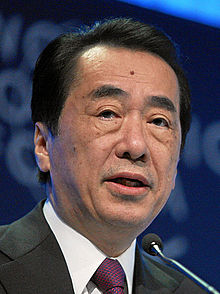 Ex-PMs Kan, Koizumi urge Japan to quit nuclear power generation https://english.kyodonews.net/news/2021/03/6b3c5a6b5519-ex-pms-kan-koizumi-urge-japan-to-quit-nuclear-power-generation.html1 Mar 21, KYODO NEWS – Former prime ministers Naoto Kan and Junichiro Koizumi on Monday urged Japan to stop using nuclear power, saying the country should learn from the Fukushima crisis a decade ago and turn to renewable energy.
 Both were proponents of nuclear power while in office but became critics following the March 11, 2011, earthquake, tsunami and subsequent triple meltdown at the Fukushima Daiichi nuclear plant.
“Japan has so much natural sources of energy like solar power, hydropower and wind power. Why should we use something that’s more expensive and less safe?” said Koizumi, a maverick reformist who held office from 2001 to 2006, at a joint press conference.
Kan, who led the response to the disaster at the time, criticized Yoshihide Suga’s vow to reduce Japan’s net carbon emissions to zero by 2050, calling it a pretense to restart nuclear reactors across the country, most of which have been halted as utilities wait to clear tougher regulations imposed after the Fukushima crisis.
While the former prime ministers come from opposite ends of the political spectrum — Koizumi led the center-right Liberal Democratic Party while Kan headed the now-defunct Democratic Party of Japan, which leaned left — they said opposing nuclear energy was a nonpartisan stance.
The main obstacle to shifting toward renewable energy is structural, Kan said, stemming from the entrenched interests of utility companies, government agencies and academics who constitute the “nuclear power village.”
“They know it would be too expensive to build new plants, or that there’s no way to properly dispose of nuclear waste. But there are a lot of stakeholders and they want to keep it that way,” said Kan, now a member of the Constitutional Democratic Party of Japan.
Regarding tritium-laced water at Fukushima Daiichi quickly filling up tanks, Koizumi said in the press conference at the Foreign Correspondents’ Club of Japan that plans to release the water into the sea were fiercely opposed by local fishermen and that further research into other options was needed.
Japan got 76 percent of its electricity from thermal power in fiscal 2019, compared with 18 percent from renewable energy and 6 percent from nuclear energy, according to preliminary data from the Ministry of Economy, Trade and Industry.
Under Suga’s “Green Growth Strategy,” the country is aiming to increase renewable energy to 50-60 percent while thermal power and nuclear energy is to constitute a combined 30-40 percent.
China to ramp up its nuclear weapons, in the interests of its own survival
|
China said to speed up move to more survivable nuclear force
By ROBERT BURNS, WASHINGTON (AP) 1 Mar 21, — China appears to be moving faster toward a capability to launch its newer nuclear missiles from underground silos, possibly to improve its ability to respond promptly to a nuclear attack, according to an American expert who analyzed satellite images of recent construction at a missile training area.
Hans Kristensen, a longtime watcher of U.S., Russian and Chinese nuclear forces, said the imagery suggests that China is seeking to counter what it may view as a growing threat from the United States. The U.S. in recent years has pointed to China’s nuclear modernization as a key justification for investing hundreds of billions of dollars in the coming two decades to build an all-new U.S. nuclear arsenal. There’s no indication the United States and China are headed toward armed conflict, let alone a nuclear one. But the Kristensen report comes at a time of heightened U.S.-China tensions across a broad spectrum, from trade to national security. A stronger Chinese nuclear force could factor into U.S. calculations for a military response to aggressive Chinese actions, such as in Taiwan or the South China Sea. The Pentagon declined to comment on Kristensen’s analysis of the satellite imagery, but it said last summer in its annual report on Chinese military developments that Beijing intends to increase the peacetime readiness of its nuclear forces by putting more of them in underground silos and operating on a higher level of alert in which it could launch missiles upon warning of being under attack. The PRC’s nuclear weapons policy prioritizes the maintenance of a nuclear force able to survive a first strike and respond with sufficient strength to inflict unacceptable damage on an enemy,” the Pentagon report said. More broadly, the Pentagon asserts that China is modernizing its nuclear forces as part of a wider effort to build a military by mid-century that is equal to, and in some respects superior to, the U.S. military. China’s nuclear arsenal, estimated by the U.S. government to number in the low 200s, is dwarfed by those of the United States and Russia, which have thousands. The Pentagon predicts that the People’s Liberation Army Rocket Forces will at least double the size of its nuclear arsenal over the next 10 years, still leaving it with far fewer than the United States. China does not publicly discuss the size or preparedness of its nuclear force beyond saying it would be used only in response to an attack. The United States, by contrast, does not rule out striking first, although President Joe Biden in the past has embraced removing that ambiguity by adopting a “no first use” policy………. https://apnews.com/article/china-moving-faster-nuclear-f711665a7ebb3a58d6c5bb7ce899ff1d |
|
Fukushima nuclear containment system failed. This kind of disaster will happen again

The supposedly failsafe containment system at Fukushima Dai-ichi Unit Three failed and released massive amounts of radioactivity into the local environment and the worldwide atmosphere. Such an enormous human tragedy will happen again at an atomic power reactor somewhere in the world.
Think about that. No nuke in the world can withstand a supersonic shockwave, and here is the evidence on international TV and across the Internet that it occurred in 2011, as Fairewinds said.
Japan’s Fukushima Meltdowns (New Video): Much Still Unknown 10 Years Later, https://www.fairewinds.org/demystify/japans-fukushima-meltdowns-10-years-later-new-video-shows-much-still-unknown February 17, 2021 By The Fairewinds Crew
As we approach the 10th commemoration of Japan’s March 11, 2011, Fukushima Dai-ichi triple meltdowns, organizations around the globe, including environmental groups, nonprofits (like Fairewinds Energy Education), engineering and pronuclear organizations, and media organizations like Japan’s Nippon TV, will release new information.
Some of this information is really new and recently uncovered. Other media events will bring people together to share and discuss what these major meltdowns meant to the people of Japan and communities worldwide. And sometimes, these media events are just a corporation or an agency marketing new nukes by putting their positive spin on nuclear power rather than acknowledging its dangers. For example, nuclear zealots continue to claim that atomic power reactors are safer for workers than working at Toys R Us, and reactors cannot meltdown and certainly will never blow up. The Fukushima disaster proved them wrong, but yet they persist!
As Fukushima Daichi Units One, Two, and Three were melting down, Nippon TV, the largest and flagship station of the Nippon Television Network System, dispatched television film crews to monitor the events as they unfolded. No one in the world has ever captured the core melting down, but Nippon TV captured two meltdown-induced explosions on film.
Now, Nippon TV has just released a new digital copy of the Fukushima Dai-ichi Unit One and Unit Three explosions (see video below ). Fukushima Centralt TV/NipponTv
At Fairewinds, we congratulate Nippon for the excellent work they did to create the original initial explosion footage in 2011 and on this essential remastered copy just completed in 2021. Nippon’s newly released digital footage is important historically and technically.
That said, the new video footage and Nippon’s ensuing interview with Tokyo Electric Company (TEPCO), the atomic power corporation that owns all six Fukushima Dai-ichi nuclear power plants, contain three glaring technical errors.
- First, Fairewinds continues to have significant concerns about TEPCO’s technical interpretations of these explosions’ cause.
- Second, TEPCO is blaming newly uncovered lethal radioactivity sitting at the top of the containment structure on the supersonic shockwave.
- Third, TEPCO does not discuss that there likely was a second explosion that occurred 3 seconds after the first.
Understanding the mechanics behind explosions is critical to understanding what happened at Fukushima and what such a danger means to nuclear power anywhere in the world.
- There are two explosion methods: a deflagration shock wave, which happened at Fukushima Unit One and Three Mile Island in Middletown, Pennsylvania, in the United States. While still destructive, a deflagration shockwave travels at subsonic speeds (less than 760 miles an hour, the speed of sound).
-
- The second type of explosion is called a detonation shockwave. It is much more destructive because it travels at supersonic speeds.
In 2011, with Geoff Sutton’s assistance from the United Kingdom, Fairewinds clearly showed that the Unit Three explosion was the more destructive detonation shockwave while Unit One’s was a deflagration.
Does it matter whether or not an explosion at Fukushima was a detonation or a deflagration? Absolutely! Hydrogen gas at room (atmospheric) pressure cannot create a supersonic shockwave. Fairewinds’s 2011 findings that a detonation shockwave occurred should have changed the scientific and nuclear engineering analyses of such events worldwide.
No nuclear power radioactive release containment system built anywhere in the world will withstand a detonation shockwave!
The fact that a detonation shockwave did occur is something the nuclear industry has ignored since Fairewinds’ Arnie Gundersen and Geoff Sutton identified it did happen at Fukushima Unit Three in 2011.
The nuke industry and its regulatory handlers do not believe that a supersonic shockwave explosion will ever happen in a nuclear power plant. If they admitted that an atomic reactor containment system would fail by detonation, the nuke industry would also have to acknowledge that nuke plants’ containment systems are not failsafe. Nuclear power containment systems will fail when there is a supersonic shockwave explosion.
The supposedly failsafe containment system at Fukushima Dai-ichi Unit Three failed and released massive amounts of radioactivity into the local environment and the worldwide atmosphere. Such an enormous human tragedy will happen again at an atomic power reactor somewhere in the world.
Think about that. No nuke in the world can withstand a supersonic shockwave, and here is the evidence on international TV and across the Internet that it occurred in 2011, as Fairewinds said.
- The second type of explosion is called a detonation shockwave. It is much more destructive because it travels at supersonic speeds.
- Fairewinds second area of concern about TEPCO’s analysis on this latest NIPPON video is the linkage of recently discovered lethal radiation levels at the top of the containment to the supersonic detonation. Ten years ago, immediately following the three meltdowns at Fukushima in 2011, Fairewinds identified superheated highly radioactive gases escaping from this same area that TEPCO suddenly claims it has just uncovered in 2021. The containment was leaking before the explosion and continued to spread radioactivity after the blast. Still, no nuclear engineer or scientist is surprised that significant contamination continues to leak from the damaged containment system. The containment was breached, which allowed this radiation to leak! However, there is no evidence to suggest that the explosion is the cause of that leak since the containment was leaking before the supersonic shockwave.
- Finally, Nippon’s remastered video vividly shows Fairewinds’ third concern. The eye is drawn to the detonation’s sudden flash and the ensuing upward-moving black cloud of rubble. Now, look again. About three seconds after the initial vertical blast, a white cloud suddenly moves horizontally at ground level to the north. (see picture on original -comparing the first and second plumes)
- Community-volunteer citizen-scientists Arnie met while collecting radioactive samples in Fukushima prefecture say they heard more than one explosion. They said it sounded like the snapping of bamboo burning in a fire. This new video shows that there were at least two explosions, one vertically and one horizontally. As more data becomes available, Fairewinds Energy Education will put forward the reasons why, but as of now, the entire explosion sequence at Fukushima Unit Three is something the nuclear industry zealots want to ignore. They continue to hope that history will not repeat itself while they continue to build and operate more lethally radioactive and highly risky atomic reactors.
- Throughout the Nippon video, the announcer reverentially refers to TEPCO and the Japanese Regulators as “the authorities” and “officials”. This kind of public propaganda occurs because TEPCO, the Japanese Government and its regulators, and the International Atomic Energy Agency (IAEA) have successfully captured the Japanese media.
What was called for in 2011 and is still desperately required in 2021 are independent experts. These would be people from outside TEPCO, its captive regulators, or its allies embedded in the nuclear industry. Once again, Fairewinds calls for an independent consortium of experts who would be able to give a frank assessment of the magnitude and extent of the problems that lie ahead for the failed Fukushima cleanup.
Did you know that in 2013, Fairewinds and 16 other international experts coauthored a letter to the United Nations (UN) asking it to establish this independent panel? The UN never had the courtesy even to acknowledge that it received these serious requests and recommendations. Such machinations by TEPCO, the Japanese Government, and the international nuclear industry are indeed a human rights and environmental injustice issue!
Ten years have passed, yet Japan’s citizens still wait for independent oversight of the Fukushima disaster. The people of Japan deserve better than the authorities covering up the truth and lying to them.
Influence of Biden administration brings peaceful push between India, China, Pakistan
 India’s sudden peace push with nuclear rivals China, Pak shows Biden impact, Business Standard, 27 Feb 21, The detente in South Asia shows all three countries responding to initiatives from the Biden administration After a year of some of the worst fighting on India’s frontiers with Pakistan and China, all three countries are suddenly talking peace as they wait to see how President Joe Biden will shift policy in the region.
India and China’s top diplomats on Thursday discussed plans to disengage troops from their Himalayan border, which last year saw the deadliest clashes since the 1970s. The phone call between Subrahmanyam Jaishankar and his Chinese counterpart Wang Yi, which stretched for more than an hour, came shortly after India and Pakistan released a rare joint statement by senior army officials announcing a halt in operations along their border.
The moves reduce tensions in one of Asia’s top flashpoints, where three nuclear-armed countries regularly challenge each other’s territorial claims. While India and Pakistan have fought three wars since Britain left the subcontinent and barely have any trade, tensions between New Delhi and Beijing escalated last year to the point where Prime Minister Narendra Modi banned hundreds of Chinese apps and slowed investment approvals.
The Biden administration welcomed the announcement on reimplementing the 2003 ceasefire agreement, which it had advocated. “When it comes to the US role, we continue to support direct dialogue between India and Pakistan on Kashmir and other issues of concern,” US State Department spokesman Ned Price told reporters.
Previous moves toward peace between India and Pakistan, including a statement in May 2018 after an escalation of cross-border shelling, have dissipated quickly. Whether they can actually build on this and move toward a more permanent peace remains an open question, but at least for the moment the shifting geopolitical winds are providing a seemingly rare opportunity to talk instead of fight.
“It eases the pressure,” Najmuddin Shaikh, Pakistan’s former foreign secretary and ambassador to nations including the U.S., said by phone when asked about the ceasefire. “Essentially what needs to come ahead is what has been proposed — that there be a resumption of dialogue.” https://www.business-standard.com/article/current-affairs/india-s-sudden-peace-push-with-nuclear-rivals-china-pak-shows-biden-impact-121022600628_1.html
The Fukushima nuclear catastrophe – far from over, 10 years later

10 years since the Fukushima nuclear disaster, Briefing paper by Dr. Philip White, Feb. 2021 https://nuclear.foe.org.au/wp-content/uploads/White-2021-Fukushima10-BackgroundBriefing.pdf
From the introduction:
Ten years ago, three of the nuclear reactors at the Fukushima Daiichi Nuclear Power Station suffered melt downs in the days following a Magnitude 9 earthquake that struck off the northeast coast of Japan on 11 March 2011. Along with the 1986 nuclear accident at the Chernobyl Nuclear Power Station in the former Soviet Union, it was one of the two worst nuclear power accidents in history.
On the tenth anniversary, it is important that we remember what happened then and what has happened since. It is in the interests of those who caused the accident that we forget. We must refuse to do so, for the sake of the victims and to prevent more disasters in future.
The most important take-home message is that the disaster is far from over. In order to win the bid for the (now postponed) 2020 Olympics, then Prime Minister Abe asserted that the nuclear accident was ‘under control’. The government now calls the games (if they are ever held) ‘the recovery Olympics’, with the torch relay route running through Fukushima Prefecture. But despite the efforts of the Japanese Government and the nuclear industry to lull the Japanese public and the world into a false sense of security, the fact is that radioactive contamination remains and many people continue to suffer. Even where compensation is available, nothing can undo the damage done to people’s lives and to the environment.
It is also important to understand that the Fukushima Daichi nuclear accident was by no means the worst-case scenario for nuclear power. But for a few remarkable pieces of good fortune, the disaster could have been far worse.
This paper summarises some of the key issues. In brief:
- thousands of people are still classified as evacuees;
- they have not been adequately compensated;
- the radioactive fallout is still a major problem;
- decommissioning of the nuclear reactors will take decades and has barely begun;
- the total cost of decommissioning, decontamination and compensation is astronomical;
- the culprits have not been punished; and
- nuclear vested interests are back in charge of Japan’s energy policy.
Fukushima evacuees on return visits find radiation signs confusing
Radiation criteria sow confusion for evacuees, https://www.japantimes.co.jp/news/2021/02/26/national/fukushima-radiation-criteria/—, 25 Feb 21, New Year holiday, with people avoiding traveling back to see their relatives due to the novel coronavirus pandemic.
Roadside signs show the radiation levels of areas near the no-go zones put in place after meltdowns in 2011 at the Fukushima No. 1 nuclear plant, reflecting the fact that, even after 10 years, Fukushima residents are unable to return to their homes.
The no-go zones, which are considered uninhabitable for the foreseeable future due to high radiation levels, stretch through six Fukushima towns and villages: Tomioka, Okuma, Futaba, Namie, Katsurao and Iitate. Parts of those zones are now designated as special reconstruction districts, where the government will concentrate its decontamination efforts so that residents can return to their homes in the future.
A decade after the tsunami-triggered nuclear disaster, decontaminating the areas damaged by the fallout is a crucial part of the reconstruction that will pave the way for evacuees to come back to their homes and resume the life they had before the disaster.
But two figures of radiation exposure levels — 20 millisieverts a year and 1 millisievert a year — that the government provides as safety criteria are causing confusion among residents, triggering criticism of what could be called a double standard.
One of the criteria for the government to lift evacuation orders is whether the area’s annual cumulative radiation level has become 20 millisieverts or below, based on a recommendation from the nongovernmental International Commission on Radiological Protection.
When there is a nuclear disaster similar to that at the Fukushima No. 1 nuclear power plant, the ICRP recommends that annual radiation exposure should be limited to between 20 to 100 millisieverts immediately after the disaster. It then recommends the exposure is lowered to between 1 to 20 millisieverts during the reconstruction period.
As the minimum recommended exposure level right after a disaster, the 20 millisieverts mark became the radiation level yardstick for the central government to order the evacuation of a certain area after the nuclear meltdowns.
Meanwhile, the government has set up a long-term decontamination goal of reducing the radiation levels of contaminated areas to an annual 1 millisievert and below. This is to keep a lifetime exposure level below 100 millisievert — the level at which it starts to affect one’s health.
Therefore, the government stipulated the annual 1 millisievert exposure level in its reconstruction policy plan for Fukushima approved by the Cabinet in July 2012. The Environment Ministry aims to keep radiation levels in the special reconstruction district under 1 millisievert as a long-term goal.
However, the no-go zones had been above 50 millisieverts on an annual basis immediately after the nuclear meltdowns. The radiation level is on the decline with natural attenuation of radioactive cesium as well as weathering effects, but there are still patches with high radiation levels.
Even within the no-go zones, there is no easy way to carry out decontamination. Typically it is done by mowing lawns, raking up fallen leaves, washing down roads and other surfaces with a high-pressure water hose, and wiping off the walls and roofs of buildings and housing.
“It’s not easy to bring down radiation levels to 1 millisievert or below just with decontamination,” said an Environment Ministry official in charge.
In Article 1 of the radiation decontamination legislation established after the nuclear disaster, it is stipulated that the purpose of decontamination is to “minimize the health risks of radioactive exposure as much as possible.”
Despite the criteria for easing evacuation orders and the long-term goal on bringing down radiation levels, it is unclear how the government can lower radiation levels to 1 millisievert after evacuation orders are lifted for no-go zones.
The two figures are creating a confusion among local residents, who are torn between the desire to return to their homes and concerns over the radiation level.
“I won’t feel safe until annual radiation levels are below 1 millisievert,” one resident said, while another said, “Can you say for sure that an annual exposure of 20 millisieverts won’t affect our health in the future?”
Fukushima nuclear mess 2021 – the tasks ahead
“………..Decommissioning and contaminated water management
The work to decommission the plants, deal with contaminated water and solid waste, and remediate the affected areas is immense. A “Mid-and-Long Term Roadmap”2 was developed soon after the disaster to set out how this will be achieved. Also, to facilitate decommissioning units 1-6, and dealing with contaminated water, TEPCO announced, at the end of 2013 the establishment of an internal entity: the Fukushima Daiichi Decontamination & Decommissioning Engineering Company, which commenced operations in April 2014. The entire decommissioning process will take 30–40 years, and, as noted above, the volume of tasks is gigantic. Therefore, the Government of Japan and TEPCO have prioritised each task and set the goal to achieve them. Essentially, it is a continuous risk reduction activity to protect the people and the environment from the risks associated with radioactive substances by:
- removing spent fuel and retrieval of fuel debris from the reactor buildings;
- establishing measures to deal with contaminated water; and
- establishing measures to deal with radioactive waste material.
Fuel removal from the reactor buildings
In the Fukushima Daiichi design of reactor, used and new fuel rod assemblies are stored in the upper part of the reactor. The used fuel rods are highly radioactive and continue to generate heat, and thus require continued cooling.
Depending on the degree of damage, the process of removing the fuel assemblies presents different challenges in each of the reactors. For example, one of the significant challenges is to firstly remove the large quantities of rubble caused by the hydrogen explosions. As noted above, reactors 5 and 6 were shut down at the time of the accident. The reactor cores were successfully cooled, and thus suffered no damage. Given that the conditions of the buildings and the equipment for storing the fuel are stable, and risks of causing any problem in the decommissioning process are estimated to be low compared to the other units, the fuel assemblies of units 5 and 6 continue to be safely stored in the spent fuel pool in each building for the time being. The next step will be to carefully remove the fuel from the fuel pools in units 5 and 6 without impact on fuel removal from units 1, 2 and 3.
All the remaining units are going through a number of stages to achieve fuel removal. They differ slightly for each unit, but essentially the stages are: survey of internal state, removal of rubble, installation of fuel handling facility, and removal of fuel. By way of example, the position regarding unit 3 is shown in Figure 3 [on original].
At unit 3, rubble removal and other work at the upper part of the reactor building, together with installation of a cover for fuel removal was completed in February 2018.
After all preparations were in place, work to remove the 566 fuel rod assemblies, including 52 non-irradiated fuel assemblies, began in April 2019. The process of fuel removal is shown diagrammatically in Figure 4.
The four stages are:
- Fuel rod assemblies stored on fuel racks in the spent fuel pool are transferred in the water one at a time to transport casks, using fuel handling equipment;
- after closing the cask cover and washing, a crane is used to lower the cask to ground level and load into a trailer;
- the cask is transported to a common pool on the site; and
- the fuel in the cask is stored in the common pool.
As of 8 January 2021, 468 assemblies including the 52 non-irradiated fuel assemblies had been removed from unit 3. Measurements of airborne contamination levels are being monitored in the surrounding environment throughout the fuel removal operations. The plan is that all fuel will have been removed from all of the reactor units by sometime during 2031.
Retrieval of fuel debris
At the time of the accident, units 1–3 were operating and had fuel rods loaded in the reactors. After the accident occurred, emergency power was lost, preventing further cooling of the cores. This resulted in overheating and melting of the fuel, together with other substances. Fuel debris refers to this melted fuel and other substances, which have subsequently cooled and solidified, and, of course, still remains dangerously radioactive. This clearly poses a very complex and difficult decommissioning challenge.
Currently the state inside the containment vessel is being confirmed, and various kinds of surveys are being conducted prior to retrieval of the debris. The current aim is to begin retrieval from the first unit (unit 2), and to gradually enlarge the scale of the retrieval. The retrieved fuel debris will be stored in the new storage facility that will be constructed within the site.
The distribution of debris between the pressure and containment vessels differs in each of the 3 units. By way of example, Figure 5 [on original] shows the current position in unit 2. Large amounts of debris are located in the bottom of the pressure vessel, with little in the containment vessel.
The investigation to capture the location of fuel debris inside unit 2 was conducted from 22 March–22 July 2016. This operation applied the muon transmission method, of which effectiveness was demonstrated in its appliance for locating the debris inside unit 1. (Muon transmission method is a technique that uses cosmic ray muons to generate three-dimensional images of volumes using information contained in the Coulomb scattering of the muons.) These operations used a small device developed through a project called “Development of Technology to Detect Fuel Debris inside the Reactor’’.
- establishing measures to deal with contaminated water; and
- establishing measures to deal with radioactive waste material.
…….. Understanding of the situation inside the stricken reactors was urgently needed following the accident in order to prevent the spread of damage and to mitigate
Purification treatment of contaminated water and management of treated water…….
The storage management plan is updated once a year, while reviewing the waste generation forecasts, taking account of progress of the decommissioning work.
For example, the latest edition of the roadmap estimates the amount of solid waste which will be generated over the next 10 years to be 780,000 m3
Fukushima nuclear station seismometers not functioning when latest earthquake happened
Fukushima nuclear plant operator: Seismometers were broken
The operator of the wrecked Fukushima nuclear power plant says two seismometers at one of its three melted reactors have been out of order since last year and did not collect data when a powerful earthquake struck the area earlier this month https://abcnews.go.com/Technology/wireStory/fukushima-nuclear-plant-operator-seismometers-broken-76044179
By MARI YAMAGUCHI Associated Press, 23 February 2021, TOKYO — The operator of the wrecked Fukushima nuclear power plant said Monday that two seismometers at one of its three melted reactors have been out of order since last year and did not collect data when a powerful earthquake struck the area earlier this month.
The acknowledgement raised new questions about whether the company’s risk management has improved since a massive earthquake and tsunami in 2011 destroyed much of the plant.
The malfunctioning seismometers surfaced during a Nuclear Regulation Authority meeting on Monday to discuss new damage at the plant resulting from a magnitude 7.3 quake that struck the region on Feb. 13. Cooling water and pressure levels fell in the Unit 1 and 3 reactors, indicating additional damage to their primary containment chambers.
The operator, Tokyo Electric Power Co., has repeatedly been criticized for coverups and delayed disclosures of problems at the plant.
Regulatory officials asked TEPCO at the meeting why it did not have seismological data from the Unit 3 reactor for Saturday’s quake, and utility officials acknowledged that both of its seismometers had failed — one in July and the other in October — and had never been repaired.
TEPCO also said that seismometers at all but two of the reactor buildings that survived the 2011 disaster were submerged by water from the tsunami and have never been replaced.
During Monday’s meeting, regulatory officials said they were concerned about the declining water levels and pressure in the Unit 1 and 3 primary containment chambers because of the possibility that the quake had expanded the existing damage or opened new leakage paths, and urged the utility to closely check for any increased radiation levels in the ground water surrounding the reactor buildings.
TEPCO said no abnormality has been detected in water samples so far.
New damage could further complicate the plant’s already difficult decommissioning process and add to the large amounts of contaminated water being stored at the plant.
Since the 2011 disaster, cooling water has been escaping constantly from the damaged primary containment vessels into the basements of reactor and turbine buildings, where the volume increases as groundwater seeps in. The water is pumped up and treated, then part of it is reused as cooling water, while the rest is stored in about 1,000 tanks.
TEPCO initially reported there was no abnormality at the plant from Saturday’s earthquake. But on Monday, it said about 20 of the tanks had slid slightly due to the quake, a storage container carrying radioactive waste had tilted, and asphalt pavement at the plant was cracked. AT TOP https://abcnews.go.com/Technology/wireStory/fukushima-nuclear-plant-operator-seismometers-broken-76044179
Fukushima – radioactive water into the sea – a nightmare for fishermen
 A decade after the Fukushima meltdown, this Japanese region faces a new nightmare — radioactive water in the sea, ABC, By North Asia correspondent Jake Sturmer and Yumi Asada in Fukushima, Japan, 21 Feb 21,
I won’t lie — I was a little nervous heading inside the destroyed nuclear plant at the centre of Japan’s 2011 nuclear accident.
It was a rare opportunity to look at how the clean-up effort was going 10 years on.
But weighing on my mind as I headed inside and took a look around was that this was of the most radioactive places on earth right now.
I’ve been inside Fukushima’s no-go zones, where the radiation levels are so high it’s unliveable and overgrown weeds entangle anything in their way — from abandoned homes, cars and even vending machines.
It is always an eerie experience seeing entire towns frozen in time and the stories from those who once called it home are equally chilling.
This is the first time I’ve been in the place responsible for it……..
It’s been 10 years since Japan’s worst nuclear accident, which was triggered by the most powerful earthquake ever recorded in the country and a massive tsunami that wiped out everything in its path.
Yet the aftershocks from the devastating March 11 disaster continue to rattle these parts — the most recent occurring only a week ago.
Japan’s nuclear disaster site is still a hive of activity
When the tsunami hit the nuclear plant in 2011, it cut power and consequently cooling to three operational reactors.
At that point, only flooding the reactors with seawater could have cooled them quickly enough to avoid a meltdown.
But that decision was delayed because of fears it would permanently destroy the reactors.
By the time the government ordered the seawater to be used, it was too late. The nuclear fuel overheated and melted down.
Some of the reactors exploded and the twisted wreckage of the blast is still exposed today.
When I arrived at the Fukushima Daiichi Nuclear Power Plant, I was given a radiation dosimeter and handed a plastic bag containing gloves, a mask and three pairs of socks.
I had been given specific instructions to put on one after the other.
The idea was to prevent any radioactive material from getting onto my pants — if it does, the officials jokingly told me, I’ll have to leave them there.
Once I’m ready, I follow an official through a maze-like path to the Whole Body Counter room.
That’s where I have a scan that measures the existing radiation levels inside my body so they can check how much I have been exposed to throughout the day.
It’s a bustling hive of activity — there are thousands of workers here and as we pass by many say ‘otsukaresama deshita’, a Japanese phrase that loosely translates to ‘thank you for your service’.
We’re accompanied and guided by several officials from the plant’s operator, the Tokyo Electric Power Company (TEPCO)……….
The long process of removing 800 tones of radioactive fuel
TEPCO has spent the last 10 years trying to cool and stabilise the three reactors so that they can eventually start to remove the molten fuel debris that sits inside them.
As we pull up to the destroyed reactors, which contain more than 800 tonnes of highly radioactive molten nuclear fuel, we can see many workers in full protective equipment heavily involved in the decontamination effort.
In the space of just a few steps, radiation levels spike from 80 microsieverts an hour to 100. At the same time, my radiation alarm goes off to tell me I’ve accumulated 0.02 millisieverts of radiation while at the plant.
It’s about the same as a chest x-ray and nothing to be worried about at this stage — but our minders tell us we shouldn’t spend too much more time here.
It’s estimated the full clean-up effort will take another 30-40 years, though some experts feel this is optimistic.
The company was hoping to start removal of the highly radioactive debris this year, but the coronavirus pandemic will prevent that from happening.
“We are planning to remove the fuel debris from Unit 2 using a robot arm and the plan was to make the arm and carry out a performance test in the UK,” TEPCO’s Yoshinori Takahashi told me.
“But because of the coronavirus, the manufacturing process and testing has been delayed.”
The delay could be up to 12 months. But that is not the most pressing issue facing TEPCO.
How do you remove a million tonnes of contaminated water?
All of the water that touches the highly radioactive molten fuel also becomes contaminated.
The water is processed to remove more than 60 different types of radioactive materials from it, but the Advanced Liquid Processing System (ALPS) doesn’t completely purify the water.
The radioactive element, tritium, remains inside all of the stored water, albeit at “low” levels, according to TEPCO.
Currently, 1.2 million tonnes of contaminated water is stored in more than 1,000 tanks spanning the entire power plant facility. But by the end of next year, the tanks and the site will be full.
The Japanese government is now weighing up what to do next.
A panel of experts has recommended disposing of it in the ocean as the most practical option as opposed to releasing it into the air, which TEPCO said would be more difficult to monitor.
Mr Takahashi said tritium was a weak form of radiation and that the water would be released in such limited quantities over such a long period that it would be safe.
But for those who make their living from the part of the ocean where TEPCO is proposing to dump its contaminated water, they fear the damage this poses to their reputation.
That includes Haruo Ono, who has been fishing in Fukushima’s waters for 50 years.
Fisherman worried about what water release will mean for their livelihoods
Although most fishermen are receiving compensation payments from TEPCO to cover their revenue shortfalls, he fears that if contaminated water is released into the ocean, it will finish off the industry for good.
“They say it’s OK to release tritium, but what do consumers think? We can’t sell fish because the consumers say no,” he said.
The 70-year-old is opposed to the scheme and says he’s hoping to watch the decommissioning first-hand over the next 30-40 years…………… https://www.abc.net.au/news/2021-02-21/a-tour-inside-fukushimas-nuclear-plant-10-years-after-accident/13158976
Post-Fukushima reactor halt produces inexperienced nuclear plant workers in Japan
February 20, 2021
The suspension of nuclear reactors in Japan after the 2011 Fukushima disaster has kept many workers there from engaging in plant operations, resulting in inexperienced employees accounting for nearly a quarter of the workforce at plants, according to a Kyodo News tally.
Of 1,923 employees at 15 nuclear power stations as of November to December, 460 had no prior work experience at online plants, the tally based on data from 10 Japanese utilities showed nearly a decade after the magnitude-9.0 earthquake and a massive tsunami hit on March 11, 2011, and caused triple meltdowns at the Fukushima Daiichi plant. The crippled facility is not included in the 15 plants.

Photo taken in November 2014 shows a signboard reading “Nuclear power: energy for a bright future” in the northeastern Japan town of Futaba, which co-host the Fukushima Daiichi nuclear power plant crippled by the March 2011 Great East Japan Earthquake.
At four plants run by Tohoku Electric Power Co., Chubu Electric Power Co. and Chugoku Electric Power Co., those with no prior work experience make up more than 40 percent.
A total of 50 reactors were shut after the worst nuclear crisis since Chernobyl in 1986 for safety concerns. Prime Minister Yoshihide Suga has said his government will seek to promote the restart of reactors under his clean energy and environment initiatives.
But the nuclear power industry faces a challenge in resuming and running reactors, as utilities are not able to offer enough on-the-job training opportunities given that many reactors remain suspended, industry experts say.
The government implemented stricter regulations for restart to address safety concerns. Nine reactors since have been rebooted under the tighter rules as of Feb. 8.
The government has set a target for nuclear power generation to account for 20 to 22 percent of the country’s electricity supply by 2030, which requires restarting 20 to 30 reactors.
In the nuclear power business, 27 percent of the total workforce joined the 10 companies after the Fukushima disaster, as the industry seeks to pass on lessons learned from the catastrophe.https://english.kyodonews.net/news/2021/02/cff1e6c7f07f-post-fukushima-reactor-halt-produces-inexperienced-plant-workers.html
Japan town mayor OKs restarting nuclear reactor over 40 years old
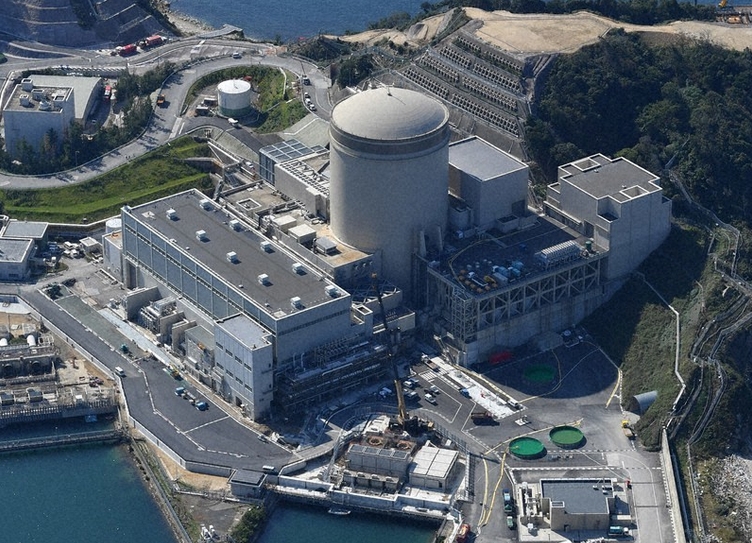
The No. 3 reactor at Kansai Electric Power Co.’s Mihama Nuclear Power Station is seen from a Mainichi Shimbun helicopter on Oct. 20, 2020.
February 16, 2021
TSURUGA, Fukui — The mayor of a central Japan town hosting a nuclear power plant operated by Kansai Electric Power Co. informed the speaker of the municipal assembly on Feb. 15 that he would approve the restart of a reactor at the plant that is more than 40 years old.
Mayor Hideki Toshima of the Fukui Prefecture town of Mihama told Mihama Municipal Assembly Speaker Yoshihiro Takenaka that he would approve the restart of the No. 3 reactor at Mihama Nuclear Power Station, which began operating in the 1970s. The assembly had already approved the reactivation of the aging reactor.
Meanwhile, Mayor Yutaka Nose of the prefectural town of Takahama, home to Kansai Electric’s Takahama Nuclear Power Station, whose No. 1 and 2 reactors are also over 40 years old, has given the green light for resuming the operations of the two rectors, while the Takahama Municipal Assembly has also approved of the move.
Now that local consent has been secured, the focus has shifted to the decisions expected from Gov. Tatsuji Sugimoto and the prefectural assembly.
The Mihama plant’s No. 3 reactor went online in December 1976. In response to the meltdowns at Tokyo Electric Power Co.’s Fukushima Daiichi Nuclear Power Station following the March 2011 Great East Japan Earthquake and tsunami, the Japanese government limited the operational life of nuclear reactors to “40 years in principle” in July 2013, while allowing a one-time extension of up to 20 years if the reactor fulfilled safety standards. The No. 3 reactor at the Mihama power station, along with the No. 1 and No. 2 rectors at the Takahama plant, have passed screening by the Nuclear Regulation Authority.
Mayor Toshima said on Feb. 15 that conditions to approve the restart “have all been met, including understanding from the townspeople and consent from the municipal assembly, as well as promising feedback over regional development by the central government and Kansai Electric.” He added, “Both supporters and skeptics of the reactor restart are concerned about its safety. I will make sure to pay attention to the process.”
Toshima had spoken with Economy, Trade and Industry Minister Hiroshi Kajiyama online three days prior. He had then expressed his intension to approve the reactivation, saying that the central government had given him positive responses about regional development and other measures he had requested.
As a general rule, a nuclear power plant operator is expected to obtain consent for restarting a rector from the local governments around the plant as well as local assemblies. As a condition for approving the restart, the Fukui Prefectural Government said Kansai Electric would need to present candidate sites outside the prefecture for interim spent nuclear fuel storage facilities. The prefectural government maintained that until that condition was achieved, the parties were “not even at the starting line of discussion.”
However, after Kansai Electric proposed on Feb. 12 that it would finalize a planned site for the storage facilities by the end of 2023, the prefectural government demonstrated a positive attitude toward reactivation. Discussion on restarting the aging reactor may develop further at the prefectural assembly session convening on Feb. 16.
https://mainichi.jp/english/articles/20210216/p2a/00m/0na/008000c
Water leaks indicate new damage at Fukushima nuclear plant
|
Water leaks indicate new damage at Fukushima nuclear plant
By MARI YAMAGUCHI TOKYO (AP) — Cooling water levels have fallen in two reactors at the wrecked Fukushima nuclear plant since a powerful earthquake hit the area last weekend, indicating possible additional damage, its operator said Friday.
New damage could further complicate the plant’s already difficult decommissioning process, which is expected to take decades. Tokyo Electric Power Co. spokesman Keisuke Matsuo said the drop in water levels in the Unit 1 and 3 reactors indicates that the existing damage to their primary containment chambers was worsened by Saturday’s magnitude 7.3 quake, allowing more water to leak. The leaked water is believed to have remained inside the reactor buildings and there is no sign of any outside impact, he said. In 2011, a powerful magnitude 9.1 earthquake and tsunami damaged the Fukushima plant’s cooling systems, causing three reactor cores to melt and nuclear fuel to fall to the bottom of their primary containment vessels. TEPCO will monitor the water and temperatures at the bottom of the containment vessels, Matsuo said. Since the 2011 disaster, cooling water has been escaping constantly from the damaged primary containment vessels into the basements of the reactor buildings. To make up for the loss, additional cooling water has been pumped into the reactors to cool the melted fuel remaining inside them. The recent decline in the water levels indicates that more water than before is leaking out, TEPCO said…….. TEPCO initially reported that there was no abnormality at the plant from Saturday’s quake. Matsuo said the cooling water level fell as much as 70 centimeters (27 inches) in the primary containment chamber of the Unit 1 reactor and about 30 centimeters (11 inches) in Unit 3. TEPCO wasn’t able to determine any decline in Unit 2 because indicators have been taken out to prepare for the removal of melted debris, it said. Increased leakage could require more cooling water to be pumped into the reactors, which would result in more contaminated water that is treated and stored in huge tanks at the plant. TEPCO says its storage capacity of 1.37 million tons will be full next summer. A government panel’s recommendation that it be gradually released into the sea has faced fierce opposition from local residents and a decision is still pending. Meanwhile, the Tokyo High Court on Friday held the government as well as TEPCO accountable for the 2011 nuclear disaster, ordering both to pay about 280 million yen ($2.6 million) in compensation to more than 40 plaintiffs forced to evacuate to Chiba, near Tokyo, for their lost livelihoods and homes. Friday’s decision reverses an earlier ruling by the Chiba district court that excluded the government from responsibility. Judge Yukio Shirai said the government could have foreseen the risk of a massive tsunami and taken measures after a long-term assessment in 2002 of seismic activities. Lawyers representing the plaintiffs welcomed the decision and said it would affect other pending cases. “The case raises the question of whether we should tolerate a society that prioritizes economic activities over people’s lives and health,” said Izutaro Mangi, a lawyer representing the plaintiffs. https://apnews.com/article/water-leaks-fukushima-new-damage-a7ecf765d0233b1cad7332ff9fed5ffe |
|
New study on highly radioactive particles emitted during Fukushima nuclear meltdown
The 10 year anniversary of the Fukushima Daiichi nuclear accident occurs in March. Work just published in the Journal ‘Science of the Total Environment’ documents new, large (> 300 micrometers), highly radioactive particles that were released from one of the damaged Fukushima reactors.
Particles containing radioactive cesium (134+137Cs) were released from the damaged reactors at the Fukushima Daiichi Nuclear Power Plant (FDNPP) during the 2011 nuclear disaster. Small (micrometer-sized) particles (known as CsMPs) were widely distributed, reaching as far as Tokyo. CsMPs have been the subject of many studies in recent years. However, it recently became apparent that larger (>300 micrometers) Cs-containing particles, with much higher levels of activity (~ 105 Bq), were also released from reactor unit 1 that suffered a hydrogen explosion. These particles were deposited within a narrow zone that stretches ~8 km north-northwest of the reactor site. To date, little is known about the composition of these larger particles and their potential environmental and human health impacts.
Now, work just published in the journal Science of the Total Environment characterizes these larger particles at the atomic-scale and reports high levels of activity that exceed 105 Bq.
The particles, reported in the study, were found during a survey of surface soils 3.9 km north-northwest of reactor unit 1
From 31 Cs-particles collected during the sampling campaign, two have given the highest ever particle-associated 134+137Cs activities for materials emitted from the FDNPP (specifically: 6.1 × 10⁵ and 2.5 × 10⁶ Bq, respectively, for the particles, after decay-correction to the date of the FDNPP accident).
The study involved scientists from Japan, Finland, France, the UK, and USA, and was led by Dr. Satoshi Utsunomiya and graduate student Kazuya Morooka (Department of Chemistry, Kyushu University). The team used a combination of advanced analytical techniques (synchrotron-based nano-focus X-ray analysis, secondary ion mass spectrometry, and high-resolution transmission electron microscopy) to fully characterize the particles. The particle with a 134+137Cs activity of 6.1 × 10⁵ Bq was found to be an aggregate of smaller, flakey silicate nanoparticles, which had a glass like structure. This particle likely came from reactor building materials, which were damaged during the Unit 1 hydrogen explosion; then, as the particle formed, it likely adsorbed Cs that had had been volatized from the reactor fuel. The 134+137Cs activity of the other particle exceeded 106 Bq. This particle had a glassy carbon core and a surface that was embedded with other micro-particles, which included a Pb-Sn alloy, fibrous Al-silicate, Ca-carbonate / hydroxide, and quartz (Fig. 2).
The composition of the surface embedded micro-particles likely reflect the composition of airborne particles within the reactor building at the moment of the hydrogen explosion, thus providing a forensic window into the events of March 11th 2011 (Fig. 3). Utsunomiya added, “The new particles from regions close to the damaged reactor provide valuable forensic clues. They give snap-shots of the atmospheric conditions in the reactor building at the time of the hydrogen explosion, and of the physio-chemical phenomena that occurred during reactor meltdown.” He continued, “whilst nearly ten years have passed since the accident, the importance of scientific insights has never been more critical. Clean-up and repatriation of residents continues and a thorough understanding of the contamination forms and their distribution is important for risk assessment and public trust.
Professor Gareth Law (co-author, University of Helsinki) added, “clean-up and decommissioning efforts at the site face difficult challenges, particularly the removal and safe management of accident debris that has very high levels of radioactivity. Therein, prior knowledge of debris composition can help inform safe management approaches”.
Given the high radioactivity associated with the new particles, the project team were also interested in understanding their potential health / dose impacts.
Dr Utsunomiya stated, “Owing to their large size, the health effects of the new particles are likely limited to external radiation hazards during static contact with skin. As such, despite the very high level of activity, we expect that the particles would have negligible health impacts for humans as they would not easily adhere to the skin. However, we do need to consider possible effects on the other living creatures such as filter feeders in habitats surrounding Fukushima Daiichi. Even though ten years have nearly passed, the half-life of 137Cs is ~30 years. So, the activity in the newly found highly radioactive particles has not yet decayed significantly. As such, they will remain in the environment for many decades to come, and this type of particle could occasionally still be found in radiation hot spots.”
Professor Rod Ewing (co-author from Stanford University) stated “this paper is part of a series of publications that provide a detailed picture of the material emitted during the Fukushima Daiichi reactor meltdowns. This is exactly the type of work required for remediation and an understanding of long-term health effects”.
Professor Bernd Grambow (co-author from IMT Atlantique) added “the present work, using cutting-edge analytical tools, gives only a very small insight in the very large diversity of particles released during the nuclear accident, much more work is necessary to get a realistic picture of the highly heterogeneous environmental and health impact”.
ICAN chief urges Japanese govt to attend UN Nuclear Ban Treaty meeting

 Antinuke group urges Japan to attend 1st U.N. nuclear ban meeting https://english.kyodonews.net/news/2021/02/739da4953af0-antinuke-group-urges-japan-to-attend-1st-un-nuclear-ban-meeting.html Antinuke group urges Japan to attend 1st U.N. nuclear ban meeting https://english.kyodonews.net/news/2021/02/739da4953af0-antinuke-group-urges-japan-to-attend-1st-un-nuclear-ban-meeting.html
The chief of an antinuclear group has urged Japan to attend the first meeting of parties to a U.N. treaty banning nuclear weapons, saying the only country to have suffered the atomic bombings has a “moral responsibility” to do so.
In a recent online interview with Kyodo News, Beatrice Fihn, executive director of the International Campaign to Abolish Nuclear Weapons, said as an observer, Japan should “discuss issues relevant to survivors of nuclear weapons use” at the meeting as it has “the knowledge and expertise.” The first meeting on the pact outlawing the development, testing, possession and use of nuclear weapons is expected to be held in Austria within a year of the treaty going into force on Jan. 22. Japan has decided not to sign the Treaty on the Prohibition of Nuclear Weapons in consideration of its security ties with the United States, which provides a nuclear umbrella to Tokyo against security threats from North Korea and others. Other nuclear-armed states are also not signatories of the pact. The head of ICAN, which won the 2017 Nobel Peace Prize for its efforts that led to the adoption of the nuclear ban treaty, said her group expects the first meeting of the treaty’s parties to discuss issues such as support for atomic bomb victims and environmental remediation following the use of nuclear weapons. Japan “should engage in these conversations about the rights and the needs of survivors,” Fihn said. “If they don’t do that, you know, it will be to abandon the hibakusha,” or survivors of the 1945 U.S. atomic bombings of Hiroshima and Nagasaki. The Swedish executive director said there has been “a growing voice” from the hibakusha and the Japanese public calling for Tokyo to join the treaty. It’s really an issue of democracy here and the government at some point has to listen,” she said. “I would encourage Japanese people to speak out louder and stronger.” Although Fihn does not believe the administration of U.S. President Joe Biden will join the nuclear ban treaty and begin disarming in the near future, she welcomed the new government that is “serious about multilateralism and diplomacy.” Fihn expressed hope that Washington will “let other countries decide for themselves” on whether or not to join the nuclear ban treaty. Noting “a lot of support” for the pact from citizens of North Atlantic Treaty Organization member countries, she said, “I hope that the U.S. will keep an open mind” when it comes to NATO states joining this treaty. |
|
New highly radioactive particles found in Fukushima
|
New highly radioactive particles found in Fukushima https://www.sciencedaily.com/releases/2021/02/210217134852.htm
|
|
|
1 This Month
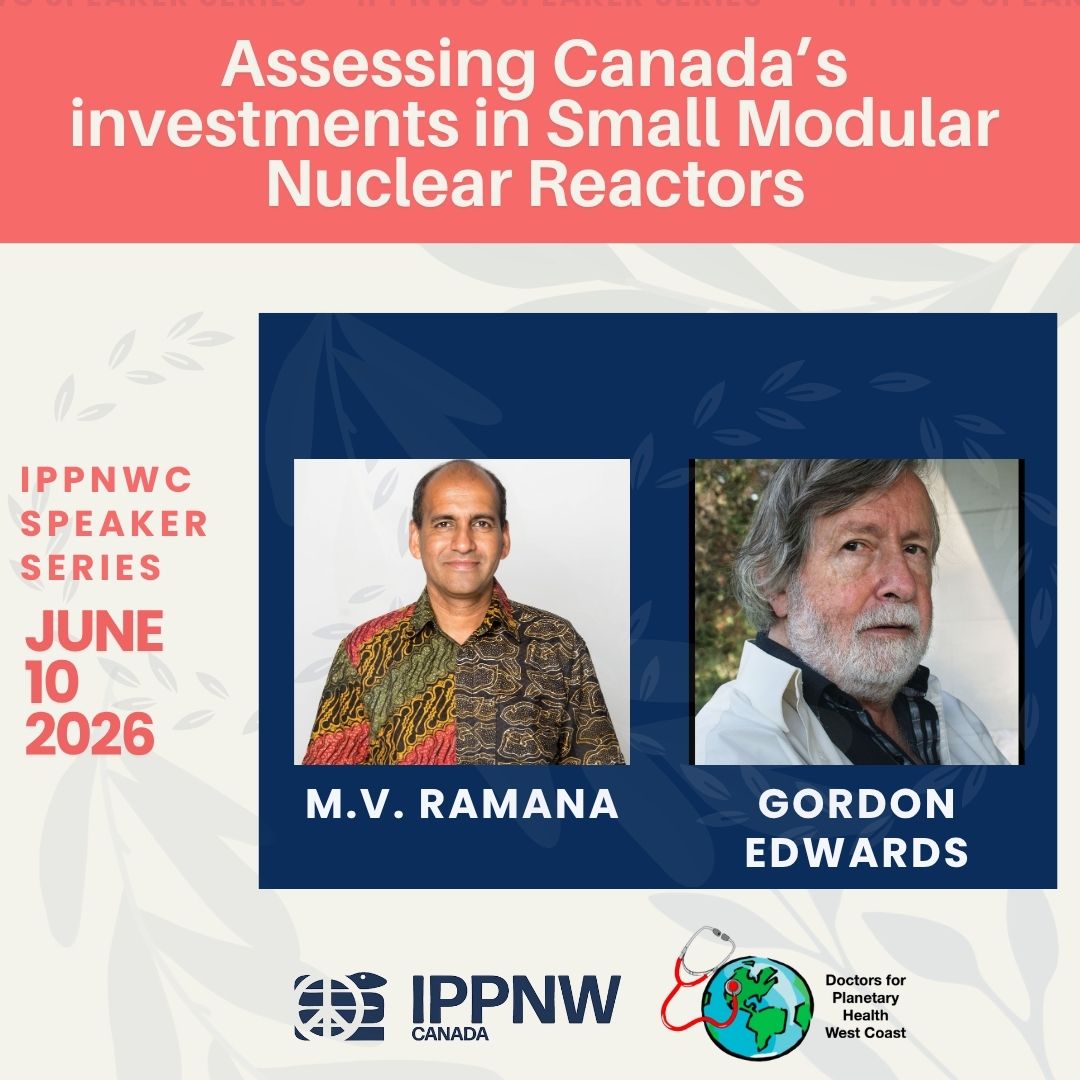
10 June – Assessing Canada’s Investments in Small Modular Nuclear Reactors – https://zoom.us/meeting/register/IiqHA5feRhaEBycOLNTJlA#/registration


Cuba Is Not a Failed State – It Is a Besieged State
PETITION: “Global Appeal to Endorse Palestinian Right of Return of Refugees”
To see nuclear-related stories in greater depth and intensity – go to https://nuclearinformation.wordpress.com
-
Archives
- June 2026 (79)
- May 2026 (306)
- April 2026 (356)
- March 2026 (251)
- February 2026 (268)
- January 2026 (308)
- December 2025 (358)
- November 2025 (359)
- October 2025 (376)
- September 2025 (257)
- August 2025 (319)
- July 2025 (230)
-
Categories
- 1
- 1 NUCLEAR ISSUES
- business and costs
- climate change
- culture and arts
- ENERGY
- environment
- health
- history
- indigenous issues
- Legal
- marketing of nuclear
- media
- opposition to nuclear
- PERSONAL STORIES
- politics
- politics international
- Religion and ethics
- safety
- secrets,lies and civil liberties
- spinbuster
- technology
- Uranium
- wastes
- weapons and war
- Women
- 2 WORLD
- ACTION
- AFRICA
- Atrocities
- AUSTRALIA
- Christina's notes
- Christina's themes
- culture and arts
- Events
- Fuk 2022
- Fuk 2023
- Fukushima 2017
- Fukushima 2018
- fukushima 2019
- Fukushima 2020
- Fukushima 2021
- general
- global warming
- Humour (God we need it)
- Nuclear
- RARE EARTHS
- Reference
- resources – print
- Resources -audiovicual
- Weekly Newsletter
- World
- World Nuclear
- YouTube
-
RSS
Entries RSS
Comments RSS
 nuclear-news