‘A form of self-destruction’: Japan weighs up plan to expand nuclear power
Japan’s prime minister is pushing for as many as 17 nuclear reactors to be switched back on, more than a decade on from the meltdown at Fukushima
Guardian, Justin McCurry in Onagawa, 30 Nov 22,
“…………………………………. In a sweeping change to the country’s energy policy, the prime minister, Fumio Kishida, has announced plans to build next-generation reactors and restart those left idle after the 2011 triple meltdown, in an attempt to end Japan’s dependence on imported fossil fuels and help meet its net zero target by 2050.
Kishida’s “green transformation”, which could include extending the lifespan of existing reactors beyond the current maximum of 60 years, underlines Japan’s struggle to secure an affordable energy supply as a result of the war in Ukraine and a power crunch that has triggered warnings of potential blackouts in Tokyo during this summer’s heatwave.
Most of Japan’s nuclear power plants have remained offline since the Fukushima meltdown, and previous governments indicated they would not build new reactors or replace ageing ones, fearing a backlash from a shaken and sceptical public.
Japan plans for nuclear to account for 20-22% of its electricity supply in 2030, compared with about a third before Fukushima. In 2020 the figure was less than 5%. Just 10 nuclear reactors among more than 30 have been restarted since the post-Fukushima introduction of stricter safety standards.
If Kishida gets his way though, seven additional reactors will be restarted after next summer, including the No. 2 unit at Onagawa, which sustained structural damage from the 2011 earthquake and tsunami but escaped a catastrophic meltdown despite being the closest atomic plant to the quake’s epicentre.
‘A threat to the safety of local people’
The restart has been approved by Japan’s nuclear watchdog and given “local consent” by Yoshihiro Murai, the governor of Miyagi – the prefecture where Onagawa is located.
But many residents argue that contingency plans for potential accidents would put lives at risk.
“The evacuation plans won’t work … they are a threat to the safety of local people,” says Masami Hino, one of 17 residents living within 30km of the plant who last year launched a legal action to block the restart, now scheduled for early 2024.
In the event of a serious accident, 1,000 residents living within 5km of the plant would leave immediately, while 190,000 people within a 30km radius would evacuate in stages, according to the official blueprint.
But many residents argue that contingency plans for potential accidents would put lives at risk.
“The evacuation plans won’t work … they are a threat to the safety of local people,” says Masami Hino, one of 17 residents living within 30km of the plant who last year launched a legal action to block the restart, now scheduled for early 2024.
In the event of a serious accident, 1,000 residents living within 5km of the plant would leave immediately, while 190,000 people within a 30km radius would evacuate in stages, according to the official blueprint.
“How can Tohoku Electric and the prefecture guarantee that an evacuation would go smoothly after something like a major earthquake? It’s impossible,” says Mikiko Abe, an independent member of the Onagawa town assembly who has spent 40 years campaigning for the plant’s closure.
“Instead of planning for an evacuation, wouldn’t it be better to live safely in a place where there’s no need to even think about fleeing our homes?”………………………………………….
While pro-nuclear members of the Miyagi prefectural assembly have helped resist calls for a referendum, a poll in April by the local Kahoku Shinpo newspaper found that 56% of residents were “strongly” or “somewhat” opposed the restart.
“All of Japan’s nuclear power plants are on the coast … and this is a country that has earthquakes, tsunamis and volcanoes,” says Tsuyoshi Suda, a member of local anti-nuclear group Kaze no Kai, as he looked at the plant – complete with a newly built 29-metre high seawall – from a nearby beach.
“For Japan to keep putting its faith in nuclear power plants is like a form of self-destruction.”
140,000 signatures “against” extending the operational period and rebuilding nuclear power plants submitted to the government “Reducing dependence on nuclear power plants is the voice of the people.

Toshi Kamata speaks in front of approximately 140,000 signatures opposing the promotion of nuclear power plants in Chiyoda Ward, Tokyo, on April 2.
December 2, 2022
On December 2, the “Sayonara 10 Million People Action Committee,” a citizens’ group, submitted 140,463 signatures to the Ministry of Economy, Trade, and Industry (METI) demanding the withdrawal of the nuclear power promotion measures being considered by the Kishida administration, including the extension of the operating period of nuclear power plants, which is stipulated to be “40 years in principle and 60 years maximum,” and the reconstruction (replacement) of nuclear power plants that are scheduled to be decommissioned. The signatures were submitted to the Ministry of Economy, Trade and Industry (METI) in late October.
The signatures had been collected by the Executive Committee since late October. On the same day, a rally was held in the National Diet building, where reportage writer Toshi Kamata, representative of the callers, said, “The people’s voice in the wake of the TEPCO’s Fukushima Daiichi nuclear power plant accident is to reduce dependence on nuclear power as much as possible. These are angry signatures asking what they are thinking,” he explained, handing the signatures to a METI official on the spot.
During the exchange of opinions following the submission of the signatures, participants voiced their opinions, such as “We should hold public hearings and listen to the public before reaching a conclusion,” but the METI official merely stated, “We will consider public comments at an appropriate time.
Regarding the proposal to rebuild a nuclear power plant that has been decided to be decommissioned with a next-generation nuclear power plant, the METI side said, “Instead of decommissioning the plant, we will build one. Whether or not they will be built on the exact site has not yet been determined,” the ministry said, declining to elaborate.
The government aims to decide on a policy to utilize nuclear power plants at the end of the year and submit a bill to amend related laws to the Diet next year. (Nozomi Masui)
https://www.tokyo-np.co.jp/article/217564?fbclid=IwAR3_igZhYVZS84Y2FGrwmzbgO0okOf0-NcGLmeIPJMGLw9hLBSTussbThn0
Ministry’s action plan drops nuclear policies set after 3/11
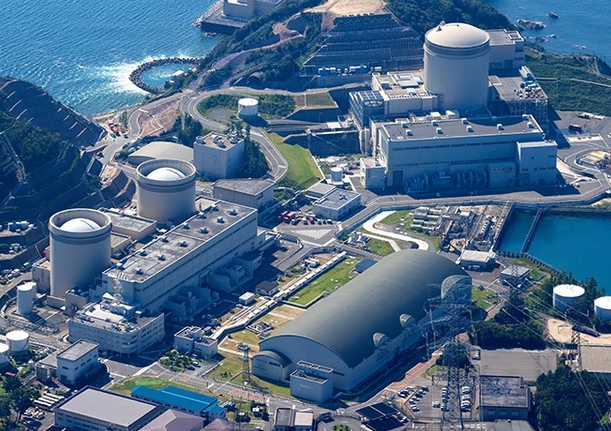
Local officials want new reactors to replace the two retired units at the front of Kansai Electric Power Co.’s Mihama nuclear plant in Fukui Prefecture.
November 29, 2022
The industry ministry proposed building new nuclear reactors to replace retired ones and effectively extending their operating lives beyond 60 years, a reversal of policies set after the 2011 Fukushima nuclear disaster.
The proposals were presented to the ministry’s advisory council, the Nuclear Energy Subcommittee, at a meeting on Nov. 28 as a draft action plan for the Kishida administration’s slogan to “make maximum use of nuclear energy.”
Although many subcommittee members endorsed the proposals, some members said not enough time was spent on discussing such a major change in energy policy.
Prime Minister Fumio Kishida in August issued a directive to a special government panel tasked with decarbonizing Japan to review the current nuclear energy policy.
The government has maintained that “for now,” it does not expect construction of new nuclear plants or a replacement of any reactor.
Because of opposition expected from local governments, the plan also did not propose building nuclear plants in areas that have never hosted such facilities or adding new reactors to existing plants.
But under the action plan, the Ministry of Economy, Trade and Industry states that construction of new reactors “will begin with those replacing retired ones,” giving utilities the green light to build reactors to take the place of those being decommissioned.
The ministry is also seeking “advanced light water reactors” as replacement units, expecting them to start operating in the 2030s. They will each come with an estimated price tag of at least 500 billion yen ($3.57 billion).
Such reactors have enhanced safety features and are an extension of current nuclear technologies, the ministry said.
The action plan also pushes for a system that will effectively extend the life cycle of reactors beyond the maximum of 60 years set under rules adopted after the 2011 triple meltdown.
It suggests that often lengthy periods when reactors are offline for examinations by the Nuclear Regulation Authority on whether they meet standards for restarts be excluded from the 60-year limit.
In addition, the time frame should not include periods when reactor operations are suspended because of lawsuits, the ministry said.
Under those proposals, a reactor that has been idle for 10 years for those reasons could operate for up to 70 years since it first went into service.
The proposed exclusions from the 60-year limit have been criticized as “taking the teeth from” the rigorous reactor regulations set in 2013.
One subcommittee member said the exclusions are “akin to ditching the lessons learned from the Fukushima accident.”
The action plan also called for a new system to provide grants to local governments that promote the use of recycled nuclear fuel at facilities in their jurisdictions.
This is meant to give some leverage to the nation’s trouble-plagued nuclear fuel cycle policy.
Although the action plan represents a sweeping policy change, it does not directly deal with a slew of challenges that have remained unsolved for decades.
For example, it is unclear when the nuclear fuel reprocessing plant under construction in Rokkasho, Aomori Prefecture, a key component in the nuclear fuel cycle program, will go into operations.
Under the program, plutonium retrieved from spent nuclear fuel from across Japan will be recycled as fuel for use at nuclear plants.
The completion date of the reprocessing plant has been pushed back 26 times so far. Around 14 trillion yen has been invested in the project.
Another big headache for the central government is securing a final disposal site for highly radioactive nuclear waste from nuclear power plants across the country.
Two small municipalities in Hokkaido have shown an interest in hosting such a storage facility in exchange for generous grants.
But the Hokkaido governor is opposed to the plan. And no other local governments in Japan have come forward as potential final disposal sites.
The ministry’s action plan did not list any specific proposals to resolve these issues. It merely said: “The state should bolster efforts to gain the understanding” of the public to the nuclear policy.
Plaintiffs claim that the wide-area evacuation plan is ineffective.

November 28, 2022
On November 28, a lawsuit filed by residents of the Onagawa Nuclear Power Plant seeking an injunction against the restart of the No. 2 reactor at Tohoku Electric Power Company’s Onagawa Nuclear Power Plant was concluded. The verdict will be handed down in May next year.
On the 28th, the plaintiffs made their final statements in oral arguments at the Sendai District Court. The plaintiffs again argued that the “wide-area evacuation plan” formulated by the prefectural government and others is ineffective because it does not include specific details about the inspection sites that would be set up along evacuation routes in the event of an accident to check residents’ radiation exposure, including the securing of personnel and materials and equipment.
Mr. Nobuo Hara, leader of the plaintiffs: “How ineffective is the wide-area evacuation plan?
Mr. Nobuo Hara, leader of the plaintiffs’ group: “We have shown how ineffective the wide-area evacuation plan is. The most realistic way to stop the restart of nuclear power plants is to obtain a ruling that nuclear power plants must not be restarted under the evacuation plan. It is the firm belief of the plaintiffs that such a ruling will be reached.”

The trial will conclude on May 28, and the verdict will be handed down on May 24 next year. Tohoku Electric Power aims to restart the Onagawa Unit 2 reactor in February 2024.

Japan studies plan to extend life of 60-year-old nuclear plants

Nov 28, 2022
Japan will consider keeping some nuclear reactors operating beyond a current 60-year limit as the country focuses increasingly on atomic power as a solution to an ongoing squeeze on energy supply.
Officials are studying a plan to exclude periods when reactors were offline from an existing limit on their lifespan, which would allow some facilities to operate for longer, according to a document released Monday by a trade ministry panel. Reactors are often halted for years to allow the nation’s nuclear watchdog to perform inspections, or as a result of legal challenges.
Following the 2011 Fukushima nuclear disaster, which was triggered by a massive earthquake and tsunami, Japan introduced stricter safety standards limiting the operation of nuclear reactors to 40 years in principle.
But operation for an additional 20 years is possible if safety upgrades are made and a reactor passes screening by regulators.
The proposal to allow operations beyond the 60-year limit comes as Japan’s public and government shift back in favor of nuclear power, despite experiencing one of the worst atomic meltdown disasters. The import-dependent country has this year grappled with more expensive fossil fuel prices as a result of Russia’s war in Ukraine, along with a weak yen, and seen its stretched power grid put under severe pressure.
The government has repeatedly asked people to take steps to limit their electricity consumption, by using fewer appliances or cutting back on heating.
In August, Prime Minister Fumio Kishida said the government will explore developing and constructing new reactors, and that it will also aim to restart seven more idled reactors from next summer.
The trade ministry proposals also call for new, next-generation nuclear reactors to be built at sites where existing units will be decommissioned.
Japanese manufacturers have announced plans to develop next-generation reactors this year. Mitsubishi Heavy Industries is jointly developing an advanced light water reactor with four other Japanese power producers, while a venture between Hitachi and General Electric is also reported to be developing a new reactor model.
https://www.japantimes.co.jp/news/2022/11/28/national/nuclear-plant-extension/
Expert panel full of proponents of nuclear power plants to discuss direction on March 28th, extending operation period and developing next-generation models, rushing to conclusion on “Prime Minister’s directive.

Basic policy subcommittee discusses extending the operational period of nuclear power plants in Kasumigaseki, Tokyo.
November 27, 2022
The Ministry of Economy, Trade, and Industry (METI) will present its direction on measures to utilize nuclear power plants, including the extension of the operating period of nuclear power plants, which is stipulated as “40 years in principle, with a maximum of 60 years,” and the development and construction of next-generation nuclear power plants, at the “Nuclear Energy Subcommittee,” a meeting of experts on November 28. Discussions will reach their final stage about three months after Prime Minister Fumio Kishida ordered the committee to study the issue in August. However, the committee did not solicit opinions from the public before reaching a conclusion, and its deliberations were noticeably more hasty than past energy policy debates. (The discussion has been held in a very slow pace compared to past energy policy debates.)
◆Draft government policy at several subcommittee meetings
Of the 21 members of the Atomic Energy Subcommittee, which discusses nuclear energy policy, only two, including Hajime Matsukubo, executive director of the NPO Nuclear Data and Information Office, have made negative statements about nuclear power at recent meetings. In the discussion on extending the operating period, many committee members called for removing the maximum 60-year limit, and at the meeting on March 28, METI is expected to push for a proposal to exclude from the number of years of operation the period during which a nuclear power plant is shut down to undergo a review before it can be restarted, without removing the limit in consideration of public outcry.
The contents of the Nuclear Energy Subcommittee’s deliberations will be discussed by the Basic Policy Subcommittee, which brings together expert panels on energy policy, and the conclusions of the subcommittee will serve as a draft of the government policy.
At the meeting on March 15, Ms. Chisato Murakami, an advisor on consumer affairs, commented, “The use of nuclear power plants will not directly lead to an end to the tight power supply and demand situation. I would like to propose that we take time to deepen the national debate.” She objected to the way the discussion was proceeding, but no other opinions were expressed calling for a reconsideration.
The subcommittee has met twice so far. The committee is expected to hold one or two more meetings before the end of the year to reach a conclusion, after which public comments will be sought.
◆Energy Basic Plan to be discussed 17 times and opinions solicited via the Internet
The previous energy policy discussions were different.
In the discussion of the “Sixth Basic Energy Plan,” a medium- to long-term guideline for energy policy formulated last October, subcommittee meetings were held 17 times over a period of 10 months. In addition, an opinion box was set up on the website during the discussions in order to listen to the opinions of the public at large. The opinions received were submitted as materials to each of the subcommittee meetings for consideration. In total, about 640 opinions were collected, with about 300 calling for a nuclear power phase-out, while about 80 supported the promotion of nuclear power.
At that time, members of the subcommittee expressed the opinion that extending the operational period of nuclear power plants and building new plants were necessary to realize a decarbonized society by 2050, but this was not explicitly stated in the basic plan. The policy of “reducing dependence on nuclear power plants as much as possible,” which came to be stated after the Fukushima accident, was also maintained.
◆Ministry of Economy, Trade, and Industry (METI) official: “The directive to reach a conclusion by the end of the year cannot take too much time.
The government has been stressing the use of nuclear power plants against the backdrop of the recent tight power supply and demand and soaring fuel prices. However, the development of next-generation nuclear power plants, for example, will take a long time and will not be a quick fix, so there is no need to reach a hasty conclusion. Even after Murakami pointed out this contradiction at the subcommittee meeting, a METI official told the interviewer, “We cannot take too much time because [Prime Minister Kishida] has instructed us to reach a conclusion by the end of the year. We will come up with a direction as soon as possible.
Mr. Matsukubo commented, “This is a heavy-handed way of proceeding, not listening to the public and having the Council of Eminent Persons decide what the government wants to do. The government’s policy of making nuclear power a given may narrow the scope for the introduction of renewable energies in the future.
https://www.tokyo-np.co.jp/article/216285?fbclid=IwAR1q4FkmUf5IMHwP2VfT5TG3LA6wvwN1V1CU7vRueWSFSkMq6upQHAuxkG4
Tohoku Electric Applies for 32.94% Increase in Electricity Rates for Households, Effective Next April

President Higuchi announces application to raise electricity rates for households.
November 24, 2022
On November 24, Tohoku Electric Power applied to the government for a 32.94% average increase in regulated electricity rates for households. This is the first time since February 2013 that the company has applied for a price increase to revise basic rates and electricity unit prices. The increase is the third largest in history. The free electricity rates for households, which do not require government approval, will also be raised by an average of 7.69%, both of which are scheduled to go into effect on April 1 next year. This is the first time that a major electric power company has applied for a price hike due to soaring fuel costs caused by Russia’s invasion of Ukraine and other factors.
At a press conference held in Sendai City on April 24, President Kojiro Higuchi said, “The current electricity revenues will not be sufficient to cover fixed costs, and if this situation continues, we will not be able to procure fuel stably or invest sufficiently in power facilities. We are deeply sorry that we are applying for a large price increase, but we hope you will understand.
The regulated rates will increase both the basic rate and the unit price of electricity. The amount of electricity used is divided into three levels, and the more electricity is used, the larger the increase. In the case of the model case (contract type: “metered electric light B,” contract current: 30 amperes, electricity consumption: 260 kWh), the monthly fee will increase by 2,717 yen to 11,282 yen.
The total cost of fuel, labor, and other costs calculated for the application averaged 2.1636 trillion yen over the 23-25 year period, an increase of 1.4 times the 1.5067 trillion yen from 13-15, the basis for the current rate setting. Rising fuel costs and the cost of procuring electricity through markets and other means account for most of this increase.
The restart of Onagawa Nuclear Power Plant Unit 2 (Onagawa Town, Miyagi Prefecture, and Ishinomaki City), scheduled for February 2012, was also factored into the cost calculation. The plant will be able to reduce the amount of fuel it buys, which will lead to an annual cost reduction of about 100 billion yen, and Higuchi said that the price increase will be curbed by about 5%.
In order to compress the price increase, the plan also included 115.9 billion yen in management efficiency improvements. In addition to the initiatives already undertaken, such as more efficient fuel procurement, the company will reduce the number of employees by curtailing new hiring and extend the periodic inspection cycle of thermal power plants.
The METI’s expert panel will review the application. In Tohoku Electric’s previous application, the actual price increase was reduced after discussions on whether the calculation of the total cost was appropriate.
The average increase in free rates for households is smaller than the regulated rates because the system was changed in December to reflect fuel price fluctuations without a cap, based on the fuel cost adjustment system.
President Higuchi’s Painful Decision to Ensure a Stable Supply
The following is a question-and-answer session with Tohoku Electric Power President Kojiro Higuchi, who announced the application for an increase in electricity rates for households.
-The increase will place a heavy burden on households.
With not only electricity rates but also prices rising, it is distressing to see the increase. I hope you understand that this is a difficult decision to make in order to ensure a stable supply of electricity.
-How do you plan to improve management efficiency?
We will reduce repair costs by extending the inspection cycle for thermal power plants and reduce fuel costs by reducing spot procurement as much as possible. In terms of personnel reduction, we will consider consolidating our sales offices.
We have already reduced executive compensation by up to 20% linked to performance and voluntarily returned up to 10% of corporate rates.
-Other major electric power companies are also planning to apply for price increases.
The biggest difference between us and other companies is the two earthquakes that occurred off the coast of Fukushima Prefecture last year and this year. (The biggest difference between us and other companies is the two earthquakes off the coast of Fukushima Prefecture last year and this year, which knocked out power (from several thermal power plants) and increased the cost of restoration.
-The deregulation of the electric power industry was supposed to lower electricity prices through competition.
However, the unexpected rise in fuel costs, such as this one, cannot be absorbed through friendly competition among power providers. Tohoku Electric is expensive, but new power companies are not cheap, and we believe that we are now in a state of emergency.
https://kahoku.news/articles/20221124khn000028.html?fbclid=IwAR2eR9Xvf8z8dHCRnRuz1G-1YCLcMlSnk2HTMs6rZzN8vy5eRV-ATnDwbOE
Kim Jong Un wants North Korea to be a nuclear superpower – the real risk is a regional arms race
The Conversation, Alexander Gillespie, December 2, 2022
The recent claim by Kim Jong Un that North Korea plans to develop the world’s most powerful nuclear force may well have been more bravado than credible threat. But that doesn’t mean it can be ignored.
The best guess is that North Korea now has sufficient fissile material to build 45 to 55 nuclear weapons, three decades after beginning its program. The warheads would mostly have yields of around 10 to 20 kilotons, similar to the 15 kiloton bomb that destroyed Hiroshima in 1945.
But North Korea has the capacity to make devices ten times bigger. Its missile delivery systems are also advancing in leaps and bounds. The technological advance is matched in rhetoric and increasingly reckless acts, including test-firing missiles over Japan in violation of all international norms, provoking terror and risking accidental war.
The question now is how best to bring the pariah nation into the orbit of arms control negotiations and international dialogue. However remote the chances of that, the alternative risks a regional nuclear arms race………………………………………….
Three decades of non-compliance with international obligations by North Korea have not engendered trust or a willingness by surrounding countries to submit to a nuclear neighbour. More likely is a regional nuclear arms race, as happened when India got the bomb and Pakistan had to keep up, or when Israel triggered Iran’s nuclear ambitions.
South Korea, Japan and possibly even Taiwan are likely to follow suit, either asking to host US ballistic missiles or pursuing independent nuclear strategies – especially if they feel the US won’t defend them after the next presidential election.
None of this makes the world safer. https://theconversation.com/kim-jong-un-wants-north-korea-to-be-a-nuclear-superpower-the-real-risk-is-a-regional-arms-race-195726
Kim Jong Un Emphasizes Nuclear Development as North Korea’s ‘Ultimate Goal’
Kim continues to double down on the importance of the nuclear program for his country.
The Diplomat, Mitch Shin, November 28, 2022, Following the successful test of its Hwasong-17 intercontinental ballistic missile (ICBM) on November 18, North Korean leader Kim Jong Un praised the work of those who contributed to the development of the missile, Korea Central News Agency (KCNA), one of the North’s main state-controlled media, reported on Sunday.
During a photo session with the contributors, Kim reiterated the importance of developing nuclear weapons as a means to protect North Korea…………….
As the Korean War stalled with a truce in 1953, the two Koreas are technically still at war………………………….
Considering Kim’s latest order to his scientists and technicians and his speech in September, he seems to have concluded that nuclear development is the only way to survive. With nuclear development described by Kim as the “ultimate goal,” it indicates that he will never preemptively denuclearize his country………………. more https://thediplomat.com/2022/11/kim-jong-un-emphasizes-nuclear-development-as-north-koreas-ultimate-goal/
JNFL’s application for examination of a nuclear fuel reprocessing plant was criticized by the Regulatory Commission for “lacking a sense of urgency”

JNFL Senior Managing Executive Officer Rei Sudo (left) and others explain at the Nuclear Regulation Authority’s review meeting in Minato-ku, Tokyo.
November 22, 2022
JNFL found multiple errors in the seismic calculation results of the application it submitted to the Nuclear Regulation Authority during the examination required for the operation of its reprocessing plant for spent nuclear fuel from nuclear power plants in Rokkasho Village, Aomori Prefecture. The errors were discovered when the Nuclear Regulation Commission pointed them out to JNFL. Even two years after the application was submitted, NNFL continues to reveal its inadequacies, and there is no prospect that the review will be completed.
The errors were in the results of seismic calculations for the cooling tower fire detectors, which NNFL submitted on November 8 in the form of an amendment to its application. According to NNFL, when the results of the seismic calculations were transcribed into the application, incorrect values were entered in several places. Although the documents were checked before submission, the mistake was not noticed. The cause of the error has not been disclosed, saying that it is under investigation. The correction will be corrected and resubmitted in the future.
According to the secretariat of the regulatory commission, the error in the calculation results was so simple that a person with expert knowledge would be able to recognize it at a glance.
At the review meeting held on March 15, the person in charge at the secretariat of the regulatory commission commented, “In the review of facility design, making a mistake in numerical values is a definite and serious problem,” and “It is the most rudimentary of rudiments. Why don’t they notice it? Why don’t they realize this? They have no sense of crisis at all. Rei Sudo, executive vice president of Nenryo, who is in charge of handling the review, simply stated, “This is something that really shouldn’t happen. We take this very seriously.
The reprocessing plant, a core facility under the government’s nuclear fuel cycle policy, met the new regulatory standards for basic accident countermeasures in July 2020, and in December of the same year, JNFL applied for a review of detailed facility designs and construction plans. However, there has been no significant progress since the application stage due to inadequate explanations from NNFL.
In September of this year, NNFL announced for the 26th time that it was postponing the completion of the plant due to the difficulties encountered in the review process. The company plans to announce the next target date for completion by the end of this year, but the examination process will inevitably become even more difficult due to the discovery of numerical errors. (Kenta Onozawa)
https://www.tokyo-np.co.jp/article/215291?fbclid=IwAR3axQXraZ9FR1wgBWFW97VsXYaz7LEtnmRwhAa8f6fSsxczwS8WNBpIdY4
USA Vice-President For the Nuclear Industry Kamala Harris on a marketing jaunt for NuScam’s Small Nuclear Reactors to Southeast Asia

Thailand, Philippines, Indonesia – nuclear reactors such a jolly idea in this earthquake ring of fire ?
US to supply Thailand, Philippines with modular nuclear reactors
BenarNews staff, 2022.11.23, Bangkok.
The United States says it will help Thailand and the Philippines with a new civilian nuclear technology to reduce climate-damaging emissions, but experts warn the final products are years away from being operational and other hurdles exist.
Plans by the U.S. to supply its longtime Southeast Asian allies with so-called small modular reactors (SMRs) were unveiled during Vice President Kamala Harris’ trip to both countries in recent days.
While attending the Asia-Pacific Economic Cooperation meetings in Bangkok last weekend, Harris launched a new clean energy partnership with Thailand.
From there, the vice president went to the Philippines where she announced that Washington and Manila were starting negotiations on the 123 Agreement, which would allow for civilian nuclear cooperation.
The U.S. nuclear technology plans for Thailand and the Philippines are firsts involving Southeast Asian nations.
The SMRs, which can be as small as a bucket and transportable, are to be constructed under “the highest standards of safety, security and nonproliferation,” officials said.
Another country in Southeast Asia that has shown interest in developing such reactors – Indonesia – appears to be looking at designs from several countries. [Never mind about the earthquakes?]
In a press release, the White House said the new partnership with Thailand would “build capacity for the secure and safe deployment of advanced nuclear reactor technologies.”
“This partnership will help Thailand take advantage of the unique benefits of SMRs that provide 24/7 reliable power, complement other clean energy sources, use a small land footprint and incorporate advanced safety features.”
The Thai government has set a goal of Net Zero Emissions by 2065, but no timeline for the SMR partnership. Washington praised the “unique benefits” of reactors which, besides providing reliable power, also fight climate change.
Small modular reactors generally are defined as advanced nuclear reactors with a capacity of less than 300 MW, according to the International Energy Agency.
A reactor could be as small as a five-gallon (18.9-liter) bucket. The traditional design has fuel and control rods, and energy is transported through boiling water, according to NuScale, a U.S. SMR manufacturer, which estimated initial costs at about U.S. $500 million.
The agreement with Manila calls for the U.S. and the Philippines to cooperate on advanced nuclear technologies to ensure energy security as that Southeast Asian country transitions to clean energy.
Once in force, the 123 agreement “will provide the legal basis for U.S. exports of nuclear equipment and material to the Philippines. The United States is committed to working with the Philippines to increase energy security and deploying advanced nuclear reactor technology as quickly as safety and security conditions permit to meet the Philippines’ dire baseload power needs,” the White House said in a statement.
Under President Ferdinand Marcos Jr.’s father, the late dictator Ferdinand E. Marcos, the Philippines began construction of the Bataan Nuclear Power Plant in 1976, in an area about 100 km (62 miles) west of Manila. The plant, constructed above a major fault line, was mothballed amid safety concerns after the 1986 Chernobyl disaster.
Today, the Philippines runs a couple of research reactors for training and education purposes while Thailand has no nuclear power.
……….. Tanagorn said Thais were concerned about safety in light of the 2011 Fukushima nuclear disaster caused by a tsunami in Japan. Other obstacles are the limited number of investors and the lack of domestic laws and regulation of nuclear activities.
John Timmer, science editor of Ars Technica, a web portal focusing on science and technology, said that with nuclear reactors, the principle is always “safety first.”
“The approval process for that reason tends to be long and includes a lot of documentation,” he said.
“The SMRs are designed to be much safer, but they haven’t been built (in the U.S.) in a final form yet, so it’s difficult to say whether the real-world experience will show that to be the case and also how useful they’ll be for addressing climate change,” Timmer told BenarNews.
“I’ve been hearing about SMRs for about a decade,” he said, adding that “until we build and get a sense what operating them is like and what costs are like, I’m going to be a bit skeptical.”
Cost is another obstacle.
“We’ve never built one of these, so this is going to be a learning experience and for the first few years. It’s going to be more expensive and more complicated to complete,” Timmer said.
‘Widespread misconceptions’
Economist John Quiggin, a professor at the University of Queensland in Australia, listed economic viability of nuclear power plants compared to coal, gas or solar and wind facilities as one of the “widespread misconceptions.”
“When pressed, nuclear fans will mostly shift the argument to the ill-defined notion of ‘small modular reactors,’ which don’t actually exist, and may never [exist],” Quiggin said, noting there are operating examples of small reactors, but “those are made on a one-off basis and are expensive because they forgo size economies.”
Once the reactors can be factory-produced “the ‘modular’ idea is to counter this loss with the economic gains of high-volume,” he said.
“There has been a lot of talk lately about a revival of nuclear power, partly in response to the need to replace the energy previously supplied by Russia, and partly as a longer-term response to climate change,” Quiggin said.
While in office U.S. President George W. Bush launched a nuclear power program, which led to talks of a “nuclear renaissance” but yielded only two projects despite no effective opposition “except from consumers objecting to the massive costs.”
Quiggin expects that the number of SMRs constructed will be also “tiny.”
“The work of decarbonizing energy supply will be done almost entirely by the sun and the wind,” he said.
Jason Gutierrez in Manila contributed to this report. https://www.benarnews.org/english/news/philippine/nuclear-reactors-11232022142149.html
USA desperate to sell NuScam’s small nuclear reactors – its latest targeted buyer is Thailand

Kamala Harris – nuclear saleswoman
BANGKOK: The United States will help Thailand develop nuclear power through a new class of small reactors, part of a programme aimed at [?] fighting climate change, Vice President Kamala Harris announced on a visit Saturday (Nov 19).
The White House said the assistance was part of its Net Zero World Initiative, a project launched at last year’s Glasgow climate summit in which the US partners with the private sector and philanthropists to promote [?]clean energy…………
Harris, who is visiting the US ally for an Asia-Pacific Economic Cooperation summit, will discuss the nuclear power initiative in a meeting later Saturday with Thai Prime Minister Prayut Chan-o-cha…………. more https://www.channelnewsasia.com/world/us-help-thailand-develop-small-nuclear-reactors-3085781
N Korea warns of ‘all-out’ nuclear response to US ‘aggression’
North Korea has promised to ‘resolutely react’ to US threat of nuclear weapons use with its own nuclear capabilities.
North Korean leader Kim Jong Un has promised to use nuclear weapons to counter threats from the United States hours after test-firing an intercontinental ballistic missile (ICMB), the latest escalation as the UN Security Council prepares to convene an emergency session on Pyongyang’s actions.
The United Nations Security Council, at the behest of Japan, South Korea and the US will gather on Monday to discuss North Korea’s latest missile launch…………………………………….. more https://www.aljazeera.com/news/2022/11/19/north-korea-warns-of-all-out-nuclear-response-to-us-provocation
Japan’s changing nuclear energy policy
No matter the policy, public trust for nuclear energy is unlikely to be restored

Nov 16, 2022
On Aug. 24, at the newly established GX (Green Transformation) Implementation Council chaired by Prime Minister Fumio Kishida, the Japanese government announced a new nuclear energy policy.
The framework for this new policy consists of three key points: maximize the use of existing nuclear power plants through an accelerated restart and extension of their operation period; develop and build advanced next-generation reactors; and develop conditions suitable for the use of nuclear energy, including back-end support.
The most contentious of these is the second point: the development and construction of advanced next-generation reactors. Since the Fukushima nuclear disaster, previous Japanese government policy has made no mention of building new power plants, so it is being seen as a major policy change. What explains this policy change and is it really feasible?
The most significant influence on the new policy is surely the 2050 Carbon Neutral policy. At present, Japan has only nine nuclear reactors in operation. In fiscal 2020, nuclear power generation accounted for only around 7% of the country’s total power generation. According to an estimate by Hajime Matsukubo, secretary-general of the Citizens’ Nuclear Information Center, achieving the government’s goal of raising this percentage to 20%-22% by fiscal 2030 will require around 26-33 operational nuclear reactors.
If the target ratio of nuclear power generation for fiscal 2050 is also set at around 20%, then around 37-50 operational reactors will be required. If new power plants are not constructed, by fiscal 2050 there will be three reactors with a 40-year service life and 23 reactors with a 60-year service life. If the Japanese government wants to keep the ratio of nuclear power generation at the stated level, then it will need around 20-40 new reactors.
Other factors cited as reasons for this shift in nuclear energy policy include soaring electric power prices due to the Ukrainian crisis and a desire to decrease dependency on fossil fuels. Whatever the reasons for the policy change may be, the government should explain them more clearly.
First, the policy mentions accelerating the restart and extending the operation period of existing nuclear power plants. However, the outlook for achieving this is unclear. Restarting nuclear power plants requires permission from the Nuclear Regulation Authority (NRA) and the agreement of local communities. Plants could also be forced to close due to legal actions such as injunctions, so there is still uncertainty.
With regard to operating period (service life), proposals — led primarily by the Ministry of Economy, Trade and Industry — have been made for the abolishment of the 40-year operating period regulation. But even with this regulation removed, the safety of all plants must ultimately be reviewed by the NAC. If the government is to observe its policy of placing top priority on safety, then it cannot influence NRA safety inspections.
In terms of constructing of new reactors, construction costs for advanced light water reactors — seen as the most practical — are already skyrocketing in the United States and Europe. In the case of small modular reactors, the second most anticipated type, almost all overseas projects are facing setbacks, delays and they have yet to be successfully constructed.
Above all, the biggest questions are these. Can nuclear power maintain competitiveness in a deregulated market? And are any power companies willing to place orders despite the investment risks? The answers are unknown.
The global situation also leaves little cause for optimism. According to the World Nuclear Industry Status Report 2022, the global ratio of nuclear power generation peaked in 1996 at 17.5% and has since gradually declined, falling to below 10% for the first time in 40 years, at 9.8% in 2021. At the same time, the ratio of renewable energy (wind and solar power) reached 10.2% in 2021, exceeding the ratio of nuclear power generation for the first time in history. In terms of future growth, it is quite likely that nuclear power generation’s contribution to combating climate change will decrease. In addition, the recent Ukrainian crisis has also highlighted the risks posed by nuclear power plants in the event of war. The future of nuclear energy at the global level hardly seems bright.
There are also numerous issues to be resolved before we can even begin speaking about a shift in policy. While the decision has already been made to allow contaminated water from the Fukushima No. 1 nuclear power plant to be released into the ocean, the agreement of local fishermen has yet to be obtained. There is also no prospect of removing the melted fuel debris from the reactor in the foreseeable future. Still today there are more than 30,000 refugees who are unable to return to their homes and many court cases for compensation are still ongoing. In short, the Fukushima nuclear disaster is not over yet.
Moreover, cleanup for the nuclear energy policy that the government has pursued over the past 50 years remains unresolved. Nuclear waste problems (including spent nuclear fuel) and the decommissioning of old reactors remain as issues, regardless of the future direction for nuclear power plants. A review of the nuclear fuel cycle policy that has left the country with massive amounts of plutonium is also necessary and inevitable.
Last but not least, there is the issue of public trust in nuclear energy — trust that was lost as a result of the Fukushima nuclear disaster and has not been regained. Looking at this policy change, there is no trace of sufficient validation or discussion. Until a process is established for developing polices with a solid factual basis and then making policy decisions through dialogue with the public, public trust in nuclear energy policy is unlikely to be restored any time soon.
Tatsujiro Suzuki is a professor and vice director at the Research Center for Nuclear Weapons Abolition, Nagasaki University. © 2022, The Diplomat
https://www.japantimes.co.jp/opinion/2022/11/16/commentary/japan-commentary/japan-nuclear-power/
Machinery manufacturer Nippon Steel Works subsidiary confirms 449 cases of fraud, including falsification of inspection resultsNippon Steel Works subsidiary confirms 449 cases of fraud, including falsification of inspection results
Machinery manufacturer Japan Steel Works announced that its subsidiary in Muroran, Hokkaido, Japan, repeatedly falsified or fabricated the inspection results of its products, and that a total of 449 irregularities were identified. These included products for nuclear power plants.

November 14, 2022
Machinery manufacturer Nippon Steel Works, Ltd. announced that its subsidiary in Muroran City, Hokkaido, Japan, has repeatedly falsified or fabricated inspection results for its products, and that a total of 449 cases of fraud have been confirmed. The company apologizes and says it will consider disciplinary action against those involved.
After an internal report uncovered irregularities in the rewriting of inspection data for parts at Muroran-based subsidiary Nippon Steel M&E, Nippon Steel established a special investigation committee made up of outside lawyers in May of this year, and has been conducting an investigation.
The company released a report summarizing the results of the investigation on April 14, stating that 449 cases of falsification and fabrication were confirmed.
The subsidiary is a major manufacturer of products used in nuclear power plants, and 20 of the fraudulent products were related to nuclear power plants.
In addition, the company has stated that none of the products involved are used in Japan for nuclear power plants.
The report also pointed out the causes of the irregularities, including a dysfunctional management system and a lack of awareness of compliance.
President Matsuo said, “We are deeply sorry for the inappropriate behavior in nuclear power products.
In response to the investigation report, Toshio Matsuo, president of Nippon Steel Corporation, issued a comment saying, “I would like to express my deepest apologies again for the inconvenience and concern we have caused you.
The report also stated, “We take the fact of the failure of the self-cleansing function and the recommendations of the special investigation committee very seriously and sincerely, and we will work to reform our systems and culture to prevent recurrence and restore confidence in our company. We are committed to reforming our systems and culture to prevent recurrence and restore trust in our company.
https://www3.nhk.or.jp/news/html/20221114/k10013891391000.html?fbclid=IwAR1jlq0dwOU2zoAmESiIxWfCogc1FQ2ikxgf0mxhLXi852vZYNKcQyF_b4o
1 This Month



26 September – International Day for the Total Elimination of Nuclear Weapons


PLEASE OPPOSE HR 8255 AND S.3639 – bills would accelerate satellite deployment, with no environmental review or safeguards – https://ncstd5li.quorum.us/campaign/169331/
To see nuclear-related stories in greater depth and intensity – go to https://nuclearinformation.wordpress.com
-
Archives
- September 2026 (233)
- August 2026 (330)
- July 2026 (355)
- June 2026 (287)
- May 2026 (306)
- April 2026 (356)
- March 2026 (251)
- February 2026 (267)
- January 2026 (308)
- December 2025 (358)
- November 2025 (359)
- October 2025 (375)
-
Categories
- 1
- 1 NUCLEAR ISSUES
- business and costs
- climate change
- culture and arts
- ENERGY
- environment
- health
- history
- indigenous issues
- Legal
- marketing of nuclear
- media
- opposition to nuclear
- PERSONAL STORIES
- politics
- politics international
- Religion and ethics
- safety
- secrets,lies and civil liberties
- spinbuster
- technology
- Uranium
- wastes
- weapons and war
- Women
- 2 WORLD
- ACTION
- AFRICA
- Atrocities
- AUSTRALIA
- Christina's notes
- Christina's themes
- culture and arts
- Events
- Fuk 2022
- Fuk 2023
- Fukushima 2017
- Fukushima 2018
- fukushima 2019
- Fukushima 2020
- Fukushima 2021
- general
- global warming
- Humour (God we need it)
- Nuclear
- RARE EARTHS
- Reference
- resources – print
- Resources -audiovicual
- Weekly Newsletter
- World
- World Nuclear
- YouTube
-
RSS
Entries RSS
Comments RSS
 nuclear-news