Hypocrisy: Indian government deports anti nuclear foreigner, fetes pro nuclear foreignors
India with it’s multi gigawatt solar availability could power the entire world with just solar
Solar is cheap today. It was 30 dollars per watt and today it has dropped down to 3 dollars per watt Nuclear is way way more expensive and will only leave our kids with a cancerous future and deadly waste forever

 from our correspondent in India, 29 Feb 12, The Government is cancelling the licences of three NGOs without giving their names because obviously these NGOs don’t exist. Let’s see what they will cook up and who they will pay to be stooges for the government. It is not an impossible task for this extremely anti-democratic government to organize goons who will agree to be phony NGOs in their attempt to derail the Koodankulam protests.
Sad this government had to stoop this low to make such a hue and cry about an innocent tourist and about non-existing foreign funding of the protests. We are however one hundred per cent sure the government is massively funded to promote foreign interests in our country. Continue reading
Cancer in India’s nuclear workers – the other side of nuclear power’s rosy picture
 After being in denial for years, last month the selfsame Department of Atomic Energy for the first time admitted that the deaths of its employees and their dependents at the Kalpakkam nuclear site were caused by multiple myeloma, a rare form of bone marrow cancer linked to nuclear radiation.
Not that the DAE willingly divulged the information – it came to light in response to a Right to Information (RTI) inquiry from October 2011, … one can only wonder what other reports the DAE is sitting on
The Darker Reality of India’s Nuclear Power Goals, By John Daly Oilprice.com 26 February 2012 India is betting heavily on nuclear power to meet its surging energy needs. While India currently has six nuclear power plants (NPPs) with 20 reactors generating 4,780 megawatts, seven other reactors are under construction and are expected to generate an additional 5,300 megawatts.
This current rate of nuclear power generation pales into insignificance with New Delhi’s future plans, Continue reading
Japan has no solution to disposing of its nuclear wastes
The country is yet to build a final disposal site for nuclear fuel.
Meanwhile, Katsutaka Idogawa, mayor of the town of Futaba in Fukushima Prefecture, which hosts the troubled Daiichi plant, criticized the panel for drafting a new atomic energy policy platform before an investigation into the cause of the nuclear crisis is concluded…..

 Panel calls for study on direct disposal of spent nuclear fuel, Mainichi Daily News, 29 Feb 12, Nothing is decided yet but TEPCO told the press at its Tokyo headquarters Wednesday morning that this is one option TEPCO officials are considering to use at the tsunami-stricken Fukushima Dai-ichi nuclear power plant in Okuma town in Fukushima Prefecture, northeastern Japan.
TOKYO (Kyodo) — A government panel commissioned to compile the country’s basic atomic energy policy said in its draft nuclear power platform Tuesday that Japan should study the possibility of burying spent nuclear fuel deep underground, instead of the current disposal
method of reprocessing spent fuel. Continue reading
Protest against India deporting German tourist because he is anti nuclear
“I don’t know whether he was involved in raising funds for anti-KNPP protestors. But being anti-nuclear does not mean one is anti-national.”
 Foreign fund remark: Kudankulam protester sends legal notice to PM Economic Times, 28 FEB, 2012, German deported, anti-Kudankulam Nuclear Power Project activist cries foul Chennai: A German national was deported from India on Tuesday on grounds of raising funds for protests against the Kudankulam Nuclear Power Project, prompting an anti-nuclear activist to say the move was anti-tourist. Continue reading
Danger continues at Fukushima nuclear plant
Employees usually work for about two to three hours at a time, but in some areas, including highly contaminated Unit 3, they can stay only a few minutes…..
“We were just lucky that Japan was able to avoid the worst-case scenario. But
there is no guarantee this kind of luck will prevail next time.”
Japan nuclear plant still fragile: chief, SMH, February 29, 2012, Japan’s tsunami-hit Fukushima power plant remains fragile nearly a year after it suffered multiple meltdowns, its chief says, with makeshift equipment – some mended with tape – keeping crucial systems
running. Continue reading
Evacuation of Tokyo considered during Fukushima nuclear disaster
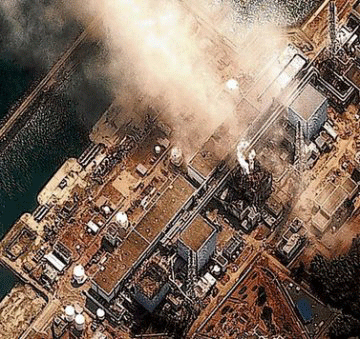 Nuclear Crisis Set Off Fears Over Tokyo, Report Says, NYT, By MARTIN FACKLER, February 27, 2012 TOKYO — In the darkest moments of last year’s nuclear accident, Japanese leaders did not know the actual extent of damage at the plant and secretly considered the possibility of evacuating Tokyo, even as they tried to play down the risks in public, an independent investigation into the accident disclosed on Monday.
The investigation by the Rebuild Japan Initiative Foundation, a new private policy organization, offered one of the most vivid accounts yet of how Japan teetered on the edge of an even larger nuclear crisis than the one that engulfed the Fukushima Daiichi Nuclear Power Plant. A team of 30 university professors, lawyers and journalists spent more than six months on the inquiry into Japan’s response to the triple meltdown at the plant, which followed a massive earthquake and tsunami last March 11 that shut down the plant’s cooling systems……. http://www.nytimes.com/2012/02/28/world/asia/japan-considered-tokyo-evacuation-during-the-nuclear-crisis-report-says.html
Mayors of 3 major cities want a switch away from nuclear power
Japan cities press utility to switch from nuclear, Feb 27, 2012
* Mayors say no utility should depend on single energy source
* Only two of 54 reactors on stream a year after nuclear disaster
By Risa Maeda TOKYO, Feb 27 (Reuters) – Three of Japan’s major cities called for Kansai Electric Power Co, its second largest nuclear generator, to draw up a plan to switch to other energy sources nearly a year after the country suffered the world’s worst nuclear accident in 25 years.
The mayors of Osaka, Kobe and Kyoto, home to a total of 5.7 million people, on Monday submitted questions on prospects for alternative energy supplies and price incentives to curb demand…..
Professors in court over radiation death, and injuries
Radiation Leak: DU Professors Summoned on March 12 Outlook India.com PTI | NEW DELHI | FEB 27, 2012 Six Delhi University professors were today summoned by a court here to explain their alleged criminal culpability in death of one persons and critical injuries to seven others in 2010 due to radiation from a radioactive irradiator, disposed of in a scrap market here.
The summonses seeking the professors’s appearance on March 12 were issued by Metropolitan Magistrate Lovleen, who took cognisance of the chargesheet, which was under the court’s consideration since September last year.
The Delhi Police had filed the chargesheet accusing the professors of endangering lives by auctioning a radioactive Cobalt-60 gamma irradiator without due mandatory precautions….. The matter came to fore when one person died and seven people were critically injured in
April 2010 after they were exposed to radiation when they cut open a Cobalt-60 irradiator at Mayapuri scrap market here. The irradiator was traced to the varsity’s Chemistry Department……. http://news.outlookindia.com/items.aspx?artid=753243
Radiation around Fukushima still at uinhabitable levels
Radiation still high around Fukushima No. 1 http://www.japantimes.co.jp/text/nn20120226a5.html Japan Times, , Feb. 26, 2012, Kyodo High levels of radiation, including a rate of 470 millisieverts per year at one location, have been detected in municipalities near the Fukushima No. 1 nuclear power plant, according to an interim Environment Ministry report. A survey conducted from Nov. 7 to Jan. 16 showed that the readings topped 50 millisieverts on an annual basis — a level deemed uninhabitable under a proposed new classification — in many spots north-northwest of the crippled power station. Continue reading
India’s P.M. blames anti nuclear activists for his government’s paralysis
Dr Singh’s statement was rejected by a coalition of women, fishermen and farmers from 17 villages that have been protesting against the plant. ”By making these absurd allegations, he is diverting everybody’s attention from the real issues here,” activist V. Pushparayan said.
 Indian government paralysed, but PM blames others, The Age Rama Lakshmi, February 26, 2012 FIRST it was the fault of the news media, then of his coalition partners, but now Indian Prime Minister Manmohan Singh is blaming someone else for his government’s inability to carry out planned projects.
On Friday, Dr Singh raised the Cold War-era bogy of the ”foreign hand”, accusing US and Scandinavian non-government organisations of stalling the commissioning of a nuclear power plant in southern India and delaying implementation of government plans to commercialise genetically modified crops by supporting protest groups.
His comments attracted a barrage of criticism….. Continue reading
Political and public opposition to Lynas’ rare earths plant for Malaysia
 Opposition leader Anwar Ibrahim said his alliance would seek an emergency motion in Parliament to urge the government to cancel the project. He also pledged the opposition would scrap the plant if it wins national polls expected by June.
Malaysia’s last rare earth refinery by Japan’s Mitsubishi group, in northern Perak state, was closed in 1992 following protests and claims that it caused birth defects and leukemia among residents. It is one of Asia’s largest radioactive waste cleanup sites.

 3,000 Malaysians rally against Australian-built rare earth plant amid radiation fears Washington Post, By Associated Press, February 25 KUALA LUMPUR, Malaysia — Some 3,000 Malaysians staged a protest Sunday against a rare earth refinery being built by Australian miner Lynas over fears of radioactive contamination.
It marked the largest rally against the $230 million plant in eastern Malaysia, and could pose a headache to the government ahead of national elections widely expected this year. Authorities recently granted Lynas a license to operate the first rare earths plant outside China in years. The plant in Pahang state has been the subject of heated protests over health and environmental risks posed by potential leaks of radioactive waste…..
Opposition leader Anwar Ibrahim said his alliance would seek an emergency motion in Parliament to urge the government to cancel the project. He also pledged the opposition would scrap the plant if it wins national polls expected by June. Continue reading
India’s nuclear deal for the benefit of foreign commercial interests
 The “foreign hand” argument perhaps applies more to the government than to the people, Sarma said. “Is it not the foreign hand that was responsible for compelling the UPA government to push through the Indo-US nuclear deal to serve the commercial interests of another country more than promoting self-reliance?
Anti-nuke groups slam PM remarks Deccan Herald, HYDERABAD/CHENNAI, Feb 26, 20012, Ex-secretary rubbishes foreign hand theory Prime Minister Manmohan Singh’s remarks that some foreign NGOs were behind the agitation against the Kudankulam Nuclear Power Project (KNPP) were rubbished by a former energy secretary at the Centre and drew a strong backlash with anti-nuclear groups organising a big rally in Chennai on Sunday.
Singh’s remarks in a TV interview that some US and Scandinavian NGOs obstructed India’s nuclear energy programme in the backdrop of the seven-month long agitation the nuclear power project in Tamil Nadu drew a sharp retort from former Union energy secretary E A S Sarma in Vishakhapatnam. He trashed the Prime Minister’s talk of “foreign hand” and made out a strong case for suspending the works on nuclear plants in the interests of the country’s future and safety. Continue reading
Indian govt uses funding stop to counter NGO anti nuclear protest
 India freezes aid group funds over nuclear protests Business Recorder, FEBRUARY 26, 2012 India said Saturday it had frozen the assets of three non-profit groups it alleges were diverting foreign aid funds to fuel protests against plans to build two atomic power stations.
The country’s move to construct two giant nuclear power stations in the southern state of Tamil Nadu and one in the western state of Maharashtra has been thrown into disarray following the protests by villagers and activists.
A senior officer at the prime minister’s office told AFP that the home ministry had frozen the accounts of three non-government organisations.
Japan banking on non-viable reprocessing, because it has nowhere to put nuclear wastes
the government has delegated the task of dealing with waste to the private sector, so there is no central decision-maker
“Why does the government stick to the very costly recycle policy? That is because if they give it up, they should explain where a final repository will be located,”
Beyond Fukushima Japan faces deeper nuclear concerns, Vancouver Sun, By RISA MAEDA, Reuters February 24, 2012 TOKYO“…..A DECENT BURIAL With Japan’s recycling efforts running so far behind the required pace
to deal with the waste problem, Japan needs to find another resting place for its waste, away from nuclear power plants, which are typically located on the coast.
But unlike France and the United States, the world’s biggest atomic power generators, Japan does not have much in the way of geologically stable and empty landscapes in which to bury nuclear waste for centuries. Given its population density is 10 times higher than the United States and almost three times higher than France, Japan faces a “not in my backyard” problem like no other big nuclear-power nation. Continue reading
Nuclear reprocessing not a viable option for Japan
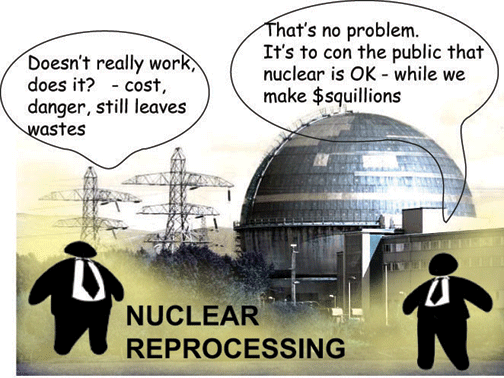 Fast-breeder said realistic no more, Japan Times, 25 Feb 12, Kyodo A panel of experts reviewing the nuclear fuel cycle policy in light of the Fukushima crisis has agreed that while a fast-breeder reactor has advantages, from a technology viewpoint it can’t be considered a realistic option for the next 20 to 30 years. The nuclear fuel policy involves reprocessing spent fuel to produce plutonium that can be reused to produce electricity.
The subcommittee of the Japan Atomic Energy Commission said in a draft document summarizing its discussions that two viable options during the next few decades would be to not reprocess spent nuclear fuel, and to recycle plutonium-uranium mixed oxide fuel, or MOX fuel.
The former option is called the “once-through” cycle, in which uranium fuel is used in nuclear reactors just one time and disposed of by burying it in the ground. In the latter option, MOX fuel is manufactured from plutonium recovered from spent nuclear fuel and used
in ordinary reactors. Continue reading
1 This Month
23-25 October – on Zoom – World BEYOND War’s annual global conferenc


Shut down the radiation-damaged Heysham nuclear reactors now
To see nuclear-related stories in greater depth and intensity – go to https://nuclearinformation.wordpress.com

Say No to NASA’s Reckless Nuclear Reactor on the Moon
Say No to NASA’s Reckless Nuclear Reactor on the Moon

-
Archives
- October 2026 (219)
- September 2026 (339)
- August 2026 (330)
- July 2026 (355)
- June 2026 (287)
- May 2026 (306)
- April 2026 (356)
- March 2026 (251)
- February 2026 (267)
- January 2026 (308)
- December 2025 (358)
- November 2025 (359)
-
Categories
- 1
- 1 NUCLEAR ISSUES
- business and costs
- climate change
- culture and arts
- ENERGY
- environment
- health
- history
- indigenous issues
- Legal
- marketing of nuclear
- media
- opposition to nuclear
- PERSONAL STORIES
- politics
- politics international
- Religion and ethics
- safety
- secrets,lies and civil liberties
- spinbuster
- technology
- Uranium
- wastes
- weapons and war
- Women
- 2 WORLD
- ACTION
- AFRICA
- Atrocities
- AUSTRALIA
- Christina's notes
- Christina's themes
- culture and arts
- Events
- Fuk 2022
- Fuk 2023
- Fukushima 2017
- Fukushima 2018
- fukushima 2019
- Fukushima 2020
- Fukushima 2021
- general
- global warming
- Humour (God we need it)
- Nuclear
- RARE EARTHS
- Reference
- resources – print
- Resources -audiovicual
- Weekly Newsletter
- World
- World Nuclear
- YouTube
-
RSS
Entries RSS
Comments RSS

