Some progress in USA – North Korea nuclear talks
U.S. nuclear talks with N. Korea produce progress but no breakthrough, Washington Post, By Chico Harlan, February 24, TOKYO — The United States’ nuclear negotiations with North Korea ended Friday with “a little bit of progress” but no breakthrough, said chief U.S. negotiator Glyn Davies, who hinted that a long and slow process will determine Pyongyang’s willingness to swap its weapons program for aid. Continue reading
Taiwanese will march for a nuclear power free homeland
Anti-nuclear rallies set for March 11 Taipei Times, Staff Writer, with CNA 25 Feb 12, Nearly 20 local non-governmental organizations (NGO) yesterday urged the public to take to the streets on March 11, the first anniversary of Japan’s devastating earthquake and tsunami, to demand that the government scrap plans for further construction of nuclear power plants.
The organizers said they hope to draw more than 10,000 demonstrators in rallies to be held in Taipei, Greater Taichung and Greater Kaohsiung. The march would mark continuing efforts to build local momentum amid global concerns over nuclear safety, the organizers said.
The action is also aimed at pushing the government to commit to a nuclear-free homeland, said Tsui Su-hsin (崔傃欣), secretary-general of the Green Citizens’ Action Alliance, one of the participating NGOs. Continue reading
Japan’s nuclear recycling plant, a probable failure
“an 80 to 90 percent chance of the [nuclear recycling] plant being a failure”
even if Rokkasho gets up and running, two problems remain: it alone cannot recycle enough fuel to stop the waste mounting up, and there is still the issue of burying the vitrified waste permanently in a crowded, quake-prone country.
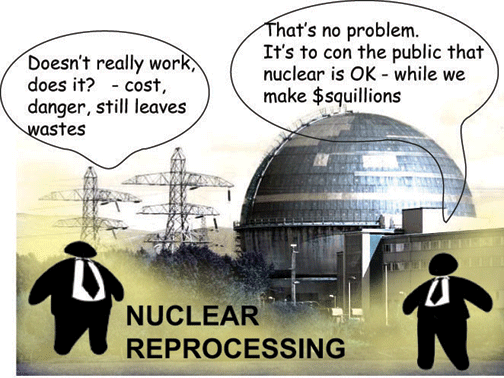
Beyond Fukushima Japan faces deeper nuclear concerns, Vancouver Sun, By RISA MAEDA, Reuters February 24, 2012 TOKYO – On a hillside in northern Japan, wind turbines slice through the cold air, mocking efforts at a nearby industrial complex to shore up the future of the demoralised nuclear power industry.
The wind-power farm at Rokkasho has sprung up close to Japan’s first nuclear reprocessing plant, a Lego-like complex of windowless buildings and steel towers, which was supposed to have started up 15 years ago but is only now nearing completion.
Dogged by persistent technical problems, it is designed to recycle spent nuclear fuel and partly address a glaring weakness in Japan’s bid to restore confidence in the industry, shredded last year when a quake and tsunami wrecked the Fukushima Daiichi power station to the south, triggering radioactive leaks and mass evacuations.
But the Rokkasho project is too little, too late, according to critics who say Japan is running so short of nuclear-waste storage that the entire industry risks shutdown within the next two decades unless a solution is found.
“You don’t build a house without a toilet,” said Jitsuro Terashima, president of the Japan Research Institute think tank and member of an expert panel advising the national government on energy policy after the Fukushima disaster….
Long-term storage of highly radioactive waste is a problem common to all nuclear-powered nations, including the United States, but experts say Japan’s unstable geology and densely populated terrain mean that its challenges are far bigger. Continue reading
55,000 Osaka residents want plebiscite on nuclear power

 Hashimoto’s opposition a big hurdle in Osaka nuclear plebiscite drive, Japan Times, By ERIC JOHNSTON Staff writer, 24 Feb 12, OSAKA — Efforts by a citizens’ group to hold a plebiscite in Osaka on the future of nuclear power hit a major stumbling block when Mayor Toru Hashimoto formally announced his opposition to the plan this week.
Earlier this month, the group pushing for a plebiscite to allow residents to vote on whether to abolish local atomic power plants submitted a petition with the signatures of more than 55,000 Osaka residents eligible to vote. The total is more than the number required to force the municipal assembly to vote on whether to hold the referendum. Continue reading
Asia and Pacific powering ahead with decentralised renewable eneergy
The Asian Development Bank (ADB), United Nations Economic and Social Commission for Asia and the Pacific (ESCAP) and the United Nations Environment Program (UNEP) released the report “Green Growth, Resources, and Resilience” this week.
 On the road to green economies, Malaya Business Insights, 24 Feb12, Net metering is empowering electric consumers in the Philippines. The scheme is embodied in the Philippines’ Renewable Energy Act of 2008 – considered to be the most comprehensive renewable energy law in Southeast Asia.
It allows electric consumers to sell power to the grid at an approved feed-in tariff and buy power as necessary at the normal retail tariff. The feed-in tariff will provide a guaranteed fixed price for at least 12 years for electricity produced from emerging renewable resources: wind, solar power, ocean, run-of-river hydropower, and biomass.
With net metering, the consumer generates electricity at the point of use, and is able to supply excess electricity generated into the grid, either earning revenue or reducing net payable consumption.
Net metering provides a regulatory basis for distributed and decentralized energy systems and at the same time provides a powerful incentive for end-use efficiency improvements. Net metering can be combined with feed-in-tariffs to promote renewable energy generation in decentralized applications. Continue reading
73,000 square metres of concrete to cover Fukushima seabed radiation
 Tepco to cement Fukushima seabed to stem
  radiation Times Live, Sapa-AFP | 22 February, 2012 The operator of Japan’s tsunami-crippled nuclear plant is to cover a large swathe of seabed near the battered reactors with cement in a bid to halt the spread of radiation, the company said Wednesday.
A clay-cement compound will be laid over 73,000 square metres (785,000 square feet) of the floor of the Pacific in front of the Fukushima Daiichi plant on the nation’s northeast coast, said Tokyo Electric Power Co. (TEPCO).
The area is equivalent to around 10 football pitches. “This is meant to prevent further contamination of the ocean… as sample tests have shown a relatively high concentration of radioactive substances in the sea soil in the bay,” a company spokeswoman said….
Contaminated water from the plant leaked into the sea and radioactive particles concentrated on the seabed. Scientists fear ocean currents could pollute areas further afield.
The cover will be 60 centimetres (24 inches) thick, with 10 centimetres expected to be eaten away by seawater every 50 years, the TEPCO official said. http://www.timeslive.co.za/world/2012/02/22/tepco-to-cement-fukushima-seabed-to-stem-radiation
Questions on Australian company Lynas’ radioactive wastes plan in Malaysia
 The Lynas Advanced Material project will produce 20,000 tones of radioactive waste, which is 10 times more than the Asian Rare Earth factory in Bukit Merah.
1. Why didn’t Lynas set-up the rare earth plant near its source of extraction in Western Australia as it would have saved a huge amount of money in shipping costs?
2. Why didn’t Lynas obtain an approval from the authorities in Western Australia to set-up the plant?
3. Could the authorities in Western Australia be concerned about the possible radiation leaks, health hazards, birth defects, lead poisoning and other complications?
4. Shouldn’t this in itself raise a red flag with the Malaysian authorities?
 Gov’t fails to learn from Bkt Merah tragedy http://www.freemalaysiatoday.com/2012/02/22/govt-fails-to-learn-from-bkt-merah-tragedy/ Free Malaysia Today February 22, 2012 Is the RM700 million in Lynas investment more important to the government than the lives of its citizens? By Charles Santiago Severe birth defects, eight leukemia cases over five years in a community of 11,000, tears and anguish of the poor people from a largely shoe-making community – these are not news headlines. Neither is it the plot of a movie.
These are the consequences of carelessly allowing the Asian Rare Earth factory to be built in Bukit Merah, Perak in 1982. When Mitsubishi Chemical started operating its rare earth factory, the villagers complained of choking sensation, pungent smell, coughs and colds. The community also saw a sharp rise in the cases of infant deaths, congenital disease, leukemia and lead poisoning. While US$100 million is estimated to be the clean-up cost of the factory and dump site, the largest in the rare earth industry, it has not wiped out the memories and heartache of the villagers who lost their children and loved ones.
But 30 years later, the government has again allowed a rare earth factory to be set-up by Lynas Corporation Ltd in Gebeng, Kuantan. This means the government has waved the green flag with full knowledge of the possible consequences and deadly effects. Continue reading
Two big hurdles to USA selling nuclear reactors to India

 US control regime a hurdle in N-deal, Deccan Herald, Kalyan Ray New Delhi, Feb 22, 2012, US export control regime has become a major stumbling block for concluding commercial nuclear agreements under the four-year-old Indo-US civil nuclear agreement signed in 2008 for peaceful uses of nuclear power.
US nuclear suppliers on Wednesday identified their own country’s control regime as the spoil sport for entering into agreements with Indian companies. The most immediate concern for the two US nuclear majors – GE and Westinghouse – is a specific provision in the US export control rules under which they have to  obtain clearance from the US government not only for supplying reactors to NPCIL but also for other Indian companies involved in constructing a nuclear power plant. “The 810 licence in the US export control regime is the most immediate issue,” Aris S Candris, president and chief executive officer of Westinghouse told Deccan Herald. on the sidelines of an international nuclear symposium here.
At the symposium organised by the World Nuclear Association, both Westinghouse and GE flagged 810 licence as the most immediate stumbling block to kick-start nuclear commerce between the two countries, though both admitted that stiff Indian nuclear liability regime posed another big hurdle. India currently plans to purchase two AP-1000 light water reactors from Westinghouse to install in Chhaya Mithi Virdi in Gujarat and two 1000 MW reactors from GE for Kovvada in Andhra Pradesh. However, land acquisition process has not started yet.
Candris said Westinghouse obtained the 810 approval for the Indian operator, Nuclear Power Corporation of India and regulator, Atomic Energy Regulatory Board. But it needed similar clearance for other nuclear industry players like Larsen and Toubro as well as other companies who will be engaged in constructing nuclear power plant….. http://www.deccanherald.com/content/229404/us-control-regime-hurdle-n.html
Report on a tour of Fukushima
Into Fukushima’s no-man’s land Calgary Herald, Agence France-Presse February 21, 2012 FUKUSHIMA DAIICHI – Every two minutes on the bus ride through the ghost towns surrounding Japan’s Fukushima Daiichi nuclear plant, a company guide in a white protective suit holds up a display showing the radiation level. And it is rising. Continue reading
Plight, and flight, of Fukushima’s farming communities
anti-nuclear activists and parents who are continuing to lobby for better protection standards for children in Fukushima insist they will not be satisfied until the government takes steps to evacuate the entire younger generation to fully safe areas.
More than 100,000 people, mostly younger people, have left Fukushima to escape radiation contamination. ….The mass migration is bound to affect agriculture production
Trust Deficit – Worst Fallout of Fukushima, By Suvendrini Kakuchi TOKYO, Feb 22, 2012 (IPS) “……..The past few months have seen the government scrambling to regain public trust with food grown in Fukushima and the neighbouring areas by scraping away contaminated top soil from local farms. Continue reading
India’s peaceful, fasting, anti nuclear protestors face armed police
 Around 500 police personnel were deployed near the road leading to
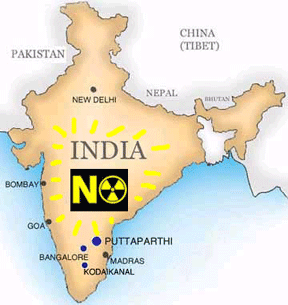 the project site on Monday and commandos have been positioned at the main gate of the KKNPP premises with automatic weapons.
Anti-nuclear protesters embark on 72-hour fast, THE HINDU, 22 Feb 2012 P. SUDHAKAR Even as a two-member International Atomic Energy Agency (IAEA) team is camping at the Kundakulam Nuclear Power Project site for a routine annual review of reactors that fall under IAEA monitoring, anti-nuke protesters have announced a 72-hour-long fast in protest against the State Experts’ Panel convener S. Iniyan’s assertions that the panel members would not meet the protesting villagers.
“The 72-hour long struggle will commence from Monday midnight as Maha Sivaratri falls on this day. Continue reading
Exposure of Fukushima residents to radiation
Fukushima residents exposed to up to 23 millisieverts of radiation Mainichi Daily News, 22 Feb 12, FUKUSHIMA (Kyodo) — The Fukushima Prefecture government said Monday that the residents of three municipalities located near the crippled Fukushima Daiichi nuclear power plant are estimated to have been exposed to up to 23 millisieverts of radiation in the four months after the accident triggered by the March 11 earthquake and tsunami.
“As annual radiation exposure of up to 100 millisieverts poses no specific cancer risks, the estimated radiation is unlikely to cause any adverse health effects,” Fukushima Medical University Vice President Shunichi Yamashita told a press conference. “It is important to reduce future radiation exposure as much as possible.”
While the allowable radiation exposure limit is ordinarily set at 1 millisievert per year, the International Commission on Radiological Protection has recommended an emergency limit of 20 to 100 millisieverts……. “The high-level radioactive contamination indicates that humans should not be allowed to live near the car park,” said Kobe University Professor Tomoya Yamauchi, who conducted a radiation test on the soil.
The crisis at the Fukushima Daiichi plant has resulted in heavy concentrations of radioactive substances at various locations in Minamisoma. The civic group said its discovery indicates that a fact-finding survey is urgently required throughout the city. http://mdn.mainichi.jp/mdnnews/news/20120220p2g00m0dm146000c.html
A dangerous hoax to make money from a false nuclear rumour

 South Korea Police Arrest 6 for Spreading N. Korea Nuclear Accident Rumors Bloomberg, By Saeromi Shin and Sangwon Yoon – Feb 20, 2012 South Korean police arrested six people for spreading false rumors about a North Korean nuclear reactor explosion on Jan. 6 to manipulate the stock market.
The six, including two office workers and a university student, conspired to circulate rumors through instant-messaging that a light-water reactor exploded in North Korea and radiation had leaked, the National Police Agency said in a statement posted on its website today. They made 61 million won ($54,314) in profits from spreading rumors to move financial markets, according to the police. … http://www.bloomberg.com/news/2012-02-21/six-arrested-in-s-korea-over-nuclear-rumors.html
Continuing radioactive leakage to the ocean from Fukushima nuclear plant
“We’re not over the hump” yet in terms of radioactive contamination of the ocean because of continued leakage from the plant,
Radiation from tsunami disaster detected 400 miles off Japan’s coast, but levels below harmful Washinmgton Post, By Associated Press, February 21 SALT LAKE CITY — Radioactive contamination from the Fukushima power plant disaster has been detected as far as almost 400 miles off Japan in the Pacific Ocean, with water showing readings of up to 1,000 times more than prior levels, scientists reported Tuesday…. Continue reading
South Korea’s nuclear program falters, as public opposition increases
the reactor has had 51 malfunctions since it went online, “due to flaws in machinery and components, including radiation leaks, coolant leaks and reactor shutdowns,”
South Korea to boost nuclear power? SEOUL, Feb. 20 (UPI) — South Korea’s plans to boost nuclear power face increasing resistance from civic and environmental groups, post Fukushima, the Japanese reactor site hit by an earthquake and tsunami last year… Continue reading
1 This Month
23-25 October – on Zoom – World BEYOND War’s annual global conferenc


Shut down the radiation-damaged Heysham nuclear reactors now
To see nuclear-related stories in greater depth and intensity – go to https://nuclearinformation.wordpress.com

Say No to NASA’s Reckless Nuclear Reactor on the Moon
Say No to NASA’s Reckless Nuclear Reactor on the Moon

-
Archives
- October 2026 (219)
- September 2026 (339)
- August 2026 (330)
- July 2026 (355)
- June 2026 (287)
- May 2026 (306)
- April 2026 (356)
- March 2026 (251)
- February 2026 (267)
- January 2026 (308)
- December 2025 (358)
- November 2025 (359)
-
Categories
- 1
- 1 NUCLEAR ISSUES
- business and costs
- climate change
- culture and arts
- ENERGY
- environment
- health
- history
- indigenous issues
- Legal
- marketing of nuclear
- media
- opposition to nuclear
- PERSONAL STORIES
- politics
- politics international
- Religion and ethics
- safety
- secrets,lies and civil liberties
- spinbuster
- technology
- Uranium
- wastes
- weapons and war
- Women
- 2 WORLD
- ACTION
- AFRICA
- Atrocities
- AUSTRALIA
- Christina's notes
- Christina's themes
- culture and arts
- Events
- Fuk 2022
- Fuk 2023
- Fukushima 2017
- Fukushima 2018
- fukushima 2019
- Fukushima 2020
- Fukushima 2021
- general
- global warming
- Humour (God we need it)
- Nuclear
- RARE EARTHS
- Reference
- resources – print
- Resources -audiovicual
- Weekly Newsletter
- World
- World Nuclear
- YouTube
-
RSS
Entries RSS
Comments RSS

