China restricting rare earths production for environmental reasons
China defends rare earths limits The Age, JOE McDONALD March 13, 2012 China defended curbs on production of rare earths used in mobile phones and other high-tech products as an environmental measure Tuesday… Beijing needs to limit environmental damage and conserve scarce resources, said a foreign ministry spokesman, Liu Weimin.
“We think the policy is in line with WTO rules,” Liu said at a regular briefing…… Rare earths are 17 elements including cerium, dysprosium and lanthanum that are used in manufacturing flat-screen TVs, batteries for electric cars and wind turbines. They also are used
in some high-tech weapons…. http://news.theage.com.au/breaking-news-technology/china-defends-rare-earths-limits-20120313-1uygw.html
Japanese do not trust the government about Fukushima radiation
 83% of Fukushima residents and 73% countrywide felt ‘greatly’ or ‘somewhat’ worried about radioactive contamination. More importantly, 70% of people in the three disaster hit prefectures , and 71% people countrywide , felt that government was “hiding” information.
This background of mistrust and deception, coming on top of enormous suffering, haunts the island nation, and especially the 350,000 people, who are living in camps unable to go back home to Fukushima.
 Debris, radiation fear, mistrust still piling up Times of India, Subodh Varma, TNN | Mar 12, It is one year since the Great Eastern Japan Earthquake generated a tsunami that ripped apart the north-eastern sea-coast of Japan leaving over 20,000 people dead and the Fukushima nuclear power plant damaged. The triple disaster is estimated to have caused losses worth $235 billion according to World Bank.
Pictures circulated worldwide by visiting journalists show spectacular scenes of the massive clean up operation launched by the government of Japan. But the reality is numbingly grim. Goshi Honoso , Japan’s environment minister speaking at a routine press conference on February 21, urged local governments to help in cleaning up the debris left behind in Iwate, Miyagi and Fukushima prefectures, the three areas which bore the brunt of the tsunami, reports Kyodo news agency.
Then, he revealed jaw dropping numbers: an estimated 22.53 million tonnes of debris was created by the tsunami . Of this, only 1.18 million tonnes, that is, about 5% has been disposed of.The rest of it is simply bulldozed and piled into giant heaps, some as high as 20 meters high. ….
Across Japan thousands protest against nuclear power
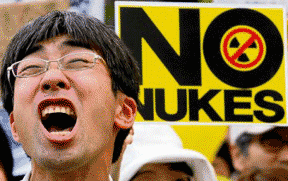 Antinuclear protests held across Japan on anniversary of disaster, Mainichi Daily News, http://mdn.mainichi.jp/mdnnews/news/20120312p2g00m0dm069000c.html 12 March 12, TOKYO (Kyodo) — Antinuclear protesters took to the streets in Tokyo and elsewhere in Japan on Sunday, the one-year anniversary of the massive earthquake and tsunami which triggered the nuclear crisis at the Fukushima Daiichi power plant.
Near the head office of Tokyo Electric Power Co., the operator of the crippled Fukushima complex, demonstrators called for the country to abandon nuclear power generation and restore Fukushima Prefecture, where more than 100,000 residents were forced to relocate.
Some 16,000 people attended an antinuclear gathering in the city of Koriyama in Fukushima and rallied in the city, calling for scrapping all nuclear reactors in Japan. The country has 54 commercial nuclear reactors, which provided a third of Japan’s electric power prior to the Fukushima plant disaster.
In Shizuoka Prefecture in central Japan, about 1,100 people gathered to call for scrapping Chubu Electric Power Co.’s nuclear reactors at its Hamaoka power plant. Those reactors were halted last May after then prime minister Naoto Kan asked the utility to suspend their operation due to concern about a powerful quake in that area of Shizuoka Prefecture.
About 1,200 people including members of antinuclear citizens’ groups marched in the city of Tsuruga, Fukui Prefecture, which hosts the prototype fast-breeder reactor Monju and Kansai Electric Power Co.’s nuclear reactors.
They voiced objection to restarting two of the reactors at Kansai Electric’s Oi power plant in the prefecture after the country’s nuclear safety agency approved results of safety tests conducted on the reactors idled for a regular checkup and left a final decision on whether to restart them to the government of Prime Minister Yoshihiko Noda.
“What we need to do, after witnessing how tragic Tokyo Electric’s Fukushima Daiichi nuclear plant accident is, is to build a society which does not rely on nuclear plants,” said Fujio Yamamoto, who leads a group which organized the protest.
Similar protests were also held in other prefectures which host nuclear power plants or related facilities, including Saga and Aomori.
In the cities of Hiroshima and Nagasaki, atomic bomb survivors took part in antinuclear protests and urged the country to stop relying on nuclear power.
Protest rally for a nuclear free Taiwan

 About 2,000 Taiwanese stage anti-nuclear protest, Mainichi Daily News, TAIPEI, Taiwan (AP) 12 March 12, — About 2,000 people have staged an anti-nuclear protest in Taiwan’s capital as they observed a moment of silence to mourn the victims of the massive earthquake and tsunami that hit Japan one year ago.
The protesters paraded in Taipei on Sunday to renew calls for a nuclear-free island by taking lessons from Japan’s disaster on March 11, 2011, which triggered meltdowns at three nuclear reactors.
They want the government to scrap a plan to operate a newly constructed nuclear power plant — the fourth in densely populated Taiwan.
Scores of aboriginal protesters demanded the removal of 100,000 barrels of nuclear waste stored on their Orchid Island, off southeastern Taiwan. Authorities have failed to find a substitute storage site amid increased awareness of nuclear danger over the past decade. http://mdn.mainichi.jp/mdnnews/international/news/20120311p2g00m0in035000c.html
Safecast helps Japanese people to learn about radiation
Even if nuclear science and the impact of a nuclear meltdown on human health were simple to understand (and they are not), there is still the rather uneasy fact of dealing with a daily foe: invisible, odourless radiation.
Working with Safecast , which crowdsources radiation readings gathered by volunteers, and combines it with data from other outfits to give a clearer picture of what’s going on, Saito wanted people to be able to determine what was safe for them based on fact, not paranoia or nuclear industry propaganda.
 Japan’s radiation: Ignorance isn’t bliss Feeling that officials aren’t doing enough, everyone, farmer to housewife, is learning about radiation contamination. Aljazeera, D. Parvaz 10 Mar 2012 Iitate Village, Japan – Second-generation farmer Muneo Kano has not been able to tend to his cattle or grow crops since the Daiichi nuclear power plant contaminated land, air and sea after being damaged by last year’s earthquake and tsunami.
He had his 11 cows scanned for radiation and sold them to another farm outside the radiation area. Kano’s own seven-hectare farm is 45km from the nuclear site, and the soil has been deemed too contaminated for farming.
And Kano has had to learn all about radiation and soil fast – he now tracks and maps radiation dips and spikes on an iPad, and has a series of maps he consults to check what authorities say about farms in the area.
Soil samples tested in Iitate still contain ten times the acceptable levels of the radioactive isotope Caesium-137 for agricultural soil, and the government has yet to remove the top layers of contaminated soil and wash the streets…. Continue reading
The mental health effects of the nuclear accident at Fukushima
they live in fear of the invisible threat in their midst. …. there is agreement that the Fukushima case is unprecedented.
conflicting information has left them confused and fearful about the future.
“We’re being treated like lab rats. The authorities should have told us as soon as they knew the reactors had melted down and helped us leave immediately
Fukushima residents plagued by health fears of nuclear threat in their midst A year after the power plant’s triple meltdown, conflicting official information leaves families confused and fearful for their future, Justin McCurry in Fukushima guardian.co.uk, 9 March 2012 The noise levels soar inside Fukushima city’s youth centre gymnasium as dozens of nursery school children are let loose on bouncy castles and pits filled with plastic balls.
The handful of teachers and volunteers on duty are in forgiving mood: for the past year, the Fukushima nuclear accident has robbed these children of the simple freedom to run around.
Instead, anxious parents and teachers have confined them to their homes and classrooms, while scientists debate the possible effects of prolonged exposure to low-level radiation on their health. Continue reading
India’s democracy shrinking, as government tries to stifle anti nuclear voices

 India Cancels Visa for Japanese Anti-Nuclear Activist, Voice of America, Kurt Achin | New Delhi, 10 March 12, India’s government has revoked the visa of a Japanese anti-nuclear activist who was scheduled to visit during the one-year anniversary of the Fukushima disaster.
Nuclear energy opponents say the move fits a pattern of seeking to stifle criticism of India’s rapid push toward nuclear power…. Activists like Raina say the visa cancellation reflects a “shrinking democratic space” when it comes to discussing nuclear power in India. Continue reading
Rising radioactivity findings in Japanese fish
 Radiation Findings in Japanese Fish Imports Rising The Fish Site, 9 Mar, 12 SOUTH KOREA – South Korea is more frequently finding radioactive materials in fishery products from Japan but has no immediate plans to ban imports as their levels are far below the
maximum intake limits, the quarantine office said Thursday.
In the first two months of the year, the country has detected traces of radioactive materials, such as cesium, in 32 separate shipments of fisheries products from Japan, according to the Animal, Plant and Fisheries Quarantine and Inspection Agency. ….
http://www.thefishsite.com/fishnews/16655/radiation-findings-in-japanese-fish-imports-rising
Nobel Laureate urges India to abandon harmful nuclear energy
Nobel laureate says nuclear energy can harm Times of India, TNN | Mar 10, 2012, “… a specialist in the field, Hans-Peter Durr, director emeritus at the Max-Planck Institute in Munich, Germany, says nuclear energy poses serious threat to public health and encourages a major financial drain on national economies. Durr won the Nobel peace prize in 1995.
He delivered the TAG-VHS diabetes research speech on ‘nuclear power and energy hunger’ in the city on Friday in the presence of Consul General of the Federal Republic of Germany Stefan Weckbach and an auditorium filled with scientists, doctors, businessmen and retired government officials. … Durr said we would be able to produce adequate energy from soft sources like the sun. “No one in the world knows what they should be doing with the waste generated from the nuclear waste, except for bombs. Even hiding the waste under the sea won’t help as its half life is several hundred years,” he said.
Earlier at a press conference on Thursday, Durr said government of India and Tamil Nadu should look at alternative sources to tap energy instead of opening a nuclear power plant inKudankulam. …. http://timesofindia.indiatimes.com/city/chennai/Nobel-laureate-says-nuclear-energy-can-harm/articleshow/12203134.cms
Evacuation plans last year, as Fukushima crisis occurred
Mr McLean revealed that Australia and other nations began compiling elaborate evacuation plans amid growing concern and uncertainly as the Fukushima plant began to explode.
The former ambassador confirmed Australia had evacuation plans in place but voiced the uncomfortable truth that, in reality, greater Tokyo (population 35 million) would have been almost impossible to evacuate.
Ex-ambassador frustrated by post-tsunami silence BY: RICK WALLACE, TOKYO CORRESPONDENT The Australian March 10, 2012 AUSTRALIA’S former ambassador to Japan has told of his frustrations with the Japanese government for keeping its close partners in the dark about the extent of the damage to the Fukushima nuclear plant at the height of the crisis almost one year ago. Continue reading
North Korea’s unsafe nuclear reactor
 Shortcuts to another nuclear disaster SF Gate, Philip Yun, 9 Mar 12, “……Fukushima cautions us that nuclear technology is inherently dangerous. It also reminds us that accidents are always possible, despite the best of precautions. Right now there is a potential nuclear disaster in Asia that is under the radar: the construction of an unsafe light-water reactor in Yongbyon, North Korea. Continue reading
Cover-up of nuclear collusion between USA and Japan at Fukushima
Prime Minister Naoto Kan has yet to disclose the truth behind his more disturbing decisions: first, the absence of stenographers and voice recordings at his emergency Cabinet meetings;
 The high-level cover-up and lab analysis of cesium-isotope ratios indicate the Japanese nuclear establishment was illegally involved in the reprocessing of weapons-grade uranium at Fukushima No. 1 and probably two other civilian nuclear plants in northern Japan.
The collaboration between Washington and Tokyo in a covert  nuclear-weapons program was a violation of international law
 The World is Powerless Against Fukushima Fallout, Hyphen Submitted by New America Media, March 8, 2012 by Yoichi Shimatsu “……..Public at Risk From Official Silence At the molecular level inside a biological cell, gamma-ray bombardment rewrites the genetic code contained in the chromosomes, scrambling the elegant poetry of life into gibberish.
Since leukemia, cancers and birth defects can be falsely attributed to other disorders, the governments of North America, Europe and Asia along with international agencies can be counted on to remain silent or mount campaigns of misdiagnosis to protect their nuclear power and weapons programs, along with their food and travel industries. Bureaucrats, at heart and out of self-interest, are cowards. Continue reading
Fukushima’s psychological trauma, as well as radiation cancer risk
Radiation is still leaking from the now-closed Fukushima Dai-ichi nuclear plant, though at a slower pace than it did in the weeks after the March 11 earthquake and tsunami. It’s not immediately fatal but could show up as cancer or other illnesses years later.
The uncertainty breeds fear.
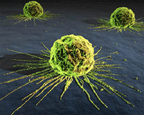 The [cancer] risk is cumulative. The radioactivity in one’s body builds up through various activities, including eating contaminated food every day or staying in a hot spot for an extended period.
Uncertain risks torment Japanese in nuclear zone, THE HINDU, 8 March 12, Yoshiko Ota keeps her windows shut. She never hangs her laundry outdoors. Fearful of birth defects, she warns her daughters — never have children.
This is life with radiation, nearly one year after a tsunami-hit nuclear power plant began spewing it into Ota’s neighbourhood, 60 km away. She’s so worried that she has broken out in hives.
“The government spokesman keeps saying there are no immediate health effects,” the 48-year-old nursery school worker says. “He’s not talking about 10 years or 20 years later. He must think the people of Fukushima are fools. It’s not really OK to live here,” she says. “But we live here.” Continue reading
India’s democracy disappearing under nuclear lobby pressure?
‘The fact that the government is going to the extent of cancelling legitimately granted visas clearly shows that they don’t want people from Japan to come to India and share their experience’ said Karuna Raina of the green group. Kobayashi helped save children from
radiation as part of a network of local mothers……
Scared India denies visa to nuclear activist and Fukushima disaster survivor Mail Online India, By DINESH C SHARMA, 7th March 2012 ‘We are a democracy, we are not like China’. Prime Minister Dr Manmohan Singh professed while making his ‘foreign hand behind nuclear protests’ remark recently.
However, actions of his government show that India is behaving much like China when it comes to muzzling dissent. The latest example of the government’s intolerant behaviour is denying a survivor of Fukushima disaster from visiting nuclear protest hotspots in India on the eve of the first anniversary of the Japanese nuclear accident on March 11. Continue reading
Plenty of future work for Japan’s nuclear professionals – in shutting down the world’s nuclear reactors
concerns over where Japan’s nuclear professionals will end up. We believe, however, that this concern needs to be reframed. There are more than 430 nuclear reactors in the world, and one by one they will all reach the end of their service lives. Regardless of the future paths of nuclear policies around the world, there will be plenty of reactors that need to be shut down.
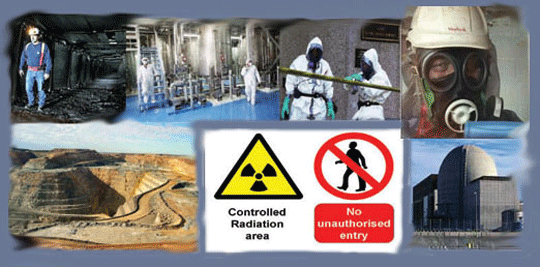
Editorial: Time to say goodbye to nuclear power, Mainichi Daily News, 7 March 12, The illusion of nuclear power safety has been torn out by the root. The Fukushima nuclear disaster that followed the great waves of March 11 last year made sure of that.. Continue reading
1 This Month
23-25 October – on Zoom – World BEYOND War’s annual global conferenc


Shut down the radiation-damaged Heysham nuclear reactors now
To see nuclear-related stories in greater depth and intensity – go to https://nuclearinformation.wordpress.com

Say No to NASA’s Reckless Nuclear Reactor on the Moon
Say No to NASA’s Reckless Nuclear Reactor on the Moon

-
Archives
- October 2026 (219)
- September 2026 (339)
- August 2026 (330)
- July 2026 (355)
- June 2026 (287)
- May 2026 (306)
- April 2026 (356)
- March 2026 (251)
- February 2026 (267)
- January 2026 (308)
- December 2025 (358)
- November 2025 (359)
-
Categories
- 1
- 1 NUCLEAR ISSUES
- business and costs
- climate change
- culture and arts
- ENERGY
- environment
- health
- history
- indigenous issues
- Legal
- marketing of nuclear
- media
- opposition to nuclear
- PERSONAL STORIES
- politics
- politics international
- Religion and ethics
- safety
- secrets,lies and civil liberties
- spinbuster
- technology
- Uranium
- wastes
- weapons and war
- Women
- 2 WORLD
- ACTION
- AFRICA
- Atrocities
- AUSTRALIA
- Christina's notes
- Christina's themes
- culture and arts
- Events
- Fuk 2022
- Fuk 2023
- Fukushima 2017
- Fukushima 2018
- fukushima 2019
- Fukushima 2020
- Fukushima 2021
- general
- global warming
- Humour (God we need it)
- Nuclear
- RARE EARTHS
- Reference
- resources – print
- Resources -audiovicual
- Weekly Newsletter
- World
- World Nuclear
- YouTube
-
RSS
Entries RSS
Comments RSS

