TEPCO: Fukushima workers’ lead shields masked radiation readings
Lead shields masked radiation readings up to 30% August 09, 2012 THE ASAHI SHIMBUN Lead radiation shields forced on workers at the stricken Fukushima No. 1 nuclear power plant to cover their dosimeters masked radiation readings by about 30 percent. Tokyo Electric Power Co., operator of the plant, and Tokyo Energy and Systems Inc., a TEPCO group company, made the admission Aug. 8 after a test. Continue reading
Japan’s handling of nuclear disaster far worse than Soviet Russia’s in Chernobyl
If Japan takes evacuation measures equivalent in scale to that following the Chernobyl disaster, it will need to relocate several millions of people in this densely populated country,
 *Asahi* Japan Physicist: Several millions will need to be evacuated from around Fukushima plant if gov’t used same scale as after Chernobyl — Japan’s handling of disaster “far worse” than Soviet Union http://enenews.com/asahi-japan-physicist-several-millions-will-need-to-be-evacuated-from-around-fukushima-plant-if-govt-used-same-scale-as-after-chernobyl-japans-handling-of-disaster-is-far-worse August 9th, 2012
By ENENews (Subscription Only) Title: INTERVIEW/ Yuko Fujita: Lone
wolf physicist calls for Nagasaki’s awakening
Source: AJW Asahi Shimbun
Author: HIROSHI MATSUBARA
Date: August 10, 2012 Continue reading
TEPCO ‘doctored’ video of Fukushima conference
Yomiuri: Tepco has ‘heavily altered’ video footage — Expert suspects images have been altered more than necessary http://enenews.com/yomiuri-tepco-has-heavily-altered-video-footage-expert-suspects-images-have-been-altered-more-than-necessary August 7th, 2012 By ENENews
Title: TEPCO video heavily altered / Alternation shows utility’s reluctance to make information available
Source: The Yomiuri Shimbun
Date: Aug. 8, 2012
The recently disclosed video of Tokyo Electric Power Co. teleconferences that took place just after the outbreak of the crisis at the Fukushima No. 1 nuclear power plant has been significantly altered, with many images blurred and audio heavily obscured. Continue reading
In Japan, (as in other countries) nuclear lobby cons children

At left is an example of AREVA’s spin to children in Australia
‘Alice in Wonderland’ was used to convince children in Japan nuclear power is safe (PHOTO & VIDEO) http://enenews.com/alice-wonderland-convince-children-japan-nuclear-power-safe-photo-video (VIDEO) August 8th, 2012 By ENENews
Speaker: Charles Ferguson, President, Federation of American Scientists Stories have come out that the government was promoting nuclear power so much that they were using cartoon characters, they were using Alice in Wonderland to convince school children nuclear power is incredibly safe. They weren’t showing the other side of the story adequately enough. It was an unbalanced presentation.
The New York Times’ Norimitsu Onishi on the ‘Alice in Wonderland’ theme: The New York Times’ Norimitsu Onishi on the ‘Alice in Wonderland’ theme:
Source: Ko Sasaki for The New York Times
Near a nuclear power plant facing the Sea of Japan, a series of exhibitions in a large public relations building here extols the virtues of the energy source with some help from “Alice in Wonderland.”
“It’s terrible, just terrible,” the White Rabbit says in the first exhibit. “We’re running out of energy, Alice.”
A Dodo robot figure, swiveling to address Alice and the visitors to the building, declares that there is an “ace” form of energy called nuclear power. It is clean, safe and renewable if you reprocess uranium and plutonium, the Dodo says.
“Wow, you can even do that!” Alice says of nuclear power. “You could say that it’s optimal for resource-poor Japan!”
Nuclear power workers co-operate in deception, in order to keep their jobs

 Nuclear power plants: A hidden world of untruths, unethical behavior August 06, 2012 THE ASAHI SHIMBUN The long and the short of it is this: Nuclear power plants probably would not operate properly in Japan if workers were not willing to sacrifice their health, and possibly their lives.
It emerges that workers at nuclear plants routinely resorted to ingenious ways to conceal the true levels of radiation to which they were exposed–simply to go on earning a living. Continue reading
Tepco managing director says “evacuate the workers from the site” after Reactor No. 3 exploded
WSJ: Tepco managing director says “evacuate the workers from the site” after Reactor No. 3 exploded — “Bulk of footage is available for viewing only by select journalist” http://enenews.com/wsj-tepco-managing-director-evacuate-workers-site-after-reactor-3-exploded-footage-available-viewing-only-select-journalist August 6th, 2012 By ENENews
Title: Tepco Releases Video Footage Taken During Critical Hours After Fukushima Daiichi Accident
Source: Wall Street Journal
Author: Phred Dvorak and Mitsuru Obe
Date: Aug 6, 2012
On Monday, Tokyo Electric Power Co. for the first time released footage taken inside its command centers
[…]
They’re 150 hours recorded over Tepco’s emergency videoconference system — 100 of them without audio — and they largely show tiny, blurred-out faces around conference tables. The bulk of the footage is available for viewing only by select journalists in Tokyo (including JRT). Continue reading
People’s Movement Against Nuclear Energy (PMANE) demand truth on India-Russia deal

Article 13 of IGA clearly states that Russia will not be held liable for any 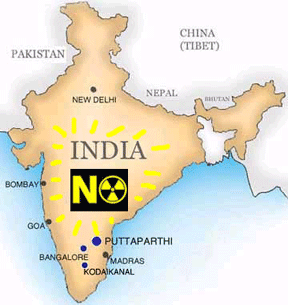 accident at the Kudankulam nuclear power plants.
Kudankulam activists seek answers on nuclear power project, NDTV, Indo-Asian News Service August 06, 2012 Chennai: The People’s Movement Against Nuclear Energy (PMANE) protesting against the Kudankulam Nuclear Power Project (KNPP) on Monday decided to send a postcard to the Russian ambassador to India demanding a copy of the Inter-Governmental Agreement (IGA) signed between India and Russia paving the way for the mega power project.
In a statement issued on Monday, PMANE said, “Since we have not got a copy or any response from the Indian government, we have decided to ask the Russian embassy for a copy of the 2008 IGA on liability. People from southern Tamil Nadu would be sending a terse postcard to the Russian embassy in New Delhi.”
According to PMANE, Article 13 of IGA clearly states that Russia will not be held liable for any accident at the Kudankulam nuclear power plants. “The Indian government does not want to give a copy of the IGA to Indian citizens, or to the people around Kudankulam. We do not know what is so secret about it? What is the Manmohan Singh government
hiding from its own people,” PMANE said.
“If they secretly sign an agreement with Russians and do not want to show it to their own people, who are they being loyal to? Isn’t this a seditious crime,” PMANE questioned……
http://www.ndtv.com/article/south/kudankulam-activists-seek-answers-on-nuclear-power-project-251896
Seoul restarts aged nuclear reactor despite safety concerns
Korea Times, 7 Aug 12 The government decided Monday to restart an aged nuclear reactor that recently underwent months-long scrutiny over its safety, amid looming signs of a power shortage due to a record heat wave.
Operation of the Reactor-1 at Gori Nuclear Power Plant in Busan was
resumed earlier in the day with the reactor expected to reach its full
generation capacity on Friday, according to the Ministry of Knowledge
Economy….. The 578-megawatt reactor, located some 450 kilometers
southeast of Seoul, was manually shut down on March 12 after the Hydro
& Nuclear Power Co. belatedly reported a major safety breach during a
regular maintenance check the previous month, when the reactor, along
with its backup generator, temporarily lost power….. the reactor had
remained shut down amid widespread public concerns over safety of the
reactor whose initial 30-year lifespan ran out but was extended by 10
years in 2008….
http://www.koreatimes.co.kr/www/news/biz/2012/08/123_116740.html
Kudankulam nuclear power plant – Russians want to avoid liability
India’s Kudankulam Nuclear Power Plant – Caveat Emptor Oil Price.com, By John Daly, 07 August 2012 As India’s nationwide power outage last week showed, the country needs new energy resources – fast.
And New Delhi sees nuclear power as a shortcut to alleviating its energy shortages, adding to its six current nuclear power plants (NPPs) containing 20 reactors which generate 4,780 megawatts, an additional seven reactors are expected to generate an additional 5,300 megawatts.
The poster child for this expansion is the $2.5 billion, Kudankulam NPP in Tamil Nadu state, containing six 1,200 megawatt and two 1,000 megawatt reactors.
Despite sustained civil protests during its construction, Nuclear Power Corporation of India Limited (NPCIL) Chairman and Managing Director K.C. Purohit told the media, “Our inspection (of the reactor pressure vessel) is almost complete,” he said from Mumbai. “We will submit our observations and reports to a committee of the Atomic Energy Regulatory Board (AERB) and load the fuel based on its decision,” adding that “the day is not far off” for the nuclear fuel rod assemblies to be loaded into the reactor pressure vessel beginning in mid-August. But this sunny picture has recently been somewhat clouded by the increasing skepticism of Indian Prime Minister Manmohan Singh, who is now querying the Department of Atomic Energy about liability and who will pay if there is a mishap at the Kudankulam NPP. It doesn’t help nuclear proponents that Prime Minister Singh is also India’s Minister for Atomic Energy.
Needless to say, everyone involved with the Kudankulam NPP has been furiously backpedaling from the issue of liability….. All of this loose talk about liability has officials at Atomstroieksport, the Russian Federation’s nuclear power equipment and service export monopoly, increasingly worried. Its not like business is booming – in 2011 the company’s net losses doubled from their 2010 rate to $469 million. So, hardly surprisingly, Russian Atomstroieksport officials, who also built Iran’s controversial Bushehr NPP, have their fingers crossed that the Indian government will not saddle them with liability for the Kudankulam NPP, which could cause yet more oceans of red ink to wash across their books…… http://oilprice.com/Alternative-Energy/Nuclear-Power/Indias-Kudankulam-Nuclear-Power-Plant-Caveat-Emptor.html
Highest Yet: 300 times over cesium limit in wild mushroom
Highest Yet: 300 times over cesium limit in wild mushroom — Found far
from Fukushima plant, 140 km away in Tochigi Prefecture
http://enenews.com/highest-yet-310-times-safety-limit-in-wild-mushroom-found-outside-fukushima-in-tochigi-prefecture August 7th, 2012
August 6, 2012 report in the Nikkei Shinbun translated by EXSKF:
Highest level of cesium detected in wild mushroom
Tochigi Prefecture announced on August 6 that 31,000 Bq/kg of
radioactive cesium was detected in wild “Lactarius volemus” (tawny
milkcap mushroom) harvested in Nikko City, far exceeding the national
safety standard (100 Bq/kg).
[…]
According to the Ministry of Health and Welfare, it is the highest
level exceeding the amount detected in “Lactarius volemus” harvested
in Tanakura-machi in Fukushima Prefecture in September last year,
which measured 28,000 Bq/kg. The Tochigi prefectural government says,
“We believe the cesium absorption was largely from the soil, but
radioactive materials from the surrounding trees may also have
affected it.”
Bloomberg: Tepco considered shooting firearms at No. 3 reactor building
Bloomberg: Tepco considered shooting firearms at No. 3 reactor building
August 7th, 2012 By ENENews Title: Tepco Weighed Using Firearms to Avoid Fukushima Explosion
Source: Bloomberg
Author: By Tsuyoshi Inajima and Yuji Okada
Date: Aug 7, 2012
As the first hydrogen explosion rocked the Fukushima Dai-Ichi nuclear plant, Tokyo Electric Power Co. (9501) officials scrambled to prevent a second blast, at one point weighing the use of firearms to shoot a hole in the reactor building to release the pressure.
[…]
Officials were discussing methods to release hydrogen gas building up inside the facility housing the No. 3 reactor after the first explosion rocked the No. 1 unit on March 12, 2011. Videos show officials considering the use of firearms and a helicopter to drop an object into the reactor housing to make a hole, with those who proposed the actions at one point suggesting they may sound “wild” or “absurd.”
[…]
Some in the U.S. government were coming up with similar plans:
« WSJ: Tepco managing director says “evacuate the workers from the site” after Reactor No. 3 exploded — “Bulk of footage is available for viewing only by select journalist” Radioactive cesium reported in Kellogg’s cereal from Japan — Almost 20 becquerels per kilogram »
Tepco Tapes: Fukushima chief calls out ‘mayday, mayday’ when Reactor No. 3 exploded http://enenews.com/tepco-tapes-fukushima-chief-calls-out-mayday-mayday-when-reactor-no-3-exploded-hq-started-to-respond-as-if-he-said-he-was-going-out-to-lunch-video — HQ started to respond as if he said he was going out to lunch (VIDEO)
Published: August 6th, 2012 at 10:53 am ET
By ENENews Video of when Reactor 3 exploded posted on Nikkei.com with summary translation by EXSKF:
It was more like Plant Manager Yoshida was calling “mayday, mayday” when Reactor 3 blew up. The people at TEPCO HQ didn’t seem to comprehend what Yoshida was saying for several seconds, and started to respond as if Yoshida had just said he was going out to lunch.
They started to say “hai”, “hai” – OK, yes -, then “Uh… so it’s the same as Reactor 1? OK it’s an emergency. I will issue emergency communication then…”
[…]
Wikipedia: Mayday is an emergency procedure word used internationally as a distress signal in voice procedure radio communications. […] It is used to signal a life-threatening emergency primarily by mariners and aviators, but in some countries local organisations such as police forces, firefighters, and transportation organizations also use the term.
Nikkei has 9 videos (Japanese only) posted here
Fukushima – deception in the workplace
Asahi: Disturbing picture emerging as nuclear employees come out of the woodwork — Fukushima workers report groups clocking in with no dosimeters http://enenews.com/asahi-disturbing-picture-emerging-nuclear-employees-woodwork-fukushima-workers-report-groups-clocking-dosimeters August 6th, 2012
By ENENews (Subscription Only) Title: Nuclear power plants: A hidden world of untruths, unethical behavior
Source: Asahi AJW
Author: Compiled from reports by Miki Aoki, Toshio Tada and Tamiyuki Kihara
The long and the short of it is this: Nuclear power plants probably would not operate properly in Japan if workers were not willing to sacrifice their health, and possibly their lives.
It emerges that workers at nuclear plants routinely resorted to ingenious ways to conceal the true levels of radiation to which they were exposed–simply to go on earning a living. Continue reading
When radioactive cesium enters body, 75% lodges in muscle tissue
including heart http://enenews.com/when-radioactive-cesium-enters-body-75-lodges-in-muscle-tissue-including-heart May 6th, 2012 By ENENews
The Worst Yet to Come? Why Nuclear Experts Are Calling Fukushima a
Ticking Time-Bomb
Alternet
Brad Jacobson
May 4, 2012
[…] Nuclear experts noted that other lethal radioactive isotopes
would also be released in such a fire, but that the focus is on
cesium-137 because it easily volatilizes and spreads pervasively, as
it did during the Chernobyl accident and again after the disaster at
Fukushima Daiichi last year.
With a half-life of 30 years, it gives off penetrating radiation as it
decays and can remain dangerous for hundreds of years. Once in the
environment, it mimics potassium as it accumulates in the food chain;
when it enters the human body, about 75 percent lodges in muscle
tissue, including the heart. […]
July 2012: Fukushima Man has 20,000 becquerels of cesium in body — Wife has 10,000 Bq http://enenews.com/july-2012-fukushima-man-20000-becquerels-cesium-body-wife-10000-bq August 5th, 2012
By ENENews August 4, 2012 report in the Asahi Shinbun with summary translation by Fukushima Diary:
A hematological physician in Minamisoma general hospital (23km from Fukushima plant) wrote on his blog that he measured 20,000 Bq/body from a man in 70s living in Fukushima by WBC (Whole body counter) though it was already July 2012. This is the total of Cs-134 and Cs-137.
He measured 10,000 Bq/body from the wife as well. It’s about 300 Bq/Kg.
1 This Month
23-25 October – on Zoom – World BEYOND War’s annual global conferenc


Shut down the radiation-damaged Heysham nuclear reactors now
To see nuclear-related stories in greater depth and intensity – go to https://nuclearinformation.wordpress.com

Say No to NASA’s Reckless Nuclear Reactor on the Moon
Say No to NASA’s Reckless Nuclear Reactor on the Moon

Please sign the petition here: https://www.change.org/p/stop-japan-s…
-
Archives
- October 2026 (190)
- September 2026 (339)
- August 2026 (330)
- July 2026 (355)
- June 2026 (287)
- May 2026 (306)
- April 2026 (356)
- March 2026 (251)
- February 2026 (267)
- January 2026 (308)
- December 2025 (358)
- November 2025 (359)
-
Categories
- 1
- 1 NUCLEAR ISSUES
- business and costs
- climate change
- culture and arts
- ENERGY
- environment
- health
- history
- indigenous issues
- Legal
- marketing of nuclear
- media
- opposition to nuclear
- PERSONAL STORIES
- politics
- politics international
- Religion and ethics
- safety
- secrets,lies and civil liberties
- spinbuster
- technology
- Uranium
- wastes
- weapons and war
- Women
- 2 WORLD
- ACTION
- AFRICA
- Atrocities
- AUSTRALIA
- Christina's notes
- Christina's themes
- culture and arts
- Events
- Fuk 2022
- Fuk 2023
- Fukushima 2017
- Fukushima 2018
- fukushima 2019
- Fukushima 2020
- Fukushima 2021
- general
- global warming
- Humour (God we need it)
- Nuclear
- RARE EARTHS
- Reference
- resources – print
- Resources -audiovicual
- Weekly Newsletter
- World
- World Nuclear
- YouTube
-
RSS
Entries RSS
Comments RSS

