Nuclear and fossil fuel lobbies wage expensive war against renewable energy
 Renewable Energy Under Siege In The USA http://www.energymatters.com.au/index.php?main_page=news_article&article_id=3326 by Energy Matters, 7 Aug 12, Renewable energy faces opposition from cashed-up fossil fuel supporters in Australia; but it’s nothing compared to what is going on in the USA at the moment. While solar energy, wind power and other clean energy sources have always hit opposition in the USA, the smearing has hit new levels as the nation prepares to vote and crucial renewable energy support mechanisms are under review.

The Sierra Club has released a report revealing how the fossil fuel industry is using tactics such as financial contributions to political campaigns, fake think tanks and faux intellectuals to attack renewable energy in order to alter public opinion and the views of lawmakers. ”From California to Pennsylvania, clean energy jobs are under attack by fossil fuel interest groups – yet many in Congress are sitting on their hands while tens of thousands of American jobs hang in the balance,” said Michael Brune, executive director of the Sierra Club.
The Sierra Club’s report claims the oil and gas industry spent more than $146 million on lobbying alone in 2011 and organizations such as the Manhattan Institute and the Heartland Institute that defend oil subsidies while attacking renewable energy have received in excess of $600,000 each since 1998 from the oil company Exxon. The report states the oil and gas industry contributed to 88 percent of all members of the U.S. House of Representatives and 89% of Senators in the 2010 election cycle.
Quoting data from Open Secrets; ConocoPhillips spent $20.5 million on lobbying last year and Royal Dutch Shell, $14.79 million. Add to those figures spending by ExxonMobil, Chevron, the American Petroleum Institute, and Koch Industries and the grand total comes to more than $74 million in 2011.
The report comes at a crucial time as a crucial element of support for wind energy – the Production Tax Credit (PTC) – may be lost at the end of this year. The PTC helps support the more than 75,000 jobs in the wind industry and many as half those jobs could be lost if it is not renewed.
The report, titled “Clean Energy Under Siege – Following the Money Trail Behind the Attack on Renewable Energy”, can be viewed in full here (PDF).
Space Travel – ionising radiation would kill you
 How a long mission to Mars could kill you NBC News, By Eric Niiler 7/18/2011 We’ve already “done” the moon, but Mars still beckons like some interplanetary Brigadoon ; visible through the eyes of clever little rovers and orbiters, but just beyond the reach of human footsteps…..
Radiation The combined effects of background cosmic rays from extragalactic sources and extreme radiation events from the sun make space travel too hazardous for an estimated six months there and six months return. ”The estimate now is you would exceed acceptable levels of fatal cancer,” said Francis Cucinotta, chief scientist for NASA’s space radiation program at the Johnson Space Center in Houston. “That’s just cancer. We also worry about effects of radiation on the heart and the central nervous system.”
Cucinotta says these estimates do take into account protective shielding around a crew vehicle, probably some form of polyethylene plastic. Lead shields actually create secondary radiation when struck by cosmic rays, while water, perhaps the best form of protection, would have to be several meters thick to get enough protection. (“Houston calling Water Balloon 1, do you copy?”)
Lead and water, in any case, are very heavy for the quantities that would be required, making them an expensive shielding to launch….. studies show that radiation can damage the vitamins in food supplies, and the loss of even one vitamin in the food chain could cause serious health effects over a long trip. Little is known about the long-term effects of radiation on food supplies, since International Space Station (ISS) crews have been partially sheltered by Earth’s magnetosphere.
It’s expected that the crew will have to grow its own food in some kind of greenhouse,… http://www.msnbc.msn.com/id/43796117/ns/technology_and_science-science/t/how-long-mission-mars-could-kill-you/?__utma=14933801.1192036095.1344035709.1344126652.1344387760.3&__utmb=14933801.1.10.1344387760&__utmc=14933801&__utmx=-&__utmz=14933801.1344387760.3.3.utmcsr=google|utmccn=(organic)|utmcmd=organic|utmctr=(not%20provided)&__utmv=14933801.|8=Earned%20By=msnbc%7Ctechnology%20%26%20science%7Cscience%7Ccosmic%20log=1^12=Landing%20Content=Original=1^1
Nuclear power workers co-operate in deception, in order to keep their jobs

 Nuclear power plants: A hidden world of untruths, unethical behavior August 06, 2012 THE ASAHI SHIMBUN The long and the short of it is this: Nuclear power plants probably would not operate properly in Japan if workers were not willing to sacrifice their health, and possibly their lives.
It emerges that workers at nuclear plants routinely resorted to ingenious ways to conceal the true levels of radiation to which they were exposed–simply to go on earning a living. Continue reading
How Nuclear Regulatory Commissioners undermined nuclear safety
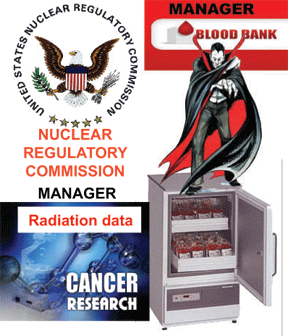 Congressman releases blockbuster report detailing NRC conspiracy in wake of Fukushima http://enenews.com/just-in-congressman-releases-blockbuster-report-detailing-nrc-conspiracy-in-wake-of-fukushima December 10th, 2011
“Regulatory Meltdown” Reveals Efforts to Improve Nuclear Safety Undermined by Four NRC Commissioners New Report Details Conspiracy to Delay, Weaken US Nuclear Safety in Wake of Fukushima, Congressman Edward Markey, Dec. 9, 2011 (Emphasis Added):
WASHINGTON, D.C. – As part of his ongoing investigation into U.S. nuclear safety since the Fukushima meltdowns, today Rep. Edward J. Markey (D-Mass.), Congress’s leading voice for nuclear safety, released a blockbuster new report that details how four Commissioners at the Nuclear Regulatory Commission (NRC) colluded to prevent and then delay the work of the NRC Near-Term Task Force on Fukushima, the entity tasked with making recommendations for improvement to NRC regulations and processes after the Fukushima meltdowns, the worst nuclear disaster in history. The Near-Term Task Force members comprise more than 135 years of collective experience at the NRC, and with full access to expert NRC staff completed a methodical and comprehensive review of NRC’s regulatory system. Continue reading
82 year old anti nuclear nun shows up security danger at nuclear weapons site
 “these anti-Christ nongovernmental terrorists, Christian militias up in Michigan that are getting ready for Armageddon, to kill for Jesus, or the Nazi party or the Taliban, might just as easily have gotten to where we got, with evil intention.”
Security Questions Are Raised by Break-In at a Nuclear Site, NYT, By MATTHEW L. WALD and WILLIAM J. BROAD August 7, 2012 WASHINGTON — An 82-year-old nun and two fellow pacifists who penetrated the defenses of one of the nation’s most important nuclear weapons facilities last week are due in federal court in Knoxville, Tenn., on Thursday to face charges of trespassing and spray-painting antiwar slogans on a building that houses nuclear bomb fuel. But the incident has also put the Department of Energy’s security system on trial.
The security breach, at Oak Ridge in Tennessee, has prompted the Department of Energy to reappraise security measures across its nuclear weapons program and private experts to criticize the agency’s safeguarding of nuclear stockpiles.
The activists, who got past fences and security sensors before dawn on July 28, apparently spent several hours in the Y-12 National Security Complex before they were stopped — by a lone guard, they told friends — as they used a Bible and candles in a Christian peace ritual. In a telephone interview, Sister Megan Gillespie Rice, of Las Vegas, said she was not sure exactly how long they were there. “It was dark; we couldn’t see our watches,” she said. Continue reading
TEPCO’s video report – well censored
Tokyo Professor: Tepco deleted parts of video, people may suspect they have something to hide — NHK: Reporters banned from making copies, only 1/3 has audio (VIDEO) http://enenews.com/tokyo-professor-tepco-deleted-parts-of-video-people-may-suspect-they-have-something-to-hide-nhk-reporters-banned-from-making-copies-only-13-has-audio-video August 6th, 2012 By ENENews
Title: TEPCO releases footage of Fukushima teleconference
Source: NHK World
Date: Aug. 6, 2012 “…. Only one-third of the 150-hours of video contain audio sound.
The media are allowed to watch the videos on personal computers at TEPCO’s head office. The company bans reporters from making copies of the footage.
[…]
The utility finally released the footage in response to requests from the public, but only on a limited basis.
The released part is not sufficient to review the responses to the accident. Calls for full disclosure are expected to increase.
[…]
Information expert Mikio Haruna, visiting professor at Tokyo’s Waseda University Graduate School
[He] is calling for full disclosure of the TEPCO video footage
He says the footage is a national asset that will help determine the cause of the accident at the power plant and prevent a recurrence
He also says the footage is critical in view of people’s right to access to information
Haruna criticizes Tokyo Electric Power Company for deleting sections of the video
He says people may suspect that the utility has something to hide
He says the video should be fully disclosed so that the accident can be thoroughly reviewed
Tepco managing director says “evacuate the workers from the site” after Reactor No. 3 exploded
WSJ: Tepco managing director says “evacuate the workers from the site” after Reactor No. 3 exploded — “Bulk of footage is available for viewing only by select journalist” http://enenews.com/wsj-tepco-managing-director-evacuate-workers-site-after-reactor-3-exploded-footage-available-viewing-only-select-journalist August 6th, 2012 By ENENews
Title: Tepco Releases Video Footage Taken During Critical Hours After Fukushima Daiichi Accident
Source: Wall Street Journal
Author: Phred Dvorak and Mitsuru Obe
Date: Aug 6, 2012
On Monday, Tokyo Electric Power Co. for the first time released footage taken inside its command centers
[…]
They’re 150 hours recorded over Tepco’s emergency videoconference system — 100 of them without audio — and they largely show tiny, blurred-out faces around conference tables. The bulk of the footage is available for viewing only by select journalists in Tokyo (including JRT). Continue reading
Occupy Nukes Challenges Nuclear Power on A-Bomb Anniversary
 The grassroots struggle against the nuclear-industrial complex in the U.S. is beginning to grow again, as evidenced by Occupy Nukes. This fall, the new anti-nuke movement should find its greatest expression since the height of the disarmament movement in the early 1980s, as thousands from across the country are expected to converge on Washington, D.C., to call for a future free of uranium mining, nuclear weapons, nuke plants and nuke waste.
Opposing Views.com By Waging Nonviolence, August 07, 2012 Occupy Nukes demonstrations were held in towns and cities across the United States on Monday, marking the anniversary of the atomic bombing of Hiroshima on August 6, 1945. Approximately 140,000 civilians were killed by the bomb, code-named Little Boy, while hundreds of thousands died later of cancer, and thousands more inherited birth defects. Nothing before or since has approached the instantaneous and horrific carnage reaped by Little Boy except, perhaps, Fat Man, dropped on Nagasaki three days later.
In a joint declaration, those of us taking part in the nationwide protests said, “Nuclear weapons allow us to gauge the full extent of brutality that the 1 percent — which rules through exploitation, coercion and violence — is capable of committing.” August 6 was a day of remembrance, but also one in which the 99 percent took action “to ensure such destruction [as took place in Hiroshima and Nagasaki] is never wrought on anyone ever again.”
Bearing a banner that read “¡Ya Basta! (un)Occupy The Bomb!” at least six people in New Mexico were arrested as a crowd of roughly 50 demonstrators, periodically throughout the day, blocked an entrance to Los Alamos National Laboratory (LANL). Occupying what was once Pueblo land and the home to 2,000 archeological sites, LANL is the birthplace of the atomic bomb. To this day, secretive weapons experiments are carried out at the lab.
New Mexico local Michelle Victoria, who helped organize the nonviolent direct action at Los Alamos, said the roadblock illustrated community and indigenous opposition to the weapons lab. Last summer, a wildfire swept through Los Alamos, narrowly missing 30,000 55 gallon drums of radioactive waste stored above ground at the site. “There’s a lot radioactivity around here,” said Victoria. “What they used to do at the lab back in the ’50s was just wheel barrels of radioactive material and dump them off the canyon.”
Victoria raised concerns that radioactive ash from last summer’s fire could have spread into the Rio Grande River, which provides drinking water to 90 percent of New Mexico’s municipalities. “We know and believe this is wrong and we are willing to put our bodies on the line for it to stop.”
Meanwhile, 20 miles West of Seattle, members of the Ground Zero Center for Nonviolent Direct Actionsymbolically shut down U.S. Naval base Kitsap-Bangor in the Puget Sound. A fleet of eight nuclear powered submarines carrying Trident D-5 ballistic missiles are docked at Bangor. Each sub can carry up to eight warheads loaded with between 100 kilotons or 475 kilotons of nuclear explosives each. By comparison, the bomb dropped on Hiroshima was 12 kt. “Those submarines could wipe out an entire continent,” said Leonard Eiger with the Ground Zero Center. “They don’t discriminate between civilian and military targets, a violation of international law.”……
On Sunday afternoon, heavily armed police kept a stern eye on peace activists and Buddhist monks making sure those gathered in front of the facility to pray away the demons inside wouldn’t try to hop the fence. In an email message, Rice told Occupy Nukes organizers to “continue the transformation each of you represents.”
The day of action comes amid President Barack Obama’s efforts to expand the U.S.’s nuclear arsenal. According to a White House fact sheet, Obama is pushing for investments of $80 billion “to sustain and modernize the nuclear weapons complex,” and $100 billion to revamp “existing capabilities and modernize some strategic [delivery] systems” by 2020. This nuclear spending spree includes $4 to 12 billion for anew plutonium processing complex at Los Alamos.
“Money spent on nukes is irradiating social programs for the 99 percent,” warns Occupy Nukes. We cite a Brookings Institution study which notes that between 1940 and 1998 the U.S. spent more money on nuclear weapons — $5.5 billion — than the “combined total federal spending for education; training, employment, and social services; agriculture; natural resources and the environment; general science, space, and technology; community and regional development, including disaster relief; law enforcement; and energy production and regulation.” That figure reached 7.2 trillion by the end of President George W. Bush’s term in the White House, and we accuse Obama of charting the same costly nuclear course……
The grassroots struggle against the nuclear-industrial complex in the U.S. is beginning to grow again, as evidenced by Occupy Nukes. This fall, the new anti-nuke movement should find its greatest expression since the height of the disarmament movement in the early 1980s, as thousands from across the country are expected to converge on Washington, D.C., to call for a future free of uranium mining, nuclear weapons, nuke plants and nuke waste.
If inspiration is coming from anywhere, though, it’s from Japan, where hundreds of thousands have taken to the streets in recent weeks against the re-ignition of reactors. The Japanese no nukes movement may even be approaching the critical mass needed to move the country off nukes for good. Close to 80 percent of the population favors a phase-out and the former prime minister, who stepped down after his government’s mishandling of the meltdown, is pushing for legislation that would accomplish just that.
Such a move would go a long way toward showing the ability of people power to disarm nuclear power and help point the way not only to a world free from the fear of another Fukushima or Hiroshima, but also a world where human health and safety is the priority above all. http://www.opposingviews.com/i/religion/christianity/occupy-nukes-challenges-nuclear-power-bomb-anniversary
Israel, not Iran, greatest threat to world peace
“The greatest threat to the world is clearly nuclear-armed Israel with its almost daily threats to launch an attack on Iran, inevitably involving the U.S. in a potentially catastrophic Middle East war,”

 Hush Now, Mitt: A Nuclear Iran Is Not the World’s Greatest Threat, The Atlantic, AUG 7 2012, Three-quarters of national security experts polled disagreed with the candidate. Three-quarters of National Journal’s National Security Insiders disagreed with a recent statement by Republican presidential candidate Mitt Romney, who said a nuclear Iran represents the greatest threat to the world.
If Tehran acquires a nuclear weapon, Romney told Israeli newspaper Ha’aretz, it would pose the most serious threat to the world, to the United States and to Israel’s existence.
Not so, said 73 percent of NJ’s pool of national-security experts, even as they acknowledged that a nuclear Iran could have a destabilizing effect on the Middle East and erode international nonproliferation efforts. “It would be an unmitigated negative for U.S. interests,” one Insider said. “But it is not the greatest security threat facing the U.S. or the world at large.” Continue reading
Budget of Nuclear Regulatory Commission – Incredible in the true sense of the word
 Nuclear Agency Can’t Ensure Their Own Budget is Credible http://pogoblog.typepad.com/pogo/2012/08/nuclear-agency-cant-ensure-their-own-budget-is-credible.html By MIA STEINLE
The agency responsible for the nation’s nuclear weapons cannot ensure its own budget is credible, which may result in overspending, according to a federal investigative office.
The National Nuclear Security Administration “does not thoroughly review” the budget estimates it compiles from U.S. nuclear weapon sites before it draws up its annual budget request to Congress, request to Congress, according to the Government Accountability Office (GAO). The eight nuclear weapons sites are managed and operated by private contractors for the government.
Senior agency officials told the GAO that there is an “inherent trust” between the agency and the nuclear sites. Additionally, they said that a lack of “financial and personnel resources” mean a formal review of the budget is unrealistic.
The National Nuclear Security Administration is a semiautonomous agency within the Department of Energy. It is “responsible for the nation’s nuclear weapons, nonproliferation, and naval reactors programs,” according to the GAO. Its proposed budget for fiscal year 2011 is more than $11.5 billion, which is almost half of the entire Department of Energy budget.
Agency officials also told the GAO that they don’t follow a Department of Energy policy that requires a formal review of the budget because it expired in 2003. However, department officials told the GAO the policy still stands.
“By not adhering to these provisions,” the GAO said the agency “is reducing the creditability of its budget proposals.”
The GAO report comes at a time when rising costs of nuclear weapons projects are turning into “a serious liability for the [agency] as it tries to fend off criticism from Congress,” John Fleck reported for the Albuquerque Journal . He cited the proposed nuclear facility at Los Alamos National Laboratory in New Mexico as a point of contention. The GAO noted that the cost of this project has increased sixfold since its inception.
The GAO also cited the rising cost of the Uranium Processing Facility in Tennessee as a concern. Given the agency’s “record of weak management of major projects,” the GAO said improved oversight of the agency is necessary to ensure responsible spending.
Joint Staffs General Calls for Cut in Nuclear Reserve
06 Aug 2012 By Greg McDonald Air Force Chief of Staff Gen. Norton Schwartz has called for the nation’s reserve of nuclear weapons to be reduced, citing its size and expense to maintain.
Schwartz became the first sitting member of the Joint Chiefs of Staff to suggest publiclythat the so-called “active reserve,” or backup supply of U.S. nuclear weapons should be cut back, the Boston Globe reported Monday.
“We have more backup systems in terms of weapons systems than we
actually have deployed,” Schwartz said in an interview with the Globe.
“Some of that is a reasonable hedge [but] there is probably room for
reductions.”
The Globe said Schwartz’s call for cuts in the reserve to be
considered is supported by a report earlier this year from retired
Marine Corps Gen. James Cartwright, whom the Globe said had been in
charge of all U.S. nuclear weapons.
According to the newspaper, the Cartwright report “recommended that
the United States during the next 10 year years reduce its nuclear
force to a total of 900 weapons, half of them on alert and half in
reserve.”… The reserves are a legacy of the Cold War nuclear
standoff between the United States and the former Soviet Union. …
http://www.newsmax.com/Newsfront/Schwartz-nukes-cut-general/2012/08/06/id/447660
People’s Movement Against Nuclear Energy (PMANE) demand truth on India-Russia deal

Article 13 of IGA clearly states that Russia will not be held liable for any 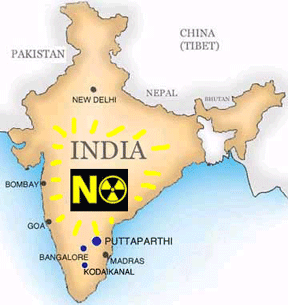 accident at the Kudankulam nuclear power plants.
Kudankulam activists seek answers on nuclear power project, NDTV, Indo-Asian News Service August 06, 2012 Chennai: The People’s Movement Against Nuclear Energy (PMANE) protesting against the Kudankulam Nuclear Power Project (KNPP) on Monday decided to send a postcard to the Russian ambassador to India demanding a copy of the Inter-Governmental Agreement (IGA) signed between India and Russia paving the way for the mega power project.
In a statement issued on Monday, PMANE said, “Since we have not got a copy or any response from the Indian government, we have decided to ask the Russian embassy for a copy of the 2008 IGA on liability. People from southern Tamil Nadu would be sending a terse postcard to the Russian embassy in New Delhi.”
According to PMANE, Article 13 of IGA clearly states that Russia will not be held liable for any accident at the Kudankulam nuclear power plants. “The Indian government does not want to give a copy of the IGA to Indian citizens, or to the people around Kudankulam. We do not know what is so secret about it? What is the Manmohan Singh government
hiding from its own people,” PMANE said.
“If they secretly sign an agreement with Russians and do not want to show it to their own people, who are they being loyal to? Isn’t this a seditious crime,” PMANE questioned……
http://www.ndtv.com/article/south/kudankulam-activists-seek-answers-on-nuclear-power-project-251896
Seoul restarts aged nuclear reactor despite safety concerns
Korea Times, 7 Aug 12 The government decided Monday to restart an aged nuclear reactor that recently underwent months-long scrutiny over its safety, amid looming signs of a power shortage due to a record heat wave.
Operation of the Reactor-1 at Gori Nuclear Power Plant in Busan was
resumed earlier in the day with the reactor expected to reach its full
generation capacity on Friday, according to the Ministry of Knowledge
Economy….. The 578-megawatt reactor, located some 450 kilometers
southeast of Seoul, was manually shut down on March 12 after the Hydro
& Nuclear Power Co. belatedly reported a major safety breach during a
regular maintenance check the previous month, when the reactor, along
with its backup generator, temporarily lost power….. the reactor had
remained shut down amid widespread public concerns over safety of the
reactor whose initial 30-year lifespan ran out but was extended by 10
years in 2008….
http://www.koreatimes.co.kr/www/news/biz/2012/08/123_116740.html
India- Russian deal on nuclear power plant seriously delayed
India’s nuclear fix Deccan Chronicle August 8, 2012 By Inder Malhotra How things change! In 2008 when the Indo-US nuclear deal was signed and sealed — and was followed by the “clean waiver” to this country by the 45-nation Vienna-based Nuclear Suppliers Group (NSG) from all its restrictive guidelines — there were great expectations here of a speedy spurt in the installation of nuclear reactors with foreign collaboration and
investment.
Four years later the picture is far less rosy. Indeed, it is no exaggeration to say that the much-needed expansion of India’s nuclear power industry could be gravely delayed, if not
disrupted……….
…There is little time, therefore, for the Manmohan Singh government to decide on a thorny issue. The Russians insist that KK-3 and KK-4 are also spawned by the 1988 deal, like the
first two plants, and are, therefore, exempt from the liability law….
Uranium price not getting any better
 Uranium Spot Prices Slip Below $50 Uranium Investing News, August 8, 2012, By Melissa Pistilli – The uranium spot price slipped further last week, dropping below the $50 mark for the first time in nearly a year as sellers gave in to lower bids.
This week, TradeTech is reporting a spot price of $49.50 per pound, down 25 cents from the previous week. …. The consulting firm said transaction activity in the spot market remains “exceptionally weak,” with transaction volume at less than 500,000 pounds of U308 over the past two months. Even with ConverDyn’s Metropolis Works conversion facility looking at a possible 15-month shutdown for safety upgrades, “the market is at a standstill.”…
1 This Month





PLEASE OPPOSE HR 8255 AND S.3639 – bills would accelerate satellite deployment, with no environmental review or safeguards – https://ncstd5li.quorum.us/campaign/169331/
To see nuclear-related stories in greater depth and intensity – go to https://nuclearinformation.wordpress.com
-
Archives
- October 2026 (81)
- September 2026 (339)
- August 2026 (330)
- July 2026 (355)
- June 2026 (287)
- May 2026 (306)
- April 2026 (356)
- March 2026 (251)
- February 2026 (267)
- January 2026 (308)
- December 2025 (358)
- November 2025 (359)
-
Categories
- 1
- 1 NUCLEAR ISSUES
- business and costs
- climate change
- culture and arts
- ENERGY
- environment
- health
- history
- indigenous issues
- Legal
- marketing of nuclear
- media
- opposition to nuclear
- PERSONAL STORIES
- politics
- politics international
- Religion and ethics
- safety
- secrets,lies and civil liberties
- spinbuster
- technology
- Uranium
- wastes
- weapons and war
- Women
- 2 WORLD
- ACTION
- AFRICA
- Atrocities
- AUSTRALIA
- Christina's notes
- Christina's themes
- culture and arts
- Events
- Fuk 2022
- Fuk 2023
- Fukushima 2017
- Fukushima 2018
- fukushima 2019
- Fukushima 2020
- Fukushima 2021
- general
- global warming
- Humour (God we need it)
- Nuclear
- RARE EARTHS
- Reference
- resources – print
- Resources -audiovicual
- Weekly Newsletter
- World
- World Nuclear
- YouTube
-
RSS
Entries RSS
Comments RSS

