Greens Party in Japan getting organised for elections
Japan Greens hope to ride anti-nuclear wave to parliament, Business Recorder, August 15, 2012 TAKEHIKO KAMBAYASAHI With anti-nuclear sentiment riding high in Japan, a former citizens’ group is trying to make the shift to a full-fledged political party. Greens Japan in late July said it would field candidates in the next elections on an environmental platform that includes weaning the country off nuclear energy. It hopes to become the first officially recognised national-level green political party. Continue reading
Japanese politicians moving towards nuclear weapons
In April the LDP published proposals for a constitutional amendment, which would eviscerate Article 9, the key to Japan’s peace Constitution. Article 9 famously renounces war and the threat or use of force as a means of settling international disputes…..
Japan playing nuclear roulette, By KEVIN RAFFERTY The Japan Times, 15 Aug 12, HONG KONG — J. Robert Oppenheimer, one of the prominent fathers of the atomic bomb, had read the Bhagavad Gita, and when he saw the first test of the weapon, he quoted the terrifying line from the Hindu scripture: “Now I am become Death, destroyer of worlds.” It is hard to imagine the horror of the dropping of the atomic bomb on Hiroshima 67 years ago. It seared the sky and instantaneously wiped much of the city and tens of thousands of people, and left a trail of misery that continues today, but which should not be forgotten.
Sadly, leading Japanese politicians today seem to have forgotten the lessons of the war and its savage end. Powerful politicians are hard at work trying to scrap Article 9 of the Constitution — which renounces war — and some of them want to go all-out to build a
Japanese nuclear weapon. Continue reading
Former head of Fukushima nuclear plant says plant is not safe
 ‘Fukushima reactors not stable’ – plant ex-boss RT.com. 13 August, 2012, The reactors at crippled Fukushima nuclear power plant are not stable, says its former head. He urged for international expertise to be called in to make the site of one of world’s worst nuclear disasters safe.
“People won’t come back to Fukushima until the plant is stabilized and we still need to find a way to do that,” Masao Yoshida said as cited by The Australian newspaper. “We have to bring people in from around the world. It will require people, technology and wisdom from all corners.”
Yoshida, 57, was speaking on Saturday after a 17-month silence in a video message, in which he described his experience of leading a desperate drive to tame the disabled plant. He and his men, dubbed the Fukushima 50 in Japan, were working to hold down melting down reactors at the facility hit by the 2011 earthquake and tsunami.
He said he had no right to go public with his warning until four investigations into the disaster were concluded. Yoshida, who is currently in hospital suffering cancer of the esophagus, said he and his workers cooperated with the probes, but since their human stories did not enter the official reports, he agreed to an interview.
“It was clear from the beginning that we couldn’t run,” Yoshida said. “Reactors five and six would have also melted down without people staying on site.
“My colleagues went out there again and again. The level of radiation on the ground was terrible, yet they gave everything that they had.”
The former Fukushima manager said he feared for his life three times in the first days of the disaster. Three huge explosions of hydrogen released from water injected into reactors rocked the facility, ripping through the roof and sending debris flying.
“At the time we didn’t know they were hydrogen explosions,” he said. “When that first explosion occurred, I really felt we might die.”…..
Some in Japan hold Yoshida as a hero for refusing orders to stop the injection of seawater into one of the damaged reactors, thus preventing the disaster from becoming even worse. There is also a video shot in the command bunker that TEPCO recently released showing Yoshida suggesting he lead a suicide mission to restore the cooling of the reactors if the situation deteriorated.
Yoshida did not touch on either of those episodes in the interview.
The Fukushima plant is currently in cold shutdown, with no nuclear reactions happening inside the reactors. There are fears that the site could be further damaged by a new earthquake, should one occur. http://www.rt.com/news/fukushima-plant-yoshida-stabilize-505/
Genetic effects of Fukushima radiation
 The devastating physical & genetic effects of Japan’s nuclear disaster are revealed — All mutant butterflies were caught far outside Fukushima evacuation zone http://enenews.com/australian-devastating-physical-genetic-effects-fukushima-daiichi-revealed-all-mutant-butterflies-caught-evacuation-zone
August 14th, 2012 a By ENENew
Title: Mutant butterflies haunt Fukushima
Source: The Australian
Author: Richard Lloyd Parry
Date: August 14, 2012
THEY have bizarre dents in their eyes, their legs are shrunken and they are marked by strange spots. Many of them are infertile and when they do conceive the offspring are even more mutated than the parents. Continue reading
Nuclear phaseout a key election policy for Japan’s ruling party


62.6 percent opposed the use of nuclear energy, giving scores between zero and 4, with 17.8 percent saying they think Japan should idle all nuclear plants immediately.
DPJ vow for next poll: a nuclear phaseout, Japan Times 14 Aug 12, Role for Kan urged to draft pre-election energy goals Kyodo Prime Minister Yoshihiko Noda’s party is arranging to make a nuclear phaseout a key policy pledge in the next general election, sources in the Democratic Party of Japan said.
The DPJ’s plan comes amid widespread opposition to the continued use of nuclear energy. Continue reading
Nuclear power industry lost $46 billion – and that’s its good news
Utilities lose $46 billion as nuclear era nears end, Japan Times, 14 Aug 12, Shareholders at risk amid efforts to break up power monopolies Bloomberg The nuclear power industry has lost a record $46 billion since the earthquake and tsunami disasters led to three meltdowns at the Fukushima No. 1 power plant last year, wiping out seven years of profit.
Then came the bad news. Continue reading
Poisonous legacy of rare earths mining in China
Rare-earth mining in China comes at a heavy cost for local villages Guardian UK Pollution is poisoning the farms and villages of the region that processes the precious minerals , 7 August 2012 From the air it looks like a huge lake, fed by many tributaries, but on the ground it turns out to be a murky expanse of water, in which no fish or algae can survive. The shore is coated with a black crust, so thick you can walk on it. Into this huge, 10 sq km tailings pond nearby factories discharge water loaded with chemicals used to process the 17 most sought after minerals in the world, collectively known as rare earths.
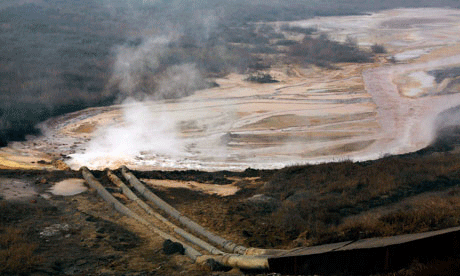
The town of Baotou, in Inner Mongolia, is the largest Chinese source of these strategic elements, essential to advanced technology, from smartphones to GPS receivers, but also to wind farms and, above all, electric cars. The minerals are mined at Bayan Obo, 120km farther north, then brought to Baotou for processing.
The concentration of rare earths in the ore is very low, so they must be separated and purified, using hydro-metallurgical techniques and acid baths. China accounts for 97% of global output of these precious substances, with two-thirds produced in Baotou.
The foul waters of the tailings pond contain all sorts of toxic chemicals, but also radioactive elements such as thorium which, if ingested, cause cancers of the pancreas and lungs, and leukaemia. “Before the factories were built, there were just fields here as far as the eye can see. In the place of this radioactive sludge, there were watermelons, aubergines and tomatoes,” says Li Guirong with a sigh.
It was in 1958 – when he was 10 – that a state-owned concern, the Baotou Iron and Steel company (Baogang), started producing rare-earth minerals. The lake appeared at that time. “To begin with we didn’t notice the pollution it was causing. How could we have known?” As secretary general of the local branch of the Communist party, he is one of the few residents who dares to speak out.
Towards the end of the 1980s, Li explains, crops in nearby villages started to fail: “Plants grew badly. They would flower all right, but sometimes there was no fruit or they were small or smelt awful.” Ten years later the villagers had to accept that vegetables simply would not grow any longer. In the village of Xinguang Sancun – much as in all those near the Baotou factories – farmers let some fields run wild and stopped planting anything but wheat and corn.
A study by the municipal environmental protection agency showed that rare-earth minerals were the source of their problems. The minerals themselves caused pollution, but also the dozens of new factories that had sprung up around the processing facilities and a fossil-fuel power station feeding Baotou’s new industrial fabric. Residents of what was now known as the “rare-earth capital of the world” were inhaling solvent vapour, particularly sulphuric acid, as well as coal dust, clearly visible in the air between houses.
Now the soil and groundwater are saturated with toxic substances. Five years ago Li had to get rid of his sick pigs, the last survivors of a collection of cows, horses, chickens and goats, killed off by the toxins.
The farmers have moved away. Most of the small brick houses in Xinguang Sancun, huddling close to one another, are going to rack and ruin. In just 10 years the population has dropped from 2,000 to 300 people…… http://www.guardian.co.uk/environment/2012/aug/07/china-rare-earth-village-pollution
India ramps up the nuclear weapons race
ndia test-fires nuclear capable Agni-II missile, Hindustan Times, Balasore, Odisha, August 09, 2012 Sharpening its missile teeth, India on Thursday successfully test-fired its medium range nuclear capable Agni-II missile with a strike range of 2000km as part of a user trial by the Army from the Wheeler Island off Odisha coast. …..
http://www.hindustantimes.com/India-news/Odisha/India-successfully-test-fires-Agni-II-missile/Article1-910715.aspx
India to launch nuclear submarine in arms race, The Age, 11 Aug 12. INDIA will soon launch its first home-built nuclear submarine, capable of firing ballistic missiles, as the country escalates an arms race with China and Pakistan.
INS Arihant, planned to be the first of five of its class, would soon be ready to begin sea trials, said Admiral Nirmal Verma, the Indian navy’s chief of staff. When the vessel is operational, India will be able to launch nuclear missiles from the sea, land and air, joining a handful of countries possessing the ”nuclear triad”. …. http://www.theage.com.au/world/india-to-launch-nuclear-submarine-in-arms-race-20120810-23zxh.html#ixzz23Hk1Y1bg
Japan’s secret nuclear weapons program
United States Circumvented Laws To Help Japan Accumulate Tons of Plutonium, DC Bureau By Joseph Trento, April 9th, 2012 “…..The Fukushima I Nuclear Power Plant after the 2011 Tōhoku earthquake and tsunami How Japan ended up in this nuclear nightmare is a subject the National Security News Service has been investigating since 1991.
We learned that Japan had a dual use nuclear program. The public program was to develop and provide unlimited energy for the country. But there was also a secret component, an undeclared nuclear weapons program that would allow Japan to amass enough nuclear material and technology to become a major nuclear [weapons] power on short notice.
That secret effort was hidden in a nuclear power program that by March 11, 2011– the day the earthquake and tsunami overwhelmed the Fukushima Daiichi Nuclear Plant – had amassed 70 metric tons of plutonium. Like its use of civilian nuclear power to hide a secret bomb program, Japan used peaceful space exploration as a cover for developing
sophisticated nuclear weapons delivery systems.
Political leaders in Japan understood that the only way the Japanese people could be convinced to allow nuclear power into their lives was if a long line of governments and industry hid any military application. For that reason, a succession of Japanese governments
colluded on a bomb program disguised as innocent energy and civil space programs. The irony, of course, is that Japan had gone to war in 1941 to secure its energy future only to become the sole nation attacked with nuclear weapons……
http://www.dcbureau.org/201204097128/national-security-news-service/united-states-circumvented-laws-to-help-japan-accumulate-tons-of-plutonium.html
Research on butterflies shows the genetic effects of low level radiation
experimental demonstration of genetic mutations in the germ-line cells that are inherited by the offspring of radiation-exposed parents has been scarce, although the germ-line damage was shown in barn swallows
We address these important issues in connection with the recent Fukushima Dai-ich NPP accident. We use the pale grass blue butterfly Zizeeria maha (Lepidoptera, Lycaenidae) as an indicator species to evaluate the environmental conditions.
We conclude that artificial radionuclides from the Fukushima Nuclear Power Plant caused physiological and genetic damage to this species.
 The biological impacts of the Fukushima nuclear accident on the pale
grass blue butterfly – Nature science journal. 9 Aug 12,Primary source. “……Prompt and reliable evaluation of the biological influences of the artificial radionuclides from the Fukushima Dai-ichi NPP is lacking, and only a few studies have been performed to date 9, 10. In the case of the Chernobyl accident, changes in species composition and phenotypic aberration in animals11, 12, 13, 14, 15, 16, 17 and an increase in the incidence of thyroid and lymph cancers in humans18 have been reported. Continue reading
Radiation effects on birds – Fukushima compared to Chernobyl
University of South Carolina, Prof Tim Mousseau et al, genetic survey of small wildlife, Fukushima. http://www.sciencedirect.com/science/article/pii/S0269749112000255 “……. Abundance of birds was negatively related to radiation in Chernobyl and Fukushima. ► Effects of radiation on abundance differed between Chernobyl and Fukushima and among species. ► For 14 species common to the two areas the effects of radiation on abundance were stronger in Fukushima than in Chernobyl.…..
Low-level radiation in Fukushima Prefecture appears to have had immediate effects on bird populations, and to a greater degree than was expected from a related analysis of Chernobyl, an international team of scientists reported Feb. 8 in Environmental Pollution. Continue reading
Secret Cold War Nuclear Policies – USA and Japan
Declassified U.S. government documents make a mockery of the Three Non-Nuclear Principles. The papers reveal that Japanese government officials ignored evidence that the United States was routinely bringing nuclear weapons into Japanese ports.

 United States Circumvented Laws To Help Japan Accumulate Tons of Plutonium, DC Burea By Joseph Trento, April 9th, 2012 “….. In October 1964, communist China stunned the world by detonating its first nuclear bomb. The world was caught by surprise, but nowhere were emotions as strong as in Japan. Three months later Japanese Prime Minister Eisaku Sato went to Washington for secret talks with President Lyndon Johnson. Sato gave LBJ an extraordinary ultimatum: if the United States did not guarantee Japan’s security against nuclear attack, Japan would develop a nuclear arsenal. The ultimatum forced LBJ to extend the U.S. “nuclear umbrella” over Japan. Ironically, this guarantee later enabled Sato to establish Japan’s Three Non-Nuclear Principles: to never own or produce nuclear weapons or allow them on Japanese territory. The policy won Sato the Nobel Prize for Peace. The Japanese public and the rest of the world never knew that these three principles were never fully enforced, and Sato allowed the secret nuclear weapons program to go on. Continue reading
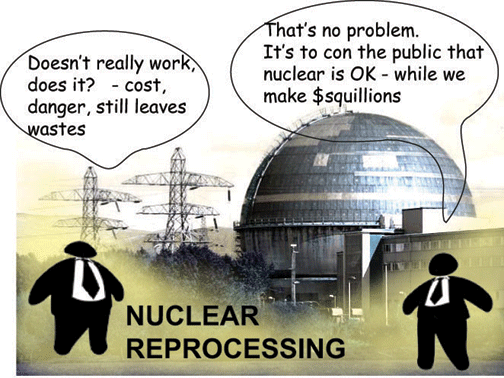
History of deception in Japan’s development of nuclear reprocessing
Japan would have to do what the Americans and Europeans had failed to do – make an experimental breeder program a commercial success.
during the Reagan administration – legislation that dramatically changed U.S. policy. The United States ceded virtually all control of U.S.-origin nuclear materials shipped to Japan.
International corporations and officials sacrificed the safety and security of the public to carry out the deception. Under the guise of a peaceful nuclear power program, they made huge profits.
United States Circumvented Laws To Help Japan Accumulate Tons of Plutonium, DC Bureau By Joseph Trento, April 9th, 2012“……Energy has always been Japan’s Achilles’ heel. Her need for oil in the face of an American embargo triggered Japan’s attack on Pearl Harbor, and the continued shortage was a recurring theme in her defeat in that war. Only one act could take more credit for Japan’s humiliation – the splitting of the atom that gave birth to the nuclear bomb. Now Japan would turn that same atom to its own purposes — to ensure a stable source of energy well into the next century and, equally important, to ensure that the homeland never again suffered the indignity of defeat.
Japan approached the nuclear problem the same way it tackled the electronics and automobile industries. A core group of companies were each given key tasks with long-term profit potential. Then the government nurtured these companies with whatever financial, technological and regulatory support needed to assure their success. The strategy worked brilliantly to bring Japan from post-war oblivion to economic dominance in a single generation. Continue reading
Falure of TEPCO’s Balloon Survey of Fukushima Nuclear Reactor 1
 Fukushima I Nuke Plant Reactor 1 Balloon Survey of 5th Floor Was Unsuccessful http://ex-skf.blogspot.ca/2012/08/fukushima-i-nuke-plant-reactor-1.html AUGUST 8, 2012 VIDEO & Pics

I had to laugh and cry, looking at the photographs of the huge, red and white balloon with cameras attached using duct tape. This is sad.
According to TEPCO’s press release on 8/8/2012, the balloon couldn’t pop out onto the operating floor (5th floor) because it was stopped by a cable on the 4th floor. The balloon did take photographs of the 4th floor.
The purpose of the survey (not fulfilled by this project) was to see what the 5th floor was like, in order to prepare for the future removal of fuel assemblies from the Spent Fuel Pool. (See my post from July 23, 2012.)
5 TEPCO employees and 14 affiliate company workers did the work, for about 35 minutes, receiving maximum 1.54 millisievert for the shortened work.
From TEPCO’s Photos and Videos Library, 8/8/2012:
This is a iconic example how Tepco is thinking and handling the disaster.
A balloon and duct tape… How desperate can you be?
It also shows that they have no solution and no ideas how to’fix’ this. It’s clearly infixable, but ‘m affraid it will take a few more ‘balloons and duct tape solutions’ before they ( goverment and big corp. ) can/will admit it’s hopeless.
In the mean time ( a few years probably ) they will try to start more nuclear reactors, to be able to keep the cashflow going to their endless deep pockets. The money is too juicy to let this just stop right now. And that’s why we will see more of these actions; completely meaningless, but as long as they can keep the show going on an pretending they are ‘fighting’ against this disaster, the money keeps coming.
It’s all about the money ( as usual ) and the bill is paid by… right, we, the people, the taxpayers, and in Fukushima and surroundings they pay the highest price… their lives.
Sad there is still not enough ‘uprising’ in Japan ( and the rest of the world). Every day that this continueing, is a lost day for the people of Japan and in particular for those poor souls in Fukushima.
Murky history of Japan’s fast breeder nuclear reactor program
 United States Circumvented Laws To Help Japan Accumulate Tons of Plutonium, DC Bureau By Joseph Trento, on April 9th, 2012“…….From the very start, the Japanese breeder program was predicated on the belief that Japanese industry could do what the Americans and Europeans had failed to do – run the extremely complicated breeder cycle safely and profitably. That belief was rooted in Japan’s national self-confidence, nurtured by two generations of success in manufacturing. Japan’s dedicated and educated workforce and its special brand of quality management made it the world leader in a host of industries. Nuclear power generation would, it was believed, merely be one more success, made possible by Japan’s superior workers and management.
Thirty years ago even Japan’s harshest critics might have agreed that perhaps it could succeed where Western efforts had failed. But that optimism soon faded as a string of nuclear catastrophes demonstrated that nuclear industries are far different than any other. Both the Monju fast-breeder reactor in 1995 and the Tokai reprocessing plant in April 1997 suffered serious, accidental radiation leaks; both accidents were the subjects of attempted cover-ups. Most egregious was the fire and leak of radioactive sodium at the Monju FBR. Japan’s Power Reactor and Nuclear Fuel Development Corporation (PNC), the government corporation that operated Monju, lied repeatedly to the public about the accident. PNC attempted to suppress video footage that showed the cause of the accident: a ruptured pipe in a secondary cooling system that had spilled an estimated two to three tons of radioactive sodium – the largest such leak in the history of fast-breeder technology. One of the reasons PNC gave for releasing the misinformation was that Monju was too important to Japan’s energy program to jeopardize the reactor’s operation. In other words, the public’s safety was secondary to the breeder program.
Had it not been for a courageous act by a group of Fukui prefecture officials in the early morning of December 11, PNC’s attempted cover-up probably would have succeeded. Suspecting a cover-up, the officials entered the plant and secured the videotape. The action came as a direct result of a previous accident at Fukui’s Tsuruga Unit I reactor in the early 1980s. Fukui prefecture officials were not permitted to investigate that mishap. When the Monju accident took place, the officials were determined not to be turned away a second time. Following revelations that the agency itself had been involved in trying to withhold the video, a PNC executive committed suicide……. http://www.dcbureau.org/201204097128/national-se
1 This Month
23-25 October – on Zoom – World BEYOND War’s annual global conferenc


Shut down the radiation-damaged Heysham nuclear reactors now
To see nuclear-related stories in greater depth and intensity – go to https://nuclearinformation.wordpress.com

Say No to NASA’s Reckless Nuclear Reactor on the Moon
Say No to NASA’s Reckless Nuclear Reactor on the Moon
-
Archives
- October 2026 (190)
- September 2026 (339)
- August 2026 (330)
- July 2026 (355)
- June 2026 (287)
- May 2026 (306)
- April 2026 (356)
- March 2026 (251)
- February 2026 (267)
- January 2026 (308)
- December 2025 (358)
- November 2025 (359)
-
Categories
- 1
- 1 NUCLEAR ISSUES
- business and costs
- climate change
- culture and arts
- ENERGY
- environment
- health
- history
- indigenous issues
- Legal
- marketing of nuclear
- media
- opposition to nuclear
- PERSONAL STORIES
- politics
- politics international
- Religion and ethics
- safety
- secrets,lies and civil liberties
- spinbuster
- technology
- Uranium
- wastes
- weapons and war
- Women
- 2 WORLD
- ACTION
- AFRICA
- Atrocities
- AUSTRALIA
- Christina's notes
- Christina's themes
- culture and arts
- Events
- Fuk 2022
- Fuk 2023
- Fukushima 2017
- Fukushima 2018
- fukushima 2019
- Fukushima 2020
- Fukushima 2021
- general
- global warming
- Humour (God we need it)
- Nuclear
- RARE EARTHS
- Reference
- resources – print
- Resources -audiovicual
- Weekly Newsletter
- World
- World Nuclear
- YouTube
-
RSS
Entries RSS
Comments RSS

