Seoul offers radiation tests to N Korea defectors as group flags nuclear risks

By Kelly Ng and Jean Mackenzie, BBC News, 24 Feb 23
South Korea will offer radiation testing to 881 North Korean defectors after concerns were raised about their exposure to the North’s nuclear tests.
It comes after a research report warned that residents around Punggye-ri, the main nuclear testing site, could be exposed to radioactive leaks in water.
The Transitional Justice Working Group (TJWG) estimates that up to half a million residents are at risk.
It also potentially affects people in China, South Korea and Japan.
The group – which was established in Seoul in 2014 by activists and researchers from South Korea, North Korea, US, UK and Canada – analysed publicly available data and open-source intelligence for its latest report.
North Korea last tested a nuclear bomb in 2017 – the most powerful of six tests conducted at Punggye-ri.
It said the tests were conducted safely, but scientists have long raised fears that radioactive material might have escaped into the surrounding soil and groundwater.
North Korean defectors, who once lived near the site, have previously reported seeing strange illnesses in their communities, but scientists have not been able to establish a link.
Authorities in Seoul are now inviting all North Koreans, who escaped from nearby towns near the site, to be tested for signs of radiation.
Nuclear experts the BBC spoke to largely agree with the possibility of nuclear contamination laid out in TJWG’s report but say its extent will be hard to determine.
Nuclear radiation can damage living cells partially or completely, sometimes resulting in cancer. As with most toxins, the risks associated with radioactive materials depend on the amount of exposure.
The Ministry of Unification, an executive department in South Korea promoting Korean reunification, stopped testing defectors for radiation exposure in 2019.
Nine of the 40 defectors tested in 2017 and 2018 showed “worrying levels” of genetic abnormalities, the group said in its report. While the TJWG did not directly attribute these to radiation exposure, it noted higher radiation doses for those who showed more abnormalities.
In particular, the TJWG flagged the leakage of radioactive materials into groundwater as a particular concern, given people’s growing tendency to consume groundwater.
North Korea’s 2008 census data shows that a sixth of households in the northernmost province of North Hamgyong, where Punggye-ri is located, use groundwater as drinking and agricultural water.
This proportion is likely to have gone up due to a chronic shortage of electricity across the country. Electricity is supplied only on a part-time basis even in the capital Pyongyang, which is always prioritised in resource allocation…………………………………………………………..
The group has urged South Korean and Chinese authorities to disclose results of past tests, for radiation exposure. It is also calling for an international inquiry into the radiation risks for communities around Punggye-ri. https://www.bbc.com/news/world-asia-64714337
China’s Position on the Political Settlement of the Ukraine Crisis
2023-02-24 https://www.fmprc.gov.cn/mfa_eng/zxxx_662805/202302/t20230224_11030713.html
1. Respecting the sovereignty of all countries. Universally recognized international law, including the purposes and principles of the United Nations Charter, must be strictly observed. The sovereignty, independence and territorial integrity of all countries must be effectively upheld. All countries, big or small, strong or weak, rich or poor, are equal members of the international community. All parties should jointly uphold the basic norms governing international relations and defend international fairness and justice. Equal and uniform application of international law should be promoted, while double standards must be rejected.
2. Abandoning the Cold War mentality. The security of a country should not be pursued at the expense of others. The security of a region should not be achieved by strengthening or expanding military blocs. The legitimate security interests and concerns of all countries must be taken seriously and addressed properly. There is no simple solution to a complex issue. All parties should, following the vision of common, comprehensive, cooperative and sustainable security and bearing in mind the long-term peace and stability of the world, help forge a balanced, effective and sustainable European security architecture. All parties should oppose the pursuit of one’s own security at the cost of others’ security, prevent bloc confrontation, and work together for peace and stability on the Eurasian Continent.
3. Ceasing hostilities. Conflict and war benefit no one. All parties must stay rational and exercise restraint, avoid fanning the flames and aggravating tensions, and prevent the crisis from deteriorating further or even spiraling out of control. All parties should support Russia and Ukraine in working in the same direction and resuming direct dialogue as quickly as possible, so as to gradually deescalate the situation and ultimately reach a comprehensive ceasefire.
4. Resuming peace talks. Dialogue and negotiation are the only viable solution to the Ukraine crisis. All efforts conducive to the peaceful settlement of the crisis must be encouraged and supported. The international community should stay committed to the right approach of promoting talks for peace, help parties to the conflict open the door to a political settlement as soon as possible, and create conditions and platforms for the resumption of negotiation. China will continue to play a constructive role in this regard.
5. Resolving the humanitarian crisis. All measures conducive to easing the humanitarian crisis must be encouraged and supported. Humanitarian operations should follow the principles of neutrality and impartiality, and humanitarian issues should not be politicized. The safety of civilians must be effectively protected, and humanitarian corridors should be set up for the evacuation of civilians from conflict zones. Efforts are needed to increase humanitarian assistance to relevant areas, improve humanitarian conditions, and provide rapid, safe and unimpeded humanitarian access, with a view to preventing a humanitarian crisis on a larger scale. The UN should be supported in playing a coordinating role in channeling humanitarian aid to conflict zones.
6. Protecting civilians and prisoners of war (POWs). Parties to the conflict should strictly abide by international humanitarian law, avoid attacking civilians or civilian facilities, protect women, children and other victims of the conflict, and respect the basic rights of POWs. China supports the exchange of POWs between Russia and Ukraine, and calls on all parties to create more favorable conditions for this purpose.
7. Keeping nuclear power plants safe. China opposes armed attacks against nuclear power plants or other peaceful nuclear facilities, and calls on all parties to comply with international law including the Convention on Nuclear Safety (CNS) and resolutely avoid man-made nuclear accidents. China supports the International Atomic Energy Agency (IAEA) in playing a constructive role in promoting the safety and security of peaceful nuclear facilities.
8. Reducing strategic risks. Nuclear weapons must not be used and nuclear wars must not be fought. The threat or use of nuclear weapons should be opposed. Nuclear proliferation must be prevented and nuclear crisis avoided. China opposes the research, development and use of chemical and biological weapons by any country under any circumstances.
9. Facilitating grain exports. All parties need to implement the Black Sea Grain Initiative signed by Russia, Türkiye, Ukraine and the UN fully and effectively in a balanced manner, and support the UN in playing an important role in this regard. The cooperation initiative on global food security proposed by China provides a feasible solution to the global food crisis.
10. Stopping unilateral sanctions. Unilateral sanctions and maximum pressure cannot solve the issue; they only create new problems. China opposes unilateral sanctions unauthorized by the UN Security Council. Relevant countries should stop abusing unilateral sanctions and “long-arm jurisdiction” against other countries, so as to do their share in deescalating the Ukraine crisis and create conditions for developing countries to grow their economies and better the lives of their people.
11. Keeping industrial and supply chains stable. All parties should earnestly maintain the existing world economic system and oppose using the world economy as a tool or weapon for political purposes. Joint efforts are needed to mitigate the spillovers of the crisis and prevent it from disrupting international cooperation in energy, finance, food trade and transportation and undermining the global economic recovery.
12. Promoting post-conflict reconstruction. The international community needs to take measures to support post-conflict reconstruction in conflict zones. China stands ready to provide assistance and play a constructive role in this endeavor.
Groundwater carries radiation risk for North Korean cities near nuke test site – rights group
By Hyonhee Shin https://www.reuters.com/world/asia-pacific/groundwater-carries-radiation-risk-north-korean-cities-near-nuke-test-site-2023-02-21/
SEOUL, Feb 21 (Reuters) – Tens of thousands of North Koreans and people in South Korea, Japan and China could be exposed to radioactive materials spread through groundwater from an underground nuclear test site, a Seoul-based human rights group said in a report on Tuesday.
North Korea secretly conducted six tests of nuclear weapons at the Punggye-ri site in the mountainous North Hamgyong Province between 2006 and 2017, according to the U.S. and South Korean governments.
The study by the Transitional Justice Working Group said radioactive materials could have spread across eight cities and counties near the site, where more than 1 million North Koreans live, and where groundwater is used in everyday lives including drinking.
The group, formed in 2014, worked with nuclear and medical experts and defectors and used open source intelligence and publicly available government and U.N. reports for the study, which was backed by the National Endowment for Democracy, a non-profit corporation funded by the U.S. Congress.
“This report is significant in showing that North Korea’s nuclear tests could threaten the right to life and health of not only the North Korean people, but also of those in South Korea and other neighbouring countries,” said Hubert Young-hwan Lee, the group’s chief and a co-author.
Telephone calls by Reuters to North Korea’s diplomatic mission to the United Nations in New York went unanswered.
In 2015, South Korea’s food safety agency detected nine times the standard level of radioactive caesium isotopes in imported hedgehog mushrooms that had been sold as Chinese produce though their actual origin was North Korea.
China and Japan have ramped up radiation monitoring and expressed concerns over potential exposure following the North’s previous nuclear tests but did not openly provide information on contaminated food.
Many outside experts have raised concerns over potential health risks from contaminated water, but North Korea rejected such concerns, saying there were no leaks of harmful materials following past nuclear tests, without providing evidence.
When North Korea invited foreign journalists to witness the destruction of some tunnels at the nuclear test site in 2018, it confiscated their radiation detectors.
Seoul’s Unification Ministry, which handles inter-Korean affairs, stopped testing defectors for radiation exposure since 2018 amid a thaw in cross-border ties.
But, out of 40 defectors from the regions near Punggye-ri who were tested for radiation in 2017 and 2018, at least nine showed abnormalities. The ministry said, however, that it could not establish a direct link with the nuclear site.
More than 880 North Koreans have escaped from those regions since 2006, the report said.
The rights group urged a resumption of testing and an international enquiry into the radiation risks for communities around Punggye-ri.
The Unification Ministry said it will consider restarting testing if any defectors report health problems and request support regarding radiation exposure.
Seoul and Washington have said Pyongyang could be preparing for a seventh nuclear test.
N Korea confirms ICBM test, touts nuclear counterattack ability
Pyongyang says its latest ICBM test was meant to bolster its ‘fatal nuclear counterattack’ capabilities.
North Korea has said it fired an intercontinental ballistic missile (ICBM) as a warning to the United States and South Korea, claiming the drill successfully demonstrated its capacity to launch a “fatal nuclear counterattack”.
The North Korean statement on Sunday came a day after it launched the Hwasong-15 into the sea off Japan’s west coast after warning of a strong response to upcoming military drills by the US and South Korea……………………………………………………………………….
Analysts say North Korea is likely to conduct more weapons tests, including a possible new solid-fuel missile which could help Pyongyang deploy its missiles faster in the event of a war.
North Korea’s ballistic missile and nuclear weapons programmes are banned under UN Security Council resolutions, but Pyongyang says its weapons development is necessary to counter “hostile policies” by Washington and its allies. https://www.aljazeera.com/news/2023/2/19/n-korea-confirms-icbm-test-touts-nuclear-counterattack-ability
Final disposal of nuclear waste is “the responsibility of the government”…but is it safe? What is happening in towns and villages in Hokkaido, where a literature review is underway
February 15, 2023
The Fumio Kishida administration is moving forward with the utilization of nuclear power. This time, he has put together a policy to take national responsibility for the final disposal of high-level radioactive waste from spent nuclear fuel. Despite the encouraging tone of the words, distrust is mounting. The government has emphasized “national responsibility” in its response to the accident at TEPCO’s Fukushima Daiichi Nuclear Power Station, but there have been instances in which the government has tended to act arbitrarily. What developments are expected in the future regarding the final disposal of the waste? How will this affect the towns of Sutsu and Kamieuchi in Hokkaido, where literature surveys are underway? (The following is a summary of the report by Yuzuru Miyahata and Naoaki Nishida.)
◆Spent nuclear fuel continues to accumulate
The government will make a concerted and concerted effort toward the final disposal of the spent fuel. A ministerial meeting was held on October 10 to discuss the selection of a final disposal site for high-level radioactive waste. The draft revision of the basic policy presented at the meeting clearly stated the above passage. The policy is currently undergoing public comment, and if it is revised, it will be the first time in eight years, since 2015, that the policy has been revised.
High-level radioactive waste from spent nuclear fuel is also known as “nuclear waste. At present, spent nuclear fuel continues to accumulate in storage pools at nuclear power plants, and vitrified waste, which is made by solidifying liquid waste with glass, is being processed.

Spent nuclear fuel from the new conversion reactor Fugen is stored in a pool at the Tokai Reprocessing Plant in Tokai-mura, Ibaraki Prefecture.
Nuclear waste is a troublesome problem because of its extremely high radioactivity and long life. According to the Final Disposal Law enacted in 2000, the plan is to dispose of nuclear waste in a geological formation deep underground, but due to safety concerns and other factors, a concrete roadmap has yet to be drawn.
The government’s emphasis on its responsibility is a reflection of this situation. Since the enactment of the Final Disposal Law, a nationwide public call for proposals, known as the “hand-picked” method, began, and Toyo Town in Kochi Prefecture applied in 2007, but the application was withdrawn due to the fierce opposition of the townspeople. Currently, only the Hokkaido towns of Sutsu-cho and Kamieuchi-mura have accepted the “literature review,” the first step in the selection process.
According to the Agency for Natural Resources and Energy of the Ministry of Economy, Trade, and Industry (METI), approximately 160 explanatory meetings were held throughout Japan over the past five years, but interest in the project was limited. On the other hand, in the case of the other countries where final disposal sites have been decided, the number of candidate sites was narrowed down from about 10 to only one. The person in charge said, “As a result of the survey, there is opposition from the public and the fact that it cannot be used as a disposal site. We need more candidate sites,” he said.
◆Disbelief in government policy: “Can we really do this?
Under the current system, the Nuclear Waste Management Organization (NUMO), to which the power companies contribute the project cost, is responsible for selecting the disposal site and the disposal itself. However, because of the difficulties in selecting a disposal site, when the basic policy was revised in 2003, the government stepped up to the plate by presenting areas that were considered highly suitable. This time, however, the government “decided to step it up a notch,” according to the person in charge of the matter mentioned above.
While Professor Yo Fujimura of Kanagawa Institute of Technology understands that “the national government is responsible for the nuclear power policy because it is a national policy,” he also has some concerns. The national government must not force the local communities to do something.
At the root of his concern is a distrust of the national government. He wonders, “Have the national government and electric power companies done anything to earn our trust in their response to the accident at the Fukushima Daiichi Nuclear Power Plant? For example, the cleanup of contaminated water at the Daiichi Nuclear Power Plant. When he was prime minister, Yoshihide Suga said that the government would take responsibility for the situation, but he turned a deaf ear to the opposition to releasing the water into the ocean and decided to release it after it had been treated.
Even though the government is moving forward with the final disposal of the waste, some doubt whether it can really be done.
It is said that it will take 100,000 years for high-level radioactive waste to become safe. Hideyuki Hirakawa, a professor of science, technology, and society at Osaka University, said, “Japan is an earthquake-prone country. There are active faults everywhere. If a problem is found after moving the waste deep underground, will it be possible to remove the radioactive waste? I have not lost faith in the technology related to nuclear power plants. And how can we be sure of safety 100,000 years from now?

◆The reason why the survey is not progressing is because of the upcoming election.
Now that the Kishida administration has declared that “the national government will take responsibility for the final disposal of the waste,” what do the people of Sutou Town and Kamieuchi Village, where the literature review is underway, think?
The literature review for both towns and villages, which began in November 2020, is still ongoing. Initially scheduled to take about two years, a NUMO spokesperson said, “It is taking longer than expected. We are in the process of asking a working group at METI for their thoughts on how to evaluate the survey results. We have not yet decided how long it will take,” he said.
Once the literature review using geological maps and academic papers is completed, NUMO plans to move on to an overview survey to examine the geology and ground conditions, based on the wishes of the local community. This is the second phase of the survey.
Masayuki Domon, 69, a member of the Kamieuchi Village Council who announced his opposition to the literature survey three years ago, wonders if the reason the survey has not been completed after two years is because an election is coming up. The “election” referred to here is the village council election scheduled for April. Given the current situation in which many village council members are in favor of the project, he suspects that they do not want to make waves.
Mr. Domon said, “Time has passed without sufficient explanation to the villagers. The governor has clearly stated that he will not accept the summary survey, so we have no choice but to urge the village mayor to keep in step with us,” he told himself.
◆Divided opinions and broken relationships
On the other hand, Kazuyuki Tsuchiya, 74, a member of an opposition group in the town of Sutomachi, said of the Kishida administration, “To put it simply, it’s just infuriating. When they emphasize that ‘the final disposal is the responsibility of the national government,’ it sounds like ‘the national government is pushing hard for the selection of a disposal site in towns and villages where investigations are underway. What the government says cannot be trusted at all.
The town’s ordinance stipulates that a referendum will be held when the town moves from a literature review to an overview survey, but the mayor’s decision is not binding.
The town council’s opinion carries weight, and currently it is split evenly between those in favor and those opposed. However, “I am having a hard time finding a candidate,” he said. In this small town, the people are closely knit, and some of them have lost their relationships with each other because of the split in support of and against the project.
He is also wary of how the proponents of the project will react to the briefing by NUMO representatives, saying, “Even if they call it a ‘place for dialogue,’ the actual situation is different. It has become a place for one side to express its viewpoints. He fears that the NUMO representatives will be more inclusive of the proponents and more likely to cut off opponents.
On October 10, the Kishida administration passed a cabinet decision on the “Basic Policy for the Realization of Green Transformation (GX),” which includes the active use of nuclear power plants. The timing of the decision to present the draft basic policy on final disposal at the time of the outbreak of objections underscored the “responsibility of the national government.
◆ “It is only making the local communities suffer and be troubled.
Tatsujiro Suzuki, a professor of nuclear policy at Nagasaki University, said, “If there is no final disposal site, they will blame us even more. We are only aware of such voices. It has a strong sense of appeal.” He doubts the intention of the government to deflect criticism. He then added, “Even if we say we will focus on the selection of a disposal site, the Federation of Electric Power Companies of Japan (DENJI-REN) will be in charge of the process. There will be no particular change.
While discussion of a final disposal site is inevitable, it would be problematic to proceed without the consent of the local residents, as was the case in the town of Sutsu and the village of Kamieuchi.
Tsunehide Chino, associate professor of environmental sociology at Shinshu University, said, “The government has often used the phrase ‘government-led promotion of understanding’ with regard to the final disposal site, but even looking at the two Hokkaido towns and villages today, there is no consensus of opinion, and in fact, this is causing division. This has only caused distress and pain to the local communities,” he continued. The problem is that the administration has not faced up to the harsh reality of the situation and has taken the easy way out by not trying to gain the public’s understanding. The government should abandon its technological and economic optimism that nuclear power is safe and that the cost of electricity will go down.
◆Desk Memo
When nuclear power plants are operated, waste is generated. But, since a disposal site has not been decided, the amount of waste is accumulating. It is difficult to manage it. It is also hard to find a place to put it. What should be done is obvious. Stop the nuclear power plants, prevent the increase in waste, and in the meantime, discuss where to dispose of the waste. However, the government has a policy of operating nuclear power plants. The more waste we generate, the more trouble we have to clean up. They are irrationally thinking and acting arbitrarily. The situation is too bad. (Sakaki)
Japan watchdog OKs new safety rules to extend reactor life

The Fukushima Daiichi nuclear power plant sits in coastal towns of both Okuma and Futaba, as seen from the Ukedo fishing port in Namie town, northeastern Japan, on March 2, 2022
February 14, 2023
TOKYO (AP) — Japanese nuclear regulators on Monday approved contentious safety evaluation changes and draft legislation to allow aging reactors to operate longer, in a rare split decision in which one of the five commissioners dissented.
The Nuclear Regulation Authority, responding to a new government policy to scrap the current 60-year operating limit for reactors, adopted a new system in which additional operating extensions can granted every 10 years after 30 years of service. No maximum limit is specified. The authority also adopted a draft revision of the reactor regulation law for approval by parliament.
It’s a major change from the current 40-year operating limit with a possible one-time extension of up to 20 years, a rule that was introduced as part of stricter safety standards adopted after the 2011 Fukushima nuclear plant disaster.
Prime Minister Fumio Kishida’s Cabinet adopted a plan last Friday to maximize the use of nuclear energy, including accelerating restarts of halted reactors, prolonging the operational life of aging plants and development of next-generation reactors to replace those designated for decommissioning, as Japan struggles to secure a stable energy supply and meet its pledge to reach carbon neutrality by 2050.
One of the authority’s five commissioners, Akira Ishiwatari, a Tohoku University geologist, opposed the changes.
“We are open to revisions (to rules) if changes are clearly to contribute to greater safety for scientific or technical reasons. To me, these changes do not serve either purpose,” Ishiwatari said at Monday’s commission meeting.
Another commissioner, Tomoyuki Sugiyama, deputy chief of the Japan Atomic Energy Agency’s nuclear safety research center, said he felt the discussion was “rushed” as a result of government pressure and that the regulatory body should have acted more independently.
Authority Chairman Shinsuke Yamanaka denied that the watchdog yielded to government pressure and said he believes the new safety system is adequate.
The authority’s task is “to inspect the safety of (aging) reactors no matter how long their operational lifespan is,” he said. “We simply do not issue safety permits for reactors with progressing deterioration.”
Anti-nuclear sentiment and safety concerns rose sharply in Japan after the Fukushima disaster, in which a massive earthquake and tsunami damaged the plant’s cooling system, resulting in the meltdown of three reactors and the release of large amounts of radiation.
The government has been pushing for a return to nuclear power amid worries of energy shortages following Russia’s invasion of Ukraine and a global push to reduce greenhouse gases.
While maintaining a 20%-22% target for nuclear energy’s share of the energy mix for 2030, the government previously denied it was considering building new nuclear plants or replacing aged reactors in an apparent attempt to avoid triggering criticism from a wary public.
https://mainichi.jp/english/articles/20230214/p2g/00m/0bu/009000c
Japan PM Kishida tells ministers to assuage public concerns over nuclear policy
Mainichi, 17 Feb 23, TOKYO (Kyodo) — Japanese Prime Minister Fumio Kishida urged his ministers Friday to assuage public concerns over the government’s planned policy shift that will allow the operation of nuclear power plants beyond the current limit of 60 years.
The instruction came after the country’s nuclear watchdog decided this week to review regulatory standards on the lifespan of nuclear reactors despite one of the five commissioners remaining opposed to the policy in a rare move.
The government plans to submit related bills to parliament during the current session. The revision will enable the operation of reactors for an extended period by excluding the time spent on inspections and other offline periods from their designed service life.
“I was instructed that the Cabinet should decide on the bills after we are ready to provide thorough explanations at the Diet to clear the public’s anxiety,” industry minister Yasutoshi Nishimura told a press conference………………
On Monday, the Nuclear Regulation Authority formally approved the revision by a majority vote after Akira Ishiwatari, a commissioner in charge of earthquake and tsunami countermeasures, opposed it.
The revision “is not based on new scientific or technical findings. It cannot be said to be a shift to the safe side,” Ishiwatari said. Another member also expressed a cautious stance in making decisions too swiftly. https://mainichi.jp/english/articles/20230217/p2g/00m/0na/060000c
Concerns over the construction of a nuclear power plant in Akkuyu, Turkey, due to its proximity to the 7.8 magnitude earthquake’s epicentre.
Deadly Turkey earthquake stirs debate over nuclear plant construction.
Activists have raised concerns over the construction of a nuclear power
plant in the southern city of Akkuyu, Mersin Province due to its proximity
to the 7.8 magnitude earthquake’s epicentre.
The New Arab 16th Feb 2023
https://www.newarab.com/news/turkey-quake-stirs-debate-over-nuclear-plant-construction
Why the US seeks War with China by 2025
A clash between the United States and China over Taiwan would be the result of the United States willfully going to war with China over a matter the United States officially recognizes as China’s internal political affairs.
The current US State Department’s website regarding “U.S. Relations With Taiwan” admits that officially, “we do not support Taiwan independence.”

The US has also poured billions of dollars’ worth of weapons into Taiwan, just as the US did in Ukraine from 2014 onward. The weapons are clearly intended for a Ukraine-style proxy war with China
.
New Eastern Outlook, : Brian Berletic 8 Feb 23
In recent weeks there has been a build-up of talk regarding a US war with China. Not because of any actual provocation from Beijing, but instead because of a collective resignation to its supposed inevitability.
This is best illustrated by comments made by US Air Force General Michael Minihan. In TIME Magazine’s article, “U.S. General’s Prediction of War With China ‘in 2025’ Risks Turning Worst Fears Into Reality,” General Minihan is quoted as saying:
Worst of all is the small but growing presence of US military activity on Taiwan itself.
Even as the US State Department claims it does not support Taiwan independence, in 2021 Voice of America in its article, “US Nearly Doubled Military Personnel Stationed in Taiwan This Year,” admits that not only are there US troops on Taiwan, the number is increasing.
The article explains:……………………………
“My gut tells me we will fight in 2025.”
The article goes on to claim:
“I hope I am wrong,” Minihan, who heads the Air Force’s Air Mobility Command, wrote in an internal memo, which circulated on social media, to the leadership of its 110,000 members. Chinese President Xi Jinping, he explains, “secured his third term and set his war council in October 2022. Taiwan’s presidential elections are in 2024 and will offer Xi a reason. United States’ presidential elections are in 2024 and will offer Xi a distracted America. Xi’s team, reason, and opportunity are all aligned for 2025.”
Yet nothing General Minihan says explains why the United States itself would conceivably find itself at war with the United States. Instead, General Minihan is more or less admitting that the US will go to war with China over Chinese actions regarding Taiwan. In fact, the article goes on to admit:
Minihan’s comments are merely the most immediate of a worrying, emerging consensus that the U.S. and China are destined to clash over Taiwan, the self-ruling island of 23 million that Beijing claims as its sovereign territory.
A clash between the United States and China over Taiwan would be the result of the United States willfully going to war with China over a matter the United States officially recognizes as China’s internal political affairs.
The current US State Department’s website regarding “U.S. Relations With Taiwan” admits that officially, “we do not support Taiwan independence.”
If the US does not support Taiwan independence then by extension the US acknowledges Taiwan is not independent and therefore Washington, officially, recognizes Beijing’s sovereignty over Taiwan. This is what defines the “One China” policy Washington and virtually every other nation on Earth has agreed to in order to establish diplomatic relations with the People’s Republic of China in Beijing.
At a time when Washington regularly lectures Moscow about “violating sovereignty,” Washington’s stance toward Beijing and Taiwan should be a simple matter of respecting Chinese sovereignty. Yet it is not because of the double-game the United States plays both internationally and with China specifically.
Washington’s Deliberate Provocations
TIME Magazine and other Western media publications attempt to depict Beijing as the aggressor, omitting any discussion of either the “One China” policy or the US State Department’s own official declaration of supposedly upholding it.
Instead, Western audiences are led to believe that Taiwan somehow is independent and that Beijing is “bullying” it. The inevitable clash between the US and China is supposedly driven by America’s desire to “stand up” for Taiwan and its inferred sovereignty. In reality, a potential clash between the US and China would be the result of Washington once again violating the sovereignty of another nation thousands of miles from its own shores.
Washington’s double game of officially recognizing Chinese sovereignty over Taiwan while openly and deliberately trampling that sovereignty is best illustrated by former US Speaker of the House Nancy Pelosi’s visit to Taiwan utilizing an official US Air Force aircraft against the protests of Beijing. Pelosi’s trip to Taiwan is only one of many made by US representatives who openly use visits like this in an attempt to goad Beijing……….
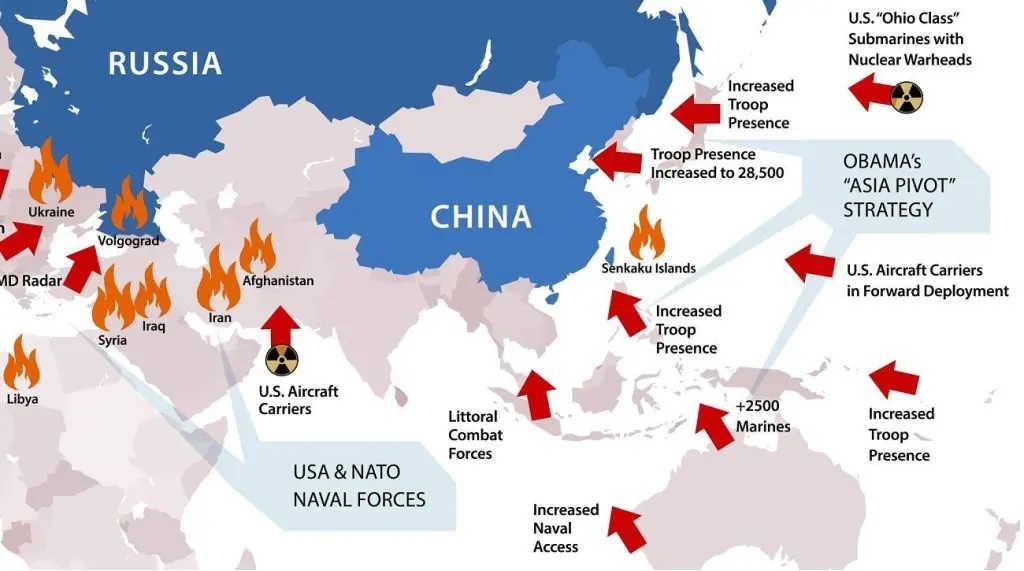
Looking at any map of US military deployments in the “Indo-Pacific” region reveals China as virtually surrounded by the US military by way of South Korea, mainland Japan, Okinawa, and with new basing agreements in the works with Manila, potentially the Philippines as well.
This puts US troops, naval assets, and hundreds of warplanes within striking distance of China, including Taiwan from north, east, and potentially the south.
The US has also poured billions of dollars’ worth of weapons into Taiwan, just as the US did in Ukraine from 2014 onward. The weapons are clearly intended for a Ukraine-style proxy war with China.
Worst of all is the small but growing presence of US military activity on Taiwan itself.
Even as the US State Department claims it does not support Taiwan independence, in 2021 Voice of America in its article, “US Nearly Doubled Military Personnel Stationed in Taiwan This Year,” admits that not only are there US troops on Taiwan, the number is increasing.
The article explains:………………………………….
One could only imagine the reaction in Washington if Beijing and a government in, say San Juan, revealed the presence of Chinese forces in Puerto Rico. Yet as is the case in many instances regarding international relations, American “exceptionalism” not only absolves the US from any penalty for blatant violations of another nation’s sovereignty, it transfers the blame to the nation being targeted itself, in this case, China.
Why US War with China by 2025?
Despite serial provocations, Beijing has exercised exemplary patience and restraint. China has invested heavily in its military and is indeed preparing for conflict with the United States, not because it seeks to wage war with the United States but because the United States has placed its military on China’s doorstep, very clearly seeking war with China.
Taiwan’s full reintegration with the rest of China is inevitable. Already its economy is heavily dependent on access to markets across the rest of China. Harvard University’s Atlas of Economic Complexity reveals that nearly 50% of all exports from Taiwan go to the rest of China. The rest of China also accounts for the largest amount of imports to the island. Many of these imports are crucial inputs for Taiwan’s semiconductor and electronic component production which constitutes, by far, Taiwan’s largest industry.
Only through Washington’s persistent and extensive interference in Taiwan’s local political affairs has gradual reintegration been suspended. Before the US-backed Democratic Progressive Party (DPP) came to power in 2016, the incumbent Kuomintang (KMT) party was on track to sign a trade agreement with the mainland that would have increased already extensive economic integration even further.
Ironically, as the US captured Ukraine politically in 2014, it was also backing opposition protests in Taiwan dubbed the “Sunflower Movement,” paving the way for the DPP’s ascent into power 2 years later. Just like the US-installed client regime in Kiev, the DPP immediately set a course for self-destruction, irrationally rolling back ties with the mainland at the expense of the people living on Taiwan.
More recently, local elections in Taiwan saw the DPP fare poorly, serving as an unofficial referendum rejecting the DPP’s separatist platform, the damage it has consistently done to the local economy, and the instability it has created across the strait with the mainland. However, just as was the case in Ukraine where public sentiment sought peace, Washington and its client regime have every intention of overriding that sentiment in Taiwan, and pushing the island closer still to yet another US-engineered proxy war.
It is clear that it is not China rushing for war with the United States, but precisely the other way around. Time, economics, and proximity favor China. In 10 years, China will be economically and militarily stronger while the US will continue its slow decline. At that point the window of opportunity will have closed for the United States to wage any type of military conflict with China and obtain anything close to resembling “victory.”
Some could argue that the window has already closed.
The Center for Strategic and International Studies (CSIS) recently published the outcome of “wargames” regarding a theoretical Chinese “invasion” of Taiwan in a paper titled, “The First Battle of the Next War: Wargaming a Chinese Invasion of Taiwan.”The paper concludes:
In most scenarios, the United States/Taiwan/Japan defeated a conventional amphibious invasion by China and maintained an autonomous Taiwan. However, this defense came at high cost. The United States and its allies lost dozens of ships, hundreds of aircraft, and tens of thousands of servicemembers. Taiwan saw its economy devastated. Further, the high losses damaged the U.S. global position for many years.
Regarding China, it says:
China also lost heavily, and failure to occupy Taiwan might destabilize Chinese Communist Party rule. Victory is therefore not enough. The United States needs to strengthen deterrence immediately.
In essence, the US will suffer unprecedented military losses and Taiwan itself will be scoured clean of its industry and infrastructure. While CSIS claims that the Chinese amphibious landing was successfully foiled in its wargames thus preserving Taiwan’s political existence, the cost is Taiwan’s physical existence.
Both the CSIS paper together with public comments made by the Pentagon about their own classified wargames indicate disparity between the US and China militarily is narrowing quickly. If there is to be a conflict between the US and China, the sooner it takes place the better chance the US has of achieving a favorable outcome. It is therefore the US racing eagerly toward war, not China. China’s military posture reflects the close proximity of US forces to Chinese territory and their obvious intent to menace China in its own territory, not a China expanding its military capabilities to threaten the United States. In fact, the CSIS paper made a specific note about China’s ability to attack the US “homeland.”
The paper claims:
Because the United States will be striking the Chinese homeland, the base case assumes that the U.S. homeland is not a sanctuary. However, the ability of the Chinese to conduct strikes against the U.S. homeland and thereby affect operations in the Western Pacific is extremely limited. A few special forces might infiltrate and attack a small number of high-value targets but not enough to materially affect military operations in the Western Pacific.
Thus, even in a war between the US and China where the US is conducting strikes on Chinese territory, CSIS admits that China has very limited means to likewise strike at the US. This reveals that US policymakers are not concerned about any real threat China poses to the US, but instead to US “interests” thousands of miles from its own shores and, in fact, within the sovereign territory of China itself.
Potential war between the US and China, if it takes place, will merely be the most recent example of US military aggression in pursuit of global hegemony targeting and attempting to undermine another nation’s sovereignty in violation of international law, not as a means to uphold it. As the US often does, the lead up to this potential war sees the US projecting its own menace toward international law, peace and stability onto the very target of US military aggression, in this case China.
Brian Berletic is a Bangkok-based geopolitical researcher and writer, especially for the online magazine “New Eastern Outlook”.
Fukushima: Japan insists release of 1.3m tonnes of ‘treated’ water is safe
Neighbouring countries and local fishers express concern as 12th anniversary of nuclear disaster looms
Justin McCurry, Guardian 15 Feb 23,
“……………….. As the country prepares to mark the 11 March anniversary, one of the disaster’s most troubling legacies is about to come into full view with the release of more than 1m tonnes of “treated” water from the destroyed Fukushima Daiichi nuclear power plant.
The tsunami knocked out the plant’s backup electricity supply, leading to meltdowns in three of its reactors, in the world’s worst nuclear accident since Chornobyl 25 years earlier.
Much has changed since the Guardian’s first visit to the plant in 2012, when the cleanup had barely begun and visitors were required to wear protective clothing and full-face masks. Atmospheric radiation levels have dropped, damaged reactor buildings have been reinforced and robots have identified melted fuel in the basements.
But as the Guardian learned on a recent visit, progress on decommissioning – a process that could take four decades – is being held up by the accumulation of huge quantities of water that is used to cool the damaged reactor cores.
Now, 1.3m tonnes of water – enough to fill about 500 Olympic-sized swimming pools – is being stored in 1,000 tanks that cover huge swathes of the complex. And space is running out.
Two steel pillars protruding from the sea a kilometre from the shore mark the spot where, later this year, the plant’s operator, Tokyo Electric Power [Tepco], plans to begin releasing the water into the Pacific Ocean, in the most controversial step in the Fukushima Daiichi cleanup to date.
The decision comes more than two years after Japan’s government approved the release of the water, which is treated using on-site technology to remove most radioactive materials. But the water still contains tritium, a naturally occurring radioactive form of hydrogen that is technically difficult to separate from water.
The discharge, which is due to begin in the spring or summer, will take place in defiance of local fishing communities, who say it will destroy more than a decade of work to rebuild their industry. Neighbouring countries have also voiced opposition.
The government and Tepco claim the environmental and health impacts will be negligible because the treated water will be released gradually after it has been diluted by large amounts of seawater. The International Atomic Energy Agency says nuclear plants around the world use a similar process to dispose of wastewater containing low-level concentrations of tritium and other radionuclides.
Tepco and government officials who guided a small group of journalists around Fukushima Daiichi this month insisted the science supports their plans to pump the “treated” water – they object to media reports describing it as contaminated – into the ocean………………………………………….
Environmental groups have challenged the Japanese government’s claims that the water will not affect marine life or human health, while the US National Association of Marine Laboratories has pointed to a lack of adequate and accurate scientific data to support its reassurances on safety………………….. https://www.theguardian.com/environment/2023/feb/15/fukushima-japan-insists-release-of-treated-water-is-safe-nuclear-disaster
South Korea’s Nuclear Flirtations Highlight the Growing Risks of Allied Proliferation
Carnegie Endowment, ERIC BREWER, TOBY DALTON, FEBRUARY 13, 2023
South Korean President Yoon Suk-yeol’s January comments about his country possibly acquiring nuclear weapons adds to the mounting nuclear dangers in Asia. Though he subsequently walked back his statement, the underlying motives and risks remain that South Korea could one day decide to go nuclear.
Yoon’s nuclear threat also fueled a debate among security experts in Washington about how to respond. Many nonproliferation analysts highlighted the rarity of national leaders making public allusions to acquiring nuclear weapons and argued that the United States needs to remind South Korea of its commitments not to do so. Others highlighted the dangers of a rising tide of “nuclear populism” that is driving South Korea’s nuclear discourse. Conversely, some analysts argued that there is little the United States can do to prevent an inevitable South Korean weapon and that it is better to reduce U.S. extended deterrence commitments in conflicts that exceed vital U.S. interests. A few go even further and suggest that Washington should welcome or even facilitate a nuclear-armed Seoul.
This debate indicates a very unsettled dynamic that American and other policymakers cannot wish away or ignore. Yoon’s comments may simply be the leading edge of a trend in nuclear flirtations by U.S. allies and partners.
Since the dawn of the nuclear age, the United States has sought to stem the spread of nuclear weapons to adversaries and allies alike. This policy aims partly to preserve the U.S. nuclear advantage and to reduce the potential that nuclear weapons are used, which many experts judge increases if more states acquire them. Over the past few decades, the major proliferation fear has been about rogue actors: North Korea, Iraq, Iran, Syria, or potentially terrorist groups. The United States and the international community developed a policy tool kit to address these threats, including sanctions, technology denial, and even cyber and military attacks on nuclear facilities. Today, however, an increasing proliferation risk comes from U.S. allies and partners worried about their security and the credibility of U.S. commitments to their defense…………………………………….more https://carnegieendowment.org/publications/89015?utm_source=rss&utm_medium=rss
Checking Back in on China’s Nuclear Icebreaker
Over four years after the project was announced, updates remain scarce on China’s first nuclear icebreaker.
The Diplomat, By Trym Eiterjord 13 Feb 23
In 2018, it became known that the state-owned China National Nuclear Corporation (CNNC) was embarking on a project to develop nuclear-powered icebreakers…………….
Over four years later, information about the project remains scarce, but a handful of patents recently filed by engineers at the CNNC Marine subsidiary would seem to indicate that development is moving forward. The content of these patents may give some insight into what is potentially China’s first nuclear-powered surface vessel.
The patents filed so far are concerned mainly with nuclear engineering. ……………………
Finally, the new subsidiary has filed a patent titled simply “A nuclear-powered icebreaker,”………………..
This is more or less the extent of new information to have come out since the project was first revealed in 2018……………………………….
The People’s Liberation Army Navy has also seemingly become interested in nuclear propulsion for polar-going icebreakers…………………….. more https://thediplomat.com/2023/02/checking-back-in-on-chinas-nuclear-icebreaker/
Many people in the public opinion polls are opposed to the idea, and briefings are being held in various regions… but the Cabinet decides to promote nuclear power plants, ignoring the voices of “grave danger to future generations”
February 11, 2023
The government’s basic policy, which includes measures to promote nuclear power plants, such as rebuilding them and operating them for more than 60 years, received nearly 4,000 opinions (public comments), many of which were against nuclear power. However, the Cabinet decision was made on April 10 without changing the main outline of the policy. The major change in nuclear policy less than six months after Prime Minister Fumio Kishida’s order to study the issue has consistently failed to address the voices of the public. (The Cabinet decision was made on October 10, 2011, without any change in the major nuclear policy.)
◆Consideration of voices within the ruling party

The TEPCO’s Fukushima Daiichi nuclear power plant accident proves that humans have no control over nuclear power plants,” and “It invites grave danger to future generations.
The results of the public solicitation of opinions announced by the government after the cabinet decision were lined with requests for the government to reconsider its decision. A total of 3,966 opinions were received in the public solicitation, which was conducted for about a month from the end of December last year, after the basic policy was decided at the government meeting. The government has clarified the contents of 356 opinions and their responses by summarizing similar opinions.
The government’s response to the negative opinions on nuclear power emphasized that the stable supply of electricity is in crisis due to changes in the energy situation caused by the crisis in Ukraine. The government reiterated its explanation that it will utilize nuclear power along with renewable energy and other energy sources that have decarbonizing effects.
Since the end of the public comment period, there has been only one major revision to the basic policy, related to nuclear power. Regarding the reconstruction of nuclear power plants, which had not been envisioned by the government after the Fukushima accident, the target location was elaborated from “nuclear power plants that have been decided to be decommissioned” to “within the premises of nuclear power plants that have been decided to be decommissioned. This is a strong indication that the government took into consideration the opinions of the nuclear power prudent within the ruling party.
◆Not listening to the voice of the people, “They are making fun of the victims.
The basic policy was discussed by a number of METI experts. Although a number of committee members who are negative about nuclear power plants called for a national debate, the public’s voice was not heard before the policy was decided.
After deciding on the basic policy at the end of last year, METI began holding explanatory meetings in mid-January in 10 cities across Japan where METI and other bureaus are located. So far, they have been held in Nagoya, Saitama, Osaka, and Sendai, and will continue until early March.
Ruiko Muto, co-chairperson of the Liaison Association of Organizations Affected by the Nuclear Power Plant Accident in Miharu-machi, Fukushima Prefecture, commented at a press conference on March 10, “I don’t understand what the meetings are for. It is ridiculous that the meeting was not held in Fukushima Prefecture, a disaster-stricken area, and that they are making fun of the victims of the disaster.
◆It’s conclusory, forced, and unacceptable as a method of policy making.” It is unacceptable as a method of policy making.
Opposition to the policy is also smoldering among regulators. The basic policy stipulates that the Nuclear Regulation Authority (NRA) will conduct rigorous examinations and regulations as a precondition for utilizing nuclear power plants. At a regular meeting of the regulatory commission on August 8, Akira Ishiwatari, a member of the commission, opposed the transfer of the 40-year operating period, with a maximum of 60 years, stipulated in the Nuclear Reactor Regulation Law, to a law under METI jurisdiction, saying that it is not necessary. It became unclear whether a new regulatory system could be decided upon.
At a press conference following the cabinet decision, METI Minister Yasutoshi Nishimura explained, “The basic policy was put together from the perspective of nuclear energy utilization policy and does not include safety regulations, so there is no problem,” and expressed his intention to continue with procedures such as amending related laws. Hajime Matsukubo, executive director of the NPO Nuclear Information and Documentation Office, who also served as a member of METI’s expert panel, commented, “They are forcibly proceeding with the conclusion that they are promoting nuclear power without listening to opposing opinions. This is unacceptable as a method of policy making.

People opposing the Cabinet decision on the basic policy in front of the Prime Minister’s official residence in Nagatacho, Tokyo, on March 10.
◆Attack on the Prime Minister’s Office
On January 10, about 100 people protested in front of the Prime Minister’s official residence in Nagata-cho, Tokyo, after the cabinet approved a basic policy that includes measures to promote nuclear power plants. In the cold rain, they called for “No new nuclear power plants” and “Don’t forget Fukushima. (Nozomi Masui)
The event was organized by the Executive Committee for 10 Million People’s Action to Say Goodbye to Nuclear Power Plants, a citizens’ group. Members of six organizations, including environmental groups and labor unions, took the microphone.
Natsuka Mitsuda, 55, secretary general of FoE Japan, an international environmental NGO, said, “In order for the nuclear industry to survive, future generations will have to bear a heavy burden and risk of accidents. We are firmly opposed to the cabinet decision that ignores the will of the people. Taeko Fujimura, 68, vice chairperson of the National Trade Union Liaison Council, said, “We have learned nothing from the accident at the Fukushima Daiichi Nuclear Power Plant. The operation of aging nuclear power plants is absolutely unacceptable.
Cabinet adopts policy of using nuclear reactors beyond 60-year limit

The No. 3 reactor at Kansai Electric Power’s Mihama nuclear power plant in Mihama, Fukui Prefecture, the first nuclear reactor in Japan to operate beyond 40 years.
Feb 10, 2023
The Cabinet formally adopted a policy on Friday that will allow for the operation of nuclear reactors beyond their current 60-year limit alongside the building of new units to replace aging ones as part of efforts to cut carbon emissions while ensuring adequate national energy supply.
The government’s “green transformation” policy features extensive use of nuclear power along with renewable energy and marks a major policy shift for the country, which suffered a devastating nuclear disaster in 2011. The Cabinet decision follows a meeting in late December at which the policy was agreed upon.
The government also plans to raise about ¥20 trillion ($152 billion) through the issuance of green transformation bonds to boost investment in decarbonization projects, as it estimates public and private investment of over ¥150 trillion will be necessary over the next 10 years.
Bills necessary to implement the new policy were submitted to parliament Friday.
The new policy will effectively extend the amount of time reactors can remain operational beyond 60 years by excluding time spent on inspections and other periods they are offline from consideration when calculating their total service life.
The policy also calls for developing advanced reactors, regarded as safer than conventional ones, and only allowing them to be built within the premises of reactors destined for decommissioning. The government aims to begin operating next-generation reactors in the 2030s.
It also states the central government is responsible for the final disposal of high-level radioactive waste created through nuclear power generation. The issue has been a source of concern among the public and a challenge in advancing nuclear policy.
Economy, Trade and Industry Minister Yasutoshi Nishimura said at a news conference after the Cabinet meeting that the government hopes to expand the areas in which it will conduct first-stage surveys as part of the selection process for the final disposal site.
The new policy stipulates government support for local governments which accept the survey.
Public sentiment turned sour over the use of nuclear power as a national source of energy following the Fukushima No. 1 nuclear disaster in March 2011 that was triggered by a massive earthquake and tsunami. The government had repeatedly said it was not considering building new reactors or replacing existing ones.
But since Russia launched a major invasion of Ukraine in late February last year, a sharp rise in global energy prices has threatened the stable supply of energy for Japan, a resource-scarce country that heavily relies on fossil fuel imports, prompting officials to look into greater use of nuclear power.
Prime Minister Fumio Kishida instructed the government last summer to look into how the country can maximize the use of its nuclear energy facilities most effectively.
Cabinet decides on a policy of “maximum utilization” of nuclear power plants, a major shift from “reducing dependence on nuclear power plants,” enabling nuclear power plants to operate for more than 60 years and promoting rebuilding

Prime Minister’s Office
February 10, 2023
On February 10, the cabinet approved the government’s basic policy for decarbonization, which includes rebuilding next-generation nuclear power plants and extending their operational life beyond 60 years. In addition to renewable energy, the policy also specifies “maximum utilization” of nuclear power plants. After the accident at TEPCO’s Fukushima No.1 nuclear power plant, the government has been advocating a reduction in dependence on nuclear power, but the worsening environment for procuring energy resources due to the crisis in Ukraine and other factors have led to a major shift in energy policy.
The decision was made in the form of the “Basic Policy for the Realization of GX (Green Transformation). Minister of Economy, Trade, and Industry Yasutoshi Nishimura stated, “The public and private sectors will work together to accelerate efforts toward the realization of GX.
After the compilation of the policy in December of last year, a public comment period was held, and approximately 3,300 opinions were received.
The period of operation of nuclear power plants, which after the Fukushima accident was set at “40 years in principle, with a maximum of 60 years,” will be extended to allow operation for more than 60 years, excluding from the calculation the period during which the plants are shut down to respond to the screening process for restarting. The company will also work on the development and construction of next-generation nuclear power plants on the grounds that this will increase safety. (Kyodo)
https://www.tokyo-np.co.jp/article/230468
1 This Month



26 September – International Day for the Total Elimination of Nuclear Weapons


PLEASE OPPOSE HR 8255 AND S.3639 – bills would accelerate satellite deployment, with no environmental review or safeguards – https://ncstd5li.quorum.us/campaign/169331/
To see nuclear-related stories in greater depth and intensity – go to https://nuclearinformation.wordpress.com
-
Archives
- September 2026 (233)
- August 2026 (330)
- July 2026 (355)
- June 2026 (287)
- May 2026 (306)
- April 2026 (356)
- March 2026 (251)
- February 2026 (267)
- January 2026 (308)
- December 2025 (358)
- November 2025 (359)
- October 2025 (375)
-
Categories
- 1
- 1 NUCLEAR ISSUES
- business and costs
- climate change
- culture and arts
- ENERGY
- environment
- health
- history
- indigenous issues
- Legal
- marketing of nuclear
- media
- opposition to nuclear
- PERSONAL STORIES
- politics
- politics international
- Religion and ethics
- safety
- secrets,lies and civil liberties
- spinbuster
- technology
- Uranium
- wastes
- weapons and war
- Women
- 2 WORLD
- ACTION
- AFRICA
- Atrocities
- AUSTRALIA
- Christina's notes
- Christina's themes
- culture and arts
- Events
- Fuk 2022
- Fuk 2023
- Fukushima 2017
- Fukushima 2018
- fukushima 2019
- Fukushima 2020
- Fukushima 2021
- general
- global warming
- Humour (God we need it)
- Nuclear
- RARE EARTHS
- Reference
- resources – print
- Resources -audiovicual
- Weekly Newsletter
- World
- World Nuclear
- YouTube
-
RSS
Entries RSS
Comments RSS
 nuclear-news