In Taiwan, strong opposition to extending life of nuclear reactor
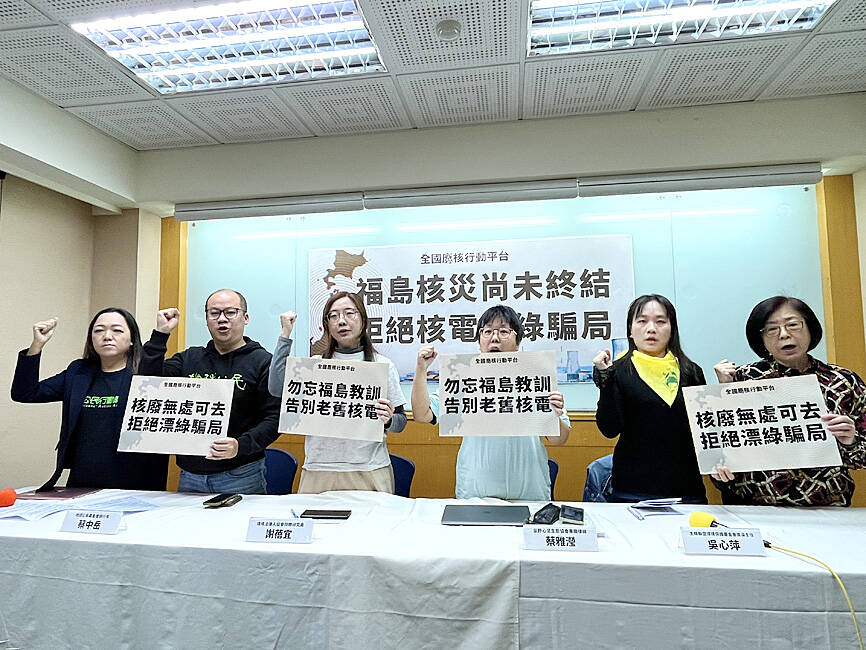
Proposed 20-year nuclear plant extension opposed
NO WASTE STORAGE: Renewable energy last year contributed more than the output of nuclear sources, but the nation risks moving backward, critics said
By Chen Chia-yi and Kayleigh Madjar / Staff reporter, with staff writer 10 Mar 23 https://www.taipeitimes.com/News/taiwan/archives/2023/03/10/2003795851
The National Nuclear Abolition Action Platform yesterday criticized calls by politicians to extend the service of the Guosheng Nuclear Power Plant’s No. 2 reactor, saying it disregards public sentiment and does not address problems with waste storage.
Some lawmakers have suggested a 20-year extension of the No. 2 reactor at the plant in New Taipei City’s Wanli District (萬里), which is set to reach the end of its lifespan on Tuesday, the groups told a news conference in Taipei.
More than 12 years after the Fukushima Dai-ichi nuclear power plant disaster in Japan, issues with contamination and wastewater have yet to be resolved, Green Citizens’ Action Alliance secretary-general Tsuei Su-hsin (崔愫欣) said.
The disaster occurred just as the plant turned 40 years old, said Tsai Ya-ying (蔡雅瀅), an attorney with the Wild at Heart Legal Defense Association.
Although the main cause was a tsunami triggered by an earthquake, an underlying weakness that exacerbated the disaster was the age of its facilities, Tsai said.
The second reactor at the Guosheng plant is about to turn 40 next week and should be decommissioned, she said.
Without locations identified to store nuclear waste, there is no basis for discussing continued use of the reactor, Environmental Jurists Association researcher Hsieh Pei-yi (謝蓓宜) said.
Politicians and corporate leaders — including Taipei City Councilor Wang Hung-wei (王鴻薇) and Broadcasting Corp of China chairman Jaw Shaw-kong (趙少康) — have been using “false, one-sided information” to call for its extension, Citizen of the Earth, Taiwan executive director Tsai Chung-yueh (蔡中岳) said.
They have not addressed the issue of waste storage sites at the plant being filled to capacity, he said, adding that they have evading the question whenever asked.
They are not only disregarding public concern about nuclear waste, but also ignoring legal provisions that require extension requests to be made at least five years before a nuclear plant’s decommission date, Tsai said.
Japan’s experience with restarting its nuclear plants was much different than perceived, the groups said.
In 2011, Japan had 54 nuclear generating units, 24 of which had been decommissioned, they said.
In the years since, seven have been restarted, and more planned restarts were canceled due to public opposition, the groups said.
Last year, renewables contributed close to that of nuclear in the nation’s power mix, at 8.3 percent, the groups said, adding that Taiwan should not to “move backward” on energy transition.
Renewable energy should be made a more viable long-term goal, Homemakers United Foundation director Wu Hsin-ping (吳心萍) said.
Solar and small-scale hydropower are being used in many communities, Wu said.
For example, one small 20-kilowatt solar installation in Taipei, despite frequent overcast weather in the capital, is able to produce a month of power in a year for about 70 households, she said.
China increasing the number of nuclear warheads, aiming to match USA’s nuclear arsenal
Moscow is cementing its alliance with Beijing through deliveries of highly
enriched uranium that are fuelling China’s race to match the nuclear
arsenal of the United States, the Pentagon has warned. President Xi’s
military chiefs are seeking nuclear parity with Washington by increasing
the number of nuclear warheads from the present estimated 350 to 400 to
1,500 by 2035.
That total would approximately equal the strategic nuclear
arsenal of the US, limited to 1,550 warheads by New Start, the only
remaining arms control treaty between the US and Russia, which President
Putin has announced could be abandoned.
Times 10th March 2023
https://www.thetimes.co.uk/article/putin-china-plutonium-nuclear-xwlzvjfwh
Twelve years after 3/11, dispute grows over Fukushima’s radioactive soil

BY TOMOKO OTAKE, STAFF WRITER, https://www.japantimes.co.jp/news/2023/03/10/national/dispute-fukushima-radioactive-soil/
OKUMA, FUKUSHIMA PREF. – On the surface, everything seems to be under control at the expansive site storing radioactive soil collected from across Fukushima Prefecture in the aftermath of the 2011 core meltdowns at the Fukushima No. 1 nuclear power plant.
Since 2015, the Interim Storage Facility, which straddles the towns of Okuma and Futaba and overlooks the crippled plant, has safely processed massive amounts of radioactive soil — enough to fill 11 Tokyo Domes — in an area nearly five times the size of New York’s Central Park. The soil was collected during decontamination procedures in Fukushima’s cities, towns and villages that were polluted by the disaster.
Here, black plastic bags full of contaminated soil are put on conveyor belts and unpacked. The contents are sifted through to remove plastic, leaves, twigs and other nonsoil waste. Then the soil is taken to dump zones, where it’s buried in 15-meter-deep pits with protective sheeting and a drainage pipe at the bottom so that radioactive cesium won’t leak into the ground. Finally, the soil is covered with noncontaminated soil and topped with a lawn. Areas where the work has been completed look like soccer fields.
The level of radiation here is about 0.2 microsieverts per hour (uSv/h), explained Hiroshi Hattori, an official at the Environment Ministry’s local office, during a recent tour of the areas where the polluted soil is buried. The radiation level there is harmless to humans, though higher than an average of 0.04 uSv/h elsewhere in Japan.
“It’s higher not because of the soil, but because of surrounding forests (which have not been decontaminated).”
The problem is that, as smooth and orderly as its operations are, the site is only a temporary home for the radioactive soil. Nobody knows where this massive pile of dirt will eventually end up. All that is certain is that the central government has pledged to — and is legally obliged to — move all of the soil out of Fukushima Prefecture by 2045.
This unresolved soil issue — along with the lingering dispute over the planned ocean release of tritium-laced wastewater from Fukushima No. 1 — is a sour reminder of the enormous toll the nuclear disaster in Fukushima has inflicted on the country and beyond.
Opposition from residents
The soil is a product of years of state-funded measures to bring radiation levels down in communities affected by the disaster. The government drew up a “decontamination road map” soon after the accident, in the hopes of a speedy return of residents to their hometowns.
The desire to avoid moving the massive amount of soil again — and to make it easier to find a final destination for it — has also led the Environment Ministry to try to reduce its volume first by reusing some of the less contaminated mud for public works projects across the nation. That way, only a quarter of the total amount that contains over 8,000 becquerel per kilogram of cesium will be subject to final disposal, the ministry says.
But it’s a tough sell. In December, the ministry held its first round of meetings with residents in areas of greater Tokyo where pilot projects to utilize the soil under the 8,000 Bq/kg threshold are planned: the Shinjuku Gyoen National Garden in Tokyo, the National Environmental Research and Training Institute in Tokorozawa, Saitama Prefecture, and the National Institute for Environmental studies in Tsukuba, Ibaraki Prefecture.
Nearby residents vehemently opposed the plan. Last month, they formally demanded that the ministry cancel the pilot projects, under which the ministry plans to bury radioactive soil underneath a 50 cm layer of cover soil, for flower beds and parking lots.
Roads, tidal walls and dams
Though little known until recently, the ministry released a policy document in 2016 that outlined the “safe use” of radioactive soil with radiation levels of 8,000 Bq/kg or less. According to the document, the government will divert such soil to embankments in public works projects “whose management entities and responsibilities are clearly defined.”
Roads, tidal walls, seaside protection forest and earthfill dams are some of the projects where use of the soil is envisioned, the document says.
The plan has raised the eyebrows of not just residents but also experts.
“Japan is very seismic and we have (harsh) weather and typhoons,” said Azby Brown, architect and lead researcher for Safecast, a citizen science group that has independently measured and publicized radiation levels in Fukushima and elsewhere.
“The half-life of cesium-137 is 30 years. It’s going to stay radioactive for a long time. What happens when these embankments get old?… It is not a very rational or sound decision, from the sense of certainly the perception of safety.”
Kenichi Oshima, professor of energy policy at Ryukoku University in Kyoto, questions the rationale of treating the soil of 8,000 Bq/kg or less as safe, pointing to a “double standard” between the ministry’s policy and the rigorous control of waste required for other nuclear power plants under the Nuclear Reactor Regulation Law. That law states only waste with radiation levels under 100 Bq/kg is considered safe enough to be reused.
All of the radioactive waste produced by the Fukushima disaster is covered by a separate “special law” that went into force in 2012. This says that Tokyo Electric Power Co. Holdings (Tepco), the operator of Fukushima No. 1, is responsible for the handling of the radioactive waste and soil within its property, while the Environment Ministry is responsible for the disposal of the 3/11-borne radioactive waste outside the plant, though the law itself does not mention the reuse of soil that has been decontaminated.
The ministry has explained that the 8,000 Bq/kg threshold keeps it consistent with the level of “designated waste materials” stipulated in that special legislation. When people are exposed to waste below 8,000 Bq/kg, the additional radiation exposure is limited to less than 1 millisievert per year, not a level that causes health concerns, according to the ministry.
“Granted, soil with 8,000 Bq/kg of radioactive materials is not one that immediately kills people who touch it,” Oshima said. “But it is low-level radioactive waste nonetheless, and so should be managed properly as such, just like low-level radioactive waste from other nuclear power plants is. It’s just inconceivable that it would be utilized as materials for infrastructure that people will be using often.”
Public support elusive
On Feb. 24, Environment Minister Akihiro Nishimura reiterated the ministry’s stance, telling a news conference that utilization of soil outside the prefecture is “important to realize its final disposal outside the prefecture (of Fukushima).”
“We would like to continue explaining our stance in detail so as to nurture public understanding,” he said.
But to nurture this understanding about an issue as serious as radioactive waste, everyone who has a stake should be involved in the decision-making process, Brown says.
“The strong consensus internationally regarding where to put things like radioactive waste requires full agreement and participation by all of the stakeholders, all of the citizens, everyone who’s involved,” Brown said. “What we usually see often in Japan in general, and certainly regarding the Fukushima issues, is that a decision is made at the top. It’s decided, it’s announced and then they try to persuade people to go along with it. This is the case with the water release issue (as well as) the soil issue.”
Around this spring or summer, the government and Tepco hope to begin discharging water that has all the radioactive nuclides except tritium removed. Construction work is already under way at the seaside plant to install an undersea tunnel, through which the water will be released 1 kilometer offshore.
The so-called JESCO law, which went into effect in 2014, gives legal grounds for the creation of the government-funded entity that runs the interim storage site, as well as the obligation for the central government to move the soil out of Fukushima by 2045. The obligation was written into law following a political compromise with the Fukushima Prefectural Government, with officials from the national government saying they “considered the excessive burden” being shouldered by the people of Fukushima.
Both Oshima and Brown, however, say they find the government’s plan to recycle the dirt out of line.
In fact, Oshima says the best solution would be to set aside an area and make it a controlled zone for all the polluted soil for 50 years until the radioactive cesium decays, which is how waste from other nuclear plants is handled, and is what the final disposal site is going to look like.
He cites a 2017 report by the Japan Atomic Energy Agency that estimated the size of the area needed for final disposal, which should be ready by 2045. If the volume of the soil is estimated at 20 million cubic meters, a subsurface ground facility for its final disposal will need to measure about 1.3 km by 1.3 km, the report concluded.
“It may sound like a huge space, but both the national government and Tepco have vacant land plots of that size,” Oshima said. Once the soil’s use as construction materials is greenlighted, however, it would be transported nationwide, and it would be impossible to track and measure its radiation doses, he argued.
“If the soil is properly stored in a controlled area, it would make the public feel so much more at ease.”
What´s happening at Fukushima plant 12 years after meltdown? Massive amounts of fatally radioactive melted nuclear fuel remain inside the reactors.

Japan is preparing to release a massive amount of treated radioactive wastewater
into the sea. Japanese officials say the release is unavoidable and should
start soon.
Dealing with the wastewater is less of a challenge than the
daunting task of decommissioning the plant. That process has barely
progressed, and the removal of melted nuclear fuel hasn´t even started.
TEPCO needs a safety approval from the Nuclear Regulation Authority.
The International Atomic Energy Agency, collaborating with Japan to ensure the
project meets international standards, will send a mission to Japan and
issue a report before the discharge begins………………………..
Massive amounts of fatally radioactive melted nuclear
fuel remain inside the reactors. Robotic probes have provided some
information but the status of the melted debris is largely unknown. Akira
Ono, who heads the cleanup as president of TEPCO´s decommissioning unit,
says the work is “unconceivably difficult.” Earlier this year, a
remote-controlled underwater vehicle successfully collected a tiny sample
from inside Unit 1’s reactor – only a spoonful of about 880 tons of melted
fuel debris in the three reactors.
That’s 10 times the amount of damaged
fuel removed at the Three Mile Island cleanup following its 1979 partial
core melt. Trial removal of melted debris will begin in Unit 2 later this
year after a nearly two-year delay. Spent fuel removal from Unit 1
reactor´s cooling pool is to start in 2027 after a 10-year delay. Once all
the spent fuel is removed the focus will turn in 2031 to taking melted
debris out of the reactors.
Daily Mail 9th March 2023
Little progress seen in removing fuel debris at Fukushima plant
By RYO SASAKI/ Staff Writer, https://www.asahi.com/ajw/articles/14854929, March 6, 2023
Tokyo Electric Power Co. has little to show in removing fuel debris at its Fukushima No. 1 nuclear power plant in the 12 years since the nuclear disaster started.
The company, in fact, has postponed the work.
An estimated 880 tons of fuel debris remain in the No. 1, 2 and 3 nuclear reactors at the plant.
Remote-control operations must be used to remove the fuel debris because radiation levels in the reactor buildings could kill a person within one hour.
TEPCO had initially planned to start removing fuel debris at the No. 2 reactor, where the level of radiation is comparatively low, by the end of 2022.
However, the company announced in August 2022 that it had abandoned this target, citing delays in developing a robotic arm that could be used to remove the debris.
The company set a new target to start the removal work in the second half of fiscal 2023.
The government and TEPCO aim to complete the decommissioning of the stricken plant between 2041 and 2051.
However, the company’s first goal is to test the retrieval of only several grams of fuel debris. It still hasn’t decided how it will conduct larger-scale removal.
TEPCO has also not explained when it will start removing fuel debris at the No. 1 and No. 3 reactors.
A “submergence method” is under consideration to remove fuel debris from the No. 3 nuclear reactor, but it’s still unclear whether it will be implemented.
With the submergence method, workers would cover the building that houses the No. 3 reactor with a metal structure, fill the inside of the structure with water to submerge the reactor, and then remove fuel debris from the upper part of the building.
Another worrying factor about the Fukushima nuclear power plant is that the foundation, or “pedestal,” supporting the No. 1 reactor’s pressure vessel has deteriorated so much that the reinforcing bars are now exposed.
Concerns have been expressed about the earthquake resistance of the pedestal.
Evacuation plans still missing around 6 nuclear power plants

THE ASAHI SHIMBUN, March 6, 2023 https://www.asahi.com/ajw/articles/14854836
Six of 15 locations with nuclear power plants, excluding those in Fukushima Prefecture, have not compiled sufficient emergency plans, including wide-area evacuations, in the event of a serious accident.
Prime Minister Fumio Kishida has pushed a policy to “return to nuclear power,” but disaster prevention challenges remained unresolved, and local people have expressed concerns.
The emergency plans were deemed necessary after the March 2011 nuclear disaster at Tokyo Electric Power Co.’s Fukushima No.1 nuclear power plant.
Niigata Prefecture hosts TEPCO’s Kashiwazaki-Kariwa nuclear plant, one of the largest in the world.
On Feb. 7, disaster prevention officials of municipal governments in the prefecture held an annual meeting online in Niigata with staff of TEPCO and members of the Cabinet Office in charge of nuclear emergency preparations.
One theme at the meeting was whether people could safely flee if a severe accident were to occur at the plant on a day with heavy snow.
“For our residents, heavy snow is a threat much closer than terrorism, and it could cause tremendous anxiety and risk,” said a Nagaoka city government official, urging the prefectural government to examine evacuation plans in heavy snow.
Municipal governments within a radius of 30 kilometers of a nuclear power plant are required to draw up evacuation plans for severe nuclear accidents and discuss emergency procedures with the central government.
These plans are then supposed to receive approval at a nuclear emergency preparedness meeting chaired by the prime minister.
But there are no such plans in place in the Kashiwazaki-Kariwa area, where 437,000 people live.
Local officials said they are stumped over how to plan an evacuation in heavy snow.
On Dec. 18, snow started falling in the city of Kashiwazaki, where the nuclear power plant is located.
The Hokuriku Expressway that runs through the city was closed for up to 52 hours. National road No. 8, which runs parallel to the expressway, was shut down for 38 hours, and stranded vehicles formed a 22-km line in the snow.
The Kashiwazaki city government estimates that about 60,000 of the 79,000 or so residents would evacuate westward in the event of a nuclear power plant accident.
Any evacuation plan in the city would be severely hampered if the Hokuriku Expressway and national road No. 8 were unusable.
On Feb. 10, the Cabinet approved Kishida’s green transformation policy, marking a dramatic shift in the government’s post-3/11 stance on nuclear power.
The new policy allows the construction of new nuclear reactors and extending the maximum life of existing units beyond 60 years.
Operations of 10 reactors have already resumed.
Seven other reactors, including the No. 6 and No. 7 reactors at the Kashiwazaki-Kariwa plant, are scheduled to restart in or after this summer.
Kishida said the central government “will be out in front and take any and every step” to push the policy, an unprecedented remark for a prime minister concerning nuclear energy.
TEPCO is seeking to resume operations of the No. 7 reactor at Kashiwazaki-Kariwa plant in October.
The Nuclear Regulation Authority has issued a de facto ban on operations of the No. 7 reactor because of the utility’s blunders related to anti-terrorism measures, but the ban may be lifted in spring.
Once the ban is lifted, the remaining conditions for the reactor restart will be obtaining consent from local people and setting up a wide-area evacuation plan.
As of Feb. 11, TEPCO had held explanatory meetings on its reactor resumption plans to local residents at five locations in the prefecture.
A total of 71 people asked questions during the process.
A woman who made the last comment to TEPCO at the meetings said, “If you can’t protect people who can’t evacuate because of heavy snow, I don’t want you to resume the operation.”
Masaya Kitta, who heads TEPCO’s Niigata headquarters, replied: “An evacuation plan is not something we make. It may appear that we are leaving it to someone else, but we, as a plant operator, are doing our best to increase the evacuation plan’s effectiveness as much as possible.”
Of the seven reactors that the Kishida administration plans to restart in or after this summer, two are located in plants lacking local government evacuation plans: the Kashiwazaki-Kariwa plant and Japan Atomic Power Co.’s Tokai No. 2 nuclear power plant in Tokai, Ibaraki Prefecture.
In August 2022, Ibaraki Governor Kazuhiko Oigawa said the Tokai No. 2 plant “is located in an extremely densely populated area,” and the prefectural government “has been in an extremely difficult situation and faced enormous problems in making an effective and sensible evacuation plan.”
Around 940,000 residents live within 30 km of the Tokai No. 2 plant and would be subject to an evacuation in a nuclear disaster. That is the largest such figure in Japan.
Disaster prevention officials have had difficulties securing routes and transportation means for many people to evacuate all at once.
In a wide-area evacuation plan designed by the Ibaraki prefectural government, residents are supposed to leave in their own cars.
The prefecture will ask bus companies for cooperation to evacuate senior residents and disabled people.
The prefectural government estimates that more than 400 buses will be needed for the task, and it does not know how it can secure that many buses.
One guiding principle of the nuclear emergency preparedness was created in response to the 2011 Fukushima disaster.
Until then, the areas required to have an evacuation plan in place were located within 8 to 10 km of nuclear plants.
But the Fukushima accident showed how radioactive materials could spread to wider areas.
The central government expanded the radius to 30 km and required municipal governments within the areas to compile evacuation plans.
The central government also set up a group to discuss nuclear-related disaster-prevention measures in normal times.
But more than 10 years have passed since then. And many of the populated areas still do not have evacuation plans.
(This article was written by Yasuo Tomatsu and Shiki Iwasawa.)
G7 should declare ‘no first use’ of nuclear weapons: ex-Hiroshima mayor
Mar. 5 Japan Today, LONDON
The Group of Seven industrialized nations should declare a nuclear weapon “no first use” policy during a summit in May in Hiroshima, the former mayor of the atomic-bombed Japanese city said in a speech on Saturday in London.
Japan, as host of the summit, can lead efforts to pressure Russian President Vladimir Putin to not use nuclear weapons in his war on Ukraine, but G7 members should “aim higher,” said Tadatoshi Akiba during a ceremony where he received a peace award from a British Islamic group.
“The G7 Hiroshima declaration should be the starting point for the universal ‘no first use’ of nuclear weapons,” the 80-year-old added.
Japanese Prime Minister Fumio Kishida, a lawmaker representing a constituency in Hiroshima, has vowed to pitch his vision of a world without nuclear weapons at the summit, which will be joined by leaders from other G7 members — Britain, Canada, France, Germany, Italy and the United States, plus the European Union.
However, Japan remains in a policy dilemma when it calls for the abolition of nuclear weapons while at the same time relying on U.S. weapons for protection.
Akiba, who served as Hiroshima mayor for 12 years through 2011, slammed as “a fantasy” the belief that “the possession of and threat of use of nuclear weapons guarantee that no nuclear powers will use such weapons.”
Holding up a graphic photo of a young victim in Nagasaki, the second Japanese city to suffer a U.S. atomic bombing in 1945, Akiba said the boy was “thrown into a living hell.”……………………………………. more https://japantoday.com/category/politics/g-7-should-vow-no-first-use-of-nukes-at-hiroshima-summit-ex-mayor
CNIC Statement: We Protest the Cabinet Decision on the Nuclear Power Promotion Bundle Bill
by Citizens’ Nuclear Information Center · February 28, 2023

Today the Kishida Cabinet made a cabinet decision to proceed with a bundle of bills (the GX Decarbonization Power Supply Bill), including legislation to extend the operational periods of nuclear power plants and to promote the use of nuclear power. We firmly protest this decision, which totally disregards the lessons of Fukushima.
What “careful explanation”?
The Government has repeatedly stated that it will make “careful explanations” to address the public’s concerns regarding the utilization of nuclear power plants since the GX policies were announced. However, this bill seeks to amend the Atomic Energy Basic Law, the Electricity Utilities Industry Law, the Nuclear Reactor Regulation Law, the Reprocessing Law and the Renewable Energy Special Measures Law all at once. How can so many revisions with so many points of contention possibly be “carefully explained”? Even at the stage of deliberations leading up to the drafting of the bill, discussions were hasty to say the least. Why must nuclear policy be changed immediately? The situation in Ukraine and resource prices are cited as reasons, but these have nothing to do with extending the operational period or building new nuclear power stations, let alone restarting them. We can only assume that the government are trying to take advantage of the crisis to promote their nuclear policy.
Safety in the back seat
There are a number of problems with each of the bills. For example, the revision bill for the Atomic Energy Basic Act states that “safety first “ should be the approach for the use of nuclear energy and that the value of nuclear energy use, such as its contribution to stable supply and green transformation, will be clarified. We disagree that nuclear power is useful for stable supply and decarbonisation, but before that, there is a serious problem. The proposed revisions transfer the regulation of the operation period of nuclear power plants from the Reactor Regulation Act to the Electricity Business Act, and also changes the operation period from 40 years in principle, allowing a maximum of 20 years extension on a one-time basis of the operation period, which is supposed to adjust for shutdown periods.
While assuring “safety first”, the government is trying to transfer the operation period regulation, a safety regulation introduced based on the lessons learnt from the Fukushima Daiichi nuclear accident, from the Nuclear Reactor Regulation Law, which is under the jurisdiction of the regulatory authority (the Nuclear Regulation Authority-NRA), to the Electricity Utilities Industry Law, which is under the jurisdiction of the utilizing authority (the Ministry of Economy, Trade and Industry-METI). This in itself can only be described as a setback for nuclear safety regulation. Furthermore, METI’s Nuclear Energy Subcommittee’s summary also contemplates allowing further extensions in the future. Such discussions would not be possible if utilization did not take precedence over regulation.
The proposed revision to the Nuclear Reactor Regulation Law will also legislate on the assessment of ageing nuclear power plants, which was previously a rule of the NRA. The Government and the NRA state that this will lead to stricter regulations, but that the substance of these stricter regulations will be discussed in the future. This in itself is a clear indication of the government’s attitude that nuclear power must be promoted according to their timetable and compared to this, nuclear safety is of secondary importance.
The NRA explains that the degradation status of a reactor can be assessed at any point in time. However, there are no nuclear power plants in the world that have been in operation for more than 60 years to begin with, and the older a reactor gets, the more its operating history will differ from the deterioration state of the reactor due to the characteristics of the materials. Even if an inspection is carried out, it is only an inspection at that point in time and cannot be said to prove safety in the future. In fact, on 30 January this year, Takahama Unit 4 automatically shut down due to a problem, but on 25 November last year, Kansai Electric Power Company had just announced that it had carried out an equipment integrity assessment (number of devices covered: approximately 4,200 devices/units) based on the assumption of a 20-year extension and ‘confirmed that there were no problems’.
Blurring the lines between operators and regulators
A major lesson of the Fukushima Daiichi nuclear disaster was that the operators of nuclear power plants must be separated from those who regulate them. Twelve years after the accident, this separation is now in great danger. We believe that the right option is to move away from nuclear power, but strict regulation is a minimum requirement for both the operation and the decommissioning of nuclear power plants. However, the regulations which are supposed to be enforced by the NRA, are limited by the framework of promoting the use of nuclear energy. In recent times, very few suspension orders have been issued and no reactor licenses have ever been revoked. Remedies are also sought through “guidance and suggestions” from the reviewing authority. With such a form of regulation and the integration of regulation and promotion, is there any hope for strict regulation? Although it is said that deterioration can be assessed at any point in time, there are no clear boundaries in the deterioration of nuclear power plants. We can only make engineering decisions under great uncertainty. Under these conditions, can the regulations be trusted to always side with the safer option?
In the current nuclear policy changes, regulation and promotion have been shown to be one and the same. Several members of the NRA have expressed their discomfort that the discussions had to conform to a fixed schedule.
Before discussing the issue of extension of the operating period, it is the state of nuclear regulation that must be questioned. If the Fukushima Daiichi nuclear accident is the starting point for nuclear policy, the GX Decarbonisation Power Supply Bill must be scrapped, and we must consider how to ensure that nuclear regulation and promotion are kept totally separate, and how strict regulation can be achieved. Without this, we can never put an end to the “safety myth” and it will be impossible to realize the most basic condition for the use of nuclear power.
Source: https://cnic.jp/english/?p=6521
Japan postponing its controversial plan for trials to reuse radioactively contaminated soil
Japan’s government is postponing trials in the Tokyo area to reuse soil
that was decontaminated following the 2011 nuclear accident due to
complaints from residents. They would have been the first of their kind
outside Fukushima Prefecture.
The trials were set to start by the end of
March in Tokyo’s Shinjuku Ward and Tokorozawa City in neighbouring Saitama
Prefecture. But Environment Ministry officials say residents complained and
raised concerns at briefing sessions in December. They say some people
questioned why their neighbourhood was chosen, and that others complained
about a lack of information. The mayor of Tokorozawa has also been
hesitant, as the majority of a local community group opposes the plan.
NHK 24th Feb 2023
Seoul aims to use strengthened US ties to expand nuclear plant exports
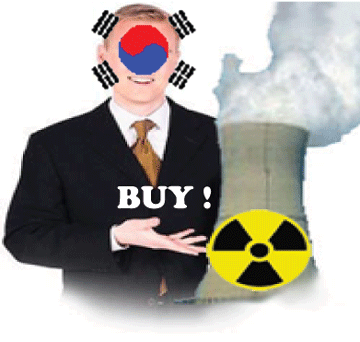
The Yoon Suk Yeol administration has scrapped the former Moon Jae-in administration’s nuclear phase-out policy based on the view that nuclear power is essential for the long-term sustainability of South Korea’s economy and its nuclear power industry
Settlement between Westinghouse and KEPCO is necessary for Washington-Seoul to expand alliance into nuclear energy
Korea Times, By Kim Yoo-chul 26 Feb 23,
Unlike the previous Moon Jae-in administration, President Yoon Suk Yeol and his foreign affairs team are clearly aiming to grow South Korea into a pivotal state given Seoul’s competitive standing to increase interoperability among a range of partners, specifically in the Indo-Pacific region.
This policy drive is backed by his administration’s concerted backing of Washington’s various protectionist industrial policies and regional security agenda items.
South Korea’s support of the Inflation Reduction Act (IRA), CHIPS and Science Act, the country’s participation in a U.S.-initiated Indo-Pacific Economic Framework (IPEF) and Chip 4 alliance are the examples signifying Seoul’s shift toward U.S. policies………………………….
Seoul’s backing of [U.S. President Joe] Biden’s signature industrial and regional security policies illustrates the fact that the country is prepared to withstand any economic and political costs by raising its profile as an advocate of major policy initiatives outlined and being managed by the U.S.’ partners and its like-minded allies,” a senior government official said in a telephone interview, adding that the majority of his comments do not necessarily reflect the official policy or position of South Korea.
Despite Seoul maintaining strategic cooperation with Beijing given its heavy reliance on the Chinese market _ China is the largest trading partner of South Korea _ and China’s huge political influence on North Korea, the Yoon administration’s apparent shift in position favoring the Biden administration’s moves to revive U.S. manufacturing, has so far been successful……………………………………..
Now, as the Biden administration has set its sights on boosting U.S. energy independence, the Yoon administration is hoping to expand its alliance with Washington into nuclear energy, in addition to batteries and chips, security analysts and company officials said.
SMRs emerge as option, legal troubles
The prime goal of the Inflation Reduction Act (IRA) is aimed at addressing rising inflation. However, the IRA also includes several tax incentives for clean energy technologies including advanced small modular reactors (SMRs). This means the IRA will possibly become a game changer for Washington’s participation in the new energy economy……………………
the IRA will have profound effects on South Korean nuclear energy and reactor companies, because they are in a better position to become one of the top beneficiaries of the act,” a trade ministry official said by telephone.
The Yoon Suk Yeol administration has scrapped the former Moon Jae-in administration’s nuclear phase-out policy based on the view that nuclear power is essential for the long-term sustainability of South Korea’s economy and its nuclear power industry. There are hopes that Yoon might reach a consensus with his U.S. counterpart on the sidelines of the Korean leader’s scheduled state-visit to the White House in late April to expand the Washington-Seoul alliance in the area of SMRs, industry sources told The Korea Times………….
U.S.-based Westinghouse and KEPCO, alongside KEPCO’s subsidiary Korea Hydro & Nuclear Power (KHNP), are involved in negotiations over their legal dispute after the U.S. company filed a lawsuit against KHNP in a U.S. federal court to block it from selling reactors to Poland. KEPCO and its subsidiary, KHNP, have been accused of infringing on Westinghouse’s intellectual property rights and Washington’s nuclear export controls.
“Reaching a settlement is highly likely before Yoon’s visit to the U.S. Westinghouse and KEPCO, along with KHNP, have until March 17 this year to address their legal issues. As nuclear technologies have also become a security issue, all parties involved in the legal dispute will have to find a compromise under the principle of reciprocity that won’t hurt national interests,” said Seok Kwang-hoon, a senior analyst at Energy Transition Korea. Westinghouse officials were not immediately available for comment.
“Westinghouse itself has no question about the significance of its commercial partnership with South Korea given the country’s supply chains for future AP1000 nuclear reactors. That means if the ongoing settlement negotiations fail, then this will impact Seoul’s efforts to win reactor deals from Poland and the Czech Republic, the countries categorized as South Korea’s target markets. It’s a plausible idea for South Korean companies to acquire Westinghouse’s property rights,” said Kim Sang-tae, a professor of nuclear engineering at Hanyang University in Seoul. https://www.koreatimes.co.kr/www/tech/2023/02/419_346075.html
Taro Kono also sounded the alarm about the dangers of spent fuel pools Attacks on nuclear power plants became a reality with the invasion of Ukraine

Taro Kono in Nagoya City on January 28, 2011.
February 22, 2023
It will be one year on the 24th since the Russian invasion of Ukraine. During this period, attacks on nuclear power plants shocked the world. When considering preparedness in Japan, the handling of spent nuclear fuel becomes important. Once it finishes its role in the reactor, it is mainly stored in storage pools, but that group and those politicians see the vulnerability of the pools as a problem. If they are left as they are now, they will become a “weak spot” in the event of an attack on a nuclear power plant, which could result in extensive damage. The Kishida administration should not focus its efforts only on nuclear power plant operation. (Naoaki Nishida and Yuichiro Yamada)
◆Russia targeted nuclear power plants immediately after the invasion.
On the 18th, the Institute for the Study of War, a U.S. think tank, expressed the following opinion: “The Russian media is advocating an attack on Ukraine’s nuclear facilities in order to cut off the power supply to the plants.
The next day, the 19th. The following day, on the 19th, the Ministry of Foreign Affairs of Ukraine issued a statement regarding the Zaporozhye nuclear power plant in Ukraine, which has been occupied by Russian troops and turned into a military base. It accused Russia of refusing to replace the International Atomic Energy Agency (IAEA) experts stationed there to ensure safety.
Attacks on the plant were feared early on. As early as last January, Sergiy Korsunsky, Ukraine’s ambassador to Japan, expressed concern. The bad predictions were right on target, and nuclear power plants were targeted immediately after the Russian invasion.
The attack continued, and a bomb landed near a spent nuclear fuel storage facility. The Russians claimed that they had been attacked from the Ukrainian side and that the greatest risk from the attack was not the reactor but the spent fuel storage facility.
Spent nuclear fuel, which can cause extensive damage, is made from uranium. It is used in nuclear reactors for four to five years and then removed.
According to Chihiro Uesawa of the Nuclear Data and Information Center, the amount of heat generated and radiation levels remain high even under these conditions. In Japan, the heat value is mainly stored in a storage pool inside the reactor building, and water is circulated to lower the heat value and other parameters.
Storage pools are not the only storage method. There is also a type of cask called a “dry cask,” which is cooled for five to six years in a pool and then placed in a metal container and cooled by air circulation. The sturdier casks are several steps ahead of the dry casks in terms of safety, but due to cost considerations, the use of dry casks is still on the road to widespread use. Compared to Europe, dry casks have lagged behind.
◆“Vulnerable to external attacks,” points out…
After the invasion of Ukraine, Yuki Kobayashi, a researcher at the Sasakawa Peace Foundation, has been raising the issue of the vulnerability of storage pools.
On the foundation’s website, he wrote, “The reactors are made of steel and are protected by a containment vessel, which has a certain degree of robustness against external attacks,” but he also pointed out that the spent fuel storage “often does not have a multiple protection system,” “is vulnerable to external attacks,” and “if the spent fuel is exposed to the atmosphere (e.g., because the water runs out), it will be exposed to high concentrations of radiation over a wide area. If the spent fuel is exposed to the atmosphere (e.g., when the water runs out), high concentrations of radiation will be emitted over a wide area.
When the hydrogen explosion occurred in the Unit 4 reactor of TEPCO’s Fukushima Daiichi Nuclear Power Plant, the possibility of an anomaly occurring in the spent nuclear fuel storage pool was discussed. When interviewed, Kobayashi said, “Even after the Fukushima accident, Japan had not decided what measures to take. It can be said that we were somewhat naive in our understanding of the situation.
The late Ryoichi Sasakawa was honorary chairman of the Sasakawa Peace Foundation. Shunichi Yamashita, vice president of Fukushima Medical University, is a trustee of the Sasakawa Health Foundation, another organization that is a descendant of the Sasakawa Peace Foundation. In a lecture after the Fukushima nuclear accident, he expressed his optimism, saying, “The effects of radiation will not come as long as you are smiling and laughing.
The Sasakawa Peace Foundation also warned of the vulnerability of the storage pools. Uesawa, mentioned above, also spoke of the vulnerability of the storage pool, saying, “If the storage pool and other facilities are destroyed in an emergency, the buildings will be inaccessible. This would cause an irreversible situation.
◆Taro Kono, who was a member of the opposition party, also called it “a potential weak point.
In the past, some have pointed out the fragility of the storage pools for spent nuclear fuel.
The vulnerability of the spent fuel pools became clear after 3.11.” “How will the security system be changed?”
The speaker was Taro Kono, the current digital minister. He is the current digital minister. In November 2011, a little more than six months after the accident at TEPCO’s Fukushima Daiichi Nuclear Power Station, he asked these questions at a meeting of the House of Representatives’ Committee on Monitoring the Settlement of Accounts. This was when he was a member of the opposition party. In September 2012, he wrote on his blog, “Nuclear reactors and spent fuel pools are potential weak points that could be targeted by terrorists or missiles.
Does he think the same way now as he did then? We asked him through his office, but had not received an answer by the evening of September 21.
So how is the Kishida administration handling the situation?
At a Lower House Budget Committee meeting last October, Katsuya Okada, secretary general of the Democratic Party of Japan’s Constitutional Democratic Party, asked, “Spent nuclear fuel in the pool is a real nuisance,” and “What would happen if a missile hit us? He asked that the spent fuel be removed from the storage pool and transferred to a dry cask in a metal container to increase protection.
In response, Yasutoshi Nishimura, Minister of Economy, Trade and Industry, said, “The Nuclear Regulation Authority is in charge of this issue centrally” and “METI would like to refrain from doing so.
◆The Nuclear Regulation Authority “is virtually unable to do so.
In March of last year, immediately after the invasion of Ukraine, Toyoshi Sarada, then chairman of the Regulatory Commission, said at a press conference that “we have no plan to discuss a facility that is robust against armed attack, and it is virtually impossible. He then went on to say that, in general terms, “dry casks are more defensible than spent fuel pools. Shinsuke Yamanaka, the current chairman of the committee, echoes this view.
A spokesperson for the Regulatory Commission said, “There is no change in our view that the Nuclear Reactor Regulation Law does not assume an armed attack. There is no indication that the Regulatory Commission has given a new directive to switch to dry casks as a counterterrorism measure,” he clarified.
Masashi Goto, a former nuclear power plant design engineer, said, “The power companies are planning to move to casks, but the fuel must be cooled in a pool after use before being moved. This takes a considerable amount of time,” he said, pointing out that as long as nuclear power plants continue to operate, storage in storage pools is an unavoidable problem.
He resents the Kishida administration’s bluntness, saying, “There are major risks, such as accidents and terrorism. Despite the existence of major risks, such as accidents and terrorism, the government has deemed the probability of their occurrence to be low and has failed to take effective countermeasures.
◆The nuclear fuel cycle is failing, but the government is moving forward with its utilization.
The amount of spent nuclear fuel stored at nuclear power plants in Japan is enormous. The amount of spent fuel stored at nuclear power plants in Japan is enormous, amounting to about 20,000 tons, most of which is kept in storage pools. The government has been pushing for the reuse of this fuel under the banner of the “nuclear fuel cycle,” but the completion of a reprocessing plant under construction in Rokkasho Village, Aomori Prefecture, has been postponed for some time. Even if the government wants to reduce the amount of nuclear fuel used for reuse, it has been unable to do so because the key facilities are not functioning.
The Kishida administration, however, is pushing forward with the use of nuclear power plants. It has taken the lead in allowing the operation of nuclear power plants for more than 60 years and in permitting the rebuilding of next-generation nuclear power plants. The amount of spent fuel stored in vulnerable pools will continue to increase, which will require more time and effort to protect.
The government is treating the spent fuel cycle as if it were still running, and is avoiding confronting the problem,” said Teru Honma, a professor at Aoyama Gakuin University. The government is treating it as if it is going around and avoiding facing the problem,” said Terumitsu Honma, Professor Emeritus of Nuclear Damage Compensation System at Aoyama Gakuin University.
The nuclear accident at Fukushima and the invasion of Ukraine have exposed the huge risks involved in operating nuclear power plants,” he continued. We have not taken responsibility for the unmanageable risks and costs. If we are going to make a decision to operate nuclear power plants, at the very least, we should take steps to address counterterrorism and safety measures that are a prerequisite.
◆Desk Memo
It is easy to imagine the fear of nuclear power plants becoming targets of spent fuel storage pools. It is also easy to imagine the damage to civilians that would result in the event of an attack. Despite this, discussions on preparedness have stalled. In contrast, the Self-Defense Forces are even discussing the possibility of moving their headquarters underground as a protective measure. Abandoning someone and protecting someone else. Is this the kind of country we are supposed to love? (Sakaki)
Mayor Hideki Toshima, a pro-nuclear power plant advocate, re-elected in Mihama, Fukui Prefecture. The Mihama NPP, the only nuclear plant already in operation for over 40 years

Hideki Toshima (center) was reelected unopposed as mayor of Mihama Town, Fukui Prefecture, on the afternoon of September 21.
February 21, 2023
Mihama Town in Fukui Prefecture, where Kansai Electric Power Co.’s Mihama Unit 3, the only nuclear power plant in Japan operating for more than 40 years, is located, announced the election of a new mayor on January 21.
There were no other candidates other than incumbent Hideki Toshima, 65, a pro-nuclear power plant advocate recommended by the Liberal Democratic Party, and he was reelected unopposed following the previous election in 2019.
Mr. Tojima said, “Sustainable use of nuclear energy is necessary for the future. We will promote the development of a town that coexists with nuclear power on the basic premise of ensuring safety and security,” he said. He answered questions from reporters in the town.
In June 2009, Mihama Unit 3 became the first nuclear power plant in Japan to be restarted after 40 years of operation, under the rule that in principle the plant should be in operation for 40 years, with a maximum extension of 20 years.
https://www.tokyo-np.co.jp/article/232442?rct=politics
Japan should consider shifting to direct disposal of nuclear waste

Vitrified radioactive waste in the storage facility at Rokkasho, Aomori Prefecture
February 20, 2023
The Kishida administration has unveiled a policy initiative to deal with high-level radioactive waste from nuclear power plants through “united government-wide” efforts.
The government plans to step up its efforts to find a local government willing to host a final disposal site for nuclear waste. The government should naturally assume the responsibility of dealing with this problem, but it should not pressure local governments to host a disposal facility.
According to the draft revision to the basic policy for tackling the problem, which was announced earlier in February, the government will set up a “council for discussions” with interested local governments to discuss the challenges and possible policy responses.
Based on these talks, the national government will propose in stages to local administrations to accept a survey for a disposal site.
Under the current basic policy, the Ministry of Economy, Trade and Industry published in 2017 a map of the nation showing potential areas for locating a deep geological disposal site. At this site, spent fuel would be buried in engineered facilities 300 or more meters below ground level.
The initial phase of assessing two municipalities in Hokkaido for their suitability to host such a disposal facility began three years ago. The first stage of the process, called “bunken chosa” (literature survey), involves reviews of geological maps and research papers concerning local volcanic and seismic hazards and other related factors.
No other municipalities have yet to volunteer for undertaking this process.
High-level radioactive waste from spent nuclear fuel, however, is not the only kind of nuclear waste that must be disposed of. Other types of nuclear waste include materials from decommissioned reactors and melted “fuel debris” from the stricken Fukushima No. 1 nuclear power plant, which has been left untreated.
One inconvenient fact for supporters of nuclear power generation is that no solution has been found as to where all these kinds of nuclear waste should be disposed of.
At nuclear power plants across the nation, growing amounts of spent nuclear fuel are fast filling up the spent fuel pools within the premises, with not much room left. Operating nuclear plants will eventually start generating spent fuel that cannot be stored anywhere.
The government’s move to accelerate its program to build a final disposal site is aimed at defusing criticism about its policy shift toward expanding nuclear power generation by signaling a willingness to tackle these policy challenges.
Since there is already a large amount of spent nuclear fuel, a disposal site is clearly necessary. A broad consensus on the issue should be built through debate involving the entire nation, including citizens of major cities who consume huge amounts of electricity.
It would be better for such a debate to be held at an independent organization that is separated from the industry ministry, which promotes the use of atomic energy. The law for regulating measures related to the final disposal of radioactive waste should be reviewed for necessary revisions.
Since Article 1 of the law refers to the “proper use of nuclear power,” the construction of a final disposal facility could justify the long-term use of nuclear power.
That would mean nuclear plants will keep producing spent fuel for decades to come. This prospect will make local communities that may host the disposal facility concerned about the possibility that radioactive waste may be brought to the site without end.
The law is based on the assumption that a nuclear fuel reprocessing system to recover plutonium and uranium from spent nuclear fuel to be reused in reactors will be established.
Northern Europe and many other countries with an advanced program to deal with radioactive waste have adopted the approach known as direct disposal, a management strategy where used nuclear fuel is disposed of in a deep underground repository, without any recycling.
Instead of adhering to the now unworkable program to establish a fuel recycling system, the government should designate direct disposal as a realistic option.
This is the time to fundamentally rethink the law, which was enacted more than two decades ago without much serious debate, taking into consideration the experiences of the Fukushima nuclear disaster.
China calls for Russia to not go down the ‘nuclear weapons route’
DFAT Australia China Council Scholar Andrew Phelan says that China has called for Russia to ‘leave nuclear power plants’ and not pursue the ‘nuclear weapons route’ in a 12-point peace plan released this afternoon.
“There are a couple of good things about it,” Mr Phelan told Sky News host Caleb Bond.
North Korea test-fires four missiles to show ability to launch nuclear attack
Guardian, 24 Feb 23,
Strategic cruise missiles hit a target after travelling 2,000km, says state media, to demonstrate ‘war posture’ of nuclear force.
North Korea test-fired four strategic cruise missiles during a drill designed to demonstrate its ability to conduct a nuclear counterattack against hostile forces, its state media said.
The exercise on Thursday involved an apparently operational strategic cruise missile unit of the Korean people’s army, which fired the four Hwasal-2 missiles in the area of Kim Chaek city, North Hamgyong province, towards the sea off the east coast of the Korean peninsula, the news agency KCNA said. Other units conducted firepower training at hardened sites without live firing.
The four strategic cruise missiles hit a preset target after travelling the “2,000km-long [1,243-mile] elliptical and eight-shaped flight orbits for 10,208 seconds to 10,224 seconds”, the English-language report said.
The drill demonstrated “the war posture of the DPRK nuclear combat force bolstering up in every way its deadly nuclear counterattack capability against the hostile forces”, KCNA said…………………………. more https://www.theguardian.com/world/2023/feb/24/north-korea-test-fires-four-missiles-to-show-ability-to-launch-nuclear-attack
1 This Month



26 September – International Day for the Total Elimination of Nuclear Weapons


PLEASE OPPOSE HR 8255 AND S.3639 – bills would accelerate satellite deployment, with no environmental review or safeguards – https://ncstd5li.quorum.us/campaign/169331/
To see nuclear-related stories in greater depth and intensity – go to https://nuclearinformation.wordpress.com
-
Archives
- September 2026 (233)
- August 2026 (330)
- July 2026 (355)
- June 2026 (287)
- May 2026 (306)
- April 2026 (356)
- March 2026 (251)
- February 2026 (267)
- January 2026 (308)
- December 2025 (358)
- November 2025 (359)
- October 2025 (375)
-
Categories
- 1
- 1 NUCLEAR ISSUES
- business and costs
- climate change
- culture and arts
- ENERGY
- environment
- health
- history
- indigenous issues
- Legal
- marketing of nuclear
- media
- opposition to nuclear
- PERSONAL STORIES
- politics
- politics international
- Religion and ethics
- safety
- secrets,lies and civil liberties
- spinbuster
- technology
- Uranium
- wastes
- weapons and war
- Women
- 2 WORLD
- ACTION
- AFRICA
- Atrocities
- AUSTRALIA
- Christina's notes
- Christina's themes
- culture and arts
- Events
- Fuk 2022
- Fuk 2023
- Fukushima 2017
- Fukushima 2018
- fukushima 2019
- Fukushima 2020
- Fukushima 2021
- general
- global warming
- Humour (God we need it)
- Nuclear
- RARE EARTHS
- Reference
- resources – print
- Resources -audiovicual
- Weekly Newsletter
- World
- World Nuclear
- YouTube
-
RSS
Entries RSS
Comments RSS
 nuclear-news