Data rewriting and erroneous statements…Sloppy handling continues at Tsuruga Nuclear Power Plant Unit No.2 of JAERI, Regulatory Commission suggests termination of review if no improvement is made

Tsuruga Nuclear Power Plant (photo taken in January 2021)
December 19, 2022
At a special meeting on December 19, the Nuclear Regulation Authority (NRA) exchanged opinions with Mamoru Muramatsu, president of Japan Atomic Power Company (JAERI), and others regarding the review of Tsuruga Unit 2 (Fukui Prefecture), where inappropriate rewriting of geological data was discovered. Shinsuke Yamanaka, chairman of the regulatory commission, said that if the data is not improved in the future, “the commission will have to discuss whether to continue the examination,” and indicated that he would consider suspending or terminating the examination.
The rewriting of the data was discovered in February 2020 when the regulatory commission pointed it out. In order to determine whether the fault directly under the reactor building was an active fault that could cause an earthquake, the state of the geological strata taken out by drilling was rewritten in 80 locations. Many other errors were also found.
The regulatory commission’s examination, which had been suspended, resumed on March 9 because the company had established rules for entering data, but at that time, new errors were also found. The number of errors in the data has totaled 1,296 so far.
At the meeting, Akira Ishiwata, a member of the committee in charge of reviewing earthquake and tsunami countermeasures, said, “There are 1,300 errors, and only JAEPCO would submit such materials. If there are any more errors, it will be difficult to continue the examination. Mr. Yamanaka expressed his distrust, asking, “Are they sure about their technical capabilities? (Nozomi Masui)
https://www.tokyo-np.co.jp/article/220955?fbclid=IwAR0zWkMDa8kLYoQqx-3FpsSe9F3BX2-Wui23ftKuWyptnwDgOWydI2QcdWU
Fukushima, Our ongoing accident.
Dec 19, 2022
What happens to the damaged reactors? The territories evacuated by 160 000 people? What are the new conditions for their return to the contaminated area since the lifting of the governmental aid procedures? Are lessons still being learned by our national operator for its own nuclear plants? We must not forget that a disaster is still unfolding in Japan and that EDF was supposed to upgrade its fleet on the basis of this feedback, which has still not been finalized.
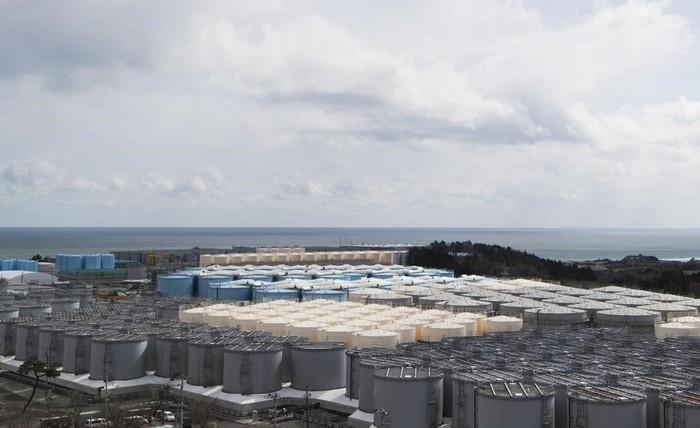
Almost twelve years after the Fukushima disaster, Japan is still in the process of dismantling and ‘decontaminating’ the nuclear power plant, probably for the next thirty to forty years as well. In the very short term, the challenges are posed by the management of contaminated water.
- All the contaminated water will be evacuated into the sea, by dilution over decades
- Each intervention in the accident reactors brings out new elements
- This has an impact on the schedule and the efficiency of the means used
- At the same time, the Japanese government’s objective is to rehabilitate the contaminated areas at any cost
- None of the French reactors is up to date with its safety level according to the post-Fukushima measures promulgated
- Japan will resume its nuclear policy, time having done its work on memories
The great water cycle
Although Japanese politicians claim that they have finally mastered the monster, the colossal task of cleaning up the site is still far from being completed to allow for the ultimate dismantling, with the length of time competing with the endless financing.
After so many years of effort, from decontamination to the management of radioactive materials and maneuvers within the dismantled plant, the actions on site require more and more exceptional means, exclusive procedures, and unprecedented engineering feats (such as robotic probes), while the nuclear fuel inside continues to be cooled permanently by water (not without generating, to repeat, millions of liters of radioactive water).
But the hardest part is yet to come: containing the corium, an estimated 880 tons of molten radioactive waste created during this meltdown of the reactor cores, and managing the thousands of fuel rods. So much so that the complete cleanup and dismantling of the plant could take a generation or more for a total estimated cost of more than 200 billion dollars (according to an assessment published by the German insurer Munich Re, Japan is 150 billion euros), a low range since other estimates raise the bill between 470 and 660 billion dollars, which is not in contradiction with the costs of an accident projected by the IRSN in France.
The removal of this corium will remain the most essential unresolved issue for a long time. Without it, the contamination of this area will continue. In February 2022, the operator Tepco (Tokyo Electric Power Company Holdings Inc.) tried again to approach the molten fuel in the containment of a reactor after a few more or less unsuccessful attempts, the radioactivity of 2 sieverts/hour being the end of everything, including electronic robots. This withdrawal seems quite hypothetical, even the Chernobyl reactor has never been removed and remains contained in a sarcophagus.
(source: Fukushima blog and Japan’s Nuclear Safety Authority NRA)
Until that distant prospect arrives, the 1.37 million tons of water will have filled the maximum storage capacity. This water was used to cool the molten fuel in the reactor and then mixed with rainwater and groundwater. The treatment via an Advanced Liquid Processing System (ALPS) is touted as efficient, but does not remove tritium. Relative performance: Tepco has been repeatedly criticized for concealing and belatedly disclosing problems with filters designed to prevent particles from escaping into the air from the contaminated water treatment system: 24 of the 25 filters attached to the water treatment equipment were found to be damaged in 2021, an already known defect that resulted in no investigation of the cause of the problem and no preventive measures after the filters were replaced.
The management of this type of liquid waste is a problem shared by the Americans. On site, experts say that the tanks would present flooding and radiation hazards and would hamper the plant’s decontamination efforts. So much so that nuclear scientists, including members of the International Atomic Energy Agency (IAEA) and the Japanese Nuclear Regulatory Authority, have recommended controlled release of the water into the sea as the only scientifically and financially realistic option.
In the end, contaminated water would have to be released into the sea through an underwater tunnel about a kilometer offshore, after diluting it to bring the concentration of tritium well below the percentage allowed by regulation (the concentration would be below the maximum limit of tritium recommended by the World Health Organization for drinking water). Scientists say that the effects of long-term, low-dose exposure to tritium on the environment and humans are still unknown, but that tritium would affect humans more when consumed in fish. The health impact will therefore be monitored, which the government already assures us it is anticipating by analyzing 90,000 samples of treated water each year.
Assessment studies on the potential impact that the release of stored contaminated water into the ocean could have therefore seem insufficient. For tritium, in the form of tritiated water or bound to organic matter, in addition to its diverse behavior according to these configurations, is only part of the problem. Some data show great variability in the concentrations of contaminants between the thousand reservoirs, as well as differences in their relative quantities: some reservoirs that are poor in tritium are rich in strontium 90 and vice versa, suggesting a high variability in the concentrations of other radionuclides and a dilution rate that is not so constant. All the ignorance currently resides on the still unknown interactions of the long-lived radioactive isotopes contained in the contaminated water with the marine biology. It is in order to remove all questions that a complete and independent evaluation of the sixty or so radioisotopes is required by many organizations.
As it stands, with the support of the IAEA so that dilution meets expectations, depending on currents, flows …, the release of contaminated materials would take at least forty years. Opponents of such releases persist in proposing an alternative solution of storage in earthquake-resistant tanks in and around the Fukushima facility. For them, “given the 12.3-year half-life of tritium for radioactive decay, in 40 to 60 years, more than 90% of the tritium will have disappeared and the risks will be considerably reduced,” reducing the direct nuisance that could affect the marine environment and even the food chain.
Modelling of marine movements could lead the waste to Korea, then to China, and finally to the Federated States of Micronesia and Palau. As such, each of the impacted countries could bring an action against Japan before the International Tribunal for the Law of the Sea to demand an injunction or provisional measures under international law.
Faced with these unresolved health issues, China, South Korea, Taiwan, local fishing communities continue to oppose this management plan, but the work is far from being completed and the problem of storage remains. Just like the ice wall built into the floor of the power plant, the release of contaminated water requires huge new works: the underwater pipe starts at about 16 meters underground and is drilled at a rate of five to six meters per day.
Time is of the essence. The tanks should reach their maximum capacity by the fall of 2023 (the volume of radioactive water is growing at a rate of about 130 to 140 tons per day). But above all, it is necessary to act quickly because the area is likely to suffer another earthquake, a fear noted by all stakeholders. With the major concern of managing the uranium fuel rods stored in the reactors, the risks that radioactivity will be less contained increase with the years.In France, releases to the sea are not as much of a problem: the La Hague waste reprocessing site in France releases more than 11,000 terabecquerels per year, whereas here we are talking about 22 terabecquerels that would be released each year, which is much less than most of the power plants in the world. But we will come back to this atypical French case…
Giant Mikado
The operator Tepco has successfully removed more than 1500 fuel bundles from the reactor No. 4 of the plant since late 2014, but the hundreds still in place in the other three units must undergo the same type of sensitive operation. To do this, again and again, undertake in detail the clearing of rubble, the installation of shields, the dismantling of the roofs of buildings and the installation of platforms and special equipment to remove the rods… And ultimately decide where all the fuel and other solid radioactive debris will have to be stored or disposed of in the long term. A challenge.
The fuel is the biggest obstacle to dismantling. The solution could lie, according to some engineers, in the construction of a huge water-filled concrete tank around one of the damaged reactors and to carry out the dismantling work in an underwater manner. Objectives and benefits? To prevent radiation from proliferating in the environment and exposing workers (water is a radiation insulator, we use this technique in our cooling pools in France) and to maximize the space to operate the heavy dismantling equipment being made. An immersion solution made illusory for the moment: the steel structure enveloping the building before being filled with water is not feasible as long as radiation levels are so high in the reactor building, preventing access by human teams. In short, all this requires a multitude of refinements, the complexity of the reactors adding to the situations made difficult by the disaster.
Experience, which is exceptional in this field, is in any case lacking. What would guarantee the resistance of the concrete of the tanks over such long periods of time, under such hydraulic pressures? The stability of the soils supporting such structures? How can the concrete be made the least vulnerable possible to future earthquakes? How to replace them in the future?

All these difficulties begin to explain largely the delays of 30 to 40 to dismantle. The reactors are indeed severely damaged. And lethal radiation levels equivalent to melted nuclear fuel have been detected near one of the reactor covers, beyond simulations and well above previously assumed levels. Each of the reactors consists of three 150-ton covers, 12 meters in diameter and 60 centimeters thick: the radiation of 1.2 sieverts per hour is prohibitive, especially in this highly technical context. There is also no doubt that other hotspots will be revealed as investigations are carried out at the respective sites. The Nuclear Damage Compensation and Decommissioning Facilitation Corporation (NDF), created in 2014, has the very objective of trying to formulate strategic and technical plans in order to proceed with the dismantling of said reactors. Given the physical and radiological conditions, the technical and logistical high-wire act.
Also, each plan is revised as information is discovered, as investigations are conducted when they are operable. For example, the reinforcing bars of the pedestal, which are normally covered with concrete, are exposed inside Reactor No. 1. The concrete support foundation of a reactor whose core has melted has deteriorated so badly that rebar is now exposed.
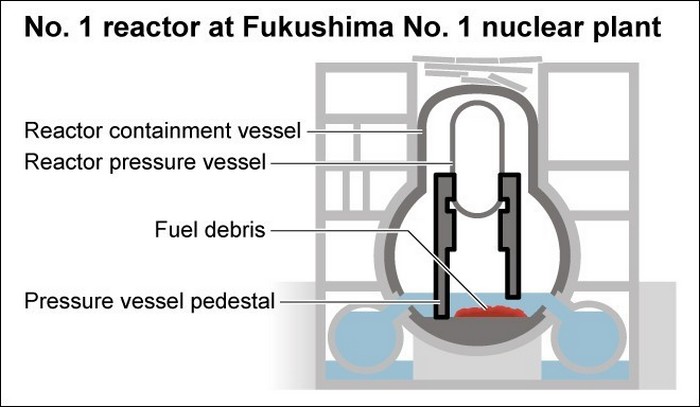
The cylindrical base, whose wall is 1.2 meters thick, is 6 meters in diameter. It supports the 440-ton reactor pressure vessel. The reinforcing rods normally covered with concrete are now bare and the upper parts are covered with sediment that could be nuclear fuel debris. The concrete probably melted under the high temperature of the debris. The strength of the pedestal is a major concern, as any defect could prove critical in terms of earthquake resistance.
Nothing is simple. The management of human material appears less complex.
Bringing back to life, whatever it takes
In the mountains of eastern Fukushima Prefecture, one of the main traditional shiitake mushroom industries is now almost always shut down. The reason? Radioactive caesium exceeding the government’s maximum of 50 becquerels per kilogram, largely absorbed by the trees during their growth. More than ten years after the nuclear disaster, tests have revealed caesium levels between 100 and 540 becquerels per kilogram. While cesium C134 has a radioactive half-life of about two years and has almost disappeared by now, the half-life of cesium C137 is about 30 years and thus retains 30% of its radioactivity 50 years after the disaster, and 10% after a century.
As more than two thirds of Fukushima prefecture is covered by forests, nothing seems favorable in the short term to get rid of all or part of the deposited radioactivity, as forests are not part of the areas eligible for ‘decontamination’, unlike residential areas and their immediate surroundings.
On the side of the contaminated residential and agricultural areas, ‘decontamination’ measures have been undertaken. But soil erosion and the transfer of contaminants into waterways, frequent due to typhoons and other intense rain events, are causing the radioactive elements to return, moving them incessantly. Scientists are trying to track radioactive substances to better anticipate geographical fluctuations in doses, but nothing is simple: the phenomena of redistribution of the initial contamination deposits from the mountains to the inhabited low-lying areas are eternal.
The Ministry of the Environment is considering the reuse of decontaminated soils (official threshold of 8,000 becquerels per kilogram), with tests to be conducted. For now, a law requires the final disposal of contaminated soil outside Fukushima Prefecture by 2045, which represents about 14 million cubic meters (excluding areas where radiation levels remain high). This reuse would reduce the total volume before legal disposal.
More generally, Japan has for some years now opted for the strategy of holding radiological contamination as zero and/or harmless. This is illustrated by the representative example of the financial compensation given to farmers, designed so that the difference between pre- and post-accident sales is paid to them as compensation for “image damage”, verbatim.
Finally, in the midst of these piles of scrap metal and debris, it is necessary to make what can be made invisible. Concerning radioactive waste for example, it must be stored in time. On the west coast of the island of Hokkaidō, the villages of Suttsu and Kamoenai have been selected for a burial project. Stainless steel containers would be stored in a vitrified state. But consultation with the residents has not yet been carried out. This is not insignificant, because no less than 19,000 tons of waste are accumulating in the accidental, saturated power plants, and must find a place to rest for hundreds of years to come.
In this sparsely populated and isolated rural area, as in other designated sites, to help with acceptance, 15 million euros are being paid to each of the two municipalities to start the studies from 2020. 53 million are planned for the second phase, and much more in the final stages. This burial solution seems inevitable for Japan, as the waste cannot remain at the level of the surface power plants and is subject at all times to the earthquakes that are bound to occur over such long periods (strong earthquakes have struck off the prefecture in 2021 and 2022). The degrees of dangerousness thus allow the government to impose a default choice, for lack of anything better.
On December 6, 2022, the Director General of the IRSN met with the President of Fukushima University and with a manager of the Institute of Environmental Radioactivity (IER). What was the objective? To show the willingness of both parties to continue ongoing projects on the effects of radioactive contamination on biodiversity and environmental resilience.
But France will not have waited for the health results of a disaster to learn and commit itself to take into account any improvement likely to improve the nuclear safety of its reactors. No ?
Experience feedback
After a few reactor restarts that marked a major change in its nuclear energy policy (ten nuclear reactors from six plants out of a total of fifty-four were restarted by June 2022), the Japanese government is nonetheless planning to build new generation nuclear power plants to support its carbon emission reduction targets. (A memorandum of understanding was signed by the Japan Atomic Energy Agency, Mitsubishi Heavy Industries and Mitsubishi FBR Systems with the American start-up TerraPower to share data for the Natrium fast neutron reactor project; the American company NuScale Power presented its modular reactor technology). But above all, the government is considering extending the maximum service life of existing nuclear reactors beyond 60 years. Following the disaster, Japan had introduced stricter safety standards limiting the operation of nuclear reactors to 40 years, but there is now talk of modernizing the reactors with safety features presented as “the strictest in the world”, necessarily, to meet safety expectations. Their program is worthy of a major refurbishment (GK).
But in France, where are we with our supplementary safety assessments?
The steps taken after the Fukushima disaster to reassess the safety of French nuclear facilities were designed to integrate this feedback in ten years. More than ten years after the start of this process of carrying out complementary safety assessments (CSA), this integration remains limited and the program has been largely delayed in its implementation.
Apparently, ten years to learn all the lessons of this unthinkable accident was not enough. Fear of the probable occurrence of the impossible was not the best motivation to protect the French nuclear fleet from this type of catastrophic scenario, based solely on these new standards. Concerning in detail the reality of the 23 measures identified to be implemented (reinforcement of resistance to earthquake and flooding, automatic shutdown in the event of an earthquake, ultimate water top-up for the reactor and cooling pool, detection of corium in the reactor vessel, etc.), the observation is even distressing: not a single reactor in operation is completely up to standard.
According to NegaWatt’s calculations, at the current rate of progress and assuming that funding and skills are never lacking, it would take until 2040 for the post-Fukushima standards to be finally respected in all French reactors. And even then, some of the measures reported as being in place are not the most efficient and functional (we will come back to the Diesels d’ultime secours, the DUS of such a sensitive model).
Even for the ASN, the reception of the public in the context of post-accident management could appear more important than the effectiveness of the implementation of the measures urgently imposed.
Then, let us complete by confirming that France and Japan have a great and long common history which does not stop in nuclear matters. Among this history, let us recall that Japan lacks facilities to treat the waste from its own nuclear reactors and sends most of it abroad, especially to France. The previous transport of highly radioactive Mox (a mixture of highly toxic plutonium oxide and reprocessed uranium oxide) to Japan dates back to September 2021, not without risk even for the British company specialized in this field, a subsidiary of Orano. The final request for approval for the completion of the Rokkasho reprocessing plant, an important partnership and technology transfer project, is expected in December 2022, although the last shipments to Japan suffered from defective products from Orano’s Melox plant, a frequent occurrence because of a lack of good technical homogenization of the products.
No one is immortal
In the meantime, the ex-managers of the nuclear power plant have been sentenced to pay 95 billion euros for having caused the disaster of the entire eastern region of Japan. They were found guilty, above all, of not having sufficiently taken into account the risk of a tsunami at the Fukushima-Daiichi site, despite studies showing that waves of up to 15 meters could hit the reactor cores. Precisely the scenario that took place.
Worse, Tepco will be able to regret for a long time to have made plan the cliff which, naturally high of 35 meters, formed a natural dam against the ocean and the relatively frequent tsunamis in this seismic zone. This action was validated by the Japanese nuclear safety authorities, no less culpable, on the basis of the work of seismologists and according to economic considerations that once again prevailed (among other things, it was a question of minimizing the costs of cooling the reactors, which would have been operated with seawater pumps).
The world’s fourth largest public utility, familiar with scandals in the sector for half a century, Tepco must take charge of all the work of nuclear dismantling and treatment of contaminated water. With confidence. The final total estimates are constantly being revised upwards, from 11,000 billion to 21,500 billion yen, future budgets that are borrowed from financial institutions, among others, with the commitments to be repaid via the future revenues of the electricity companies. A whole financial package that will rely on which final payer?
Because Tepco’s financial situation and technical difficulties are deteriorating to such an extent that such forty-year timetable projections remain very hypothetical, and the intervention of the State as a last resort is becoming more and more obvious. For example, the Japanese government has stated that the repayment of more than $68 billion in government funding (interest-free loans, currently financed by government bonds) for cleanup and compensation for the Fukushima Daiichi nuclear power plant disaster, owed by Tepco, has been delayed. Tepco’s mandatory repayments have been reduced to $270 million per year from the previous $470 million per year. It is as much to say that the envisaged repayment periods are as spread out as the Japanese debt is abysmal.
Despite this chaotic long-term management, the Japanese government has stated that it is considering the construction of the next generation of nuclear power plants, given the international energy supply environment and Japan’s dependence on imported natural resources. Once the shock is over, business and realpolitik resume.
On a human scale, only radioactivity is immortal.
In the Pacific, Outcry Over Japan’s Plan to Release FukushimaWastewater.
The proposal has angered many of Japan’s neighbors,
particularly those with the most direct experience of unexpected exposure
to dangerous levels of radiation. Tanks are storing radioactive water at the
Fukushima Daiichi nuclear power plant in Japan.
The government plans to
release the water, treated, but still slightly radioactive, into the
Pacific starting in spring 2023. Every day at the Fukushima Daiichi nuclear
plant in Japan, officials flush over a hundred tons of water through its
corroded reactors to keep them cool after the calamitous meltdown of 2011.
Then the highly radioactive water is pumped into hundreds of white and blue
storage tanks that form a mazelike array around the plant. For the last
decade, that’s where the water has stayed.
But with more than 1.3 million
tons in the tanks, Japan is running out of room. So next year in spring, it
plans to begin releasing the water into the Pacific after treatment for
most radioactive particles, as has been done elsewhere.
New York Times 30th Dec 2022
Japan’s Rokkasho nuclear reprocessing project delayed again – for the 26th time
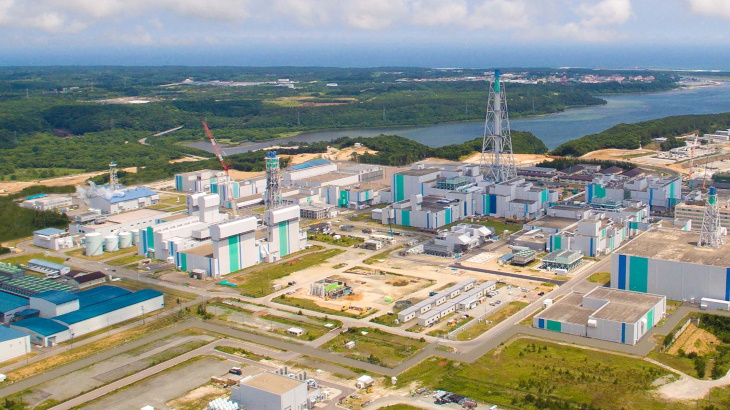
The completion of a nuclear fuel reprocessing plant in Aomori Prefecture
will be delayed by two years, the 26th postponement since the project
started three decades ago.
Senior officials with Japan Nuclear Fuel Ltd.,
operator of the facility under construction, said the new completion date
will be in the first half of fiscal 2024. The officials visited the Aomori
prefectural government and the village hall of Rokkasho, the site of the
plant, on Dec. 26 to explain the situation.
An earlier completion timeframe
was listed as in the first half of fiscal 2022. But the company in
September postponed this deadline without giving a new date. It said
prolonged safety checks of the facility by the Nuclear Regulation Authority
made it difficult to do so and pledged to announce the new deadline by the
year-end.
According to Japan Nuclear Fuel’s latest estimate, the NRA’s
screening of the detailed design of the plant will take about a year, while
checks of the plant will take four to seven months after it clears the
safety standards. The company said it will work hard to move up the
completion to an early date of the first half of fiscal 2024.
Asahi Shimbun 27th Dec 2022
North Korea says it will boost nuclear warhead production ‘exponentially’, as another missile fired
ABC News 1 Jan 2023, North Korean leader Kim Jong Un has vowed to increase the production of nuclear warheads “exponentially” and build a more powerful intercontinental ballistic missile, state media reports, signalling deepening animosities with the United States, South Korea and others.
Key points:
- Kim Jong Un said his country would be “doubling down” on building military power
- He said this was in response to the “dangerous military moves” of the US and “other hostile forces”
- His statement came hours after North Korea fired another ballistic missile on Sunday
Mr Kim’s statement at a key ruling party meeting was released hours after North Korea fired a ballistic missile toward its eastern waters, entering 2023 with another weapons test following a record number of missile firings last year…………………………………………………………….. more https://www.abc.net.au/news/2023-01-01/north-korea-to-boost-nuclear-warhead-production-exponentially/101820160
Under pressure from Washington, Japan rearms
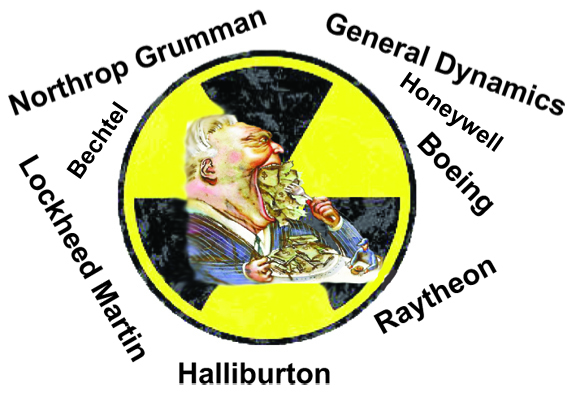
U.S. corporate power is the immediate beneficiary of this sharp turn in policy, built on military threats and economic sanctions.
JAPAN REARMS UNDER WASHINGTON’S PRESSURE, Popular Resistance, By Sara Flounders, Workers World. December 29, 2022
A Wake-Up Call To The Antiwar Movement.
The Dec. 16 announcement by Japan’s Prime Minister Fumio Kishida of a new defense strategy, while doubling military spending by 2027 to implement it, is the largest defense shake-up in decades and a wake-up call to the antiwar movement.
The decision includes openly acquiring offensive weapons and reshaping its military command structure for its expanded armed forces. On Dec. 23, the draft budget was approved by Kishida’s cabinet.
Japan’s dangerous military expansion should set off international alarm bells. This major escalation is taking place based on intense U.S. imperialist pressure. It is the next step in the “Pivot to Asia,” aimed at threatening and surrounding China and attempting to reassert U.S. dominance in the Asia Pacific.
The movements opposing endless U.S. wars must begin to prepare material and draw mass attention to this ominous threat.
The plan to double military spending will add $315 billion to Japan’s defense budget over the next five years and make Japan’s military the world’s third largest, after the U.S. and China. Defense spending will escalate to 2% of gross domestic product, equal to the goal the U.S. sets for its NATO allies. Japan’s economy is the world’s third largest.
The Japanese government plans to buy up to 500 Lockheed Martin Tomahawk missiles and Joint Air-to-Surface Standoff Missiles (JASSM), procure more naval vessels and fighter aircraft, increase cyber warfare capabilities, manufacture its own hypersonic guided missiles and produce its own advanced fighter jets, along with other weapons. The plan shifts from relying solely on missile defense to also embracing “counterstrike” capabilities.
Three key security documents — the National Security Strategy (NSS), as well as the National Defense Strategy (NDS) and the Defense Buildup Program (DBP) — shed some of the postwar constraints on the Japanese military.
Article 9 – a class struggle against military rearmament
Although the U.S. occupation force, after defeating Japan’s military in World War II, imposed a “pacifist” constitution on Japan, for decades now U.S. strategists have pressured Japan’s government to aggressively rearm, and especially to buy U.S.-made weapons, to act as a junior partner to U.S. efforts to dominate the Asia-Pacific region.
Article 9 of the imposed Japanese constitution prohibits Japan from maintaining an army, navy and air force. To get around this, the “Japanese Self-Defense Forces” (JSDF) have since 1952 been treated as a legal extension of the police and prison system. The U.S. occupiers considered the JSDF an essential repressive tool defending capitalist property relations against the workers’ movement.
The decision for aggressive military expansion is in open violation of Japan’s supposedly pacifist constitution……………………………………
Targeting China
Japan’s military expansion fits in with Washington’s aggression aimed at China, the DPRK and Russia. U.S. strategists’ goal is to use the U.S. alliance with Japan, South Korea and Australia, just as it uses the U.S.-led NATO alliance in Europe………………………..
China is Japan’s largest trading partner in both imports and exports. Previous National Strategy Documents said Japan was seeking a “mutually beneficial strategic partnership” with China. Suddenly Japanese strategists started labeling China “the greatest strategic challenge in ensuring the peace and security of Japan.” (U.S. Institute of Peace, Dec. 19)………..
U.S. praise of Japan’s rising militarism
The U.S. media praised Japan’s new security strategy document as a “bold and historic step.” U.S. National Security Advisor Jake Sullivan praised the defense spending hike, which “will strengthen and modernize the U.S.-Japan alliance.” U.S. Secretary of State Antony Blinken called Japan an “indispensable partner” and cheered that the changed security documents reshape the ability to “protect the rules-based order in the Indo-Pacific region and around the world.” (quotes, whitehouse.gov, Dec. 16)
U.S. corporate power is the immediate beneficiary of this sharp turn in policy, built on military threats and economic sanctions………………………………………………………………….
Having goaded Russia into an invasion of Ukraine in a bid to weaken and fragment Russia, the U.S. is next seeking to turn Taiwan into a military quagmire for China. The Biden administration is facilitating Taiwan’s purchase of advanced weaponry from the U.S. and greater diplomatic ties with the island. https://popularresistance.org/japan-rearms-under-washingtons-pressure-%E2%88%92-a-wake-up-call-to-the-antiwar-movement/
EDITORIAL: Without national debate, radical nuclear policy shift intolerable

But the most fundamental and intractable challenge is how to deal with spent nuclear fuel and radioactive waste from nuclear plants, inevitable byproducts of nuclear power generation.
The grim reality is that there is no prospect for establishing a nuclear fuel recycling system or securing a site for final disposal of nuclear waste in the foreseeable future.
Let us not forget the lessons of the 2011 nuclear disaster and consider how best to fulfill our responsibility to future generations.
https://www.asahi.com/ajw/articles/14800117 December 23, 2022
Prime Minister Fumio Kishida is embarking on yet another radical policy shift without weighing the possible consequences. The government devised new policy guidelines for expanding the use of nuclear energy while turning a blind eye to fundamental and intractable issues that inevitably will result. It also failed to address a host of doubts and questions.
The Kishida administration spent only four months on this policy initiative without making any serious effort to win broad public support. The attempt to chip away at important policy principles comes on the heels of its recent decision to drastically beef up Japan’s defense capabilities.
The administration’s new agenda calls for accelerating the process of restarting idled nuclear reactors, extending the life span of aging reactors and constructing new ones to replace moribund facilities. It deviates sharply from the restrictive policy in place since the 2011 Fukushima nuclear disaster. We beg the administration to retract this unacceptable policy about-face.
RASH MOVE BASED ON DUBIOUS LOGIC
Kishida in late August called for debate on promoting nuclear power generation. He did not mention any potentially controversial key elements of the proposal during the July Upper House election, such as “reconstruction” of old reactors, even though this represents a major regime shift. After the election, the administration raced to develop new policy guidelines in a manner that were far from democratic.
It amounts to keeping the nation heavily dependent on nuclear energy for decades to come. This will hollow out the principle of reducing the nation’s reliance on nuclear power “as much as possible,” which has been upheld since the catastrophic triple meltdown more than a decade ago.
The administration is also using distorted logic and dubious arguments to support the policy change.
Kishida cited the “ongoing crisis” of a power crunch and rush to realize a carbon-neutral future as reasons for expanding the use of nuclear power.
But the government’s plan to promote nuclear power generation will not help ride out the current energy crisis. Restarting an offline reactor requires following established procedures, so this approach will not increase the nation’s power supply quickly or significantly. Extending the life span of aging reactors and building new ones to replace those destined to be decommissioned will only start producing benefits after 10 or more years. The outlook of these plans is murky and a strong case cannot be made for rushing into the decision.
The government also has its policy priorities askew. The overriding priority is to secure a stable energy supply and reduce the nation’s carbon footprint. This should be accomplished by promoting domestic renewable energy sources, not on expanding nuclear power generation. The government has promised to develop renewable energy into a major power source. It should first make all-out efforts to ramp up power generation using renewable energy sources and, if shortages remain, consider ways to tap other energy sources.
NUMEROUS QUESTIONS UNANSWERED
The proposal to bolster nuclear power generation raises numerous questions.
The older a reactor grows the more uncertain its safety becomes. The legal life span of a nuclear reactor is 40 years in principle but can be extended to 60 years in certain cases. This rule was introduced under a bipartisan agreement after the disaster at the Fukushima No. 1 nuclear plant and incorporated into the related law under the jurisdiction of the Nuclear Regulation Authority (NRA).
But the government has decided to transfer this rule to the jurisdiction of the Ministry of Economy, Trade and Industry, which champions nuclear power generation. The move is aimed at paving the way for extending the life span of reactors beyond the 60-year limit by establishing a new system of periodical reactor inspections for safety checks at intervals of 10 years or less. This amounts to nothing more than a fait accomplis to secure reactor operations beyond 60 years without engaging in meaningful policy debate. It could also gut the principle of “the separation between promotion and regulation.”
Rebuilding aged reactors is also questionable from an economic viewpoint. The cost of building new reactors keeps ballooning. The government has offered to subsidize the costs in response to a request from the power industry. That could lead to an excessive and unreasonable financial burden on the public.
The government’s plan also calls for developing and constructing “next-generation innovative reactors.” The only next-generation innovative reactor that appears technologically feasible in the near term, however, is a conventional light-water reactor equipped with a better safety mechanism than the current version. These reactors are already in operation in some countries. But it remains doubtful whether this is really a safety innovation.
In addition to Japan’s susceptibility to major natural disasters, potentially grave nuclear safety hazards include its ability to deal with a a possible military attack like the one that occurred in Ukraine.
But the most fundamental and intractable challenge is how to deal with spent nuclear fuel and radioactive waste from nuclear plants, inevitable byproducts of nuclear power generation.
The grim reality is that there is no prospect for establishing a nuclear fuel recycling system or securing a site for final disposal of nuclear waste in the foreseeable future.
The new nuclear policy guidelines offer no answers to these questions. Just as it did in making a radical shift in the nation’s security policy, the Kishida administration is taking advantage of public anxiety to rush headlong into a major nuclear policy change by simply stressing the benefits of the move without responding to legitimate questions and concerns.
The four-month process of making the decision on this policy change indicates the government only acted in line with predetermined conclusions and a certain timeframe in mind.
LESSONS OF FUKUSHIMA
The advisory council for the industry ministry that discussed the proposal did not even scrutinize the core question of how nuclear power generation will help secure a stable energy supply, which is supposed to be the core purpose of the new policy initiative.
Instead, the panel spent ages discussing approaches to extending the life of reactors and building new ones, apparently on the assumption that promoting nuclear power is a given.
Members of the panel were mostly proponents of expanded use of atomic energy. A small number who remained cautious called for national debate on the matter over the next 12 months, but the idea was brushed aside.
Nuclear power remains a sharply divisive policy issue. Ensuring stability in this field requires broad public support. If the government gives short shrift to the process of listening to a wide range of views to build broad public consensus, it cannot hope to recover public trust in its nuclear policy that was dashed by the disaster.
The government says it will solicit public opinions and hold meetings with concerned parties to alleviate any fears. But such steps would be meaningless if they are intended only to placate disgruntled citizens to ease the political pressure of opposition.
Meaningful debate requires the involvement of a wider spectrum of experts, including those who have no interest in nuclear power generation and those who remain skeptical. The country deserves a meticulous and multifaceted debate on all key issues and questions, including whether it is really vital to produce more electricity with nuclear power to achieve a carbon-free future.
The Diet has an important role to play. All the political parties should start independent discussions on this issue.
Any rash change in nuclear policy is unacceptable. Let us not forget the lessons of the 2011 nuclear disaster and consider how best to fulfill our responsibility to future generations.
METI panel of experts approves policy of extending operating period and promoting rebuilding of nuclear power plants
December 16, 2022
The Ministry of Economy, Trade, and Industry (METI) has approved a proposal for the utilization of nuclear power plants by the Ministry of Economy, Trade, and Industry (METI), which focuses on the reconstruction (replacement) of nuclear power plants that the government has kept under wraps following the TEPCO Fukushima Daiichi nuclear accident, at a meeting on December 16. This is a clear shift in nuclear energy policy only less than five months after Prime Minister Fumio Kishida’s order, amid the ongoing restoration work from the Fukushima accident and compensation for the victims of the disaster. The government will make a formal decision at the Green Transformation (GX) Implementation Conference to be held before the end of the year.

At a meeting of the Basic Policy Subcommittee of the Advisory Committee on Natural Resources and Energy, Yasutoshi Nishimura, Minister of Economy, Trade, and Industry, said, “We would like to move forward with concrete steps to rebuild the reactors we have decided to decommission into next-generation innovative reactors (next-generation nuclear power plants)” on the premise that safety is assured and local governments understand the situation.
The law was amended after the Fukushima accident to limit the operating period of nuclear power plants to “40 years in principle, with a maximum of 60 years,” but by excluding the shutdown period due to the Nuclear Regulation Authority’s review and other factors, it will be possible to operate nuclear power plants for over 60 years. The government is expected to submit the revised bill to the ordinary Diet session next year.
At the end of July, the prime minister had ordered a study of measures to ensure a stable energy supply toward a decarbonized society. (Shinichi Ogawa)
◆An overwhelming majority of committee members advocate the promotion of nuclear power generation
On July 16, the Ministry of Economy, Trade, and Industry (METI) held a meeting of its experts, the Subcommittee on Basic Policy of the Advisory Committee on Natural Resources and Energy, and approved the ministry’s policy, which focuses on rebuilding (replacing) nuclear power plants and allowing them to operate for 60 years or longer. The committee approved the policy. While an overwhelming majority of the committee members advocated the promotion of nuclear power plants, only one member called for careful discussion.
At 1:00 p.m. in a conference room on the 17th floor of the Ministry of Economy, Trade and Industry (METI) in Kasumigaseki, Tokyo. Eighteen of the 21 committee members were present, including online, and three were absent. In addition to METI Minister Yasutoshi Nishimura, the meeting was attended by executives including Hosaka Shin, director general of the Agency for Natural Resources and Energy.
The METI officials explained that the public discussion should be held over a period of about one year. The only one who “waited” on the METI’s proposed policy on the use of nuclear power plants was Ms. Chisato Murakami, an advisor to the committee on consumer affairs. Murakami also criticized the ministry’s approach to the discussion, saying that it was “too hasty” at another METI expert panel meeting on the nuclear energy subcommittee, which discussed the use of nuclear power plants in detail.
Each committee member had five minutes to express his or her opinion. The other committee members supported METI’s policy, calling it “groundbreaking. Shuzo Sumi, a member of the committee and Senior Advisor to Tokio Marine & Nichido Fire Insurance, commented, “Construction of nuclear power plants has been halted for more than 10 years. We need to make a decision now in terms of human resources and industry.
Commissioner Takeo Tachibanagawa, Vice President of Kokusai University, said that while nuclear power plants are necessary, he disagreed with the current policy. He pointed out the contradiction in the policy, saying, “Extending the operation of nuclear power plants will postpone the construction of next-generation innovative reactors (next-generation nuclear power plants), which will cost about 1 trillion yen. He also questioned the policy guideline, the Basic Energy Plan, which calls for renewable energy to be the main source of power, but “there was not much talk about renewable energy.
The meeting ended in two hours, 30 minutes earlier than scheduled. The executives of the Agency for Natural Resources and Energy, who had been looking at each other sternly, left the meeting room looking relaxed and chatting with the committee members. (The meeting ended 30 minutes early.)
https://www.tokyo-np.co.jp/article/220394
No nuclear power plant in the world has been in operation for more than 60 years. Troubles continue to occur
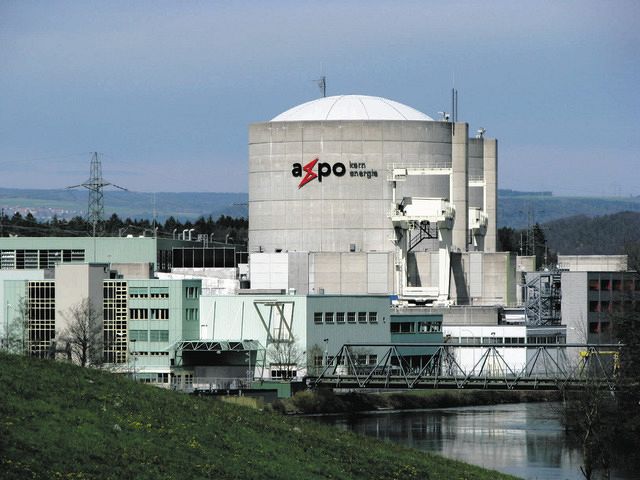
Beznau nuclear power plant in northern Switzerland in 2012, after 53 years of operation.
December 9, 2022
The draft action guidelines for the utilization of nuclear power plants, which were discussed at the METI’s experts’ meeting on December 8, would maintain the current restriction on the operating period and allow operation beyond the “maximum 60 years,” with a view to eliminating the limit in the future. However, there is not a single example in the world of a nuclear power plant that has operated for more than 60 years. In Japan, there has been a string of troubles due to equipment deterioration, and the Nuclear Regulation Authority is having a hard time regulating this “unexplored area. (The Nuclear Regulation Authority of Japan is having a hard time regulating this “unexplored area.)

A thin piece of iron rust (triangle in the center) stuck in a pipe (bottom right) inside the steam generator at the Takahama Unit 4 nuclear power plant in Fukui Prefecture (courtesy of Kansai Electric Power Co.).
According to the International Atomic Energy Agency (IAEA), the longest operating period of a nuclear power plant in the world, including those that have already been decommissioned, is 53 years and one month for India’s Tarapur reactors Nos. 1 and 2. All four reactors are still in operation.
Like Japan, the U.S. has a 40-year operating period, but if a plant passes a regulatory review, it can be extended for 20 years, and there is no limit to the number of extensions. In the U.K. and France, there is no upper limit to the operating period, and a review is required every 10 years.
However, many nuclear power plants were designed and built with a 40-year service life in mind. As nuclear power plants age, maintenance and management costs become higher, and many operators are likely to choose decommissioning over long-term operation.
Even nuclear power plants in Japan that are less than 40 years old are experiencing problems due to deterioration.
Since 2018, KEPCO’s Takahama Units 3 and 4 (Fukui Prefecture), which have been in operation for 37 years, have experienced a series of troubles in which flakes of iron rust have accumulated in the steam generators connected to the reactors over many years of operation, hitting and damaging pipes. The problem was confirmed six times during regular inspections and recurred even after the steam generators were cleaned.
Even more serious are inspection leaks. In 2004, at Mihama Unit 3, which had been in operation for less than 30 years, a pipe that had been omitted from the inspection list and never checked became thin and broke due to age-related deterioration, spewing hot water and steam that killed five people and seriously injured six others.
At TEPCO’s Kashiwazaki Kariwa Nuclear Power Station in Niigata Prefecture, it was discovered in October of this year that the piping in the turbine building of Unit 7, which was shut down shortly after the Fukushima Daiichi nuclear accident, had not been inspected in 11 years and had developed holes due to corrosion.
Hiromitsu Ino, professor emeritus of metallurgy and materials science at the University of Tokyo, said, “Ultrasonic inspection to check the deterioration status is difficult to measure behind the pipes. If deterioration progresses due to long-term operation, the risk of inspection leakage increases, leading to a serious accident,” he warned.
The Regulatory Commission, which examines whether or not to extend operation from the aspect of safety, has been unable to begin considering concrete measures on how to regulate nuclear power plants that are over 60 years old.
A major hurdle is the lack of data on how reactors actually deteriorate. The way of understanding the degree of deterioration differs from that of the U.S., which is ahead of the U.S. in the examination of operation extensions. Shinsuke Yamanaka, the chairman of the committee, said at a press conference, “The period beyond 60 years is an unknown area. We need to create Japan’s own rules,” he said, acknowledging the difficulty of the study.
While the regulations remain unclear, only the mechanism to make it possible to exceed 60 years is moving ahead. Mr. Ino emphasizes. Japan has many earthquakes and a high population density. The situation is different from other countries. Nuclear power plants should be operated for 40 years, which is the design guideline.”
https://www.tokyo-np.co.jp/article/218838.
Tokyo enacts ordinance mandating solar power for homes, first in Japan, starting in spring of 2025
December 15, 2022
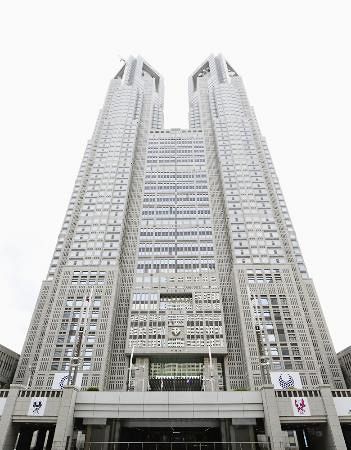
On December 15, the final day of the regular session of the Tokyo Metropolitan Assembly, a revised ordinance related to the nation’s first mandatory installation of solar panels on newly constructed single-family homes was passed and enacted with a majority of votes in favor. The aim is to reduce greenhouse gas emissions in the residential sector. The new system will begin in April 2025, after a preparatory period to support businesses and inform residents.
According to the Tokyo Metropolitan Government, major housing manufacturers will be obligated to install panels on buildings with a total floor area of less than 2,000 square meters, including residences. Purchasers will be required to reduce the environmental impact of their homes as an obligation to make an effort.
The TMG estimates that if 4-kilowatt panels are installed, the initial cost of 980,000 yen can be recovered in 10 years through the income from electricity sales, and only 6 years if the TMG subsidy is used.
https://www.tokyo-np.co.jp/article/220091
Mothering a Movement: Notes from India’s Longest Anti-Nuclear Struggle

It was striking how these women activists situated their politics in motherhood and in their responsibility as the guardians for future generations. Prayers to Lourde Matha at the main church, floral tributes to Kadalamma, and protests against the nuclear plant all lie on a continuum as acts of reverence for life. While this politics around maternity might not sit well with a certain progressive outlook, these women are clear about their feminist goals.
A time will come. We will take over the village and remove the nuclear power plant.
Radiowaves Collective, Half-Life, December 2022
‘……………………………………………………………………… Both Idinthikarai and Kudankulam, the other settlement that abuts the northern boundary of the nuclear plant, lie off the beaten path for the tourists that come to Kanyakumari—a narrow strip of “Land’s End” with an old temple, newer memorials to regional and national personages, and the Indian Ocean—located a little over twenty-five kilometers away. Yet in 2011 and 2012, Kudankulam and its nearby villages had commanded significant media attention. Putting aside their caste and religious differences, the locals around Kudankulam had put up a remarkable non-violent resistance against the nuclear establishment. We want to find out what has happened to that movement a decade later.
Next morning, en route to Kudankulam, our bus lurches past the bustling town of Anjugramam and other smaller settlements, surrounded by farmlands and coconut and palmyra trees. But it is the giant windmills, mushrooming all over, that dominate the landscape and serve as a reminder that India is a country hungry for energy. All of this area, Anjugramam onwards, falls under what is called the emergency planning zone: a sixteen-kilometer radius around the nuclear plant that would need evacuation in case of a disaster. Our fellow passengers include some non-locals, who form the bulk of the workforce at the plant. When we do not get off at either the Anuvijay— “Victory of the Atom”— town, a gated community for staff and their families, or the plant some seven kilometers away, the few remaining people on the bus start eyeing us.
Once at the busy main market in Kudankulam, our local guide and a few other men quickly whisk us away to a house where we are scheduled to interview women activists who were involved in the 2012 protests. However, before we can start a conversation with them, a man in a striped blue shirt asks us to write down our names and contact details. “CID [Criminal Investigation Department],” he replies softly when we ask why. “He is a policeman. He is just doing his job,” another man chimes in, matter of factly. The sprawling nuclear plant across the road reaches far into the lives of the people here. Police surveillance is part and parcel of the architecture of the nuclear establishment.
The KKNPP is India’s largest nuclear power plant, housing two Russian VVER-1000 reactors—similar to the ones under siege now in Zaporizhzhya, Ukraine—and has four others in the pipeline. As far as one can tell, it has little to do with nuclear weapons, but the Department of Atomic Energy (DAE)—the agency which oversees all things nuclear in India—makes it easy to indulge in wild speculations. Right from its inception in 1954, the DAE has been notoriously opaque, with little independent or public scrutiny, and prone to misinformation and grandiose statements.
While the US launched its “Atoms for Peace” program in 1953, the motto of the DAE has always been “Atoms in the service of the nation.” But the nebulous nature of these slogans is often put on display. For instance, in 1974, the DAE tested nuclear weapons in the guise of a peaceful nuclear program, calling them “peaceful nuclear explosives” for the development of the nation.1 Things have been equally farcical in the case of the civilian nuclear energy program, where, in the name of national security, the DAE has refused to share details about basic public matters such as energy costs and nuclear safety. And even though the DAE is currently (and consistently) decades behind in meeting its own projections for power generation, it still proclaims a fifty-fold increase in nuclear power by 2050.2 The message is loud and clear: the future is nuclear, and only fools worry about the past—or the present.
“If we say anything against [the plant], they will file a case against us,” says a young woman who teaches science at a nearby school. “We don’t have permission to talk about this issue with the students. We can only teach things that are mentioned in the books,” she continued. While adding that the KKNPP supports some schools in its vicinity, like many others in Kudankulam, she is more concerned about the dismal state of affairs. “We do not have any facilities, we have long power cuts, we receive drinking water only once every ten days, and there are all sorts of diseases. Now, it is not possible to remove the plant, but at least our people should get better jobs. Outsiders have all the permanent positions there.” She is sympathetic to the DAE’s rhetoric of nation-building, but dismayed with the lopsidedness of it all. Why should people who live in metropolitan India receive the benefits of nuclear energy while people from Kudankulam take on the risks?
“People protested a lot, and nothing happened. Many who protested can’t get jobs there. It was a waste,” the teacher concluded. “People have accepted that they must live with the diseases. They have made up their mind to live happily until they die. They have started building bigger houses. And since people have come from other places, the land rates have increased, like in the big cities.” Indeed, right outside the nuclear plant, locals have opened new shops selling food, cellphones, and other sundry items. The area has become a real estate hotspot………………..
The region has seen sporadic protests ever since India and the erstwhile Soviet Union had signed an agreement to build these reactors in 1988, as part of post-Chernobyl nuclear diplomacy.3 With the fall of Soviet Union, the project went nowhere for a decade. In the wake of its Pokhran-II nuclear weapons tests in May 1998 and the sanctions that followed, however, India sought Russia’s help. Construction work at the Kudankulam plant finally began in 2000. However, it was the 2011 Fukushima accident in the aftermath of a tsunami that hit close to home…….
A few days after the Fukushima accident, a senior DAE official announced that “there [was] no nuclear accident or incident [in Fukushima],” instead claiming that “it was purely a chemical reaction and not a nuclear emergency.”4 Such technocratic stonewalling, typical of the DAE, did little to allay the anxieties of people living around the plant. Following a test run at the nuclear plant in July 2011, which involved generating high pressure steam to check safety mechanisms, residents started protesting non-violently. The DAE sought to further counter the heightened fear of locals with high-handedness and by flexing its scientific, economic, and legal authority.
Former Indian president A. P. J. Abdul Kalam—uniquely positioned as both a leading defense scientist and a member of the coastal fishing community in Tamil Nadu—visited KKNPP in November 2011. He declared the nuclear plant to be safe and recommended introducing four-lane highways, hospitals, jobs, and bank subsidies to the area. However, the former President refused to meet those in the village with anti-nuclear sentiments, declaring instead that “history is not made by cowards. Sheer crowd cannot bring about changes. Only those who think everything is possible can create history and bring about changes.”
Months later, tired of intransigent protestors, the state enlisted the help of India’s leading mental health hospital to counsel them. Meanwhile, the police and additional security agencies dealt with dissenting locals in their own style. By the first anniversary of the non-violent protests in August 2012, nearly 7,000 people had been accused of sedition and waging war against the state. Many in Idinthakarai still refuse to forgive the state for how they responded to the protests.
Mildred, a fifty-year-old leader of the Idinthikarai protests with dozens of legal cases against her recounted the day they had marched on the nuclear plant in September 2012. “We were frightened by the gun fire. I was in the front with other women and the hot gas fell between our legs. We couldn’t breathe. We couldn’t see for many days. They captured six other women, but I escaped by swimming into the sea,” For Mildred and other villagers from Idinthikarai, marching on the plant was a last-ditch effort to stop the loading of the nuclear fuel rods and the commissioning of the first reactor at KKNPP.
“That changed everything. We decided to protect the village by destroying the roads. We rang the church bell to warn people about the arrival of the police. We were hurt in our hearts,” Mildred continued. Throughout, the state could only see the irrationality and naïveté of this resistance, with the Prime Minister and Home Minister alleging that “foreign NGOs” were instigating the locals against the KKNPP. However, most apprehensions of the women activists we met in Kudankulam and Idinthakarai were grounded in their personal experience and knowledge…………
In Idinthakarai, this fierce sense of belonging to the soil and sea is a common refrain, even among different generations of women. A senior government official once put this down to their “primitive” mindset—calling them a “sea-tribe”—and to their inability to understand modern society. This framing is, of course, an attempt to dismiss these people as relics of a bygone era. “Mobile phones came around [the protest] time. We started googling the effects [of radiation]. Only then did we realize how dangerous this could be. We saw the fate of Chernobyl, of Fukushima,” a twenty-seven-year-old nurse, Preeka, who was shortly leaving to work at a hospital in Qatar, told us.
…………………there is little substantive dialogue around nuclear safety with the local communities. To date, let alone independent monitoring, plant authorities do not make their environment survey lab reports publicly available.
Albeit without recourse to scientific data, these women read the nuclear plant and its effects on their lives in anecdotal terms and in stories that make sense to them. The fish catch, the illnesses, the changing climate, and the sea all have become signs of things to come. Preeka observed, “the sea is my favorite. But now it is not good and it angers me. Many babies are affected with diseases, such as cancer and thyroid, these diseases are coming to our people… And since people get affected by diseases without doing anything wrong, they can’t control it. It makes me very sad.”
…………………….. these women are not far off from the scholars who see human-made radioactive nuclides as a marker of the Anthropocene.
Even though the authoritarian techniques of the nuclear establishment have prevailed, the activists in Idinthakarai have faith in their own powers………………………………………….. It was striking how these women activists situated their politics in motherhood and in their responsibility as the guardians for future generations. Prayers to Lourde Matha at the main church, floral tributes to Kadalamma, and protests against the nuclear plant all lie on a continuum as acts of reverence for life. While this politics around maternity might not sit well with a certain progressive outlook, these women are clear about their feminist goals.
A time will come. We will take over the village and remove the nuclear power plant…………………………….
A few days before we came, Idinthakarai witnessed a showdown between those who wanted to accept money from the nuclear plant to renovate the village playground and others who remain opposed to any such enticements. Even though the voices of the women activists carried the day, it isn’t clear how long this resistance will last. On our way out, we meet a young engineer, and ask him about his future plans. “I don’t blame others who might work at the plant, but I refused to work there. I have seen the people of my village struggle against it… Our people have no say. I am preparing for a government job. We need to take charge.” Perhaps the hopes of the women aren’t too far-fetched, for people’s movements too have long half-lives. https://www.e-flux.com/architecture/half-life/508409/mothering-a-movement-notes-from-india-s-longest-anti-nuclear-struggle/
Japanese Power Plants Less Than 40 Years Old Are Experiencing Problems.
Due To Relatively Rapid Deterioration. A nuclear power plant that has been in operation for more than 60 years, there is no example in the world Design life is 40 years Piping breaks, holes due to corrosion … troubles occur one after another December 9, 2022, 06:00 ~ tokyo-np.co.jp https://www.tokyo-np.co.jp/article/218838...
Objections to nuclear power in Taiwan
https://www.taipeitimes.com/News/editorials/archives/2022/12/12/2003790557 By Chen Yi-nan 陳逸南 12 Dec 22
An article published by the Liberty Times on Thursday reported that Wang Hung-wei (王鴻薇), the Chinese Nationalist Party’s (KMT) candidate in the legislative by-election in Taipei’s third electoral district, has proposed that the Guosheng Nuclear Power Plant in New Taipei City’s Wanli District (萬里) and the Ma-anshan Nuclear Power Plant in Pingtung County not be decommissioned.
Environmental organizations criticized Wang’s proposal as being “legally baseless and practically infeasible,” to which she has yet to respond.
Instead, she asked her rival in the by-election, the Democratic Progressive Party’s (DPP) Enoch Wu (吳怡農), to answer the question, and invited him to a public policy debate.
Wu said that Taiwan Power Co (Taipower) had already deemed Wang’s proposal unrealistic and it is “highly irresponsible” to discuss national energy plans by striking a bargain.
Wu added that the Taiwan Environmental Protection Union had also released a statement opposing Wang’s proposal.
While Wang advocates keeping the nation’s nuclear power plants operational, the union believes that the goal should be to achieve a nuclear-free homeland.
Without responding to the union, Wang wished to hear Wu’s opinions on public policy.
Spent nuclear fuel rods at the Guosheng and the Ma-anshan plants are high-level radioactive waste that cannot be processed or safely disposed of in Taiwan.
The spent fuel rods are kept in the power plants’ spent fuel pools.
The dry-cask storage method was once employed in an attempt to dispose of the radioactive waste, but a long-term solution to the issue has never been developed.
If the Guosheng and the Ma-anshan plants continue to operate, how can the nation take care of high-level radioactive waste?
Where would the used fuel rods be stored?
This is an extremely serious problem, and all parties involved should think about it seriously.
Politicians should not appropriate the issue to win votes. If radioactive waste is not handled carefully, future generations would pay the price.
Former US president Abraham Lincoln once said: “You can fool all of the people some of the time, and some of the people all of the time, but you cannot fool all of the people all the time.”
People in Taiwan should take heed of and reflect upon Lincoln’s words, especially Taiwanese politicians.
Whether the Guosheng and the Ma-anshan plants should be decommissioned is a highly technical issue requiring scientific expertise.
It is not necessarily a problem concerning laws and politics, nor is it public policy open to debate. The candidates for a legislative by-election need not concern themselves with it.
A candidate’s irresponsible proposal is likely a trick to win votes, which is nothing more than fraud.
Candidates should not toy with the issue of nuclear power plants and radioactive waste, while voters should be sensible, smart and alert.
Chen Yi-nan is an arbitrator.
Translated by Yi-hung Liu
Japanese prime minister may seek in-depth nuclear abolition talks at Hiroshima G7 summit
Japan Times, 11 Dec 22, HIROSHIMA – Prime Minister Fumio Kishida on Sunday expressed hope to hold thorough debates for a world without nuclear weapons at next year’s Group of Seven summit in Hiroshima in May.
“I want to deepen discussions (at the G7 summit) so that we can release a strong message toward realizing a world free of nuclear weapons,” he said at a closing ceremony for the first meeting of the International Group of Eminent Persons for a World without Nuclear Weapons, or IGEP, held in Hiroshima for two days from Saturday.
“We are facing tough barriers over nuclear disarmament, such as growing threats to use nuclear weapons,” Kishida said, asking IGEP member experts to “produce meaningful outcomes regarding specific ways to bring the tough reality closer to the ideal.”………………… more https://www.japantimes.co.jp/news/2022/12/11/national/fumio-kishida-nuclear-weapons/
News WatchNews Watch by Citizens’ Nuclear Information CenterNews Watch

December 4, 2022
NRA Complicit in Abolishing NPP Operation Period Limits
After hearing Director General Matsuyama Yasuhiro of the Energy Conservation and Renewable Energy Department (Agency for Natural Resources and Energy of the Ministry of Economy, Trade and Industry (METI)) explain METI’s point of view at a regular meeting of the Nuclear Regulation Authority (NRA) on October 5, NRA Chairman Yamanaka Shinsuke indicated a positive stance toward METI’s proposal to rescind the rule under Japan’s Nuclear Reactor Regulation Act that says for nuclear power plants (NPPs), in general “the period set forth” may be extended “only once upon the expiration thereof, not exceeding 20 years,” and limits it to special cases. Yamanaka remarked, “The operation period is a policy decision on the ideal way to employ nuclear power, and is not a matter for NRA to comment on.” Moreover, on November 2, barely a month later, he went as far as to say new regulatory system proposals were being drafted that would allow operation of NPPs in excess of 60 years for 10-year periods providing the facilities underwent inspections for deterioration and met the new regulatory standards.
Regarding METI’s proposals, which are described below, at a press conference following an NRA meeting on November 9, the same Chairman Yamanaka expressed negativity toward the exclusion of periods when operation of a reactor was suspended from the operation periods as an immediate means of extending operation past 60 years, saying “Our regulations are so-called calendar-based, and we evaluate by calendar year.”
METI Proposals for NPP Operation Period Extension Rules
METI submitted three proposals for future operation rules to the “Nuclear Power Subcommittee” panel of experts on November 8, regarding extension of NPP operation periods, which is being considered by Japan’s government. The three proposals METI submitted are 1) maintaining the current rule based on a 40-year limit with extension of up to 20 years if the NPP obtains NRA approval., 2) no upper limit on additional extensions, and 3) setting a uniform upper limit on operation periods (e.g., 20 years), while not counting periods of suspended operation resulting from “heteronomous factors” that are difficult for electric power companies to anticipate as part of the operating period.
At the meeting that day, only two people supported proposal 1), CNIC Secretary General Matsukubo Hajime and Nippon Association of Consumer Specialists Director Murakami Chisato, both of whom opposed any extensions to begin with. The other 16 committee members were nuclear power supporters from the outset, so a number of them supported proposal 3), but proposal 2) drew the most support. Nevertheless, the mass media all said that proposal 3) had the most backing. This clearly reflects METI’s intentions.
Examples of “heteronomous factors” put forward were suspension periods for meeting stronger safety regulations following the Fukushima nuclear accident and suspension periods based on provisional dispositions by courts ordering injunctions against operation.
Japan’s government is expected to set forth its new rules before year end, but many, in particular the Liberal Democratic Party (LDP) faction supporting nuclear power, are seeking the abolition of upper limits on operation periods as in proposal 2).
Applications Filed for 60-year Operation of Sendai Units 1 and 2
Kyushu Electric Power Co. filed for approval from the NRA on October 12 to extend the operation periods of Sendai NPP Units 1 and 2 by 20 years. They said no problems with deterioration of the equipment had been found in the special inspections performed for the Unit 1 reactor in October 2021 and for the Unit 2 reactor in February 2022 and that the soundness of the reactors up to the 60-year point had been confirmed. The results of the special inspections, however, were examined by the Kagoshima Prefectural Nuclear Safety and Evacuation Planning Committee, who pointed out a number of issues with them. At a meeting on October 17, one committee member expressed his view that the principle of good faith had been violated due to the applications being filed before those results were made available.
Doubling of Subsidies to Municipalities that Approve NPP Restarts
METI announced on October 10 that it would expand the subsidies provided to municipalities hosting NPPs upon their restart. The maximum subsidy provided to prefectures where NPPs are located and which have been restarted in April 2022 or later will be doubled from 500 million yen to 1 billion yen, and subsidies of up to 500 million yen will also be newly provided to prefectures adjacent to municipalities hosting those NPPs. The rules for Infrastructure Development Support Project Grants for areas hosting NPPs were to have been revised by the end of October.
The same day, Commissioner Hosaka Shin of METI’s Agency for Natural Resources and Energy held talks on-line with Governor Maruyama Tatsuya of Shimane Prefecture and Governor Hirai Shinji of Tottori Prefecture to tell them that they would be the recipients of the first round of the newly expanded subsidies, with up to 1 billion yen to be provided to Shimane Prefecture, which had agreed to restart Chugoku Electric Power Co.’s Shimane NPP Unit 2 reactor, and up to 500 million yen to the adjacent Tottori Prefecture.
Mission of the UN Special Rapporteur on Human Rights of Internally Displaced Persons to Japan
UN Special Rapporteur on Human rights of Internally Displaced Persons Cecilia Jimenez-Damary visited Japan in September, where for about two weeks she investigated the circumstances of the Fukushima nuclear accident evacuees. She presented the results of her investigation as a provisional statement at a press conference at the Japan National Press Club on October 7. The official report will be released in Geneva next June.
The provisional statement made it clear that the evacuees, “Regardless of whether or not they come from areas designated [as] areas where forced evacuation orders were enforced, are all internally displaced persons with the same rights and entitlements as citizens of Japan” and that their categorization as forced or voluntary evacuees in terms of receiving support and assistance “should therefore be dropped in practice.”
Compensation for Fukushima Nuclear Accident: Capital Repayment from TEPCO to Take as Long as until FY2064
The Board of Audit of Japan released its report on its audits of account settlements for FY2021 on November 7, 2022. In the report, the Board of Audit’s estimations revealed that the recovery of funds that had been lent in effect to Tokyo Electric Power Co. (TEPCO) by Japan’s government for providing compensation for the accident involving that company’s Fukushima Daiichi Nuclear Power Station could take as long as until FY2064. A similar estimation four years ago said it would take up to until FY2051, so the current estimation has the repayment period prolonged by 13 years. The amount of compensation TEPCO is paying to the disaster victims still has the potential to increase, and the Board of Audit notes, “The current estimation of the recovery completion date suggests the possibility of further delays in the future.”
To pay the compensation, the government borrowed money from financial institutions and loaned it in effect via the Nuclear Damage Compensation and Decommissioning Facilitation Corporation (NDF) to TEPCO interest-free, for use in covering compensation, decontamination and other expenses. Each year, the NDF receives a “General Assessment” from each of Japan’s major electric power companies that have NPPs, plus an additional “Special Assessment” from TEPCO, and pays these funds back to the government. The interest paid by the government to the loaning financial institutions is entirely covered by taxes.
The original General Assessment and Special Assessment for the NDF’s repayments to the government have been insufficient, so the government has adopted a new idea of a “past portion” of the compensation funds that should have been secured before the nuclear accident. From FY2020, it has had the customers of Power Producer & Suppliers (new electric power businesses under Japan’s liberalized system) bear part of the burden in the form of an additional charge on power grid usage (consignment charge) by the major electric power companies. For FY2021, that additional charge came to 60.9 billion yen.
When the Board of Audit investigated the contribution charges, the General Contribution paid by each of the major electric power companies in FY2013-2020 was 163 billion yen, but in FY2021 it decreased to 133.7 billion yen. Details on this change were not released. The Special Contribution paid by TEPCO had been ranging from 50 billion to 110 billion yen per year, but in FY2021, it fell to a record low of 40 billion yen. Regarding the method for determining the Special Contribution, the Board of Audit says, “It is not clear if it meets legal criteria.”
According to the Board of Audit, 13.5 trillion yen worth of government bonds have been issued to support TEPCO, and about 8 trillion yen of that has yet to be repaid by the NDF to the government. In addition to the General Contribution, the NDF collects the Special Contribution from TEPCO, profits from sales of TEPCO shares by the NDF and other sources of funding, and uses them to pay back the loans. The Board of Audit’s estimations of how long it will take to pay back the full amount are based on the state of these funds.
The Board of Audit bases its estimations on the assumptions that TEPCO’s business conditions and stock price will not improve as expected, that, in the case where the most time is needed, the Special Contribution will be 40 billion yen annually in and after FY2023, and that the profits from sales of TEPCO shares will only be 110 billion yen. In such a scenario, they estimate it will take 42 more years—until FY 2064—to repay the full amount.
However, the oceanic release of processed contaminated water accompanying decommissioning work is expected to commence in the spring of FY2023, and if this results in reputational damage to TEPCO, the amount of compensation it will have to pay out could increase. Moreover, since the amount of compensation ordered in the suit brought by the disaster victims and evacuees nationwide exceeds the standard based on the government’s guidelines, those guidelines may be reviewed, which could result in further increases in compensation.
Because of these factors, the Board of Audit says, “If the amount granted (loaned) by the government increases further as a result of increased compensation, the burden borne by Japan’s citizens will increase.” It is therefore asking the government to explain this to its citizens in an appropriate manner and requesting TEPCO to improve its profitability.
Source: https://cnic.jp/english/?p=6363
1 This Month

of the week – Shut Down Drone Warfare!


Tell the Ukrainian Government to Drop Prosecution of Peace Activist Yurii Sheliazhenko

Petition to revoke the licensing of the Near Surface Nuclear Disposal Facility (NSDF) at Chalk River. https://www.ourcommons.ca/petitions/en/Petition/Details?Petition=e-7247
To see nuclear-related stories in greater depth and intensity – go to https://nuclearinformation.wordpress.com
-
Archives
- April 2026 (103)
- March 2026 (251)
- February 2026 (268)
- January 2026 (308)
- December 2025 (358)
- November 2025 (359)
- October 2025 (376)
- September 2025 (257)
- August 2025 (319)
- July 2025 (230)
- June 2025 (348)
- May 2025 (261)
-
Categories
- 1
- 1 NUCLEAR ISSUES
- business and costs
- climate change
- culture and arts
- ENERGY
- environment
- health
- history
- indigenous issues
- Legal
- marketing of nuclear
- media
- opposition to nuclear
- PERSONAL STORIES
- politics
- politics international
- Religion and ethics
- safety
- secrets,lies and civil liberties
- spinbuster
- technology
- Uranium
- wastes
- weapons and war
- Women
- 2 WORLD
- ACTION
- AFRICA
- Atrocities
- AUSTRALIA
- Christina's notes
- Christina's themes
- culture and arts
- Events
- Fuk 2022
- Fuk 2023
- Fukushima 2017
- Fukushima 2018
- fukushima 2019
- Fukushima 2020
- Fukushima 2021
- general
- global warming
- Humour (God we need it)
- Nuclear
- RARE EARTHS
- Reference
- resources – print
- Resources -audiovicual
- Weekly Newsletter
- World
- World Nuclear
- YouTube
-
RSS
Entries RSS
Comments RSS
 nuclear-news
