China still has poor record on nuclear safety, uranium environmental damage
Should China be involved in the UK’s nuclear energy infrastructure? Guardian UK, Paul Dorfman, 21 Sept 12“….In Tibet, the Chinese nuclear industry is engaged in a determined effort to secure uranium deposits located in Amdo, where leaching and open pit extraction are reported to have resulted in significant environmental contamination. Regulation of safety oversight mechanisms is relatively weak in the Chinese nuclear industry, and according to a recent Nuclear Materials Security Index report, China ranks 29th among the group of 32 nuclear nations in terms of nuclear security and materials transparency. Although it’s to be hoped that greater corporate social responsibility and sensitivity to vulnerable industrial communities is evolving in both Russia and China, it’s still troubling to reflect on their respective human rights situations, documented by Amnesty International……http://www.guardian.co.uk/environment/blog/2012/sep/21/nuclearpower-energy?newsfeed=true
Danger of nuclear war in Asia
India-Pakistan dispute may pose nuclear threat to Asia: ex-Oz PM Indian Express 22 Sept 12 Asia continue to face three key conflicts involving states with nuclear weapons and highly uncertain nuclear doctrines, former Australian Prime Minister Kevin Rudd warned today.
“Asia Pacific was sprinkled with three flashpoints, each of which was capable of triggering one form of conflict or another,” Rudd said in his keynote address at the Singapore Global Dialogue.
“We must never forget that all three of these disputes involve nuclear states and in some cases, states with highly uncertain nuclear doctrines,” he warned, pointing to the dispute involving India-Pakistan, the Korean Peninsula, and the Taiwan Straits……. He called for restrain and reason on behalf of all parties to these disputes though acknowledged that the stakes were becoming increasingly high among claimants of islands in the East Asian waters.
http://www.indianexpress.com/news/indiapakistan-dispute-may-pose-nuclear-threat-to-asia-exoz-pm/1005908/2
Less than a quarter of Japan’s nuclear engineers think that the industry is trustworthy
Only 23.4 percent, down from 43.8 percent a year earlier, said they “can agree” with the view that “the safety awareness and efforts of those engaged in the use of nuclear energy are trustworthy.”
Atomic engineers feel less confident about nuke safety September 22, 2012 THE ASAHI SHIMBUN After watching one of the world’s worst nuclear disasters in their own backyard, members of the Atomic Energy Society of Japan, a pro-nuclear association of nuclear engineers, are not surprisingly feeling much less confident about the safety of their industry. Continue reading
Business ahead of safety, as Japan waters down its nuclear power phaseout
Business leaders praised the Cabinet’s perceived backpedaling

 Japan Nuclear Phase-Out Plan Falls Apart HUFFINGTON POST, By MARI YAMAGUCHI 09/19/12 TOKYO — Japan’s Cabinet stopped short of a commitment Wednesday to phase out nuclear power by 2040, backtracking from an advisory panel’s recommendation in the face of opposition from pro-nuclear businesses and groups.
The decision came on the same day that Japan launched a new nuclear regulatory body to replace an agency whose links to the nuclear industry reportedly contributed to last year’s disaster at the Fukushima Dai-ichi nuclear plant. Continue reading
Daunting tasks for Japan’s new Nuclear Regulation Authority
 Nuclear regulatory body faces
  mountain of urgent tasks http://www.yomiuri.co.jp/dy/national/T120920003922.htm Koichi Yasuda / Yomiuri Shimbun 21 Sept 12, Five members of the new nuclear regulatory commission, headed by Shunichi Tanaka, showed strong determination to ensure the safety of the nation’s nuclear facilities and restore public confidence, based on lessons learned from the crisis at the Fukushima No. 1 nuclear
power plant.
However, the Nuclear Regulation Authority faces a growing number of urgent tasks, including establishing new regulations for nuclear power generation.
The commission must first determine how to evaluate stress tests that have served as a tentative yardstick for restarting reactors in the aftermath of last year’s disaster.
It must also decide what requirements need to be met to allow nuclear reactors to operate more than 40 years–which would be an exception to the government’s new energy strategy announced earlier this month.
It remains to be seen how the commission will conduct research on active faults under nuclear power plants nationwide.
Lastly, it also needs to introduce mandatory countermeasures for severe accidents, including reactor meltdowns, as well as expand disaster preparedness zones around nuclear plants. The fact that the commission was launched with members who were not approved by the Diet has added to these concerns.
Former Nuclear Safety Commission Chairman Shojiro Matsuura, 76, said establishing the above rules is “essentially a job that would take years for specialists to accomplish.
“I’m worried whether [the commission] will be able to tackle the problems without support of both the ruling and opposition parties,” he said.
Considering the head of the new commission will be given greater command authority during emergencies, Matsuura’s concern is reasonable.
The new commission, which has been granted a high level of independence, must pursue safety improvements at nuclear power plants from scientific and technological viewpoints, and keep a distance from political and economic concerns. The public will closely watch its
every action.
Success for nuclear lobby, as Japan backs down on phasing out nuclear power
 Japan, Under Pressure, Backs Off Goal to Phase Out Nuclear Power by 2040 NYT, By HIROKO TABUCHI 19 Sept 12 TOKYO — In an abrupt turnabout, the Japanese government on Wednesday stopped short of formally adopting the momentous goal it announced just last week — to phase out nuclear power by 2040 — after the plan drew intense opposition from business groups and communities whose economies depend on local nuclear power plants
The cabinet of Prime Minister Yoshihiko Noda said it would “take into consideration” the 2040 goal, but formally endorsed only a vague promise to “engage in debate with local governments and international society and to gain public understanding” in deciding Japan ’s economic future in the wake of the 2011 nuclear disaster at Fukushima. Energy policy will be developed “with flexibility, based on tireless verification and re-examination,” the cabinet’s resolution read.
A day earlier, the chairmen of Japan’s most prominent business associations, including the influential Keidanren group, called a rare joint news conference to demand that Mr. Noda abandon the 2040 goal. On Wednesday, they praised the cabinet’s decision. Continue reading
Chinese news reports increased exposure to radioactivity as one cause of birth defects
Consumption of prohibited medicine, increased exposure to radioactivity and drinking have also contributed to the increase, experts said.
 900,000 Chinese born with birth defects every year http://www.beijingnews.net/index.php?sid/209107845/scat/55582c89cb296d4c/ht/900000-Chinese-born-with-birth-defects-every-year Beijing News.Net 12th September, 2012 Around 900,000 babies are born with birth defects in China every year, the health ministry said Wednesday.
This constitutes about 5.6 percent of the total number of newborns, Xinhua reported.
The ministry report for 2012 on prevention and treatment of defects in newborn babies said birth defects — at 19.1 percent — have become the second-biggest cause of infant deaths in China.
Birth defects are a serious problem in China’s rural areas. Continue reading
Cattle with strange skin lesions near Fukushima Diiachi
Skin lesions, LIvestock, a few Kms from Fukushima Diiachi
http://nuclearhistory.wordpress.com/2012/09/18/skin-lesions-livestock-a-few-kms-from-fukushima-diiachi/
http://fukushima-farmsanctuary.blogzine.jp/blog/2012/09/post_1af1.html
Translation of salient text by KM (Japan):
“Spots in the hair of cattle appeared
“I have never seen like this symptoms before” Mr.Yoshizawa said. 10 of
380 cattle in the Ranch have similar to a little less symptoms.
Diagnosis by veterinarians is mycosis with no identification of
bacteria. While a year and half, cattle pasture in Namie have been
grazing and drinking from groundwater
We require strongly detailed examination of this disease.
Our ranch farm is 14km(about 9miles) from Fukushima Daiichi nukes
plants and cesium measured in the air is 3~4mS/h now at here.”
Screen captures from website:……
Japan’s govt to build two new nuclear power plants
 JP Gov to restart the construction of 2 nuclear plants by Iori Mochizuki September 15th, 2012 · Japanese government is not going to shut down nuclear plants.
They approved the construction of 2 more nuclear plants in Aomori and Shimane.
On 9/15/2012, Edano, Minister of Economy, Trade and Industry had a meeting with Aomori governor and headmen of local governments in Aomori city and approved the construction and restart of nuclear plants in Oma (Aomori) and Shimane nuclear plant.
It’s unit3 that they are going to restart the construction in Shimane nuclear plant. Oma nuclear plant belongs to J-power (construction progress 37.6%) , Shimane nuclear plant belongs to The Chugoku Electric Power Co.,Inc. (construction progress 93.6%)

Those constructions have been stopped since 311. This will be the first restart of construction of nuclear plants since Fukushima accident.
Japanese government decided on 9/14/2012 to phase out nuclear power completely sometime in the 2030s, approving a “massive” shift in national energy policy 18 months after the Fukushima Daiichi plant disaster spurred strong public opposition to nuclear power in the earthquake-prone nation…… because they are going to allow these newly constructed nuclear plants to run for 40 years, they will be generating power until 2050s, which contradicts 2030 policy.
The construction of Higashi dori nuclear plant in Aomori has also been stopped since 311 as well, which belongs to Tepco. Edano is pending the approval to restart the construction to comment Tepco is not ready to have a discussion about the restart.In total, there are 12 plans to build new nuclear plants in Japan….. http://fukushima-diary.com/2012/09/jp-gov-to-restart-the-construction-of-2-nuclear-plants/
250 arrested in Tuticorin as India’s govt cracks down on anti nuclear movement
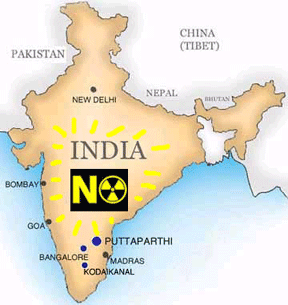 Kudankulam protest: 250 anti-
 nuclear activists arrested Zee News, September 16, 2012, Kudankulam (TN): Around 250 people were arrested in Tuticorin when they attempted to set out on a march to express solidarity with anti-nuclear agitators here who on Sunday buried themselves upto waist in beach sand, in a new form of protest against loading of fuel in Kudankuklam plant.
A ‘solidarity march’ by cultural leaders from Kerala to Kudankulam to express support with the anti-nuclear activists here was also stopped on the state’s border with Tamil Nadu.
Leader of Peoples Movement Against Nuclear Energy (PMANE), which is spearheading the protest here, meanwhile, offered unconditional talks with the central and state governments and said they were ready to give up the agitation if the government assured that fuel would not be loaded for now. ….. Continue reading
India: Police block march of peaceful anti nuclear writers and activists

 Kerala marchers stopped Deccan Chronicle, September 17, 2012 Thiruvananthapuram | Chennai The Kerala-Kudankulam march led by writers and social activists on Sunday to express solidarity with the anti-nuclear protests in Kudankulam was blocked by the police near the Kerala-Tamil Nadu border at Inchivila.
Kerala Anti-Nuclear Support Group, which organised the march, then tried to bus the activists to the protest site.
But this attempt was also derailed when the bus was stopped and asked to return by TN police before Kudankulam.
The march, undertaken by over 200 people, was inaugurated by poetess Sugatha Kumari at Parassala. Other noted personalities who took part in the march were: writer Sara Joseph, former diplomat M.K. Bhadrakumar, Latin Diocese Vicar-General Eugene Pereira, social activist B.R.P. Bhaskar, Gandhian P. Gopinathan and former naxallite K. Ajitha…… http://www.deccanchronicle.com/channels/nation/south/kerala-marchers-stopped-454
India: opposition to nuclear power despite government repression of protestors
 India’s Judiciary creates scam over Kudankulam The Canadian, 17 SEPTEMBER 2012 There is no reason why the judiciary, the conscience of the nation, should willingly play pro-regime roles by opposing people’s and humanity concerns……
as national support for the five-year-long campaign against the Jaitapur plant snowballed. The National Committee in Solidarity with the Jaitapur Struggle – comprising leaders like Prakash Karat, AB Bardhan, Sitaram Yechury and Ram Vilas Paswan, independent experts and intellectuals – trenchantly criticised the project, based on French company Areva’s troubled European Pressurised Reactors (EPRs).
The grounds of protest against the 9,800 MW plant in Maharashtra are somewhat similar to those being echoed in Tamil Nadu. The protestors argue that the plant will damage local ecology, their consent for the plant wasn’t sought and also speak of the obvious fear of how a potential accident at the plant could affect them. While the issue is currently not in the headlines anymore, the agitators in the Ratnagiri district of Maharashtra are no doubt closely following the developments in Kudankulam……
Regime-Judiciary Nexus
When the Madras High court refused to stay the deadly fuelling operation in the nuclear terror plant, the people of Kudankulam and the humanity at large, besieged by nuclear terror operations of state, still had hopes of getting justice from Supreme court but when apex court also sided with the state terror operators and delivered an interim judgment in favour of state nuclear terror intent against the people, humanity has become shaky, felt betrayed yet again, losing trust in the judicial ability in justice delivery. As suggested by the regime and nuclear mafias, the courts have protected the transnational nuclear mafias.
Declining to put on hold for now the loading of fuel rods in one of the two reactors of Kundankulam nuclear power plant in Tamil Nadu, the Supreme Court Thursday Sep 13 said it would hear Sep 20 the plea seeking to restrain the central government.
The apex court’s decision came as hundreds of people from Tamilnadu’s Idinthakarai village, the epicentre of the protests against the Kudankulam Nuclear Power Plant (KNPP), stood in the sea water Thursday to protest moves to load uranium fuel in one of the two reactors.
Justice K. S. Radhakrishnan and Justice Dipak Misra declined to pass any immediate order on a petition seeking to restrain the government from going ahead with the loading of nuclear fuel rods in the reactor of the plant. The court said it would hear Sep 20 the plea seeking to restrain the central government from doing so.
Judiciary mischief is perhaps the worst kind of menace and brute evil. Madras High court seems have created the basis for the Supreme court to promote state nuclear terror agenda. Supreme Court has just said the regime must ensure security and safety of the people and the regime knows it has to just file another affidavit stating that people are safe. In other words, the judiciary has clearly offered the regime and nuclear mafias to ensure safety of the people by killing them so that they need not to live until the nuclear plant blasts.
The nuclear terror project was cleared in haste in violation of the recommendations of an official Task Force, and without even the fig leaf of an Environmental Impact Assessment (EIA) report. The NPCIL has refused to furnish to the public the site evaluation and safety analysis reports, although so directed by the Central Information Commission………http://www.agoracosmopolitan.com/news/intrnational/2012/09/17/4465.html
Japan’s science panel calls for a curb on nuclear waste production
The recommendation said it is essential to set an upper limit on the total amount of radioactive waste and to implement controls to prevent it from increasing without limits.
Science panel recommends delaying burying radioactive waste http://ajw.asahi.com/article/behind_news/social_affairs/AJ201209120009 September 12, 2012 THE ASAHI SHIMBUN, Jin Nishikawa contributed to this article. Citing the country’s geologically unstable archipelago as a threat, the Science Council of Japan is recommending that the government build temporary storage facilities to hold more than 27,000 cylinders of high-level radioactive waste.
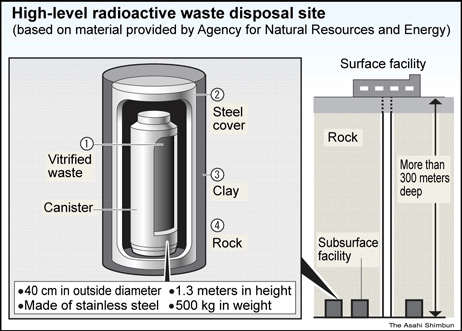
The council on Sept. 11 completed a report that calls for regulating the total amount of radioactive waste from nuclear power plants and storing it temporarily. Continue reading
Solar lighting for Delhi’s historic sites
 Delhi’s monuments will be lit by solar energy Zee News, September 16, 2012, New Delhi: More and more of the capital’s best known monuments may now be illuminated through solarenergy.
Building on the experience gained over the last three years and keen on promoting the use of environment-friendly solar energy, the Delhi government plans to light up more of the capital’s historical sites through cheap and plentiful energy from the sun.
The 13th century Qutub Minar, the 17th century red sandstone Red Fort and the 16th century Humayun’s Tomb – all declared UNESCO World Heritage Sites – are among the six sites where the Delhi government plans to install solar power plants to replace conventional sources of electricity. Continue reading
Youtube video – fake worker documents at Fukushima
 Watch: Fukushima worker films at plant — I was asked to fake documents — Underage people employed (VIDEO)http://enenews.com/watch-fukushima-worker-films-plant-asked-fake-documents-underage-workers-employed-video September 14th, 2012 By ENENews Source: 8bitnews Translation: mina564da
Date Filmed: June 18, 2012(?) Date Published: Sept 11, 2012
I was employed by a subcontractor of Tepco.
I was asked to write a fake CV by the contracting company.
I was told my duty was to be logistical support. But the reality was to work at the highly radioactive area (over 1 milliSv/hr).
Most of the workers come from all over Japan as a day laborer.
Underage workers (18 & 19 years old) are also employed.
These are just ordinary people without good knowledge of radiation. The fake CV establishes them as an experienced worker and they are sent to the Fuksuhima Daiichi NPP.
1 This Month
23-25 October – on Zoom – World BEYOND War’s annual global conferenc


Shut down the radiation-damaged Heysham nuclear reactors now
To see nuclear-related stories in greater depth and intensity – go to https://nuclearinformation.wordpress.com

Say No to NASA’s Reckless Nuclear Reactor on the Moon
Say No to NASA’s Reckless Nuclear Reactor on the Moon
-
Archives
- October 2026 (190)
- September 2026 (339)
- August 2026 (330)
- July 2026 (355)
- June 2026 (287)
- May 2026 (306)
- April 2026 (356)
- March 2026 (251)
- February 2026 (267)
- January 2026 (308)
- December 2025 (358)
- November 2025 (359)
-
Categories
- 1
- 1 NUCLEAR ISSUES
- business and costs
- climate change
- culture and arts
- ENERGY
- environment
- health
- history
- indigenous issues
- Legal
- marketing of nuclear
- media
- opposition to nuclear
- PERSONAL STORIES
- politics
- politics international
- Religion and ethics
- safety
- secrets,lies and civil liberties
- spinbuster
- technology
- Uranium
- wastes
- weapons and war
- Women
- 2 WORLD
- ACTION
- AFRICA
- Atrocities
- AUSTRALIA
- Christina's notes
- Christina's themes
- culture and arts
- Events
- Fuk 2022
- Fuk 2023
- Fukushima 2017
- Fukushima 2018
- fukushima 2019
- Fukushima 2020
- Fukushima 2021
- general
- global warming
- Humour (God we need it)
- Nuclear
- RARE EARTHS
- Reference
- resources – print
- Resources -audiovicual
- Weekly Newsletter
- World
- World Nuclear
- YouTube
-
RSS
Entries RSS
Comments RSS

