Japan insurance company won’t cover damage caused by nuclear fuel material
Insurance company “no coverage for damage caused by nuclear fuel material” http://fukushima-diary.com/2012/09/insurance-company-no-coverage-for-damage-caused-by-nuclear-fuel-material/ by Mochizuki September 15th, 2012 ·
A Japanese posted tweeted like this below,
<Translate>
Recently insurance company adds this item on their instruction.
“We won’t pay insurance for the damage caused by nuclear fuel material.”
<End>
We need to verify how it was before 311.
Peaceful anti nuclear protestors from Kerala stopped by large police presence at border
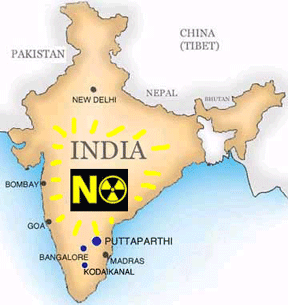 The activists, writers and poets from Kerala, including writers Sugathakumari and Sara Joseph, social activist K Ajitha, environmental activist C R Neelakantan had sought permission from the Kerala police to take out a march from Parasalai to Idinthakarai, but were denied permission.
KKNPP: Kerala activists try to enter TN http://timesofindia indiatimes.com/city/madurai/KKNPP-Kerala-activists-try-to-enter-TN/articleshow/16429530.cms TNN | Sep 17, 2012, TIRUNELVELI: A group of activists from Kerala, who took out a march to Idinthakarai were prevented from entering the Tamil Nadu border at Kaliyakkavilai in Kanyakumari district on Sunday. Continue reading
Kolkata’s solar energy policies going ahead
Solar heaters a must for Kolkata highrises Suman Chakraborti, TNN | Sep 17, 2012, KOLKATA: Civic bodies of Kolkata, Howrah, Durgapur and Siliguri are bringing some provisions in the building by-laws, which will make installation of solar water heaters in all multi storied commercial establishments, including hospitals and five-star hotels, mandatory.that the state government came out with earlier this year.
Representatives from the ministry of new and renewable energy (MNRE) and the United Nations Development Programme (UNDP) are coming to the city on September 29 to meet the officials of these four civic bodies. where this matter will be looked into.
Officials of the New Town Kolkata Development Authority (NKDA) and West Bengal Renewable Energy Development Agency (WBREDA) will also attend the meeting.
It may be noted that the state has already come out with the renewable energy policy this year. …. http://timesofindia.indiatimes.com/city/kolkata/Solar-heaters-a-must-for-Kolkata-highrises/articleshow/16428464.cms
Inadequate safety plans for Kudankulam nuclear reactors
India’s Judiciary creates scam over Kudankulam The Canadian, 17 SEPTEMBER 2012“……In the name of nation and national interests they protect the rich and multinationals and want the common people also support that. Recent disclosures from a special official safety review on all Russian reactor designs reveal their several generic flaws, including inadequate emergency cooling, poor evacuation procedures, and non-factoring of earthquake hazards. The Kudankulam reactors lack an independent freshwater source, critical to cooling them in emergencies. They are probably the world’s only nuclear reactors dependent on unreliable seawater desalination, which can fail and has no backup. The Atomic Energy Regulatory Board (AERB) approved the fuel-loading despite all this and without the mandatory emergency evacuation drill in a 16-km radius. AERB approval is NPCIL’s clinching justification for fuel-loading. The AERB “has no rule-making powers.” It never fulfilled the mandate to prepare an overall nuclear and radiation safety policy.
It has failed to develop as many as 27 of the 168 Standards, Codes and Guides it itself termed essential. It has no role in radiological surveillance and monitoring workers’ health. It doesn’t directly oversee on-site emergency drills. The AERB doesn’t even possess a full inventory of nuclear materials and radiation sources. It has no framework for decommissioning nuclear plants……. http://www.agoracosmopolitan.com/news/intrnational/2012/09/17/4465.html
S. Korea urges U.S. to allow ‘peaceful’ nuclear enrichment SEOUL, Sept. 17 (Yonhap) –– South Korea called for the United States to approve it undertaking “peaceful” enrichment of uranium and reprocessing of spent nuclear fuel, a government think tank said Monday, as little progress has been made in bilateral negotiations to revise the countries’ nuclear accord.
Under a 1974 accord with the U.S., South Korea is banned from enriching uranium or reprocessing spent nuclear fuel. The allies have held five rounds of formal negotiations since 2010 to rewrite the bilateral nuclear cooperation treaty, which expires in 2014…..
Some nonproliferation experts say pyroprocessing is not significantly different from reprocessing, and pyroprocessed plutonium could be quickly turned into weapons-grade material….. http://english.yonhapnews.co.kr/national/2012/09/17/38/0301000000AEN20120917002600315F.HTML
People of Kudankalam’s petition to stop nuclear power plant
The petition said the Government had also absolved the Russian supplier of the nuclear reactor from any liability in case of an accident. And Russia has already stated that it not responsible for any nuclear blasts.
India’s Judiciary creates scam over Kudankulam The Canadian, 17 SEPTEMBER 2012 ……….When the Indian government Regime Targets People.
The Indian regime, committed to the welfare of the people is interested only in promoting the nuclear and other arms merchants and is threatening the people with impending nuclear disasters.
One has no idea as to how many more nukes India wants and for what, because it has already plenty of weapons of mass destruction at various sites. Madras High court and Supreme court seem not worried about the deadly risks involved in the state nuke manufacturing agenda. Both High CA private company’s employee moved the Supreme Court against a Madras High Court order giving the green signal to the commissioning of the Kudankulam nuclear power plant in Tamil Nadu. Continue reading
Japan Times: “Alarming estimate of cancer fatalities… 1 million extra deaths” — Nobody mentions krypton and xenon that poured from Fukushima plant, says Gundersen — 2-3 times greater than Chernobyl http://enenews.com/japan-times-nobody-mentions-cancer-causing-krypton-and-xenon-that-poured-from-fukushima-plant-says-gundersen-2-3-times-greater-than-chernobyl
September 15th, 2012
By ENENews Title: ‘The government could still save lives’
Source: The Japan Times Online
Author: DAVID MCNEILL
Date: Sep. 16, 2012
[…]
Experts waved away fears about radiation, cabinet ministers scoffed at comparisons to Chernobyl, and the word “meltdown” itself was effectively scoured from the media.
Some observers, however, were quick to hit the panic button. One of the best known was U.S. antinuclear campaigner Arnie Gundersen, who predicted that the disaster would lead to 1 million extra deaths from cancer.
[…]
Gundersen, a nuclear engineer, says [the official release amount is] an underestimate. He puts the release of cesium at about half that of Chernobyl, and says little attention has been paid to radioactive gases, Xenon and Krypton, which poured out of the No. 1 plant in quantities “two to three times” greater than the 1986 Ukraine meltdown. He is sticking to his original alarming estimate of cancer fatalities.
[…]
Gundersen bases much of his assessment of Fukushima on what he learned from America’s worst nuclear accident, the 1979 partial meltdown at the Three Mile Island plant in Pennsylvania. As an expert witness during the probe that followed, Gundersen said the official estimate of radioactive releases there was also much too low. “You have to remember, we don’t know how much radiation was released. It’s guys like me who have to calculate it.” His assessment upped the official radiation figure for the accident by five times. “I’m dead sure that’s too low,” he says, adding that he believes the true figure could be 15 times higher than the industry estimate.
[…]
He cites the work of Steve Wing, an epidemiologist who says he has tracked 10,000 extra deaths from lung cancer in the first six to seven years after the accident.
“The same gases (Xenon and Krypton) that caused those cancers leaked out of the containment vessel at the Daiichi (No. 1) plant,” he says. “Nobody is talking about it.” He says the gases quickly disperse and are notoriously hard to measure. Other emissions are more straightforward. Plutonium is heavy and does not widely disperse. Cesium is relatively easy to track.
[…]
34% of Fukushima city people want to evacuate, local gov “Measures need to be taken” http://fukushima-diary.com/2012/09/34-of-fukushima-city-people-want-to-evacuate-local-gov-measures-need-to-be-taken/#.UFZI1IGM8Ng.facebook by Mochizuki September 16th, 2012
For the questionnaire, 34% of the people answered they want to evacuate Fukushima city, and local government staff is commenting they need to take measures about this situation.
In May, Fukushima city government sent questionnaires to 5,000 people
of over 20 years old living in Fukushima city and to 500 people who
evacuated to out of Fukushima city. The valid response rate was 55%.
The result showed 34% of them answered “They want to evacuate even
now.”. 31% of them answered “They used to want to evacuate.”.
Among people who evacuated to out of Fukushima city, 27% of them
answered “They don’t want to come back.”. 19% of them answered “They
don’t want to come back to Fukushima city if possible.”
However, 55% of them answered “They want to come back to Fukushima city.”
The city government staff comments, “The result is very severe. We
need to take some measures. “.
Japan’s government stops the “bad news” from Fukushima
 July, 2011, Japan passes law to cleanse “bad” Fukushima news from internet
  http://www.huntingtonnews.net/6482 EDITED BY TONY RUTHERFORD FROM MULTIPLE REPORTS Japan has passed a new law to cleanse the internet of “bad” Fukushima news. In fact, Japan in this You Tube video tells citizens they have no right to
  live a radiation free life. . http://japanfocus.org/-Makiko-Segawa/3516
The following is a quote from “Fukushima Residents Seek Answers Amid Mixed Signals From Media, TEPCO and Government. Report from the Radiation Exclusion Zone (Updated May 16) Makiko SEGAWA in Fukushima, published byh Asia-Pacific Journal, Japan Focus.
“Now the Japanese government has moved to crack down on independent reportage and criticism of the government’s policies in the wake of the disaster by deciding what citizens may or may not talk about in public.
A new project team has been created by the Ministry of Internal Affairs and Communication, the National Police Agency, and METI to combat “rumors” deemed harmful to Japanese security in the wake of the Fukushima disaster.
The government charges that the damage caused by earthquakes and by the nuclear accident are being magnified by irresponsible rumors, and the government must take action for the sake of the public good. The project team has begun to send “letters of request” to such organizations as telephone companies, internet providers, cable television stations, and others, demanding that they “take adequate measures based on the guidelines in response to illegal information. ”The measures include erasing any information from internet sites that the authorities deem harmful to public order and morality.” Japan Focus…… http://nuclearhistory.wordpress.com/2012/09/14/28-july-2011-japan-passes-law-to-cleanse-bad-fukushima-news-from-internet/
Indian govt’s harsh crackdown on anti nuclear protesors

 India: Government crushes nuclear protests http://www.globalpost.com/dispatches/globalpost-blogs/india/india-nuclear-protests 14 Sept 12, Nuclear projects in India can only be thrust on unwilling citizens at gunpoint, writes activist Praful Bidwai In the wake of police firing that killed one of the many Indians protesting against the Kudankulam nuclear power plant in Tamil Nadu, activist Praful Bidwai lays it into the government that not long back was hailed for its groundbreaking civilian nuclear agreement with George W. Bush.
“The repression, including lethal firing, unleashed on peaceful protesters against the Kudankulam nuclear plant on Monday, on top of FIRs over many months charging thousands with sedition, makes two things clear. Nuclear projects in India can only be thrust on unwilling citizens at gunpoint. [And] as the jalsatyagraha (water civil disobedience) shows, people will resist them tenaciously, because they are aware of their hazards,” Bidwai writes in India’s Hindustan Times newspaper .
As GlobalPost reported last year, a massive nuclear project planned for Jaitapur, Maharashtra, has also faced large protests.
Casual readers and the government dismisses these protests as the work of ignorant villagers and eco-radical agitators (as demonstrated by the claim that the opposition can be traced to various “foreign-funded” NGOs).
But Bidwai points out that every single nuclear project India has planned has spurred committed resistance:
“That’s true of every nuclear project, whether Jaitapur (Maharashtra), Gorakhpur (Haryana), Mithi-Virdi (Gujarat), Kovvada (Andhra Pradesh), Haripur (West Bengal), Chutka (Madhya Pradesh) or Banswada (Rajasthan). For instance, at Gorakhpur, there has been a daily dharna against four proposed reactors for two years, unbeknownst to Delhi, which lies in their potential radiation-fallout zone,” he writes.
And when some 100 activists met in Delhi this August, nobody listened to their reservations about the Kudankulam project, which Bidwai says “was cleared in violation of the recommendations of an official Task Force, and without even the fig leaf of an Environmental Impact Assessment (EIA) report.”
Now villagers, and, yes, more than a few “agitators” have walked into the sea near the reactor, in imitation of a protest against the flooding of villages in Gujarat earlier this month.
They might be wrong. The government says Kudankulam is safe. Coal isn’t without its dangers. And the huge number of hydropower projects planned for Northeast India will destroy cultures and wildlife in one of the country’s last remaining wilderness areas. (Personally, I was sold on nuclear after visiting Arunachal Pradesh for this series on dams–if the government can proceed responsibly).
But it is foolishness bordering on the criminal to undertake such projects on the assurances of company insiders and circumvent the environmental clearance regime, as Bidwai and others say has been done for nuclear plants, and other environmental activists say is routinely done for big dams, coal mines, and every sort of industrial activity.
And it’s bad politics simply to dismiss those claims because of some hidebound commitment to the ideology of economic growth.
USA government worried about Japan cutting out nuclear power?
U.S. energy official voices concern over zero nuclear energy target, Japan Times, 14 Sept 12, Jiji WASHINGTON — U.S. Deputy Secretary of Energy Daniel Poneman has voiced concerns about Japan’s apparent plans to end its nuclear energy dependence by the 2030s, Democratic Party of Japan executive Seiji Maehara said Wednesday.
At a meeting with the DPJ’s policy chief Tuesday, Poneman said that if Japan takes such steps it might have unexpected effects on the United States and other concerned parties, Continue reading
Japan’s radiation standards relaxed following lobbying by nuclear power companies
Fukushima Nuclear Disaster – Public Health Lessons and Challenges
“Federation of Electric Power Companies of Japan has successfully lobbied radiation specialists including ICRP members and the Nuclear Safety Commission to relax radiation standards.”
—
FEPC has covered travel costs for ICRP members
to attend international conferences through the
Radiation Effects Association….
Conclusions
The health risks posed by radiation are not
limited to cancer.
There is risk of cancer even at levels less than 100mSv.
There is both theoretical and epidemiological evidence
for this.
The risk is purported to be an unknown. Is this to maintain
the power of MEXT, METI, and the utilities in order to
promote nuclear power?…
CITIZENS’ RESPONSES IPPNW public mee.ng, 27 August 2012, Tokyo
HOSOKAWA Komei(細川弘明), k22m@me.com
Takagi Fund for Ci.zen Science / Asia-Pacific Resource
Center / Greenpeace Japan / Kyoto Seika University http://fukushimasymposium.files.wordpress.com/2012/08/e382abe38390e383bceng.pdf
Japan’s proposed new nuclear safety chief worried about independence
U.S. energy official voices concern over zero nuclear energy target, Japan Times, 14 Sept 12, Jiji..…..Authority head worried Kyodo FUKUSHIMA — Radiation physicist Shunichi Tanaka said Thursday his slated appointment without parliamentary approval as head of the new nuclear regulatory body may compromise its political independence. Continue reading
Lynas rare earths company trying to overturn Western Australia law against importing radioactive wastes
Lynas left holding the baby, Aliran, 14 September 2012 If Lynas Corporation thinks that Western Australia will take its radioactive waste, it can think again, asserts Robin Chapple. Lynas has now submitted an application to the regulator, the Australian Radiation Protection and Nuclear Safety Agency (ARPANSA), to import radioactive waste from Malaysia,” an Australian High Commission spokesman told The Malaysian Insider today.
This revelation beggars belief as just a few days ago a two-year temporary licence to operate was granted to Lynas, who intend to ship radioactive ores through Fremantle Port to export them to their plant in Malaysia, now seem to be asserting that they should be able to import the wastes of those ores back onto Australian soil.
Malaysia’s nuclear regulator Atomic Energy Licensing Board (AELB) had said that the Australian miner was legally bound to remove radioactive waste from its Lynas Advanced Materials Plant (LAMP) and return the residue to Australia under conditions of the temporary operating licence.
However, this news flies in the face of Australian government policy, and indeed Western Australian legislation, which asserts that Australia does not accept or import radioactive waste from other countries.
Robin Chapple MLC, Greens spokesperson for Mining Issues, commented on Lynas’ recent move: “It seems that again Lynas thinks it is outside the law as it is operating in Malaysia, and may be subject to less rigorous legal scrutiny. Well, it isn’t, and if it thinks that Western Australia will take this radioactive waste, it can think again.
“It didn’t consult with community on shipping its radioactive ores through Fremantle port, and it certainly hasn’t consulted on shipping back the radioactive waste. The WA Nuclear Waste Storage (Prohibition) Act 1999 prohibits it here. Period!
But really, you have to laugh. Lynas has now been tripped up by its own lack of willingness to take heed of Australia’s expectations with respect to sustainable mining and environmental, social and legal standards, and hasn’t it got it’s come-uppance. Talk about being left holding the baby!… http://aliran.com/10198.html
Russian scientists find high levels of cesium 137 in Pacific ocean near Fukushima
[The Voice of Russia] Cs137 in Pacific ocean 500~800km from Fukushima, “10 times higher than norm” http://fukushima-diary.com/2012/09/the-voice-of-russia-cesium137-detected-in-pacific-ocean-500800km-from-fukushima-10-times-higher-than-normal/#.UFOPru59MAQ.facebook by Mochizuki on September 14th, 2012
<Quote> [The voice of Russia]
Russian scientists find radiation off Fukushima coast
Russian scientists have detected radiation in the north-west of the
Pacific Ocean at a distance between 500-800 km to the east from
Japan’s troubled Fukushima-1 nuclear power plant.
The expedition of the Russian geographical society has detected that
the concentration of cesium-137 in that area exceeds the norm 10
times.
This is the first time when concentration of cesium 137 was found in
the local sea waters while the air is clean.
The level of radiation near the Russian coast is normal.
1 This Month
23-25 October – on Zoom – World BEYOND War’s annual global conferenc


Shut down the radiation-damaged Heysham nuclear reactors now
To see nuclear-related stories in greater depth and intensity – go to https://nuclearinformation.wordpress.com

Say No to NASA’s Reckless Nuclear Reactor on the Moon
Say No to NASA’s Reckless Nuclear Reactor on the Moon
-
Archives
- October 2026 (190)
- September 2026 (339)
- August 2026 (330)
- July 2026 (355)
- June 2026 (287)
- May 2026 (306)
- April 2026 (356)
- March 2026 (251)
- February 2026 (267)
- January 2026 (308)
- December 2025 (358)
- November 2025 (359)
-
Categories
- 1
- 1 NUCLEAR ISSUES
- business and costs
- climate change
- culture and arts
- ENERGY
- environment
- health
- history
- indigenous issues
- Legal
- marketing of nuclear
- media
- opposition to nuclear
- PERSONAL STORIES
- politics
- politics international
- Religion and ethics
- safety
- secrets,lies and civil liberties
- spinbuster
- technology
- Uranium
- wastes
- weapons and war
- Women
- 2 WORLD
- ACTION
- AFRICA
- Atrocities
- AUSTRALIA
- Christina's notes
- Christina's themes
- culture and arts
- Events
- Fuk 2022
- Fuk 2023
- Fukushima 2017
- Fukushima 2018
- fukushima 2019
- Fukushima 2020
- Fukushima 2021
- general
- global warming
- Humour (God we need it)
- Nuclear
- RARE EARTHS
- Reference
- resources – print
- Resources -audiovicual
- Weekly Newsletter
- World
- World Nuclear
- YouTube
-
RSS
Entries RSS
Comments RSS

