Under the new policy, Japan will maximize the use of existing reactors by restarting as many of them as possible and prolonging the operating life of aging ones beyond a 60-year limit. The government also pledged to develop next-generation reactors.In 2011, a powerful earthquake and the ensuing tsunami caused multiple meltdowns at the Fukushima Daiichi plant — a disaster that supercharged anti-nuclear sentiment in Japan and at one point led the government to promise to phase out the energy by around 2030. But since then, the government has recommitted to the technology, including setting a target for nuclear to make up 20-22% of the country’s energy mix by the end of the decade.
Japan to use Self-Defense Forces to guard nuclear power plants
Government thinks critical infrastructure could be targeted, as seen in Ukraine.
Nikkei Asia 4 Jan 23, TOKYO –– The Japanese government will task the country’s Self-Defense Forces with protecting critical infrastructure, such as nuclear power plants, as it plans to respond immediately if civilian facilities become the target of an attack………….
Attacks on critical civilian infrastructure are banned under the Geneva Conventions, which sets the ground rules for the conduct of war. Russia’s strikes have highlighted the need to develop a response.
In Japan’s National Security Strategy, which was approved by the cabinet in December, the government states that measures to ensure the safety of critical facilities will be taken, not only in the event of an armed attack but in the run-up to a crisis that does not lead to such an attack………… https://asia.nikkei.com/Politics/Japan-to-use-Self-Defense-Forces-to-guard-nuclear-power-plants
Reviving Japan’s nuclear power industry will not be easy
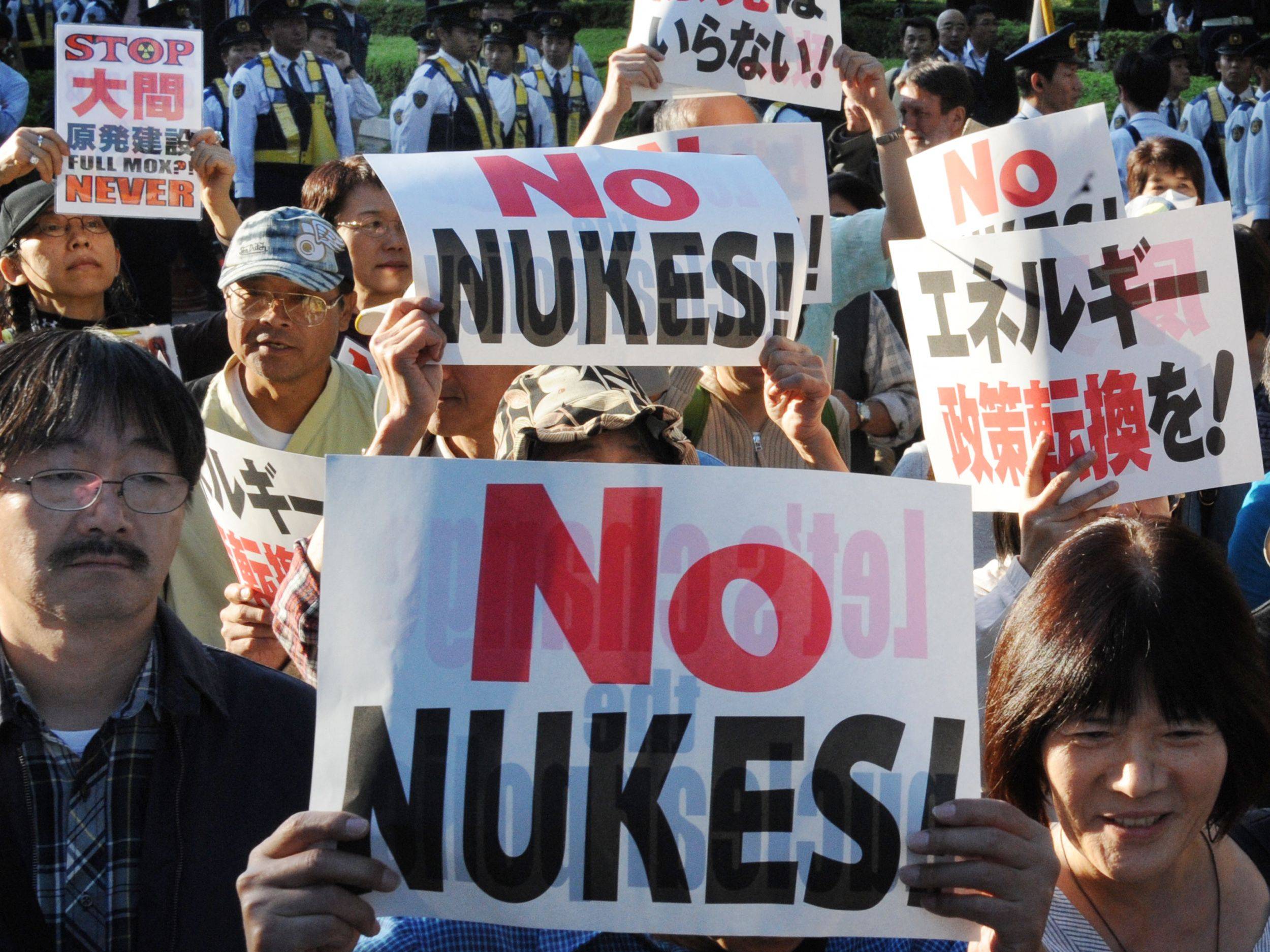
Jan 3, 2023
Japan is facing its most severe energy crisis in decades and wants to speed up the revival of its nuclear energy industry to reduce its dependence on imported fossil fuels.
But restarting more nuclear reactors remains controversial, more than a decade after the 2011 Fukushima disaster.
What does the government want?
All the country’s reactors were shut down for safety checks after the Fukushima meltdown, and there are currently 33 considered operable.
By mid-December, nine were generating electricity, meeting a target set by Prime Minister Fumio Kishida this summer to help counter energy shortages and cover around 10% of Japan’s winter power consumption.
The national nuclear safety watchdog has approved the restart of seven other reactors in principle, but such moves often face fierce opposition from local communities.
In August, Kishida called for these seven reactors to come online by summer 2023 and said Japan should also consider building next-generation nuclear reactors.
He also said authorities would discuss extending the service life of existing reactors beyond the current 60-year limit if safety can be guaranteed.
Before the Fukushima disaster, nearly a third of Japan’s power generation came from nuclear energy, but in the fiscal year to March 2022, the figure stood at around 7%.
The government is aiming for nuclear power to account for between 20% and 22% of electricity production by 2030, part of efforts to reach carbon neutrality by 2050.
What are the obstacles?
The success of these nuclear power ambitions lies with Japan’s independent Nuclear Regulation Authority (NRA), which must give a green light to the plans before they go ahead.
“It will be a challenge” to get existing reactors going again, because some have been “stalled for quite a long time,” said Tom O’Sullivan, a Tokyo-based energy consultant at Mathyos Advisory.
Bringing nuclear plants online could also be complicated by “nervousness about anti-terrorism issues,” he added, pointing to concerns around plants caught in Russia’s war in Ukraine.
“Given what’s happening with the Zaporizhzhia nuclear power plant in Ukraine, I think the NRA is probably more sensitive nowadays to potential terrorist attacks.”
Surveys show that reticence among the Japanese public toward a nuclear power revival has eased since the war in Ukraine triggered a steep rise in energy prices last year.
But opposition from people living near the plants will remain a sticking point, while reports of security breaches at one large plant in recent years have added to public unease, said analyst Hiroe Yamamoto of Moody’s Japan.
How quickly the government’s nuclear power revival hopes can become reality depends on local authorities but also Kishida’s popularity this year, said Nobuo Tanaka, chair of the Innovation for Cool Earth Forum steering committee.
The prime minister is currently “in trouble,” with his approval ratings dragged down last year by scandals, Tanaka said at a recent news conference.
So “just saying we need (more reactors online) because of high energy prices — this kind of argument may not be sustainable,” and the government must also address issues such as waste disposal, he said.
https://www.japantimes.co.jp/news/2023/01/03/national/reviving-nuclear-industry/
Nuclear plant hosts split over Japan’s reversed energy policy
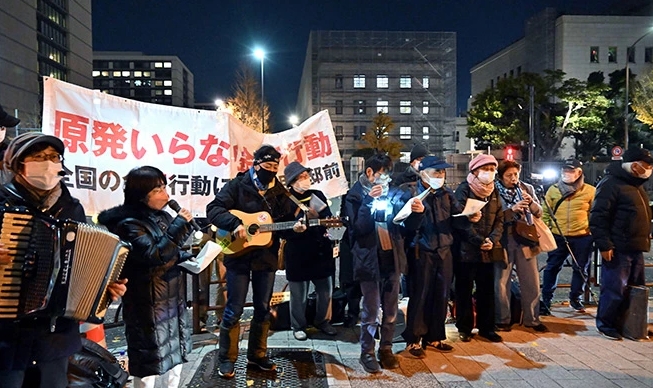
An anti-nuclear rally is held near the prime minister’s office building in Tokyo on Dec. 16.
December 23, 2022
The government’s return to reliance on nuclear energy sparked both anger and joy among municipalities that host nuclear power plants.
The Fumio Kishida administration, in a sweeping reversal of the nation’s nuclear energy policy, says it intends to make “maximum use” of nuclear power to secure a stable energy supply and reduce greenhouse gas emissions.
“We are still struggling to rebuild our community,” said Hisato Iwamoto, a member of the Futaba town assembly. “The central government must have forgotten the Fukushima disaster.”
The town co-hosts the Fukushima No. 1 nuclear plant, which suffered a triple meltdown after the Great East Japan Earthquake and tsunami in March 2011.
Iwamoto’s family was forced to move from one place to another in the prefecture following the disaster.
In fact, all residents of Futaba were told to evacuate their homes.
As a member of the town assembly that had endorsed nuclear power, Iwamoto said he feels responsible.
“It had never occurred to us that an accident could happen at the plant because we constantly asked the central government and Tokyo Electric Power Co. to ensure the plant’s safety,” he said. “I now know there is no such thing as ‘absolutely safe’ no matter how advanced nuclear plants become in the future.”
Since the 2011 triple meltdown, Iwamoto has consistently sounded warnings that a serious accident could occur at any nuclear plant when he attended meetings of assembly members of municipalities hosting nuclear plants across the country.
But their reactions have been lukewarm, according to Iwamoto.
Iwamoto, 65, noted that politicians opposed to nuclear energy would have difficulty winning elections in areas whose economies rely largely on nuclear plants.
His father, Tadao, was a good example.
Tadao was first elected to the Fukushima prefectural assembly in 1971 and began activity opposing nuclear plants. That opposition resulted in three straight election losses since 1975.
Even in the 1979 election, which followed the Three Mile Island nuclear accident in the United States in March that year, he gained the least number of votes among candidates.
After he switched his position and accepted nuclear power, he was elected Futaba mayor. He served five terms at the post.
Evacuees from Futaba were allowed to return to live in their hometown in August.
But Futaba is now a far cry from what it used to be, said Iwamoto, who still lives in evacuation in Iwaki in the prefecture.
“Community ties have never been restored,” he said.
Ritsuko Yanai, a 44-year-old mother who evacuated to Aizuwakamatsu in the prefecture, said she suspects the central government is “trying to wipe the slate clean.”
She is from Okuma, the other co-host of the Fukushima No. 1 nuclear plant.
She fled the disaster with her 1-month-old son. Her parents’ home was dismantled to make space for and interim facility to store debris and waste from decontamination work.
There is no clue on when decommissioning of the plant will be completed. And the release into the sea of tons and tons of treated water stored at the plant is expected to begin in spring.
“The nuclear accident is not over yet,” Yanai said.
But in Mihama, a town hosting the Mihama nuclear plant in Fukui Prefecture, the central government’s decision on nuclear power was mostly welcomed.
The prefecture facing the Sea of Japan hosts 15 reactors, the most in the nation. Seven of them, including two prototype reactors and two reactors at the Mihama plant, are in the process of decommissioning.
“The central government finally took action,” said Jitaro Yamaguchi, a former mayor of the town. “Nothing can serve as an alternative to nuclear energy.”
Yamaguchi, who was Mihama mayor for 20 years until he stepped down in 2019, had lobbied Kansai Electric Power Co., operator of the Mihama nuclear plant, to build more reactors in the town, with a population of about 9,000.
His pro-nuclear power stance remained unchanged even after the Fukushima disaster.
“We need nuclear plants when we think about environmental issues and power supply,” he said. “They have benefitted the local economy.”
The Mihama nuclear plant is called the “heart” of the local economy, sending “blood” to every corner of the town.
More than half of the town’s initial budget of 8.6 billion yen ($65 million) for fiscal 2022 is funded by revenues from nuclear facilities.
Since retiring as mayor, Yamaguchi, 79, has served as head of an organization promoting nuclear power.
He said he is pleased with the government’s new policy to replace retired reactors with new units. Previous governments had refused to commit to such projects following the Fukushima accident.
The town now has better prospects for construction of brand-new reactors–and more money.
“Nuclear power plants are an integral part of the local industry,” he said. “They should be built seamlessly.”
But the town is not without opponents of new reactors as well as advocates for a shift to renewables.
“A nuclear plant is akin to a drug addiction that you cannot break,” said Teruyuki Matsushita, a 74-year-old assemblyman. “Once a huge sum of money from a nuclear project is poured in the town, you are increasingly less likely to give serious thought on how to build the future of the town.”
(This article was compiled from reports by Keitaro Fukuchi, Nobuyuki Takiguchi and Tsunetaka Sato.)
Japanese panel approves return to nuclear power as disaster memories fade

Dec 22, 2022
Prime Minister Fumio Kishida’s advisory panel approved a plan to extend the lifespans of nuclear reactors beyond 60 years and build new units to replace those that are decommissioned, reversing policies put in place after the Fukushima disaster in 2011.
The step reflects a shift in public opinion, as the import-reliant country struggles with the threat of blackouts amid Russia’s war in Ukraine and extreme weather. While massive demonstrations calling for the abolition of atomic power were a regular occurrence in the wake of the meltdowns, recent polls indicate growing support for restarting idled plants.
The government is aiming to present legislation to parliament during the next session to put the basic plan into action, Kishida told a meeting of his “green transformation” panel, which is made up mostly of business executives and academics, on Thursday. The proposal will be opened for public comment and could gain Cabinet approval by February, the Nikkei newspaper reported.
Japan is joining a global shift back to nuclear energy after the prices of natural gas and coal shot to records this year as Russia’s invasion of Ukraine upended markets. The Kishida administration is also turning to nuclear to help curb emissions and hit Japan’s 2050 net-zero target.
A survey by the Yomiuri newspaper in August found 58% in favor of restarting idled reactors, the first time a majority approved of the idea in that poll series since the question was initially posed in 2017. A separate survey by public broadcaster NHK earlier this month found 45% approved of the panel’s plan, while 37% opposed it.
The government still faces some opposition from local residents over nuclear restarts and lawsuits related to safety concerns still keep many reactors offline. Only a third of Japan’s operable reactors have restarted since the 2011 disaster.
After the Fukushima disaster, Japan swore to phase out nuclear power. But not anymore

The Fukushima Daiichi nuclear power plant is seen on March 17. Japan on Thursday adopted a new policy promoting greater use of nuclear energy to ensure a stable power supply amid global fuel shortages and reduce carbon emissions — a major reversal of its phaseout plan since the Fukushima crisis.
December 22, 2022
TOKYO — Japan adopted a plan on Thursday to extend the lifespan of nuclear reactors, replace the old and even build new ones, a major shift in a country scarred by the Fukushima disaster that once planned to phase out atomic power.
In the face of global fuel shortages, rising prices and pressure to reduce carbon emissions, Japan’s leaders have begun to turn back toward nuclear energy, but the announcement was their clearest commitment yet after keeping mum on delicate topics like the possibility of building new reactors.
Still, restart approvals for idled nuclear reactors have come slowly since the Fukushima disaster, which led to stricter safety standards. Utility companies have applied for restarts at 27 reactors in the past decade. Seventeen have passed safety checks and only 10 have resumed operation.
According the paper laying out the new policy, nuclear power serves “an important role as a carbon-free baseload energy source in achieving supply stability and carbon neutrality” and pledged to “sustain use of nuclear power into the future.” Prime Minister Fumio Kishida said he planned to get the Cabinet to approve the policy and submit necessary bills to Parliament.
As part of the new policy, the Economy and Industry Ministry has drafted a plan to allow extensions every 10 years for reactors after 30 years of operation while also permitting utilities to subtract offline periods in calculating reactors’ operational life.
The plan was endorsed on Wednesday by the Nuclear Regulation Authority, Japan’s nuclear watchdog. New safety inspection rules still need to be put into law and approved by Parliament.
The regulation authority’s commissioner, Shinichi Yamanaka, told a news conference the new safety rules requiring operational permits every decade after 30 years will be safer than a current one-time 20-year extension option for 40-year-old reactors. But experts cast some doubt on that.
Some experts question extending the lifespan of older reactors
Takeo Kikkawa, an economics professor at the International University of Japan and an expert on energy, said utility operators under the new policy could keep using old equipment instead of investing in new technology or renewables.
“Naturally, we should aim for newer technology and use it safely. Therefore, extending reactors’ lifespans is an undesirable move,” Kikkawa recently told a talk show.
Most nuclear reactors in Japan are more than 30 years old. Four reactors that have operated for more than 40 years have received permission to operate, and one is currently online.
Under the new policy, Japan will also push for the development and construction of “next-generation innovative reactors” to replace about 20 reactors now set for decommissioning.
Kenichi Oshima, a Ryukoku University professor of environmental economy and energy policy, said some of what the government calls “innovative” reactors are not so different from existing technology and that prospects for nuclear fusion and other next-generation reactors are largely uncertain and not achievable anytime soon.
Thursday’s adoption of the new policy comes less than four months after Kishida launched the “GX (Green Transformation) Implementation Council” of outside experts and ministers to “consider all options” to compile a new policy that addresses global fuel shortages amid Russia’s war on Ukraine and seeks to achieve carbon neutrality by 2050.
Japan’s nuclear energy goals may be out of reach
Nuclear energy accounts for less than 7% of Japan’s energy supply, and achieving the government’s goal of raising that share to 20-22% by 2030 will require about 27 reactors, from the current 10 — a target some say is not achievable. The new policy also does not help address imminent supply shortages because reactors cannot be restarted quickly enough.
While public opinion on nuclear energy has softened since Fukushima, opponents still argue atomic power is not flexible and not even cheaper than renewables when final waste management and necessary safety measures are considered — and that it can cause immeasurable damage in an accident.
Ruiko Muto, a survivor of the Fukushima disaster, called the new policy “extremely disappointing.” She added: “The Fukushima disaster is not over yet and the government seems to have already forgotten what happened.”
The regulation authority came under fire Wednesday after revelations by a civil group that a few of its experts had discussed details with industry ministry officials before the watchdog was officially asked to consider a rule change for aging reactors, despite their compulsory independence.
Prime Minister Kishida also said Thursday that the government will do more to find candidate sites for a final repository for high-level nuclear waste that Japan does not yet have. Preliminary studies have begun in two small towns in Hokkaido, angering some residents.
Now that the government has turned to promoting nuclear power, I would like you to see a photo book published that tells the history of opposition to the construction of the Onagawa Nuclear Power Plant. Valuable data that survived the disaster

After the accident at the Fukushima Daiichi Nuclear Power Plant, Muneyoshi Abe (right), a resident of Onagawa Town, Miyagi Prefecture, held a banner saying, “Let Fukushima be a lesson to us all. Muneyoshi Abe (right) holds up a flag with the slogan “Oppose Onagawa Nuclear Power Plant” (from the photo book “50 Years in the Town of Nuclear Power Plants”).
December 22, 2022
A photo book titled “50 Years in the Town of Nuclear Power Plants: Thinking about the Future from Onagawa” was published to document the struggle to stop the construction of Tohoku Electric Power Company’s Onagawa Nuclear Power Plant (Onagawa Town, Miyagi Prefecture, and Ishinomaki City). While the Kishida administration has been pushing for nuclear power, Mikiko Abe, 70, the editor of the book and a member of the Onagawa Town Council, says, “I would like people to come into contact with the faces and thoughts of the local residents who have been fighting for half a century against nuclear power plants. (Norio Noro)
The plan to build a nuclear power plant in Onagawa was announced in 1968, and the struggle against the plant by fishermen and others began. Mr. Abe returned to his hometown after graduating from Chuo University in 1975 and joined in the struggle led by his father, Muneyoshi, who ran a shipping agent. He was outraged when he saw police riot police raising their shields and beating him, and began filming with a camera.

In September 1976, women in kappo-gowns marching in a demonstration at the “Three Towns United to Absolutely Stop Onagawa Nuclear Power Plant” rally held in Onagawa (from the photo collection “50 Years in the Town of Nuclear Power Plants”).
Residents blocking an overnight bus carrying supporters to the prefectural government’s “nuclear power plant briefing,” a demonstration at sea on a fishing boat, and a request to protest Tohoku Electric Power Company…. Standing on the frontlines of the struggle, the film records their thoughts and actions in defense of “the sea is life.
In 1977, the Onagawa Fisheries Cooperative Association passed a resolution at an extraordinary general meeting to invite nuclear power plants to Onagawa. While opponents were celebrating when the only thing reported outside was the “rejection of the abandonment of fishing rights,” which had been decided at the same time, Mr. Abe took a picture of himself shouting, “We passed a resolution to invite the nuclear power plant, so don’t shout ‘Hooray!
Construction of Onagawa Nuclear Power Plant Unit 1 began in 1979, and commercial operation began in 1984. In 2008, when the opposition to the plant continued, a town official asked Mr. Abe to preserve the photos he had taken, saying, “The struggle against the plant is part of Onagawa’s history, so I want to preserve it.

Mikiko Abe
However, her house and the town hall were hit by the tsunami in the Great East Japan Earthquake of 2011, and her precious photos and CDs were lost. However, she was lucky enough to find the data on a CD she had given to an acquaintance in Sendai City, which was left on the computer of another friend. Teiji Wada, 70, a native of the town and the head of the publishing company Ichiyo-sha (Kita-ku, Tokyo), and others have been working together to compile a photo collection.
The book contains approximately 340 photographs, including those taken by Mr. Abe in the 1970s, when the struggle was fierce. The book also includes testimonies from fishermen and others who describe the situation at that time, the Great East Japan Earthquake, and other events.
On April 26, after the accident at TEPCO’s Fukushima No. 1 nuclear power plant, Mr. Abe stood with Mr. Soetsu at the site of their debris-strewn home. That day marked the 25th anniversary of the Chernobyl nuclear power plant accident in the former Soviet Union. On the momohiki that had washed ashore, he wrote “Let Fukushima be a lesson to you? and “All nuclear reactors must be decommissioned! and “All nuclear power plants must be decommissioned! Muneyoshi passed away in 2012 at the age of 86, following in his father’s footsteps.
The Kishida administration has announced a shift in nuclear power policy to promote nuclear power for the first time since the Fukushima accident. Furthermore, the administration has been touting nuclear power as a decarbonizing and effective countermeasure to global warming.
Mr. Abe said, “The large amount of wastewater emitted from nuclear power plants is 7 degrees higher than the temperature of seawater, and this will contribute to global warming. Decommissioning or building new reactors requires enormous amounts of energy and increases carbon dioxide emissions. How will radioactive waste be disposed of and managed? I hope that people will see the origin of the struggle against nuclear power and deepen their understanding of the need for nuclear power plant phase-out,” he said.

Photo book “50 Years in the Town of Nuclear Power Plants” looks back on the struggle against the construction of the Onagawa Nuclear Power Plant.
The photo book is A4 size, 136 pages, 2,200 yen. Ichiyo-sha Publishing Co.
https://www.tokyo-np.co.jp/article/221467
Bad move to prolong the life of an industry with no growth potential: Official Decision to Operate Nuclear Power Plants for More Than 60 Years, With the Goal of Restoring the Nuclear Power Plant Accident Unseen

Prime Minister’s Office
December 22, 2022
On the afternoon of December 22, the government will hold a meeting of the Green Transformation (GX) Council at the Prime Minister’s Office to discuss industrial transformation to realize a decarbonized society, and will formally decide on a basic policy that includes measures to utilize nuclear power plants, focusing on operating them for “more than 60 years” and rebuilding (replacing) them.
After the accident at TEPCO’s Fukushima Daiichi Nuclear Power Station in 2011, the government had legally limited the operating period of nuclear power plants to “40 years in principle, with a maximum of 60 years,” and had stated that it “does not envision” rebuilding or adding new plants, but 11 years and 9 months after the accident, the government is making a major change in its nuclear policy.
According to the Ministry of Economy, Trade and Industry, nuclear power plants will be allowed to operate for more than 60 years, excluding the period of suspension due to the Nuclear Regulation Authority’s examination and judicial decisions for restarting operations. The revised bill is expected to be submitted to the ordinary Diet session next year.
In addition, the company will move forward with concrete plans to rebuild nuclear power plants that have been decided to be decommissioned with next-generation nuclear power plants, based on the assumption that safety is ensured and that the local governments in which the plants are located have their understanding. The construction of new nuclear power plants is estimated to cost more than 1 trillion yen, and the government will also consider financial support measures to help electric power companies bear the initial costs.
The basic policy will also include the development of the power grid to maximize the use of renewable energy.
At the end of July, Prime Minister Fumio Kishida instructed relevant ministries and agencies to advance discussions on overcoming the energy crisis caused by Russia’s invasion of Ukraine and the GX as one, and to specify items requiring a political decision.
◆ While uninhabitable areas still remain and compensation for the affected people is still ongoing
Prime Minister Kishida is calling it a “political decision” to change the nuclear energy policy. While the GX’s cause of reforming the socioeconomic system to combat global warming has been raised, the maximum utilization of nuclear power plants is a bad move, a measure to prolong the life of an industry that is not expected to grow.
There are two pillars of the government’s decision to utilize nuclear power plants: The first is to cut to the bare bones the rule of “40 years in principle, with a maximum of 60 years” for operation, effectively allowing operation “beyond 60 years.
Ensuring the safety of old nuclear power plants requires an enormous amount of manpower, money, and time. Nuclear power plants, which the government has promoted as an “inexpensive power source,” would impose a tremendous double-digit trillion-yen burden on electric power companies if even one severe accident were to occur. The accident at TEPCO’s Fukushima Daiichi Nuclear Power Plant 11 years and 9 months ago brought this to light.
The other pillar of the plan is to rebuild the decommissioned nuclear power plants with next-generation nuclear power plants. Although it is touted as the introduction of new technology, the number of human resources in the industry has decreased since the Fukushima accident, and there is an undeniable lack of personnel and technical capabilities. Nuclear power plant construction has long ceased, and nuclear power plant exports, promoted as a growth strategy by the Shinzo Abe administration, the longest in the postwar era, have failed at every turn.
At the site of the world’s worst nuclear accident, located 220 kilometers from Tokyo, the goal of restoration work remains elusive. Uninhabitable areas remain in the vicinity of the plant, and compensation for the victims is still ongoing. There is no hope for political decisions that do not face reality. (Shinichi Ogawa)
https://www.tokyo-np.co.jp/article/221469?fbclid=IwAR3rXy86c0b5tNBmOiRJCsrggIOJjQUSyuQk97hGXvxymepmv1loO36wC-Y
Electromagnetic radiation – cellphones as a health hazard
What to Know About Cellphone Radiation, https://www.propublica.org/article/what-to-know-about-cellphone-radiation, by Peter Elkind Jan. 4,2023
To many people, the notion that cellphones or cell towers might present a health risk long ago receded into a realm somewhere between trivial concern and conspiracy theory. For decades, the wireless industry has dismissed such ideas as fearmongering, and federal regulators have maintained that cellphones pose no danger.
But a growing body of scientific research is raising questions, with the stakes heightened by the ongoing deployment of hundreds of thousands of new transmitters in neighborhoods across America. ProPublica recently examined the issue in detail, finding that the chief government regulator, the Federal Communications Commission, relies on an exposure standard from 1996, when the Motorola StarTAC flip phone was cutting edge, and that the agency brushed aside a lengthy study by a different arm of the federal government that found that cellphone radiation caused rare cancers and DNA damage in lab animals.
The newest generation of cellphone technology, known as 5G, remains largely untested.
Here’s what you need to know:
Do cellphones give off radiation?

Yes. Both cellphones and wireless transmitters (which are mounted on towers, street poles and rooftops) send and receive radio-frequency energy, called “nonionizing radiation.” The amount of this radiation absorbed by the human body depends on how close a person is to a phone and a cell transmitter, as well as the strength of the signal the phone needs to connect with a transmitter. Cellphones displaying fewer bars, which means their connection with a transmitter is weak, require stronger power to communicate and so produce more radiation. Wireless transmitters, for their part, emit radiation continually, but little of that is absorbed unless a person is very close to the transmitter.
What does the science say about this? Is it harmful?
That’s the multibillion-dollar question. Government-approved cellphones are required to keep radiation exposure well below levels that the FCC considers dangerous. Those safeguards, however, have not changed since 1996, and they focus exclusively on the unlikely prospect of “thermal” harm: the potential for overheating body tissue, as a microwave oven would. The government guidelines do not address other potential forms of harm.
But a growing body of research has found evidence of health risks even when people are exposed to radiation below the FCC limits. The array of possible harms ranges from effects on fertility and fetal development to associations with cancer. Some studies of people living near cell towers have also confirmed an array of health complaints, including dizziness, nausea, headaches, tinnitus and insomnia, from people identified as having “electromagnetic hypersensitivity.”
The most sensational — and hotly debated — health fear about wireless radiation is cancer. In 2011, the International Agency for Research on Cancer, an arm of the World Health Organization, cited troubling but uncertain evidence in classifying wireless radiation as “possibly carcinogenic to humans.” In 2018, a study by the federal government that was nearly two decades in the making found “clear evidence” that cellphone radiation caused cancer in lab animals. A major study in Italy produced similar results.
Do cellphones pose any special health risks for kids?
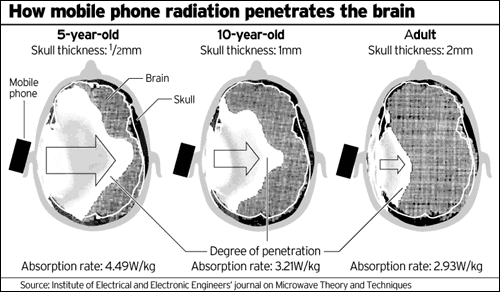
Some experts say they do, citing studies suggesting children’s thinner, smaller skulls and developing brains leave them more vulnerable to the effects of cellphone radiation. The American Academy of Pediatrics embraces this concern and has for years urged the FCC to revisit its radiation standards, saying they don’t adequately protect kids. More than 20 foreign governments, as well as the European Environment Agency, urge precautionary steps to limit wireless exposure, especially for children.
What about risks in pregnancy?
A Yale study found hyperactivity and reduced memory in mice exposed to cellphone radiation in the womb, consistent with human epidemiological research showing a rise in behavioral disorders among children who were exposed to cellphones in the womb. Dr. Hugh Taylor, the author of the mouse study and chair of the obstetrics, gynecology and reproductive sciences department at the Yale School of Medicine, told ProPublica: “The evidence is really, really strong now that there is a causal relationship between cellphone radiation exposure and behavior issues in children.”
What does the U.S. government say about cellphone radiation?
The key federal agencies — the FCC and the Food and Drug Administration — have echoed the wireless industry and a number of other groups in rejecting evidence of any “nonthermal” human health risk, saying it remains unproven. The government websites also reject the claim that children face any special risk.
In 2019, during the administration of President Donald Trump, the FCC shut down a six-year review of its 1996 wireless-radiation safety standards. The agency rejected pleas to make the standards more stringent, saying it had seen no evidence its safeguards were “outdated or insufficient to protect human safety.” In 2021, however, a federal appeals court ordered the FCC to revisit the issue, saying the agency had ignored evidence of an array of noncancer harms to humans, animals and the environment, and that its decision to uphold its exposure standard failed to meet “even the low threshold of reasoned analysis.” The FCC has taken no formal action since then.
Why is the issue not resolved?
Determining wireless radiation’s health effects with certainty is difficult. Researchers cannot ethically subject people to endless hours of cellphone radiation to gauge the results. Scientists have to rely on alternatives such as animal studies or epidemiological research, where challenges include getting subjects to accurately recount their wireless use and pinpointing the specific causes of disease or harm. Many health effects of toxic exposure, especially cancer, take years or decades to appear. And the mechanisms of how wireless radiation could affect the body at the cellular level are poorly understood.
Research funding on the issue has also been scarce in the U.S., despite frequent calls for more study. Research (and researchers) raising health concerns have come under sharp attack from industry, and government regulators have remained skeptical. A key FDA official, for example, dismissed the relevance of the federal study that found “clear evidence” of cancer in lab animals, saying it wasn’t designed to test the safety of cellphone use in humans, even though his agency had commissioned the research for that reason.
Linda Birnbaum, who led the federal agency that conducted the cellphone study, said that while proof of harm remains elusive, what is known means that precautions are merited. “Do I see a smoking gun? Not per se,” she told ProPublica. “But do I see smoke? Absolutely. There’s enough data now to say that things can happen. … Protective policy is needed today. We really don’t need more science to know that we should be reducing exposures.”
If I’m concerned about the risk, are there precautions I can take to protect myself and my family?
Because exposure varies dramatically with your proximity to the source of the radiation, experts say a key to minimizing risk is increasing your distance from the phone. This means keeping any cellphone that’s turned on away from direct contact with your body. Don’t keep it in your bra, in your pocket or (especially if you’re pregnant) against your abdomen, they say. And instead of holding the phone against your head when you talk, use a speaker or wired earphones. (Wireless headsets, such as AirPods, also emit some radiation.) Try to avoid making calls when the phone is telling you the signal is weak because that boosts the radiation level. You can also limit exposure by simply reducing how much time you spend talking on your cellphone and texting instead, they say. Using an old-fashioned landline avoids the problem altogether.
Take Japan to court for nuclear water dumping
By Zhang Zhouxiang | China Daily 2023-01-05
The Japanese government had announced in April 2020 that it plans to dump nuclear waste water from its wrecked Fukushima nuclear plant into the ocean from the spring of 2023.
As the date approaches, and given Japan’s record, it will not be surprising if Japan starts dumping the water any time soon without giving other countries advance notice.
While the action will save the Japanese government and the Tokyo Electric Power Company money and trouble, it will also shift the trouble and cost onto other nations, the Pacific ones in particular. There is a precedent here. Years after the United States carried out nuclear tests on the Bikini Atoll, also in the Pacific, from 1946 to 1958, radiation levels there were considered too high to allow resettlement in 1998.
Fishermen from China, the Republic of Korea and other Southeast Asian countries, including from Japan, depend on the waters in the region to make a living. No wonder, Japanese fishermen were protesting the move to dump nuclear waste into the waters.
The US, which Japan always looks up to, has supported Japan’s plan despite studies showing that the region most polluted by the discharge will be the US’ west coast in two years…………
Senior Japanese officials, despite bowing politely at news conferences, have shown no sincerity in negotiating with their Pacific neighbors. When they announced the decision to dump the water into the ocean, they did not ask for understanding from any side except the US.
There is the UN Convention on the Law of the Sea and multiple nuclear safety conventions to which Japan is a signatory, but it has helped little. It is time for all sides involved to sue the Japanese government in international courts. Japan cannot do this evil deed and just walk away unpunished. https://global.chinadaily.com.cn/a/202301/05/WS63b613aba31057c47eba7bd1.html
Japan’s shortage of engineers and manufacturing capacity sets back its nuclear ambitions
Japan’s ambitions to reboot its nuclear industry risk being set back by a
shortage of engineers and manufacturing capacity that has atrophied in the
decade following the Fukushima nuclear disaster.
Prime Minister Fumio Kishida’s new policy calls for the construction of new nuclear power
plants, raising hopes for Japanese manufacturers that are working on
smaller reactors and other upgraded nuclear technologies. But the
industry’s nuclear supply chain is under strain, warned industry executives
and experts. The 2011 accident triggered a massive exit of more than 20
manufacturers, including Kawasaki Heavy Industries and Sumitomo Electric
Industries.
FT 4th Jan 2023
https://www.ft.com/content/e179ece0-6e0b-4ce7-98b5-30ae01d41501
KEPCO: 197 employees obtained national licenses illegally, also engaged in nuclear power plant construction work

December 20, 2022
On December 20, KEPCO announced that 197 employees of KEPCO and its group companies (17 of whom had retired) had taken the technical certification examination for construction management engineers, a national certification that is required for process management in construction work, without the required period of work experience, and had fraudulently obtained the certification. An investigation report by outside lawyers found no evidence of systematic involvement in the fraud.
The Osaka District Court found no problems with the quality of construction work performed by the company’s employees, including 15 cases involving the three nuclear power plants in its jurisdiction, in which the improperly qualified employees were engaged as chief engineers.
https://www.jiji.com/jc/article?k=2022122001091&g=eco&fbclid=IwAR3d-PETosvWBi5K5o3XeQFFa8mRI9Er2cPAKkyQZkykurV1LLgRK4A0dAc
South Korea asks US for greater role in managing nuclear weapons
AFR, Sangmi Cha, Jan 2, 2023,
Seoul | South Korean President Yoon Suk Yeol said his government was in talks with the US on taking a more active role in managing nuclear weapons on the Korean Peninsula, which would mark a significant shift in a decades-old policy among American allies to deter North Korea.
“While the nuclear weapons belong to the US, intel sharing, planning, and training should be done jointly,” Mr Yoon told South Korea’s Chosun Ilbo newspaper. “The US’ stance is quite positive,” he added, saying the policy should be conducted under the concept of “joint planning and joint exercise”.
He said the strategy of “nuclear umbrella”, or “extended deterrence”, was no longer reassuring for the public now that North Korea had developed nuclear weapons and a range of missiles to deliver them.
Since taking power last May, Mr Yoon has sought to put South Korea on a path of overwhelming military strength against North Korea, which has launched scores of missiles in defiance of United Nations resolutions and is preparing for another nuclear test………………………… more https://www.afr.com/world/asia/south-korea-asks-us-for-greater-role-in-managing-nuclear-weapons-20230102-p5c9wu
North Korea to have “exponential increase” in its nuclear arsenal
Kim Jong-un has vowed to ramp up the production of nuclear warheads and
build a more powerful intercontinental ballistic missile (ICBM), while
singling out South Korea as his country’s “undoubted enemy”, North
Korean state media reported on Sunday. In a sign of deepening animosity
towards the US, South Korea and Japan, Kim called for an “exponential
increase” in the regime’s nuclear arsenal during an address at a plenary
meeting of the ruling Workers’ party that ended on Saturday.
Guardian 1st Jan 2023
Pakistan supplies India with a list of its nuclear facilities
Pakistan said it had handed a list of its nuclear installations and
facilities to the Indian mission in Islamabad on Sunday under a decades-old
agreement between the two nuclear-armed rivals. The neighbours have fought
three wars and have had a number of military skirmishes in recent years.
Last year an Indian missile accidentally landed in Pakistan, setting off
alarm bells across the world.
Reuters 1st Jan 2023
Kashiwazaki Kariwa, a Distant Recovery of Confidence TEPCO Shares Crisis Awareness to Prevent Misconduct

Deputy General Manager Daito explains the operating floor. Before entering the building, biometric authentication and other enhancements were in place.
December 19, 2022
A series of scandals, including flaws in anti-terrorism measures, at the Kashiwazaki Kariwa Nuclear Power Plant (Niigata Prefecture), which Tokyo Electric Power Company (TEPCO) aims to restart, has called into question TEPCO’s efforts to restore trust. If distrust grows, it could affect the decommissioning of the Fukushima Daiichi Nuclear Power Plant, which caused the accident. As an operator involved in nuclear power generation, TEPCO is required to improve its internal structure to prevent misconduct, such as by ensuring that each and every employee shares a sense of crisis.
Crisis awareness “is a weak point
In October, the Local Newspaper Energy Study Group, a group of local newspapers in areas where nuclear facilities are located, visited the Kashiwazaki Kariwa Nuclear Power Plant to observe the status of remedial measures being taken. Masaki Daito, 56, deputy director of the Kashiwazaki Kariwa Nuclear Power Plant, admitted to a lack of awareness of the crisis, saying, “There were parts of the situation that we should have been aware of, but we were naive in our understanding of the situation.
In September 2008, an employee of the plant took a colleague’s ID card without permission and entered the central control room illegally, and in April 2009, the Nuclear Regulation Authority issued an order prohibiting the transfer of nuclear fuel. In April 2009, the Regulatory Commission issued a de facto operation ban order prohibiting the transfer of nuclear fuel. The restart of the plant has been put on hold, and TEPCO officials stress that they will work to restore trust in the plant, saying, “Without the understanding of the local community, we will not be able to restart the plant.
Improvement Measures, Starting with Greetings
In response to the series of scandals, TEPCO is working on 36 improvement measures related to the protection of nuclear materials. A Security Management Department has been established within the power plant, the personnel structure has been reviewed, and the budget for equipment has been expanded from 20 billion yen to 58 billion yen. During the inspection tour, the monitoring system was strengthened, with biometric authentication required to enter the “operating floor,” the upper level of the Unit 6 reactor.
TEPCO believes that a lack of communication with employees and workers at partner companies is behind the scandals. The company explained that as a measure to improve the situation, executives and others are standing at the main gate in the morning and making efforts to conduct a “greeting campaign,” but an unusual situation comes to mind in which a review of the basics is unavoidable.
Response is backward and “lousy.
How did the local administration, business community, and residents react to the scandal? The study group interviewed Masahiro Sakurai, 60, mayor of Kashiwazaki City, and Masao Nishikawa, 66, chairman of the Kashiwazaki Chamber of Commerce and Industry. Both are in favor of restarting the nuclear reactors, but they are also very critical of TEPCO in light of the scandals.
In a word, they are lousy. Mayor Sakurai laments TEPCO’s backward steps, such as strengthening biometric authentication after the scandal. While he praises TEPCO’s measures to deal with the scandal, saying that “they are making efforts,” he also points out that a sense of tension and crisis awareness has not penetrated the company’s ranks. Chairman Nishikawa also stated that “the relationship of trust has broken down,” and revealed that he had submitted a letter of request to TEPCO to protest the situation.
Kazuyuki Takemoto, 72, a resident of Kariwa Village who has been campaigning against the plant, questioned the government’s nuclear fuel cycle policy, including the disposal of spent nuclear fuel, saying, “The government is desperately trying to get the plant restarted, but can it really be moved? TEPCO wants to move forward with the restart, but it must not forget the lessons of the nuclear accident. In the visitor’s house at the Kashiwazaki Kariwa Nuclear Power Plant, there is a panel that reads, “Our responsibility for the recovery of Fukushima. How will they face these words and show them through their actions? The public is watching closely. (News Department, Satoshi Mizuno)
https://www.minyu-net.com/news/news/FM20221219-747455.php?fbclid=IwAR0nhAklKQFJuZM0ZvTte_9cByVby2h11Vbls1yTWLwR_nCduxxv2KmD5mE
1 This Month

of the week – Shut Down Drone Warfare!


Tell the Ukrainian Government to Drop Prosecution of Peace Activist Yurii Sheliazhenko

Petition to revoke the licensing of the Near Surface Nuclear Disposal Facility (NSDF) at Chalk River. https://www.ourcommons.ca/petitions/en/Petition/Details?Petition=e-7247
To see nuclear-related stories in greater depth and intensity – go to https://nuclearinformation.wordpress.com
-
Archives
- April 2026 (103)
- March 2026 (251)
- February 2026 (268)
- January 2026 (308)
- December 2025 (358)
- November 2025 (359)
- October 2025 (376)
- September 2025 (257)
- August 2025 (319)
- July 2025 (230)
- June 2025 (348)
- May 2025 (261)
-
Categories
- 1
- 1 NUCLEAR ISSUES
- business and costs
- climate change
- culture and arts
- ENERGY
- environment
- health
- history
- indigenous issues
- Legal
- marketing of nuclear
- media
- opposition to nuclear
- PERSONAL STORIES
- politics
- politics international
- Religion and ethics
- safety
- secrets,lies and civil liberties
- spinbuster
- technology
- Uranium
- wastes
- weapons and war
- Women
- 2 WORLD
- ACTION
- AFRICA
- Atrocities
- AUSTRALIA
- Christina's notes
- Christina's themes
- culture and arts
- Events
- Fuk 2022
- Fuk 2023
- Fukushima 2017
- Fukushima 2018
- fukushima 2019
- Fukushima 2020
- Fukushima 2021
- general
- global warming
- Humour (God we need it)
- Nuclear
- RARE EARTHS
- Reference
- resources – print
- Resources -audiovicual
- Weekly Newsletter
- World
- World Nuclear
- YouTube
-
RSS
Entries RSS
Comments RSS
 nuclear-news