Radiation level as high as in 2011 at Fukushima Daiichi nuclear power plant
Fukushima radiation levels as high as 2011, RT July 27, 2013 Water samples taken at an underground passage below the Fukushima Daiichi nuclear power plant contain alarming levels of radiation which are comparable to those taken immediately after the catastrophe.
According to a Saturday statement by Tokyo Electric Power Company (TEPCO), the tested water contains 2.35 becquerels of cesium per liter, and the radioactive water is now seeping into the sea. The findings were also evident from samples taken within a 50-meter radius around the plant.
Fight looming in Taiwan over referendum on nuclear power
Showdown looms in legislature over nuclear plant vote, Focus Taiwan 2013/08/01 Taipei, Aug. 1 (CNA) Leaders of the ruling Kuomintang (KMT) caucus in the Legislative Yuan vowed Thursday to push for a vote on holding a referendum to decide the fate of Taiwan’s fourth nuclear power plant, as opposition lawmakers prepared to block the procedure.
DPP caucus whip Wu Ping-jui said his caucus made a decision to enter the floor early in order to occupy the podium overnight. Wu said his colleagues will not “give an inch” if a motion is called Friday, as announced by the KMT majority…………
Meanwhile, as a showdown loomed in the Legislature, activists stepped up their anti-nuclear protests around Taipei Thursday……
It mentioned the Fukushima Daiichi nuclear disaster in Japan as an example, saying that compensation for the 2011 disaster has so far reached 2.64 trillion yen (US$26.77 billion). The nationalization of the Tokyo Electric Power Co. means that taxpayers have to cover the losses, it added.
Taipower, on the other hand, would not be able to cover such losses, the groups said……….. http://focustaiwan.tw/news/asoc/201308010027.aspx
Nearly 1000 radioactive cars reached Russia from Japan
Radiation-Contaminated Japanese Cars Still Concern – Russian Customs . VLADIVOSTOK, August 1 (RIA Novosti) – Japanese cars contaminated with radiation in the aftermath of the 2011 Fukushima nuclear disaster is still a concern regarding the importation of such vehicles to Russia, a customs official said Thursday.
According to Russian customs, more than 930 radiation-contaminated vehicles from Japan have been detected at far eastern Russian ports since a magnitude-9 earthquake and subsequent tsunami ravaged the Fukushima nuclear power plant in central Japan…….
A representative of Russia’s federal consumer-protection watchdog, Rospotrebnadzor, told RIA Novosti that it is easier to send such cars back to Japan than to spend money on their decontamination…….http://en.ria.ru/business/20130801/182537097/Radiation-Contaminated-Japanese-Cars-Still-Concern–Russian-Customs.html
China’s $323 billion renewable energy program
China outlines renewable energy splurge July 30, 2013 http://www.smh.com.au/business/carbon-economy/china-outlines-renewable-energy-splurge-20130730-2qx92.html#ixzz2amhMZ8XK
China may invest another 2.3 trillion yuan in key energy- aving and emission-reducing projects, Xie Zhenhua, vice chairman of the National Development and Reform Commission, said Tuesday at a conference in Beijing. China stands by its pledge to cut carbon emissions per unit of economic output by as much as 45 per cent before 2020 from 2005 levels, he said.
The increased reliance on renewable sources of energy fits with efforts by China, the world’s biggest carbon emitter, to help mitigate the effects of pollution blanketing its major cities. Along with renewables investments, the environment ministry is considering stricter controls on vehicle and industry pollution.
The government aims to have 100 gigawatts of wind-power installed capacity and more than 35 gigawatts of solar power by 2015, Xie reiterated today. China’s targets have encouraged companies including China Petrochemical Corp., also known as Sinopec Group, to strengthen their commitment to protect the environment.
Sinopec Monday said it will invest 22.9 billion yuan on an environmental protection plan.
China asked seven cities and provinces last year to put in place regional caps and pilot programs for trading emission rights.
The country will gradually expand the regions falling under its carbon trading pilot program starting from 2015 in order to explore the potential for a national system, Xie said.
Tepco: no plan for Fukushima nuclear cleanup, don’t know what they’re doing
VIDEO Anger mounts at Fukushima plant operator over radiation leaks http://www.euronews.com/2013/07/26/you-don-t-know-what-you-re-doing-fukushima-plant-operator-told/ Anger is growing at the operators of Fukushima, as an increasing number of reports indicate that Japan’s crippled nuclear plant does not have radiation risks under control.
Tokyo Electric Power Company (TEPCO), which runs Fukushima, admitted on Monday that contaminated water could be leaking into the sea. The firm had persistently denied that this was the case, despite repeated warnings from nuclear experts and marine biologists.
Dale Klein, Chairman of the Nuclear Reform Monitoring Committee criticised the firm for how it has been communicating with the public:
“These actions indicate that you do not know what you’re doing, and that you do not have a plan, and you’re not doing all you can to protect the environment and the people,” Klein told TEPCO. Anger is growing at the operators of Fukushima, as an increasing number of reports indicate that Japan’s crippled nuclear plant does not have radiation risks under control.
Tokyo Electric Power Company (TEPCO), which runs Fukushima, admitted on Monday that contaminated water could be leaking into the sea. The firm had persistently denied that this was the case, despite repeated warnings from nuclear experts and marine biologists.
Dale Klein, Chairman of the Nuclear Reform Monitoring Committee criticised the firm for how it has been communicating with the public:
“These actions indicate that you do not know what you’re doing, and that you do not have a plan, and you’re not doing all you can to protect the environment and the people,” Klein told TEPCO.
TEPCO slow to admit to radiation leaking: “mustn’t worry the public”
 Japan utility says reluctance to worry public delayed disclosure of nuclear plant’s leaks WP, by Associated Press July 26, TOKYO — The operator of Japan’s crippled nuclear plant said Friday that it delayed acknowledging that the plant was leaking contaminated water into the sea because it did not want to worry the public until it was certain there was a problem.
Tokyo Electric Power Co. acknowledged for the first time this week that its Fukushima Dai-ichi plant was leaking contaminated underground water into the ocean, a problem many experts had suspected since shortly after the crisis unfolded more than two years ago. The plant suffered multiple meltdowns after the March 2011 earthquake and tsunami destroyed its power and cooling systems. After a major leak of contaminated water in April of that year, TEPCO said it had contained the problem, and denied there were any further underground leaks into the ocean until Monday.
TEPCO has repeatedly been criticized for delayed disclosures of problems and mishaps at the plant, which still runs on makeshift equipment and has been plagued with problems, including recent blackouts and minor water leaks from storage tanks………….The head of the reform committee, Dale Klein, said he was disappointed and frustrated by TEPCO’s handling of the disclosure of the leaks.
“These actions indicate that you do not know what you’re doing, and that you do not have a plan, and you’re not doing all you can to protect the environment and people,” Klein, former chairman of the U.S. Nuclear Regulatory Commission, said at the meeting.
On Thursday, the chief of Japan’s national federation of fisheries, Hiroshi Kishi, said TEPCO had betrayed the public by denying the leaks for more than two years and demanded the company take steps to stop the leaks immediately and step up monitoring of radioactivity in seawater near the plant.
TEPCO last detected spikes in radiation levels in underground and seawater samples taken at the plant in May. The company says the contamination is limited to just near the plant, but the extent of the contamination is unknown. Most fish and seafood from along the Fukushima coast are barred from domestic markets and exports.http://www.washingtonpost.com/world/asia_pacific/japan-utility-says-reluctance-to-worry-public-delayed-disclosure-of-nuke-plants-leaks/2013/07/26/9364c412-f5d4-11e2-81fa-8e83b3864c36_story.html
Richard Wilcox’s personal journey to Fukushima’s irradiated “dead zone”
We also spotted many suspicious looking flowers and other forms of vegetation. According to Yoichi, radiation has affected some flowers in the nuclear zone to go haywire and outgrow their natural size (a
topic for future research). Yoichi noted that radiation affects different plants differently, some are hardy and not affected; others, especially flowers may receive small doses but have big results in terms of mutations.
Below: Yoichi indicates the normal height of this flower compared to this giant version

We already know that the biologist and expert on mutagenetic affects, Tim Mosseau, has shown that in Fukushima prefecture a variety of insects and other species have been affected (1).
 My Trip To The Fukushima Nuclear Disaster Zone http://rense.com/general96/trip.html
(Part One) By Richard Wilcox Ph.D. 7-26-13 On July 20, 2013 Yoichi Shimatsu and I departed from Ueno station in Tokyo to visit the Fukushima nuclear disaster region and see what we
could see…..
Undoubtedly Japan’s countryside regions have suffered from brain drain and thus the numbers of passengers do not justify the number of trains. After the Fukushima disaster many people moved out of the immediate area and this has reduced the need for trains.
Beyond that fact, Yoichi speculates that the Japanese government does not want people going up there to snoop around, Fukushima is now a DEAD ZONE and off limits. Indeed it is, even while they are urging
some people to move back in. Families that moved out of the immediate area of the nuclear disaster may now live in safer zones to the south, but they are forced to train their kids back to their original schools during the daytime, if that is where their family property is registered. Continue reading
Steaming continuing from Fukushima nuclear reactor 3
 [Steaming reactor3] Thermography shows the steaming area is over 15℃ hotter than atmosphere http://fukushima-diary.com/2013/07/steaming-reactor3-thermography-shows-the-steaming-area-is-over-15%E2%84%83-hotter-than-atmosphere/
by Mochizuki on July 25th, 2013 Following up this article..Reactor3 steaming again / Over 1 Sv/h at 6 of 25 locations on the operation floor [URL]
On 7/24/2013, Tepco conducted the second thermography survey of the operation floor of reactor3, where the steam was observed.
The surveying time was 4:40 ~ 6:04 AM. They conducted the first thermography survey on 7/20/2013 but because the surveying time was from 12:39 to 14:40, sunshine distracted the details. (cf, Thermography shows 50℃ on operation floor of “steaming” reactor3 [URL 2])
This second thermography survey showed the steaming area is about 34.3℃, where the atmospheric temperature was 18.6℃.
It was surveyed at 5m above the floor.
Around where they detected over 1Sv/h, the temperature was 24.7℃, which was also higher than back ground. However, it was surveyed at 40m above the floor. Details are not clear. (cf, Reactor3 steaming again / Over 1 Sv/h at 6 of 25 locations on the operation floor [URL 3])
Effect of public opposition to nuclear power, USA project in India cancelled
 US company nukes Rs 2724 cr nuclear parts project at Vizag Manish & Swati Rathor, TNN | Jul 26, 2013, “….. US player Brighton Energy Corporation Ltd’s Rs 2724 crore megaproject to make forged steel components for use in nuclear power plants was to come up inVisakhapatnam district. According to officials of the Andhra Pradesh Industrial Infrastructure Corporation (APIIC), the project planned by US player in Nakkapalli mandal of the district has been shelved. ….
Nuclear nationalism – the dangerous hubris
The dangers of nuclear hubris, Praful Bidwai Thursday, Jul 25, 2013, Agency: DNA Nuclear weapons and aggression always go together. So do nuclear weapons, hubris and machismo. Aggressiveness — and readiness to wreak mass destruction or inflict great cruelties upon an adversary’s civilians — lies at the heart of the nuclear weapons rationale, the acceptance and normalisation of their mind-numbing violence, and the development and deployment of such armaments, whether they are used or not.
Nuclear deterrence seeks security through terror, by threatening the enemy with “unacceptable” damage. As the Dr Strangelove film shows, nuclear scientists and experts quintessentially, yet naturally, imbibe deeply cynical, male-supremacist and pathologically aggression-prone attitudes. Many of them personally, literally, exude violence.
Fukushima nuclear plant cleanup costs – $50 billion and climbing
 With Fukushima nuclear plant still leaking, Japan clean-up bill soars to $50bn Many are sceptical that government-led effort will make area habitable again THE INDEPENDENT, DAVID MCNEILL TOKYO
WEDNESDAY 24 JULY 2013 Japanese researchers say the cost of cleaning up from the Fukushima nuclear disaster could top $50bn (£32.6bn), more than four times the amount allocated by the government.
The figure does not include compensation for those affected by the explosion and the subsequent fallout, or the multibillion-dollar price tag for decommissioning the Fukushima Daiichi plant, which the
government and regulators say will take at least 40 years to complete…….. Continue reading
Fukuxshima nuclear reactor 3 in “cold shutdown” but boiling!
BBC: It’s boiling somewhere inside Fukushima Unit No. 3 — Reactor supposed to be in cold shutdown — Situation ‘worrying’ http://enenews.com/bbc-boiling-inside-fukushima-unit-3-reactors-supposed-be-cold-shutdown-situation-worrying
Title: Fukushima nuclear plant: Japan takes steps over sea leak
Source: BBC News
Date: July 23, 2013
h/t Anonymous tip
[…] (Tepco) said steam was seen around the fifth floor of the building housing Reactor No 3 […]
It is not clear what is causing the steam […]
The sight of steam rising is worrying because it means somewhere inside the reactor building water is boiling, says the BBC’s Rupert Wingfield-Hayes in Tokyo.
Th badly damaged reactors are supposed to be in what is called “cold shutdown”; the temperature of the cooling water inside the reactor should be well below boiling point.
It is another sign that Tepco still does not fully know what is going on inside the damaged reactors […]
Fukushma Nuclear Reactor 4: constant danger from fuel pool
By Harvey Wasserman 25 July 13 Radiation leaks, steam releases, disease and death continue to spew from Fukushima and a disaster which is far from over. Its most profound threat to the global ecology—a spent fuel fire—is still very much with us. ………
the worst fear of all remains unabated. At Unit Four, which apparently did not actually explode, the building’s structural integrity has been seriously undermined. Debate continues to rage over exactly how this happened.
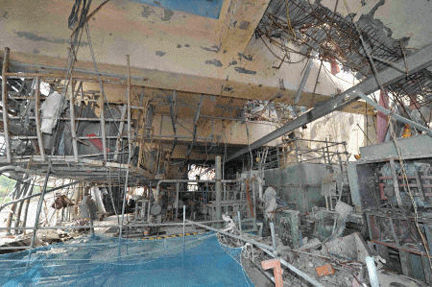
In such an event, the radioactive emissions could be catastrophic. Intensely lethal emissions could spew for a very long time, eventually circling the globe many times, wrecking untold havoc.
The Japanese have removed two apparently unused rods from the fuel pool so far. But intense international pressure to clear out the rest of them has thus far been unsuccessful.
So while a depleted, discredited and disorganized nuclear utility moves to restart its other reactors, its stricken units at Fukushima continue to hold the rest of us at the brink of apocalyptic terror.
Fukushima radiation contaminating the marine food chain
 Japan Times: ‘Fears marine life is being poisoned’ by nuclear material flowing from Fukushima — Experts warn of ‘festering radioactive sore’ contaminating food chain — Tepco flip-flop ‘shocking’ http://enenews.com/japan-times-fears-marine-life-is-being-poisoned-by-nuclear-material-flowing-from-fukushima-experts-warn-of-festering-radioactive-sore-contaminating-food-chain-tepco-flip-flop-shocking
Title: Tepco now admits radioactive water entering the sea at Fukushima No.1
Source: AFP-JIJI
Date: July 22, 2013
Fisheries exec shocked by utility’s flip-flop on groundwater’s flow
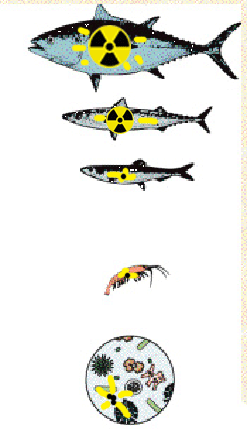
Fukushima nuclear plant operator Tepco on Monday admitted for the first time that radioactive groundwater is flowing into the sea, fueling fears that marine life is being poisoned. […]
Tetsu Nozaki, chairman of Fukushima Prefectural Federation of Fisheries Co-operative Associations, voiced deep concern.
“It was quite shocking,” he told NHK. “(Tepco’s) explanation is totally different from the one in the past.”
Environmental experts warn that the festering radioactive sore could contaminate the food chain by tainting marine life and ultimately, the humans who eat it. […]
See also: NYT: Fukushima plant leaking for past 2 years? Japan Times: Groundwater is reaching sea — Reuters: Growing alarm, problems mounting — Official: If you have solutions, we’d like to know — WSJ: No ‘immediate’ health threat
Mysterious steam engulfing Fukushima Daiichi nuclear reactor no 3
AFP: ‘Fukushima reactor site engulfed by steam’ — Kyodo: ‘Something like steam’ coming from unknown source at Unit No. 3 — Tepco: ‘Continuously wafting through the air’ — Work to remove rubble suspended http://enenews.com/just-in-fukushima-reactor-site-engulfed-by-steam-something-like-steam-coming-out-of-unit-no-3-continuously-wafting-through-the-air-work-to-remove-rubble-suspended
Kyodo, July 23, 2013:[… Tepco] said Tuesday it has confirmed “something like steam” is coming out of the No. 3 reactor building again […Tepco] said one of its monitoring cameras showed what appeared to be steam coming out of the building’s fifth floor just above the reactor container at around 9:05 a.m. Tuesday. The steam continued to be seen at 10:30 a.m. […] TEPCO has suspended work to remove rubble at the reactor building due to the apparent steam emission, they said.
Washington Post,July 23, 2013: […] Tepco also said in an e-mailed statement today that steam from an unknown source that was first spotted near the fifth floor of the Fukushima plant’s No. 3 reactor building on July 18 was seen again this morning. […]
The Australian, July 23, 2013 (h/t RadChick): Fukushima reactor site engulfed by steam […] Workers at the crippled Fukushima nuclear plant in Japan have reported steam inside a battered reactor building for the second time in less than a week. The operator said today steam was seen around the fifth floor of the building housing Reactor No 3 shortly after 9am […] Steam was spotted in the same area on Thursday […] with TEPCO saying it did not know for sure what had caused it. […]
TEPCO Press Release, July 23, 2013: Steam Found Near the Central Part of the Fifth Floor (Equipment Storage Pool Side) of Unit 3 Reactor Building at Fukushima Daiichi Nuclear Power Station (Follow-up Information 9) […] This is a follow-up report on the statuses of steam found wafting through the air near the central part of the fifth floor (equipment storage pool side) of Unit 3 on July 18. At around 9:05 AM today (July 23), we found steam coming from near the central part of the fifth floor (equipment storage pool side) of Unit 3 by a camera. […] The steam is continuously wafting through the air as of 10:30 AM. We will continue to monitor the status closely.
1 This Month
23-25 October – on Zoom – World BEYOND War’s annual global conferenc


Shut down the radiation-damaged Heysham nuclear reactors now
To see nuclear-related stories in greater depth and intensity – go to https://nuclearinformation.wordpress.com

Say No to NASA’s Reckless Nuclear Reactor on the Moon
Say No to NASA’s Reckless Nuclear Reactor on the Moon
-
Archives
- October 2026 (169)
- September 2026 (339)
- August 2026 (330)
- July 2026 (355)
- June 2026 (287)
- May 2026 (306)
- April 2026 (356)
- March 2026 (251)
- February 2026 (267)
- January 2026 (308)
- December 2025 (358)
- November 2025 (359)
-
Categories
- 1
- 1 NUCLEAR ISSUES
- business and costs
- climate change
- culture and arts
- ENERGY
- environment
- health
- history
- indigenous issues
- Legal
- marketing of nuclear
- media
- opposition to nuclear
- PERSONAL STORIES
- politics
- politics international
- Religion and ethics
- safety
- secrets,lies and civil liberties
- spinbuster
- technology
- Uranium
- wastes
- weapons and war
- Women
- 2 WORLD
- ACTION
- AFRICA
- Atrocities
- AUSTRALIA
- Christina's notes
- Christina's themes
- culture and arts
- Events
- Fuk 2022
- Fuk 2023
- Fukushima 2017
- Fukushima 2018
- fukushima 2019
- Fukushima 2020
- Fukushima 2021
- general
- global warming
- Humour (God we need it)
- Nuclear
- RARE EARTHS
- Reference
- resources – print
- Resources -audiovicual
- Weekly Newsletter
- World
- World Nuclear
- YouTube
-
RSS
Entries RSS
Comments RSS

