After 2 years of denial, Tepco admits radioactive water leaks int o the sea
TEPCO had persistently denied contaminated water reached the sea, despite spikes in radiation levels in underground and sea water samples taken at the plant.
TEPCO Admits Radiation Leaking Into Sea For Past Two Years http://crooksandliars.com/susie-madrak/tepco-admits-fukushima-radiation-leak July 22, 2013 By Susie Madrak That cat’s on the roof and it won’t come down! TEPCO dribbles out some more information. I wonder what they’re not telling us? Because it’s a little odd that this isn’t front page news in America:TOKYO — A Japanese utility said Monday its crippled Fukushima nuclear plant is likely leaking contaminated water into sea, acknowledging for the first time a problem long suspected by experts.
Tokyo Electric Power Co., which operates the Fukushima Dai-ichi plant, also came under fire Monday for not disclosing earlier that the number of plant workers with thyroid radiation exposures exceeding threshold levels for increased cancer risks was 10 times what it said released earlier.
The delayed announcements underscored the criticisms the company has faced over the Fukushima crisis. TEPCO has been repeatedly blamed for overlooking early signs, and covering up or delaying the disclosure of problems and mishaps. Continue reading
Fukushima cancer risk to workers, thyroid cancer to older people
 ‘Fukushima cancer risk surges’ — Ongoing saga at nuclear plant ‘dangerously murkier’ — Over 10 times more workers suffered cancer-inducing radiation doses than Tepco admitted http://enenews.com/fukushima-cancer-risk-surges-ongoing-saga-at-nuclear-plant-dangerously-murkier-over-10-times-more-workers-suffered-cancer-inducing-radiation-doses-than-tepco-admitted
Title: Fukushima cancer risk surges
Source: The Times of India
Author: Subodh Varma
Date: Jul 21, 2013
Fukushima cancer risk surges
The ongoing saga of Fukushima nuclear plant in Japan that suffered a triple meltdown in March 2011 just got dangerously murkier.
The number of workers who suffered cancer-inducing radiation doses is not 178, but 1,978, Asahi Shimbun reported on Friday. That’s eleven times more than admitted by Tepco, the owner of the plant last December.
[…] Very shaky records of radiation testing and results have been maintained.
The Fukushima plant continues to leak radiation in the sea and the groundwater and Tepco […] appears to have no clue as to what is happening. […]
Asahi Shimbun:: Children are believed to be the highest at risk to thyroid gland doses. But a recent study showed the risk of cancer from thyroid gland doses rises even in people over 40, countering the previous belief that older people were far less susceptible to the cancer-inducing effects of radiation.
See also: 25 times as many people in Fukushima area developed thyroid cancer after disaster — Japan Expert: My heart breaks greatly that those U.S. servicemembers suffered radiation exposure
10 million data points: Safecast volunteers map Fukushima radiation
 Volunteers See Fukushima Radiation on the Move http://www.technologyreview.com/view/517416/volunteers-see-fukushima-radiation-on-the-move/ Aviva Hope Rutkin, 23 July 13
Crowd-sourced data provides a high-res view of radiation levels in Japan.The radiation-mapping project launched shortly after the Fukushima Daiichi nuclear disaster recently surpassed more than ten million data points, all gathered by a network of local volunteers. The maps show, among other things, that radiation levels are dropping more quickly than should be expected via half-life decay alone. Project director Sean Bonner says this may be a sign that radioactive contamination is on the move. “This could mean that organic material (such as leaves on tree, brush) might have been contaminated and fallen off and washed away over the last two years, lowering the overall background of an area,” he said in an email.
The project, Safecast, was founded one week after the disaster to share information about radiation levels around Japan. Although the Japanese government provides its own statistics on this issue, its data is sometimes unreliable and can be restricted from public access. Safecast sends volunteers cheap Geiger counters, called geigies, to measure local levels of radioactivity. Volunteers can either purchase a unit for anywhere from $200 to $1000 or build their own using a $450 kit. This data is then mapped and made publicly available through the Safecast website.
Over more than two years of data collection, Safecast has produced the highest resolution picture to date of Japan’s radiation levels. The project’s maps confirm that the majority of the country’s radiation levels remain near background, with no appreciable change in radioactive activity. In areas that do have significant radiation, the maps show how levels can fluctuate simply when one crosses the street in a given neighborhood—uncovering small, previously unrecognized hotspots, though the organization maintains that these hotspots are not cause for concern.
Safecast plans to continue collecting data to use in a larger analysis of how these levels change in different cities over the coming years. They hope to uncover more about where the radiation is spreading, and how a given area’s climate, topography, and soil affect the way surface radioactivity decays.
Criminal charges against India’s Kudankulam anti nuclear protestors
 Kudankulam: Criminal cases against nuclear plant protestors to stay A Subramani, TNN | Jul 23, 2013 CHENNAI: The situation in Kudankulam is neither conducive nor ripe for withdrawal of criminal cases registered against the anti-nuclear power plant activists, the Tamil Nadu government informed the Madras high court on Tuesday.
When three PILs seeking fulfillment of 15 conditions laid down by the Supreme Court prior to the operationalisation of the nuclear power plant and also for withdrawal of cases against the agitating activists came up for hearing before the first bench, advocate general of Tamil Nadu A L Somayaji said: “The stage is not ripe for withdrawal of criminal cases already filed.”
Somayaji told the bench comprising acting Chief Justice R K Agrawal and Justice M Sathyanarayanan that the agitators faced cases for snatching a pistol, holding ‘marana porattam’ (stir unto death) and fishing boycott. He said their agitations continued even after the apex court ruling and they were targeting the unit-II of the plant as well.
Pointing out that the tenor of the apex court’s condition no. 14 that endeavours should be made to withdraw cases against the agitators was different from other conditions such as AERB and NPCIL clearances for operationalisation of the plant, Somayaji said there was no positive sign for the state government to drop the cases. ……http://timesofindia.indiatimes.com/city/chennai/Kudankulam-Criminal-cases-against-nuclear-plant-protestors-to-stay/articleshow/21280617.cms?
According to TEPCO, 2000 Fukushima workers at higher risk of thyroid cancer
 Workers at Japan’s Fukushima nuclear plant see raised cancer risk http://www.thehindubusinessline.com/news/international/workers-at-japans-fukushima-nuclear-plant-see-raised-cancer-risk/article4931822.ece TOKYO, JULY 19: Japan’s Tokyo Electric Power Company said on Friday that 1,973 employees who were at the nuclear power plant damaged after a 2011 tsunami are facing a higher risk of thyroid cancer.
Workers at the Fukushima Daiichi Nuclear Power Station have estimated thyroid radiation doses exceeding 100 millisieverts, the widely accepted level for an increase in the risk of cancer, the company said.
They are to undergo annual ultrasonic thyroid examinations, it said.
Health tests were given to 19,592 workers — 3,290 Tokyo Electric employees and 16,302 employees of its affiliated companies.
They were involved in the struggle to bring the plant under control after the world’s worst nuclear crisis since the 1986 Chernobyl disaster.
The Fukushima plant suffered meltdowns at three of its six reactors after the earthquake and tsunami two years ago.
Steam rising from Fukushima No 3 nuclear reactor
Fukushima nuclear plant in Japan seen leaking steam but operator TEPCO says it’s no emergency Date SMH July 19, 2013 Steam has been spotted in a reactor building at the crippled Fukushima nuclear plant in Japan, its operator says, stressing there is no sign yet of increased radiation.
The incident, which Tokyo Electric Power Co (TEPCO) said was not “an emergency situation”, is the latest underlining the plant’s continuing precariousness more than two years after it was wrecked by a tsunami.
TEPCO is struggling to manage the clean-up, which scientists say could take up to four decades to complete.
Steam has been seen around the fifth floor of the Reactor 3 building, a TEPCO spokesman said on Thursday, adding it was “drifting thinly” and was not a large column of vapour.
“We do not believe an emergency situation is breaking out, although we are still investigating what caused this,” he said.,,,,he steam is the latest in a growing catalogue of mishaps that have cast doubt on the utility’s ability to fix the world’s worst atomic disaster in a generation.
A series of leaks of water contaminated with radiation have shaken confidence, as did a blackout caused by a gnawing rat that left cooling pools without power for more than a day. http://www.smh.com.au/world/fukushima-nuclear-plant-in-japan-seen-leaking-steam-but-operator-tepco-says-its-no-emergency-20130718-2q73e.html#ixzz2ZWRAaHGM
300,000 tons of radioactive water at Fukushima, and still growing
 As of May 7, the Japan Times reported that TEPCO had installed 290 huge storage talks at Fukushima to hold more than 78 million gallons (290,000 tons) of radioactive water, with another 25 million gallons still uncollected. Fukushima is generating an estimated 100,000-plus gallons (400 tons) of radioactive water every day
TEPCO estimates that groundwater is entering the complex at a rate of at least 54,000 gallons per day.
Fukushima 2013: “Remaining Radioactive Mass”, “Dangerous Leaking Radioactive Water”, All Four Reactors are “Getting Worse” By William Boardman Global Research, July 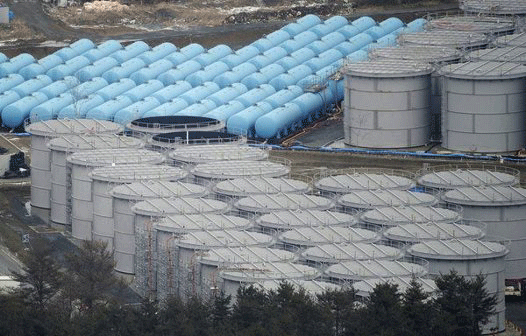 11, 2013 The first thing to know about the danger from the radioactive mass remaining on site in the three reactors that melted down at Fukushima is that nobody knows how much radioactive material there is, nobody knows how much uranium and plutonium it contains, and nobody knows how to make it safe — so no one knows how great the continuing danger is.
In order to prevent nuclear material from being diverted to use in weapons, the International Atomic Energy Agency of the U.N. requires each country to report regularly on the volume of nuclear materials in its nuclear power plants. At Fukushima, this is currently impossible with the cores of the three reactors that melted down.
Diversion of this material to weapons use is not a problem at the moment, since the level of radioactivity is high enough to kill anyone who comes close to it, which is why it hasn’t been moved. On the other hand, it is necessary to move it in order to measure it, and even if it was movable now, the technology to measure it does not yet exist. Continue reading
China’s government fears that anti-nuclear activism may become a national movement
 The government in Beijing would be happy if anti-nuclear protests were to stay at the level of bickering between counties or even the occasional outburst of nimbyism, as in Jiangmen. But there is a risk that the success of Jiangmen residents in securing a change of heart could encourage others. “We can expect similar protests wherever a nuclear project is planned,” says Eva Sternfeld of Berlin’s Technical University, who has studied such activism.
 Nuclear activism Limiting the fallout, The Economist A rare protest prompts the government to scrap plans to build a uranium-processing plant. Is anti-nuclear activism on the rise? Jul 20th 2013 | PENGZE, JIANGXI PROVINCE |OPPOSE nuclear pollution”; “Give us back our green homeland”. So declared banners raised by some of the hundreds of protesters who took to the streets of Jiangmen city in the southern province of Guangdong on July 12th. In a remarkable concession, the local government announced that it would heed their demands and abandon plans to build a uranium-processing facility. For officials in Beijing, keen to develop nuclear power and keep activism in check, the demonstration was an unsettling sign of potential
trouble.
The protest was the first known major public rally against a project involving the nuclear-power industry since China began building nuclear plants in the mid-1980s. Continue reading
94% of Japanese think that the Fukushima crippled nuclear plant is not under control
Survey: Most Japanese think Fukushima nuclear accident not settled http://ajw.asahi.com/article/0311disaster/fukushima/AJ201307180064 July 18, 2013 By SHIGEKO SEGAWA / Staff Writer The vast majority of Japanese, 94 percent, think the nuclear accident at the Fukushima No. 1 nuclear power plant triggered by the earthquake and tsunami two years ago has not been put under control, a survey showed.
A research team led by Hirotada Hirose, a professor emeritus of Tokyo Woman’s Christian University, sent out questionnaires in March to 1,200 people across the nation ranging in age from 15 to 79.
According to the survey, 94 percent said that they thought the nuclear accident had not been settled. When asked for reasons, many responded that radioactive substances were still leaking from the stricken plant.
 As far as who the respondents said they trust, 33 percent said disaster information disseminated from the central government and its ministries and agencies was the most untrustworthy, while 2 percent chose local governments as the most unreliable source of disaster information.
“An (effective) nuclear policy is impossible unless the central government wins the understanding and support of not only local residents living in areas that host nuclear power plants but also the support of all the people in Japan,” Hirose said.
Twenty-three percent of respondents said they believe it is only a matter of time before another accident will occur if nuclear plant operators resume operations at now-idle reactors, while 57 percent said they think a similar nuclear disaster will likely happen.
Thirty-one percent said nuclear power should be abandoned as soon as possible, whereas 54 percent said Japan should phase out nuclear power over time.
The research team presented the findings to a meeting of the Cabinet Office’s Atomic Energy Commission on July 17.
World Health Organisation predicted cancers from Fukushima radiation, called for long term monitoring
Fukushima 2013: “Remaining Radioactive Mass”, “Dangerous Leaking Radioactive Water”, All Four Reactors are “Getting Worse” By William Boardman Global Research, July 11, 2013 “………Radiation Dose So Far Not Harmful, U.N. says – But It’s Not Over Yet
In February the World Health Organization (WHO) of the U.N. released an almost 200-page assessment of the health risks from the Fukushima disaster, “the first-ever analysis of global health effects due to radiation exposure” from Fukushima. In a press release issued in Geneva, WHO concluded that: “for the general population inside and outside of Japan, the predicted risks are low and no observable increases in cancer rates above baseline rates are anticipated.”
Using preliminary dose estimation data to make its predictions, the WHO report also found “that the estimated risk for specific cancers in certain subsets of the population in Fukushima Prefecture has increased and, as such, it calls for long term continued monitoring and health screening for those people.”
The release quotes Dr Angelika Tritscher, Acting Director for WHO’s Food Safety and Zoonosis Department, saying that: “In addition to strengthening medical support and services, continued environmental monitoring, in particular of food and water supplies, backed by the enforcement of existing regulations, is required to reduce potential radiation exposure in the future.”
And the WHO report “notes that the psychosocial impact of Fukushima] may have a consequence on health and well-being. These should not be ignored as part of the overall response.”…..http://www.globalresearch.ca/fukushima-2013-remaining-radioactive-mass-dangerous-leaking-radioactive-water-all-four-reactors-are-getting-worse/5342466
Radiation the most probable cause of Fukushima’s deformed butterflies
 Japan Biologist: Radioactivite contamination from Fukushima disaster is most reasonable explanation for butterfly deaths and abnormalities — “I think maybe this is a very touchy issue, politically” http://enenews.com/japan-biologist-radioactivity-from-fukushima-is-most-reasonable-explanation-for-butterfly-deaths-and-abnormalities-i-think-maybe-this-is-a-very-touchy-issue-politically
Source: Nature
Author: Ewen Callaway
Date: 16 July 2013 […] Last week […] biologists studying Fukushima and Chernobyl came together at the annual meeting of the Society for Molecular Biology and Evolution in Chicago […]What Fukushima data do exist are sporadic — and contested. […]
[…] Insects collected in May [2011] showed few problems, but their lab-reared offspring had many abnormalities, such as misshapen wings and aberrant eyespots, and many died as pupae (A. Hiyama et al. Sci. Rep. 2, 570; 2012). Among the September-collected butterflies, more than half of the progeny showed such defects.
[…] “You can come up with alternative explanations, but I think the hypothesis that radiation caused death and abnormalities is the most reasonable,” [Joji Otaki, an ecologist at the University of the Ryukyus in Nishihara, Japan] says.
Tim Mousseau, an evolutionary geneticist at the University of South Carolina in Columbia […] is heading to Fukushima this week to begin his third season of field work […] His team saw die-offs in some insects and declining numbers of some bird populations […]
For funding, Otaki says he has had to turn mostly to private foundations. “I think maybe this is a very touchy issue, politically,” he says.[…] The Department of Energy has largely stopped funding its research programme in low-dose exposure, and the National Science Foundation and the National Institutes of Health have awarded few grants […]
See also: Japan Scientists: Truly unusual deformities in Fukushima — Forests may be evolving into different ecosystems — “There’s been a sudden, large change”
Taiwan nuclear reactor in danger during typhoon

 Kyodo: Worker panicking while trying “to keep water level up” in reactor during typhoon — Seawater reportedly overran cooling water intake #Taiwan http://enenews.com/kyodo-worker-was-panicking-while-trying-to-keep-water-level-up-in-reactor-during-typhoon-seawater-reportedly-overran-cooling-water-intake-no-mention-of-neutrons-taiwan
Kyodo News,, July 16, 2013: Human error causes Taiwan’s nuclear plant shutdown […] Chai Fu-feng, a spokesman of Taiwan Power Co. (Taipower), told Kyodo News that the Unit 2 reactor of the Chinshan nuclear power station in New Taipei City was automatically shut down when instruments detected too much water in the reactor pressure vessel. […] a plant worker switched off a draining valve to control the heat in the reactor […] Panicking, he added water to the reactor to keep the water level up, but he added too much water too fast, which eventually caused the reactor to automatically scram, he said. […]
World Nuclear News,, July 16, 2013: […] winds above 117 kilometres per hour threatened transmission systems. […] the height of the storm saw damage to Chinshan 2′s main transformer, which triggered an automatic shutdown. A few hours later seawater overran the cooling water intake bringing in plant debris that clogged the debris screen. Later inspection confirmed lightning damage to the main transformer, as well as storm damage to the switchyard insulator and 350 kV overhead lines. […]
Nuclear dilemma facing Japan
Japan’s nuclear energy dilemma Alex Thomson, 17 July 13 Everything about nuclear power is divisive…..
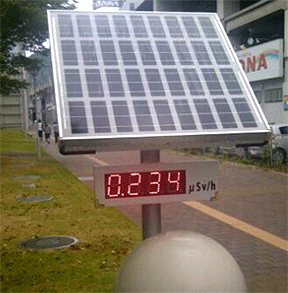 (at left – Japan- solar-powered radiation monitor) ….even as they continue to pour tonnes of water daily into the reactor fuel rods at Fukushima to stop a full-scale meltdown; even as they struggle to isolate why the place is leaking radioactive water into the Pacific; even as they cannot explain why caesium levels near to Reactor 2 are now higher than at any time since the earthquake struck the plant – even as all this is gong on, the Japanese nuclear industry is rousing itself from idling offline and looking to generate power once again.
Ten nuclear power plants are actively lobbying to restart full operations, and most are sited at or near the coast, as is the Japanese way. Many – like Fukushima – are old plants now and desperate to get back into the game after sitting offline for this long period of national Japanese soul-searching.
Yet a recent demonstration against the nuclear industry brought more than 30,000 onto the streets of Tokyo. That is a big number in Japan…… Even as they struggle to contain what is going on in the plant (and nobody really knows the full extent of that) debate rages across Japan and beyond……
For now though, they are still crisis-managing at the stricken plant itself. Indeed whether they really are managing it at all is another level altogether of raging debate. Meanwhile, there are permanent-looking radiation monitors which have spring up for miles around the plant itself, displaying to the public the background radiation levels twenty-four seven.
Nobody much notices them nowadays. But I cannot help seeing they are powered by solar panels. http://blogs.channel4.com/alex-thomsons-view/japans-nuclear-energy-dilemma/5381
FUKISHIMA: RADIOACTIVITY in SEAWATER
Issue 1: The number of radio-nuclides entering the marine environment of the east coast of Japan.
Issue 2: The nature of the radio-nuclides derived from reactor and cooling pond outputs
It’s my conclusion that the official monitoring regime being carried out by TEPCO and other Japanese agencies is inadequate to the task of identifying the potential radiobiological threats to the public.
 An OPEN BRIEFING, Tim Deere-Jones: Marine Radioactivity Consultant, timdj@talktalk.netJuly 2013
I’m a UK based Marine Radioactivity Consultant, Researcher and Campaigner whose been researching the subject since the 1980’s and working (on a freelance, independent basis) as a consultant to NGO’s, Green Groups, Citizens Campaign Groups and UK Local Authorities since the 1980’s.
My field work experience and desk review research have been focussed on the behaviour and fate of man made radioactivity in UK and European marine, coastal and estuarine environments and the pathways by which doses of marine radioactivity may be delivered to maritime, coastal zone and island populations.
In the context of the ongoing contamination of the marine environment following the multiple meltdowns and loss of coolant from the Fukushima site I note the ongoing near-site monitoring of the marine environment (sea water) and of some marine environmental media (principally fish, with some marine algae).
However I am deeply concerned to note that a number of highly relevant issues and phenomena relating to the behaviour and fate of the Fukushima sea discharged radioactivity and its potential for delivering doses to human populations remain un-recorded, under researched and/or completely ignored.
Thus it is evident that the true impacts of the radioactive contamination of the Japanese east coast are not being documented or acted upon.
The short, informal briefing, set out in the following pages, identifies and comments on some of those issues and introduces the outcome of a number of UK observations and studies (principally carried out in one of the planets most radioactive sea areas: the Irish Sea and it’s adjacent waters) in order to provide some supporting background information in support of my concerns relating to the Fukushima case.
N.B. Input of the search term “Tim Deere-Jones: Marine Radioactivity” to most of the popular search engines will upload links to a number of fully referenced, scientific and technical reports and studies, on the behaviour, fate and doses potential of marine discharged radioactive wastes in UK and European waters, that I have authored for a number of clients. Continue reading
Fukushima’s malformed vegetables- is radiation the cause?
 Fukushima Vegetables Have Bizarre Tumor-Like Growths And Deformities: Is Nuclear Meltdown To Blame For Freaky Produce? [PHOTOS] International Science Times, By Philip Ross on July 15, 2013 Photos of what look like malformed vegetables from Fukushima, Japan, have surfaced on Imgur.

Thestrange produce have deformities, bumps and lumps all over them, and look like mutant cabbage patch kids beamed to Earth after having been harvested on an alien planet…… This isn’t the first time the Fukushima nuclear power plant disaster has sparked fears that radiation was causing deformities in nature. In August 2012, researchers in Japan discovered evidence of mutant butterflies.
IScience Times reported that researchers collected 144 specimens of the pale grass blue butterfly, a common species in Japan, two months after the disaster. They found that 12 percent of the butterflies showed signs of mutation and abnormalities, including antennae disfigurement, small wings and a change in color patterns……To see more photos of the Fukushima vegetables, click here. http://www.isciencetimes.com/articles/5641/20130715/fukushima-vegetables-fukushima-disaster-nuclear-meltdown.htm
1 This Month
23-25 October – on Zoom – World BEYOND War’s annual global conferenc


Shut down the radiation-damaged Heysham nuclear reactors now
To see nuclear-related stories in greater depth and intensity – go to https://nuclearinformation.wordpress.com

Say No to NASA’s Reckless Nuclear Reactor on the Moon
Say No to NASA’s Reckless Nuclear Reactor on the Moon
-
Archives
- October 2026 (170)
- September 2026 (339)
- August 2026 (330)
- July 2026 (355)
- June 2026 (287)
- May 2026 (306)
- April 2026 (356)
- March 2026 (251)
- February 2026 (267)
- January 2026 (308)
- December 2025 (358)
- November 2025 (359)
-
Categories
- 1
- 1 NUCLEAR ISSUES
- business and costs
- climate change
- culture and arts
- ENERGY
- environment
- health
- history
- indigenous issues
- Legal
- marketing of nuclear
- media
- opposition to nuclear
- PERSONAL STORIES
- politics
- politics international
- Religion and ethics
- safety
- secrets,lies and civil liberties
- spinbuster
- technology
- Uranium
- wastes
- weapons and war
- Women
- 2 WORLD
- ACTION
- AFRICA
- Atrocities
- AUSTRALIA
- Christina's notes
- Christina's themes
- culture and arts
- Events
- Fuk 2022
- Fuk 2023
- Fukushima 2017
- Fukushima 2018
- fukushima 2019
- Fukushima 2020
- Fukushima 2021
- general
- global warming
- Humour (God we need it)
- Nuclear
- RARE EARTHS
- Reference
- resources – print
- Resources -audiovicual
- Weekly Newsletter
- World
- World Nuclear
- YouTube
-
RSS
Entries RSS
Comments RSS

