More leaks found at Fukushima nuclear plant
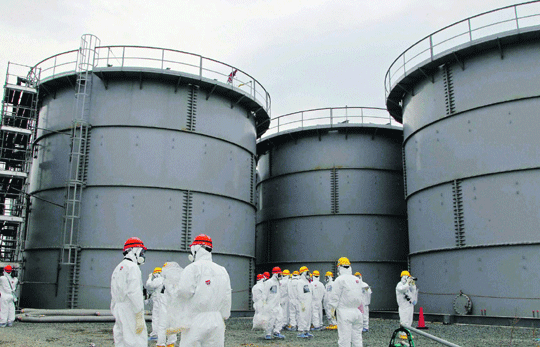 Fukushima Leaks: More Tank Leaks Found At Crippled Japanese Nuclear Plant HUFFINGTON POST, By MARI YAMAGUCHI 09/02/13 “……On Monday, Japan’s top nuclear regulator raised safety concerns about the hastily built storage tanks and their foundations after signs of new leaks.
One was found over the weekend in a connecting pipe, and plant operator, Tokyo Electric Power Co., said it suspects three storage tanks where elevated radioactivity was detected also have had leaks.
Nuclear Regulation Authority Chairman Shunichi Tanaka told a news conference that the small leak and possible other leaks have added to concerns about the plant’s stability.
They follow a major leak two weeks ago. TEPCO reported a loss of 300 tons of highly radioactive water from a steel tank on Aug. 19, saying most of it is believed to have seeped underground but some might have escaped into the sea. The company has yet to determine the cause or exactly where the water went.
More than 300 tanks there are of a similar type. About 1,000 tanks hold 330,000 tons of contaminated water at the plant, and the amount grows by 400 tons daily. The water is part of the makeshift system to keep the radioactive material at the plant stable. TEPCO also said it overlooked several signs of leaks – increases of radioactivity near the tanks and higher exposure levels for workers – for more than a month. http://www.huffingtonpost.com/2013/09/02/fukushima-leaks_n_3855621.html?ir=World
Spread of high radiation at Fukushima nuclear plant
High radiation spreads at ruined Fukushima plant, Japan vows aid SMH, September 3, 2013 – Tokyo: High radiation levels are spreading at the ruined Fukushima nuclear plant, its operator said on Monday, and the Japanese government prepared to offer more funding and oversight to try to contain the crisis. Japanese authorities were seeking to address criticism that Tokyo Electric Power Co has bungled the response to the world’s worst nuclear accident since Chernobyl.
Japanese officials fear the Fukushima crisis could threaten Tokyo’s bid to host the 2020 Olympics

“Tokyo Electric has been playing a game of whack-a-mole with problems at the site,” Trade and Economy Minister Toshimitsu Motegi said in a televised interview.
Prime Minister Shinzo Abe vowed to “step forward and implement all necessary policies” to deal with the flood of radioactive waste building up at Fukushima since the March 2011 reactor meltdown at Fukushima……….
Olympic Bid At Stake
Japan’s nuclear industry, which once provided a third of its energy, has ground nearly to a halt since the earthquake, causing reactor meltdowns. Restarting Japan’s idled reactors, and reducing its reliance on foreign energy supplies, is a central element of Abe’s economic growth plans.
Japanese officials also fear that international attention to the Fukushima crisis could threaten Tokyo’s bid to host the 2020 Olympics, a decision set to be made by the International Olympic Committee on Saturday in Buenos Aires.
Yasuhisa Shiozaki, deputy policy chief of the ruling Liberal Democratic Party and head of its project team on nuclear regulation, called for the creation of a “decommissioning agency” that could resemble Britain’s National Decommissioning Authority, a public body charged with managing the dismantling of the nation’s atomic power and research stations. http://www.smh.com.au/world/high-radiation-spreads-at-ruined-fukushima-plant-japan-vows-aid-20130903-2t1jf.html#ixzz2dssfzv3V
Out of control: Fukushima will finish off the nuclear industry
Professor Busby believes the situation is clearly out of control and that no one can go anywhere near it. “Nobody can go in to measure where these leaks are or do anything about them, because anybody who is to approach that sort of area would be dead quite quickly. They would be seriously harmed”
 What happens next is anyone’s guess,
This will have a domino impact on all nuclear reactors in my opinion. The cost of keeping those still operating will have to go up, and as the cost of decommissioning them becomes clearly extraordinary, often more than double the cost of building them, and sometimes, like Sellafield, orders of magnitude more, and in a climate of disappearing liquidity……… nobody will be able to afford to build any nukes. There simply won’t be the funds, as all the money that could have been used disappears down the blackhole of decommissionings.
The last nail in the Nuclear Coffin….http://damnthematrix.wordpress.com/2013/09/02/the-last-nail-in-the-nuclear-coffin/ 2 Sept 13, Things have been looking grim at Fukushima. First, they realised that for some time they had been using a radiation meter that could not read beyond 100 milli Sieverts and believed that this was the actual radiation level there…. only to find out with another instrument that levels were in fact much higher, and that hundreds of tonnes of highly radioactive water were leaking into the Pacific Ocean daily for…. well no one knows.
Then it was decided (as I recently reported) that fuel rods lying perilously in a damaged above ground leaking pool that keeps those rods from melting down and causing an actual out of control nuclear reactor (read explosion + mushroom cloud…) were going to be moved, by hand… because? Well the cranes that normally do this have been destroyed by the earthquake, presumably ably assisted by the tsunami.
At the time I commented “what could go wrong?”……..
Well…. things have actually taken a turn for the worse, even before the attempt to move the rods. Continue reading
Pacific Ocean – a handy drain for Fukushma’s radioactive trash
Use sea as nuclear sink, says Tokyo http://www.theaustralian.com.au/news/world/use-sea-as-nuclear-sink-says-tokyo/story-fnb1brze-1226709319491 BY:RICK WALLACE, TOKYO CORRESPONDENT September 03, 2013 THE head of Japan’s nuclear watchdog has flagged dumping contaminated water from the Fukushima Daiichi nuclear power plant into the Pacific Ocean amid mounting woes over storage and seepage of radioactive water.
But Nuclear Regulation Authority chairman Shunichi Tanaka said any water released would be treated to an extent that the level of contaminants was well below international limits.
“If (the situation) becomes more severe, and some water falls below regulatory limits, it might have to be discharged into the ocean,” he said yesterday in a speech to the Foreign Correspondents’ Club of Japan in Tokyo.
“I know this (previously) created a great stir in some circles. However, I will absolutely not support the dumping of water where the level of contamination is above the limits.”
Mr Tanaka said properly functioning nuclear plants dumped contaminated water into the ocean as part of normal operations, provided it met the limits.
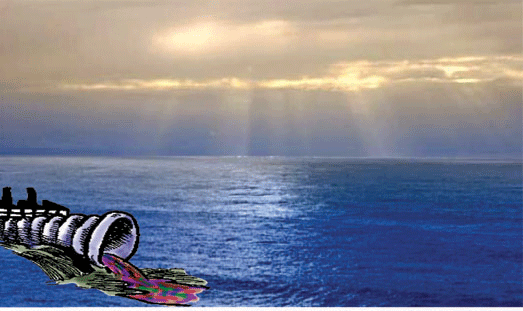
But any discharge of water – irrespective of the level of decontamination carried out – is likely to spark outrage from environmentalists, fishing operators and neighbouring countries. Continue reading
India, Japan, negotiating purchase of nuclear reactors

 India, Japan to restart nuclear talks today NEW DELHI, DHNS: Sep 3, 2013 India will continue to stonewall pressure from Japan to convert its unilateral moratorium on nuclear tests into a bilateral commitment, even as the two countries are set to restart negotiations on a proposed agreement for cooperation in civilian use of atomic energy on Tuesday.
Over two years after the accident at its Fukushima Daiichi nuclear plant prompted Japan to pause talks with India for a bilateral civil nuclear cooperation agreement, the process is now set to resume. The negotiations, however, are likely to be tough, as New Delhi will resist Tokyo’s pressure to add a clause to the agreement providing for termination of bilateral cooperation in the event of a nuclear test conducted by India.
Sources told Deccan Herald that India would also insist on protecting its right to reprocess the fuel spent on nuclear reactors to be procured under the agreement with Japan.
Two officials of the Ministry of External Affairs—Joint Secretary (East Asia) Gautam Bambawale and Joint Secretary (Disarmament) Bala Venkatesh Varma—are in Tokyo to restart the talks……. http://www.deccanherald.com/content/354971/india-japan-restart-nuclear-talks.html
Massive radioactive water collection grows, Japan’s government paralysed on this issue
Tepco has yet to decide how to dispose of the contaminated water, spokeswoman Mayumi Yoshida said. But before it can act it will need approval from the government, residents and fishermen, who are already suspicious of the company’s motives.
Fukushima’s toxic water pool grows as Tepco dithers http://www.smh.com.au/world/fukushimas-toxic-water-pool-grows-as-tepco-dithers-20130830-2svvn.html#ixzz2dncD1B4t August 31, 2013 Yuriy Humber The Tokyo Electric Power Company is trying to decide what to do with the largest pool of radioactive water in the history of nuclear accidents. It can either dump it in the ocean, let it evaporate into the air, or both.
The more than 330,000 tonnes of water with varying levels of toxicity is stored in pits, basements and hundreds of tanks at the wrecked Fukushima nuclear plant.
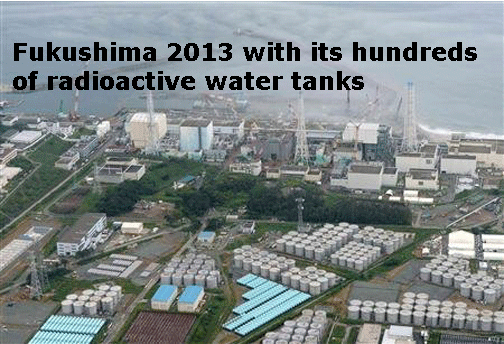
The government said this week it would take a bigger role in trying to staunch the toxic outflow that has grown to 40 times the volume accumulated in the atomic disaster at Three Mile Island in the US.
Processing and disposing of the water – enough to fill a large crude oil tanker or 132 Olympic-size swimming pools – is presenting one of the most challenging engineering tasks of our generation, former nuclear engineer Michael Friedlander said. Continue reading
UK government’s dilemma as China demands more control of UK’s new nuclear plants


 Chinese seek greater say in UK nuclear plants By Guy Chazan Dt.com Sept 1 13, The state-owned Chinese nuclear group that is in talks to invest in Britain’s new nuclear programme wants greater operational control of any new plants it finances, potentially creating a national security headache for the government.
China General Nuclear Power Group (CGN), is in talks with EDF of France on sharing the cost of building a new plant at Hinkley Point, Somerset, which has an estimated price tag of £14bn.
But CGN has made it clear to EDF that it will only proceed if it is given more of a say in running other plants the two companies build together in the UK, according to people familiar with the talks.
As well as Hinkley, EDF also has plans to construct two new reactors at Sizewell in Suffolk. One of the people said CGN could seek to become joint operator of the new Sizewell plant – although EDF is likely to retain overall control. The Chinese could also push for greater involvement in the plant’s construction, and might even seek to provide the design for its reactors. “CGN is using Hinkley as a stepping stone,” he said. “In the next project, they’ll want greater control.”
However, given the sensitivities surrounding nuclear power, the idea of allowing a Chinese state-backed company to take an operational role in a nuclear power station could raise a welter of national security concerns……..
Mark Pritchard, a Conservative MP and member of the national security strategy committee, said Chinese companies should only be able to take a “minor” role in sensitive sectors of the economy such as energy………http://www.ft.com/intl/cms/s/0/3dfb8eb0-10b5-11e3-b5e4-00144feabdc0.html#axzz2dnO4ZmCk
Shutdown of nuclear reactor leaves Japan with only one functioning nuclear reactor
 Japan shuts down nuclear reactor for inspections , channel news Asia, 2 Sept 13,
Workers will switch off one of Japan’s two working reactors Monday, with the other set for shutdown later this month and no restarts in sight amid continued public hostility to nuclear power. TOKYO: Workers will switch off one of Japan’s two working reactors Monday, with the other set for shutdown later this month and no restarts in sight amid continued public hostility to nuclear power.
Kansai Electric Power will start reducing generating power at its Unit No 3 at the Oi plant, Fukui prefecture, western Japan, shortly before 5:00 pm (0800 GMT), a company spokesman said.
The reactor will be fully shut down by early Tuesday in readiness for inspections legally mandated within 13 months of the start of commercial operations, he said.
The reactor is one of the only two still generating power in Japan. The other one, Unit No 4 at Oi, is to be switched off on September 15.
It is not known when they will resume operations because they will be assessed under a set of guidelines recently drawn up by the nuclear watchdog, according to Kansai Electric.
The two reactors were restarted — despite public opposition — in July last year after passing safety tests, ending a brief period in which no atomic power was generated in Japan.
They were the only units to be brought back online after undergoing such tests in the aftermath of the disaster in March 2011 at Fukushima……. The company said Sunday it had found highly radioactive water dripping from a pipe connecting two coolant tanks at one of four radiation hotspots http://www.channelnewsasia.com/news/asiapacific/japan-shuts-down-nuclear/798834.html
Japan could face legal action by other countries, due to Fukushima radiation
Japan Official: Fukushima contamination “increasingly seen as international problem… lawsuits may be filed overseas” — “Gov’t should take preventive actions based on a worst-case scenario” says S. Korea newspaper http://enenews.com/japan-official-lashes-out-fukushima-contamination-is-increasingly-seen-as-an-international-problem-lawsuits-may-be-filed-overseas-govt-should-take-preventive-actions-based-on-a-wors
Title: Government under fire for slow response to Fukushima leak
Source: Asahi Shimbun
Date: Aug. 30, 2013
[…] In a meeting at the ruling Liberal Democratic Party headquarters on Aug. 29, party lawmaker Yasuhisa Shiozaki lashed out at the Abe administration […]
“The issue of radioactive water is increasingly seen as an international problem, and lawsuits may be filed overseas,” said Shiozaki, acting chairman of the LDP Policy Research Council and a former chief Cabinet secretary.
Shiozaki’s anger can be seen as the first explicit criticism of the government from the ruling party since the LDP returned to power in December. […]
The Chosun Ilbo newspaper said [on August 26], “The South Korean government should take preventive actions based on a worst-case scenario, without relying only on information from the Japanese government and TEPCO.” […]
See also: Korea Times: Quarter-billion liters of Fukushima contaminated water flowed into Pacific — Japan cover-up could violate international law — Hid global issue of environmental concern?
Fukushima has new radiation hot spots
 New radiation hotspots found at Fukushima nuclear plant ABC News, North Asia correspondent Mark Willacy, wires 1 Sept 13, The operator of Japan’s crippled Fukushima nuclear plant says it has found new radiation hotspots, one with levels so high it could kill a person within a few hours. TEPCO has long struggled to deal with the growing volume of contaminated water it has used to cool reactors that went into meltdown after being struck by an earthquake and tsunami in 2011.
The company says workers have discovered high levels of radioactivity on three tanks and one pipe at the Fukushima plant.
It says one reading was 1,800 millisieverts per hour – a level that can kill a person in four hours.
Although no change in water level was detected in the tanks, TEPCO does believe that new leaks could be possible……. http://www.abc.net.au/news/2013-09-01/an-new-radiation-hotspots-found-at-fukushima/4927684
Fukushima radiation levels vastly higher than previously thought
Fukushima radiation levels 18 times higher than previously thought, Justin McCurry in Tokyo theguardian.com, Sunday 1 September 2013 Operator of Japanese nuclear power plant claims there has been no leak but has yet to discover cause of radiation spike Radiation levels 18 times higher than previously reported have been found near a water storage tank at the Fukushima Daiichi nuclear power plant, causing fresh concern about the safety of the wrecked facility.
The plant’s operator, Tokyo Electric Power (Tepco), said radiation near the bottom of the tank measured 1,800 millisieverts an hour – high enough to kill an exposed person in four hours. Tepco said water levels inside the tank had not changed, indicating there had not been a leak. But the company said it had yet to discover the cause of the radiation spike.
Last month Tepco said another storage tank – of the same design as the container causing concern at the weekend – had leaked 300 tonnes of radioactive water, possibly into the sea.
Japan‘s nuclear watchdog confirmed last week it had raised the severity of that leak from level 1, an “anomaly”, to level 3, a “serious incident”, on an eight-point scale used by the International Atomic Energy Agency for radiological releases.
Earlier, the utility belatedly confirmed reports that a toxic mixture of groundwater and water being used to cool melted fuel lying deep inside the damaged reactors was seeping into the sea at a rate of about 300 tonnes a day.
Experts said those leaks, which are separate from the most recent incidents, may have started soon after the plant was struck by a powerful tsunami on 11 March 2011……… http://www.theguardian.com/environment/2013/sep/01/fukushima-radiation-levels-higher-japan
No great future for nuclear power in India
Nuclear: Playing a marginal role http://www.thehindubusinessline.com/industry-and-economy/nuclear-playing-a-marginal-role/article5082669.ece 1 Sept 13, M. RAMESH Limping all the way, the first unit of the 2,000 MW Kudankulam Nuclear Power Project in Tamil Nadu achieved criticality on July 13, two decades after it was conceived.
With it, the country’s total nuclear power capacity has risen to 5,780 MW. Assuming that Kudankulam’s second unit will start producing electricity eventually, the number will increase by 1,000 MW.
Currently, there are five nuclear power plants coming up: Rawatbatta in Rajasthan (two units of 700 MW each), Kakrapar in Gujarat (2×700 MW), and Kalpakkam in Tamil Nadu (one prototype fast breeder reactor of 500 MW). Together, these add up to 4,300 MW. When they are all on stream — scheduled to happen by 2016 — India’s nuclear power capacity will be a little over 10,000 MW.
The nuclear establishment, though, has been speaking of 20,000 MW by 2020 and 60,000 MW by 2032. However, the road beyond the first 10,000 MW is rough, for reasons, economic and human.
On paper, the plans involve the Russians, the French and the Americans. Kudankulam 3 & 4, and perhaps 5 & 6, have been offered to the Russians (Rosatom); Chhayamithi Virdi in Gujarat and Kovvada in Andhra Pradesh to the Americans (Westinghouse and GE, respectively); and Jaitapur, Maharashtra, to the French (Areva), for six units of 1,650 MW each.
The Nuclear Power Corporation of India will build these plants, with reactors supplied by the companies. NPCIL also plans a bunch of 700 MW projects in several places.
But the future looks bleak. Kudankulam 3 & 4 are estimated to cost Rs 40,000 crore. Negotiations will take years and the exchange rate of the US dollar, in which prices are denominated, is certain to be higher. The very economic viability of these projects is thus under question.
There will also be protests and litigation. India has a track record of 325 reactor years of safe operation. However, that is not going to stop protestors.
Japan’s offical cover-up of how bad things really are at Fukushima
 Professor: Fukushima disaster “beyond a cover-up” — Japan gov’t thinks they can get away with tricking masses about extent of problem — Officials and Tepco cannot be trusted, they are lying to the camera http://enenews.com/professor-fukushima-disaster-beyond-a-cover-up-japan-govt-thinks-they-can-get-away-with-tricking-the-masses-about-extent-of-problem-officials-and-tepco-cannot-be-trusted
Title: Are the Japanese government lying about the fallout from Fukushima?
Source: Newstalk 106 FM
Author: Raf Diallo
Date: 29 August 2013
Alexis Dudden (SOURCE: University of Connecticut)
[…] Alexis Dudden, a Professor of History at the University of Connecticut and a regular visitor to Japan [who was recently in Fukushima Prefecture] spoke to me about events in the country and why the Japanese government nor the Tokyo Electrical Power Company (TEPCO) can be trusted regarding the nuclear issue.Two years ago she told me that the way the Fukushima disaster was handled was beyond a cover-up and her opinion has not changed.
“There is a willful determination that (the government) can get away with it, that they can get away with tricking the masses about the extent of the problem. [Japan’s] former ambassador to Switzerland wrote a letter to the International Olympic Committee, saying that the government lied,” says Dudden of a situation she believes is just as bad as Chernobyl in relation to its long-term impact. […]
“They blamed TEPCO for the last two years but they haven’t moved to disband the organization. Shares in TEPCO were doing well until recently so the people in charge profited in the interim. They are lying to the camera,” says Dudden. […]
She believes that hundreds of thousands of people should have been evacuated from the affected area immediately after the disaster to reduce pain and suffering and it is a view backed up by the head of Japan’s Medical Association who also happens to be from Fukushima. […]
See also: Korea Times: Japan cover-up could violate international law — Hid global issue of environmental concern?
Mysterious white spots on Fukushima cows – ignored by government
TV: Mystery spots on Fukushima cows ignored by gov’t — Veterinarian: It’s extremely important, Japan has to think of what to do with this problem (VIDEO) http://enenews.com/tv-mysterious-white-spots-on-fukushima-cows-ignored-by-govt-officials-veterinarian-its-extremely-important-japan-has-to-think-of-what-to-do-with-this-problem-video
Title: “White spots” on Fukushima cattle ignored by Japanese officials
Source: Channel NewsAsia
Reporter: Makiko Segawa
Date: Aug. 29, 2013
h/t Anonymous tip Channel News Asia: […] radiation exposure can cause DNA and immunological changes in living organisms. […] Farmer Masami Yoshizawa kept his cattle alive to monitor changes due to prolonged radiation exposure. Now, mysterious white spots on the fur and skin are appearing on ten […] so far, nothing has been said about the issue.

SOURCE: Farm Sanctuary
Makiko Segawa, Reporter: When you visited in December 2012 do you remember? Did youu see these white spotted cows?
Kazuo Suzuki, Ministry of Agriculture official: No, I do not remember them […]
Segawa: Could you please test these cows next time you visit?
Suzuki: As I explained before it’s not my duty. They should go to the nearby Livestock Hygiene Service. […]
Channel News Asia: Local farmers disagree, saying they were told by the Fukushima prefectural officials that all such investigations do actually fall under the Ministry of Agriculture’s authority […] Beef from Fukushima [Prefecture] was still the 5th most traded and shipped [in 2012] at Japan’s biggest beef market in Tokyo. […]
Toshimitsu Matsubara, veterinarian and president of the BBB Beef Association: “What is happening [to these cows] now is extremely important. Japan has to think of what to do with this problem.” […]
More photos of Yoshizawa’s affected cattle
Watch the Channel News Asia broadcast
Secrecy and inadequacy in India’s nuclear regulation
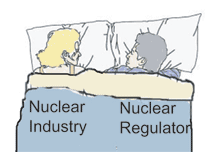 INADEQUACY of Indian Nuclear Regulation Manifest in Reactor Accident IEEE Spectrum, By Bill Sweet
29 Aug 2013 It is no secret that India still lacks a politically independent nuclear oversight authority that is well separated from the industry it oversees. The Fukushima nuclear catastrophe was a recent reminder of just how important it is to have independent nuclear oversight, a lesson already driven home a generation before by the serious U.S. accident at Three Mile Island (TMI). The stubborn refusal of India’s government to set up the kind of regulatory authority that is so obviously needed means, in effect, that one cannot have real confidence in a nuclear program that could in principle be one of the world’s most important.
A telling but little-known and little-discussed example of what can happen under weak regulatory circumstances was a serious accident that took place at India’s Narora reactor in March 1993,, an incident that “came close to joining Chernobyl and Fukushima in the annals of industrial civilization,” as writer Madhusree Mukerjee put it in a recent review of M.V. Ramana’s The Power of Promise: Examining Nuclear Power in India (Penguin/Viking, 2012)……….
1 This Month
23-25 October – on Zoom – World BEYOND War’s annual global conferenc

To see nuclear-related stories in greater depth and intensity – go to https://nuclearinformation.wordpress.com

Say No to NASA’s Reckless Nuclear Reactor on the Moon
Say No to NASA’s Reckless Nuclear Reactor on the Moon
-
Archives
- October 2026 (160)
- September 2026 (339)
- August 2026 (330)
- July 2026 (355)
- June 2026 (287)
- May 2026 (306)
- April 2026 (356)
- March 2026 (251)
- February 2026 (267)
- January 2026 (308)
- December 2025 (358)
- November 2025 (359)
-
Categories
- 1
- 1 NUCLEAR ISSUES
- business and costs
- climate change
- culture and arts
- ENERGY
- environment
- health
- history
- indigenous issues
- Legal
- marketing of nuclear
- media
- opposition to nuclear
- PERSONAL STORIES
- politics
- politics international
- Religion and ethics
- safety
- secrets,lies and civil liberties
- spinbuster
- technology
- Uranium
- wastes
- weapons and war
- Women
- 2 WORLD
- ACTION
- AFRICA
- Atrocities
- AUSTRALIA
- Christina's notes
- Christina's themes
- culture and arts
- Events
- Fuk 2022
- Fuk 2023
- Fukushima 2017
- Fukushima 2018
- fukushima 2019
- Fukushima 2020
- Fukushima 2021
- general
- global warming
- Humour (God we need it)
- Nuclear
- RARE EARTHS
- Reference
- resources – print
- Resources -audiovicual
- Weekly Newsletter
- World
- World Nuclear
- YouTube
-
RSS
Entries RSS
Comments RSS

