Huge project to make Fukushima area habitable again may be doomed
 Fukushima clean-up may be doomed http://www.irishtimes.com/news/world/asia-pacific/fukushima-clean-up-may-be-doomed-1.1537702 24 Sept 13
Critics say Japan’s government is engaged in a vast, duplicitious and fruitless campaign Across much of Fukushima’s rolling green countryside they descend on homes like antibodies around a virus, men wielding low-tech tools against a very modern enemy: radiation. Power hoses, shovels and mechanical diggers are used to scour toxins that rained down from the sky 30 months ago. The job is exhausting, expensive and, say some, doomed to failure. Continue reading
Ice wall around Fukushima nuclear plant might increase the risk
 Video: Recriticality Concerns at Fukushima — BBC: Professor warns underground ice walls could become ‘neutron reflectors’ and cause nuclear chain reaction Title: Jaczko, Johnson & Tsutsui, The Ongoing Fukushima Daiichi Crisis
Title: Jaczko, Johnson & Tsutsui, The Ongoing Fukushima Daiichi Crisis
Source: Foreign Correspondents’ Club of Japan
Date: September 24, 2013
Martin Kölling, reporter at Handelsblatt (German financial newpaper): Regarding this frozen wall […] some are concerned that this ice wall could work as a neutron reflector and increase the risk of recriticality in the reactor cores. Have you heard about this concern and what do you think about it?
Gregory Jaczko, Former Chairman of the U.S. Nuclear Regulatory Commission: I have not heard of the issue of neutron reflection. My gut reaction is that that would not necessarily be an issue. You have water at the site. So I would be skeptical that that would be an issue to be concerned about. But certainly I’m sure it’s something that should be looked at if there is a possibility of that, but I would not initially think that that’s something that would be of concern.
BBC, Sept. 4, 2013: Dr. Komei Hosokawa from Kyoto Seika University, Japan, warns that in some respects, the ice wall idea could make matters worse: “Underground ice walls surrounding the reactor basement may work as neutron reflectors, which might make an easier condition for the melted fuel debris to go back to criticality (i.e. chain reaction).” Watch the FCCJ event here
Should TEPCO, should Japan, be allowed to attempt this on its own?
 We are now within two months of what may be humankind’s most dangerous moment since the Cuban Missile Crisis. There is no excuse for not acting. All the resources our species can muster must be focused on the fuel pool at Fukushima Unit 4. … Neither Tokyo Electric nor the government of Japan can go this alone. There is no excuse for deploying anything less than a coordinated team of the planet’s best scientists and engineers. …
We have two months or less to act. For now, we are petitioning the United Nations and President Obama to mobilize the global scientific and engineering community to take charge at Fukushima and the job of moving these fuel rods to safety.
Risky repair of Fukushima could spill 15,000x radiation of Hiroshima, create 85 Chernobyls, America Blog 9/23/2013 10:00am by Gaius Publius
Should TEPCO be allowed to attempt this on its own?
Should Japan be allowed to attempt this on its own?
This is the heart of today’s problem. In reality, the events that are about to unfold at Fukushima in the next 60 days will affect much of the world. They could in fact change life in the northern hemisphere, if the worst of the worst occurs.
The Japanese government has ceded control of the next phrase — removing more than 1300 fuel rods from Reactor 4 — to TEPCO. (Seems that Japan has a “corporate capture of government” problem similar to our own.) Reuters (quoted here):
Tokyo Electric Power Co (Tepco) is already in a losing battle to stop radioactive water overflowing from another part of the facility, and experts question whether it will be able to pull off the removal of all the assemblies successfully.
“They are going to have difficulty in removing a significant number of the rods,” said Arnie Gundersen, a veteran U.S. nuclear engineer and director of Fairewinds Energy Education, who used to build fuel assemblies.
The operation, beginning this November at the plant’s Reactor No. 4, is fraught with danger, including the possibility of a large release of radiation if a fuel assembly breaks, gets stuck or gets too close to an adjacent bundle, said Gundersen and other nuclear experts. … The utility says it recognizes the operation will be difficult but believes it can carry it out safely.
Nonetheless, Tepco inspires little confidence. Sharply criticized for failing to protect the Fukushima plant against natural disasters, its handling of the crisis since then has also been lambasted.
Who has sovereignty here? Who has control? Better, who should have sovereignty and control? Continue reading
Research indicates Fukushima’s atmospheric release of 210 quadrillion becquerels of cesium-137
 EU-funded Research: Fukushima atmospheric release of 210 quadrillion becquerels of cesium-137 used as upper bound in simulation — Chernobyl estimated at 70 to 85 quadrillion http://enenews.com/eu-funded-research-fukushima-atmospheric-release-210-petabecquerels-cesium-137-upper-bound-simulation-chernobyl-estimated-70-85-petabecquerels
Title: Modelling the global atmospheric transport and deposition of radionuclides from the Fukushima Dai-ichi nuclear accident
Source: Atmospheric Chemistry and Physics
Authors: T. Christoudias and J. Lelieveld
Date: 2013
Emphasis Added
We modeled the global atmospheric dispersion and deposition of radionuclides released from the Fukushima Dai-ichi nuclear power plant accident. […]
We obtained good agreement with measurements of 133Xe, at both T255 and T106 resolution. The comparison for 137Cs is less favorable, though not systematically biased based on the 137Cs emission estimate of 36.7 (20.1–53.1) PBq [petabecquerels (quadrillion becquerels)] by Stohl et al. (2012). This is equivalent to somewhat less than half the 137Cs source by Chernobyl (85 PBq, International Atomic Energy Agency (IAEA) (2006)). The estimate of 13 PBq by Chino et al. (2011) (revised to 8.8 PBq by Terada et al. (2012) and confirmed as a lower bound of 12 PBq by Winiarek et al. (2012), with an upper bound of 210 PBq, was also included in our comparison.
[…] Although the prevailing wind direction during the accident was in easterly direction, some of the atmospheric radioactivity was transported toward the west and southwest, and deposited in Japan and to a lesser extent reached the Philippines. Based on the above mentioned emission estimates, we calculated that an area of Japan of 34,000 km2 was contaminated by more than 40 kBqm−2 of 137Cs and 131I, to which 9.4 million people were exposed. Our model results indicate that a surface area of 60,000 km2 received a total deposition greater than 10 kBqm−2, a region inhabited by 46 million people.
[…] The research leading to these results has received funding from the European Research Council under the European Union’s Seventh FrameworkProgramme.
Nuclear Energy Agency’s 2002 assessment of the Chernobyl disaster: The total 137Cs release was estimated to be 70 petabecquerels (PBq)
Association of Southeast Asian Nations (Asean) urged to focus on benefits of renewable energy
Greenpeace Report Calls for Renewed Vigor in Asean’s Renewable Energy Drive Jakarta Globe, By Ethan Harfenist September 24, 2013. Greenpeace Southeast Asia laid out an argument on Tuesday for a concerted push for renewable energy in the Association of Southeast Asian Nations (Asean), focusing on both the economic and environmental benefits of a greener power policy.
“The deteriorating climate should be Asean’s top concern, given that the region is experiencing frequent and more intense extreme weather events due to climate change caused by carbon emissions,” said Amalie H. Obusan, regional climate and energy campaigner for Greenpeace Southeast Asia.
Launched at the 31st Asean Ministers of Energy meeting in Bali, “Energy [R]evolution: A Sustainable Asean Energy Outlook” emphasizes the socio-economic advantages of pursuing renewables in a roadmap detailing how the regional group could safeguard its energy security.
“The Asean region, with its rapid pace of economic and population growth should play an important role in this global solution as the E[R] report clearly shows that a low carbon development path is possible,” Obusan said.
The report said sustainable energy sources — such as wind, photovoltaics and geothermal energy — could comprise 70 percent of the region’s total electricity generation by 2050. This is due in part to a “democratization of energy production,” according to Greenpeace — access to solar panels could bring electricity to remote or deprived Southeast Asian communities currently unconnected to electricity grids.
Costs and benefits
The exploitation of green-energy sources across Asean could, the report said, result in $2.8 trillion worth of investment, $2.7 trillion in fuel-cost savings and 1.1 million jobs by 2030…….http://www.thejakartaglobe.com/news/greenpeace-report-calls-for-renewed-vigor-in-aseans-renewable-energy-drive/
Rural India’s growing opposition to nuclear power
“We have not forgotten the criminal record of ‘Union Carbide’s now Dow Chemical’ in theBhopal gas tragedy and the shameless episode of Indian politicians letting the culprits goes Scott-free: both physically and in terms of adequate liability for the horrendous disaster,” the activists stated.
Communities near the existing nuclear facilities in Tarapur, Rawatbhata, Kalpakkam, Kaiga, Kakrapar and Hyderabad have also been raising voices against radiation leaks and their harmful effects. Existing and proposed new uranium mines in Jharkhand, Andhra Pradesh and Meghalaya have also met with massive protests.

Mith Virdi Nuclear Power Project faces opposition from villagers http://economictimes.indiatimes.com/news/news-by-industry/energy/power/mith-virdi-nuclear-power-project-faces-opposition-from-villagers/articleshow/22929250.cms By Mitul Thakkar, ET Bureau | 23 Sep, 2013 NEW DELHI: Activists against proposed nuclear power project at Mith Virdi in Bhavnagar district of Gujarat are planning a 40 km rally with participation from over 50 villages to mark their protest. Bhavnagar Jilla Gram Bachao Samiti, Gujarat Anu-urja Mukti Andolan and Paryavaran Suraksha Samiti are taking the lead in the protests against 6,000 mw nuclear fired power project. They decided to register their opposition through rally after they learnt that the government of India is moving to further dilute the Nuclear Liability Act to seal the nuclear deal with the US government during Prime Minister’s visit to Washington soon.
Farmers’ movement aims to stop India’s Mithivirdi nuclear plant
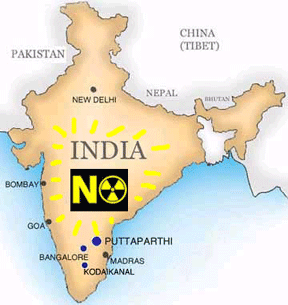 Farmers protest against Mithivirdi nuclear plant http://timesofindia.indiatimes.com/city/rajkot/Farmers-protest-against-Mithivirdi-nuclear-plant/articleshow/22951094.cms TNN | Sep 23, 2013, RAJKOT: Farmers from 30 villages located around the proposed site of 6,000 MW nuclear power plant in Mithivirdi, about 40 km from Bhavnagar, took out the protest rally fromJaspara village to Bhavnagar against the move to set up the power plant.
Throughout their 40km yatra, farmers shouted slogans like ‘Amne pani apo, anu-vijali nahi’ (we want water, not nuclear power) and ‘Jan daisu, zamin nahi’ (we will give our lives, but not land).
Among those who participated in the rally were former BJP MLA from Mahuva Dr Kanubhai Kalsaria and former minister of state for home Gordhan Zadaphia.
“If you want to give us anything, give us irrigation water and we will be happy practicing agriculture,” an agitating farmer from Jaspara village Sonal Gohil said.The farmers have been claiming that the major chunk of 777.8 hectares of land that is proposed to be acquired for the nuclear plant is fertile.
Activists, including veteran Gandhian Chunibhai Vaidya, Dr Kalsaria, former finance ministerSanat Mehta and Rohit Prajapati have been leading the agitation against the project since 2010. They have been raising concerns on threat of radiation.
Over 290 farmers submitted their affidavits saying they don’t want a power plant at the cost of their fertile land to district collector Pravin Solanki.
The plant is proposed to be built by acquiring land in Jaspara, Mandva, Khadpar and Mithivirdi villages. The project is to be implemented in three phases.
Radioactive water sprayed out on Fukushima workers, from tank leak

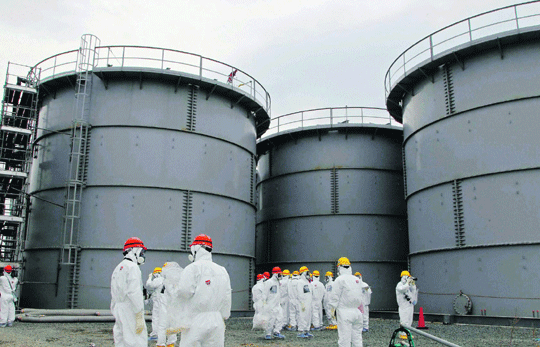 Fukushima Worker: People showered with highly radioactive water at plant — Leaking tanks spraying out contamination http://enenews.com/fukushima-worker-people-showered-highly-radioactive-water-plant-leaking-tanks-spraying-contamination
Title: People working at, living near Fukushima plant say Abe is in the dark
Source: Asahi Shimbun
Authors: Takuro Negishi and Shinichi Fujiwara
Date: September 20, 2013
[…] one man who has helped assemble the tanks from which contaminated water has leaked said, “I wonder if [Prime Minister Shinzo abe] is using words like ‘blocked’ and ‘control’ after really understanding what is going on at the site.”
The man recalls that one day he saw contaminated water spraying out of a tank. An employee of an affiliated company to TEPCO wore a raincoat over protective clothing to tighten a bolt on the tank, even as he was being showered with leaking water.
The man witnessed a similar scene on another day. However, TEPCO made no announcement about the two incidents.
“The affiliated company probably did not want to get on the bad side of TEPCO, so it stopped the leak and concealed the defect in the tank,” the man said. […]
Prime Minister Abe on nuclear marketing visit to India
Shinzo’s Delhi visit is an extension of his 2007 secret deal with Dick Cheney in Tokyo where a quadrilateral alliance in the Asia-Pacific region was sealed with the US, Japan, Australia and India as partners to contain and confront China and its allies North Korea and Russia. The nuclear mafia rules OK!

 The Japan-India Nuclear Energy Deal Manmohan Singh’s Atomic Pile May Become Critical after Shinzo Abe’s Deal By Arun Shrivastava Global Research, September 22, 2013 Japanese Prime Minister Shinzo Abe is coming to India to discuss a ‘range of issues;’ the truth is that he is coming here as chief salesman of global nuclear industry, now collapsing under the collective onslaught of nuclear scientists, nuclear power plant engineers, physicists, investigative journalists and people.
Shinzo is known for many things: dogged attempts at reviving Japan’s nuclear industry, his alleged connections with Japan’s notorious mafia, Yamaguchi-gumi. Continue reading
Radioactive cesium in wastes found 500 km from Fukushima near great lake
 ‘Extremely Malicious’: Hundreds of tons of radioactive waste found over 500 kilometers from Fukushima near Japan’s biggest lake http://enenews.com/extremely-malicious-hundreds-of-tons-of-radioactive-waste-found-near-japans-biggest-lake-over-500-kilometers-from-fukushima
Title: Tons of cesium-tainted wood chips found near Japan’s biggest lake
Source: Kyodo
Tons of cesium-tainted wood chips found near Japan’s biggest lake
Radioactive cesium has been found on an estimated 200 to 300 tons of wood chips that were left months ago near Lake Biwa in Shiga Prefecture, prefectural officials said.
Samples of the chips show a reading of up to 3,000 becquerels per kilogram, the officials said Tuesday. […]
The Shiga government started an investigation to determine where the chips came from. They were found in the dry bed of the Kamo River in Takashima and other locations near the lake, officials said. […]
“The site is an estuary leading to Lake Biwa, and leaving (the chips) there without permission is extremely malicious. We will deal with the matter strictly,” Gov. Yukiko Kada said.
India’s Dept of Atomic Energy wants help in winning hearts and minds towards nuclear power
More important, DAE touched upon the growing protest against nuclear energy in India and told US industry members they would have to address ideological opposition in this regard and also safety- related concerns and public awareness. US industry would also have to tackle issues relating to land acquisition and resource mobilisation.
DAE invites US firms to be part of India’s nuclear story http://www.business-standard.com/article/economy-policy/dae-invites-us-firms-to-be-part-of-india-s-nuclear-story-113092000753_1.html Sanjay Jog | Mumbai September 23, 2013 A high-level delegation of the Department of Atomic Energy (DAE) in Vienna rolled out a red carpet for US industry to invest in the nuclear capacity addition programme. India proposes to increase its nuclear capacity to 63,000 Mw by 2032 from the present level of 4,780 Mw, with a mix of indigenous reactors and also through foreign technical cooperation.
The DAE, however, in no uncertain terms told the US industry delegation the companies would have to meet Indian regulatory requirements. Indian laws would be applicable to them, though the presentation did not make a mention of the civil nuclear liability law.
A couple of global nuclear reactor supplier companies have raised serious objections against our civil nuclear liability law. The DAE team, led by Atomic Energy Commission (AEC) chief R K Sinha, was in Vienna to attend the International Atomic Energy Agency’s 57th general conference between September 16 and 19. Continue reading
Fukushima nuclear plant never should have been placed over river site
TV: Warnings the worst is yet to come at Fukushima — Deep underneath nuclear plant a massive pool of contamination is believed to be heading toward Pacific Ocean (VIDEO) Title: Fukushima leak questions handling of nuclear plant crisis
Source: ABC News (Australia)
Date: Sept. 19, 2013 MARK WILLACY, REPORTER: Atsunao Marui is one of Japan’s top groundwater scientists and a member of a panel set up by TEPCO and the Government to try to find ways of managing Fukushima’s growing reservoir of radioactive water. He says putting the nuclear plant on this stretch of coast in the first place was inviting disaster
ATSUNAO MARUI, GROUNDWATER SCIENTIST(voiceover translation): A river used to flow right where the turbine and reactor buildings are now standing, so the groundwater is flowing very fast through there and it’s spreading the contamination. The company should have known this could happen.
WILLACY: But there are warnings the worst is yet to come because it’s believed that deep beneath the nuclear plant is a massive underground pool of contaminated water which is slowly making its way towards the sea.
Japanese government considers taking over the Fukushima radiation cleanup
J apan LDP Plan Would Put Government in Control of Fukushima Cleanup, WSJ, Proposal Would Reduce Tepco’s Financial Burden By MARI IWATA, 20 Sept 13 TOKYO—Japan’s ruling Liberal Democratic Party is considering a plan that would give the government sole responsibility for containing and cleaning up contamination from the stricken Fukushima Daiichi nuclear-power plant, allowing its operator, Tokyo Electric Power Co., 9501.TO -2.28% to focus its dwindling resources more efficiently on decommissioning the facility……..
The government had already effectively nationalized Tepco by buying a majority of its shares, but the stock still trades on the Tokyo Stock Exchange, and Prime Minister Shinzo Abe’s administration is eager to see the cash-strapped company return to financial health, a significant challenge, given lost revenue from the idling of all of the company’s nuclear reactors, as well as the costs of the cleanup and purchasing of more liquefied natural gas than before the accident to fuel thermal-power plants to make up for lost nuclear generation.
Tepco has posted two straight years of large net losses since the accident. It swung to a profit in the April-June quarter, solely on the back of a large government subsidy to help it pay compensation to Fukushima victims but it carries Y800 billion ($8.14 billion) in debt that should be refinanced this fall. On top of that, Tepco estimates it must borrow an additional Y300 billion by the end of December if it wants to stay afloat, a spokesman said……..
Tepco President Naomi Hirose said Thursday that the company would prepare Y1 trillion ($10 billion) to decommission the entire plant in addition to Y960 billion it had reserved for the work by the end of June. This doesn’t include costs associated with handling contaminated water at the site. There hasn’t been any estimate on the total cost of decommissioning the stricken plant…….Japan’s Nuclear Regulation Authority Chairman Shunichi Tanaka has urged the government and Tepco to intensify the decommissioning effort, saying “the deadliest risk is another huge natural disaster,” which would “destroy all these makeshift tanks and water processing systems, releasing all the radioactive materials there into the environment.” http://online.wsj.com/article/SB10001424127887324492604579086742989825408.htm
Serious legal problems for India in weakening Nuclear Liability
The Act does have its flaws but it has raised some key challenges to international liability principles that historically insulated the supplier from liability in practically all situations. It should be borne in mind that these provisions will be interpreted by an Indian court in the context of a nuclear incident. Any watering down of the law by the operator offering waivers of statutory provisions would only increase the ambiguities, and is in no one’s interests, including those of the foreign suppliers.
Don’t waver now on nuclear liability THE HINDU, MOHIT ABRAHAM M. P. RAM MOHAN , 20 SEPT 13, India’s Civil Liability for Nuclear Damages Act, 2010 (the Act), was a watershed moment in international nuclear liability jurisprudence because of the unique way in which
 it dealt with supplier liability. Up until this enactment, all liability in relation to a nuclear power plant was channelled exclusively to the operator. The only two situations in which a operator could claim a subsequent right of recourse against a supplier under international liability law as well as under domestic law of other countries were i) where the nuclear incident arose out of an act or omission by the supplier with an intent to cause damage (which is covered under Section 17(c) of the Act); and ii) a contractual right of recourse (which is covered under Section 17(a) of the Act).
The Act however, also introduced a novel concept of supplier liability in Section 17(b) by which the operator would have the ability to reclaim any compensation it may pay, from a supplier, if the product supplied has patent or latent defects or the service provided is substandard.
Section 17(b)
This expanded concept of supplier liability is vehemently resisted by major supplier countries including the United States, Russia and France, Continue reading
“Confidentiality Agreement” on nuclear sales USA to India
Decks cleared for nuclear pact with US firmIndrani Bagchi, TNN | Sep 21, 2013 NEW DELHI: India and the US have cleared the decks for a pre-early works agreement betweenNPCIL and US nuclear company, Westinghouse. National security adviser (NSA) Shivshankar Menon said, “The two sides have resolved all government-to-government permissions and understandings required for enabling commercial negotiations”. The two sides signed a “confidentiality agreement” last week that would allow both sides to share confidential data with each other.

Speaking at an event at Aspen Institute on Friday, Menon said the Atomic Energy Regulatory Board (AERB) will soon begin safety evaluations of Westinghouse’s AP1000 nuclear reactor that they propose to sell to India.Westinghouse is already building four of these reactors in China, the first of which is expected to begin operations next year…… http://timesofindia.indiatimes.com/india/Decks-cleared-for-nuclear-pact-with-US-firm/articleshow/22828566.cms
1 This Month
23-25 October – on Zoom – World BEYOND War’s annual global conferenc

To see nuclear-related stories in greater depth and intensity – go to https://nuclearinformation.wordpress.com

Say No to NASA’s Reckless Nuclear Reactor on the Moon
Say No to NASA’s Reckless Nuclear Reactor on the Moon
-
Archives
- October 2026 (160)
- September 2026 (339)
- August 2026 (330)
- July 2026 (355)
- June 2026 (287)
- May 2026 (306)
- April 2026 (356)
- March 2026 (251)
- February 2026 (267)
- January 2026 (308)
- December 2025 (358)
- November 2025 (359)
-
Categories
- 1
- 1 NUCLEAR ISSUES
- business and costs
- climate change
- culture and arts
- ENERGY
- environment
- health
- history
- indigenous issues
- Legal
- marketing of nuclear
- media
- opposition to nuclear
- PERSONAL STORIES
- politics
- politics international
- Religion and ethics
- safety
- secrets,lies and civil liberties
- spinbuster
- technology
- Uranium
- wastes
- weapons and war
- Women
- 2 WORLD
- ACTION
- AFRICA
- Atrocities
- AUSTRALIA
- Christina's notes
- Christina's themes
- culture and arts
- Events
- Fuk 2022
- Fuk 2023
- Fukushima 2017
- Fukushima 2018
- fukushima 2019
- Fukushima 2020
- Fukushima 2021
- general
- global warming
- Humour (God we need it)
- Nuclear
- RARE EARTHS
- Reference
- resources – print
- Resources -audiovicual
- Weekly Newsletter
- World
- World Nuclear
- YouTube
-
RSS
Entries RSS
Comments RSS

