The gap between official information and the real news about Fukushima
 Nuclear Industry Report: ‘Reduced stability’ of fuel pool in Fukushima Unit 4; Admits there’s damaged fuel inside? — Gundersen: Fuel racks moved and damaged; Fallen debris distorted tops (AUDIO) http://enenews.com/nuclear-industry-report-reduced-stability-of-unit-4-fuel-pool-at-fukushima-admits-some-fuel-inside-is-damaged-gundersen-fuel-racks-moved-from-quake-fallen-debris-distorted-tops-audio
World Nuclear News,Sept. 26, 2013 (Emphasis Added): […] Underwater inspections in the [Unit 4] pond have shown most of the fuel to be undamaged, but the pond contains a lot of dust and debris which will complicate operations. […] Its full core load of fuel, plus used fuel from previous operation, was being stored in a fuel pool at the top of the reactor building. […] The stability of the pool was then reduced by major structural damage to the building caused by the ignition of hydrogen […]
World Nuclear News is funded by the World Nuclear Association. The WNA represents the interests of the international nuclear industry. -Source
Bridging the News Gap, with Professor Matt Noyes
Fairewinds Energy Education Podcast, Sept.. 26, 2013 (at 21:15 in) – Arnie Gundersen, Fairewinds Chief Engineer: These racks [in the Unit 4 fuel pool] have moved, they’ve been distorted by the earthquake, there’s junk that’s fallen on top of them and distorted the tops. […] One of two things is going to happen. They’re either going to pull too hard and snap the bundle, or they’re going to be unable to pull all of the fuel out of the pool. Full podcast available here
How Japan lied its way into the 2020 Olympic Games
 The Namie Town Assembly unanimously passed the Sept. 20 protest resolution stating that there is a “serious problem” with Abe’s remarks as they “contradict reality.”
 Fukushima Out of Control Did Japan Lie Its Way Into the Olympics? CounterPunch WEEKEND EDITION SEPTEMBER 27-29, 2013 by PETER LEE In order to secure the 2020 Tokyo Olympics for Tokyo, Japan’s Prime Minister Shinzo Abe assured the IOC that the Fukushima situation was “under control”, per AFP:
“Let me assure you the situation is under control,” [Abe] said.
“It has never done or will do any damage to Tokyo.”
Abe replied decisively when pressed by veteran Norwegian IOC member Gerhard Heiberg over Fukushima.
“You should read past the headlines and look at the facts,” he said.
“The contaminated water has been contained in an area of the harbour only 0.3 square kilometres big.
“There have been no health problems and nor will there be. I will be taking responsibility for all the programmes with regard to the plant and the leaks.” Continue reading
National comparative birth defects study needed in Japan
Reporters in Japan write about rise in birth defects for 2011 — University won’t publish data on malformed babies after many years of doing so; Not releasing figures for Fukushima, other prefectures — Expert: This is ridiculous http://enenews.com/reporters-in-japan-write-about-birth-defects-after-nuclear-disaster-university-no-longer-publishing-data-on-malformed-babies-refuses-to-release-figures-for-fukushima-or-other-prefectures-expe
Title: The Fukushima Generation: New Data on Birth Defects in Post-Meltdown Japan
Source: Daily Beast
Author: Jake Adelstein, Nathalie Kyoko Stucky
Date: Sept. 26, 2013
Emphasis Added
The Daily Beast recently obtained unpublished data on birth defects in Japan, which showed a small increase in prevalence rates for 2011 […] The university that conducted the study will not release regional figures. However, several nuclear experts in and outside of the country assert that Japan needs to seriously measure the health impact of its nuclear problems, including birth defects, “with not just annual data but monthly data and broken down by prefecture.”
[…] Yokohama City University […] has been doing studies of birth defects in Japan for over a decade. The 2011 Report on Congenital Malformations notes the prevalence of malformed infants as 2.43 percent, the highest figure since 1999 (1.48 percent). However, the figures for 2010 were 2.31 percent, indicating only a small increase between 2010 and 2011. […]
Since 1999, the Yokohama City University has been releasing the statistical report regularly around the month of May, but did not publish the data this year. After repeated requests, it finally provided the 2011 data, which is still currently unavailable to the public. Continue reading
TEPCO applies to restart Kashiwazaki Kariwa nuclear plant
Mr Izumida, a strident critic of TEPCO, said he was allowing the utility to apply for safety approval, but withholding final judgment on restarting the plant.
“Kashiwazaki Kariwa nuclear power plant may be halted, but it is a living facility, and safety must be ensured at the plant,” he said in a statement.
He had previously denounced TEPCO as unfit to run a nuclear plant and has called for the company’s liquidation.
 Fukushima operator TEPCO seeks restart of Japan’s Kashiwazaki Kariwa nuclear plant http://www.abc.net.au/news/2013-09-27/fukushima-operator-seeks-reactor-restart/4985444 27 Sept 13 TEPCO has applied to restart a nuclear plant in north-western Japan, an initial step on its planned recovery from the Fukushima nuclear disaster.
But final approval to resume power generation at the Kashiwazaki Kariwa facility, the world’s largest nuclear plant, 300 kilometres north west of Tokyo, is uncertain and any decision would take many months at best. Continue reading
USA – India nuclear sales deal
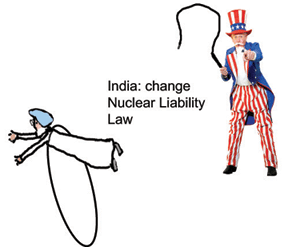 India, US seal first commercial deal on civil nuclear power http://zeenews.india.com/news/delhi/india-us-seal-first-commercial-deal-on-civil-nuclear-power_879777.html 28 Sept 13 Washington: India and the US have reached the first commercial agreement on civilian nuclear power, five years after a landmark deal between the two countries was clinched.
Addressing a joint media interaction after talks with Prime Minister Manmohan Singh, President Barack Obama disclosed that the two countries have sealed the agreement.
“We’ve made enormous progress on the issue of civilian nuclear power, and in fact, have been able to achieve just in the last few days an agreement on the first commercial agreement between a US company and India on civilian nuclear power,” Obama said.
 India’s nuclear operator NPCIL (Nuclear Power Corporation of India Limited) and US firm Westinghouse have signed an agreement that will pave the way for setting up an atomic plant in India.
However, there was no word on the tough nuclear liability clause in the Indian laws over which the US firms had strong objections.
There was a major uproar in India last week over the agreement because of apprehensions that it entailed bypassing the Civil Nuclear Liability Law in place in the country by waiving the operator’s right to recourse with the supplier.
Damaged underwater radiation barrier at Fukushima
NHK: Typhoon approaching Fukushima plant — Underwater fences breached — Tepco: No ‘immediate’ effect (VIDEO) http://enenews.com/nhk-typhoon-approaching-fukushima-plant-underwater-fences-breached-tepco-no-immediate-effect-video
Xinhua, Sept. 26, 2013: The operator of the crippled Fukushima Daiichi nuclear plant, Tokyo Electric Power Co., (TEPCO), said Thursday that damage was found on an underwater curtain under the stricken complex, according to local media. […] Local reports said that a worker found a cut in the fence Thursday morning, adding the TEPCO did not provide more details and is checking the impact of the crack. […] The TEPCO said it plans to repair the fence after an upcoming typhoon, according to Japan’s Kyodo News. […]
SOURCE: NASA
Fukushima News 9/26/13: Typhoon Damage-Underwater Barrier
NHK WORLD, Sept. 26, 2013: The operator of the crippled Fukushima Daiichi nuclear plant says underwater barriers in the facility’s port have been breached. […] The silt fences are to stop contaminated sea-bed soil from near the damaged No. 1, 2, 3 and 4 reactors polluting water near the still-intact No. 5 and 6 reactors. […] It plans to repair the fences once high waves triggered by an approaching typhoon subside. The Nuclear Regulation Authority instructed the power company to measure radiation levels […]
RT: “The fence is also designed to prevent radioactive material emerging from damaged units 1, 2, 3 and 4″
Tepco: “We don’t think this situation will have any immediate effect”
Fukushima disaster an ongoing health problem
Hiroshima seeks to distance itself from Fukushima despite parallels of radiation woes in Japan, WP26 Sept 13, “……The widespread sentiment in this southwestern city, he said, is that Hiroshima has endured something more terrible than the aftermath of a nuclear accident, and people resent getting lumped together. Matsui lost relatives in the attack, and his parents’ home was destroyed.
The bombing killed some 140,000 people — some instantly, others within months. Three days later, the U.S. dropped a second atomic bomb on Nagasaki, killing an estimated 70,000 people shortly before the end of World War II. Those categorized by the government as sick from the Hiroshima bombing’s radiation still number more than 200,000.
No one is known to have died from the Fukushima radiation, but the plant’s three nuclear meltdowns will take decades to clean up and it is impossible to know what the health toll will ultimately be. Only recently has the government acknowledged that much more radioactive water is leaking into the sea than it had previously believed.
The Japanese government has detected 44 confirmed and suspected cases of thyroid cancer among the 217,000 youngsters, 18 and under, checked in Fukushima. Thyroid cancer among children is generally rare, estimated at only one in a million. The link to radiation is still inconclusive, and extensive testing of Fukushima children could account for the higher numbers.
But according to the World Health Organization, thyroid cancer struck thousands of people after the only nuclear-plant disaster worse than Fukushima, the 1986 Chernobyl meltdown in what is now Ukraine. http://www.washingtonpost.com/world/asia_pacific/hiroshima-seeks-to-distance-itself-from-fukushima-despite-parallels-of-radiation-woes-in-japan/2013/09/26/420331b0-266e-11e3-9372-92606241ae9c_story.html
Fukushima workers spot hole in radiation barrier
Hole in Fukushima anti-radiation fence Sky News, 26 Sept 13 Workers at Japan’s crippled Fukushima nuclear plant have spotted a hole in one of the barriers intended to keep radioactive particles contained in the harbour, the operator says.
Tokyo Electric Power set up silt fences in the harbour next to the plant, including one covering each outlet at reactor units 1-4, which were damaged in the 2011 tsunami, and another on the egress of reactors 5-6 which remain intact.
A silt fence is a device to trap sediment before water flows into the sea.
The fence around the undamaged reactors was found to be holed, a TEPCO spokesman said…….. Radioactive contamination of the sea has emerged as one of the major concerns after the nuclear accident, with TEPCO using thousands of tonnes of water to tame the reactors and keep them cool.
The utility says they are now stable but need more water every day to keep them cool and to prevent them running out of control again.
Much of that now-contaminated water is being stored in temporary tanks at the plant, and TEPCO has so far revealed no clear plan for its disposal. Some of the tanks have sprung leaks.
Prime Minister Shinzo Abe insisted at a meeting of Olympic chiefs this month that adverse effects from contamination were limited to the 0.3-square-kilometre harbour.
His reassurances, given at the meeting of the International Olympic Committee in Buenos Aires, were seen as key to Tokyo’s successful bid to host the 2020 Olympic Games. http://www.skynews.com.au/world/article.aspx?id=909741
Japan finally accepting foreign help in Fukushima crisis
 AUDIO Japan agrees to foreign help with Fukushima ww.abc.net.au/worldtoday/content/2013/s3855960.htm Mark Willacy reported this story on Wednesday, September 25, 2013
PETER LLOYD: To nuclear issues of another kind now, and Japan has finally accepted international help to sort out the mess at the Fukushima nuclear plant. It’s agreed to let the French help decommission and dismantle it. Our Tokyo correspondent Mark Willacy says it’s a climb-down that signals how little success Japan has had stopping the spread of contaminant since the earthquake two and a half years ago. Continue reading
Japan is on the verge of a collapse after Fukushima- Tokyo Professor
 Tokyo Professor: I want to stress that Japan is on verge of collapse after Fukushima — Osaka Professor: If you don’t recognize health risks and take action right now, you have no future (VIDEO) http://enenews.com/tokyo-professor-i-want-to-stress-japan-is-on-verge-of-collapse-after-fukushima-osaka-professor-if-you-dont-recognize-health-risks-and-take-action-right-now-you-have-no-future-video
September 24th, 2013
By ENENews
Title: 0.23μ㏜ – Fukushima: Is There a Way Out?
Source: Arirang TV
Date: Sept. 9, 2013
Fukushima: Is There a Way Out? […] What kind of tomorrow awaits Japan? […] The Japanese public spends every day in fear and anxiety, as the repercussions of the nuclear crisis can be felt everywhere, and there is no end in sight yet. […] Where is Fukushima headed? Will Japan be able to find a way out?
At 42:00 in
Professor Taisei Namura, Ph.D., National Institute of Biomedical Innovation (Under jurisdiction of Japan’s Ministry of Health, Labor and Welfare, located in Osaka): Cancer doesn’t happen immediately. If you don’t recognize it and take action right now, you have no future. We must raise public awareness. We can’t rest assured just because it’s a small amount. The symptoms will not appear until decades later.
At 46:00 in
Professor Eiji Makino, Hosei Universityy (“One of the most traditional private universities based in Tokyo”): This tragedy has revealed that Japan’s political, social, economic, and moral standards are falling apart. I think we’re facing a big crisis. I want to stress one more time that Japan is on the verge of a collapse.
Watch the 48 minute broadcast here
Fukushima radiation leaks an international crisis
 The water flowing through the site is also undermining the remnant structures at Fukushima, including the one supporting the fuel pool at Unit Four.
The immediate bottom line is that those fuel rods must somehow come safely out of the Unit Four fuel pool as soon as possible.
Spent fuel must somehow be kept under water. It’s clad in zirconium alloy which will spontaneously ignite when exposed to air.
Each uncovered rod emits enough radiation to kill someone standing nearby in a matter of minutes. A conflagration could force all personnel to flee the site and render electronic machinery unworkable.
Fukushima Radiation Leaks Totally Out of Control – Threatening Human Survival http://www.marketoracle.co.uk/Article42434.html Harvey Wasserman writes: We are now within two months of what may be humankind’s most dangerous moment since the Cuban Missile Crisis. 25 Sept 13
There is no excuse for not acting. All the resources our species can muster must be focussed on the fuel pool at Fukushima Unit 4. Fukushima’s owner, Tokyo Electric (Tepco), says that within as few as 60 days it may begin trying to remove more than 1300 spent fuel rods from a badly damaged pool perched 100 feet in the air. The pool rests on a badly damaged building that is tilting, sinking and could easily come down in the next earthquake, if not on its own.
Some 400 tons of fuel in that pool could spew out more than 15,000 times as much radiation as was released at Hiroshima.
The one thing certain about this crisis is that Tepco does not have the scientific, engineering or financial resources to handle it. Nor does the Japanese government. The situation demands a coordinated worldwide effort of the best scientists and engineers our species can muster.
Why is this so serious? Continue reading
Damning verdict on Japan’s ability to stop radioactive groundwater leak
Former US nuclear chief’s damning Fukushima report http://www.radioaustralia.net.au/international/radio/program/asia-pacific/former-us-nuclear-chiefs-damning-fukushima-report/1195596 25 September 2013,
The former chief nuclear regulator in the United States has delivered a damning verdict on Japanese authorities’ ability to stop contaminated groundwater from the crippled Fukushima nuclear plant flowing into the sea. Gregory Jaczko was responding to comments by the Japanese Prime Minister that the situation at Fukushima was under control.
Mr Jaczko told foreign journalists in Tokyo that the surging groundwater “was beyond human control”, warning that a planned underground ice wall around the site would also fail to stop the sea becoming contaminated.
Reporter: Mark Willacy
Speakers: Shinzo Abe, Japanese Prime Minister; Gregory Jaczko, former United States Nuclear Regulatory Commission chairman
WILLACY: It was a last ditch guarantee from a prime minister fighting to win the Olympics for his country. Continue reading
“Police state ” methods used to promote nuclear power in Japan
Official: “Police state methods” used by gov’t to promote nuclear power (VIDEO) http://enenews.com/official-police-state-methods-govt-promote-nuclear-power-video
September 24th, 2013
By ENENews
Title: Tatsuya Murakami, Mayor of Tokai-mura in Ibaraki Prefecture
Source: Foreign Correspondents’ Club of Japan
Date: Sept. 5, 2013
Tatsuya Murakami, Mayor of Tokai-mura
Tatsuya Murakami, Mayor of Tokai-mura in Ibaraki Prefecture: When I consider what has been done in the past, the national government has had the state policy of promoting nuclear power.
And the way that they have promoted nuclear power has been very similar to the way a kind of bad government would operate.
In other words, they have used sort of military, police state methods in order to promote nuclear power, and I’m not in favor of that kind of action at all.
But having said all of this, concerning the severity of this accident I think the state must step in.
Watch the FCCJ event here
The world must help in unprecedented crisis of Fukushima
 Japan Professors: “Problem of such unprecedented magnitude” at Fukushima — International consequences — Fuel rods melted through reactor floors? http://enenews.com/japan-professors-problem-of-such-unprecedented-magnitude-at-fukushima-international-consequences-fuel-rods-melted-through-reactor-floors
Thomas Snitch, Senior Professor of Science at Institute for Advanced Studies (United Nations University, Tokyo), ), Japan Times, Sept. 23, 2013: Let the world help at Fukushima No. 1 […] It would be useful if the government of Japan would avail themselves of the assistance and technology that could be provided by foreign corporations with experience in the decommissioning of nuclear plants. […] The consequences of the continued delay in addressing the real challenges at Fukushima have international consequences. So, why not allow the international nuclear community the opportunity to help?
Colin P. A. Jones is a professor at Doshisha Law School in Kyoto Japan Times, Sept. 17, 2013: : […] If anything called for a nation’s government to quickly intervene actively on a massive scale and assume direct responsibility for a situation, it would be the crisis that continues to unfold 200 km from Tokyo. […] here we are 2½ years later, learning highly radioactive water has been leaking into the groundwater and the ocean and that storage tanks full of even more radioactive water are starting to fail. Surely it is a basic fact of life in nuclear power that fuel rods need to be kept cool whether sitting in a containment pool or melted through the reactor floor? The accumulation of radioactive water at the Fukushima plant was an utterly predictable problem almost from the day things first started to explode. Tepco gets a failing grade here for sure, but what about the people expecting a single company to deal with a problem of such unprecedented magnitude in the first place? […]
See also: BBC: Fukushima plant in “unprecedented crisis” and it’s getting worse, says Japan nuclear official
Fukushima’s nuclear reactor No 4 poses an apocalyptic danger
We’re in very apocalyptic territory, with a wide and unknown range of outcomes. Take that for what it’s worth — little could go wrong, or much
Risky repair of Fukushima could spill 15,000x radiation of Hiroshima, create 85 Chernobyls, America Blog 9/23/2013 by Gaius Publius Does the planned November 2013 removal of the spent fuel rods stored at Fukushima’s heavily damaged Reactor 4 need a global intervention, or should TEPCO (Tokyo Electric Power Co., a for-profit company) be allowed to go it alone?
So far, the Japanese government is allowing TEPCO to handle it. Why should you care? Read on………
Reactor No 4 today. Notice that it has no roof. The spent fuel rods (and about 200 “fully loaded” unspent rods — remember that “reactor 4 had been de-fueled” prior to the accident) are stored in a water-containing chamber high off the ground in a crumbling room and building without a roof. Below – Unit 4 today
How will “they” get the damaged fuel rods out of that crumbling room?
This is the problem today. There are about 1300 fuel rods stored in that room, packed together vertically in racks. Think of a pack of cigarettes standing upright with the top of the pack removed. Normally, the movement of fuel rods is done by a computer-driven machine that reaches into the room from above and removes or replaces a fuel rod by drawing it upward or lowering it downward.
The machine knows to the millimeter where each fuel rod is located. Also, the rods are undamaged — perfectly straight.
The problem is that this pack of cigarettes is crumpled, and the process must done manually. Therefore, the likelihood that some of the fuel rods will break is high. If that happens and fuel rods are exposed to the air — BOOM. What does “boom” look like?
Fukushima’s owner, Tokyo Electric (Tepco), says that within as few as 60 days it may begin trying to remove more than 1300 spent fuel rods from a badly damaged pool perched 100 feet in the air. The pool rests on a badly damaged building that is tilting, sinking and could easily come down in the next earthquake, if not on its own.
Some 400 tons of fuel in that pool could spew out more than 15,000 times as much radiation as was released at Hiroshima.
Meanwhile, at the rest of the site: Continue reading
1 This Month
23-25 October – on Zoom – World BEYOND War’s annual global conferenc

To see nuclear-related stories in greater depth and intensity – go to https://nuclearinformation.wordpress.com

Say No to NASA’s Reckless Nuclear Reactor on the Moon
Say No to NASA’s Reckless Nuclear Reactor on the Moon
-
Archives
- October 2026 (160)
- September 2026 (339)
- August 2026 (330)
- July 2026 (355)
- June 2026 (287)
- May 2026 (306)
- April 2026 (356)
- March 2026 (251)
- February 2026 (267)
- January 2026 (308)
- December 2025 (358)
- November 2025 (359)
-
Categories
- 1
- 1 NUCLEAR ISSUES
- business and costs
- climate change
- culture and arts
- ENERGY
- environment
- health
- history
- indigenous issues
- Legal
- marketing of nuclear
- media
- opposition to nuclear
- PERSONAL STORIES
- politics
- politics international
- Religion and ethics
- safety
- secrets,lies and civil liberties
- spinbuster
- technology
- Uranium
- wastes
- weapons and war
- Women
- 2 WORLD
- ACTION
- AFRICA
- Atrocities
- AUSTRALIA
- Christina's notes
- Christina's themes
- culture and arts
- Events
- Fuk 2022
- Fuk 2023
- Fukushima 2017
- Fukushima 2018
- fukushima 2019
- Fukushima 2020
- Fukushima 2021
- general
- global warming
- Humour (God we need it)
- Nuclear
- RARE EARTHS
- Reference
- resources – print
- Resources -audiovicual
- Weekly Newsletter
- World
- World Nuclear
- YouTube
-
RSS
Entries RSS
Comments RSS

