India wants Russia to make Koodankulam Nuclear Power Plant safer
India Seeks More Security Measures for Koodankulam Nuclear Power Plant New Indian Express, By Prashant Rangnekar 9 June 14 MOSCOW: India has sought “enhanced security measures” for the Koodankulam Nuclear Power Plant after the Fukushmia Daichi atomic disaster in Japan, Russia said.
“This can lead to immediate stopping of chain reaction in case of crisis. The system will ensure water supply for cooling of the reactor even if there is a black out for 24 hours,” Asmolov said.
He was speaking at the sidelines of Atom2014 Expo, a conference organised by Rosatom, a Russian state atomic energy body……
Anti-nuclear activists and People’s Movement Against Nuclear Energy (PMANE) have been spearheading more than a two-year-old protest against KNPP in Tirunelveli, demanding its closure, citing safety reasons.http://www.newindianexpress.com/nation/India-Seeks-More-Security-Measures-for-Koodankulam-Nuclear-Power-Plant/2014/06/09/article2271651.ece
Japan fudges its reporting to IAEA on plutonium

 Japan underreports 80 nuclear bombs-worth of plutonium to IAEA Rt.com : June 08, 2014 Japan has failed to mention having about 640 kg (1,411 lbs) of unused plutonium in reports it submitted to the International Atomic Energy Agency (IAEA) in 2012 and 2013. The unreported amount is enough to make about 80 nuclear bombs.
The MOX fuel was loaded into the No. 3 reactor of Kyushu Electric Power Co.’s Genkai nuclear plant in March 2011 during its regular checkup, shortly before the Fukushima Nuclear disaster happened later that month. It was then taken out two years later as the reactor remained offline.
The unreported plutonium was first found by Kakujoho, a nuclear information website……..http://rt.com/news/164504-japan-nuclear-ieae-reports/
Corrosion of Fukushima’s melted nuclear cores is releasing more plutonium
Study: Water helps dissolve Fukushima’s melted nuclear cores, accelerates  corrosion — Plutonium concentrates on outer edge of fuel — Poses “a much longer environmental threat” than initial releases — Transport of nuclear material into environment to continue for many years if not isolated http://enenews.com/study-water-helps-dissolve-fukushimas-melted-nuclear-cores-accelerates-corrosion-plutonium-concentrates-outer-edge-fuel-poses-longer-environmental-threat-initial-releases-transport-nuclear-ma?utm_source=feedburner&utm_medium=email&utm_campaign=Feed%3A+ENENews+%28Energy+News%29
‘Nuclear Fuel in a Reactor Accident’ — Peter Burns, Rodney Ewing, Alexandra Navrotsky, 2012: Seawater was injected into the three active reactors […] large amounts of salt may have deposited in the reactor cores. […] Nonuniform burn-up in a fuel pellet gives higher concentrations of 239Pu near the pellet edge […] the major potential pathway for continued release of radionuclides is through flowing water. […] Many radionuclides form aqueous complexes that are soluble in water. Furthermore, water promotes dissolution of the rod/fuel matrix, which releases radionuclides [that] pose a much longer environmental hazard […] The radiolytic breakdown of water creates oxidants (e.g., hydrogen peroxide) that can accelerate the oxidative corrosion of fuel […] If the water is alkaline, soluble nanoscale uranyl peroxo cage clusters are likely to form and persist in solution. […] there is no reliable way of predicting dissolution rates of damaged fuel in water under the conditions of a nuclear accident, especially one like Fukushima Daiichi in which fuel is exposed to hot or boiling seawater […] an understanding of the factors that determine radionuclide release is central to taking appropriate and timely action in order to minimize impacts on the environment and human health. […] Water that interacts with damaged fuel will transport radionuclides that present both short-term and longer-term environmental risk […] potentially continuing for many years if the damaged fuel is not adequately isolated […]
AAAS Science Podcast interview with Peter Burns about study:[…] it’s the interaction of the water and the air with that that is going to control the release of radioactivity to the environment […] what’s different about Fukushima relative to the earlier events is the vast quantities of water that were pumped into the reactor cores […] that created a whole new release pathway for radionuclides out of the reactors into the environment. We don’t know how much radioactivity was released through the water flow, and we don’t know very much about how the water interacted with the fuel and other structure materials. […] we need to take very seriously the development of knowledge about how […] melted nuclear fuel […] interacts with the environment, especially water that we might use in an emergency to cool it. Studies that have been done to date really haven’t looked at the longer-term interactions of water and the atmosphere with these damaged materials. […] as it interacts with water or whatever over time – [fuel] has a potential to release radionuclides that have much longer half-lives and they pose a much longer environmental threat.
China’s nuclear plants face safety challenges (Is near enough good enough?)
 China’s nuclear power plants “generally safe”: watchdog
Xinhua) 20:34, June 04, 2014 BEIJING, June 4
China’s operating nuclear power units enjoy a relatively good safety record, and the quality of the units under construction has been well controlled, said the head of China’s nuclear watchdog on Wednesday…
.. However, Li said maintaining safety in this area is a challenging task,
as it concerns state security. He admitted that loopholes and problems, both in supervision and the whole nuclear industry, still exist.
The vice minister vowed to strengthen supervision with a well-established institution, a perfected legal system, as well as more capable personnel.
http://english.peopledaily.com.cn/n/2014/0604/c90882-8736930.html
Fukushima: High radioactivity stops workers from fixing dangerous structure
 Japanese Journalist: Workers “very worried” about deformed 400 ft. structure falling on Fukushima reactor buildings and causing another crisis — Immediate repairs needed yet “can’t do anything” due to extreme radiation levels — Staff told to “constantly watch it” — One of site’s most dangerous places http://enenews.com/japan-journalist-workers-very-worried-about-deformed-400-ft-structure-falling-on-fukushima-reactor-buildings-needs-immediate-repair-yet-they-cant-do-anything-about-it-due-to-extr?utm_source=feedburner&utm_medium=email&utm_campaign=Feed%3A+ENENews+%28Energy+News%29 3 May 14
Fukushima Voice, May 28, 2014: Mako Oshidori in Düsseldorf “The Hidden Truth about Fukushima” […] The lecture, given in Japanese [on March 8, 2014] and translated into English.
Moderator: My name is Mariko. Welcome to a lecture by Mako Oshidori. […] A huge earthquake, followed by tsunami and the nuclear accident, has become an unprecedented disaster for the Japanese as well as the rest of the world. Moreover, this accident is not only out of control but continues to be in critical state. […]
Mako Oshidori: I am actually a journalist with the highest attendance rate at the TEPCO press conference. […] in 2013 when the Japanese central government decided to begin to restart nuclear power plants, the government placed a watch on me […] a piece of paper was distributed with a list of names […] such as the former prime minister Naoto Kan […] A researcher who was given the list and told not to approach anybody on it was friendly with me and told me the list included my name. Soon after that a mysterious man began to follow me. […]

Deformed ‘Stack’ Near Units 1 & 2
- Oshidori: I would like to talk about the current status of Fukushima Daiichi nuclear power plant. This is a chimney called a “stack” […] one of the places that I consider the most dangerous. It is 120 m tall. In December 2013, it was discovered the highest radiation level, 25 Sv/h, at the bottom of the stack. […] humans cannot go near it. The problem gets worse. TEPCO discovered deformities on 4 sides at 60 of the 120 meter height […] Some are totally severed. Ordinarily, this should be immediately repaired, but the bottom of the stack is 25 Sv/h […] they can’t do anything about it. What TEPCO is doing about this is they have appointed workers to constantly watch it. […] Workers on site are very worried about whether it would fall onto the reactor buildings. If it ever fell on Unit 1 or 2, all the workers would have to evacuate […] and it could lead to a severe accident necessitating evacuation […]
Two Pakistani Nuclear military offices murdered
 2 Linked to Pakistan nuclear program killed in attack Fox News June 04, 2014 A suicide attacker killed two military officers linked to Pakistan’s nuclear program, along with three civilians, near the Kamra air base, not far from this capital, police told Efe.
The incident occurred in the Fateh Jang area about 10 a.m. when a vehicle belonging to the Pakistan Atomic Energy Commission was boarded by the suicide bomber, who was on foot, after which he detonated the explosives attached to his body…….http://latino.foxnews.com/latino/news/2014/06/04/2-linked-to-pakistan-nuclear-program-killed-in-attack/
Another nuclear hazard in Japan – 110 active volcanoes
 ‘Ring of Fire’ volcano risk the last obstacle for Japan nuclear plants BY MARI SAITO AND KENTARO HAMADA TOKYO Tue Jun 3, 2014 (Reuters) – In the three years since the Fukushima disaster, Japan’s utilities have pledged $15 billion to harden their nuclear plants against earthquakes, tsunamis, tornadoes and terrorist attacks.
But as Japan’s nuclear safety regulator prepares to rule on whether the first of the country’s 48 idled reactors is ready to be come back online, the post-Fukushima debate about how safe is safe enough has turned to a final risk: volcanoes.
The Nuclear Regulation Authority (NRA) has already said the chance of volcanic activity during the lifespan of Kyushu Electric Power’s nuclear plant at Sendai was negligible, suggesting it will give it the green light. The plant, some 1,000 km (600 miles) south of Tokyo, lies in a region of active volcanic sites.
Critics, including some scientists who were consulted by the NRA, say that shows regulators are turning a blind eye to the kind of unlikely but potentially devastating chain of events that pushed the Fukushima Daiichi plant into a triple meltdown in 2011 when a tsunami crashed into the facility.
The debate has played out in several months of public hearings in Tokyo by the NRA and could weigh on the last hurdle for restarting nuclear plants – the opinion of local residents – at a time when the costs of keeping reactors shut are mounting……..
Critics say the NRA safety review overestimates the power of science to predict future volcanic eruptions.
Japan lies on the “Ring of Fire”, a horseshoe-shaped band of fault lines and volcanoes circling the edges of the Pacific Ocean. Japan itself is home to 110 active volcanoes.
Sendai, at the southern end of the island of Kyushu, is 50 km (31 miles) from Sakurajima, an active volcano. Five giant calderas, crater-like depressions formed by past eruptions, are also in the region, the closest one just 40 km (25 miles) from the Sendai plant.
“No-one believes that volcanic risks have been adequately discussed,” said Setsuya Nakada, a professor of volcanology at the University of Tokyo, who advised officials when they were forming regulatory guidelines for monitoring volcanoes……..
As soon as the NRA clears the Sendai nuclear plant for restart, local townships closest to the facility will hold public hearings. The government has said it will defer to the prefecture and the host city to make the final decision. http://www.reuters.com/article/2014/06/04/us-japan-nuclear-volcano-idUSKBN0EE2BF20140604
India on the road to a renewable energy revolution?
India’s energy future: Australian coal or renewable revolution? The Conversation, Craig Froome Global Change Institute – Clean Energy Program Manager at University of Queensland “…….…Renewable revolution?
India’s renewable energy ambitions are driven both by the need to reduce carbon emissions and by falling renewableenergy prices (relative to increasing coal prices).
Currently India has four renewable energy schemes. They are:
- Renewable Mix Target (Electricity)
- Renewable Capacity Target
- Renewable Portfolio Standard (PAT Scheme)
- Jawaharlal Nehru National Solar Mission
The Renewable Mix Target sets a target of 15% of India’s total electricity generation by 2020. This target ignores large-scale hydroelectricity, but with renewable energy generation currently at 12% India is in a good starting position.
The Renewable Capacity Target is a target for installed capacity. Set in 2012, it aims for 41.3 gigawatts of installed renewable capacity by 2017, increasing to 72.4 gigawatts by 2022. As of March 31 India has 29.5 gigawatts installed capacity. The capacity target also sets ambitions for individual technologies 4 to 20 gigawatts of solar capacity, and 20.2 gigawatts to 27.3 gigawatts of wind energy by 2017 and 2022. Solar and wind currently stand at 2.2 and 20.2 gigawatts respectively.
The portfolio standard is a cap-and-trade scheme, due to end in 2015. Current estimates suggest the scheme has had the desired effect, and rules for continuing the scheme are being considered.
Finally, the solar mission is a solar-specific program to increase grid-based generation to 20 gigawatts by 2020, funded by a national feed-in tariff. More than 80 solar manufacturers are now establishing in India in anticipation for the roll out……..http://theconversation.com/indias-energy-future-australian-coal-or-renewable-revolution-26569
Record levels of strontium on basements of Fukushima nuclear reactors
Strontium reaches 500 Billion Bq/m³ in basements at Fukushima — Record levels reported at 5 locations near ocean — U.S. Senior Scientist: “We see strontium becoming more of concern… food chain will have to be studied more carefully” http://enenews.com/strontium-reaches-500-billion-bqm3-in-basements-at-fukushima-record-levels-reported-at-5-locations-near-ocean-u-s-expert-we-see-strontium-becoming-more-of-concern-food-chain-will-have-to?utm_source=feedburner&utm_medium=email&utm_campaign=Feed%3A+ENENews+%28Energy+News%29

JIJI PRESS,May 29, 2014: [TEPCO] said Thursday that it plans to improve a cesium adsorption system […] to enable it to remove strontium. The move is aimed at reducing risks when radioactive water leaks from storage tanks […] TEPCO plans to begin test operation of the improved SARRY system at the end of August. Highly radioactive water [is] accumulating in the basements of the No.1 to No. 4 reactor buildings [with] strontium levels standing at 40 million to 500 million becquerels per liter [500 billion becquerels per metric ton (Bq/m³)].
Results Published May 28, 2014 (Bq/liter):KUSP, May 30, 2014: [Ken Buesseler, Senior scientists at the Woods Hole Oceanographic Institution] doesn’t worry about cesium-containing fish swimming across the ocean and appearing in other fisheries. The situation is different for strontium-90 […] Strontium behaves like calcium, and it can replace calcium in your bones. “Instead of [cesium’s] 50 days, think of more like 500 days, a couple of years, before it would be released back through natural processes,” he says. […] In the ocean near the power plant, levels of strontium-90 have grown since the accident. But Buesseler says he hasn’t seen alarming numbers for strontium in fish yet. “Down the road, as we see strontium becoming more of concern, that isotope in the food chain will have to be studied more carefully,” he says. Buesseler hopes to monitor strontium levels in the ocean and seafloor near Japan in the future. Should that strontium move across the Pacific Ocean, it will take three years for it to reach the West Coast of the United States.
At Fukushima nuclear emergency, safety inspectors were the first to flee
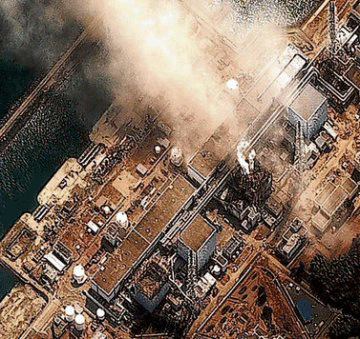 Nuclear safety inspectors first to flee stricken Fukushima plant June 03, 2014 Asahi Shimbun, By SHINICHI SEKINE/ Staff Writer Safety inspectors with the government’s nuclear watchdog body were the first to flee when disaster struck the Fukushima No. 1 nuclear power plant in March 2011.
The exodus of Nuclear and Industrial Safety Agency (NISA) officials compromised communications between the government and plant operator Tokyo Electric Power Co. at a critical juncture.
This unexpected turn of events shows that the government itself was not sure what role it should play in the nuclear crisis.
The plant manager, Masao Yoshida, who died last year of esophageal cancer, was questioned by the government’s Investigation Committee on the Accident at the Fukushima Nuclear Power Stations several months after the accident. The Asahi Shimbun obtained a copy of his testimony.
According to his testimony, on March 15, 2011, four days after the Fukushima plant was hit by the magnitude-9.0 Great East Japan Earthquake and tsunami, 90 percent of the workers in the plant withdrew to the Fukushima No. 2 nuclear power plant some 10 kilometers away, ignoring Yoshida’s order to remain in and around the compound of the No. 1 facility.
Before that, however, NISA inspectors fled the site immediately after the accident even though they should have stayed to assess what steps were needed to deal with the accident. They went to makeshift government headquarters set up about five kilometers from the No. 1 plant.
On March 15, the makeshift facility was transferred to Fukushima city, some 50 kilometers away. With all government safety inspectors absent from the No. 1 nuclear power plant, the government had no direct means to grasp what was happening there. As a result, it was forced to depend entirely on TEPCO for information.
But channels of communication between the government and TEPCO did not go smoothly. This chaotic situation prompted the prime minister, Naoto Kan, to go to TEPCO’s head office in Tokyo. That was the catalyst for the government and TEPCO to jointly set up headquarters in Tokyo, 230 kilometers away, to deal with the nuclear accident.
The government’s investigation committee’s reports based on Yoshida’s recall of the events highlight the withdrawal of the No. 1 plant’s workers to the No. 2 plant even though the government’s safety inspectors were the first to flee……..http://ajw.asahi.com/article/0311disaster/fukushima/AJ201406030026
Amid serious doubts, the Fukushima ice wall construction starts
 Japan builds underground ice wall at Fukushima nuclear plant http://www.abc.net.au/news/2014-06-02/japan-builds-fukushima-underground-ice-wall/5495358 Japan has started work on an underground ice wall at the crippled Fukushima nuclear plant, freezing the soil under broken reactors to slow the build-up of radioactive water. The wall is intended to block groundwater from nearby hillsides that has been flowing under the plant and mixing with polluted water already there.
The Nuclear Regulation Authority, the national watchdog, last week authorised construction of the ice wall at Fukushima Daiichi, owned and operated by Tokyo Electric Power (TEPCO).
“We started construction of the frozen earth wall this afternoon,” a TEPCO official told a news conference in Tokyo on Monday.
The government-funded scheme will see 1,550 pipes laid deep in the soil through which refrigerant will be piped to create the 1.5-kilometre frozen wall that will stem the inflow of groundwater.
“We plan to end all the construction work in March 2015 before starting trial operations,” the company official said, adding that the ice wall could be fully operational several months after construction was completed.
The ice wall is the latest in a series of clean-up operations being carried out after the worst nuclear disaster in a generation, in which three reactors went into meltdown.
The idea of freezing a section of soil, which was proposed for Fukushima last year, has previously been used to build tunnels near watercourses.
However, scientists point out that it has not been done on this scale before nor for the proposed length of time.
Coping with the huge – and growing – amount of water at the tsunami-damaged plant is proving to be one of the biggest challenges for TEPCO.
As well as all the water used to keep broken reactors cool, the utility must also deal with water that makes its way along subterranean watercourses from mountainsides to the sea. Last month TEPCO began a bypass system that diverts groundwater into the sea to try to reduce the volume of contaminated water.
Full decommissioning of the plant at Fukushima is expected to take several decades.
An area around the site remains out of bounds, and experts warn that some settlements may have to be abandoned because of high levels of radiation following the March 2011 accident.
A cry for help on behalf of Fukushima’s children subjected to radiation
Official in Fukushima: “Please Please HELP US!” — Hot particles of melted fuel are inhaled by children everyday — We are forced to have it in our bodies — “Please let all people in the world know the life we are living” http://enenews.com/official-in-fukushima-please-please-help-us-hot-particles-of-melted-fuel-are-inhaled-by-children-everyday-we-are-forced-to-have-it-in-our-bodies-please-let-all-people-in-the-world-kno?utm_source=feedburner&utm_medium=email&utm_campaign=Feed%3A+ENENews+%28Energy+News%29
Excerpts from Oyama Koichi of the Minamisoma City Council, May 13, 2014 — Translation byDissensus Japan, May 25, 2014:
- I want to shout for all the people in this world: “Please Please HELP US!”
- The cause substance have been found. This is an aggregate of radionuclides which starts with Uranium [in] a nuclear reactor at more than 5000°C.
- This mixed metal contains four different substances, α・β・γ and also have the possibility to radiate neutron ray.
- No creature on earth never knew this substance.
- We are forced to have those strong substances inside our body without knowing where it exactly stays.
- To say that “Cesium has got the same system as potassium and it will be discharged from the body” is just a lie! […]
- We are all manipulated by the words “radiation” and “radiation doze” without knowing the real identity of radiation source. We are not told the real facts of being irradiated […]
- They only compare radiation doze and natural potassium contained in bananas and manipulated people as if it was a scientific study. I really want the scholars patronized by the government to be punished by the rancorous of all children on this earth. […]
- The informations say that hot particles were diffused and flied in all directions in Japan. The particles from hell is flying in the air and people don’t protect themselves anymore three years after the nuclear accident and children are aspirating those horrible particles everyday!!!
- PLEASE PLEASE PLEASE HELP US! Please let all people in the world to know the life we are living since the accident, everyday and today.
Fukushima radiation has caused genetic deformities in generations of butterflies
Japan Scientist: We gave butterflies food from Fukushima… then, they died; Deformities get worse with each generation — TV: “Truly horrifying… it doesn’t really even look like a butterfly anymore” (PHOTOS & VIDEO) http://enenews.com/japan-scientist-butterflies-fed-leaves-fukushima-died-deformities-worse-generation-tv-doesnt-look-like-butterfly-anymore-especially-scary-photos-video?utm_source=feedburner&utm_medium=email&utm_campaign=Feed%3A+ENENews+%28Energy+News%29
Vice on HBO, Season 2 Episode 10, May 24, 2014 (at 5:30 in):
- Dr. Joji Otaki, lead researcher, University of Ryukyus: We collected houseplant leaves from Fukushima, and those leaves are given to [butterfly] larvae collected from Okinawa… Those larvae aresupposed to be healthy. But they ate contaminated food from Fukushima. Then we see what happens.
- Vikram Ghandi, Vice: What happened?
- Otaki: They died.
- Ghandi: Dr. Otaki’s experiments have shown the truly horrifying effects contaminated food can have on living organisms.
- Otaki: You can see wrinkled wings.
- Ghandi: It doesn’t really even look like a butterfly anymore.
- Otaki: We found that mortality rate and abnormality rate of the 2nd generation is much higher — even worse in the 3rd generation.
- Ghandi: The evidence contaminated food has increasingly worse effects over the course of generations is especially scary since one of Fukushima’s primary industries is agriculture.
- Kazuya Tarukawa, farmer in Sukagawa 50 miles from Fukushima Daiichi: We had been growing produce that measured 3,000 [Bq/kg] without even knowing it. Selling such produce to the markets made me feel severely guilty.
- Ghandi: His father was consumed with guilt.
- Tarukawa: He hung himself from the tree.
Every day over 75 tons of highly radioactive liquid leaking at Fukushima
Official: Breach at Fukushima reactor blamed on saltwater corrosion — Over 75 tons of highly radioactive liquid flowing out everyday (PHOTOS & VIDEO) http://enenews.com/official-breach-at-fukushima-reactor-blamed-on-saltwater-corrosion-over-75-tons-of-highly-radioactive-liquid-flowing-out-everyday-photos-video?utm_source=feedburner&utm_medium=email&utm_campaign=Feed%3A+ENENews+%28Energy+News%29
Kyodo News, May 28, 2014: [Tepco] has identified the location of a leak at the bottom of the container in the No. 1 reactor […] water was leaking from a joint in a pipe […] The metal bellow joint is likely to have been corroded [“destruction of materials from chemical reaction“] by seawater [the Tepco official said.] The official denied the possibility that the leakage was caused because the earthquake damaged equipment. He said the company will continue to investigate if there are other areas of leakage nearby.
Jiji Press, May 28, 2014: Tepco said it had confirmed water was leaking from a pipe in the reactor containment vessel inside the plant’s No. 1 reactor building. The utility used a camera-mounted remote-controlled robot […] water was leaking from the vessel’s bottom near the pipe, at a rate of up to 3.2 tons per hour [76.8 tons/day]. In the No. 1 to No. 3 reactor buildings, highly contaminated water leaking from the vessels has amassed, preventing work to remove nuclear fuel.
NHK,May 27, 2014: The water is leaking from a point on a pipe leading to the containment vessel. An image taken by a robot probe shows a black area on the brown pipe. The leak point is above a donut-shaped unit called a suppression chamber where a robotic investigation detected flows of contaminated water last November. The chamber is in the lower part of the containment vessel. […] A contaminated water leak has also been found in the containment vessel of the Number 3 reactor. Officials say they will now investigate the suppression chamber and other parts of the Number 2 reactor.
Watch footage of the Unit 1 suppression chamber survey published on May 28 here
Japan about to extract the teeth from its Nuclear safety Watchdog?
The government should not be allowed to make the nuclear watchdog toothless by nominating experts who are convenient to it and the industry.
EDITORIAL: Nuclear watchdog must not be made toothless –The Asahi Shimbun, May 29 Prime Minister Shinzo Abe has a habit of trying to promote policy changes through political appointments. His administration seems to have employed this political ploy to achieve its goals in the area of nuclear safety inspections.
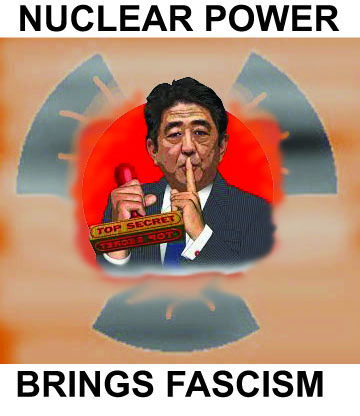
This is the only possible way to put proposed replacements for two outgoing commissioners of the Nuclear Regulation Authority (NRA) into perspective. Continue reading
1 This Month
15 October. Joint Appeal for Nuclear Abolition Day -presentation to the UN on October 15 will be live on UNWebTV
Endorse the Nuclear Abolition Day Appeal
23-25 October – on Zoom – World BEYOND War’s annual global conference

To see nuclear-related stories in greater depth and intensity – go to https://nuclearinformation.wordpress.com
-
Archives
- October 2026 (149)
- September 2026 (339)
- August 2026 (330)
- July 2026 (355)
- June 2026 (287)
- May 2026 (306)
- April 2026 (356)
- March 2026 (251)
- February 2026 (267)
- January 2026 (308)
- December 2025 (358)
- November 2025 (359)
-
Categories
- 1
- 1 NUCLEAR ISSUES
- business and costs
- climate change
- culture and arts
- ENERGY
- environment
- health
- history
- indigenous issues
- Legal
- marketing of nuclear
- media
- opposition to nuclear
- PERSONAL STORIES
- politics
- politics international
- Religion and ethics
- safety
- secrets,lies and civil liberties
- spinbuster
- technology
- Uranium
- wastes
- weapons and war
- Women
- 2 WORLD
- ACTION
- AFRICA
- Atrocities
- AUSTRALIA
- Christina's notes
- Christina's themes
- culture and arts
- Events
- Fuk 2022
- Fuk 2023
- Fukushima 2017
- Fukushima 2018
- fukushima 2019
- Fukushima 2020
- Fukushima 2021
- general
- global warming
- Humour (God we need it)
- Nuclear
- RARE EARTHS
- Reference
- resources – print
- Resources -audiovicual
- Weekly Newsletter
- World
- World Nuclear
- YouTube
-
RSS
Entries RSS
Comments RSS

