Japan’s Abe govt determined to bring back nuclear, but the impediments are strong
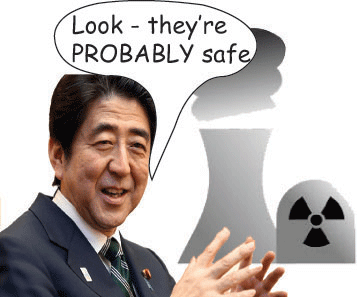 Abe and Kepco Push Nuclear Restart The government and nuclear companies maneuver to restart Japan’s reactors, as nearby cities dig in. The Diplomat, By Clint Richards May 29, 2014 As The Diplomat noted last week, Japan’s nuclear energy providers are struggling to remain profitable with all the country’s nuclear reactors currently offline. The government is highly aware of its struggling nuclear power sector, and the threat of another summer where Japan’s energy grid is stretched to the limit, and energy imports soar. With both of these problems in mind, three news items highlight the direction both the government and nuclear companies may take to avoid another summer energy crunch.
The Fukui District Court ruling would allow people living within 250 km of the plant the right to sue to have the plant closed. According to a separate Japan Times article, “The entire Kansai region, most of Chubu, including Nagoya, much of Chugoku, including Hiroshima, and roughly a third of Shikoku lies within 250 km of the Oi plant.”
Despite strong local opposition, Abe’s government is determined to bring back online as many nuclear reactors as logistically possible. On Wednesday, an NRA official told AFP that Abe’s government wants to replace two of five commissioners serving on the NRA when their terms expire. One of the commissioners Abe reportedly most wants to replace is Kunihiko Shimizu, who has been criticized for saying that at least two reactors sit on active fault lines………
Local governments and their constituencies are determined to keep the tragedy of Fukushima as far from their own doorstep as possible. The inability of Tepco to adequately address the continued problems at the Daiichi power plant only further reinforces the fear of people who live near existing reactors. Despite Abe’s insistence, local populations are likely to keep the number of reactors that come back online much lower than the government wants, at least in the near future, as long as the central government and energy providers give them veto power. http://thediplomat.com/2014/05/abe-and-kepco-push-nuclear-restart/
With new Indian government a slowdown in nuclear power expansion looks likely
 Narendra Modi government may go slow on nuclear energy expansion: PwC, The Economic Times, May 27, 2014, MUMBAI: The new government may put on the back-burner a plan to install 20 gigawatts of nuclear power capacity in the country by 2020 and instead focus on wind and solar to achieve energy security, says PwC……….
Rather than nuclear, the Modi government may focus on increasing wind and solar power capacity, especially when these models worked successfully in Gujarat, Mohapatra said.
The power, coal, and new and renewable energy portfolios in the Modi Cabinet are held by Piyush Goyal, who is from Maharashtra, where BJP ally Shiv Sena was opposing the 9,900 MW Jaitapur nuclear project……..An industry expert from KPMG, who did not want to be identified, said that before the new government takes any decision on nuclear power, it will first have to tackle issues of supply chain, safety and acceptance from locals. http://articles.economictimes.indiatimes.com/2014-05-27/news/50122504_1_energy-security-power-capacity-nuclear-power
Pro nuclear expert replaces safety conscious seismic expert on Japan’s Nuclear Safety Agency
Pro-nuclear expert replacing NRA commissioner who raised flag on quake risk THE ASAHI SHIMBUN 29 May 14, http://ajw.asahi.com/article/behind_news/politics/AJ201405280023 Replacements for two outgoing commissioners of the Nuclear Regulation Authority suggest the Abe administration will find it easier to gain approval for restarts of the nation’s nuclear reactors.Few people in government circles and the nuclear industry will be sorry to see Kunihiko Shimazaki go. His successor is expected to more quickly give the green light to reactivate nuclear power plants.
Shimazaki, who is 68 and a professor of seismology, proved to be a thorn in the side of electric power companies with his calls for a reassessment of the force with which seismic waves and tsunami could pummel nuclear plants being considered for restarts. Kenzo Oshima, 71, a former undersecretary-general at the United Nations, is also stepping down. Both men are leaving because their terms expire in September.
Continued cover-up of health effects of Fukushima radiation
Cancer Expert in Fukushima: “There has undoubtedly been radiation poisoning, people shouldn’t be living here”; Officials only focus is covering up crisis — TV: On playground, we found radiation levels 2,000% higher than displayed by gov’t monitoring post (VIDEO) http://enenews.com/cancer-expert-fukushima-undoubtedly-radiation-poisoning-people-be-living-officials-only-focused-covering-crisis-tv-playground-found-radiation-levels-2000-higher-nearby-govt-monitoring-post-displaye
Fukushima VICE
Vice on HBO, Season 2 Episode 10, May 24, 2014 (at 3:45 in):
Dr. Masamichi Nishio, MD, Hokkaido Cancer Center radiologist who was examining children at elementary school 40 miles from Fukushima Daiichi: There has undoubtedly been radiation poisoning, so people should not be living here. But the government will not say that out loud. All they wanted to do was cover-up what had been done. There is a lot of secrecy. […]
Kayoko Hashimoto, Fukushima resident: The figures don’t add up. They don’t match what the government is saying.
Vikram Ghandi, Vice: The whole concept of these stationary Geiger counters becomes suspect when only a few feet away the readings are twice as high. And when you move even further away, those government monitors start feeling completely irrelevant. Over here by the edge of the school… Whoa. Sh*t. So the reading is now 3.5 [microSv/hr]. That level is 20 times higher than the monitoring post around the corner — on the playground, at an elementary school.
Vikram Gandh’s ‘Debrief’, May 24, 2014:
Shane Smith, Vice: Vikram Gandhi went to Fukushima, where levels of radiation have been drastically downplayed by the Japanese government. […]
Ghandi: Our Geiger counter was reading measurements up to 900 times the measurements we found in Tokyo.
Tepco’s hopes that a giant ice wall will solve radiation leak problem
 Japan building giant ice wall at Fukushima after all as TEPCO gets go ahead RT May 28, 2014 Japan’s nuclear authority will allow Fukushima’s nuclear power plant operator, TEPCO, to build an underground ice wall isolating radioactive water build-up. This is despite earlier concerns that the wall might cause the ground to sink.
The Nuclear Regulation Authority (NRA) no longer has reservations about the 32 billion yen (US$314 million) government-funded project, in which a giant “wall of ice” is to be built around the crippled Fukushima No. 1 nuclear plant’s four reactors, Kyodo news agency reported.
The plan, which involves 1.5 kilometers of pipes with coolant powerful enough to make the earth around it freeze, earlier raised concerns that it could cause trouble by making the ground near the reactors less stable.
TEPCO officials have, however, persuaded NRA experts that the ground around the ice wall may sink only up to 16 mm, posing no threat to its stability.
“I think we have been able to confirm today the scale of ground sinking, which is what we have most feared as side effects of building the wall,” NRA Commissioner Toyoshi Fuketa told Kyodo.
While accepting the operator’s explanation, the NRA still has issues to discuss with TEPCO, which include ways to accurately measure the level of radioactive water accumulating inside the reactor buildings. The issue of contaminated groundwater seeping through the ground and into the ocean has for years been one of the major problems faced by TEPCO. ……
Public trust at a low ebb in Japan, as staff of Nuclear Regulation Agency changes
 TEPCO public trust remains low as Japan shuffles nuclear watchdog http://www.channelnewsasia.com/news/asiapacific/tepco-public-trust/1125884.html The Japanese government announced it will replace two of its five officials on the Nuclear Regulation Authority, while the Tokyo Electric Power Co. (TEPCO) is still grappling with low public trust. TOKYO: Japan’s government has announced it will replace two of its five members on the Nuclear Regulation Authority which determines if a nuclear plant is ready for a restart.
Speculation is rising that the government is removing the seismic expert responsible for actually beefing up the requirements for nuclear plants. The Tokyo Electric Power Company (TEPCO) is eager to spread the message that the Kashiwazaki Kariwa (KK), one of the world’s largest nuclear plants, is ready to be restarted after having been offline since the March 2011 Fukushima nuclear plant disaster.
Nuclear Reform Monitoring Committee deputy chair Lady Barbara Judge, who was the former chair of the United Kingdom Atomic Energy Authority, supports an energy mix that includes nuclear power even in Japan where the risk of a massive earthquake is high.
In Japan, many continue to oppose the restart of nuclear power plants. There are lawsuits taking place all over Japan not only against nuclear power plants but also uranium-related facilities. In May, a local court ruled for the first time against the restart of Oi nuclear power plant in Fukui Prefecture.
“In a lawsuit to stop the Oi nuclear plant, the historic ruling was based on the fact that the risk cannot be controlled by humans” said Tamotsu Sugenami, secretariat of the Takagi Fund for Citizen Science.
“Immediately, those who support nuclear energy began a campaign stating that zero risk is an old way of thinking. We cannot tolerate this.”
Aside from the technical safety concerns, public trust in TEPCO also remains low. “They (TEPCO) put little films on their websites on what’s going on,” said Lady Judge.
“They’re trying to explain to the public what they’re doing inside of walls of power plants which is new. And that’s more important than anything in terms of regaining public trust.”
TEPCO is aware of its reputation problem but there is also the issue of compensation.
Co-author of the book “It’s necessary to dissolve TEPCO for the revival of the Japanese economy” Hideaki Takemura claims the government has bankrolled TEPCO with the banks pumping in some 2 trillion yen to salvage the company.
He said: “There has been no compensation from (TEPCO’s) own pocket. It’s using the government money to compensate the victims and deal with the accident. There is no company as irresponsible as that.”
There are clearly many questions in Japan’s ongoing nuclear debate but there is no question that the Abe government is as keen as ever to get the country’s nuclear power plants back online.
Radiation levels close popular tourist park in Ibaraki Prefecture
 HITACHI SEASIDE PARK CLOSED DUE TO RADIATION, FUKUSHIMA UPDATE MAY 26, 2014
via JapanCrush / May 25, 2014 / Netizens have been alarmed by the news from national broadcaster, NHK, that part of the beautiful Hitachi Seaside Park have been closed off due to a peak in radiation levels.Ibaraki Prefecture, which is home to the park, neighbours Fukushima Prefecture, and therefore concerns over radiation levels have been ongoing since the 2011 nuclear disaster.
From NHK.com – “…….Hitachi Seaside Park is one of Ibaraki prefecture’s leading tourist spots and had over 350000 visitors during Golden Week this year and from now on MLIT will be carrying out decontamination of the area.” http://fukushimaupdate.com/hitachi-seaside-park-closed-due-to-radiation-fears/
Japan’s nuclear regulator OK’s dodgy government funde plan for ice wall around Fukushima nuke plant
Japan to create underground ice wall at crippled nuclear plant https://au.news.yahoo.com/thewest/world/a/23861341/japan-to-create-underground-ice-wall-at-crippled-nuclear-plant/ Tokyo (AFP) – Japan’s nuclear regulator on Monday approved a plan to freeze the soil under the crippled Fukushima nuclear plant to try to slow the build-up of radioactive water, officials said.
The Nuclear Regulation Authority examined plans by Tokyo Electric Power Co (TEPCO) to construct an underground ice wall at the Fukushima Daiichi nuclear plant starting in June, regulatory officials said.
The wall is intended to block groundwater from nearby hillsides that has been flowing under the plant and mixing with polluted water used to cool reactors that went into meltdown after an earthquake and tsunami in March 2011.
Under the plan, which is funded by the government, the firm will circulate a special refrigerant through pipes in the soil to create the 1.5-kilometre (0.9-mile)frozen wall that will stem the inflow of groundwater.

“We had some concerns, including the possibility that part of the ground could sink,” one official said on condition of anonymity.
“But there were no major objections to the project during the meeting, and we concluded that TEPCO can go ahead with at least part of the project as proposed after going through further necessary procedures.” However, TEPCO may have to review other parts of the project amid fears it might affect existing structures at the plant such as underground drains, he added.
The idea of freezing a section of the ground, which was proposed for Fukushima last year, has previously been used in the construction of tunnels near watercourses.
However, scientists point out that it has not been done on this scale before nor for the proposed length of time.
Coping with the huge — and growing — amount of water at the tsunami-damaged plant is proving to be one of the biggest challenges for TEPCO, as it tries to clean up the mess after the worst nuclear disaster in a generation.
As well as all the water used to keep broken reactors cool, the utility must also deal with the water that makes its way along subterranean watercourses from mountainsides to the sea.
Last week TEPCO began a bypass system that diverts groundwater into the sea to try to reduce the volume of contaminated water.
Full decommissioning of the plant at Fukushima is expected to take several decades. An area around the plant remains out of bounds and experts warn that some settlements may have to be abandoned because of high levels of radiation.
Japan’s atomic survivors, Hibakusha in Peru, on their global voyage of nuclear warning
Global Voyage for a Nuclear Free World – Radiation survivors tell their story in Lima, Peru Peru This Week By Roxana Garmendia, 27 May 14 Hiroshima and Nagasaki survivors visit Lima as part of their worldwide tour campaign ‘world free of nuclear weapons.’Hiroshima and Nagasaki are two words one cannot easily forget. They represent the destruction and the immense human suffering and loss caused by the usage of nuclear weapons. On August 6, 1945, American airplanes dropped a nuclear bomb on the Japanese city of Hiroshima, and three days later on Nagasaki. 69 years have passed since then but the effects of such acts are still present to this day. To tell us more on these tragic events, a delegation of survivors recently visited Lima as part of their worldwide tour campaign on a ‘world free of nuclear weapons.’
A group of both men and women – most of them in their 70s – shared their memories and the consequences these events had in their lives and those of their families. They were young – if not infants – and some did remember those moments quite well; others learnt about them growing up and through their families. One man recalled his hair falling off and having open wounds in his legs and body caused by the radiation and from which worms would stem out; a lady being covered with a blanket by her mother, saving her from getting the radiation burns – different was the fate of the other family members who died soon after, she explained. More than 200,000 people have died of radiation sickness; the vast majority of them civilians.
There were, of course, those who survived the nuclear attacks; in Japan they are known as hibakushas. A hibakusha technically is someone that has been exposed to radiation within a few kilometers of the hypocenter or was not yet born but was carried by a pregnant woman that had been exposed to such radiation. It is estimated that there are more than 220,000 hibakushas alive – Japanese for the most part but also Koreans and Chinese who were brought to Japan as forced labor during those years. One percent of them are believed to still suffer from some disease related to the bombings. The effects of the radiation, it must be said, are both short and long-term, and may appear later.
It was not only the physical scars, illnesses and traumas that the hibakusha have suffered all along; they were also victims of discrimination. Jobs were difficult to get as people were afraid of any disease transfer. Likewise in social terms, it was not any better as the belief that the illness could be hereditary was very much in the air, and doubts about this still persist. A Japanese lady revealed, for example that all her children suffer from cancer, thyroid, and intestinal problems, common illnesses among other second generation hibakushas (approx. 300 to 500,000).
Several years after, the hibakushas organized themselves and managed to obtain some benefits from the Government. The Japanese Government provides them a monthly allowance and free medical treatment for those registered hibakushas. No compensation, however, was ever paid by the Americans even though they were the ones who threw the bombs……http://www.peruthisweek.com/news-global-voyage-for-nuclear-free-world-radiation-survivors-tell-their-story-in-lima-peru-103071
South Korea and China in agreement on threat of North Korea’s nuclear activities
China agrees North Korea’s nuclear activities a serious threat, says South Mon May 26, 2014 SEOUL (Reuters) – South Korea and China agreed on Monday that recent nuclear activity by North Korea posed a serious threat to the peace and stability of the region and Pyongyang must not conduct a nuclear test, Seoul said after a meeting of their top diplomats.
Renewed activity at North Korea’s nuclear test site has indicated Pyongyang may be preparing a fourth nuclear test in contravention of U.N. sanctions.
Analysis have suggested the North may be close to miniaturising a nuclear warhead to mount on a missile, alarming regional powers that have for two decades tried to rein in Pyongyang’s atomic programme.
Chinese Foreign Minister Wang Yi held talks with his South Korea counterpart Yun Byung-se to discuss the North’s nuclear programme, as well as an upcoming visit by Chinese President Xi Jinping to Seoul this year, South Korea’s foreign ministry said.
“The two ministers agreed to step up cooperation based on the united position that they object to the North’s nuclear test and that recent nuclear activities by the North pose a serious threat to the peace and stability of the Korean peninsula and the region,” the ministry said.
China, North Korea’s lone major ally, is usually very guarded in its opinion on Pyongyang’s nuclear programme, usually expressing its desire for a nuclear-free “Korean peninsula” and careful not to be seen to be taking sides…….http://af.reuters.com/article/worldNews/idAFKBN0E61LJ20140526
A legal precedent that could stall Japan’s nuclear power restart
 Oi ruling may fuel anti-nuclear push Plaintiffs elated as district court prioritizes rights over profits Japan Times, BY ERIC JOHNSTON MAY 22, 2014 Wednesday’s court ruling blocking restarts of the No. 3 and 4 reactors at Kansai Electric Power Co.’s Oi plant may embolden opponents of nuclear power nationwide.
It creates a legal precedent and could fuel resistance to restarts, throwing into question whether the administration of Prime Minister Shinzo Abe will be able to push ahead with them as swiftly as planned.
The government earlier asserted that the ruling, by the Fukui District Court, would have no impact on its plans.
Kepco announced Thursday it has appealed the lower court’s decision to the Kanazawa branch of the Nagoya High Court. There, the case could take two or three years to be decided……….
Kepco came under intense criticism from the Fukui court, which said the utility had made optimistic safety projections with no clear evidence. But in a move that could have ramifications nationwide, the court also ruled that 166 plaintiffs living within a 250-km radius of the Oi plant faced concrete dangers from the operation of nuclear power stations.
That could open the door to lawsuits from anyone living within 250 km of a nuclear plant, if the Fukui court’s decision is used as the basis for a claim that other utilities, as well as the Nuclear Regulation Authority, have created inadequate safety measures to deal with the possibility of an accident.
The entire Kansai region, most of Chubu, including Nagoya, much of Chugoku, including Hiroshima, and roughly a third of Shikoku lies within 250 km of the Oi plant.
Plaintiffs were particularly happy the court ruling included language that said providing electricity via nuclear plants is a mere economic activity, and as such has a lower priority than personal rights……..ww.japantimes.co.jp/news/2014/05/22/national/oi-ruling-may-fuel-anti-nuclear-push/#.U4PbrnJdWik
IN Japan, huge public opposition to nuclear power is ignored by the Abe government
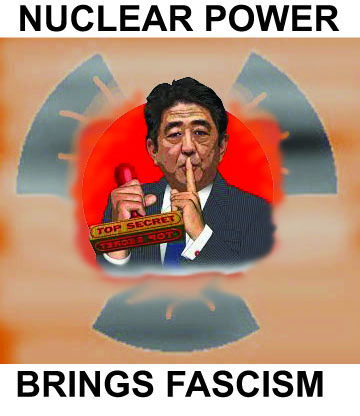 Abe administration ignored massive public opposition to nuclear power Asahi Shimbun, By ATSUSHI KOMORI/ Senior Staff Writer, 25 May 14, More than 90 percent of respondents during a public comment period on the Abe administration’s basic energy policy were opposed to nuclear power generation, according to an Asahi Shimbun estimate released on May 25.
The Asahi Shimbun made the determination by tallying how many of 2,109 of about 19,000 comments sent to the government from December to January were in opposition.
Failing to take into account that overwhelming public sentiment, the Cabinet approved in April the basic energy policy, which described nuclear power generation as an “important base load electricity source.” The base load electricity source means that nuclear power will continue to be relied on to meet a percentage of the electricity demand, regardless of the season or time of day.
The Ministry of Economy, Trade and Industry released on Dec. 6, 2013, the draft of the basic energy policy, the first compiled by the Abe administration since the accident at the Fukushima No. 1 nuclear power plant triggered by the March 2011 Great East Japan Earthquake and tsunami.
After releasing the draft, the Abe administration gathered public comments for a month until Jan. 6 through e-mails, faxes and other means. In all, about 19,000 responses were sent to the government.
The industry ministry disclosed representative comments in February. However, it did not tally how many replies it received were for or against nuclear power generation………..
As for the 2,109 e-mails, The Asahi Shimbun counted how many were for or against nuclear power generation. It found that 2,008 of them, or 95.2 percent, opposed nuclear power generation. Only 33, or 1.6 percent, supported nuclear power. The remaining 68 e-mails, or 3.2 percent, were “other replies.”
As for the reasons why they opposed nuclear power generation, many of the 2,008 respondents said that the nuclear accident in Fukushima Prefecture has yet to be resolved or that there are no disposal sites for spent nuclear fuels. Some of the comments also criticized the draft plan, which regarded nuclear power as an important electricity source, for going against public opinion……… http://ajw.asahi.com/article/behind_news/politics/AJ201405250023
Indian government contemplating nuclear attack on Pakistan?
Narendra Modi will have to ‘press the nuclear button’ if Pakistan does not ‘mend its ways’, says Shiv Sena chief Uddhav Thackeray DNA, 25 May 2014 – : Mumbai | Agency: PTI “……..In a statement issued in Mumbai, Sena president Uddhav Thackeray said, “So far only India has taken initiative of forgetting the past and starting afresh. Hence, it is difficult to trust Pakistan. But we trust Modi’s leadership and hence we do not want to create hurdles for him. If Pakistan does not mend its ways, Modi will have to press the nuclear button.” ………http://www.dnaindia.com/india/report-narendra-modi-will-have-to-press-the-nuclear-button-if-pakistan-does-not-mend-its-ways-says-shiv-sena-chief-uddhav-thackeray-1991286
The nuclear industry is not winning hearts and minds in China
 People power holds key to China’s nuclear plans FT.com, By Lucy Hornby at Daya Bay, 26 May 14, China’s nuclear industry has in recent years ventured overseas for new opportunities but it is now facing challenges at home gaining public acceptance of its $150bn expansion plans.
Fears of a nuclear power backlash, stoked by recent demonstrations against other large industrial projects, have rattled regulators as well as nuclear operators China National Nuclear Corp (CNNC) and China General Nuclear Power Corp (CGN).
Regulators fear images of riot police crushing protests at a reactor site – like this month’s violent clashes over a planned garbage incinerator – could quickly harden attitudes against nuclear power.
“If the government just keeps the same attitude of secrecy as in the past, it will create more problems. They need to pursue nuclear power appropriately and safely otherwise there will be more conflicts between the government and people,” says Cao Heping, who studies green economy at Peking University.
The concerns have even moved Chinese regulators to request help from the UK in the hope its government can offer tips on developing public and media support for nuclear power.
Industry executives say Mr Li’s “when appropriate” caveat followed internal discussions about the need to tread carefully, to avoid arousing any anti-nuclear sentiment.
Meanwhile, the meltdown at Fukushima in Japan strengthened Chinese regulators’ hand but also raised worries about public acceptability.
After the Fukushima meltdown, regulators shelved almost half of the 100 or so planned reactor projects due to design or site concerns, including those in earthquake zones or on inland rivers with limited water supply.
That review plus signs of slippage in construction means China could struggle to have all of the new reactors operational in the next six years.
China’s protracted crackdown on civil dissent deters local activists from taking the lead publicly on sensitive projects. Opposition can thus quickly turn into street protests despite new government initiatives to allow public feedback and that could prove a problem if public opinion sours on nuclear power.
Local governments often welcome the investment and jobs nuclear projects bring but disagreement among local officials can fuel protests. City officials’ unease over oil company Sinopec’s long-delayed paraxylene plant was a factor http://www.ft.com/intl/cms/s/0/a6f10e96-e41c-11e3-a73a-00144feabdc0.html#axzz32rprEjFF
Legal ruling in Japan throws doubt on ANY nuclear reactor restarts
 Reflect on Fukui nuclear ruling, Japan Times 23 May 14 The Fukui District Court’s ruling this week that it will not allow the restart of two nuclear power reactors run by Kansai Electric Power Co. challenges the Abe administration’s energy policy of keeping nuclear power as a key source of the nation’s electricity supply despite the safety risks that materialized in the wake of the Fukushima nuclear power plant disaster in March 2011.
The court’s Wednesday ruling was on a lawsuit filed by a group of 189 people from Tokyo, Fukui and other prefectures against the 2012 restart of two of the reactors at
Kepco’s Oi Nuclear Power Plant in Oi, Fukui Prefecture.
The two Oi reactors — the first to have been reactivated after all of the nation’s nuclear reactors were shut down following the triple meltdowns at Tokyo Electric Power Co.’s Fukushima No. 1 plant — were taken offline last year for regular maintenance, leaving the nation again without nuclear power.
The content of the court’s ruling, in effect, questions the plans by power firms and the government to restart more than a dozen nuclear reactors around the country just three years after the disaster in Fukushima, ……
The district court said the Nos. 3 and 4 reactors at the Oi plant have “structural deficiencies” in their safety measures against severe earthquakes, and determined that restarting their operation would violate the fundamental rights to life of plaintiffs who live within 250 km of the plant — the maximum range where the effects of a worst-case nuclear power plant disaster are estimated to spread in simulations based on the Fukushima case……
The ruling dismissed an argument by Kepco in court, noting that it is legally irrelevant to discuss people’s fundamental rights to life on the same level as the question of rising costs of generating electricity.
It went on to say that even if Japan suffers large trade deficits because of the nuclear power plant shutdowns, the real loss of national wealth is when people become unable to live stable lives on their land — an apparent reference to the shattered lives of those residents around the Fukushima plant who were forced to flee their homes. The court also called the radiation fallout from the Fukushima disaster “the worst environmental contamination” in Japan’s history and brushed aside as completely missing the point the argument that the nation needs to have nuclear power as a clean energy that reduces emissions of global warming gases.
One of the key points of the ruling is that operation of the Oi reactors needs to be stopped if there is “even a slightest chance” that the reactors’ ability to keep cooling their cores and contain radioactivity could be lost — as happened in the case of the Fukushima No. 1 plant — if the plant is crippled by severe earthquakes.
The crucial point of the ruling is its contention that it is inherently impossible to determine on scientific grounds that an earthquake more powerful than assumed in the operator’s worst-case scenario would not happen. It noted that since 2005, four nuclear power reactors around the country have experienced quake shocks more powerful than the maximum level anticipated on their sites. It is “groundless optimism” in this quake-prone country that such a temblor would never hit the Oi plant, the ruling stated……..
The Abe administration and the power companies need to stop and reflect on the Fukui court ruling in the context of what the events of the Fukushima disaster. The core meltdowns at Tepco’s Fukushima plant took place after the operator deliberately underestimated tsunami risks and failed to take necessary precautions. When it hit, Tepco sought to excuse its lack of preparedness by characterizing the tsunami as simply beyond the scope of “conventional assumptions.”
What the ruling called the “groundless optimism” about safety of the Oi plant can be a malady common to all nuclear power plants in this country. The “safety myth” in nuclear power was shattered in the Fukushima disaster. Such a myth should not be resurrected. http://www.japantimes.co.jp/opinion/2014/05/23/commentary/reflect-on-fukui-nuclear-ruling/#.U4ENcHJdWik
1 This Month
15 October. Joint Appeal for Nuclear Abolition Day -presentation to the UN on October 15 will be live on UNWebTV
Endorse the Nuclear Abolition Day Appeal
23-25 October – on Zoom – World BEYOND War’s annual global conference

To see nuclear-related stories in greater depth and intensity – go to https://nuclearinformation.wordpress.com
-
Archives
- October 2026 (149)
- September 2026 (339)
- August 2026 (330)
- July 2026 (355)
- June 2026 (287)
- May 2026 (306)
- April 2026 (356)
- March 2026 (251)
- February 2026 (267)
- January 2026 (308)
- December 2025 (358)
- November 2025 (359)
-
Categories
- 1
- 1 NUCLEAR ISSUES
- business and costs
- climate change
- culture and arts
- ENERGY
- environment
- health
- history
- indigenous issues
- Legal
- marketing of nuclear
- media
- opposition to nuclear
- PERSONAL STORIES
- politics
- politics international
- Religion and ethics
- safety
- secrets,lies and civil liberties
- spinbuster
- technology
- Uranium
- wastes
- weapons and war
- Women
- 2 WORLD
- ACTION
- AFRICA
- Atrocities
- AUSTRALIA
- Christina's notes
- Christina's themes
- culture and arts
- Events
- Fuk 2022
- Fuk 2023
- Fukushima 2017
- Fukushima 2018
- fukushima 2019
- Fukushima 2020
- Fukushima 2021
- general
- global warming
- Humour (God we need it)
- Nuclear
- RARE EARTHS
- Reference
- resources – print
- Resources -audiovicual
- Weekly Newsletter
- World
- World Nuclear
- YouTube
-
RSS
Entries RSS
Comments RSS

