Illness and deaths among Fukushima’s nuclear clean-up volunteers
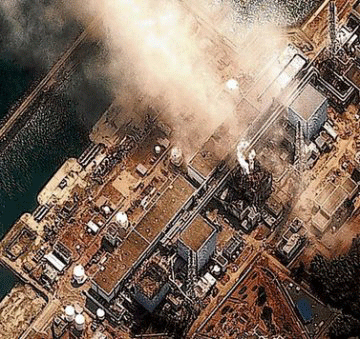 Fukushima Guide: “Lots of people suddenly started having nose bleeds, cats and dogs too, it lasted for some time” after 3/11 — Article: Many who volunteered in Fukushima have died, including 2 students from group of 15 helping to decontaminate http://enenews.com/fukushima-guide-lots-of-people-suddenly-started-having-nose-bleeds-cats-and-dogs-too-it-lasted-for-some-time-after-311-article-many-who-volunteered-in-fukushima-have-died-including-2-stud?utm_source=feedburner&utm_medium=email&utm_campaign=Feed%3A+ENENews+%28Energy+News%29
Zukunashi no Hiyamizu, June 9, 2014 (h/t Dissensus Japan]: Why many of decontamination volunteers died — “Genpatsu Mondai” wrote a blog article in the May 21, 2014 titled “Joining the volunteer with Fukushima citizens result in sudden death!!! Two of fifteen students in the neighborhood already died from an unknown cause”. In this article, you can read many dead cases of volunteers who went to Fukushima and worked there. They went to contaminated area and worked for decontamination as volunteers. […] Basically the purpose of volunteers is to go to the contaminated area where the air dose rate is high and to work there.
Sulejman Brkic, June 12, 2014: We left for Fukushima by bus very early on May 31, from Yokohama […] At the rest area where we stopped to pick up our guide, Masumi K. […] According to Masumi san, the population is divided between those who trust the government and the ones who don’t […] Don’t forget Fukushima are the words spoken to us by Masumi K. […] Masumi is from Okuma which she fled with her family after the nuclear explosions in 2011 […] She has been also battling cancer for some time now […] her husband got seriously sick and needed a new kidney, Masumi gave him one of hers. […] [A] young anonymous worker [at Fukushima Daiichi] told us […] about so many small and big acts of exploitation […] that…well…one stops listening, not on purpose, but it’s just too much, too overwhelming, it starts sounding normal after a while, I am sorry I can’t remember all of it. At every step in that area one can see or hear or feel the Japanese government’s lies and crimes. […] After the young anonymous worker, Masumi K talked again. She told us, again among many other stories of suffering, about the increase in suicides, consumption of alcohol, domestic violence, depression…she also told us how after the ongoing nuclear disaster there was a time when quite lots of people suddenly started having nose bleeds, cats and dogs too, it lasted for some time and then it suddenly stopped.
40 times above normal – thyroid cancer rates in Fukushima’s children
 Fukushima’s Children are Dying (includes audio)http://ecowatch.com/2014/06/14/fukushima-children-dying/2/ Harvey Wasserman | June 14, 2014 Some 39 months after the multiple explosions at Fukushima, thyroid cancer rates among nearby children have skyrocketed to more than forty times (40x) normal.
More than 48 percent of some 375,000 young people—nearly 200,000 kids—tested by the Fukushima Medical University near the smoldering reactors now suffer from pre-cancerous thyroid abnormalities, primarily nodules and cysts. The rate is accelerating.
More than 120 childhood cancers have been indicated where just three would be expected, says Joseph Mangano, executive director of the Radiation and Public Health Project.
The nuclear industry and its apologists continue to deny this public health tragedy. Some have actually asserted that “not one person” has been affected by Fukushima’s massive radiation releases, which for some isotopes exceed Hiroshima by a factor of nearly 30.
But the deadly epidemic at Fukushima is consistent with impacts suffered among children near the 1979 accident at Three Mile Island and the 1986 explosion at Chernobyl, as well as findings at other commercial reactors. Continue reading
Anxiety in China, over its not so safe rush to nuclear power
Losers aplenty in China’s race for nuclear power THE AUSTRALIAN JUNE 21, 2014 Scott Murdoch China
 Correspondent Beijing IN China’s far eastern region of Rongsheng, the government is rolling out one of the most ambitious nuclear power developments in the world.
China has commissioned at least three power plants in the Shandong province as it attempts to reduce its reliance on fossil fuels. However, the details of the projects remain tightly controlled, with hundreds of residents, farmers and business owners left to question their future amid concerns over the safety of nuclear technology.
A journalist, photographer and news assistant from The Weekend Australian were recently detained by police while researching the Shidaowan project. The company behind the development, the China Huaneng power company, refused to answer questions. French nuclear regulators this week warned China needs to step up its level of supervision, control and interaction with the rest of the world as it invests more in nuclear generation. There are 20 nuclear reactors in operation in China and a further 28 under construction.
It has been mooted that Shidaowan will come online by 2017, more than three years behind schedule, after the 2011 Fukushima disaster in Japan halted nuclear development around the world.
Under the government’s plans, next-generation CAP1400 reactors are being developed in Shandong. The program has been approved by the National Development and Reform Commission, the peak economic planning agency in China.
It is forecast that nuclear power generation will almost triple, from 15.69 gigawatts to at least 58GW, by 2020, as China aims to reduce its reliance on coal-fired power generation.
However, in the small villages around the new power plant in Rongsheng, the human and environmental costs of the development are already clear.
Villages have been razed, with dozens of residents forced from their homes in the early stages of the plant’s construction.
The project has brought work, with labourers housed in cramped conditions. But residents are concerned about the use of world-first technology. Some have been told they will be moved and placed in high-rise accommodation, leaving behind their friends, family, traditions and culture………
“The villagers have had land by the seaside for generations, we could grow our own food, we could fish, and not only feed our family but we could make some money from that.
“But now the land has been seized and if something goes wrong then the seas will be completely damaged and our villages could be wiped out.”………
Former nuclear power engineer Du Minghai said while China was rolling out the most ambitious nuclear program in the world, it had to ensure it strengthened safeguards to prevent environmental, social and health problems.
“In terms of the plant design, equipment manufacturing and maintenance management, China still has gaps compared with the world’s most advanced levels,” he said.
“We should introduce and insist that foreign-management methods are put in place, and make sure that we don’t localise the management systems of the plants.
“Some people are saying that China is using the highest standards and building the most advanced nuclear units, but to some extent I think this is just political language being used to make sure politicians support their projects.”
Additional reporting: Wang Yuanyuan http://www.theaustralian.com.au/news/world/losers-aplenty-in-chinas-race-for-nuclear-power/story-e6frg6so-1226961728367#
Fukushima reactors too “hot” to allow workers to look for molten nuclear cores
 Hemisphere facing generations of radiologic contamination” from Fukushima — TV: It’s a major humanitarian crisis — NYT: “Nobody really knows” if 100s of tons of plutonium & uranium fuel resolidified — Experts: It’s certain reactor cores ‘moved around’; “Flowed to different part of buildings”? (VIDEO)
Al Jazeera, June 17, 2014: Fukushima ‘ice wall’ looking more like a dirt Slurpee […] Skeptics of the plan to build a massive ice wall […] didn’t have to wait particularly long for their first “I told you so.” […] “We have yet to form the ice stopper because we can’t make the temperature low enough to freeze water,” a TEPCO spokesman said. […] What if freezing causes the ground to sink? What if the ice and the ensuing expansion and contraction interrupts or further damages drainage in the reactor buildings? […] TEPCO’s experiment around the margins does nothing to address the hot mess at the core (as it were) of the crisis, and is cold comfort to those people still displaced or a country and hemisphere facing generations of radiologic contamination.
Christopher Morris, Muon Radiography Program Leader, June 16, 2014: “It’s certain that the reactor cores melted and the material moved around. By using muons going through the cores, we can make a radiograph of the uranium material and find out how much is left inside the pressure vessel, how much has leaked out of the pressure vessel.”
Duncan McBranch, Los Alamos Lab’s Chief Technology Officer, June 18, 2014: “The material itself may have melted and flowed to a different part of the building. Invasive techniques such as video endoscopy or introduction of robots run the risk of releasing radiation.”
New York Times, June 17, 2014: […] there are three wrecked reactor cores, twisted masses of hundreds of tons of highly radioactive uranium, plutonium, cesium and strontium. […] most of the material in the plant’s reactors resolidified, in difficult shapes and in confined spaces, wrapped around and through the structural parts of the reactors and the buildings. […] that is what the engineers think. Nobody really knows, because nobody has yet examined […] “nobody knows what happened inside,” [McBranch] said. “Nobody wants to go in to find out.” […] concrete, steel and water will all be distinguishable from uranium, plutonium and other very heavy materials. […] Testing will begin later this year, officials say, and final images will be produced next year.
KRQE, June 18, 2014: LANL technology to examine Fukushima damage […] “This is a major humanitarian crisis,” said Matt Durham, a post-doctoral researcher at Los Alamos […] “They are much too radioactive to go in and look at things,” said Christopher Morris, the lead researcher on the project. […] LANL hopes the detectors will be used in about a year. >> Full broadcast here
Fukushima ice wall project not working out too well
 Fukushima operator struggles to build ice wall to contain radioactive water Tepco says it is behind schedule with scheme
because temperature of pipes sunk into ground is not low enough Agence France-Presse in Tokyo theguardian.com, Tuesday 17 June 2014 The operator of Japan‘s battered Fukushima nuclear power plant has said it is having trouble with the early stages of an ice wall being built under broken reactors to contain radioactive water.
Tokyo Electric Power (Tepco) has begun digging the trenches for a huge network of pipes under the plant through which it intends to pass refrigerant. This will freeze the soil and form a physical barrier that is intended to prevent clean groundwater flowing down mountainsides from mixing with contaminated water underneath the leaking reactors.
Tepco said on Tuesday that a smaller, inner ice wall whose pipes it sank earlier to contain the already-contaminated water was proving difficult. “We have yet to form the ice stopper because we can’t make the temperature low enough to freeze water,” a Tepco spokesman said.
“We are behind schedule but have already taken additional measures, including putting in more pipes, so that we can remove contaminated water from the trench starting next month.” The coolant being used in the operation is an aqueous solution of calcium chloride, which is cooled to -30C (-22F).
The idea of freezing a section of the ground, which was proposed for Fukushima last year, has previously been used in the construction of tunnels near watercourses.
However, scientists point out that it has not been done on this scale before, nor for the proposed length of time……http://www.theguardian.com/environment/2014/jun/17/fukushima-ice-wall-radioactive-water
Strange deaths of horses irradiated by Fukushima nuclear catastrophe
Japan Paper: “Horses became weak and died, one by one, from an unknown cause” at farm in Fukushima — Farmer: “There is something seriously wrong going on… This country is going mad, I‘m sure something grave is going to happen” — 14 out of 15 newborn horses died last year (PHOTOS) http://enenews.com/japan-paper-horses-became-weak-and-died-one-by-one-from-an-unknown-cause-at-farm-in-fukushima-farmer-there-is-something-seriously-wrong-going-on-this-country-is-going-mad-i?utm_source=feedburner&utm_medium=email&utm_campaign=Feed%3A+ENENews+%28Energy+News%29
Kyodo News, June 14, 2014: Tadao Mitome feels a duty to continue capturing images of the area to document the effects of the nuclear disaster […] Mitome, 75, published a photo book titled “3/11 Fukushima: Hibaku no Bokujo” (“Stock Farm Exposed to Radiation”), documenting a farm in the village of Iitate and its dying horses. “People should do whatever they are capable of doing,” Mitome said […] Iitate, about 40 km away from the wrecked power plant, [farmer Tokue Hosokawa] defied the central government’s order to evacuate. […] After nearly two years, horses became weak and died, one by one, from an unknown cause. Some horses in Fukushima were also put to death and sent away for autopsies. Mitome said he felt as though the eyes of the killed animals were trying to tell him that they would never let human beings forget about the nuclear disaster. […] “There are things that I must let people in the world know,” he said.
World Network For Saving Children From Radiation, Feb. 27, 2014: Mr. Hosokawa again lost three of his horses this summer. […] “Since then, three more horses have died. This village is reaching its end […] I don’t feel good”, he said.
Evacuee from Iitate: “University of Tohoku dissected the dead horses […] there were apparent abnormal results from the analysis of the blood […] 3 more horses have died here this summer. Hosokawa must be in shock […] I have demanded the Ministry of Environment to inform us of the results. But they keep saying, ‘we don’t know anything yet’ […] why can’t they at least publish the results so far? Surely there must be something wrong if they can’t publish.”
World Network For Saving Children From Radiation: “There is something seriously wrong going on” -Hosokawa […] According to him, horses have fallen ill one by one within these short weeks […] a white miniature horse, had the worst condition. Its skin was badly damaged. The veterinarian doctor who accompanied us saw it and indicated the symptoms of damaged liver […] It had jaundiced eyes. The doctor was wondering why its knees were so wobbly. […] 15 foals have been born since the beginning of this year, but 14 of them died within a month, sometimes within a week. “I have lived with horses since I was a kid, but I have never seen anything like this. It’s not normal. I think radiation is responsible for this”. Hosokawa stresses the effect of radiation as a cause. […] we asked a public health control centre to check the blood of the miniature horse. The results were negative for transmitted diseases or nutrient deficiency. […] We were overwhelmed by Hosokawa’s ghastly expression on his face and stunned with a shock by the grave situation, which was beyond our imagination. “This country is going mad, I‘m sure something grave is going to happen”.
Strong protest movement opposes restart of Kagoshima reactors, Japan
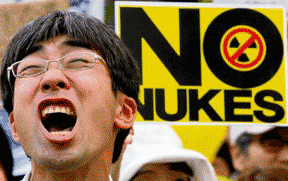 Anti-nuclear activists ratchet up pressure to block restart of Kagoshima reactors June 14, 2014 Asahi Shimbun By MASANOBU HIGASHIYAMA/ Staff Writer KAGOSHIMA–More than 1,000 protesters assembled before the prefectural government building here June 13 to oppose moves to restart a local nuclear power plant.
If the Sendai nuclear plant in Satsumasendai, Kagoshima Prefecture, were to go back online, it would mark the nation’s first restart under new safety standards brought in after the March 2011 nuclear disaster in Fukushima Prefecture.
The rally, which organizers deemed a “critical phase” in their anti-nuclear efforts, coincided with the start of the prefectural assembly session.
“Governor, why don’t you pick a fight with the central government like the Hakodate mayor has done to protect the life and health of residents?” Satoshi Kamata, a noted nonfiction writer who has written extensively about labor and environmental pollution issues, barked through a loudspeaker.
Kamata, 76, was referring to a lawsuit filed in April by the Hakodate municipal government in Hokkaido to demand a halt to the construction of a nuclear power plant across the Tsugaru Strait in Oma, Aomori Prefecture.
“After serious problems of pollution in the 1970s, Japanese learned that their lives are more important than the nation’s economy. Why are we regressing to the same situation in the question of nuclear power?” asked Kamata, who flew in from Tokyo, where he regularly participates in a weekly anti-nuclear protest held outside the prime minister’s office.
Among the other participants were evacuees from the disaster at the Fukushima No. 1 nuclear power plant. The rally was organized by about 90 groups, including a local co-op.
The protesters submitted to prefectural officials a petition signed by about 120,000 people from across Japan in protest to the restart of the plant, which is operated by Kyushu Electric Power Co…….http://ajw.asahi.com/article/0311disaster/fukushima/AJ201406140025
Conflict of interest as new Commissioners joing Japan’s nuclear regulator
 NRA conflict rule ignored by Abe administration
When the Democratic Party of Japan established the NRA, then–prime minister Naoto Kan implemented a rule to prevent conflicts of interest. It stopped anyone from becoming an NRA commissioner who had been employed by a nuclear organization in the three preceding years, which was defined as someone receiving $5,000 per year from the nuclear industry during that time period.
It appears that the Liberal Democratic Party has ignored that rule.
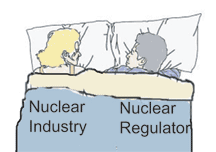 Post-Fukushima nuke watchdog outrages Japanese, Straight,com NRA appointee Satoru Tanaka’s financial ties to the nuclear industry provoke howls from environmentalists and opposition politicians by MARTIN DUNPHY on JUN 13, 2014 JAPAN’S PARLIAMENT, THE Diet, approved a controversial government appointee to the country’s nuclear watchdog agency on Wednesday (June 11).
Satoru Tanaka, a 64-year-old professor of nuclear engineering, will start his job as commissioner with the Nuclear Regulation Authority (NRA) in September.
The staunch supporter of nuclear power has deep ties to the nuclear industry and has accepted tens of thousands of dollars from affiliated companies over the years. Continue reading
Opposition to nuclear power is strengthening in South Korea

 S. Korea faces strong opposition to nuclear power SEJONG, June 15 (Yonhap) — The South Korean government is facing a renewed opposition against nuclear power plants sparked by the recent tragic sinking a passenger ferry while the need for what is considered the cheapest source of power is growing, government officials said Sunday.
The opposition against nuclear power plants gained a new momentum on raised public awareness for safety following the April 16 sinking of the passenger ferry, Sewol, in which 292 people have been confirmed dead with 12 still unaccounted for.
Those who have long opposed nuclear power are again pointing their fingers at nuclear power plants as the most hazardous facilities, which, they claim, could cause a far greater and more devastating tragedy than the ferry sinking should there be any accident, according to the government officials, who spoke on condition of anonymity.
Such a sentiment was also seen in recent remarks by Rep. Park Young-sun, floor leader of the main opposition New Politics Alliance for Democracy, who said, “Nuclear power plants are now said to be the largest threat to safety in our society after the sinking of the Sewol.”
Already, environmental groups are demanding the government decommission a nuclear reactor at Wolseong Nuclear Power Plant, which is currently undergoing review for a possible extension of its lifespan. The initial 30-year lifespan of the reactor located some 400 kilometers southeast of Seoul expired in November 2012……
Fukushima’s scattered melted nuclear cores are not found nor being dealt with

 Japanese Nuclear Expert: Melted reactor cores not in one piece at Fukushima, as gov’t claims — I think nuclear fuel scattered everywhere, stuck to walls — Chernobyl-like sarcophagus may be needed — Nothing has been done, by time they deal with this I’ll be long dead http://enenews.com/japanese-nuclear-expert-melted-fuel-not-in-one-piece-at-fukushima-as-govt-says-its-probably-scattered-everywhere-pieces-of-nuclear-core-stuck-to-walls-i-think-its-better-to-just-build-sa?utm_source=feedburner&utm_medium=email&utm_campaign=Feed%3A+ENENews+%28Energy+News%29
Radio Forum #72, May 24, 2014 — Translated by DISSENSUS JAPAN, June 10, 2014:
- Jiro Ishimaru, host: They don’t even know where the melted fuel is. What is the current situation of the melted fuel?
- Hiroaki Koide, professor at Kyoto University Research Reactor Institute: Nothing has been done. I don’t think the melted fuel is sitting in one piece as TEPCO and the government imagine. Probably, many pieces are scattered everywhere in the reactor vessel. For example, there are pieces stuck to the wall, I think. If, for example, they somehow can collect 50 pieces of debris they can’t collect the other 50; if many workers are forced to be exposed to radiation to do this ineffective job, I think it’s better to just contain it like the Chernobyl sarcophagus.
- Ishimaru: It is going to be a long road to decommissioning…
- Koide: The government says it will take 40 years, but that is not going to be enough at all. When they finish, I will have been dead for a long time.
Translation of interview here | Audio of interview here (Japanese)
Individual shareholders in Japan push for withdrawal from nuclear power
Individual Shareholders of Japan Nuclear Power Plants Want Reduced Reliance on Nuke Energy – Report International Business Times, By Esther Tanquintic-Misa | June 13, 2014 Individual shareholders of Japan‘s nuclear power plants want the government to review the country’s current energy mix to rely less on nuclear energy, a report by the Asahi Shimbun said. Shareholders of Tokyo Electric Power Co (TEPCO) want the company to evaluate and examine its Comprehensive Special Business Plan.
Plan.
The report noted individual shareholders of Japan‘s nine electric utilities with nuclear power plants had also submitted proposals to strengthen their call ahead of the June 26 annual general shareholders’ meetings of the power companies.
It was the first time that individual shareholders joined in the fray to push for a withdrawal of Japan’s dependence on nuclear power.
However, Asahi Shimbun believed their calls for major changes in policy would fall on deaf ears. These individual shares, when gathered, make up only a small number of total shares.
The bulk of the nine electric utilities’ shareholders belong to financial institutions and other corporate entities…….http://au.ibtimes.com/articles/555644/20140613/shareholders-japan-nuclear-power-plants-reliance-nuke.htm#.U5z0IJRdUnk
Nuclear fuel pool at Fukushima reactor No 4 in danger of collapse
Japan Nuclear Professor: It’s feared Fukushima fuel pool to “collapse in” at any time; “Any scale of accident is possible” — Expert warns ice wall increases risk that reactor units will move or shift; Buildings ‘very precarious’ even without frozen barrier being constructed (AUDIO) http://enenews.com/japan-nuclear-prof-its-feared-pool-of-fukushima-nuclear-fuel-may-collapse-in-at-any-time-any-scale-of-accident-is-possible-expert-warns-ice-wall-increases-risk-of-reactor-units-moving?utm_source=feedburner&utm_medium=email&utm_campaign=Feed%3A+ENENews+%28Energy+News%29
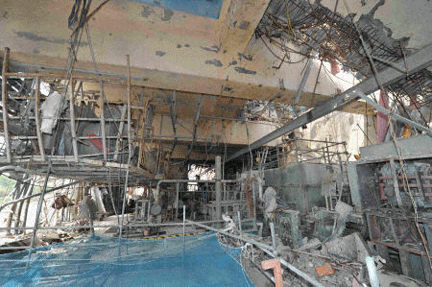
Radio Forum #72, May 24, 2014 — Translated by DISSENSUS JAPAN, June 10, 2014:
- Jiro Ishimaru, host: About the current progress of decommissioning…
- Hiroaki Koide, professor at Kyoto University Research Reactor Institute: […] In November 2013, they started with Reactor #4 because it was the most accessible pool, and the most dangerous. The floor that housed the Used Fuel Pool in Reactor #4 was hugely damaged and it has been feared that the pool might collapse in any time. This is a very dangerous job. Any scale of accident is possible. But they have to do it. […]
- Translation of complete interview available here
WBUR — Here and Now, June 9, 2014:
- Ken Buesseler, senior scientist at Woods Hole Oceanographic Institution: Maybe there’s some side effects [to the ice wall] that might also creep into this game, that they really haven’t considered here… if you stop the flow of water into certain soil, you can get things like settling — Buildings can move, so these are very precarious situation anyways, so we don’t want to have shifting.
- Full WBUR broadcast available here
Japan joins scramble to sell nuclear technology to India, despite Liability Law
 Japan wants slice of nuclear pie, warms up to liability law Indian Express, by Subhomoy Bhattacharjee , Anil Sasi | New Delhi | June 12, 2014 While Toshiba owns US-based reactor manufacturer Westinghouse, Hitachi is a partner of GE’s reactor business. The deadlock on the liability issue, which had stonewalled progress on the operalisation of nuclear pacts that India had signed with global reactor vendors, is on the verge of being broken.
Japan could offer Prime Minister Narendra Modi a nuclear deal in the civil sector when he travels to Tokyo next month, Hiroshi Hirabayashi, former Japanese ambassador to India and now adviser to Prime Minister Shinzo Abe, indicated.
Russia too is reported to have communicated an “in principle” nod to the Indian nuclear liability law, paving the way for signing a contract for the setting up the third and fourth units of the Kudankulam Nuclear Power Project…….
Japan is a key player in the operationalisation of the commercial nuclear pacts signed by India. Japanese companies are major players in two of the four reactor vendors that have signed preliminary agreements with India for supply of equipment for imported Light Water reactor-based projects planned on coastal sites.
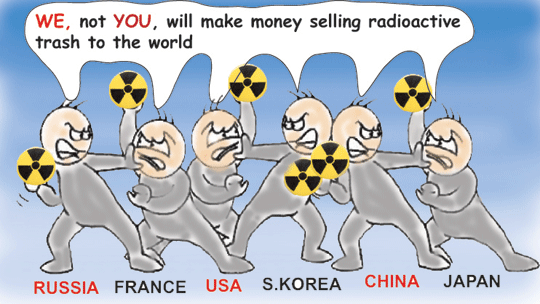
While Toshiba owns US-based reactor manufacturer Westinghouse, Hitachi is a partner of GE’s reactor business.The government has short-listed Toshiba-Westinghouse’s ‘AP1000’ reactors, GE-Hitachi’s ‘ESBWR’ reactors, along with French firm Areva’s EPRs and the Russian firm Atomstroyexport’s ‘VVER’ series reactors, which are already being deployed at Kudankulam. http://indianexpress.com/article/business/business-others/japan-wants-slice-of-nuclear-pie-warms-up-to-liability-law/
Melted reactor cores might now be exposed, as water levels fall in Fukushima nuclear reactors
Japan TV ‘News Flash’: Officials fear melted reactor fuel is now exposed at Fukushima — Tepco: We don’t know at this point if fuel is uncovered — Large drop in water level — Experts ‘struggling’ to find condition of nuclear cores, http://enenews.com/tv-officials-fear-melted-fuel-from-reactor-2-is-now-exposed-at-fukushima-tepco-we-dont-know-at-this-point-if-fuel-is-uncovered-water-level-drops-dramatically-experts-struggling-to-fin?utm_source=feedburner&utm_medium=email&utm_campaign=Feed%3A+ENENews+%28Energy+News%29nothing is known for all 3 reactors (VIDEO)
NHK WORLD, June 9, 2014: TEPCO: Water in reactor half expected level— Officials with the operator of the damaged Fukushima Daiichi nuclear plant say the water level inside the No.2 reactor’s containment vessel is about half what they had estimated. […] They found the water was around 30 centimeters [11.8 inches] deep. TEPCO officials […] say they don’t know whether the fuel is entirely submerged. […] They believe then flowing out of the reactor building through holes in the chamber.
NHK WORLD, June 10, 2014: TEPCO officials are struggling to find […] the condition of the melted fuel […] Officials believe that at reactor number 2, water is leaking […] at the bottom of the containment vessel, but do not know exactly from where. [At] reactors 1 and 3, the utility has found the sources of some leaks, but suspects there are other breaches […] Nothing is known about the condition of the melted fuel in all 3 reactors. TEPCO is considering various forms of surveys, including a plan to send a camera-mounted robot […]
Kyodo News, June 9, 2014: TEPCO confirms water level of Fukushima No. 2 reactor container […] A TEPCO official [said] the detailed condition of the melted fuel remains unknown.
NHK Transcript, June 9, 2014:
- Officials at Tepco are facing another setback.
- They don’t know whether [the water] even covers all of the nuclear fuel.
- Officials don’t know about the condition of the melted fuel.
- Officials believe the water level at another reactor is 10 times deeper.
- Teruaki Kobayashi, Tepco official: “We cannot tell at this point if the fuel is entirely submerged or if part of it’s above the water.”
- They believe it’s flowing through the chamber then out of the reactor building.
India’s nuclear liability law poses a challenge to Russia-India nuclear power agreement

 Russia agrees on India’s nuclear liability law http://economictimes.indiatimes.com/industry/energy/power/russia-agrees-on-indias-nuclear-liability-law/articleshow/36359852.cms MOSCOW: Russia has in principle agreed on the Indian nuclear liability law, paving the way for signing a contract for unit 3 and 4 of the Kudankulam Nuclear Power Plant in July, Russian officials said today. “The (liability) law enacted is certainly challenging. We are working with our colleagues (counterparts) in India and the issue has been resolved,” said Kirill Komarov, Deputy Director General on Development and International business, Rosatom State Corporation. “We have just signed the protocol. The approvals will take some time. We have are awaiting nod from the Indian side. The India’s over view authority (Atomic energy Regulatory Board) is yet to give its nod. “They are also checking seismic activity in the area. So by July we should be ready with a roadmap after which we can start implementing the General Framework Agreement signed between the two countries,” said told a press conference. Unit 1 of the KKNPP has attained 100 per cent capacity of 1000 MW while the second unit should start generating power from this year. Units 1 and 2 of Tamil Nadu-based Kudankulam Nuclear Power Plant (KKNPP) have been built with the help of Russian assistance at the cost of Rs 17,200 crore. Insuring nuclear power plants is a daunting task because of its high cost and there is no single governmental insurance entity in the country that can insure these installations .. .. http://economictimes.indiatimes.com/articleshow/36359852.cms?utm_source=contentofinterest&utm_medium=text&utm_campaign=cppst
1 This Month
15 October. Joint Appeal for Nuclear Abolition Day -presentation to the UN on October 15 will be live on UNWebTV
Endorse the Nuclear Abolition Day Appeal
23-25 October – on Zoom – World BEYOND War’s annual global conference

To see nuclear-related stories in greater depth and intensity – go to https://nuclearinformation.wordpress.com
-
Archives
- October 2026 (149)
- September 2026 (339)
- August 2026 (330)
- July 2026 (355)
- June 2026 (287)
- May 2026 (306)
- April 2026 (356)
- March 2026 (251)
- February 2026 (267)
- January 2026 (308)
- December 2025 (358)
- November 2025 (359)
-
Categories
- 1
- 1 NUCLEAR ISSUES
- business and costs
- climate change
- culture and arts
- ENERGY
- environment
- health
- history
- indigenous issues
- Legal
- marketing of nuclear
- media
- opposition to nuclear
- PERSONAL STORIES
- politics
- politics international
- Religion and ethics
- safety
- secrets,lies and civil liberties
- spinbuster
- technology
- Uranium
- wastes
- weapons and war
- Women
- 2 WORLD
- ACTION
- AFRICA
- Atrocities
- AUSTRALIA
- Christina's notes
- Christina's themes
- culture and arts
- Events
- Fuk 2022
- Fuk 2023
- Fukushima 2017
- Fukushima 2018
- fukushima 2019
- Fukushima 2020
- Fukushima 2021
- general
- global warming
- Humour (God we need it)
- Nuclear
- RARE EARTHS
- Reference
- resources – print
- Resources -audiovicual
- Weekly Newsletter
- World
- World Nuclear
- YouTube
-
RSS
Entries RSS
Comments RSS

