Whose finger is now on the nuclear button, in North Korea?
 Kim Jong-un Disappearance Leads to Nuclear Weapon Concerns Liberty Voice, by Rebecca Savastio on October 10, 2014. Kim Jong-un’s continuing disappearance has led to speculation about whose finger is on the North Korean nuclear weapon arsenal. The Supreme Leader of the Democratic People’s Republic of Korea has not been seen in over a month. Why should the world care? Does it matter to anyone outside of North Korea if he is vacationing, ill, deposed or dead? The fact that North Korea is a nuclear power, though without the capability to launch nuclear intercontinental ballistic missiles at the United States, makes the tiny communist nation’s stability of interest for everyone…….
……..The true state of politics within North Korea is an impenetrable mystery. It is disconcerting that the world knows so little about a country it fears so much. Given its nuclear capabilities, any change of government needs to be smooth and stable. Many feel that the only scenario worse than a communist dictator who hates America is a rogue element with nothing to lose. Whether orchestrated by Kim or accomplished without his authority, the moves made by the North Korean officials seem to be a small step in the right direction. The world is waiting to see what happens, because Kim Jong-un’s continuing disappearance had led to speculation about whose finger is on the North Korean nuclear arsenal. http://guardianlv.com/2014/10/kim-jong-un-disappearance-leads-to-nuclear-weapon-concerns/#gCOhfjJo3gRiifyJ.99
South Korea’s nuclear unsafety – 684 Accidents and Failures over 37 Years

 Korean Nuclear Power Plants Exposed to 1,843 Hacks over Five Years– Business Korea 10 OCTOBER 2014The number of hacking attempts against nuclear power plants in Korea was found to have reached 1,843 during the last five years. Experts are calling for special cybersecurity measures for nuclear power stations under the circumstances
…..684 Accidents and Failures over 37 Years
With the situation as it is, the general public’s concerns over aging nuclear power plants as well as hacking attempts are on the rise. The total number of nuclear power generation accidents and breakdowns in Korea has reached 684 since the commercial operation of Gori 1 back in 1978. Out of those, 130 have happened in the oldest facility.
“The government is just repeating that nuclear power generation is a safe way of power supply,” Democratic United Party lawmaker Moon Byung-ho explained, continuing, “However, it would be well advised to reexamine its safety, security, sustainability, and economic advantages by taking this as an opportunity and shutting down the oldest nuclear power stations for a paradigm shift.” http://www.businesskorea.co.kr/article/6718/security-unawareness-korean-nuclear-power-plants-exposed-1843-hacks-over-five-years#sthash.iaBiCo9G.dpuf
Security officer shoots dead three colleagues guarding Kalpakkam nuclear power plant

 3 CISF personnel shot dead by colleague at Kalpakkam atomic plant in Tamil Nadu A Selvaraj, TNN | Oct 8, 2014, CHENNAI: Three Central Industrial Security Force (CISF) personnel guarding the atomic power plant at Kalpakkam near Chennai were killed and two others were injured when one of their colleagues opened fire on them on Wednesday morning.
Police said the incident happened inside the barracks where the security personnel were taking rest early in the morning. The reason for the attack was not known, police said.
The accused, head constable Vijay Pratap Singh, was nabbed and handed over to police……..The CISF head constable used a 9mm carbon rifle to attack his colleagues.
CISF senior officers have rushed to the scene. Further investigations are on. http://timesofindia.indiatimes.com/india/3-CISF-personnel-shot-dead-by-colleague-at-Kalpakkam-atomic-plant-in-Tamil-Nadu/articleshow/44679818.cms
City of Samcheok, South Korea, votes NO to nuclear power
 South Korean town votes no to nuclear plant WP, By Associated Press October 9 SEOUL, South Korea — Voters in a South Korean city have rejected plans to build a nuclear power plant in a referendum the government says has no legal effect.
Thursday’s vote in Samcheok, on South Korea’s east coast, went as expected following this year’s election of a mayor who wants the government to scrap nuclear plant……..“I will persuade the national government based on this result,” the Samcheok mayor, Kim Yang-ho, told Yonhap News Agency. “I hope the government’s policy will reflect Samcheok citizens’ real opinion.”……..
Some 85 percent of the 28,867 residents who cast ballots said no, according to a volunteer committee set up to administer the referendum after election authorities refused. Out of 42,488 who registered to take part, turnout was 68 percent……http://www.washingtonpost.com/world/asia_pacific/south-korean-town-votes-no-to-nuclear-plant/2014/10/09/1d3d23ce-5023-11e4-877c-335b53ffe736_story.html
Will the 6000 Fukushima radioactive clean-up workers ever get the promised danger pay?

 Nuclear workers kept in dark on Fukushima hazard pay 25 CNBC Reuters 7 Oct 2014 Almost a year after Japan pledged to double hazard pay at the stricken Fukushima nuclear plant, workers are still in the dark about how much extra they are getting paid, if anything, for cleaning up the worst nuclear disaster since Chernobyl.
Under pressure to improve working conditions at Fukushima after a series of radioactive water leaks last year, Tokyo Electric Power Co President Naomi Hirose promised in November to double the hazard pay the utility allocates to its subcontractors for plant workers. That would have increased the amount each worker at the nuclear facility is supposed to earn to about $180 a day in hazard pay.
Only one of the more than three dozen workers interviewed by Reuters from July through September said he received the full hazard pay increase promised by Tepco. Some workers said they got nothing. In cases where payslips detailed a hazard allowance, the amounts ranged from $36 to about $90 a day – at best half of what Hirose promised.
In some instances, workers said they were told they would be paid a hazard bonus based on how much radiation they absorb – an incentive to take additional risks at a dangerous work site…….
Tepco still relies on some 800 mostly small contractors to provide workers for the cleanup after the tsunami that swamped the plant on March 11, 2011 sparked meltdowns at three reactors. Subcontractors provide almost all of the 6,000 workers now employed at the plant. Tokyo Electric employs only about 250 on its own payroll at the facility.
The workforce at Fukushima has almost doubled over the past year, mostly as part of an effort to protect groundwater from being contaminated and to store water that comes in contact with melted fuel in the reactor buildings.
Some of the workers who arrived recently at the plant have been building bunkers to store highly radioactive sludge, which is a by-product of the process whereby contaminated water is treated. Others are installing equipment to freeze a ring of earth around four reactors at Fukushima to keep water from reaching the melted cores, an unprecedented effort directed by Kajima and expected to cost nearly $300 million.
Kazumitsu Nawata, a professor in the University of Tokyo’s department of technology who has researched conditions inside Fukushima, said that if workers do not receive pay that is commensurate with the risks they are taking, they will ultimately look elsewhere for employment. If more experienced workers leave for safer jobs in Tokyo where constructionprojects are accelerating ahead of the 2020 Olympic Games, it will also increase the likelihood of accidents at the plant, Nawata said in an interview.
“Until now, we have relied heavily on the goodwill of workers. But it’s already been three years since the accident. This is no longer sustainable,” he said. http://www.cnbc.com/id/102068504#.
Russia’s nuclear company Rosatom sends third expedition to monitor Fukushima radiation
Russia sends third expedition to Kuril Islands to monitor radiation levels October 7, 2014 Gleb Fedorov, RBTH Radiation from the Fukushima Nuclear Power Plant does not threaten Russian territory. However, the consequences of the 2011 accident will be felt for decades to come. RBTH spoke to the scientists involved with the third expedition to be sent to the Kuril Islands in the Russian Far East in order to monitor the radiation.
The scientific expedition vessel Professor Khlyustin, carrying Russian scientists, experts and military personnel, left the port of Vladivostok in Russia’s Far East on September 25 and headed east toward the Kuril Islands of Urup and Simushir, where they were due to take samples of soil, freshwater and silt.
……..In the space of a month, the expedition plans on crossing the Sea of Japan and sailing along the eastern shores of the Kuril Islands, a narrow chain of isles stretching 800 miles from Russia’s Kamchatka Peninsula to the Japanese island of Hokkaido. The scientists’ principal aim is to monitor radiation levels in the area affected by the accident at Japan’s Fukushima Nuclear Power Plant on March 11, 2011. This is the third expedition since the disaster. The first one took place right after the catastrophe, the second – a year later. The new expedition is being carried out under the aegis of the Russian Geographical Society and has been organized by the State Oceanographic Institute. Aboard the vessel are collaborators from state nuclear corporation Rosatom, the Ministry of Defense, the Russian Hydro-Meteorological Institute, the Rospotrebnadzor Monitoring Agency and the  Nevelsky Naval University. Results from past expeditions showed that pollution was almost zero and the biggest threat to Russia was the accumulation of radiation in fish.
………The only thing threatening Russia after Fukushima, according to Panchenko, is the accumulation of radiation in various types of commercial fish: “Fukushima’s radioactive discharges polluted the sand in the shallows where we find the little sand eels. Sand eels are caught by fishermen and are eaten by bigger commercial fish, which thus accumulate radiation.”
Source: Russia Beyond the Headlines – http://rbth.com/science_and_tech/2014/10/07/russia_sends_third_expedition_to_kuril_islands_to_monitor_ra_40417.html)
Volcanoes a rare risk to nuclear reactors, but consequences would be devastating
Difficulties remain in protecting nuclear plants from volcanic eruptions October 05, 2014 THE ASAHI SHIMBUN by Takeshi Nakashima and Chikako Kawahara The deadly eruption of Mount Ontakesan in central Japan has rekindled concerns about whether Japan’s nuclear power plants, such as the Sendai plant in Kagoshima Prefecture, have adequate safeguards for dealing with such a disaster………
Active volcanoes are located near the Sendai plant, with Mount Sakurajima about 50 kilometers away and Mount Kirishima about 60 km away.
In the past, huge volcanic eruptions have led to the formation of large calderas and pyroclastic flows in the area.
Major eruptions occur in Japan about once every 10,000 years. However, nuclear plants have to implement measures depending on the risk even if the frequency of an event is low.
Nuclear plants are not designed to withstand pyroclastic flows at high temperatures. For that reason, if such flows should reach a facility, the consequences could be disastrous.
Kyushu Electric insists that the possibility of an eruption while the Sendai plant is operating is sufficiently low. The utility also says it would be possible to capture signs of a major eruption and remove nuclear fuel beforehand.
The Nuclear Regulation Authority has supported Kyushu Electric’s position.
The removal of the nuclear fuel from the reactors is expected to take several years.
However, the Mount Ontakesan eruption once again demonstrated the limits to accurately predicting volcanic eruptions.
Concerns about the safety measures at the Sendai plant were raised at a Sept. 30 session of a special committee of the Kagoshima prefectural assembly. Some members raised doubts about whether early signs of an eruption could be detected. Others criticized Kyushu Electric’s position………http://ajw.asahi.com/article/behind_news/social_affairs/AJ201410050034
China launches long range test missile, in effort to catch up with USA’s nuclear arsenal
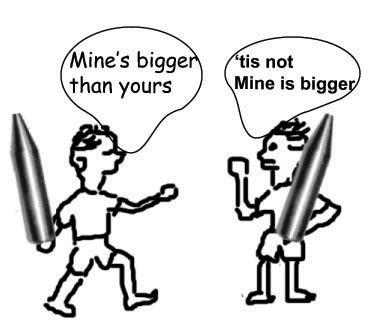
 China Launches Test Missile Capable of Carrying Nuclear Warheads to Europe and US New missile system places London and US east coast under the crosshairs of China’s military .International Business Times By Mark Piggott October 5, 2014 China has successfully launched a test missile capable of carrying a nuclear warhead 10,000km – meaning the whole of Europe and parts of the US is within its range.
“We continue to monitor China’smilitary modernization, including its missile tests”
– Pentagon spokeswoman Cynthia O Smith
The Dongfeng missile can be fired from mobile launchers capable of traversing rough terrain, meaning they can be easily moved and hidden from detection by spy satellites.
China launched the missile on 26 September. The Pentagon confirmed the launch it took place.
Although refusing to provide details, Pentagon spokeswoman Cynthia O Smith told the Washington Free Beacon: “We continue to monitor China’s military modernization, including its missile tests.”…..
It is estimated that China only has around 250 nuclear warheads, compared with the 2,104 operational warheads operated by the US.
Major General Yao Yunzhu, China’s director of the Center of America-China Defense Relations for the Academy of Military Science, said in a letter to the Pacific Forum of the Center for Strategic and International Studies, that China still lags behind the US in terms of nuclear weapons.
“The Ballistic Missile Defense systems that the US and its allies have deployed, or are planning to deploy, are capable of intercepting Chinese nuclear weapons launched for retaliation after it has already been attacked, thus potentially negating the deterrence effect of the Chinese nuclear arsenal,” said Yunzhu.
Retired Peoples’ Liberation Army general Xu Guangyu told the South China Morning Post: “Beijing just wants to increase China’s military might and its nuclear strategic threat. It’s not really targeting the US or other countries.
“China needs to conduct intensive weapons tests and military drills because the (US-led build-up) now in the Asia-Pacific area is not good for Beijing………,.”http://www.ibtimes.co.uk/china-launches-test-missile-capable-carrying-nuclear-warheads-europe-us-1468574
North Korea wanting to resume nuclear talks with world powers
In a wide-ranging interview, he said that reports about the ill health of its leader Kim Jong-un were “fabricated rumours” and that it was not clear whether the US was willing to negotiate the release of three detained Americans.
Russian foreign minister Sergei Lavrov said after talks with North Korea’s foreign minister in Moscow on Wednesday that he saw a possibility thatstalled talks on Pyongyang’s nuclear programme could resume, but it would take time.
“For the six-party talks we are ready, and as far as I think, China and Russia and the DPRK are ready,” So said in the interview in the DPRK’s mission overlooking Lake Geneva.
“But America, they don’t like that kind of talks right now. Because America does not like that, so that’s why the countries like South Korea, Japan also are not ready for those talks.”
North Korea promised to abandon its nuclear programme in 2005 but appeared to renege on the agreement when it tested nuclear devices in 2006 and 2009………http://www.theguardian.com/world/2014/oct/03/north-korea-ready-resume-nuclear-programme-talks-un-envoy-so-se-pyong
Japan now closing super-costly Tokai nuclear fuel processor
 Tokai nuclear fuel processor to close due to cost of meeting new standards http://mainichi.jp/english/english/newsselect/news/20140930p2a00m0na009000c.html
The Japan Atomic Energy Agency has announced that it will shut down a spent nuclear fuel processor in Tokai, Ibaraki Prefecture, as the cost to prepare the facility for new regulation standards established after the Fukushima nuclear plant crisis is predicted to top 100 billion yen.
The agency reported the decommission plan of the existing nuclear fuel processor at a meeting of its reform committee held on Sept. 29.
According to the agency, the nuclear fuel processing technology that has been under development at the Tokai facility has almost been completely moved to another processing station in Aomori Prefecture operated by Japan Nuclear Fuel Ltd.
The new regulation standards for running a nuclear fuel reprocessing facility require operators to take the same level of safety and anti-disaster measures against earthquakes and tsunami as nuclear power stations. The agency’s executive director Shigeo Nomura told the meeting that continuing the spent fuel recycling project will not be approved by the public in terms of economic rationality.
The agency will include the decommission plan in its medium-term operational policy, which comes into effect in the next fiscal year, and file a decommission plan with the Nuclear Regulation Authority as early as fiscal 2017.
The Tokai plant came into full operation in 1981. Since 2006, it had reprocessed spent nuclear fuel from the now-decommissioned converter-type nuclear reactor Fugen in Fukui Prefecture.
There are some 110 metric tons of spent nuclear fuel left in the Tokai plant, and the agency plans to commission France to treat the remaining fuel.
Japan’s electricity utilities blocking renewable energy
 4 more utilities stop signing contracts for purchasing renewable energy, Manichi, 3 Oct 14TOKYO (Kyodo) — Four more regional utilities said Tuesday they will stop signing contracts to buy renewable energy from mega solar power plants and other suppliers, citing transmission network capacity limitations.
The move by the regional utilities serving Shikoku, Hokkaido, Tohoku and Okinawa follows Kyushu Electric Power Co.’s announcement last week that it was suspending acceptance of applications from renewable energy suppliers.
The suspension by Kyushu Electric has already prompted the government to review the incentive scheme introduced in July 2012 for renewable energy, which it has been encouraging since the 2011 Fukushima Daiichi disaster heightened safety concerns about nuclear power.
Under the so-called feed-in tariff scheme, power utilities are obliged to purchase electricity generated from renewable sources at fixed prices. The costs are passed on to consumers in their electricity bills.
But the five utilities have said they can no longer sign power-purchasing contracts as blackouts could occur if all output from renewable energy suppliers is transmitted to the utilities’ grids, causing overcapacity…….http://mainichi.jp/english/english/newsselect/news/20141001p2g00m0bu040000c.html
20% of Japanese worried about radiation in Fukushima food
 One in Five Japanese Cautious About Fukushima Food WSJ, 2 Oct 14, The proportion of consumers saying they hesitate to buy food products from Fukushima prefecture because of radiation fears reached 20%, up from 15% in February, according to a twice-yearly survey by the Consumer Affairs Agency released this week.
The percentage was the highest since February 2013, when the agency began issuing reports on how misinformation and harmful rumors were affecting consumer views of food and radioactive contamination.
The latest study was conducted online in August, and surveyed 5,176 adults in 11 prefectures including Tokyo and Osaka as well as the Tohoku region where the 2011 earthquake and tsunami hit hardest.
Of those surveyed, 22.5% said the government should impose stricter regulations concerning radiation and food, and 47% said that they would like to avoid intake of food with radioactive substances even if the radiation level is below government-set safety limits…….http://blogs.wsj.com/japanrealtime/2014/10/02/one-in-five-japanese-cautious-about-fukushima-food/
Former Japanese Prime Ministers forget their differences – join in opposing nuclear power
Two former Japanese prime ministers take anti-nuclear stance to stage at rock festival http://www.abc.net.au/news/2014-09-30/two-former-japanese-prime-ministers-take-anti-nuclear-stance-to/5777958 30 Sep 2014,
“We must create a country where nuclear power generation is zero. Let’s develop our country without nuclear power,” shouted charismatic former leader Junichiro Koizumi from the festival stage, hosted by renowned musician Ryuichi Sakamoto.
Mr Koizumi told reporters that an “unexpected event could happen anytime” at nuclear power plants in Japan, touching on the recent volcanic eruption of Mt Ontake in central Japan which occurred without warning and killed dozens of climbers.
In Japan, earthquakes, tsunami and volcanic eruptions could occur in various locations. It’s a country not allowed to have nuclear power plants,” he said.
Morihiro Hosokawa, another former prime minister, said he felt hope in his anti-nuclear campaigning as he saw the eyes of youths at the festival “twinkling”.
The prime minister at the time of the 2011 earthquake and Fukushima meltdown, Naoto Kan, also attended an anti-nuclear protest on Sunday, rallying against the imminent restart of two reactors at the Sendai nuclear plant.
Mr Kan became an anti-nuclear activist upon stepping down as prime minister in September 2011.
The government of Shinzo Abe is pushing for the resumption of reactors that clear new safety requirements introduced in the wake of the Fukushima accident.
Shambles of Japan’s plans for evacuation after the next nuclear accident
 Not nearly enough buses for mass exodus after nuclear accident THE ASAHI SHIMBUN by Masanobu Higashiyama and Hiroki Koike.27 Sept 14 The gargantuan task of moving residents in a nuclear crisis will fall on chartered buses, according to the local governments’ evacuation plans.
The problem is there may not be nearly enough vehicles to move huge numbers of people to safety.
Some prefectures already realize they would be lucky to assemble just half the number of buses for the job.
There is also opposition from bus companies, which say they will not subject their drivers to hazardous radiation risks.
In a 10-kilometer radius of Kyushu Electric Power Co.’s Sendai nuclear power plant in Kagoshima Prefecture, which has passed safety checks for a restart, surveys show that local governments can charter only one-fourth of buses that would be needed to evacuate residents.
Although the prefecture plans to sign an agreement with the prefectural association of bus companies to preferentially charter vehicles, a local bus drivers’ union said it will oppose the plan unless safety measures for drivers are mapped out.
According to evacuation plans submitted by Satsuma-Sendai, the city hosting the nuclear plant, and surrounding municipalities within a 30-km radius of the plant, people who need nursing care and others without family cars will have to evacuate by bus……..
In addition to the lack of buses, the void of safety measures to prevent bus drivers from being exposed to radiation during an evacuation casts a shadow on plans by local governments to use chartered buses.
Central government guidelines stipulate that ordinary people such as bus drivers must not be exposed to more than 1 millisievert of radiation annually in normal situations. However, there are no measures in place to deal with those who are exposed to higher readings.http://ajw.asahi.com/article/0311disaster/fukushima/AJ201409270012
In addition, rules for distributing potassium iodide tablets to protect against thyroid cancer due to radiation have yet to be devised……..
During an Aug. 29 news conference, Niigata Governor Hirohiko Izumida asked if it is realistic for residents to rely on chartered private buses in a case of a nuclear disaster. The prefecture hosts Tokyo Electric Power Co.’s Kashiwazaki-Kariwa nuclear power plant.
“Is it possible to make drivers from private bus companies work in areas that are highly contaminated with radiation?” Izumida asked.
Officials at Fukushima Prefecture’s Nuclear Power Safety Division said they had not confirmed reports that bus companies refused to send vehicles due to concern for drivers’ safety during evacuation procedures for the Fukushima nuclear disaster.
But some trucks transporting relief goods did refuse to enter areas that were highly contaminated with radiation, according to the officials.
“A private company can face legal charges if its employees are exposed to radiation because of work orders,” said an official of Niigata Prefecture. “Even if we sign an agreement with bus companies, it will not ensure the efficacy of such an evacuation plan.”
Secrecy and poor labour conditions at Fukushima nuclear plant
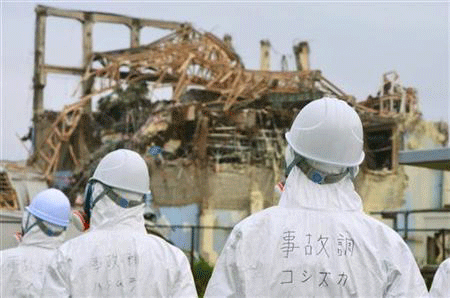 Fukushima Worker: “All sorts of troubles going on in plant”; Officials won’t tell public what really happens — People should worry, it’s not under control — Employees wear disguises over fear of retaliation — Reporter: Tour of plant “was very strange… feels completely dead… not many people” (VIDEO) http://enenews.com/fukushima-worker-all-sorts-troubles-going-inside-plant-officials-arent-disclosing-problems-public-im-concerned-safety-employees-wear-disguises-fear-retaliation-plant-control-people-be-worried-vi?utm_source=feedburner&utm_medium=email&utm_campaign=Feed%3A+ENENews+%28Energy+News%29
NHK, Sept. 24, 2014 (at 2:15 in): [A Fukushima Daiichi worker’s attorney] warns that the current system could endanger the entire decommissioning process… “Tepco should be held accountable for turning a blind eye. It needs to improve labor conditions, otherwise the situation will make it impossible to secure enough workers to deal with the nuclear accident.” >>Watch the video here
The Guardian, Sept. 9, 2014 (emphasis added):Fukushima fallout continues… [There’s an] unprecedented attempt by four Fukushima Daiichi workers to sue the utility for unpaid wages… [T]he four men… wore masks in court for fear of reprisals from their employers… “A year ago, the prime minister told the world that Fukushima was under control. But that’s not the case,” Tsuguo Hirota told Reuters… “It’s becoming a place for amateurs only, and that has to worry anyone who lives near the plant.”… “My health could suffer… I believe there are many people who can’t speak out about this kind of problem,” one of the workers told public broadcaster NHK.
Time Magazine correspondent Hannah Beech, Sept. 7, 2014: Just to get into the plant it –again — it’s like a Hollywood movie… What was very strange about walking into this place is that it feels completely dead. You don’t see that many people moving around. And those people that you do see, there’s not a palpable sense of urgency, but you realize that the work that they’re doing is so important. And they may not be getting the full of backing that they should to be able to do this. >> Full interview here
NPR, March 11, 2014: About 100 out of the 4,000 people working in the plant every day are TEPCO employees. The rest are subcontractors… Workers [are barred from] speaking to the media… I met a TEPCO worker who was on the job when the quake and tsunami hit… and talked in his car… on the condition that we not identify him and disguise his voice. He says it’s well known at the plant that shoddy work is being done… Many problems inside the Fukushima plant go unreported… The worker says that the Japanese government now needs to step in and guarantee the welfare and safety of all the workers…
TEPCO employee at Fukushima Daiichi (at 2:45 in): I’m concerned about my safety… There are things they feel they don’t have to disclose. There are all sorts of troubles going oninside the plant.
Full interview with the anonymous Fukushima worker here http://enenews.com/fukushima-worker-all-sorts-troubles-going-inside-plant-officials-arent-disclosing-problems-public-im-concerned-safety-employees-wear-disguises-fear-retaliation-plant-control-people-be-worried-vi?utm_source=feedburner&utm_medium=email&utm_campaign=Feed%3A+ENENews+%28Energy+News%29
1 This Month


of the week– Nuclear Reactor Information Task Force

14 May – online event From Bombs to Data Centres: the Face of Nuclear Colonialism
To see nuclear-related stories in greater depth and intensity – go to https://nuclearinformation.wordpress.com
-
Archives
- May 2026 (187)
- April 2026 (356)
- March 2026 (251)
- February 2026 (268)
- January 2026 (308)
- December 2025 (358)
- November 2025 (359)
- October 2025 (376)
- September 2025 (257)
- August 2025 (319)
- July 2025 (230)
- June 2025 (348)
-
Categories
- 1
- 1 NUCLEAR ISSUES
- business and costs
- climate change
- culture and arts
- ENERGY
- environment
- health
- history
- indigenous issues
- Legal
- marketing of nuclear
- media
- opposition to nuclear
- PERSONAL STORIES
- politics
- politics international
- Religion and ethics
- safety
- secrets,lies and civil liberties
- spinbuster
- technology
- Uranium
- wastes
- weapons and war
- Women
- 2 WORLD
- ACTION
- AFRICA
- Atrocities
- AUSTRALIA
- Christina's notes
- Christina's themes
- culture and arts
- Events
- Fuk 2022
- Fuk 2023
- Fukushima 2017
- Fukushima 2018
- fukushima 2019
- Fukushima 2020
- Fukushima 2021
- general
- global warming
- Humour (God we need it)
- Nuclear
- RARE EARTHS
- Reference
- resources – print
- Resources -audiovicual
- Weekly Newsletter
- World
- World Nuclear
- YouTube
-
RSS
Entries RSS
Comments RSS
 nuclear-news