2014 Conference on Radioecology and Environmental Radioactivity (final link at bottom of page), K. Buesseler, E. Black, and S. Pike of Woods Hole Oceanographic Institution; T. Kenna of Lamont-Doherty Earth Obseratory; P. Masqué of Autonomous University of Barcelona, Sept 12, 2014 (emphasis added): Plutonium Isotopes In The Ocean Off Japan After Fukushima— The Fukushima Dai-ichi nuclear power plants (NPPs) are known to be an unprecedented accidental source of 137Cs, 134Cs and other volatile radionuclides to the ocean. Much less is known however about the extent of input of refractory radionuclides such as plutonium to the environment. Limited available data from land soils and vegetation, suggest at least some atmospheric delivery of particulate Pu… In 2011, in surface ocean waters, we found ratios 240Pu/239Pu >0.3, which implies a component of Fukushima Pu had been delivered to the ocean… Fukushima derived Pu was not found deeper in the water column.
51:00 — Ken Buesseler, Woods Hole senior scientist: People have a hard time with radiation risk because we can’t taste it, we can’t smell it… we have no control over this accident.
5900 – Question: I’m wondering about the corium and whether anything you’ve detected in the water is coming form the core, the meltdown?
59:30– Buesseler: Great question… What I’m thinking of are things like plutonium uranium, the fuel itself… We’ve actually seen, I’d say a trace amount of plutonium, I’ve seen two talks on that… It doesn’t come out as a gas, it’s in the ocean, probably because of all that cooling water they put on there. Hydrogen makes it very acidic… it dissolves some of the materials and bring that back into the ocean… We haven’t yet taken that into the seafood… [It] may have come out in the hot acidic water, that’s been — still to this day btw – they’re putting on 100s of tons of water a day to cool those reactors and only recovering about half of that water… They have to cool that thing for decades, for years certainly and that takes water and they’ve got leaks everywhere.
Utilities balk at safer storage of spent nuclear fuel to avoid ‘wasted investment’ by Ryuta Koike and Toshio Kawada. January 04, 2015 THE ASAHI SHIMBUN Power companies have resisted government calls to construct safer storage facilities for spent nuclear fuel and are instead waiting for a fuel reprocessing plant to finally start running after nearly two decades of delays.
The utilities say that building dry storage facilities, which hold spent nuclear fuel encased in metal or concrete casks, could prove a waste of money if the Rokkasho reprocessing plant in Aomori Prefecture begins operations and takes all the spent fuel off their hands.
They also cite concerns in communities that host nuclear reactors that dry storage facilities could lead to permanent storage there.
Under Japan’s basic energy plan approved by the Cabinet in April last year, the central government promotes the construction and use of dry storage facilities.
Shunichi Tanaka, chairman of the Nuclear Regulation Authority, has repeatedly referred to the importance of such facilities, which are deemed safer and less expensive to operate than the traditional method of keeping spent nuclear fuel submerged in storage pools at nuclear plant.
Spent fuel pools are usually located next to reactors for swift transport because the fuel rods continue to be highly radioactive and emit heat after use.
The risk of using storage pools was exposed when all power sources were lost at the Fukushima No. 1 nuclear plant after the Great East Japan Earthquake and tsunami struck on March 11, 2011.
Tokyo Electric Power Co., operator of the plant, not only had to deal with three reactor meltdowns, but it was also forced to take measures to prevent the release of radiation from spent fuel storage pools at the site.
Under the dry storage method, the encased spent fuel is cooled with circulating air at a facility built separate from the reactor building. Dry storage is mainly used for spent fuel whose radioactive decay heat has already dropped to a certain level.
One big advantage that dry storage has over storage pools is that it can continue to cool spent fuel even after a power failure in the event of a nuclear accident or natural disaster.
In fact, spent fuel in a dry storage facility at the Fukushima No. 1 nuclear plant did not suffer any major damage in the 2011 disaster, according to TEPCO.
The only other nuclear power station currently equipped with a dry storage facility within its plant site is Japan Atomic Power Co.’s Tokai No. 2 nuclear power plant in Ibaraki Prefecture.
Chubu Electric Power Co. plans to set up a dry storage facility at its Hamaoka nuclear plant in Shizuoka Prefecture in fiscal 2018. That plan was hatched before the Fukushima nuclear disaster.
But no other utility in Japan has moved in that direction despite the government’s urging………..
The biggest reason the utilities are hesitant to build dry storage facilities is that the government has kept alive the Rokkasho nuclear fuel reprocessing plant project, despite its many problems.
According to the project, the Rokkasho plant will take in the utilities’ spent nuclear fuel and reprocess it for reuse at nuclear reactors around Japan.
The Rokkasho plant was originally scheduled to open in 1997. However, the start of operations has been delayed 21 times because of technical glitches, human error and safety issues.
Japan Nuclear Fuel Ltd., operator of the Rokkasho plant, has postponed the completion date to March 2016.
Still, electric power companies do not want to spend on dry storage facilities now because they believe the plant will start running and alleviate them of their spent fuel problems.
“Even if we build a dry storage facility, it would likely be a wasted investment,” said an official in the nuclear power industry, alluding to the Rokkasho plant.
The utilities say they are also concerned that building dry storage facilities could stoke fears among nearby residents and local officials that hazardous spent fuel would remain in their neighborhoods for a prolonged period……..
Tadahiro Katsuta, associate professor of nuclear energy policy at Meiji University, said the central government should provide incentives to spur utilities to shift to dry storage facilities.
“When the safety of a nuclear plant is at issue, it is obvious that dry storage is more reliable (than pools) since it does not require emergency measures to safeguard the facility in the event of an accident,” Katsuta said. “Financial benefits and setting a limit on the storage period should be considered.” http://ajw.asahi.com/article/0311disaster/fukushima/AJ201501040021
China as a model renewable energy economy Ft.comBy Li Hejun, China New Energy Chamber of Commerce and Hanergy Holding Group 31 Dec 14 Almost 200 governments met in Peru this month to hammer out a first draft of a global deal to cut emissions, ahead of a new round of climate talks next year in Paris. If the world is to arrest climate change, global economies need to embrace renewable energy. Those looking for a model of how this might be done should consider a possibly surprising source: China.
It has been little noticed by the outside world, but in China a technological revolution that will result in huge gains in efficiency and new applications for renewable energy has already begun…….
China’s renewable energy goals are not simply hot air. The country’s leadership recognises that China must break its dependency on coal if it is to satisfy the surging power demands of a growing middle class and an expanding economy without blanketing the country in smog. China’s renewable energy goals are also necessary for the country’s long-term energy security. Neither coal, shale gas nor any other fossil fuel can secure our energy future………
The new goals will trigger a huge investment push towards renewables. The scale of the new generating capacity to be installed in the next decade will reshape China’s renewable energy market, weeding out weak companies as the government gradually phases out subsidies, and driving gains in efficiency and technological innovation as the remaining industry players compete for market share.
I believe that solar will be at the forefront of this technological advance. Solar energy is fast becoming more affordable. The cost for solar power generation is now 50 per cent lower than it was three years ago. China’s cost of solar power generation has fallen to below Rmb1 per kWh and if we continue that trend, I predict that within 3-5 years the generation cost of solar cells will approach that of coal-fired power………….. http://blogs.ft.com/beyond-brics/2014/12/31/guest-post-china-as-a-model-renewable-energy-economy/
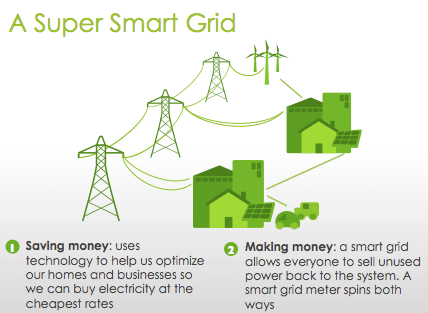
China as a model renewable energy economy Ft.com By Li Hejun, China New Energy Chamber of Commerce and Hanergy Holding Group 31 Dec 14 “……..Even more exciting than falling costs are the new ways in which China will use and transmit power. China is now intent on developing a distributed power grid that will rely on the interconnection of thousands of rooftop and building-integrated solar installations generating power close to the point of consumption. This is a drastic departure from the current centralised power system that relies on goliath, coal-burning power plants and costly, inefficient power transmission over hundreds, or even thousands of kilometres. This new, smart grid will help eliminate pollution, slash costs, and increase reliability.
In addition to making the distributed grid possible, new forms of solar technology are ushering in an era of mobile energy in which customers can take power with them wherever they go.
At present, around 90 per cent of the world’s solar power output is geared towards first-generation crystalline silicon panels, which for a long time were the most efficient technology available. But traditional silicon panels are hard, opaque and heavy, while thin film solar technology can be can be lightweight, flexible, and translucent, making it ideal for a wide variety of applications, from curved automobile rooftops and building integration to consumer clothing and portable power stations.
In recent years, thin-film technology has caught up with, and even surpassed, crystalline silicon in terms of both conversion efficiency and cost. Furthermore, producing thin-film cells requires just a fraction of the material and energy necessary to make crystalline silicon, conserving resources, cutting costs, and reducing pollution.
In the coming years, technologies will continue to improve, and prices will continue to fall. Two of the most promising technologies now are solar cells made from CIGS (Copper, Indium, Gallium, Selenide) and those from GaAs (Gallium-Arsenide), with maximum conversion efficiencies topping 20 percent, and 30 percent, respectively. As these are further developed and brought to market on a mass scale, solar panels will transform into something capable of being integrated into nearly every fabric, product, and structure at a reasonable cost……..
India, Pakistan exchange list of nuclear facilities Times of India
PTI | Jan 1, 2015 NEW DELHI: India and Pakistan on Thursday exchanged the list of their nuclear installations under a bilateral agreement that bars them from attacking each other’s atomic facilities.
This is the 24th consecutive exchange of such list between the two countries, the first one having taken place on January 1, 1992. ……http://timesofindia.indiatimes.com/india/India-Pakistan-exchange-list-of-nuclear-facilities/articleshow/45714569.cms
China Takes Nuclear Weapons Underwater Where Prying Eyes Can’t See East Asian News and Politics 2 Jan 15 From Bloomberg News China is preparing to arm its stealthiest submarines with nuclear missiles that could reach the U.S., cloaking its arsenal with the invisibility needed to retaliate in the event of an enemy strike.
Fifty years after China carried out its first nuclear test, patrols by the almost impossible-to-detect JIN class submarines armed with nuclear JL–2 ballistic missiles will give President Xi Jinping greater agility to respond to an attack.
The nuclear-powered subs will probably conduct initial patrols with the missiles by the end of this year, “giving China its first credible sea-based nuclear deterrent,” according to an annual report to Congress submitted in November by the U.S.-China Economic and Security Review Commission.
Deploying the vessels will burnish China’s prestige as Xi seeks to end what he calls the “cold war” mentality that resulted in U.S. dominance of Asia-Pacific security. Since coming to power, Xi has increased military spending with a focus on longer-range capacity, including plans to add to the country’s tally of a single aircraft carrier.
“For the first time in history, China’s nuclear arsenal will be invulnerable to a first strike,” said independent strategist Nicolas Giacometti, who has written analysis for The Diplomat and the Center for Strategic and International Studies. “It’s the last leap toward China’s assured nuclear-retaliation capability.”…………….
First Use
“We must continue to modernize our nuclear capabilities,” Admiral Harry Harris said Dec. 2 at his nomination hearing to become commander of the U.S. Pacific Command, when asked how the U.S. should respond to China’s build up. Harris said that he considered North Korea, which is developing its own nuclear arsenal, to be the biggest threat to security in Asia.
Analysts don’t expect China to modify its longstanding “no-first-use” nuclear policy that states its weapons will only be used if China comes under nuclear attack.
Having enhanced its nuclear-deterrence capability, China may begin to communicate more about the planned evolution of its nuclear forces, Giacometti said.
The specific details of the low-risk worm remain unclear. South Korea’s Energy Ministry says that the malware probably ended up on the nuclear power facilities through an unauthorized USB device. The reactor controls of Korea Hydro and Nuclear Power (KHNP), the state-run utility affected, are not connected to any external networks. However, somewhat surprisingly, Energy Minister Yoon Sang-jick told parliament that the worm was not connected to the other hacking incidents, a claim that “[drew] skepticism from some lawmakers,” according to Reuters. Either way, the worm and them hacks do not reflect well on the state of South Korea’s cybersecurity.
This is an especially worrisome attack in South Korea, since a third of the country’s power comes from nuclear reactors. Authorities have not ruled out the possibility that North Korea is to blame, and KHCP is beefing up its cybersecurity staff from 53 to 70. That still seems like a small number of people to guard 23 nuclear reactors, huh? [Reuters]
“Turkey does not need nuclear power plants. We have plenty of wind and sun in our country which can be used to generate plenty of energy,” says Tanay Sidki Uyar, head of the department of energy at the University of Istanbul.
Criticizing the lack of transparency in compiling the environmental assessment report, the energy expert highlights the lack of clarity and openness over the issue of nuclear waste disposal.
Turkey set to get nuclear reactors, DW 30 Dec 14By mid-2015, Turkey wants to build its first nuclear power plant despite all objections and without regard for the fears of those affected by its construction. DW takes a look at the country’s energy policy. For the sixth time in four months, Devin Bahceci is visiting the site in Akkuyu in the Turkish province of Mersin. Standing in front of the barrier erected at the site, he shakes his head.
“To date, we do not know what to expect. The project is extremely non-transparent and it’s frustrating,” says the energy and climate activist from the environmental organization Greenpeace. Continue reading →
Gujarat: Hinustan Salt, SJVN to set up renewable energy plants, NITI Central, Shimla, Dec 30 (PTI) Sutlej Jal Vidyut Nigam (SJVN) along with Hindustan Salt will set up ultra mega hybrid renewable energy park, having up to 5,000 MW power generation capacity in Gujarat.
The proposed park would have both solar and wind plants. The park will be developed on the surplus salt pan land of Hindustan Salt.
Fukushima desires to host preliminary events for 2020 Tokyo Olympics Global Post, Xinhua News Agency December 16, 2014 TOKYO, Dec. 16 –– Japan’s northeastern Fukushima prefecture on Tuesday expressed desire to host some preliminary events for the 2020 Tokyo Olympics as part of efforts to show its recovery from the 2011 nuclear disaster.
The Foreign Ministry will help local governments tear down overseas barriers on food imports maintained because of worries over radiation, sources said.
Some states still ban some imports of agricultural, forestry and fishery products because of the fear of contamination from Tokyo Electric Power Co.’s Fukushima No. 1 nuclear plant. As a result, the ministry will cooperate with local governments in organizing events overseas to assure regulators and consumers that products are safe.
In 2015, the ministry plans to hold two to three such events, the sources said Sunday.
Unfounded rumors are a matter of life and death for municipalities where agriculture, fisheries or forestry are key industries.
The ministry said 13 countries, including Canada and Vietnam, have lifted import restrictions imposed after the accident on agricultural, forestry and fishery products from affected areas, but nine economies including South Korea, Singapore and Taiwan still have bans.
South Korea bans marine products from prefectures such as Miyagi and Fukushima.
Many countries also implement some kind of import control, such as requiring safety certificates.
When the ministry holds the events abroad, it will give assistance through embassies, aiming to allay concerns among local companies and media organizations.
A senior ministry official said the support for local governments boils down to wanting to disseminate correct information and to sell Japan’s attractions.
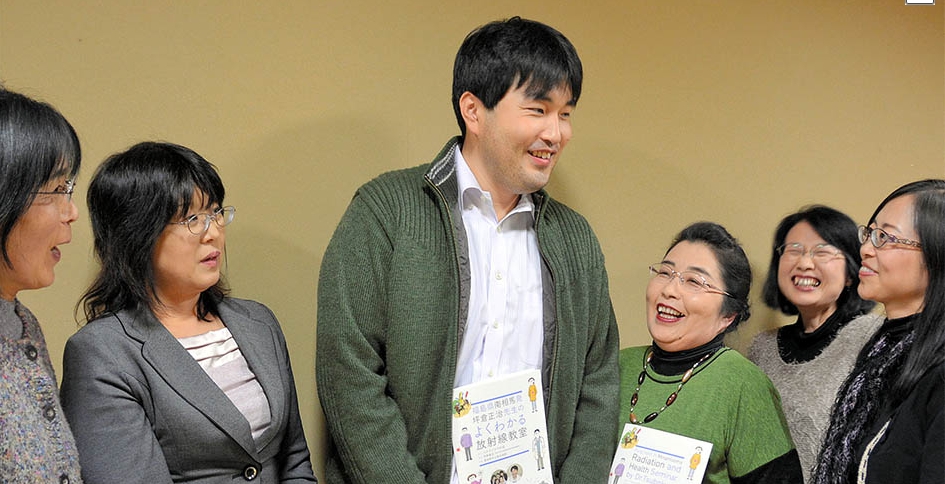
Masaharu Tsubokura, center, and the members of the Veteran Mothers’ Society in Minami-Soma, Fukushima Prefecture
December 29, 2014
MINAMI-SOMA, Fukushima Prefecture–Mothers living near the stricken Fukushima No. 1 nuclear plant have compiled a booklet offering basic knowledge about radiation and explanations addressing safety concerns arising from the disaster.
The booklet, titled “Yoku Wakaru Hoshasen Kyoshitsu” (Radiation and Health Seminar), is available in both Japanese and English and was created by the Veteran Mothers’ Society, which consists of five mothers from the city of Minami-Soma.
The members, some of whom are former high school classmates, decided to create the booklet “for children’s sake.”
The information incorporates lessons learned from doctors at seminars the group organized following the accident at Tokyo Electric Power Co.’s Fukushima No. 1 nuclear plant in March 2011.
Amid the confusion and fears over radiation after the disaster unfolded, the mothers convened their first seminar for children and guardians in December 2011. They invited Masaharu Tsubokura, a doctor of hematology from the University of Tokyo’s Institute of Medical Science who had been providing consultations at the Minami-Soma municipal general hospital.
Other physicians later joined the effort to spread accurate information about radiation, and the mothers have held the sessions once or twice a month.
In the seminars, the children peppered Tsubokura with questions, such as “Can I touch my pets?” and “Is it OK to lick the snow?”
Ikumi Watanabe, the society’s 54-year-old vice chairwoman, recalled that Tsubokura’s explanations “were spoken in an easy-to-understand manner so the information popped straight into our heads. It was nice that we could talk with him on the same level and in person.”
Even now, the nature of the questions has not changed much.
“People have felt pressured not to talk about radiation, and some mothers have finally gotten the information only now, more than three years after the accident,” Tsubokura said. “I hope I can help them make decisions without thinking negatively about themselves or losing their self-confidence.”
In addition to basic knowledge, such as the differences between external and internal radiation exposure and between becquerels and sieverts, the booklet answers questions like: “Can radiation be transmitted from one person to another?” and “Is the tap water OK?”
According to the Veteran Mothers’ Society, 20,000 copies of the Japanese version were distributed to schools, companies and other organizations. The English version has been ordered by international schools, international exchange organizations and other groups.
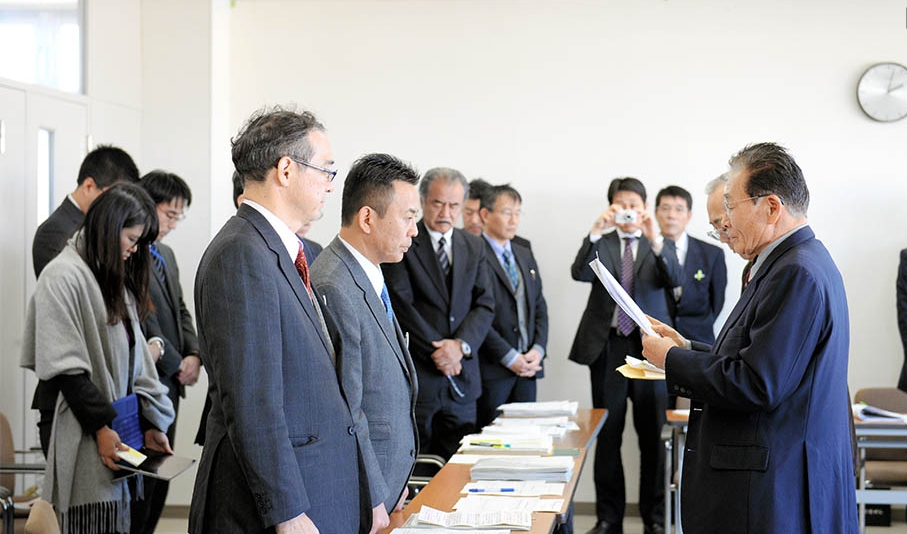
MINAMI-SOMA, Fukushima Prefecture–The central government lifted on Dec. 28 the last recommended evacuation advisory for several districts in this city, saying radiation levels from the nuclear accident fell below the annual exposure limit.
However, many of the residents of 152 households within these districts voiced their opposition to the lifting.
The central government designated areas that registered high radiation levels outside the zones under mandatory evacuation orders as specific recommended evacuation spots following the triple meltdown at the Fukushima No. 1 nuclear power plant. The residents living within these locales were encouraged to evacuate from their homes.
The districts in Minami-Soma were designated as such because they were at risk of exceeding the annual accumulated dose limit of 20 millisieverts, or 3.8 microsieverts per hour.
The central government in June 2011 issued the advisory for some locales in the cities of Minami-Soma and Date and the village of Kawauchi, all in Fukushima Prefecture, home to 281 households. The advisory for Date and Kawauchi was lifted earlier.
Central government officials explained their latest decision to the residents and local officials, saying that the health risks are not expected because radiation levels in their sites now measure well below the designated limit of 20 millisieverts.
They also presented support measures to encourage the residents to return to their homes.
However, evacuee Katsuji Sato, among the residents of the 152 households, said he would not immediately return home.
The 79-year-old, who lives in temporary housing in Minami-Soma, had lived in a family of six of four generations before the Great East Earthquake and tsunami on March 11, 2011, set off the nuclear disaster.
Sato’s mother died where she evacuated to, and his eldest son, the son’s wife and their elementary school child moved to Miyagi Prefecture.
“My wife and I cannot return to our home even though we want to unless decontamination work is undertaken again,” Sato said.
The head of the Takakura district, right, reads aloud a statement in opposition to the lifting of a recommended evacuation advisory to officials of the nuclear emergency local response headquarters
Fukushima rocked by strongest quakes to hit country this month; Epicenter just offshore from reactors; Nuke plant cam shows shaking for over a minute — Top Japan Newspaper: ‘Major quake disasters could strike anywhere in nation’… Great increases in probability; Measures urgently needed (VIDEO) http://enenews.com/fukushima-rocked-strongest-quakes-hit-country-month-footage-nuke-plant-shows-shaking-minute-top-japan-newspaper-major-quake-disasters-could-strike-anywhere-nation-great-increases-perceived-probabil?utm_source=feedburner&utm_medium=email&utm_campaign=Feed%3A+ENENews+%28Energy+News%29
Yomiuri Shimbun, Dec. 24, 2014 (emphasis added): Major earthquake disasters could strike anywhere in the nation — What is the probability of a major earthquake striking each part of the nation? The government’s Headquarters for Earthqake Research Promotion has unveiled its 2014 version of a geographical forecast for massive quakes… A glance at the map shows us that no region in this nation is free from the risk of seismic disaster… The data in question shows that no further delay may be permitted in taking necessary measures… Despite theurgent need for measures to cope with the situation, some municipal governments have not done enough… In producing the latest version, the headquarters expanded the scope of the areas with estimated epicenters while also extending the scales for predicted quakes. This resulted ingreat increases in the perceived probability of a major earthquake striking some areas, including Saitama [north of Tokyo]. The figure for the city marked a 21-point increase to 51 percent.
Prensa Latina, Dec 25, 2014: 5.5 Magnitude Quake Rocks Japan — A 5.5 magnitude quake rocked northeastern Japan yesterday night… The medium-intensity quake [was centered off] Futaba district, Fukushima, with epicenter at a depth of 30 km.
Epoch Times (China), Dec 25, 2014: Earthquake Today in Japan: Strong Quake Off Coast of Fukushima on Christmas… The US Geological Survey said the quake… was measured at 5.5-magnitude… The quake had a depth of 6.2 miles, said the USGS.
The Herald, Dec 21, 2014: Earthquake hits near Fukushima — A 5.9 magnitude earthquake hit Japan’s Honshu island… shaking Fukushima where crippled nuclear power plants are located… A spokesman for Tokyo Electric Power said no irregularities have been found at its Fukushima Daiichi or Daini plants.
Ministry, TEPCO seek to end compensation for Fukushima businesses in Feb. 2016 Mainichi, 29 Dec 14The government and Tokyo Electric Power Co. (TEPCO) have proposed to Fukushima Prefecture’s commerce and industry federation a plan to end nuclear disaster compensation for businesses in February 2016, it has been learned.
The Ministry of Economy, Trade and Industry and TEPCO presented the plan to the Fukushima Federation of Societies of Commerce and Industry on Dec. 25. The ministry and the utility told the federation that they plan to end compensation payments to all businesses, except for those in the agricultural, forestry and fisheries sectors, in February 2016. Ministry and utility officials explained that they would map out future policies after hearing claims from business owners.
The federation’s secretary-general, Hideki Endo, however, criticized the proposal.
“Fukushima business owners face different situations depending on their evacuation statuses and their business categories,” he said. “While we understand the need to draw the line somewhere, we cannot accept the end of compensation payments within a year and a few months from now when the nuclear disaster has still not been brought to a conclusion and there are no prospects that harmful rumors will end in the foreseeable future.”…….http://mainichi.jp/english/english/newsselect/news/20141227p2a00m0na007000c.html