Slow journey of small amounts of Fukushima radiation in ocean to USA
Gary Griggs, Our Ocean Backyard: Tracking Fukushima radiation across the Pacific By Gary Griggs, Our Ocean Backyard 26 Dec 14, Radiation from the meltdown of the three reactors at the Fukushima Daiichi Nuclear Plant in March 2011 quickly entered the offshore ocean.
The radiation was detected in the water immediately. Several species of fish caught offshore in 2011 and 2012 had radioactive cesium levels that exceeded Japan’s seafood consumption levels, but overall concentrations have dropped since the fall of 2011………..
Anything picked up by the Kuroshio Current as it passes by Japan, whether tsunami debris, glass fishing floats, or radioactive contaminants, heads towards North America, but slowly, a little more than 5 miles every day on average.
At this speed, water moving from Japan in a straight path would take about three years or longer to get to the west coast. Shortly after the Fukushima Daiichi meltdown and radiation release, oceanographers projected that it would likely take until 2014 until it reached the West Coast of North America……
the nuclear bomb testing that went on in the Pacific from the 1940s to the 1980s, contributed hundreds of times more radioactivity to the oceans than Fukushima. There is also uranium dissolved naturally in seawater.
So Fukushima is not the largest contributor to radiation in the waters of the Pacific Ocean.
Although no U.S. federal agency has routinely monitored the offshore waters for radiation, scientists from Woods Hole Oceanographic Institution and Oregon State University have been analyzing samples intermittently since the March 11 disaster. On Nov. 10, 2014, Woods Hole announced that they had detected trace amounts of radioactivity that could be used to fingerprint Fukushima because of the presence of cesium-134………http://www.santacruzsentinel.com/environment-and-nature/20141226/gary-griggs-our-ocean-backyard-tracking-fukushima-radiation-across-the-pacific
Three South Korean workers died after accident at nuclear plant construction site
The accident at the construction site in the southeastern city of Ulsan came as the state-run Korea Hydro and Nuclear Power Co was on high alert over a series of threats by hackers who claim they can disable the control systems of its plants.
Newly made public: testimonies of Fukushima nuclear disaster
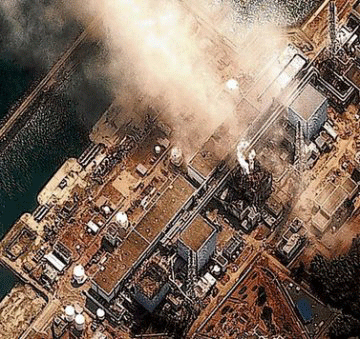 Govt. releases more accounts of Fukushima disaster http://www3.nhk.or.jp/nhkworld/english/news/20141226_03.html NHK Wrld, 25 Dec 14 The Japanese government has released more interview accounts of the 2011 nuclear accident.
772 interviews were conducted in 2011 and 2012 by a government committee that investigated the disaster.
The testimonies came mainly from government officials and staff from Tokyo Electric Power Company, which operates the crippled Fukushima Daiichi plant.
Some testimonies including those from then prime minister Naoto Kan, and then plant chief Masao Yoshida have already been released.
An additional 127 were made public on Thursday after receiving consent from interviewees.
Among those newly released is one from a worker at Tokyo Electric headquarters. He analyzed conditions inside the reactors in early April 2011 when the effects of the disaster began to unfold.
The official said he thought the upper half of the nuclear fuel rods at the No.1 reactor core must have completely melted. Cooling water was covering only the lower half of the rods.
But the employee added he remembered his company refrained from using the word “meltdown” in news briefings as much as possible. He said he heard TEPCO feared that a misunderstanding could occur as there was no exact definition for the term. Nuclear fuel melted at the No.1, 2 and 3 reactors. But Tokyo Electric admitted the possibility of meltdowns only in May 2011.
Success still eludes TEPCO, in trying to deal with Fukushima radioactive wastewater
New method for contaminated water may be failing http://www3.nhk.or.jp/nhkworld/english/news/ 20141226_37.htmlTokyo Electric Power Company has indicated that a new method aimed at tackling a large volume of highly radioactive wastewater at the Fukushima Daiichi nuclear power plant has not been entirely successful.
TEPCO gave a progress report on its work to a panel of experts at the Nuclear Regulation Authority on Friday.
The utility last month began pouring cement into underground tunnels filled with the contaminated water from the reactor buildings to stop the water inflow. The water is believed to be leaking into the sea.
TEPCO officials told the panel that workers have completely filled the U-shaped tunnels except for 4 vertical pits that connect the tunnels to the ground surface. They removed 2,500 tons of radioactive water.
But the officials said that when they pumped water up from one of the pits, the water level at another pit changed. That suggests that gaps exist in the concrete-filled tunnels. The officials argued that they can stop the water from flowing into the tunnels once the 4 vertical pits are filled. But panel members and authority commissioners said more thorough inspections are needed.
TEPCO plans to monitor water levels for a month, look for gaps, and study more effective ways to block the water.
The utility initially planned to freeze wastewater at the end of the tunnel to stop inflow from the reactor buildings and remove the water. But the plan did not work.
Central government was too slow to order Fukushima evacuation, claims former Governor
Fukushima ex-governor slams government for tardy radiation evacuation orders, Japan Times 26 Dec 14 JIJI Former Fukushima Gov. Yuhei Sato had criticized the central government for failing to issue evacuation orders in a timely manner in March 2011 after the Fukushima No. 1 nuclear plant suffered three reactor core meltdowns and spewed radioactive fallout, according to records disclosed Thursday.
The central government at first did not provide any information about the meltdowns at Tokyo Electric Power Co.’s Fukushima No. 1 nuclear plant, the records quoted Sato as saying.
“Because we received various information from local communities, I decided to issue an evacuation order,” Sato said.
The prefectural government issued an evacuation order on its own to people living within 2 km of the plant soon after the disaster started.
“An evacuation order from the central government came afterward,” the records quoted Sato as saying……….http://www.japantimes.co.jp/news/2014/12/26/national/fukushima-ex-governor-slams-government-tardy-radiation-evacuation-orders/#.VJ8d2sA8
New method for contaminated water may be failing
 Dec. 26, 2014
Tokyo Electric Power Company has indicated that a new method aimed at tackling a large volume of highly radioactive wastewater at the Fukushima Daiichi nuclear power plant has not been entirely successful.
TEPCO gave a progress report on its work to a panel of experts at the Nuclear Regulation Authority on Friday.
The utility last month began pouring cement into underground tunnels filled with the contaminated water from the reactor buildings to stop the water inflow. The water is believed to be leaking into the sea.
TEPCO officials told the panel that workers have completely filled the U-shaped tunnels except for 4 vertical pits that connect the tunnels to the ground surface. They removed 2,500 tons of radioactive water.
But the officials said that when they pumped water up from one of the pits, the water level at another pit changed. That suggests that gaps exist in the concrete-filled tunnels.
The officials argued that they can stop the water from flowing into the tunnels once the 4 vertical pits are filled. But panel members and authority commissioners said more thorough inspections are needed.
TEPCO plans to monitor water levels for a month, look for gaps, and study more effective ways to block the water.
The utility initially planned to freeze wastewater at the end of the tunnel to stop inflow from the reactor buildings and remove the water. But the plan did not work.
Source: http://www3.nhk.or.jp/nhkworld/english/news/20141226_37.html
Radiation too high for workers: Fukushima nuclear reactors 1,2 & 3 require robots for clean-up
Japan Atomic Power set to deploy 100 specialists to help with Fukushima dismantling THE ASAHI SHIMBUN by Daiki Koga and Tsuyoshi Nagano, 25 Dec 14 Japan Atomic Power Co. is working on plans to send a team of more than 100 specialists, backed up by robotic technology, to the beleaguered Fukushima No. 1 nuclear power plant to accelerate decommissioning work there……….
The plant operator finished removing nuclear fuel at the No. 4 reactor on Dec. 20 and is expected to start full-scale dismantling of the more problematic Nos. 1 to 3 reactors soon.
However, due to difficulties in preventing the spread of radioactive substances and removing debris around the reactor, the removal of fuel at the No. 1 reactor is estimated to start two to five years later than originally planned.
Some of the procedures are likely too difficult for TEPCO to undertake on its own, as the utility does not have sufficient experience in decommissioning nuclear reactors.
Workers in protective suits undertook the removal of fuel from the No. 4 reactor in rotation, as radiation levels were relatively low there. However, as radiation levels are much higher at the No. 3 reactor, the removal of fuel from its storage pool has to be conducted using remote-controlled robots……..http://ajw.asahi.com/article/0311disaster/fukushima/AJ201412250035
Fukushima mothers feel intimidated against speaking about radiation anxieties
INTERVIEW/ Yukihiko Kayama: Experts should help Fukushima mothers speak up about radiation fears, Asahi Shimbun December 26, 2014 By YURI OIWA/ Staff Writer FUKUSHIMA--Psychiatrist Yukihiko Kayama said it is becoming more embarrassing, with the passage of time since the Fukushima nuclear disaster of 2011, for mothers in Fukushima Prefecture to casually discuss their fears of radiation.
In a recent interview with The Asahi Shimbun, Kayama attributed the trend to a “division” within the population of Fukushima Prefecture, whereby a divergence in their lifestyles according to their residential areas, available economic resources and other factors has made it difficult for them to relate to each other’s feelings.
He proposed meetings of experts with small audiences of residents, where participants could feel at ease talking about their own experiences, concerns and other problems. That would ease the speakers’ emotions to a certain extent, Kayama said.
Excerpts of the interview follow:……………
“….For one thing, people consciously keep from talking about radiation because many of them have found their own ways of coming to terms with radiation in their lives. But rather, I think it is truer to say that, with the passage of time since the nuclear disaster, it is becoming more embarrassing to talk about radiation at all.
That is partly because you are afraid you could be taken for being eccentric if you don’t react to radiation concerns the way others do. Some are concerned they could be taken for nervous ones who still worry about radiation if they just mentioned the topic of radiation.
You also tend to keep your mouth shut when you don’t know the background of the people you are talking to………..” http://ajw.asahi.com/article/views/opinion/AJ201412260004
South Korea wants China’s help to investigate hacking attempts on nuclear power company
 Korea calls on China for help following hack attempt on nuclear power company IP address used in the hack traced to city on China-North Korea border. Ars Technica by John Timmer – Dec 24 2014
Last week, Korea Hydro and Nuclear Power, which runs South Korea’s 23 nuclear plants, suffered a security breach in which personnel records, public health monitoring data, and reactor designs were obtained from the company’s systems and posted online. The attacker, which linked to the materials on an anti-nuclear activist site, also threatened to release further information unless three of the company’s plants were shut down by tomorrow.
Now, Korean investigators have identified a Chinese IP address as the source of the attacks and are asking the Chinese government for assistance in the investigation.
According to a report in The Korea Times, the attacks were routed through three different VPN service providers in the US, Japan, and Korea. By obtaining these records, the initial IP address that launched the attack were traced to the city of Shenyang, which is on the China-North Korea border.An article from Australia’s ABC indicates that this city hosts one end of North Korea’s main Internet connection to the outside world, which was severed earlier this week.
A number of sources confirm that South Korea has asked for China’s assistance in the matter and quote an unnamed official as saying the country isn’t pointing the finger at its neighbor: “There is a possibility that the IP addresses in China are not the final source but used in a routing.” But suspicion isn’t directed at China itself; rather, it’s suspected that North Korean agents were using the Chinese city for their activities……..http://arstechnica.com/security/2014/12/korea-calls-on-china-for-help-following-theft-from-nuclear-power-company/
Underage student employed for Fukushima radiation cleanup work
Tochigi firm warned for hiring high school student for decontamination work, Mainichi 25 Dec 14 NASU, Tochigi –– A construction company hired a high school student for work to decontaminate houses tainted with radiation from the Fukushima nuclear disaster, the Mainichi Shimbun has learned.
The Nasu Municipal Government revealed on Dec. 25 that a construction firm in the town employed a male high school student from outside the town as a part-timer for decontamination work in possible violation of the Labor Standard Act. The law prohibits engaging those under 18 for work that exposes individuals to harmful radiation. The Ministry of Health, Labor and Welfare has ruled that the legal ban applies to decontamination work.
The municipal government gave a verbal warning to the president of the construction company, while reporting the incident to a local labor standards inspection office in November.
According to town officials, the company hired a second-year high school student in August last year…….http://mainichi.jp/english/english/newsselect/news/20141225p2a00m0na002000c.html
TEPCO’s secrecy on worker injuries at Fukushima
TEPCO Not Disclosing Worker Injuries At Fukushima Daiichi SimplyInfo December 25th, 2014
Journalist Ryuichi Kino has documents a large number of injuries to workers in 2014 that TEPCO has not made public. The information was submitted to the Agency for Natural Resources and Energy. TEPCO’s excuse seemed to be, if the workers didn’t require an outside ambulance ride or helicopter, they were not going to disclose the injury. But some of these injuries were quite serious. Eighteen required repair of broken bones or sutures. There were also 32 cases of heat stroke, this can be quite serious and was the cause or contributor to the death of a number of workers in the first year of the disaster……..http://www.fukuleaks.org/web/?p=14246
Hacker got into South Korea’s nuclear plant computers
 South Korea nuclear plant hit by hacker, Lance Whitney , c/net 23 Dec 14 The hacking comes in the wake of increased tension and trouble from North Korea, though the source has not been confirmed. Computers at a nuclear power plant in South Korea have been compromised by a hacker, but the plant’s operator says no critical data has been leaked.
The hacker was able to access blueprints, floor maps and other information on the plant, the South Korean Yonhap News Agency reported Sunday. Using a Twitter account called “president of anti-nuclear reactor group,” the hacker has released a total of four postings of the leaked data since December 15, each one revealing internal designs and manuals of the Gori-2 and Wolsong-1 nuclear reactors run by Korea Hydro and Nuclear Power Co. (KHNP), Yonhap added. The hacker has threatened to leak further information unless the reactors are shut down…………..
Government officials looking into the incident were able to trace the hacker’s IP address to a PC located in a specific location, Yonhap said. Investigators have been sent to the location as well as to the plant’s reactors to probe further. http://www.cnet.com/au/news/south-korea-nuclear-plant-hit-by-hackers/
Unacceptable for Japan’s government to now go for nuclear power development
 Moves to reconstruct nuclear power plants unacceptable, Mainichi 23 Dec 14 拡大写真An expert panel to the Ministry of Economy, Trade and Industry is poised to include the approval of rebuilding nuclear power plants in an interim file to be compiled later this year as one of the subjects to be considered. The move appears to signify the government’s clear declaration that it is not pursuing a zero nuclear power policy.
After the Dec. 14 House of Representatives election, the Nuclear Regulation Authority (NRA) gave a de-facto stamp of approval to reactivation of the Takahama Nuclear Power Plant’s No. 3 and No. 4 reactors in a safety screening. This is one of a series of moves leading to dependence on nuclear power. We cannot tolerate any moves that would promote a U-turn to nuclear power without any debate or seeking of public opinion.
The expert panel — the Nuclear Energy Subcommittee under the ministry’s Advisory Committee for Natural Resources and Energy — is planning to include acceptance of nuclear plant reconstruction in its interim file by underscoring the need to ensure “the supply capacity to make up for the decommissioning of reactors.”
It will be the first time for the government to spell out the need to rebuild nuclear plants since the outbreak of the Fukushima No. 1 Nuclear Power Plant disaster. Reconstruction of a nuclear power complex — in which a new plant will be built while dilapidated reactors are decommissioned — is essentially the same as building a new nuclear plant………. Continue reading
Malaysian NGO firmly rejects nuclear power

 NGO rejects nuclear option for Malaysia FMT | December 24, 2014
AMAN is convinced that nuclear power is neither cheap, clean nor safe. “It is not required for the generation of electricity in Malaysia,” said Aman chairman Dr. Ronald McCoy in a statement.
“AMAN therefore rejects the construction of any nuclear power plant (NPP) in Malaysia.”
AMAN, according to its statement, has taken this position, based on seven key factors: possibility of nuclear weapons proliferation; energy security; extremely expensive; vulnerable to natural disasters and accidents; a ticking time bomb; Malaysia’s existing and planned electricity by other means are sufficient; and the rate of construction of NPPs is skydiving.
AMAN was aware of the ongoing dissemination of false information by the nuclear industry and other vested interests, added the NGO, and “there has not been any genuine transparency of the government’s intentions nor sincere public consultation”.
“Our country must not make the serious mistake of investing in and constructing a nuclear power plant, particularly when there is no existing method of safely disposing the long-lasting radioactive nuclear waste, which will threaten the health of future generations of Malaysians.”
Globally, the use of nuclear power as an energy source was in decline, the statement points out.
Some figures:………….http://www.freemalaysiatoday.com/category/nation/2014/12/24/ngo-rejects-nuclear-option-for-malaysia/
Anti nuclear activists challenge pro nuclear Taiwan government
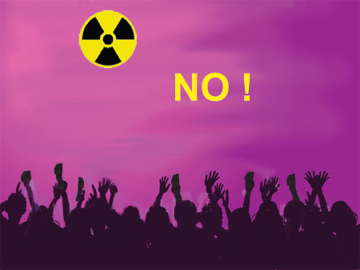
 Nuclear backers, critics clash at public meeting, Taipei Times By Sean Lin / Staff reporter 22 Dec 14 Anti-nuclear energy activists clashed with their pro-nuclear counterparts on Saturday at an event in Taipei held to gather public opinions in preparation for next month’s energy conference.
The conference is set to focus on identifying alternative energy sources after the construction of the Fourth Nuclear Power Plant in New Taipei City’s Gongliao District (貢寮) was suspended over widespread protests about the safety risks of the facility.The wide divide among advocates and critics of nuclear energy became clear soon after the northern preliminary meeting began……………
Taoyuan Local Union director-general Pan Chung-cheng (潘忠政) said he suspects that the Atomic Energy Council has mobilized many state-sponsored and pro-nuclear academics and members of related groups to attend the meetings because the public generally opposes nuclear energy.
“The government can work with academics and provide all these scientific facts about the benefits of nuclear power, but at the end of the day, the decision as to whether to adopt nuclear energy should be decided by the public,” he said.
“I do not think they really understand how people feel about nuclear energy and their actions are a violation of democratic values,” he said.http://www.taipeitimes.com/News/taiwan/archives/2014/12/22/2003607328
1 This Month
15 October. Joint Appeal for Nuclear Abolition Day -presentation to the UN on October 15 will be live on UNWebTV
Endorse the Nuclear Abolition Day Appeal
23-25 October – on Zoom – World BEYOND War’s annual global conference

To see nuclear-related stories in greater depth and intensity – go to https://nuclearinformation.wordpress.com
-
Archives
- October 2026 (139)
- September 2026 (339)
- August 2026 (330)
- July 2026 (355)
- June 2026 (287)
- May 2026 (306)
- April 2026 (356)
- March 2026 (251)
- February 2026 (267)
- January 2026 (308)
- December 2025 (358)
- November 2025 (359)
-
Categories
- 1
- 1 NUCLEAR ISSUES
- business and costs
- climate change
- culture and arts
- ENERGY
- environment
- health
- history
- indigenous issues
- Legal
- marketing of nuclear
- media
- opposition to nuclear
- PERSONAL STORIES
- politics
- politics international
- Religion and ethics
- safety
- secrets,lies and civil liberties
- spinbuster
- technology
- Uranium
- wastes
- weapons and war
- Women
- 2 WORLD
- ACTION
- AFRICA
- Atrocities
- AUSTRALIA
- Christina's notes
- Christina's themes
- culture and arts
- Events
- Fuk 2022
- Fuk 2023
- Fukushima 2017
- Fukushima 2018
- fukushima 2019
- Fukushima 2020
- Fukushima 2021
- general
- global warming
- Humour (God we need it)
- Nuclear
- RARE EARTHS
- Reference
- resources – print
- Resources -audiovicual
- Weekly Newsletter
- World
- World Nuclear
- YouTube
-
RSS
Entries RSS
Comments RSS

