China’s role in the nuclear marketing frenzy
 Chinese nuclear firms urged to boost presence overseas South China Morning Post 16 Jan 15 China will push its big nuclear firms to improve their competitiveness and boost their presence overseas as it bids to become one of the world’s dominant nuclear energy powers, Premier Li Keqiang said.
“To continue the struggle to become a strong nuclear energy power, China must comprehensively raise the industry’s competitive advantages, promote nuclear power equipment overseas…..
the country’s two biggest state nuclear companies, China National Nuclear Corp (CNNC) and China General Nuclear Corp (CGN), have agreed to invest in Britain’s Hinkley Point nuclear project.
Wang Zhongtang, the chief engineer at State Nuclear Power Technology Corp, said China was also well on its way to securing projects in Turkey and South Africa.
China has been making steady progress on its own third-generation reactors, including the Hualong I, jointly developed by CNNC and CGN for the purpose of winning overseas projects.
Zheng Hua, a deputy chief engineer with CGN’s reactor design unit, said last month that China hoped to develop Hualong I reactors in Britain, building on the agreement to invest in Hinkley Point.
China was also considering a plan to merge CNNC and CGN in order to pool their resources and improve their competitiveness overseas, sources said late last year. http://www.scmp.com/business/economy/article/1680957/chinese-nuclear-firms-urged-boost-presence-overseas
Japanese government mulls putting the nuclear financial burden on to consumers, as in UK


 Eiji Oguma: Planned protective measures show real cost of nuclear power Asahi Shimbun January 15, 2015 The industry ministry is discussing a new protective measure for nuclear power plants: the contract for difference (CfD) system.
The CfD, introduced in Britain, guarantees that electricity will be purchased at a fixed rate over a certain period of time.
The purchase price is calculated in consideration of the plant’s total cost, including future expenses, such as those for disposing of spent nuclear fuel and decommissioning reactors.
An agreement has been reached to apply the system to one nuclear power plant in Britain, with the reference purchase price set at 8.95 pence (around 15 yen or $0.13) per kilowatt-hour. That is higher than the corresponding price for a land-based wind farm, and comes with a longer guarantee period of 35 years.
A nuclear plant requires so much initial investment that there is no guarantee the cost will be recovered under the market economy. That is why the CfD and other protective measures for nuclear plants are being discussed in Japan ahead of the liberalization of the power retail market slated for 2016.
But various objections have been raised to the introduction of such measures.
First, the purchase price will likely be reflected in electricity rates, increasing the financial burden on consumers……….
Second, the decision process is not transparent………http://ajw.asahi.com/article/views/column/AJ201501150006
China well up in the throng to market nuclear technology to other countries
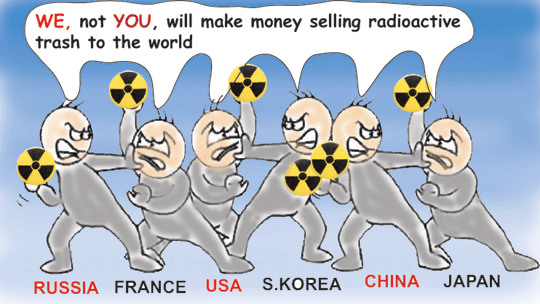
 China ready to sell nuclear fuel for NPPs in Ukraine and Eastern Europe — CNNC source http://itar-tass.com/en/world/771570 January 16, 15 Ukrainian energy sector workers are facing technical problems with American nuclear fuel loading into the Soviet-type reactors BEIJING, January 16. /TASS/. China is ready to sell fuel for nuclear power plants in Ukraine and Eastern Europe, a China National Nuclear Corporation (CNNC) source told TASS on Friday on the sidelines of the World Nuclear Spotlight forum.
According to the source, Chinese companies intend to sell the fuel to the countries that operate various types of Soviet-and Russian-made NPPs. Aside from Ukraine, China is viewing the possibility of exporting nuclear fuel to Hungary and Romania.
The source said Ukrainian energy sector workers are facing technical problems with American nuclear fuel loading into the Soviet-type reactors.
At the moment China is actively buying uranium mines with a view to exporting uranium to other countries in the foreseeable future. Asked about Russia’s possible claims to the Chinese manufacturers of nuclear fuel, he said that “there are no special restrictions.” “Despite the related agreements, the Russian side is unlikely to stop the supplies,” said the CNNC representative.
Russia and China have been actively developing co-operation in the nuclear sphere for many years. For example, State Atomic Energy Corporation Rosatom and CNNC signed a protocol to launch the discussion of possible formats of co-operation in the sphere of construction of nuclear power plants in third countries.
Record high radiation in Fukushima waste water -Cesium up 7,500% this week
 Huge radiation spike detected at Fukushima plant — Multiple records set near workers trying to stop nuclear waste flowing into ocean — Cesium up 7,500% this week http://enenews.com/huge-radiation-spike-detected-fukushima-plant-record-levels-workers-attempting-stop-radioactive-material-flowing-ocean-cesium-7500-week?utm_source=feedburner&utm_medium=email&utm_campaign=Feed%3A+ENENews+%28Energy+News%29
Tokyo Electric Power Company Press Release, January 12, 2015 (Google Translation):
For pumping water groundwater observation hole No.1-12 taken on January 12, cesium 134, cesium 137, cobalt 60 and total beta value is higher as compared with the previous value, the maximum value previously is detected.
 Cesium-134: 140 Bq/L [~7,500% above Jan. 5 level; new record high]
- Cesium-137: 470 Bq/L [~7,500% above Jan. 5 level; new record high]
- Cobalt-60: 1.9 Bq/L [Quadruple previous record high set in 2013]
- β (all beta): 15,000 Bq/L [~6,000% above Jan. 8 level; ~1,300% above previous record high]
Note that observation hole No. 1-12 is near the Unit 2 trench which is filled with thousands of tons of highly radioactive water. Tepco is attempting to seal the trench, but has failed to do so. According to page 2 of Tepco’s presentation to Japan’s Nuclear Regulatory Authority on Dec. 26, 2014 the only part of the trench that has been blocked is right next to No. 1-12 (see map on right).
China’s nuclear power delay – problems with its new Westinghouse Advanced Reactor

 China’s First Advanced Nuclear Reactor Faces More Delays Start-Up Now Unlikely Until 2016 at the Earliest WSJ By CHUIN-WEI YAP And BRIAN SPEGELE Jan. 15, 2015 BEIJING—China’s ambitions to be a leader in nuclear technology have been dealt a fresh blow, as construction of its most advanced reactor is facing a new delay.
The project—which China is developing with Westinghouse Electric Co. of the U.S.—faces new development problems and now isn’t expected to start up until 2016 at the earliest, the chief engineer at China’s state-owned reactor technology company said Thursday.
“We discovered some new problems during tests so we need to delay it more until next year,” Wang Zhongtang, chief engineer of China’s State Nuclear Power Technology Corp., said on the sidelines of an industry conference. Mr. Wang didn’t specify the nature of the latest problems found at ongoing trials for the reactor, nor did he provide a more precise time frame for its launch.
The delay is the second for the project, which had been slated to start by the end of 2013. It marks another setback for China’s clean-energy ambitions, as technical hurdles loom over Beijing’s aim to triple its nuclear power capacity by 2020…
….the delays have illustrated shortcomings in China’s nuclear sector, particularly when dealing with immature and first-of-a-kind technologies such as those found in the AP1000 reactor, said Li Ning, a nuclear-industry expert at China’s Xiamen University.
Chinese officials “are certainly very frustrated,” said Mr. Li. “I think they feel Westinghouse oversold the system, oversold the technology, promised more than they could really deliver.”………
China’s ambitions and vast market remain vital for the global nuclear industry. French nuclear engineering firm Areva S.A. , which lost out a key bid in 2007 to Westinghouse to build four reactors for China, is still seeking business there…….http://www.wsj.com/articles/chinas-first-advanced-nuclear-reactor-faces-more-delays-1421297393
Neutron radiation from Fukushima has been grossly underestimated
Fukushima Released 13,000,000,000 Times More Neutrons than Initially Estimated http://www.globalresearch.ca/fukushima-released-13000000000-times-more-neutrons-than-initially-estimated/5424619
 “Neutron radiation is the most severe and dangerous radiation” known to mankind January 14, 2015
We estimated a lower limit of 5.2 × 10²¹ slow neutrons m–2 sec–1 [m–2 sec–1 = per sq. meter per second] were emitted from the nuclear fuel rods to the sea water injected in the reactors
- Priyadarshi et al. (2011) have estimated a release amount of 4 × 10¹¹ slow neutrons m–2. The large difference with our estimation [13,000,000,000 times higher] comes from the intrinsic limit of the box model study by Priyadarshi et al.
- Our model directly estimates the amount of material released from the reactor core
- The estimated… number of neutron represent a lower limit of the amount of radiation emitted from the nuclear reactors… These values can be used as a proxy to the total amount of radiation emitted since the melt down
- [The authors] express their gratitude to… the Japanese Ministry of Environment…Ministry of Education, Culture, Sports, and Technology (MEXT)… [and] the Cabinet Office
Priyadarshi et al.: Evidence of neutron leakage at the Fukushima nuclear plant… Despite the obvious implication for human health… there are no quantitative estimates of the neutron flux leakage… [T]ons of seawater were used as a coolant… A consequence is that salts and minerals present in seawater become radioactive by reaction with thermal neutrons… We calculated the total number of neutrons that leaked from the reactor core [and] estimate that a total of 4 × 10¹¹ neutrons per m2 were released before March 20.
Office of Homeland Security & Emergency Coordination: Neutron radiation is a kind of ionizing radiation which consists of free neutrons… Neutrons readily pass through most material, but interact enough to cause biological damage. Neutron radiation is considered to be the most severe and dangerous radiation available. Neutrons can travel great distances…
Japan’s electricity consumers to pay half the $180+ cost of dismantling each nuclear reactor
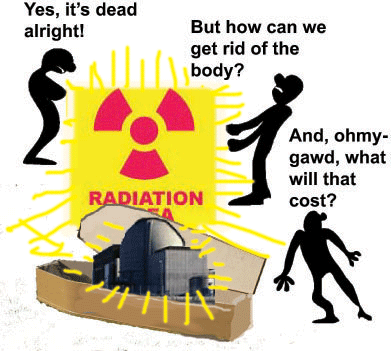 Japanese electric power consumers to share NPP dismantling costs It costs at least $180 million to decommission one reactor TOKYO, January 14. /TASS/. The costs of dismantling of outdated or unsafe nuclear power plants in Japan will be equally shared by the country’s electric power consumers, a working group of the economy, trade and industry ministry said on Wednesday………The government said nuclear power plants will be decommissioned when their authorized 40-year lifespans expire. Some 5 reactors are expected to be dismantled and the plans will be officially announced next month.
The loss due to decommissioning of one reactor is estimated at least at $180 million. Such expenses could deal a serious economic blow to private companies, which own the power reactors, and weaken the country’s economy in general.
Japan’s energy companies have submitted applications for another 19 reactors to resume their operations, but the process has been slowed down by safety checks and paperwork…….http://itar-tass.com/en/world/771074
Prime Minister Narendra Modi’s ally backs anti-nuclear movement to stop Jaitapur nuclear power project
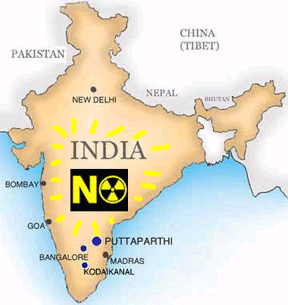 Notwithstanding PM’s nuke push, Sena to oppose Jaitapur plant Indian Express -By: Press Trust of India | Mumbai January 12, 2015 Notwithstanding Prime Minister Narendra Modi’s strong push for nuclear energy which he wants trebled by 2024, ally Shiv Sena today said it will continue to back those opposed to the 9,900 MW Jaitapur nuclear power project in Maharashtra.
“It has been our stand that Shiv Sena will support the locals of Jaitapur who have been opposing the plant. If there is an opposition, then why should we go against the will of the locals. After all, we are working for the development of the people,” senior Shiv Sena leader and state’s Industries Minister Subhash Desai told reporters.
Locals and anti-nuclear activists have been holding protests against the proposed plant over “scientific and environmental” concerns and Shiv Sena has been actively backing them.
“We (Shiv Sena) believe that if the need for power (for Maharashtra) is sufficed by other sources of energy including conventional and non-conventional resources, then why set up a destructive project,” he said.
Shiv Sena is a partner in BJP-led governments both at the Centre and in Maharashtra.The project is proposed to be set up in collaboration with French company Areva in the coastal Jaitapur village in Ratnagiri district. It will have six units of 1650 MW each built with Areva’s European Pressurised Reactor technology. JNPP would be one of the costliest nuclear power plant projects considering its sheer size and the new technology. – See more at: http://indianexpress.com/article/india/india-others/notwithstanding-pms-nuke-push-sena-to-oppose-jaitapur-plant/#sthash.aXD0KlPZ.dpuf
Futaba town accepts interim storage facilities
The Japanese government’s plan to build intermediate storage facilities for radioactive waste from the 2011 nuclear accident is set to move ahead, now that the candidate sites have accepted the plan.
The government wants to build facilities for storing contaminated soil and debris on a 16-square-kilometer site straddling the towns of Futaba and Okuma in Fukushima Prefecture. The 2 towns host the damaged Fukushima Daiichi nuclear plant.
Okuma accepted the plan last month. The mayor of Futaba made the same decision on Tuesday in Iwaki city, where most of the town’s residents have evacuated.
Those in favor of accepting the intermediate storage facilities say they will help speed up decontamination efforts in the region.
But others cite the risk of the intermediate facilities becoming permanent unless the government fulfills its promise to dispose of nuclear waste outside the prefecture.
The government plans to continue purchase negotiations with the site’s landowners. It is also working out safety arrangements with the prefecture and the 2 towns for the transportation of radioactive waste to the facilities.
Futaba Mayor Shiro Izawa said acceptance of the government’s plan is an unavoidable part of accelerating post-disaster rebuilding.
Source: NHK
http://www3.nhk.or.jp/nhkworld/english/news/20150113_26.html
Failure to control radioactive waste water continues, at crippled Fukushima nuclear site
Engineer: Outright failures continue to plague Fukushima plant — “Public may think worst is over… Nothing could be further from the truth” — Japan TV: New method failing to stop flow of highly contaminated water — Experts: ‘Diluting’ radiation in ocean adds to danger; Spreading it out only makes health damages worse (VIDEO)http://enenews.com/outright-failures-continue-plague-fukushima-japan-tv-new-method-failing-stop-flow-highly-contaminated-water-public-thinks-worst-could-be-further-truth-video?utm_source=feedburner&utm_medium=email&utm_campaign=Feed%3A+ENENews+%28Energy+News%29
Dr. Steve Elwart, professional engineer and expert for Dept. of Homeland Security, Dec 14, 2014 (emphasis added): With most of the media silent about the cleanup, the public may think the worst is over [at Fukushima Daiichi]… Nothing could be further from the truth… [Radioactive water is] leaking out into the ocean, allowing it to spread… around the world through ocean currents [and this has] prompted grave concerns over the impact on sea life in the area and around the world. [Officials] decided to build an “ice wall” around the reactor site… TEPCO conceded defeat and announced the efforts to construct the plug failed… As if things couldn’t get worse, less than two months ago, TEPCO once again came out with an announcement that it was having problems with the ice wall [and] was going to cease operations on the ice wall and pour cement… TEPCO President Naomi Hirose stated officials “will never give up” on the wall…debate continues over how to stop water from leaking into the ocean… outright failures continue to plague the Fukushima cleanup efforts.
NHK Transcript, Dec 26, 2014: TEPCO is still struggling to deal with contaminated water at the Fukushima Daiichi nuclear power plant.
NHK, Dec 26, 2014: New method for contaminated water may be failing — [TEPCO] has indicated that a new method aimed at tackling a large volume of highly radioactive wastewater at the Fukushima Daiichi nuclear power plant has not been entirely successful. TEPCO gave a progress report on its work to a panel of experts at the Nuclear Regulation Authority on Friday. The utility last month began pouring cement into underground tunnels filled with the contaminated water from the reactor buildings to stop the water inflow. The water is believed to be leaking into the sea… officials said that when they pumped water up from one of the pits, the water level at another pit changed. That suggests that gaps exist in the concrete-filled tunnels.
Documentary featuring radiation experts (at 6:30 in):
- Dr. Alice Stewart, physician and epidemiologist: All recommendations say one big hit is more dangerous than just a little one… It’s the basis of the control of nuclear waste — if you dilute it enough, it will be safe. Well, we say dilute it and it will add to the dangers.
- Jan van de Putte, radiation safety specialist: There’s a philosophy called the dilution philosophy, which means if you dilute something, then it doesn’t give any harm. But with all the knowledge we have today, we must say radiation is inducing health damage regardless of how little the doses of are. If you dilute radiation… all the health effects will only be more widely distributed. This is the only effect of this dilution philosophy.
- Dr. Richard Piccioni, biophysicist: Whether you have put it all in one place or have spread it out, the total irradiation of human beings… is the same. In fact if what some researchers like Dr. Stewart are saying is true, it will be even worse.
- Watch the documentary here
Fukushima released 13,000,000,000 times more neutrons than initially estimated — “Obvious implication for human health”
- We estimated a lower limit of 5.2 × 10²¹ slow neutrons m–2 sec–1 [m–2 sec–1 = per sq. meter per second] were emitted from the nuclear fuel rods to the sea water injected in the reactors
- Priyadarshi et al. (2011) have estimated a release amount of 4 × 10¹¹ slow neutrons m–2. The large difference with our estimation [13,000,000,000 times higher] comes from the intrinsic limit of the box model study by Priyadarshi et al.
- Our model directly estimates the amount of material released from the reactor core
- The estimated… number of neutron represent a lower limit of the amount of radiation emitted from the nuclear reactors… These values can be used as a proxy to the total amount of radiation emitted since the melt down
- [The authors] express their gratitude to… the Japanese Ministry of Environment…Ministry of Education, Culture, Sports, and Technology (MEXT)… [and] the Cabinet Office
Source: Scientists from Tokyo Institute of Technology, U. of California San Diego & Kyushu U., made available Oct 16, 2014
_a_numerical_simulation_global_transport
Evidence of neutron leakage at the Fukushima nuclear plant… Despite the obvious implication for human health and the surrounding ecology, there are no quantitative estimates of the neutron flux leakage… Heat must be removed by cooling the system to prevent… meltdown, which results in injection of neutrons and other fission products into the atmosphere… [T]ons of seawater were used as a coolant… A consequence is that salts and minerals present in seawater become radioactive by reaction with thermal neutrons… We calculated the total number of neutrons that leaked from the reactor core [and] estimate that a total of 4 × 10¹¹ neutrons per m2 were released before March 20.
Source: Priyadarshi et al.:
http://www.pnas.org/content/108/35/14422.full
Slow Neutrons: “In water-cooled reactors like the ones at Fukushima, the right combination of slow neutrons and enriched fuel leads to a self-sustaining process… [Water] acts as a so-called moderator, slowing down the neutrons and keeping the reaction going.”
Health effects of neutron radiation:
- Wikipedia: [Neutron] radiation is considered to be the most severe and dangerous radiation to the whole body when it is exposed to external radiation sources [and] roughly ten times more effective at causing biological damage compared to gamma or beta
- Dr. Robert Gale, MD (In 2011 Gale was called to Japan to deal with medical consequences of the Fukushima disaster): All three types of particles… can harm humans. Neutrons are the most dangerous because they are very energetic, can penetrate deeply, and deposit large amounts of energy into tissues.
- US Nuclear Regulatory Commission: Neutrons… have an exceptional ability to penetrate other material… neutrons are the only [type of ionizing radiation] that can make objects radioactive… neutrons can travel great distances in air.
- Dept. of Health & Human Services: Neutrons… are significantly more potent carcinogens [and] induces… chromosomal aberrations, mutations, and DNA damage… more efficiently
Source: Enenews
http://enenews.com/fukushima-released-13000000000-times-neutrons-initially-estimated
Radioactive contamination level jumped over 57 times outside of underground wall

January 13, 2015
Cs-134/137 and all β nuclides (including Sr-90) density showed the rapid increase in groundwater, according to Tepco.
The sample was taken in the seaside of Reactor 2. Sampling date was 1/12/2015.
Compared to the previous measurement of 1/8/2015, Cs-134/137 density rose up by 57 times, all β nuclides density also rose up by 57 times.
This is the highest reading measured from this boring. Tepco hasn’t identified the reason. This boring is located outside of the underground wall to stop contaminated groundwater flowing to the sea.
TEPCO groundwater plume mapping assumed the contaminated water released from the unit 1 turbine building would eventually reach this area.
TEPCO said within recent weeks that the portions of this trench that were not yet filled in with concrete were seeing contaminated water re-fill the trench as they pumped it out and that both ends of the trench seem to rise and fall with each other.
The concreting of the unit 2 trench that had been full of highly contaminated water since 2011 has caused leaking contaminated water to divert over to this area.
Theoretically, it is natural to assume the high level of contamination is flowing to the sea without anything to stop.
http://www.tepco.co.jp/nu/fukushima-np/f1/smp/2015/images/2tb-east_15011202-j.pdf
http://www.tepco.co.jp/cc/press/2015/1247139_6818.html
Source: Fukushima Diary
Radioactive contamination level jumped over 57 times outside of underground wall
India’s Koodankulam reactor no 1 not really functioning, repeated shutdowns

 Reactors from Russia are unsafe and unreliable, India shouldn’t buy them: Russian environmentalist Vladimir Slivyak DiaNuke.org, 9 Jan 15 “……..The Koodankulam reactor no 1, despite its commissioning with much fanfare last year, is not really functioning and has seen repeated shut-downs. The people’s movement in Koodankulam says its because of the sub-standard equipments from Russia and it is unsafe. What do you think?
Bad quality of equipment and reactor components coming from Russia is not a secret anymore. It was noticed in China as well. Under current management, Rosatom became deeply corrupted which resulted in regular public scandals and arrests. In last 3 years several deputy directors of Rosatom were arrested on corruption charges, and in total about 300 people were fired from Rosatom’ organizations for the same reason. Very huge scandal happened with Zio-Podolsk producing steam-generators for nuclear plants – people there used cheap metal for manufacturing, instead of expensive one required by technology. Difference in price of cheap and expensive metals was going into pockets of top-management. Another scandal was about stealing money for radioactive waste treatment, and another one about bribes and procurement, etc.
Bad quality of reactor components, you are likely dealing with in case of Kudankulam, is a direct consequence of corruption. You can read more on corruption issue in the special report on Russian nuclear industry published in December (can be downloaded here)…….http://www.dianuke.org/russian-reactors-are-unsafe-and-unreliable-india-shouldnt-buy-them-russian-environmentalist-vladimir-slivyak/
Safety concerns may close South Korea’s Wolsong No.1 reactor
 Hacking of Korea’s nuclear operator raises risk of aging reactor closures Yahoo News By Meeyoung Cho SEOUL (Reuters) 12 Jan 15, – The hacking of South Korea’s nuclear operator means the country’s second-oldest reactor may be shut permanently due to safety concerns, said several nuclear watchdog commissioners, raising the risk that other aging reactors may also be closed.
“The operator failed to prevent it (the hack) and they don’t know how much data has been leaked. If the old reactor is still allowed to continue to run, it will just hike risks,” said Kim Hye-jung, one of the nine commissioners who will this month review an application to restart the Wolsong No.1 reactor.
The future of Wolsong No.1, shut in 2012 after reaching its 30-year lifespan, is seen as critical to the fate of other reactors, including the oldest Kori No.1 which had its lifespan extended by 10 years to 2017………
Even those commissioners who deem the reactor safe think that other issues such as public pressure will likely influence their decision, which is expected in February at the earliest.
Concerns over nuclear power have grown since the Fukushima disaster in Japan in 2011 and revelations in 2012 of fake certificates for reactor parts in South Korea.
(Additional reporting by Sohee Kim and Brian Kim; Editing by Henning Gloystein and Michael Perry) http://news.yahoo.com/hacking-koreas-nuclear-operator-raises-risk-aging-reactor-070014531–finance.html
Little chance that USA will get India to really change its Nuclear Liability Act
 Insuring nuclear power The Financial Express | January 12, 2015 Given the relatively low level of political capital it has in the Rajya Sabha, and the backdrop of the Bhopal gas tragedy and recent tragedies such as the Fukushima disaster in 2011, it seems unlikely the government is going to go out of its way to try and amend the Civil Liability of Nuclear Damage Act in a hurry—the Act has once again come to the forefront with US President Barack Obama coming to the Republic Day function.
 Since no US firm is going to build nuclear plants in India until Section 17(b) of the Act allows the Nuclear Power Corporation of India Limited (NPCIL) to take action against them in case of a nuclear accident, revoking this has been on the US agenda for a long time. Apart from the political sensitivity around such an action, as finance minister Arun Jaitley acknowledged at a seminar on the Act earlier this week, both the BJP and the Congress had passed the Act—so changing an integral part of the Act doesn’t look as if it is on the cards…….http://www.financialexpress.com/article/economy/editorial-insuring-nuclear-power/28748/
1 This Month


of the week– Nuclear Reactor Information Task Force

14 May – online event From Bombs to Data Centres: the Face of Nuclear Colonialism
To see nuclear-related stories in greater depth and intensity – go to https://nuclearinformation.wordpress.com
-
Archives
- May 2026 (180)
- April 2026 (356)
- March 2026 (251)
- February 2026 (268)
- January 2026 (308)
- December 2025 (358)
- November 2025 (359)
- October 2025 (376)
- September 2025 (257)
- August 2025 (319)
- July 2025 (230)
- June 2025 (348)
-
Categories
- 1
- 1 NUCLEAR ISSUES
- business and costs
- climate change
- culture and arts
- ENERGY
- environment
- health
- history
- indigenous issues
- Legal
- marketing of nuclear
- media
- opposition to nuclear
- PERSONAL STORIES
- politics
- politics international
- Religion and ethics
- safety
- secrets,lies and civil liberties
- spinbuster
- technology
- Uranium
- wastes
- weapons and war
- Women
- 2 WORLD
- ACTION
- AFRICA
- Atrocities
- AUSTRALIA
- Christina's notes
- Christina's themes
- culture and arts
- Events
- Fuk 2022
- Fuk 2023
- Fukushima 2017
- Fukushima 2018
- fukushima 2019
- Fukushima 2020
- Fukushima 2021
- general
- global warming
- Humour (God we need it)
- Nuclear
- RARE EARTHS
- Reference
- resources – print
- Resources -audiovicual
- Weekly Newsletter
- World
- World Nuclear
- YouTube
-
RSS
Entries RSS
Comments RSS
 nuclear-news