India to get $1 Billion ExIm Bank Credit, nearly all of it for renewable energy development
 Renewables to Get Most of $1 Billion ExIm Bank Credit Reed Landberg (Bloomberg) 27 Mar 15 – Renewable energy developers will receive “the vast majority” of a $1 billion credit line the Export-Import Bank of the U.S. extended to India, the institution’s president said.
Regulatory policies in India, including terms for selling power, are conducive to financing solar- and wind-power projects, and make it easier for the bank to ensure it will be repaid, said Fred Hochberg, who is also chairman of the Washington-based lender.
The comments are an indication that the ExIm bank’s funding for renewables is poised to rise ….. The credit line sealed during President Barack Obama’s visit with Indian Prime Minister Narendra Modi in January is part of the U.S. effort to back an unprecedented expansion of clean energy in developing nations and check rising pollution blamed for global warming.
India’s Ambitions
Modi wants to install by 2022 five times as many photovoltaics as the U.S. has now, an ambition that may cost $160 billion, according to the Council on Energy, Environment & Water, a research group in New Delhi. Obama wants India to join in a global deal limiting greenhouse gases, and India’s ministers are seeking financial support from the West to cut the cost of emissions.
The U.S. developer SunEdison Inc. announced in January plans to build as much as 5 gigawatts of wind and solar power in India, and First Solar Inc., the largest U.S. solar manufacturer, is also developing power plants in the country. Regulations in India permit power purchase agreements that extend as long as 20 years. That makes it easier for banks to finance solar and wind projects…….http://www.bloomberg.com/news/articles/2015-03-26/renewables-to-get-most-of-1-billion-exim-bank-credit
8 Significant facts about Fukushima Daiichi Nuclear Station
6. In Japan, the only radiation from Fukushima Daiichi Nuclear Reactors that is being measured is the radioactive cesium. However large amounts of strontium 90 and tritium are spreading all over Japan. Strontium and tritium’s radiation consists of beta rays, and are very difficult to measure. However both are extremely dangerous: strontium can cause leukemia, and tritium can cause chromosome disorder.
8. ……Tokyo Governor Naoki Inose said .“It is not under control now.”
Some Facts You Must Know About Fukushima Takashi Hirose | CounterPunch, 26 Mar 15 “………Here are eight things you need to know. Continue reading
Fukushima clean-up failures – RADIOACTIVE RAINWATER, BAD IDEAS, TECHNICAL ERRORS etc
Fukushima disaster followed by four-year litany of failures costing hundreds of millions http://www.news.com.au/world/asia/fukushima-disaster-followed-by-four-year-litany-of-failures-costing-hundreds-of-millions/story-fnh81fz8-1227280207492 VERY GOOD PHOTOS MARCH 26, 2015 THE tragedy of Fukushima is far from over, a whole four years after 18,000 people died when the Daiichi nuclear power plant was destroyed by a tsunami and earthquake.
Japanese government auditors have revealed that more than a third of the $2 billion of taxpayer money dedicated to the clean-up has been wasted.
Tourists are returning to the region as radiation fears fade, and there are plans to host events in the area for the 2020 Tokyo Olympics, yet the region is in chaos, seemingly cursed by a litany of failures and screw-ups.
- RADIOACTIVE RAINWATER Continue reading
Grave danger in Australia’s planned uranium sales deal with India
Australia and India face a graver test than cricket Against the backdrop of Australia and India squaring up in the World Cup cricket, the two nations now face a test with much graver consequences, write Dave Sweeney and Jim Green. SBS News, 26 Mar 15 When Prime Minister Tony Abbott signed a uranium deal with Indian Prime Minister Narendra Modi last September, he praised India’s “absolutely impeccable non-proliferation  record”. This praise came despite the reality that India is actively expanding its nuclear weapons arsenal and its missile delivery capabilities.
Mr Abbott declined to answer serious questions about India’s nuclear weapons program or the inadequate safety standards in and inadequate regulation of its civil nuclear program. Instead, he offered a cricketing cliché, declaring that Australia and India trust each other on issues like uranium safeguards because of “the fundamentally ethical principle that every cricketer is supposed to assimilate – play by the rules and accept the umpire’s decision”.
Gaining comfort from clichés while ignoring inconvenient truths might work for those in Canberra and mining company boardrooms but it fails any real world test.
The proposed India uranium agreement is currently being considered by federal parliament’s treaties committee, and it has yet to be ratified by parliament. Submissions to the treaties committee have raised many serious concerns − and not just from the usual suspects.
Those raising concerns and objections include John Carlson, former Director-General of the Australian Safeguards and Non-Proliferation Office; Ron Walker, former Chair of the International Atomic Energy Agency (IAEA) Board of Governors; Prof. Lawrence Scheinman, former Assistant Director of the US Arms Control and Disarmament Agency; Princeton University physicist Dr M.V. Ramana; and nuclear arms control expert Crispin Rovere.
The uranium agreement with India weakens Australia’s nuclear safeguards standards, increases the chances of Australian uranium finding its way into Indian weapons and would lead to further undermining of nuclear checks and balances. If the uranium agreement is approved there will be sustained pressure for Australia to apply equally inadequate standards to other uranium customer countries. As John Carlson notes in his submission: “If the Government does compromise Australia’s safeguards conditions, inevitably this will lead to other agreement partners asking for similar treatment.”
Mr Carlson’s critique carries particular weight given that for over two decades he was the head of Australia’s nuclear safeguards office……..http://www.sbs.com.au/news/article/2015/03/26/comment-australia-and-india-face-graver-test-cricket
Japan Anti-nuclear activists want formal public hearings on risks of restarting reactors in Fukui Prefecture
 Activists seek public hearings in Shiga on Takahama reactor restarts http://www.japantimes.co.jp/news/2015/03/26/national/activists-seek-public-hearings-in-shiga-on-takahama-reactor-restarts/#.VRS6i_yUcnk BY ERIC JOHNSTON STAFF WRITER MAR 26, 2015
Representatives of the Citizens’ Commission on Nuclear Energy, a group of scholars, engineers, lawyers, and activists, met with Gov. Taizo Mikazuki, who was elected on an anti-nuclear platform in July 2014, to discuss concerns over the restart of the No. 3 and 4 reactors at Kansai Electric Power Co.’s Takahama plant and what impact a disaster would have on the prefecture.
“It’s important to have a place where Shiga residents can discuss the technical, economic, and social problems related to the restart of the Takahama reactors and a disaster response system in case of an accident,” said Hitoshi Yoshioka, chairman of the citizens’ commission and a professor at Kyushu University.
Parts of the northern Shiga city of Takashima, which has a population of 52,400, lie within 30 km of the Takahama reactors. The prefecture has long been concerned about the central government’s disaster response plans and wants to be consulted by both Kepco and the central government about the restarts.
In addition, the group called on the governor to seek a wide variety of expert advice about the cost of restarts, and to consult economists who are skeptical of claims by the pro-nuclear camp about the economic and financial benefits of restarts.
Mikazuki, they said, expressed a desire to sponsor a public hearing, probably sometime after local elections in April. Both the governor and his predecessor have long worried about the impact of an accident on Lake Biwa, which provides water to about 14 million Kansai residents.
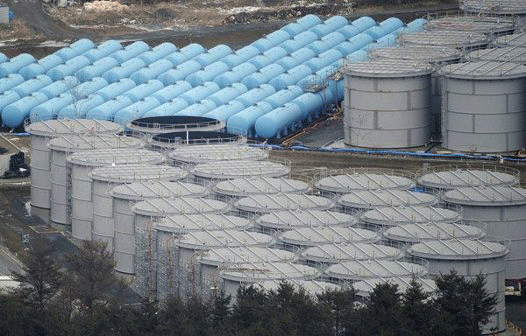
Daunting problem of Fukushima’as continuing flood of radioactive water
Fukushima food products mislabeled
 TAIWAN: 283 MISLABELED JAPANESE FOOD PRODUCTS ORIGINATED NEAR FUKUSHIMA, Fukushima Update, MARCH 25, 2015 By Stephanie Chao / chinapost.com More than 283 Japanese food products imported from the radiation-stricken areas near the Fukushima Dai-ichi nuclear disaster were found to be relabeled as having come from other areas of Japan and sold to local customers, authorities said yesterday.
Officials from New Taipei City’s Department of Health, as well as the Food and Drug Administration and other law-enforcement authorities, seized the mislabeled products, although a substantial portion had already been sold to consumers.
Authorities inspected warehouses in New Taipei City belonging to food companies such as Sheng Yu (盛裕), Li Tuo (勵拓), Sun Friend (上煬) and Tai Crown (太冠).
Health Department officials said Sheng Yu imported soy sauce labeled “Tokyo-made” last month. In reality, they were manufactured in areas that have import restrictions, such as Chiba (千葉), Gumma (群馬), Fukushima (福島), Ibaraki (茨城) and Tochigi (櫪木) prefectures.
Nineteen products originated from areas exposed to radiation and five other products have expired, the department said.
The department also investigated Li Tuo, Sun Friend and Tai Crown’s warehouses in Taishan, Xinzhuang and Xindian districts. They discovered several products from areas with import restrictions: seven from Li Tuo, 25 from Sun Friend and 19 from Tai Crown.
Further investigation revealed downstream companies that stock the imported products include well-known Japanese department stores, food chains and boutiques, including Wellcome (頂好), JPMed (日藥本舖), Matsusei (松青), Shin Kong Mitsukoshi (新光三越), B&Q (特力屋) and HOLA.
Officials have discovered a total of 2,391 kilograms of problematic products and will continue to investigate……..http://fukushimaupdate.com/taiwan-283-mislabeled-japanese-food-products-originated-near-fukushima/
Japan’s Monju fast breeder reactor still closed: over 10,000 cases of maintenance errors in 2013
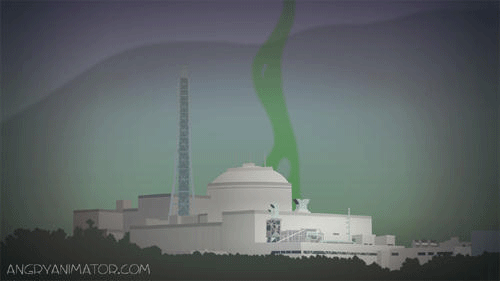 More errors with Monju nuclear reactor maintenance found, Mainichi, 27 Mar 15 Several more maintenance problems have been discovered at the Monju fast-breeder reactor facility in Tsuruga, Fukui Prefecture, which has been banned from operation following the discovery of over 10,000 cases of maintenance errors in 2013, it has been learned.
The Nuclear Regulation Authority (NRA) secretariat revealed on March 25 that the newly discovered maintenance errors — which involve the facility’s piping system — mean that Monju operator Japan Atomic Energy Agency (JAEA) may have violated safety regulations……..http://mainichi.jp/english/english/newsselect/news/20150326p2a00m0na007000c.html
Radioactive cesium in Fukushima’s soil
Soils retain, contain radioactivity in Fukushima Science Daily, March 24, 2015 Source: American Society of Agronomy (ASA), Crop Science Society of America (CSSA)
Radiocesium dissolves easily in water, allowing it to spread quickly. However, different soils have the ability to retain various toxins and prevent them from spreading or entering the food chain. The authors measured the ability of a large number of soil samples collected from Fukushima to intercept radiocesium. They found success depends on various factors.
One key factor is the presence of rough or weathered edges of certain minerals, such as mica, in the soil. These rough edges catch the radiocesium and prevent its movement. This is the frayed edge site (FES) concentration. Nakao explains, however, that “quantification of the FES with a simple experiment has proven difficult.” A “surrogate” measurement used by soil scientists is the radiocesium interception potential (RIP). This measurement is time-consuming and requires specialized facilities, preventing its measure at local institutes.
Thus, Nakao’s study looked for and found that other, more easily measured soil properties to predict the radiocesium interception potential (RIP) of a soil. “These findings may be useful in screening soils that are particularly vulnerable to transferring radiocesium to plants grown in them,” Nakao says. “However, the amounts of radiocesium transferred to plants are normally negligible, because most of the radiocesium is strongly fixed on the frayed edge site.”……..http://www.sciencedaily.com/releases/2015/03/150324101006.htm
Tepco’s nuclear clean-up wasted $1.6 billion of tax-payers’ money
Japanese audit finds $1.6 billion wasted in Fukushima nuclear plant cleanup Fox News, 24 mar 15 TOKYO – Japanese government auditors say the operator of the Fukushima Dai-ichi nuclear plant has wasted more than a third of the 190 billion yen ($1.6 billion) in taxpayer money allocated for cleaning up the plant after it was destroyed by a March 2011 earthquake and tsunami.
A Board of Audit report describes various expensive machines and untested measures that ended in failure. It also says the cleanup work has been dominated by one group of Japanese utility, construction and electronics giants despite repeated calls for more transparency and greater access for international bidders……
 Some of the failures cited in the report:
FRENCH IMPORT: Among the costliest failures was a 32 billion yen ($270 million) machine made by French nuclear giant Areva SA to remove radioactive cesium from water leaking from the three wrecked reactors. The trouble-plagued machine lasted just three months and treated only 77,000 tons of water, a tiny fraction of the volume leaking every day. It has since been replaced with Japanese and American machines.
SHODDY TANKS: TEPCO hurriedly built dozens of storage tanks for the contaminated water at a cost of 16 billion yen ($134 million). The shoddy tanks, using rubber seals and assembled by unskilled workers, began leaking and some water seeped into the ground and then into the ocean. The tanks are now being replaced with more durable welded ones.
GIANT UNDERGROUND POOLS: A total of 2.1 billion yen ($18 million) was spent on seven huge underground pools built by Maeda Corp. to store the contaminated water. They leaked within weeks, and the water had to be transferred to steel tanks.
 UNFROZEN TRENCH: A 100 million yen ($840,000) project to contain highly contaminated water in a maintenance tunnel by freezing it failed because the water never completely froze. TEPCO subsidiary Tokyo Power Technology even threw in chunks of ice, but eventually had to pour in cement to seal the trench. http://www.foxnews.com/world/2015/03/24/japanese-audit-finds-millions-dollars-wasted-in-fukushima-nuclear-plant-cleanup/
Nuclear terrorism danger would be magnified, if Japan reactivated nuclear reprocessing
Nuclear terrorism risks in Northeast Asia: Japan’s reactor restart and spent fuel Nautilus Peace and Security NAPS Net Special Report by Peter Hayes 23 March 2015 “…..Japan’s Post-Fukushima Choice
Due to Fukushima, Japan now must choose to go in one of two directions that are largely exclusive: either towards a reactor restart choice that leads to a minimalist phase-out of separated plutonium over time; or towards a maximalist reliance on separated plutonium over time in a closed fuel cycle………
Should Japan opt to start enough reactors to justify reactivating the plutonium fuel cycle, then the implications for nuclear terrorism would be substantial. The train of logic for maximum spent fuel arising from a closed nuclear fuel cycle is radically different to that for the once-through fuel cycle. In this trajectory, the following would occur:
- Japan starts many more light water reactors, sooner rather than later, and extends reactor lifetimes beyond forty years, and constructs new reactors
- This choice enables far more MOx fuel fabrication and recycling of MOx fuel to these reactors than in the once-through fuel cycle usage; this choice would either slowly reduce or rapidly increase the stockpile of separated plutonium that would be supplemented (if the central state is willing to subsidize heavily the utilities for using MOx fuel) by reprocessing the spent fuel from the operation of the light water reactors
- Thereby generating a new stream of separated and un-separated plutonium in Japan to store and secure, and available for diversion or attack.
Although it does not follow automatically, this vision of the revived closed fuel cycle also implies that:
- The fast reactor is developed in order to burn actinides to reduce the waste disposal problem (whether it would do so is debatable)
- The fast reactor would be developed to breed plutonium based on the argument that doing so makes Japan more independent from external nuclear fuel supply.
All the steps in this second path which maximizes separated fuel involves more transport, more bulk processing and storage, and creates more opportunity for non-state actors to divert fissile material or to attack directly the spent fuel stocks in pools or other nuclear materials process sites in the envisioned “closed” fuel cycle. In short, this trajectory maximizes the nuclear terrorist threat, directly and indirectly, over the next thirty years, especially when the demonstration effect on other states to follow suit are taken into account. For exactly this reason, the United States has reaffirmed recently that it does not favor MOx use and breeder activity in Japan or elsewhere……..[19]http://nautilus.org/napsnet/napsnet-special-reports/nuclear-terrorism-risks-in-northeast-asia-japans-reactor-restart-and-spent-fuel/
Japanese court rejects lawsuit against MOX nuclear plan
Lawsuit targeting Genkai nuclear plant’s MOX plan rejected KYODO SAGA – The Saga District Court on Friday rejected a suit seeking to block Kyushu Electric Power Co.’s plan to use plutonium-uranium mixed oxide fuel (MOX) at the Genkai power plant in Saga Prefecture.,,(subscribers only) http://www.japantimes.co.jp/news/2015/03/20/national/lawsuit-targeting-genkai-nuclear-plants-mox-plan-rejected/#.VQ8uJ_yUcnk
Fukushima accident – pieces of fuel rods and reactor vessels blasted to least 130km
 NHK admitted pieces of fuel rods and reactor vessels blasted to at least Ibaraki to contain Uranium & Zirconium http://fukushima-diary.com/2014/08/nhk-admitted-pieces-fuel-rods-reactor-vessels-blasted-least-ibaraki-contain-uranium-zirconium/ Iori Mochizuki In the early morning news flash of 8/9/2014, NHK announced that pieces of nuclear fuel, fuel rods, reactor pressure vessels and the internal structure were blasted to at least 130km away from Fukushima nuclear plant.
It was 2μm diameter particle. The ball-looking shape proves it was molten in high temperature and quickly cooled down. The particles contain Uranium, Zirconium etc, which are the same material as nuclear fuel and the structure inside the vessels. These were collected from 3/14 ~ 3/15/2011 in Tsukuba city Ibaraki prefecture by the study group of Science Univ. of Tokyo.
The reason why NHK suddenly started reporting about this fact is not clear. It has been already 3 years and 5 months, which is probably too late to escape. There is a possibility that NHK announces the actual contamination situation in the area closer to Tokyo when people pay much less attention to Fukushima accident.
International Research Institute for Nuclear Decommissioning found no nuclear fuel nor water in Fukushima reactor 1
IRID SAW no fuel or water remaining in reactor core of Reactor 1 http://fukushima-diary.com/2015/03/irid-saw-no-fuel-or-water-remaining-in-reactor-core-of-reactor-1/ Iori Mochizuki Following up this article. Tepco to start “scanning” inside of Reactor 1 in early February by using muon [URL] IRID (International Research Institute for Nuclear Decommissioning) and High Energy Accelerator Research Organization announced they could not find a potential part of nuclear fuel in Reactor core of Reactor 1.
On 3/19/2015, they released the prompt report of their “scanning” test implemented until 3/10/2015.
The report tells they could not find anything longer than 1m in reactor core, where originally fuel assemblies were set.
The muon equipment was installed in North of Reactor 1 and also in North-West of Reactor 1. However, neither of them detected a potential fuel assembly.
Also, no water is retained in the reactor core of RPV (Reactor Pressure Vessel). These facts found strongly supports the possibility that the molten fuel has already dropped onto the bottom of Primary Containment Vessel. They did not mention the further possibility that the molten fuel has already gone through the outer wall of the vessel.
About the state of Spent Fuel Pool 1, they did not conclude more than “assuming the fuel remains inside the pool, but the size is not identified”.
Doubts that American nuclear companies will sell reactors to India
IS THE INDIA NUCLEAR AGREEMENT REALLY THE ‘BREAKTHROUGH’ OBAMA PROMISED? Chauthi Duniya, March 20th, 2015 Analysts and experts familiar with the negotiations say that the legal issues remain so complex that private U.S. companies may continue to shy away from new deals in India,….
The Indian Government has already slated sites for nuclear power facilities for Westinghouse Toshiba in the western state of Gujarat and GE Hitachi Nuclear Energy in the state of Andhra Pradesh. “My feeling is that there’s not as much there,” said Daryl Kimball, executive director of the nonprofit Arms Control Association, a non-proliferation watchdog group. “The real test is, will GE or Westinghouse say ‘this is good enough for us’ or not and whether they will sign contracts.”…….
The key issue will be whether the conflict between international law and Indian law can be waved away by a memorandum from India’s Attorney General. The memorandum would have to say that the 2010 liability law “doesn’t mean what it says,” said a Washington lawyer familiar with the issues but who asked for anonymity to protect his professional relationships. Continue reading
-
Archives
- October 2026 (129)
- September 2026 (339)
- August 2026 (330)
- July 2026 (355)
- June 2026 (287)
- May 2026 (306)
- April 2026 (356)
- March 2026 (251)
- February 2026 (267)
- January 2026 (308)
- December 2025 (358)
- November 2025 (359)
-
Categories
- 1
- 1 NUCLEAR ISSUES
- business and costs
- climate change
- culture and arts
- ENERGY
- environment
- health
- history
- indigenous issues
- Legal
- marketing of nuclear
- media
- opposition to nuclear
- PERSONAL STORIES
- politics
- politics international
- Religion and ethics
- safety
- secrets,lies and civil liberties
- spinbuster
- technology
- Uranium
- wastes
- weapons and war
- Women
- 2 WORLD
- ACTION
- AFRICA
- Atrocities
- AUSTRALIA
- Christina's notes
- Christina's themes
- culture and arts
- Events
- Fuk 2022
- Fuk 2023
- Fukushima 2017
- Fukushima 2018
- fukushima 2019
- Fukushima 2020
- Fukushima 2021
- general
- global warming
- Humour (God we need it)
- Nuclear
- RARE EARTHS
- Reference
- resources – print
- Resources -audiovicual
- Weekly Newsletter
- World
- World Nuclear
- YouTube
-
RSS
Entries RSS
Comments RSS

