200 years before Japan can hope to clean up Fukushima
Japan faces 200-year wait for Fukushima clean-up The chief of the Fukushima nuclear power station has admitted that the technology needed to decommission three melted-down reactors does not exist, and he has no idea how it will be developed.
Japan’s ‘nuclear village’ is back in control
The corruption and collusion of Japan’s nuclear village led to numerous accidents before the Fukushima disaster.
And the corruption and collusion of Japan’s nuclear village was a root cause of the Fukushima disaster itself. On that point the Nuclear Accident Independent Investigation Commission could not have been blunter: “The accident was the result of collusion between the government, the regulators and TEPCO, and the lack of governance by said parties.”
A big part of the post-Fukushima spin is that lessons were learned from the nuclear disaster and improvements made. But the real lesson from this saga is that the nuclear industry – in Japan at least – has learned nothing from its catastrophic mistakes.
As Yotaro Hatamura says, an accident will surely happen again.

After Fukushima: Japan’s ‘nuclear village’ is back in charge, Ecologist Jim Green28th March 2015 Public opposition to nuclear power in Japan remains strong, writes Jim Green, but piece by piece, Shinzo Abe’s right-wing government has been putting the country’s infamous ‘nuclear village’ back in control – boosted by draconian press censorship laws, massive interest-free loans, and a determination to forget all the ‘lessons’ of Fukushima. Is another big accident inevitable?
Public opposition to reactor restarts (and the nuclear industry more generally) continues to exert some influence in Japan.
Five to seven of the oldest of Japan’s 48 ‘operable’ reactors are likely to be sacrificed to dampen opposition to the restart of other reactors, and local opposition may result in the permanent shut down of some other reactors.
Currently, all 48 of Japan’s ‘operable’ reactors are shut down – and the six reactors at Fukushima Daiichi have been written off.
However, slowly but surely, the corrupt and collusive practices that led to the Fukushima disaster are re-emerging. The ‘nuclear village’ is back in control……..
The Basic Energy Plan approved by Cabinet in April 2014 contains nothing more than a meaningless nod to widespread public anti-nuclear sentiment, stating that dependence on nuclear energy will be reduced ‘to the extent possible’.
Junko Edahiro, chief executive of Japan for Sustainability and one of the people removed from the energy policy advisory committee, noted in November 2014: Continue reading
Plutonium-241 from Fukushima nearly 70,000 times more than atomic bomb fallout in Japan.
 Fukushima: Uranium and Plutonium Contamination of Large Areas of Oceans, Ground-water, Soils.By Edmondo Burr Global Research, March 29, 2015 Your News Wire Scientists have raised concern over the rate of radioactive contamination of the Pacific, due to the Fukushima nuclear accident.
- Expert : Plutonium-241 from Fukushima nearly 70,000 times more than atomic bomb fallout in Japan.
- Officials : Molten fuel now ‘particle-like’, contains ‘special’ nuclear materials.
- Gov’t Labs : Large areas of oceans contaminated by plutonium from events such as Fukushima; Build-up in biosphere expected; Considerable hazard to humans.
Energy News statement :
Detection of long-lived plutonium isotopes in environmental samples by Accelerator Mass Spectrometry (AMS) — Plutonium isotopes 239Pu, 240Pu and 242Pu are anthropogenic radionuclides emitted into the environment by nuclear activities. Pu is accumulated in the human body and hence, poses a considerable hazard to human health. Due to the long half-lives, these isotopes are present in the biosphere on large time scales and a build-up can be expected. Therefore it is important to study the contamination pathway of Pu into the drinking water… a method to detect long-lived Pu isotopes by Accelerator Mass Spectrometry (AMS) is being developed. AMS requires only few milligrams of sample material… Consequently, more samples from different locations can be taken which is essential when searching for locally increased Pu concentrations as in the Pacific Ocean after the Fukushima accident… Samples from different locations in the Pacific Ocean and from the snow-hydrosphere are planned…
Statement by: Taeko Shinonaga, head of Radioanalytical Laboratory at Helmholtz Zentrum Munchen (research institution founded jointly by Germany’s Federal Ministry of Education & Research and Bavaria’s Finance Ministry), scientists from Technische Universitat Munchen (Germany), Verhandlungen der Deutschen Physikalischen Gesellschaft 2013 meeting (emphasis added)
Presentation by: Taeko Shinonaga, head of Helmholtz radioanalytical lab (pdf), Nov 2014: Comparison of activity between [nuclear bomb testing] fallout Pu particle and Fukushima origin Pu particle:…..http://www.globalresearch.ca/fukushima-uranium-and-plutonium-contamination-of-large-areas-of-oceans-ground-water-soils/5439271
How Japan’s government financially props up TEPCO nuclear company
 After Fukushima: Japan’s ‘nuclear village’ is back in charge, Ecologist Jim Green28th March 2015 “…….Many have called for TEPCO to be nationalised, or broken up into separate companies, but the LDP government has protected and supported the company. The government has also greatly increased financial support for TEPCO.
For example in January 2014 the government approved an increase in the ceiling for interest-free loans the Nuclear Damage Liability Facilitation Fund is allowed to give TEPCO, from 5 trillion yen to 9 trillion yen (€39.0-70.2 billion)
The government will also cover some of the costs for dealing with the Fukushima accident which TEPCO was previously required to pay, such as an estimated 1.1 trillion yen (€8.6 billion) for interim storage facilities for waste from clean-up activities outside the Fukushima Daiichi plant.
The government has also amended the Electricity Business Act to extend the period for collecting decommissioning funds from electricity rates by up to 10 years after nuclear plants are shut down. The amendments also allow TEPCO to include in electricity rates depreciation costs for additional equipment purchased for the decommissioning of the Fukushima plant………http://www.theecologist.org/News/news_analysis/2810545/after_fukushima_japans_nuclear_village_is_back_in_charge.html
35-ton piece of machinery debris impedes gate at Fukushima No 1 nuclear reactor
Setback at Fukushima No. 1 plant threatens reactor 3 rod removal Tokyo Electric Power Co. has disclosed that a 35-ton piece of machinery debris might be resting on the inner gate of the spent fuel pool for reactor 3 of the Fukushima No. 1 power plant and that the gate is slightly out of position.
Tepco said Thursday that a fuel-handling machine dislodged during the March 2011 quake, tsunami and meltdown-triggered hydrogen explosions is touching one of two gates that stand between the pool and the reactor containment vessel……http://www.japantimes.co.jp/news/2015/03/27/national/debris-poses-risk-spent-fuel-pool-gate-fukushima-1s-reactor-3-tepco/#.VRiPYPyUcnk
It didn’t work: Toshiba’s state of the art technology to find Fukushima nuclear cores
Cutting-edge tech to scan Fukushima for nuclear fuel flops in front of reporters, Rt.com March 27, 2015 A presentation of state-of-the-art technology aimed to show the location of nuclear fuel molten debris at the crippled Fukushima plant in Japan ended in a flop, raising concerns about the $5 million project.
Fukushima operator Tokyo Electric Power Co (TEPCO) tasked Japanese tech giant Toshiba to come up with a solution after the nuclear plant was hit by an earthquake and tsunami in 2011.
After four years of research, Toshiba has developed a technology, which relies on muons in finding the nuclear fuel’s location.
Those tiny cosmic-ray subatomic particles are capable of going through almost anything except for the heavy elements like uranium and plutonium used for nuclear fuel.
The company plans to erect two tall walls right next to each reactor to shoot out muons through them to create an image of what’s inside – similar to medical X-rays.
Previously, the muons have been successfully used to scan volcanoes, ship’s cargoes and even the Egyptian pyramids.
But the technology’s presentation Friday turned into an epic fail as a programming glitch, which wasn’t fixed in time, prevented it from displaying any images of muons at all…….http://rt.com/news/244717-fukushima-muons-scan-toshiba/
Pakistan Climate Change Minister calls for tapping massive clean energy potential
Mushahid Ullah Khan calls for tapping massive clean energy potential, Business Recorder, Sunday, 29 March 2015 SLAMABAD: Federal Minister for Climate Change Senator Mushahid Ullah Khan has said that renewable energy, which is clean and environment-friendly, is future of Pakistan.
“Pakistan is abundantly replete with the renewable energy sources, which can help the country cope with deepening energy crises and pave the way for achieving sustainable development goals,” the minister underlined.
 In a press statement issued here on Sunday in the context of the Earth Hour event observed across the world including Pakistan, he explained that renewable energy is generally defined as energy that comes from resources, which are naturally replenished on a human timescale such as sunlight, wind, rain, tides,waves and geothermal heat.
Highlighting the importance of marking the Earth Hour, the minister Mushahid Ullah Khan said that the global Earth Hour event, in fact, calls for the global climate action by investing in renewable energy technologies to free the world including Pakistan of reliance on fossil fuels for energy generation, which are unclean, unreliable and not environment-friendly………
“Above all, harnessing the sun’s power is deemed to be an attractive alternative. For, it is a renewable resource, which leads no pollution. In contrast to conventional fuels, its use requires no need for refining, transporting and conveying fuels and power over long distances,” the minister said.http://www.brecorder.com/pakistan/politics-a-policy/235421-mushahid-ullah-khan-calls-for-tapping-massive-clean-energy-potential.html
Free Press Corporation in Japan, and pressure from the nuclear lobby
 Mako Oshidori in Düsseldorf “The Hidden Truth about Fukushima”, Fukushima Voice version 2E 28 May 2014 On March 8th, 2014, comedienne/journalist Mako Oshidori gave a lecture, “The Hidden Truth About Fukushima” in Düsseldorf, Germany, organized by a citizen’s group, SAYONARA Genpatsu Düsseldorf. Translation of Mako Oshidori’s March 6th, 2014 press conference at the German IPPNW (International Physicians for the Prevention of Nuclear War) Symposium in Frankfurt can be found here.The lecture, given in Japanese with German interpretation, was transcribed and translated into English……Transcription by Takashi Mizuno Translation by @YuriHiranuma
Mako: I am the director of Free Press Corporation in Japan.
This organization was originally created after the earthquake. The media is controlled as I just mentioned. This alliance was created for the purpose of conveying accurate, fresh information without media control.
Mako: Actually, it was created shortly before the earthquake. It was sort of coincidental…..
I was invited to talk to you, but I am actually not active in the anti-nuclear power plant movement. What I do is conduct investigations. There are numerous issues in Japan that I investigate, from the nuclear accident to other medical issues such as Minamata disease and Asbestosis.
However, doctors and scientists attending the IPPNW conference, which ended yesterday, shared how they end up being labeled as anti-nuclear activists even though they don’t consider themselves to be as such, when they research and publicize facts inconvenient for promotion of nuclear power. There is a tremendous amount of pressure exerted when researching and writing up facts the nuclear lobby doesn’t like. Continue reading
Cry for help from an official in Fukushima
Official in Fukushima: “Please Please HELP US!” — Hot particles of melted fuel are inhaled by children everyday — We are forced to have it in our bodies — “Please let all people in the world know the life we are living”http://linkis.com/2dWaC
Excerpts from Oyama Koichi of the Minamisoma City Council, May 13, 2014 — Translation byDissensus Japan, May 25, 2014:
- I want to shout for all the people in this world: “Please Please HELP US!”
- The cause substance have been found. This is an aggregate of radionuclides which starts with Uranium [in] a nuclear reactor at more than 5000°C.
- This mixed metal contains four different substances, α・β・γ and also have the possibility to radiate neutron ray.
- No creature on earth never knew this substance.
- We are forced to have those strong substances inside our body without knowing where it exactly stays.
- To say that “Cesium has got the same system as potassium and it will be discharged from the body” is just a lie! […]
- We are all manipulated by the words “radiation” and “radiation doze” without knowing the real identity of radiation source. We are not told the real facts of being irradiated […]
- They only compare radiation doze and natural potassium contained in bananas and manipulated people as if it was a scientific study. I really want the scholars patronized by the government to be punished by the rancorous of all children on this earth. […]
- The informations say that hot particles were diffused and flied in all directions in Japan. The particles from hell is flying in the air and people don’t protect themselves anymore three years after the nuclear accident and children are aspirating those horrible particles everyday!!!
- PLEASE PLEASE PLEASE HELP US! Please let all people in the world to know the life we are living since the accident, everyday and today.
International Atomic Energy Agency Slams India’s Nuclear Regulations
 Global Watchdog Slams India’s Nuclear Regulations NDTV All India | Written by Pallava Bagla | Updated: March 27, 2015 NEW DELHI: India’s atomic regulatory body is not independent and lacks internal emergency arrangements, a draft report by the global nuclear watchdog International Atomic Energy Agency, or IAEA, has said.
 India, it also said, should allow more safety inspections of nuclear plants by independent bodies. These
facts have often been stated by anti-nuclear activists.
The experts of the Integrated Regulatory Review Service made their assessment after visiting various nuclear facilities during a 12-day trip to India at the invitation of the government.
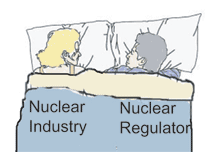 The global experts said India’s nuclear regulatory body – the Atomic Energy Regulatory Board or AERB — should be separated from bodies that can unduly influence its decision making. They also said India should have a system of radioactive waste management……http://www.ndtv.com/india-news/united-nations-nuclear-watchdog-review-slams-indias-nuclear-regulation-750131
Mako Oshidori on the status of Fukushima Daiichi nuclear power plant
Mako Oshidori in Düsseldorf “The Hidden Truth about Fukushima”, Fukushima Voice version 2E 28 May 2014 “……….I would like to talk about the current status of Fukushima Daiichi nuclear power plant. This is a chimney called a “stack” behind Units 1 and 2. There are various issues all over Fukushima Daiichi NPP, but this is one of the places that I consider the most dangerous. It is 120 m tall.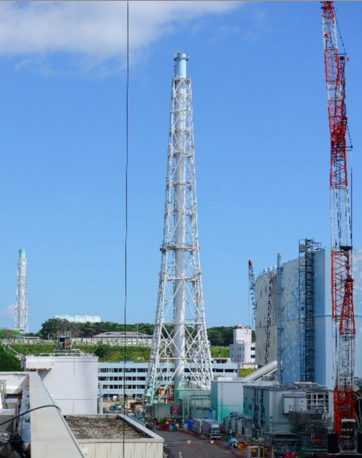

 Ordinarily, this should be immediately repaired, but the bottom of the stack is 25 Sv/h, and there is one spot that is 15 Sv/h. So, they can’t do anything about it. What TEPCO is doing about this is they have appointed workers to constantly watch it. This is very close to Units 1 and 2. We still get occasional earthquakes in Fukushima and eastern Japan. Workers on site are very worried about whether it would fall onto the reactor buildings. If it ever fell on Unit 1 or 2, all the workers would have to evacuate. There is no guarantee they would have enough time to evacuate, and it could lead to a severe accident necessitating evacuation of nearby residents once again.
One of the things not well known is the fact that in reality radioactive materials continue to be released into air and groundwater from the reactors at Fukushima Daiichi nuclear power plant.
Groundwater is of course contaminated. This [diagram] is the area where PM Abe declared the contaminated water being completely blocked when trying to bring the Olympics to Tokyo.
The Nuclear Naval Arms Race between India and Pakistan
India and Pakistan Locked in a Nuclear Naval Arms Race A new report provides a useful summary of the naval nuclear dynamics in the Indian Ocean. The Diplomat By Franz-Stefan Gady March 28, 2015 A while back, I reported on the murky detailssurrounding Pakistan’s sea-based nuclear deterrent. Much of it remains a mystery, including its future submarine force.
Conversely, the Indian Navy still does not have a capable ballistic missile with which to arm the INS Arihant – New Delhi’s only ballistic missile submarine (which only began sea trials in December). India’s submarine fleet is also experiencing difficulties in maintaining its readiness rate, which has dropped below 40 percent.
However, both India and Pakistan are set to continue to develop their naval nuclear forces, as a new report by the Carnegie Endowment for International Peace points out. Yet, this should not automatically be a cause for alarm, Iskander Rehman, the author of a newly released Carnegie policy paper, argues.
“By further institutionalizing relations between their navies and by insisting on stronger transparency with regard to naval nuclear developments, both countries may succeed in adding a greater degree of stability to what otherwise promises to be a dangerously volatile maritime environment,” he notes.
Rehman highlights a few other interesting points about the naval nuclear dynamics in the Indian Ocean:
- India’s pursuit of a sea-based nuclear strike force is the next logical step in its quest for an assured retaliatory capability.
- To enjoy an effective sea-based deterrent vis-à-vis China, India’s other prospective nuclear adversary, New Delhi has to develop larger SSBNs with greater missile carriage capacity and more powerful nuclear reactors.
- Pakistan’s naval nuclear ambitions are fueled primarily by the sense of a growing conventional, rather than strategic, imbalance between New Delhi and Islamabad.
- By dispersing low-yield nuclear weapons across a variety of naval platforms, Islamabad aims to acquire escalation dominance and greater strategic depth and to reduce the incentives for a preemptive strike on its nuclear assets.
Interestingly, Rehman also underlines that, “the submarine-based leg of India’s nuclear triad will have a major impact on the nation’s existing command-and-control arrangements.”…….http://thediplomat.com/2015/03/india-and-pakistan-locked-in-a-nuclear-naval-arms-race/
Coal plants funded by Japan’s money designated for fighting climate change

 Japan Uses Climate Cash for Coal Plants, Chem Info Karl Ritter & Aijaz Rahi, Associated Press (AP) 27 Mar 15 — Despite mounting protests Japan continues to finance the building of coal-fired power plants with money earmarked for fighting climate change, with two new projects underway in India and Bangladesh, The AP reported in December that Japan had counted $1 billion in loans for coal plants in Indonesia as climate finance, angering critics who say such financing should be going to clean energy like solar and wind power.
Japanese officials now say they are also counting $630 million in loans for coal plants in Kudgi, India, and Matarbari, Bangladesh, as climate finance. The Kudgi project has been marred by violent clashes between police and local farmers who fear the plant will pollute the environment. …….
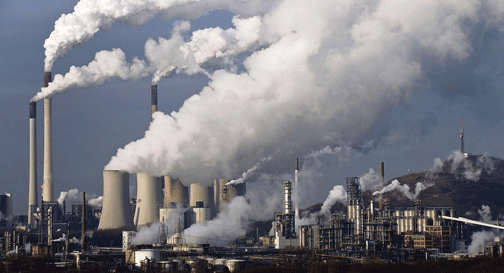
Environmental activists are demanding that at the very least, climate finance should exclude coal and other fossil fuels that scientists blame for warming the planet. “Japan’s support for new coal-fired power plants not only destroys the climate — it also displaces communities, is likely to cause untold local environmental damage, and primarily benefits Japanese companies instead of recipient countries,” said Brandon Wu of ActionAid. “This is unacceptable on its own, and the fact that it is being done in the name of ‘climate finance’ makes a farce of the entire concept,” he said.
….Climate finance is money promised by rich countries in U.N. climate talks to help poor countries limit their carbon emissions. Japan announced at a U.N. climate conference in Peru in December that it has provided $16 billion in climate finance since 2013. Yet the U.N. has no rules defining climate finance, meaning governments decide for themselves what projects to include in their accounting.Climate activists are now urging the recently created Green Climate Fund, which is supposed to become a key channel of climate finance, to explicitly ban funding for fossil fuel projects. The issue is likely to be discussed at the GCF’s board meeting this week in South Korea. The Matarbari plant is financed with a Japanese development loan agreed with the government of Bangladesh last June……..http://www.chem.info/news/2015/03/japan-uses-climate-cash-coal-plants
Concerns of mothers and children in Fukushima
Mako Oshidori in Düsseldorf “The Hidden Truth about Fukushima”, Fukushima Voice version 2E 28 May 2014 “…….. Next, I would like to talk about mothers in Fukushima. These mothers (and fathers) live in Iwaki City, Fukushima. They are active on school lunch issues. Currently, Fukushima produce isn’t selling well due to suspected contamination. So the prefectural policy is to encourage the use of Fukushima produce in school lunches, in an attempt to appeal its safety. As a large municipality, Iwaki City had been purchasing produce from distant prefectures instead of Fukushima produce, but after the accident, the policy changed to use Fukushima produce in school lunches in order to appeal safety of Fukushima produce by showing it’s safe enough to give to children.
By the way, the current measure to deal with areas contaminated with a high level of radioactive material is to remove the soil, put it in bags, and place them in an empty lot. It’s not just Fukushima Prefecture. Neighboring prefectures in eastern Japan, such as Ibaraki Prefecture, Gunma Prefecture, Miyagi Prefecture and Iwate Prefecture also have a lot of areas with contamination where people live. They decontaminate, put the soil in bags, and stack them in an empty lot. By the way, these bags look small, but each bag actually weighs 1 ton. It’s rather large. ……
Mako Oshidori on the plight of TEPCO’s nuclear plant workers
Mako Oshidori in Düsseldorf “The Hidden Truth about Fukushima”, Fukushima Voice version 2E 28 May 2014 “…..Next, I would like to talk about the nuclear power plant workers. This man [photo in original] used to work for TEPCO as a nurse at a medical clinic inside FDNPP. I interviewed him when he quit his job at TEPCO in 2013. [photo]There was an NPP worker who died in January 2012. I did a fairly thorough investigation after I was able to obtain police report on him. We got an address for the guarantor for the deceased worker, so we went to that address. There was an apartment building at this address without a unit numbered 204 which was supposed to be where the guarantor lived. In Japan, number four could mean bad luck (Note: In Japanese, number 4 phonetically sounds just likea Japanese word for “death”). After room 203, there was room 205, skipping room 204. I asked the other occupants of the apartment building, but there was no resident there by the name of this guarantor, so it didn’t seem like I wrote down the number wrong. Even though the building could be located on a map, you have to go there to verify the room is actually there. This might have been an guarantor with an imaginary address. This is the dark side of the construction and nuclear industries, not just post-nuclear accident, that those without families, especially elderlies, are given harsh work.
Workers who were exposed to 100 mSv in 2011 are entitled to annual cancer screening and thorough medical care. However, most workers get exposure doses below 100 mSv, such as 90, 95, or 83 mSv, and they don’t qualify for thorough medical care. Workers who had been working at NPP since before the accident know what could happen to them a after reaching a certain exposure dose in one year, or what it means to get exposed to 35 mSv in 2 hours during a particular work. They talk about how they probably won’t live too long. They are determined not to have any children, and they often talk about how uncertain they are about their lives in 5 years.
In current Japan, even children are not being protected, but there are some who are determined to protect children’t health. However, there is hardly any group or individuals advocating for protecting the workers in the most dangerous environment at FDNPS. I believe that is our responsibility. My article about the deceased worker from the January 2012 investigation was actually published in a weekly magazine Shukan Bunshun. However, a singer Ayumi Hamazaki suddenly got divorced right then, and I was asked to cut 75% of the article. I think a big reason why information such as this is not publicized is because readers are not craving for such information. We are in essence not fulfilling our duty to be informed……….http://fukushimavoice-eng2.blogspot.com.au/2014/05/mako-oshidori-in-dusseldorf-hidden.html
-
Archives
- October 2026 (129)
- September 2026 (339)
- August 2026 (330)
- July 2026 (355)
- June 2026 (287)
- May 2026 (306)
- April 2026 (356)
- March 2026 (251)
- February 2026 (267)
- January 2026 (308)
- December 2025 (358)
- November 2025 (359)
-
Categories
- 1
- 1 NUCLEAR ISSUES
- business and costs
- climate change
- culture and arts
- ENERGY
- environment
- health
- history
- indigenous issues
- Legal
- marketing of nuclear
- media
- opposition to nuclear
- PERSONAL STORIES
- politics
- politics international
- Religion and ethics
- safety
- secrets,lies and civil liberties
- spinbuster
- technology
- Uranium
- wastes
- weapons and war
- Women
- 2 WORLD
- ACTION
- AFRICA
- Atrocities
- AUSTRALIA
- Christina's notes
- Christina's themes
- culture and arts
- Events
- Fuk 2022
- Fuk 2023
- Fukushima 2017
- Fukushima 2018
- fukushima 2019
- Fukushima 2020
- Fukushima 2021
- general
- global warming
- Humour (God we need it)
- Nuclear
- RARE EARTHS
- Reference
- resources – print
- Resources -audiovicual
- Weekly Newsletter
- World
- World Nuclear
- YouTube
-
RSS
Entries RSS
Comments RSS

