North Korea claims to be nuclear missile ready
North Korea says can fire nuclear missile at ‘any time’ (Reuters) 19 Mar 15 – North Korea has the ability to fire a nuclear weapon and would use a nuclear missile in retaliation if it is attacked, the country’s ambassador to Britain told Sky News on Friday.
“It is not the United States that has a monopoly on nuclear weapons strikes,” Ambassador Hyun Hak-bong told Sky at the isolated Asian country’s London embassy.
Asked if that meant North Korea, which quit the nuclear Non-Proliferation Treaty in 1993, had the capability to fire a nuclear missile now, he replied: “Any time, any time, yes.”
“If the United States strike us, we should strike back. We are ready for conventional war with conventional war, we are ready for nuclear war with nuclear war. We do not want war but we are not afraid of war,” he added.
In a speech on March 3, North Korean Foreign Minister Ri Su Yong said his country had the power to deter an “ever-increasing nuclear threat” by the United States with a pre-emptive strike if necessary.
He also denounced military exercises staged by South Korea and the United States as provocative. The United States has said it is seriously concerned about North Korea’s nuclear work, which it says breaches international agreements.
North Korea has conducted three nuclear detonations, the most recent in February 2013, and the commander of U.S. forces in South Korea said in October he believed Pyongyang had the capability to build a nuclear warhead that can be mounted on a ballistic missile, although there had been no tests or other evidence to show it had taken that step. http://www.reuters.com/article/2015/03/20/us-northkorea-crisis-idUSKBN0MG26Q20150320
Security risks in Pakistan’s Tactical Nuclear Weapons programme
Pakistan’s Nuclear programme prone to security risks: US Report By Manu Pubby, ET Bureau | 21 Mar, 2015 NEW DELHI: A report on Pakistan’s tactical nuclear programme by a prominent Washington-based think tank raises questions on the country’s ability to secure warheads even in peacetime, concluding that the introduction of mini nuclear weapons in the subcontinent has substantially increased the risk of a confrontation with India getting out of hand.
Japan has no solution to nuclear wastes. Closing reactors should start the end of nuclear industry

 Decommissioning reactors should be step toward ending reliance on nuclear power Asahi Shimbun, 19 Mar 15 Kansai Electric Power Co. and Japan Atomic Power Co. on March 17 decided to decommission three nuclear reactors that have been in operation for more than 40 years. And on March 18, two more nuclear reactors, operated by Chugoku Electric Power Co. and Kyushu Electric Power Co., joined the “to be decommissioned” list.
This is the first application of the regulation that, in principle, limits the operation of nuclear reactors to 40 years. That rule was adopted after the March 2011 accident at the Fukushima No. 1 nuclear power plant.
Nearly 20 of Japan’s 48 commercial nuclear reactors have been in service for 30 years or longer. Utilities get a one-time-only chance to extend operations beyond 40 years, but the reactor in question must pass special inspections and will require further investments. As the reactors continue to age, the utilities will have to make up their minds from year to year.
Since succeeding in nuclear power generation in 1963, Japan has promoted nuclear energy without any plans for decommissioned reactors. As a result, the nation is now stuck with all sorts of issues that must be resolved if the decommissioning of older reactors is to proceed. Only by overcoming these challenges and becoming a “nation capable of decommissioning nuclear reactors” will Japan be able to take its first firm step toward weaning itself off nuclear energy.
NUCLEAR WASTE PROBLEMS UNRESOLVED
Nuclear waste poses the most critical challenge to the planned decommissioning of nuclear reactors. Directives are effectively nonexistent as to where to store spent nuclear fuel and nuclear waste left behind by dismantled reactors.
The government has never addressed this issue, citing its “nuclear fuel cycle” policy that presupposes the full recycling of all spent nuclear fuel. But in practice, this policy is completely useless. Utilities are effectively forced to resort to on-site storage of spent fuel in cooling pools or dry casks.
According to a promise made by Kansai Electric to the Fukui prefectural government, spent nuclear fuel will be “stored or disposed of outside the prefecture.” The utility’s decision to dismantle two reactors at the Mihama power plant means having to deal with this promise.
The handling of radioactive waste is just as problematic. While the waste is supposed to be sorted by the level of radioactivity and stored underground accordingly, nothing has been decided about specific storage locations, not only for highly radioactive waste but also for low-level waste. Nor have any standards been set for the management of buried waste.
Obviously, reactors cannot be dismantled in the absence of rules for spent fuel and nuclear waste disposal. In fact, Japan Atomic Power, which became the first in the nation to decide to decommission a reactor at the Tokai power plant in Ibaraki Prefecture, had to postpone the dismantling work for three years, and then an additional five years, because disposal rules for low-radiation nuclear waste could not be established in time.
Having given up on waiting for communities to volunteer as permanent storage sites for highly radioactive waste, the government has decided to take the initiative and start selecting candidate sites. But given that no community has ever volunteered, the selection process is obviously not going to be easy. To ensure that no community will be forced to become a nuclear waste dump against its will, the government must guarantee procedural transparency and be fully ready for dialogue with every candidate……..http://ajw.asahi.com/article/views/editorial/AJ201503180044
South Korea blames North Korea for nuclear power cyber attack
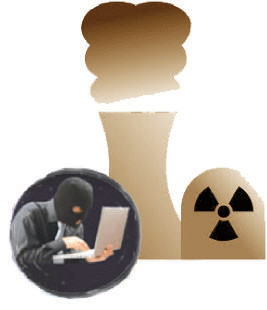
 South Korea claims North hacked nuclear data Hackers stole blueprints, employee data, and threatened “destruction” if demands not met, Ars Technica, by Sean Gallagher – Mar 18, 2015 The South Korean government issued a report today blaming North Korea for network intrusions that stole data from Korea Hydro and Nuclear Power (KHNP), the company that operates South Korea’s 23 nuclear reactors. While the government report stated that only “non-critical” networks were affected, the attackers had demanded the shutdown of three reactors just after the intrusion. They also threatened “destruction” in a message posted to Twitter………
In addition to identifying the malware used in the attack, the South Korean government’s investigation traced Internet traffic related to the attack back to addresses for a network in northeast China near the North Korean border. The government had earlier requested assistance from the Chinese government in identifying the source of the attack. http://arstechnica.com/security/2015/03/south-korea-claims-north-hacked-nuclear-data/
Greater cancer risk for girls – radioactive fallout from Fukushima
it is very important that we recognize the danger posed to children by the routine ingestion of contaminated food with Cesium-137 where ever they might live. It is also important to prevent further nuclear disasters which release these fiendishly toxic poisons into the global ecosystems. Given the immense amounts of long-lived radionuclides which exist at every nuclear power plant this is an urgent task.
 The Implications of The Massive Contamination of Japan With Radioactive Cesium [excellent slides and graphs]
Steven Starr
Senior Scientist, Physicians for Social Responsibility
Director, University of Missouri, Clinical Laboratory Science Program
Helen Caldicott Foundation Fukushima Symposium New York Academy of Medicine, 11 March 2013 “……..So now that we have some idea of the extreme toxicity of Cesium-137, let’s look at the extent of the contamination of the Japanese mainland.
It is now known that the reactors 1, 2, and 3 at Fukushima Daiichi all melted down and melted through the steel reactor vessels within a few days following the earthquake and tsunami of March 11, 2011. This was not made public by either TEPCO or the Japanese government for two months.
The greatest amounts of highly radioactive gases were released shortly after the meltdowns and 80% of this gas released by the reactors is believed to have traveled away from Japan over the Pacific. However the remaining 20% was dispersed over the Japanese mainland.
On March 11th, the US National Nuclear Security Administration offered the use of its NA-42 Aerial Measuring System to the Japanese and US governments. The National Atmospheric Release Advisory Center of the Lawrence Livermore Lab stood up to provide atmospheric modeling projections. The next two slides were produced by Lawrence Livermore and presumably given to the Japanese government.
On March 14th, the easterly winds which had been blowing the highly-radioactive gases and aerosols coming from Fukushima out to sea, shifted and pushed the radioactive plume back over the Japanese mainland. You can see the progression. The red indicates the radioactive plume.
Note that the images indicate that the plume first went south over Tokyo and then reversed and went north as the wind changed. All the areas where the radioactive gases passed over were contaminated. However the heaviest contamination occurred where rainfall was occurring and the radiation rained out. This accounts for the patchy deposition of the radioactive fallout.
Eight months after the disaster, the Japanese Science Ministry released this map, which shows that 11,580 square miles, which is 30,000 square kilometers, which represents 13% of the Japanese mainland, had been contaminated with long-lived radioactive cesium. Note that the official map does not note any Cesium-137 contamination in the Tokyo metropolitan area, unlike an unofficial survey done at about the same time by Professor Yukio Hayakawa of Gunma University. Given the fact that the Japanese government and TEPCO denied for two months that any meltdowns had occurred at Fukushima, one must look at all official data with a healthy degree of skepticism.
4500 square miles (or earlier today we heard 7700 square miles)—which is an area larger than the size of Connecticut—was found to have radiation levels that exceeded Japan’s previously allowable exposure rate of 1 millisievert per year.
Rather than evacuate this area, Japan chose to raise its acceptable radiation-exposure rate by 20 times, from 1 millisievert to 20 millisieverts per year.
However, approximately 300 square miles adjacent to the destroyed Fukushima reactors were so contaminated that they were declared uninhabitable. 159,000 Japanese were evicted from this radioactive “exclusion zone.” They lost their homes, property, and businesses, and most have received only a small compensation to cover the costs of their living as evacuees.
Note here that the criteria used for evacuation is the millisievert. It is not a measured quantity of radiation per unit area that I have described such as the Curie or Becquerel. Rather the Sievert is a calculated quantity. It’s calculated to represent the biological effects of ionizing radiation. In other words, the millisievert is a derived number, based on the mathematical models which are used to convert the absorbed dose to “effective dose.”
So what is the increased health risk to Japanese based upon their exposure to 20 millisieverts per year? Let us examine figures constructed on the basis of data published by the National Academy of Sciences, courtesy of Ian Goddard.
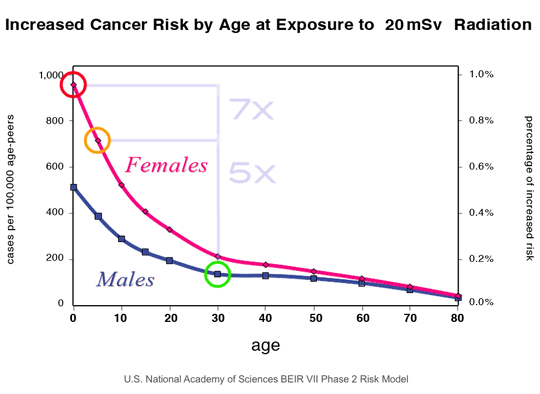
The vertical Y-axis is calibrated to the number of cancer cases per 100,000 age-peers, and the horizontal X-axis depicts the age of the population, beginning at zero years and moving towards old age. Now examine the allegedly safe dose of 20 millisieverts per year.
As a result of this exposure, there will be about 1000 additional cases of cancer in female infants and 500 cases of cancer in infant boys per 100,000 in their age groups. There will be an additional 100 cases of cancer in 30 year old males per 100,000 in this age peer group.
Notice that children, especially girls, are at the most risk from radiation-induced cancer. In fact a female infant has 7 times greater risk and a 5 year old girl has 5 times greater risk of getting a radiation-induced cancer than does a 30 year old man. Continue reading
In Japan, the “nuclear village” , like USA’s “military industrial complex” allows TEPCO to go unscathed
How does Tepco get away with it? It’s protected from on high by the “nuclear village,” Tokyo’s answer to the military-industrial complex that is said to hold sway in Washington.
This alliance of pro-nuclear politicians, bureaucrats and power companies promotes reactors over safer forms of energy like solar, wind or geothermal, and works to shield utilities from competition and global standards.

It’s Time for Japan to Punish Tepco, Bloomberg 18 MAR 10, 2015 By William Pesek Fishermen trawling the waters off Japan’s eastern coast have been alleging for a while that radioactive water was again spilling into the Pacific from the Fukushima power plant that melted down after a massive earthquake in 2011. On Feb. 24, Tokyo Electric Power Co., which is responsible for the site, admitted those suspicions were justified. And it turns out that Tepco knew about this latest radioactive leak since last May — and the giant utility said nothing for almost a year.
In the 15 days since Tepco finally confessed, have investigators raided its Tokyo headquarters? Have regulators demanded that heads roll? Has Prime Minister Shinzo Abe used his bully pulpit to demand accountability from the company that gave the world its worst nuclear crisis since Chernobyl? In any other major democracy, those steps would have been obvious. But none have occurred in Japan. And that raises troubling questions not just about Tepco’s corporate governance, but the rampant cronyism enabling it. Continue reading
Anti nuclear protest: 45,000 people march in Taiwan
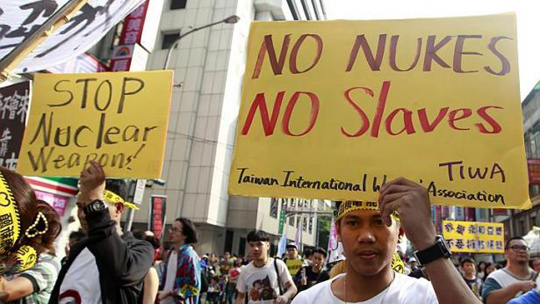
45,000 people join anti-nuclear rallies in Taiwan, Straits Times, MAR 14, 2015 TAIPEI (AFP) – Thousands of people took to the streets in Taiwan on Saturday to call for the island to scrap its use of nuclear energy and to voice opposition to controversial plans to ship nuclear waste abroad, organisers said.
Protesters in central Taipei waved placards and dressed in T-shirts emblazoned with slogans including “Goodbye to nuclear energy” and “We don’t need nuclear power”, just days after Japan marked the fourth anniversary of an undersea earthquake which triggered a massive tsunami and nuclear disaster.
Taiwan’s government has faced growing public pressure over its unpopular nuclear energy facilities……….
We urge the government to reform its energy policy and focus on green energy and saving energy,” said one of the rally’s organisers Tsui Shu-hsin.
“Politicians should listen to the voices of the people… so Taiwan can become nuclear-free.” The government says that Taiwan will run out of energy if it ditches nuclear power, which currently supplies about 20 per cent of the island’s electricity.
The Taipei rally drew around 30,000 people, while two other rallies held simultaneously across the island had a combined turnout of 15,000, according to estimates by organisers. Police estimates were not immediately available.
Organisers were also collecting signatures in a bid to stop a plan by the state-run Taiwan Power Co to process its nuclear waste abroad, which they said was aimed at extending the operations of two plants which are approaching capacity.
The plants, which currently store the spent fuel rods, were launched in 1978 and 1981 and will each be decommissioned once they have been operational for 40 years.
“Taiwan is earthquake-prone like Japan and it is smaller so nuclear facilities are much closer to our homes,” said Wu Bor-chyun, a banker who was living in Japan at the time of the 2011 nuclear accident.
“Nuclear power is not safe and it is very costly. Taiwan should heed the lessons in Japan.”http://www.straitstimes.com/news/asia/east-asia/story/45000-people-join-anti-nuclear-rallies-taiwan-20150314#sthash.Y0GCWbnB.dpuf
Fish and wild foods still showing radioactivity in Fukushima area
The decline in contamination has been very slow among bottom fish, including karei flat fish and ainame greenling caught off Fukushima. The same is true of freshwater fish, including iwana, caught from rivers, lakes and ponds in Fukushima, Miyagi, Tochigi, Gunma and Chiba prefectures.
As for mushrooms and wild vegetables, samples from 11 prefectures, including Fukushima, Yamanashi, Nagano and Shizuoka, exceeded the threshold between April 1 last year and March 1, according to the data.
Produce worries easing but some fish, wild foods still a problem in wake of Fukushima meltdowns, Japan Times BY MIZUHO AOKI STAFF WRITER MAR 12, 2015 The public panic over the threat of radioactive food has subsided in the four years since the Fukushima No. 1 nuclear power plant experienced three reactor core meltdowns and spewed massive amounts of fallout, but worries persist.
Seikatsu Club, a mail-order food delivery co-op, maintains an online database that includes more than 700,000 results of radiation tests on food items. Page views have fallen to about one-tenth of their peak in 2012, said Hiroshi Tsuchida, a quality management division chief with the co-op, but there are people who still visit the site almost daily.
“For such members, we are continuing testing and disclosing all the data on our website,” Tsuchida told The Japan Times. “In Ukraine, there are screening devices at markets where people check food even today, nearly 30 years since the (start of the Chernobyl) nuclear disaster. I believe we should do the same.”
Despite the lingering fears, however, overall contamination levels of farm produce and seafood from Fukushima and neighboring prefectures have declined significantly……..
But concern remains over fish, wild vegetables and wild game. Between April 1 last year and March 1, around 292,000 such samples were tested for radioactive cesium and 502, or 0.17 percent, exceeded the safe threshold, the health ministry said. In fiscal 2012, that ratio stood at 0.85 percent. Continue reading
Asian and Pacific green Parties unite in aim for nuclear free region
 Green Parties call for a nuclear free region on anniversary of Fukushima, Global Greens 10 March, 2015 “……The Green Parties of the Asia Pacific region offer our sincere condolences for the tragedy suffered, and our solidarity with the people and Green Party of Japan.
We use this anniversary to remind the Governments of the world, that it is the responsibility of all nations to ensure the safety of our planet.
There is no doubt, the suffering for the Japanese people has been immense, especially for those living in and around Fukushima, and it is not yet over. The world has already witnessed suffering following nuclear disasters in Chernobyl (Ukraine), Khystym (Russia), Sellafield (United Kingdom), and Three Mile Island (USA). However, there are currently 71 new nuclear plants under construction around the world, the majority of which are in the Asia Pacific region (China 26, Taiwan 2, India 6, Japan 2, Pakistan 2, South Korea 5). (3)
It is time we fully committed to a nuclear-free world.
 Whether your country is listed as one of these constructing further nuclear plants or not, we are all implicated in the nuclear supply chain – through uranium mining, refining, power generation, radioactive waste, nuclear weapons, or through complicity by not discouraging the practice of our trading partners.
 Green Parties around the globe oppose the expansion of nuclear power and are working to rapidly phase it out. Nuclear energy is not the emissions-free solution that the world needs to address climate change, in fact, it is a net producer of greenhouse gases.(4)
As we have seen with Fukushima, the human and planetary costs are too high, and when examining the nuclear supply chain, it is simply ineffective at reducing emissions.
We need to stay focused on transitioning to clean renewable energy sources – these are not only safer, but offer a more equitable solution. We can achieve economic development with genuine quality of life through a sustainable smart green economy. Examples of this kind of development include community-based, co-operative, renewable energy operations complemented by reduced energy consumption through electricity saving government policies.
At this critical moment, we ask the people Asia Pacific to call on their governments to:
- Commit to a nuclear-free world.
- Move to clean equitable renewable energy solutions for your country
- Provide democratic process in citizens’ referenda on nuclear power.
- Ensure information transparency, participatory democracy, social and environmental justice for residents living near power plants and nuclear waste fields.
- Prioritise in decision-making the wellbeing of our planet and future generations.
Signatories:
The Asia-Pacific Greens Federation (APGF) Coordination Committee
The APGF’s members are:
- Australia: Australian Greens
- India: Uttarakhand Parivartan Party (UKPP)
- Indonesia: Sarekat Hijau (Indonesian Green Union)
- Japan: Greens Japan
- Korea, Republic of: Green Party Korea
- Mongolia: Mongolian Green Party
- Mongolia: Civil Will Green Party of Mongolia
- Nepal: Nepali Greens (Green Civil Society)
- New Zealand: Green Party of Aotearoa New Zealand
- Pakistan: Pakistan Green Party
- Taiwan: Green Party Taiwan http://www.globalgreens.org/news/green-parties-call-nuclear-free-region-anniversary-fukushima
Another major leak of radioactive water at Fukushima nuclear facility
 Japan TV: “Radiation levels surge” at Fukushima — “Another major leak” — “Massive leak of … highly contaminated water” — “Hundreds of tons… breached barriers” (VIDEO) http://enenews.com/groundwater-radiation-levels-surge-fukushima-after-another-major-leak-750-tons-water-relatively-high-levels-radioactivity-video?utm_source=feedburner&utm_medium=email&utm_campaign=Feed%3A+ENENews+%28Energy+News%29
TEPCO, Mar 11, 2015 (emphasis added): Fukushima Daiichi NPS Prompt Report — Tepco Reports Rainwater Containing Strontium90 Found Seeping Into Ground At Fukushima Daiichi Tank Area; No Leakage Into Ocean… approximately 750 tons of rainwater containing Strontium90 may have seeped into the ground… [TEPCO] explained that the water is unlikely to leak out to the ocean through any of its drainage channels but it is monitoring the situation… the total amount of nuclides emitting beta rays such as Strontium90 ranged from 150 to 8,300 Bequerels per liter… it is investigating the cause of the rainwater contamination…
Asahi, Mar 11, 2015: [TEPCO] reported a massive leak of radioactive rainwater… on March 10. It said hundreds of tons of contaminated rainwater breached barriers surrounding storage tanks for highly radioactive water and seeped into the ground… Highly contaminated wateralso leaked from the same area and seeped into the ground in summer 2013… In the latest leakage, workers discovered bubbles at the junctions of side ditches in the area. Officials said this indicated that contaminated rainwater had seeped through the junctions and into the ground.
NHK, Mar 11, 2015: Radioactive rainwater leak at Fukushima plant — The operator of the Fukushima Daiichi nuclear plant says an estimated 750 tons of rainwater with relatively high levels of radioactivity has been leaked… TEPCO officials said the rainwater was 15 centimeters deep at 10:30 PM on Monday, but the figure had fallen to 8 centimeters shortly after 8 AM on Tuesday… They say the water inside the dam contained up to 8,300 becquerels per liter of beta-particle-emitting substances. TEPCO officials say all the water has now been collected. They say the drainage channel to the ocean is buried underground and it is unlikely that the water flowed into the ocean.
Jiji Press, Mar 11, 2015: TEPCO initially put the amount of leaked rainwater at 400 tons. The number was revised to 747 tons.
Arirang, Mar 12, 2015: Another major leakat… Fukushima nuclear power plant earlier this week may have raised radiation levels in nearby waters. [TEPCO] told Seoul-based Yonhap News that the radiation levels in water collected on Wednesday were 30 times higher than the sample collected on Monday. TEPCO said earlier this week that nearly [750] tons of contaminated rainwater had escaped the plant.
NHK, Mar 11, 2015: Groundwater radiation levels surge after leak – [TEPCO] says levels of radioactive material in groundwater have surged 30-fold, apparently after contaminated rainwater leaked outside a barrier… [It] estimates the leak at about 750 tons of rainwater, and it says levels of beta ray-emitting substances [were] 8,300 becquerels per liter. On Wednesday, TEPCO measured 11,000 becquerels per liter in groundwater… up from 370 becquerels…
32 million people in Japan are exposed to radiation from the Fukushima nuclear disaster
The 2015 Fukushima Report is available for download in English at http://www.greencross.ch/en/news-info-en/case-studies/fukushima-report.html.
As with the Chernobyl nuclear accident, which impacted 10 million people, Japan is expected to see increased cancer risk and neuropsychological long-term health consequences. The stress-related effects of evacuation and subsequent relocation are also of concern. The evacuation involved a total of over 400,000 individuals, 160,000 of them from within 20km of Fukushima. The number of deaths from the nuclear disaster attributed to stress, fatigue and the hardship of living as evacuees is estimated to be around 1,700 so far.
“Our local presence and ongoing activities to help the communities impacted by radioactive contamination in Chernobyl and Fukushima gives us first-hand experience of the human and environmental consequences of nuclear disasters,” said Adam Koniuszewski, Chief Operating Officer of Green Cross International, who recently shared the stage with former Japanese Prime Minister Naoto Kan for a conference on nuclear power. “This is why we are demanding more transparency and better governance around nuclear power and the risks involved, and a better assessment of its mounting costs. The management of nuclear waste in increasingly burdensome and the cost of decommissioning plants is escalating. In the meantime, renewable energy solutions are getting cheaper. Over the last five years the cost for utility scale solar has declined by 78 per cent, and by for wind by 58 per cent.”……….
About Green Cross International:
GCI is an independent non-profit and nongovernmental organization founded in 1993 by Nobel Peace Laureate Mikhail Gorbachev. It addresses the interconnected global challenges of security, poverty and environmental degradation through global advocacy and local projects. GCI is headquartered in Geneva, Switzerland, and has a network of national organizations in 27 countries http://www.gcint.org/
For further information, please contact:
Green Cross International (GCI)
Etienne Lacombe-Kishibe
Communications Coordinator
Phone: +41 22 789 08 13
Mob: +41 78 839 79 03
Email: etienne.lacombe(at)gci(dot)ch
Website: http://www.gcint.org http://www.prweb.com/releases/2015/03/prweb12577655.htm
Nuclear wastes out of control? Fukushima’s bags of radioactive trash pile up
The fruits of the laborers’ efforts are stacked in those giant sacks—5.5 million of them and counting. They are spread out across Fukushima province, along roadsides, in parking lots and backyards. They are tagged and bar-coded so authorities know what’s inside and how radioactive it is – and when the bags might start to wear out.
As the bags pile up and workers fan out across the landscape, some locals are questioning the cost-benefit analysis.
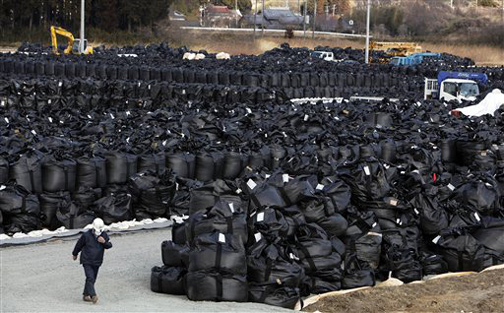
Fukushima nuclear plant cleanup has cost $13 billion and counting After 4 years, Fukushima nuclear cleanup remains daunting, vast LA Times, By JULIE MAKINEN contact the reporter 12 Mar 15 “…..Karimata is in charge of the work here in an evacuation zone about 12 miles north of the Fukushima Dai-ichi nuclear plant—part of the most extensive, and expensive, nuclear cleanup ever attempted.
The scale and complexity of what Japan is trying to do in the aftermath of the 2011 meltdown at Fukushima is mind-boggling. Decontamination plans are being executed for 105 cities, towns and villages affected by the accident at Fukusima Dai-ichi, 140 miles northeast of Tokyo.
Many Japanese regard this massive undertaking as a solemn obligation to right a terrible wrong. Others, even some of the people directly affected, question whether it’s a quixotic waste of resources.
Karimata’s delegation marches up a side street to check on a brigade of laborers wearing gloves, masks, helmets and fluorescent vests with radiation detectors tucked in their chest pockets. Some are spreading fresh soil in the yard of an uninhabited home. Next door, workers are up on a scaffold, preparing to wipe down the roof and gutters.
Across the street, near a bamboo grove, two men are erecting a plastic frame to support a massive double-lined garbage bag about the size of a hot tub. Dozens of identical black sacks, each weighing about a ton and stuffed with radiation-contaminated soil, leaves, wood chippings and other debris, stretch out behind them, awaiting transport at some uncertain date to a yet-unspecified final resting place.
Four years after the Great Tohoku Earthquake shook northern Japan to its core, touched off a deadly tsunami and precipitated the Fukushima Dai-ichi disaster, hundreds of square miles remain off-limits for habitation due to radioactivity. Some 79,000 people still cannot return home.
But unlike the 1986 accident at Chernobyl, where authorities simply declared a 1,000 square-mile no-habitation zone, resettled 350,000 people and essentially decided to let the radiation dissipate over decades or centuries, Japan is attempting to make the Fukushima region livable again. It is an unprecedented effort.
The sheer manpower and money dedicated to the house-to-house effort is staggering: Continue reading
Japanese public to bear the costs of scrapping 5 old nuclear reactors
 Five ageing nuclear reactors to be scrapped in Japan Sun Daily, 12 March 2015 -TOKYO: Japanese power companies are expected to announce the decommissioning of five ageing nuclear reactors next week, local media reported Thursday.
Four operators – Kansai Electric Power Co, Japan Atomic Power Co, Chugoku Electric Power Co and Kyushu Electric Power Co – will decide on Wednesday to scrap the reactors, which went into service in the 1970s, Kyodo News agency reported without citing any sources.
The operators will avoid the cost of beefing up safety measures to meet higher standards following Japan’s worst nuclear accident in Fukushima prefecture in 2011, Kyodo said.
The Industry Ministry said in January that the cost of decommissioning reactors, which can run to hundreds of millions of dollars and take decades until the property is ready for other uses, should be met by the general public……..http://www.thesundaily.my/news/1353191
Prolonged exposure to radiation is taking health toll on Fukushima’s kids
 TV: Officials lying, many more kids getting cancer after Fukushima — Report: 1,200+ deaths from “illness caused by prolonged exposure” — Mom: “I’m really worried… children not the same… sick… nosebleeds, rashes.. white blood cells decreased” — Radiation by school 100 times normal (VIDEO) http://enenews.com/tv-fukushima-residents-govt-lying-im-really-worried-many-children-same-sick-nosebleeds-rashes-incredible-fatigue-white-blood-cells-decreased-radiation-levels-school-100-times-normal-video?utm_source=feedburner&utm_medium=email&utm_campaign=Feed%3A+ENENews+%28Energy+News%29
ABC (Australia), Mar 11, 2014 (emphasis added): Radiation levels posing cancer risks… Before the disaster, there was just one to two cases of thyroid cancers in a million Japanese children but now Fukushima has more than 100 confirmed or suspected cases, having tested about 300,000 children… It is expected that thyroid cancers could turn up about four to five years after a nuclear disaster… [Megumi] Muto said her daughter and son, like many other children, had not been the same since experiencing the Fukushima fallout. “They had rashes on their bodies then nose bleeds. My son’s white cells have decreased and they both haveincredible fatigue… both have multiple nodulesaround their thyroids. I’m really worried.”… Mutowanted to move her family out of Fukushima city but she said she could not afford to.
News 24 (SAPA), Mar 10, 2015: A total of 1232 deaths in Japan’s Fukushima prefecture over the past year were linked to the nuclear accidentfour years ago, up 18% from a year earlier, a news report said on Tuesday. A death is considered nuclear-related if is not directly resulting from a nuclear accident but is due from an illness caused by prolonged exposure. Namie town, close to the Fukushima Daiichi Nuclear Power Station, had the largest number of deaths at 359, followed by 291 in Tomioka town, which is also near the complex, the Tokyo Shimbun reported.
ABC (Australia) video transcript, Mar 11, 2014:
- Headline: Fukushima residents have taken cancer and radiation testing into their own hands, saying authorities are lying to them about the safety of their community.
- Matthew Carney, ABC correspondent: It’s a heartbreaking time for Megumi Muto. Her daughter is being tested to see if the lumps in her thyroid gland have grown… Megumi isconvinced exposure to high radiation levels after the Fukushima nuclear meltdowns is the cause.
- Megumi Muto, Fukushima mother (translated): I feel angry. I think the authorities hide the real dangers, and now many more children are being diagnosed.
- Carney: Many residents in Fukushima don’t trust the government or TEPCO.
- Muto: Since the disaster my kids have been sick with nosebleeds, rashes and lethargy. Fukushima used to be a safe… area, but not now.
ABC (Australia) audio transcript, Mar 11, 2014:
- Michael Brissenden, ABC: the issue of long term health implications like cancer are causing the greatest concern and controversy in Japan…
- Matthew Carney, ABC correspondent: [Fukushima residents say the local and central] governments failed to protect the children. And they do not trust what the government or TEPCO… are telling them about radiation levels and safety. They’re conducting their own radiation tests and near this school in Fukushima City, the monitor reads 3 mircosieverts an hour. That’s about 100 times the rate of Tokyo.
- Sumio Kunno, nuclear plant engineer: I have to investigate and inform the public of the facts… They’re still not decontaminating areas where children live or play.
Nuclear blackmail – South Korean computer hacker demands money
 Hacker demands money to withhold information on S. Korean nuclear reactors Korea Times, SEJONG, March 12 (Yonhap) — A hacker who had posted inside information on South Korea’s nuclear power plants made a fresh threat Thursday, demanding money in exchange for not handing over sensitive information to third countries.
Using an account under the name of the president of an anti-nuclear group in Hawaii, the hacker posted additional files on Twitter, which reportedly included documents concerning the country’s indigenous advanced power reactor 1400.
“Need money. Only need to meet some demands… Many countries from Northern Europe, Southeast Asia and South America are saying they will buy nuclear reactor information. Fear selling the entire information will undermine President Park (Geun-hye)’s efforts to export nuclear reactors,” the posting said.
The hacker did not say how much money he wanted but warned that South Korea will end up losing much more if it tries to save a few hundreds of millions of dollars…….The latest posting marked the sixth of its kind since Dec. 15…….
In the latest posting, the hacker “congratulated” the KHNP for finding 7,000 viruses but claimed 9,000 more were awaiting his or her order.
The information released Thursday reportedly included the transcript of a telephone conversation between President Park and the U.N. chief, Ban Ki-moon, on Jan. 1. http://www.koreatimesus.com/hacker-demands-money-to-withhold-information-on-s-korean-nuclear-reactors/
-
Archives
- October 2026 (129)
- September 2026 (339)
- August 2026 (330)
- July 2026 (355)
- June 2026 (287)
- May 2026 (306)
- April 2026 (356)
- March 2026 (251)
- February 2026 (267)
- January 2026 (308)
- December 2025 (358)
- November 2025 (359)
-
Categories
- 1
- 1 NUCLEAR ISSUES
- business and costs
- climate change
- culture and arts
- ENERGY
- environment
- health
- history
- indigenous issues
- Legal
- marketing of nuclear
- media
- opposition to nuclear
- PERSONAL STORIES
- politics
- politics international
- Religion and ethics
- safety
- secrets,lies and civil liberties
- spinbuster
- technology
- Uranium
- wastes
- weapons and war
- Women
- 2 WORLD
- ACTION
- AFRICA
- Atrocities
- AUSTRALIA
- Christina's notes
- Christina's themes
- culture and arts
- Events
- Fuk 2022
- Fuk 2023
- Fukushima 2017
- Fukushima 2018
- fukushima 2019
- Fukushima 2020
- Fukushima 2021
- general
- global warming
- Humour (God we need it)
- Nuclear
- RARE EARTHS
- Reference
- resources – print
- Resources -audiovicual
- Weekly Newsletter
- World
- World Nuclear
- YouTube
-
RSS
Entries RSS
Comments RSS

