Afraid about radiation, but afraid to speak out: Fukushima mothers
 Reluctant to speak, Fukushima moms admit fear of radiation, pressure from families, Japan Times, BY MEGAN GREEN, 29 Sept 15 STAFF WRITER To stay or to flee. Mothers in Fukushima Prefecture had to make harsh decisions for their families after the nuclear disaster of March 2011. More than four years on, they still have to.
Those who remain there live in constant fear for their children’s health. But choosing to flee opened them to accusations of being bad wives who abandoned their relatives, community and husbands tied to jobs.
It is a no-win situation for those who face the decision to stay or go, because they may be unable to live up to the ideal of a ryosai kenbo (good wife, wise mother).
“Consciously or subconsciously, women are aware of the role we are expected to play in a family. After the earthquake and nuclear disaster, however, everything changed,” said Yukiko (not her real name), a mother and voluntary evacuee in her 30s. “I can’t live up to those expectations any more, and society judges me.”
All women interviewed for this story spoke on condition of anonymity.
As the crisis at the Fukushima No. 1 nuclear power plant began to play out, Tokyo Electric Power Co. established a 20-km no-go zone around the site, outside of which the government said conditions were safe. Many did not believe the assertion.
Yuriko, a woman in her 70s who lives in the city of Minamisoma, Fukushima Prefecture, believes the zone restrictions divided the community.
“Some people trusted the government’s word and continued to live here, but others couldn’t stand living every day in fear and moved out,” Yuriko said. “Nobody knew what to believe and communities have fallen apart.”
The fear of radiation, rumors and media reports about the safety of local food prompted many mothers just outside the no-go zone to evacuate voluntarily for the sake of their children’s health. Some moved to neighboring prefectures, including Iwate and Miyagi, and others made the great leap south to Tokyo.
“To be honest, I didn’t have much knowledge about the nuclear reactors in Fukushima. But I did know how deadly high exposures of radiation could be,” said Yuko, in her 30s, who has a 6-year-old daughter. “I evacuated to Tokyo within a week of the disaster. My husband stayed in Fukushima, but I was determined to leave to prioritize the safety of my daughter.”
In many cases, voluntary evacuees like Yuko are mothers who fled with their children while their husbands remained in Fukushima to work………….. http://www.japantimes.co.jp/news/2015/09/29/national/social-issues/reluctant-speak-fukushima-moms-admit-fear-radiation-pressure-families/#.VgsUZOyqpHx
Japan’s coastal population: risks from radiation ignored by govt and IAEA
UK research clearly shows that coastal zone populations are exposed to doses of marine radioactivity under the following set of environmental parameters:
- resident in coastal zones up to at least 200kms downstream of a source of liquid radioactive discharges to sea
- resident in coastal zones adjacent to coastal waters with high suspended sediment loadings
- resident in coastal zones adjacent to extensive fine sediment inter tidal/sub tidal sediment deposits (salt marsh, mud flats etc)
- resident in coastal zones subject to prevailing onshore winds and storm or tidal conditions generating marine aerosols, sea spray and coastal inundation
- resident in coastal zones where such parameters (A to D above) have, elsewhere, been shown to enable/facilitate the penetration of marine radioactivity for across the shoreline and up to 10 miles inland from the coast.

Fukushima: Japanese government and IAEA ignore radiation risks to coastal population http://www.theecologist.org/News/news_analysis/2985454/fukushima_japanese_government_and_iaea_ignore_radiation_risks_to_coastal_population.html Tim 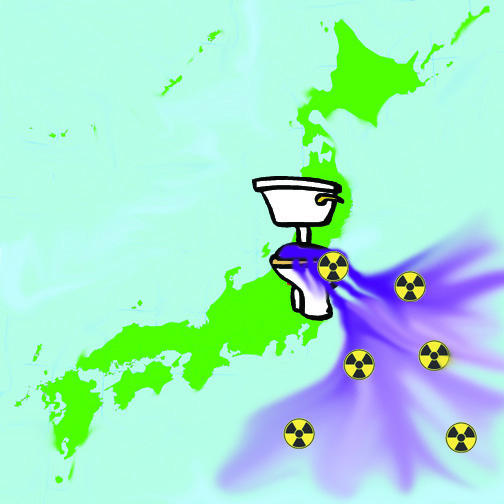 Deere-Jones 28th September 2015
Radiation can be carried long distances by marine currents, concentrated in sediments, and carried in sea spray 16km or more inland, writes Tim Deere-Jones. So Fukushima poses a hazard to coastal populations and any who eat produce from their farms. So what are the Japanese Government and IAEA doing? Ignoring the problem, and failing to gather data.
Review of the official Japanese marine monitoring programme reveals that the Japanese government is turning a blind eye to the risks of marine radiation from the stricken Fukushima site.
The strategy it has adopted, with the support of the IAEA, consistently ignores the latest evidence about the way marine radioactivity behaves in inshore marine environments and the potential radiological risks to coastal populations.
This strategy is based on a flawed hypothesis, developed by the nuclear industry through the late 1940s and early 1950s, when both oceanography and the study of the behaviour and fate of radioactivity in marine environments were in their absolute infancy.
As a result, the principal conclusions on the marine impact of the Fukushima event put forward in recent reports from the IAEA, the Government of Japan and it’s relevant agencies, minimise the environmental and public health negatives and emphasise a range of hypothetical ‘positives’.
This is a major flaw because the empirical evidence from ‘non-aligned’ research in the UK is that coastal communities are subjected to highly enriched doses of marine radioactivity through pathways of exposure, and from environmental parameters, which will not be analysed and researched under current Fukushima monitoring plans.
As a result, significant public health impacts of the event will not be documented, nor will important data about the way Fukushima marine radioactivity behaves at the coastline.
Failing to gather the evidence of coastal radiation Continue reading
Death of heroic anti war photographer Kikujiro Fukushima
Renowned Anti-War Japanese Photographer Kikujiro Fukushima Dies at 94, Peta Pixel, September 28, 2015 by Michael Zhang Acclaimed Japanese photojournalist Kikujiro Fukushima passed away on September 24th, 2015, after suffering a stroke at the age of 94. Fukushima was known for his criticism of Japan’s decision to go to war in World War II, and he spent decades documenting both the war and the aftermath of it in his homeland.
In the early years of his career, Fukushima pointed his camera at survivors of the atomic bombs dropped on Japan. The work was published in an award-winning 1961 photo book titled “Pika Don: Aru Genbaku Hisaisha no Kiroku” (which translates to “Atomic bomb: Records of one atomic bomb survivor”).
He went on to create projects, books, and exhibitions about subjects that were off the beaten path: Japanese military secrets, social injustices, feminist movements, industrial pollution, the fight against nuclear power plants, and more.
Fukushima is the only photographer who documented the aftermaths of both the nuclear bomb dropped on Hiroshima in 1945 and the Fukushima nuclear disaster in 2011.
Both are nuclear crises but different kinds,” Fukushima told the New York Times in an interview published last year. “Hiroshima’s crisis was caused by the bomb dropped by the enemy during the war. Fukushima’s crisis, though initially triggered by the earthquake and tsunami, was not really natural. It was caused by Japan’s nuclear industry whose interests more lie in their financial gain rather than the safety of the public.”
“In Hiroshima, I photographed people who were dying. In Fukushima, it looked normal but nobody knows what is going to happen in long term. I didn’t know where to begin.”……..http://petapixel.com/2015/09/28/renowned-anti-war-japanese-photographer-kikujiro-fukushima-dies-at-94/
Fukushima’s Unit no.5 nuclear reactor was gravely endangered, IAEA finally admits
IAEA Report Admits Fukushima Unit 5 Worse Than Previously Stated, Simply Info, September 28th, 2015 | Details found in the recent IAEA report on the Fukushima disaster admitted some key information about the events at unit 5. These details show that the events at unit 5 were much more dire than the impression given to the public.
During the initial disaster little was mentioned about unit 5 as other units spiraled into catastrophic meltdowns. TEPCO’s reporting was limited, purposely avoids key events and obfuscates others. The Japanese government official report did provide more detail but it used carefully crafted language to downplay and avoid admitting the real risks unfolding at this unit…….http://www.fukuleaks.org/web/?p=15022
Energy sector cooperation with North Korea in support of a regional Nuclear Weapons Free Zone

 Energy sector cooperation with the DPRK in support of a regional Nuclear Weapons Free Zone NAPSNet Special Report David von Hippel and Peter Hayes,, NAPSNet Special Reports, September 21, 2015, http://nautilus.org/napsnet/napsnet-special-reports/energy-sector-cooperation-with-the-dprk-in-support-of-a-regional-nuclear-weapons-free-zone/
INTRODUCTION
In this paper, we describe the DPRK energy economy, including a description of recent trends in DPRK energy supply and demand. We then summarize the DPRK’s energy security situation and energy sector needs, along with a brief description of potential regional/international cooperation options for providing energy sector development assistance to DPRK. These options include conventional energy, energy efficiency, and renewable energy. They are followed with more general approaches to engagement and an example “package” of cooperation measures. These non-nuclear options are benchmarked to a quantitative estimate of the net present value of the two light water reactors that were to be provided in the US-DPRK Agreed Framework but never completed, as a reasonable benchmark, followed by a review of the DPRK nuclear energy sector and related potential cooperation options and issues related to the DPRK domestic pilot light water reactor and enrichment programs. We conclude by highlighting key insights and opportunities for increasing the DPRK’s energy security in the context of regional energy development in which all states have a stake……….http://nautilus.org/napsnet/napsnet-special-reports/energy-sector-cooperation-with-the-dprk-in-support-of-a-regional-nuclear-weapons-free-zone/
Russia is watching North Korea’s nuclear program closely
Russia Rejects North Korea To Be Recognized As Nuclear State, Value Walk, By: Polina Tikhonova September 27, 2015 Russia does not recognize North Korea as a nuclear state while openly opposing Pyongyang’s nuclear program, according to top Russia’s envoy in South Korea Alexander Timonin. Speaking at a forum marking the 25th anniversary of the establishment of diplomatic relations between South Korea and Russia, Alexander Timonin said the Kremlin will never justify North Korea’s nuclear missiles nor its nuclear program.
Timonin noted that if North Korea wants to claim the right as a sovereign state to use nuclear energy for peaceful purposes, then North Korean leader Kim Jong-un first needs to uphold his father’s pledges made on September 19, 2005 under the Joint Statement to abandon the nuclear program as well as comply with UN resolutions banning Pyongyang from launching long-range missiles.
Timonin also noted that the Kremlin has repeatedly notified North Korean leadership of its stance over Pyongyang’s nuclear program during many diplomatic events.
North Korea is not the only Korea Russia is concerned about. Timonin also expressed Moscow’s concern over possible delivery of an advanced U.S. missile defense system in South Korea.
He warned that Russia and China will have to respond for the sake of their own security in case a Terminal High-Altitude Area Defense (THAAD) battery is delivered to South Korea.
Pyongyang and Moscow have significantly strengthened bilateral ties in the past year, with Russian foreign ministry calling 2015 the ‘Year of Friendship’ with North Korea. However, Kim Jong-un declined to attend Moscow’s Victory Day Parade in May, and has not had a meeting with Russian President Vladimir Putin yet.
Russia is watching North Korea’s nuclear program closely
It doesn’t seem like a ‘Year of Friendship’ at all, considering the latest non-supportive concerns expressed by Russian foreign ministry toward North Korea’s plans to resume nuclear operations and launch missiles announced on Tuesday.
In a statement on Thursday, Russian foreign ministry spokeswoman Maria Zakharova said the Kremlin has been “paying attention” and monitoring the situation ever since North Korea announced plans to launch a missile and resume activities at its Yongbyon nuclear site.
“Russia expresses its concern regarding North Korea’s continued pursuit of rocket launches and nuclear weapons production, activities that have been prohibited by U.N. Security Council resolutions,” Zakharova said, as reported by Yonhap……..http://www.valuewalk.com/2015/09/russia-rejects-north-korea-as-nuclear-state/
Up to 100% of No. 2 reactor fuel may have melted
First it was cold shutdown, then it became meltdown, what if most of it had been expelled in the skies, and if so how long it will take for them to finally admit it to the world…
A group of researchers says it is highly likely that 70 to 100 percent of fuel has melted at one of the damaged reactors at the Fukushima Daiichi nuclear power plant.
The group includes researchers from Nagoya University. It has been probing the plant’s No. 2 reactor since April of last year, using a device that uses elementary particles called muons to see into its interior.
The researchers say the results of their study show few signs of nuclear fuel at the reactor core, in contrast to the No. 5 reactor where fuel was clearly visible at its core.
This led them to believe that 70 to 100 percent of fuel at the reactor has likely melted.
The researchers say further analyses are needed to determine whether molten fuel penetrated the reactor and fell down.
The No.2 reactor is said to have released large amounts of radioactive substances following the March 2011 accident.
Tokyo Electric Power Company, the plant’s operator, has estimated that part of nuclear fuel at the reactor remains at its core.
The locations of nuclear fuel will have a significant impact on the process to remove it from the damaged reactors, the most difficult step of the decommissioning work.
The Japanese government and TEPCO plan to scan the No. 2 reactor once again using a different device.
They are also preparing to use robots around the reactor.
The group will announce the results of its study at a meeting of the Physical Society of Japan in Osaka on Saturday.
Source : NHK
Fukushima reactor could have suffered total meltdown – report
Fukushima’s reactor No.2 could have suffered a complete meltdown according to Japanese researchers. They have been monitoring the Daiichi nuclear power plant since April, but say they have found few signs of nuclear fuel at the reactor’s core.
The scientists from Nagoya University had been using a device that uses elementary particles, which are called muons. These are used to give a better picture of the inside of the reactor as the levels of radioactivity at the core mean it is impossible for any human to go anywhere near it.
However, the results have not been promising. The study shows very few signs of any nuclear fuel in reactor No. 2. This is in sharp contrast to reactor No.5, where the fuel is clearly visible at the core, the Japanese broadcaster NHK reports.
The team believes that 70 to 100 percent of the fuel has melted, though they did add that further research was needed to see whether any fuel had managed to penetrate the reactor
A report in May by the Tokyo Electric Power Company (TEPCO), which is the plant’s operator, said that a failure in reactor No.2’s pressure relief systems was one of the causes of the disaster. The team used a robot, which ventured into the building and measured radiation levels at various places, while also studying how much leakage had occurred from the control systems.
TEPCO has used 16 robots to explore the crippled plant to date, from military models to radiation-resistant multi-segmented snake-like devices that can fit through a small pipe.
However, even the toughest models are having trouble weathering the deadly radiation levels: as one robot sent into reactor No.1 broke down three hours into its planned 10-hour foray.
Despite TEPCO’s best efforts, the company has been accused of a number of mishaps and a lack of proper contingency measures to deal with the cleanup operation, after the power plant suffered a meltdown, following an earthquake and subsequent tsunami in 2011.
Recent flooding caused by Tropical Typhoon Etau swept 82 bags, believed to contain contaminated materials that had been collected from the crippled site, out to sea.
“On September 9th and 11th, due to typhoon no.18 (Etau), heavy rain caused Fukushima Daiichi K drainage rainwater to overflow to the sea,” TEPCO said in a statement, adding that the samples taken “show safe, low levels” of radiation.
“From the sampling result of the 9th, TEPCO concluded that slightly tainted rainwater had overflowed to the sea; however, the new sampling measurement results show no impact to the ocean,” it continued.
A recent study by the University of Southern California said the Fukushima disaster could have been prevented. One of the main faults cited was the decision to install critical backup generators in low-lying areas, as this was the first place the 2011 tsunami would strike, following the massive earthquake.
LISTEN MORE:https://soundcloud.com/rttv/fukushima-research
Source: RT
http://www.rt.com/news/316593-fukushima-reactor-meltdown-study/
Fukushima dairy farmers to restart shipments
FUKUSHIMA – Dairy farmers who were forced to suspend business following the 2011 nuclear accident at Tokyo Electric Power Co.’s Fukushima No. 1 power plant plan to restart milk shipments as early as this year, with a new large-scale stock farm completed in the city of Fukushima on Friday.
Fully supported by the government and the prefectural dairy cooperative association, the stock farm, with 580 cows, is expected to become a foothold for rebuilding the prefecture’s dairy industry, hit hard by business closures and radiation-related rumors.
The farm is operated by a company established jointly by five dairy farmers from Minamisoma, Namie and Iitate. Kazumasa Tanaka, 44, from Iitate, has been appointed president of the company.
The company aims to produce 5,000 tons of raw milk annually under a computer-based control system on the 3.6-hectare (8.9-acre) farm.
“I have chosen to do this because of a sense of responsibility for the rebuilding of the dairy industry in Fukushima,” Tanaka said at a completion ceremony. “It will be the happiest thing to cheer up our peers by our stock farm getting on a growth path.”
Following the triple meltdown at the nuclear plant triggered by the massive earthquake and tsunami in March 2011, 76 dairy farmers had to evacuate and suspend their operations. Among them, only 13 farmers have restarted their businesses.
In the prefecture, annual production of raw milk remains sluggish at around 80,000 tons, down 20 percent from before the disaster.
The new stock farm was developed and is owned by the prefectural dairy cooperative, which is subsidized by the central and prefectural governments.
Source: Japan Times
TEPCO rejected requests for anti-tsunami steps before nuclear crisis
Tokyo Electric Power Co turned down requests in 2009 by the nuclear safety agency to consider concrete steps against tsunami waves at the Fukushima Daiichi nuclear plant, which suffered a tsunami-triggered disaster two years later, government documents showed Friday.
“Do you think you can stop the reactors?” a TEPCO official was quoted as telling Shigeki Nagura of the now-defunct Nuclear and Industrial Safety Agency, who was then assigned to review the plant’s safety, in response to one of his requests.
The detailed exchanges between the plant operator and regulator came to light through the latest disclosure of government records on its investigation into the nuclear crisis, adding to evidence that TEPCO failed to take proper safety steps ahead of the world’s worst nuclear accident since the 1986 Chernobyl disaster.
According to records of Nagura’s accounts, Nagura heard TEPCO’s explanations of its tsunami estimates at the agency office in Tokyo in August and September 2009 as it was becoming clear that the coastal areas of Fukushima and Miyagi prefectures were hit by massive tsunami in an 869 earthquake.
TEPCO said the height of waves was estimated to be around 8 meters above sea level and will not reach the plant site located at a height of 10 meters, they show.
But Nagura said he remembered thinking pumps with key cooling functions, which are located on the ground at a height of 4 meters, “will not make it” and told TEPCO, “If this is the outcome, you better consider concrete responses.”
In refusing to immediately act, TEPCO said it would wait for related studies to be carried out by the academic society of civil engineers, which it had requested to be done by March 2012.
Nagura also proposed placing the pumps inside buildings to protect them from being exposed to water, but a TEPCO official told him, “Our company cannot make a decision without seeing the results of the (studies by the) society of civil engineers.”
Then another TEPCO official told Nagura, “Do you think you can stop the reactors?” according to the government documents.
Nagura recalled in the documents, “I wondered why I had to be told such a thing.” But he also admitted that, after all, he only encouraged TEPCO to “consider” tsunami countermeasures and did not request that it “take” specific measures.
The Fukushima crisis has revealed how Japan, which had boasted of possessing the world’s safest nuclear power plants, was ill-prepared against a severe nuclear accident. Three reactors suffered core meltdowns after they lost their key cooling functions amid a loss of all electrical power following a huge earthquake and tsunami in March 2011.
The government-appointed nuclear accident investigation panel has already issued a final report, and the government is now gradually disclosing the records of hearings conducted to people involved.
Source: Japan Today
Still 0.88 MBq/km2 of Cs-134/137 falls in Tokyo monthly

According to NRA (Nuclear Regulation Authority), Tokyo still has fallout from Fukushima nuclear plant.
From their report released on 8/31/2015, 0.88 MBq/km2 of Cs-134/137 falls onto Tokyo this July. The sampling location was Shinjuku.
The comparable data on Fukushima prefecture is not listed on the same report for some reason.
However the reading of Tokyo includes Cesium-134 at the significant level to prove this is from Fukushima plant.
In Miyagi prefecture, where is in the North of Fukushima prefecture, the fallout level is 0.55 MBq/km2. The fallout density in Tokyo is higher than Miyagi prefecture.
Other nuclide density is not reported.
http://radioactivity.nsr.go.jp/en/contents/11000/10193/24/195_20150831.pdf
Source: Fukushima Diary
‘Japanese govt creates illusion of normality at Fukushima’
Japanese authorities made a troubling decision to let people to return to their houses in the zone of the Fukushima disaster as there is still much radioactive contamination in the region, Kevin Kamps of Beyond Nuclear told RT.
RT: Would you approve of the decision of the Japanese authorities to let people return to their houses in the zone of the Fukushima disaster?
Kevin Kamps: It is a very troubling decision, because there is radioactive contamination still throughout the countryside. In fact they just announced this time to move back to Naraha under threat of cutting people off from their compensation payments from Tokyo Electric Power Company [TEPCO]. Ironically, just days later, Typhoon Etau which had with it record breaking floods redistributed the radioactivity. Not only did bags of radioactive waste wash out the sea and down rivers, but the entire landscape- areas that had not been decontaminated – that contamination then floated with the water down mountain sides, downhill into areas that had been contaminated like Naraha, but also into areas that had not been contaminated before. So this radioactivity, as we saw, as we still see with the Chernobyl nuclear catastrophe – the radioactivity from Fukushima is moving in the environment. So it is a very troubling decision by the Japanese government to try to create the illusion of normality when there is so much radioactive contamination still in the environment.
RT: How long-lasting would the effect of the disaster be?
KK: It depends on the radioactive poison that you’re speaking about specifically. So, for example, radioactive Cesium-137 has a half-life of 30 years. You have to multiply it by 10 or 20 to get the hazardous persistence. So that is 300 to 600 years of hazard with radioactive Cesium-137. Strontium-90 is about the same – 300 to 600 years of radioactive hazard. And then you have radioactive poisons that are deadly virtually forever more into the future. For example, Plutonium-239 a half-life of 24,000 years – that is a radioactive hazard of 240,000 if not 480,000 years into the future.
RT: How dangerous is the area right now?
KK: Unfortunately we don’t have much information yet after these record breaking floods just last week, which in a very big way has moved radioactivity to new places in the environment, or has re-contaminated places previously decontaminated supposedly. So there is so much that we don’t know. Certainly there have to be very careful steps taken to measure the radioactivity in the environment. Any pronouncements by local mayors or even the Japanese government that they are only detecting so much radioactivity one meter above the ground – it misses the point in a very big way. Radioactive cesium, strontium, tritium, and other radioactive poisons can enter the food supply, and people can eat the radioactivity or drink it in their drinking water. Very careful measures to guard against the contamination of the food supply and the drinking water supply have to be taken. And I don’t know if that is happening in all places right now.
RT: There are claims that TEPCO is still concealing some important information about the Fukushima tragedy. Would you say that this could be true?
KK: Absolutely, TEPCO has been caught so many times even before this catastrophe began, but certainly after the catastrophe. Just to give one example: this past February, 2015 Tokyo Electric finally announced, let the public know, that every time it rained at the site- and they had some major typhoons hit that site in the last four and a half years – the radioactivity levels in the ditches went up very significantly. Very high level radioactive water was flowing down these ditches. It turned out that there was a very badly contaminated spot on top of the Unit 2 reactor building, which suffered very large scale radioactivity releases during the catastrophe. They were simply letting this water flow down the ditches and into the ocean. They kept that quiet not for days, or for weeks, or for months, but for years. Unfortunately, TEPCO controls a lot of the information coming out of the Fukushima Daiichi Nuclear Power Plant Station. Of course it would be in their interest to try to keep things quiet that are bad for their public relations. Fortunately, this truth finally came out. But you have to wonder – how many more things are they hiding.
‘Disaster by design’
The nuclear plant was doomed from the very beginning for a number of reasons, including TEPCO’s underestimation of the possibility of a tsunami in the area, says Costas Synolakis of the Tsunami Research Center, University of Southern California.
There were two major failures of TEPCO which eventually led to the disaster, he told RT.
“First of all, it starts back when the plant was built in the 1960’s. If you can believe it – there was a coastal cliff at that location. They took it down (it was 30 meters high) to minus 4 meters, so that… it would be easier to put the foundation for the nuclear power plant plus also to save on cost. Obviously back in the 1960’s they didn’t think about tsunamis even though tsunamis happened in Japan all the time…So number two – they didn’t consider the historic reports [about tsunamis],” he said.
“TEPCO had clear chances all along the way; they were warned by Japanese seismologists and Japanese scientists that there was evidence of big tsunamis in the area… What is very serious, from my point of view, is the rationalizations that TEPCO tried to do in the beginning. At one point they were writing in one report that their analysis was conservative. Conservative means that they had overestimated the tsunami – in fact they had underestimated the tsunami. A very famous social scientist in the US – his name is Dennis Mileti, would call this ‘disaster by design’, meaning that it was just there waiting to happen.”
LISTEN MORE:https://soundcloud.com/rttv/fukushima-research
Source: RT
http://www.rt.com/op-edge/316311-fukushima-nuclear-disaster-japan/
TEPCO to sign cooperation pact with France’s CEA
NHK has learned that the operator of the crippled nuclear plant in Fukushima plans to sign an agreement with a French organization to obtain the necessary technology to decommission the facilities.
Tokyo Electric Power Company, or TEPCO, will initially focus on decontaminating the areas around the reactor containment vessels.
The removal of molten nuclear fuel will be the toughest challenge in the decontamination process because of the extremely high radiation levels.
TEPCO plans to obtain technical knowhow from the Alternative Energies and Atomic Energy Commission, or CEA, which is funded by the French government. The French organization has expertise in dismantling aged nuclear reactors and fuel-reprocessing facilities.
Sources say that under the agreement, the CEA will help TEPCO to develop remote-controlled robots that can withstand high radiation levels.
The CEA will also help with training workers and TEPCO will provide data for the decommissioning process.
This will be TEPCO’s second agreement with a foreign organization. Last year, it signed a pact with a British company to address the buildup of contaminated water.
Source: NHK
http://www3.nhk.or.jp/nhkworld/english/news/20150923_08.html
China and UK joining in promoting new nuclear technology

 China, UK to fund nuclear research centre http://www.world-nuclear-news.org/NN-China-UK-to-fund-nuclear-research-centre-25091502.html 25 September 2015
China and the UK will work together to co-fund a £50 million ($78 million) nuclear research centre, to be headquartered in the UK. Chinese vice premier Ma Kai and British chancellor George Osborne announced the plan on 21 September during the 7th UK-China Economic and Financial Dialogue summit in Beijing.
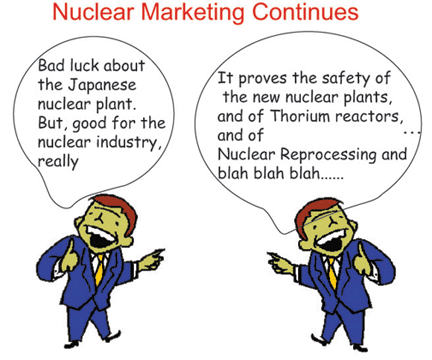
The Chancellor also announced a regional collaboration agreement between Cumbria and Sichuan Province, deepening commercial ties between the province and the north west of England’s expertise in nuclear decommissioning and waste management. These developments followed a landmark announcement by Osborne the same day that the UK government would provide up to £2 billion ($3 billion) in support for the planned Hinkley Point C nuclear power plant, which China may participate in.
The UK’s National Nuclear Laboratory (NNL) said on 22 September that it will jointly lead the new UK-China Joint Research and Innovation Centre (JRIC) with the China National Nuclear Corporation (CNNC).
The JRIC – which will incorporate projects in a number of different areas of work across the whole nuclear fuel cycle – will “act as a portal to allow UK companies and academic organizations and their Chinese counterparts to work together on areas of mutual benefit and will support the development of Subject Matter Experts and others with higher level skill in both countries,” NNL said.
Over the coming months NNL and CNNC will work together to establish a program of work for the JRIC and to develop links with other UK bodies including the Nuclear Advanced Manufacturing Research Centre (NAMRC), the National Skills Academy for Nuclear (NSAN), the Nuclear Innovation and Research Advisory Board (NIRAB) and key UK universities working in the nuclear sector.
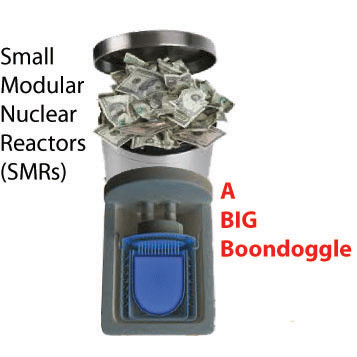 Professor Andrew Sherry, chief scientist at NNL, wrote in a blog on the Department of Energy and Climate Change’s website that there is a strong case for exploring the potential of next generation nuclear technologies. “There is scope for developing new reactor concepts including small and modular reactors, which can provide both electricity and potentially heat, and also for considering even more advanced reactors which can be powered with reprocessed spent fuel to make more efficient use of the uranium fuel, and generate less nuclear waste,” he said. “These advances will need targeted research across the UK, drawing together universities, national laboratories and industry and linking effectively with the international community.“
Britain uncomfortably close to Chinese control of nuclear power system
 The China syndrome, Economist, 25 Sept 15 Britain’s nuclear plans look over-expensive and over-reliant on China “…….. Already the £24.5 billion project to build a nuclear power station called Hinkley Point C in Somerset is expected to finish over-budget and beyond the projected start date of 2023, if it ever starts at all. But on September 21st, after unveiling in Beijing a £2 billion inducement to China to help finance Britain’s first reactor in 20 years, George Osborne exposed himself to further criticism. The country should lead the way on nuclear power as it did in the 1950s, he said. But the implication was, it could only do it with China’s help (see Bagehot).
Critics say this reveals a whiff of desperation about the government’s bet on a nuclear renaissance, ………
Analysts say Mr Osborne is engaged in a complex manoeuvre to ensure that two Chinese firms help finance EDF. The £2 billion guarantee is one inducement. Another is an offer for China to build a reactor of its own at Bradwell in Essex. That has set off further alarm bells, though. Not only would it test confidence in Britain’s Office for Nuclear Regulation, it would also put a critical part of the nuclear industry and the national grid into Chinese hands.
Roland Vetter of CF Partners, an energy trader, doubts a go-ahead for the China project will come soon; licensing new nuclear technology in Britain takes years. It could be a strategic gambit, though. EDF’s boss in Britain, Vincent de Rivaz, notes that British and French companies are keen to help China, which has an ambitious programme of its own to build nuclear power plants. Mr Osborne may also calculate that Hinkley Point will create numerous jobs and building opportunities, the economic benefits of which would accrue quickly.
The costs, meanwhile, would not become apparent until the plant is completed and bills rise. Future governments would reap the fallout, not this one. http://www.economist.com/news/britain/21667932-britains-nuclear-plans-look-over-expensive-and-over-reliant-china-china-syndrome
-
Archives
- October 2026 (112)
- September 2026 (339)
- August 2026 (330)
- July 2026 (355)
- June 2026 (287)
- May 2026 (306)
- April 2026 (356)
- March 2026 (251)
- February 2026 (267)
- January 2026 (308)
- December 2025 (358)
- November 2025 (359)
-
Categories
- 1
- 1 NUCLEAR ISSUES
- business and costs
- climate change
- culture and arts
- ENERGY
- environment
- health
- history
- indigenous issues
- Legal
- marketing of nuclear
- media
- opposition to nuclear
- PERSONAL STORIES
- politics
- politics international
- Religion and ethics
- safety
- secrets,lies and civil liberties
- spinbuster
- technology
- Uranium
- wastes
- weapons and war
- Women
- 2 WORLD
- ACTION
- AFRICA
- Atrocities
- AUSTRALIA
- Christina's notes
- Christina's themes
- culture and arts
- Events
- Fuk 2022
- Fuk 2023
- Fukushima 2017
- Fukushima 2018
- fukushima 2019
- Fukushima 2020
- Fukushima 2021
- general
- global warming
- Humour (God we need it)
- Nuclear
- RARE EARTHS
- Reference
- resources – print
- Resources -audiovicual
- Weekly Newsletter
- World
- World Nuclear
- YouTube
-
RSS
Entries RSS
Comments RSS

