Russia woos Malaysia to its nuclear technology
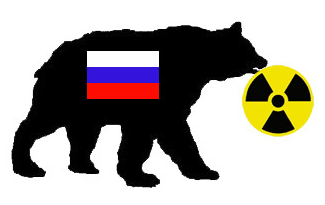 Russia offers nuclear expertise to Malaysia Star.com. 25 Sept 15 KUALA LUMPUR: Russia will extend its expertise if Malaysia decides to develop its own nuclear programme.
Russian Minister of Economic Development Alexei Ulyukayev, who said this, added that his country was well-placed to build and support a national nuclear industry.
“We will propose a very sophisticated and complex construction of a local nuclear programme. We can construct nuclear power generation stations………http://www.thestar.com.my/News/Nation/2015/09/25/Russia-offers-nuclear-expertise-to-Msia/
Japan’s draconian new secrecy laws linked to Fukushima and nuclear radiation
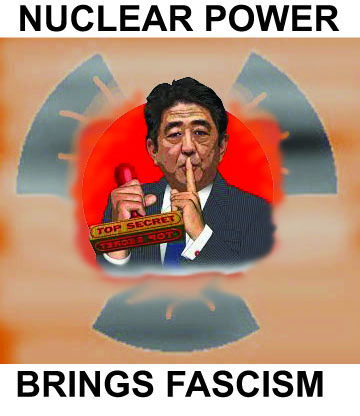 Fukushima Disaster Aftermath: Japanese Government Has Something to Hide. Sputnik News 24 Sept 15 Commenting on the aftermath of Fukushima disaster, US climate journalist Robert Hunziker suggests that the Japanese government has something to hide; “it must be really big,” the journalist notes, referring to the hard-hitting new secrecy law Tokyo has adopted.
North Korea’s nuclear belligerence highlights need for diplomacy and global disarmament treaty
The right lessons to take from North Korea’s nuclear belligerence are that nuclear weapons threaten the security of all nations, even those that possess them, and that nuclear double standards are a recipe for proliferation, not disarmament. Continuing to point nuclear weapons at North Korea while asking them not to point them back obviously won’t work.
For biological and chemical weapons, anti-personnel landmines and cluster munitions, a clear treaty prohibition paved the way for their progressive elimination. Establishing a clear moral, political and legal norm against these indiscriminate and inhumane weapons has drastically reduced their use and influenced even countries not signed up to the relevant treaty. Yet the nuclear-armed states show no intent of fulfilling their legally binding obligation to disarm.
Indeed, all are investing massively in modernising their nuclear arsenals. That is why states without the weapons need to take the lead and start negotiations that are open to all states but blockable by none, for a global treaty to prohibit nuclear weapons and provide for their verifiable elimination from the arsenals of all nations
 If we can’t stop an impoverished nation like North Korea making nuclear weapons, our
tactics are clearly wrong The Conversation, Tilman Ruff Associate Professor, International Education and Learning Unit, Nossal Institute for Global Health, School of Population and Global Health, University of Melbourne, 24 Sept 15 The timing of North Korea’s announcement last week that it has resumed “normal operation” of its Yongbyon nuclear reactor – along with a reaffirmation of its belligerent rhetoric against the United States – might be interpreted simply as a response to Chinese President Xi Jinping’s current US state visit.
But that is not to say that it shouldn’t be taken seriously. Continue reading
Temporary waste sites to be returned to owners
 As of the end of June, there were 1,134 temporary storage sites in Fukushima Prefecture, storing a total of 6.4 million cubic meters of contaminated waste — equal to filling Tokyo Dome five times over. However, due to a chronic shortage of temporary storage sites, about 1.8 million cubic meters of contaminated waste and soil have been kept at decontamination sites as it is impossible to transport them anywhere else.
The Minami-Soma municipal government in Fukushima Prefecture plans to return to landowners part of the private land used for the temporary storage of radioactive contaminated waste, marking the first time a municipal government has decided not to renew a land lease for a temporary storage site.
The construction of an interim storage facility (see below) has been delayed and three-year land leases for temporary storage sites in the prefecture have been expiring one after another since early this year. As the municipal government feels there are no prospects for gaining the understanding of landowners, it has decided to make the move with six months left on the existing lease.
Temporary storage sites were set up to store radioactive contaminated waste and soil collected during decontamination work following the nuclear crisis at Tokyo Electric Power Co.’s Fukushima No. 1 nuclear power plant. At other locations, there have been many cases in which landowners and nearby residents have shown reluctance to have their lands continue to be used as temporary storage sites, due to concerns over radioactive materials.
Under such circumstances, it is more likely that a plan for the disposal of radioactive contaminated waste, which has been promoted by the Environment Ministry, could be stalled.
Temporary storage sites were set up to store contaminated waste and soil until it becomes possible to bring the contaminated materials to an interim storage facility. To secure land for such sites, the central government signed leases with landowners in designated evacuation zones. In other areas, relevant municipal governments signed such leases.
As of the end of June, there were 1,134 temporary storage sites in Fukushima Prefecture, storing a total of 6.4 million cubic meters of contaminated waste — equal to filling Tokyo Dome five times over. However, due to a chronic shortage of temporary storage sites, about 1.8 million cubic meters of contaminated waste and soil have been kept at decontamination sites as it is impossible to transport them anywhere else.
 Minami-Soma has decided to return to landowners a temporary storage site in the Baba area of the city. It is the second largest such site in the city, set up in March 2013 by the Minami-Soma municipal government, which leased about 12 hectares of paddy fields from 41 landowners.
In October 2011, while announcing the construction plan for the interim storage facility, the Environment Ministry stated that contaminated waste and soil should be stored for three years at temporary storage sites. With this in mind, the Minami-Soma municipal government signed a three-year land lease with individual landowners, thinking that it would be possible to move contaminated waste out of the temporary storage sites in March 2016. Currently, bags filled with contaminated waste are piled up at these temporary storage sites. The amount of waste stored in the bags totals about 65,000 cubic meters, equal to filling 120 25-meter swimming pools.
However, there has been little progress in the construction of the interim storage facility due to difficulties in acquiring the necessary land. The landowners of the temporary storage site in the Baba area plan to readjust their paddy fields from around 2018, and the municipal government has considered it difficult to extend the land lease with no prospect of when contaminated waste can be removed. The municipal government has not yet found another site to store the contaminated waste after the current temporary storage site is returned to landowners.
■ Interim storage facility
An interim storage facility is planned to be built in an area covering 16 square kilometers in a difficult-to-return zone straddling the Fukushima Prefecture towns of Okuma and Futaba, site of the crippled Fukushima No. 1 nuclear power plant. The envisaged facility is intended to be able to store up to 22 million cubic meters of contaminated waste and soil generated by decontamination work. In March this year, a small amount of contaminated waste was transported to the facility site on a trial basis. The law stipulates that contaminated waste should be transported outside the prefecture within 30 years after it is first stored at the interim storage facility.
Source: Yomiuri
Radiation Impact Studies: Chernobyl and Fukushima
 “Chernobyl and Fukushima Studies Show that Radiation Reduces Animal and Plant Numbers, Fertility, Brain Size and Diversity… and Increases Deformities and Abnormalities”
Some nuclear advocates suggest that wildlife thrives in the highly-radioactive Chernobyl Exclusion Zone, animals like it, and not only that, a little radiation for anybody and everybody is harmless and maybe good, not bad. This may seem like a senseless argument to tackle were it not for the persistence of positive-plus commentary by nuke lovers. The public domain deserves better, more studied, more crucial answers.
Fortunately, as well as unfortunately, the world has two major real life archetypes of radiation’s impact on the ecosystem: Chernobyl and Fukushima. Chernobyl is a sealed-off 30klm restricted zone for the past 30 years because of high radiation levels, whereas PM Abe’s government in Japan has already started returning people to formerly restricted zones surrounding the ongoing Fukushima nuclear melt-down.
The short answer to the supposition that a “little dab of radiation is A-Okay” may be suggested in the title of a Washington Blog d/d March 12, 2014 in an interview of Dr. Timothy Mousseau, the world-renowned expert on radiation effects on living organisms. The hard answer is included further on in this article.
Dr. Mousseau is former Program Director at the National Science Foundation in Population Biology, Panelist for the National Academy of Sciences’ Panels on Analysis of Cancer Risks in Populations Near Nuclear Facilities and GAO Panel on Health and Environmental Effects from Tritium Leaks at Nuclear Power Plants, and a biology professor – and former Dean of the Graduate School, and Chair of the Graduate Program in Ecology – at the University of South Carolina.
The title of the Washington Blog interview is:
“Chernobyl and Fukushima Studies Show that Radiation Reduces Animal and Plant Numbers, Fertility, Brain Size and Diversity… and Increases Deformities and Abnormalities”
Dr. Mousseau made many trips to Chernobyl and Fukushima, making 896 inventories at Chernobyl and 1,100 biotic inventories in Fukushima. His mission was to test the effects of radiation on plants and animals. The title of his interview (above) handily serves to answer the question of whether radiation is positive for animals and plants. Without itemizing reams and reams of study data, the short answer is: Absolutely not! It is not positive for animals and plants, period.
Moreover, low doses of radiation, aka “radiation hormesis”, is not good for humans, as advocated by certain energy-related outlets. Data supporting their theory is extremely shaky and more to the point, flaky.
Furthermore, according to the Cambridge Philosophical Society’s journal Biological Reviews, including reported results by wide-ranging analyses of 46 peer-reviewed studies published over 40 years, low-level natural background radiation was found to have small, but highly statistically significant, negative effects on DNA and several measures of good health.
Dr. Mousseau, with co-author Anders Møller of the University of Paris-Sud, examined more that 5,000 papers involving background radiation in order to narrow their findings to 46 peer-reviewed studies. These studies examined plants and animals with a large preponderance of human subjects.
The scientists reported significant negative effects in a range of categories, including immunology, physiology, mutation and disease occurrence. The frequency of negative effects was beyond that of random chance.
There is no threshold below which there are no effects of radiation.
With the levels of contamination that we have seen as a result of nuclear power plants, especially in the past, and even as a result of Chernobyl and Fukushima and related accidents, there’s an attempt in the industry to downplay the doses that the populations are getting, because maybe it’s only one or two times beyond what is thought to be the natural background level…. But they’re assuming the natural background levels are fine. And the truth is, if we see effects at these low levels, then we have to be thinking differently about how we develop regulations for exposures, and especially intentional exposures to populations, like the emissions from nuclear power plants….
Results of Major Landmark Study on Low Dose Radiation (July 2015)
A consortium of researchers coordinated by the International Agency for Research on Cancer (IARC) in Lyon, France, examined causes of death in a study of more than 300,000 nuclear-industry workers in France, the United States and the United Kingdom, all of whom wore dosimeter badges.1
The workers received on average just 1.1 millisieverts (mSv) per year above background radiation, which itself is about 2–3 mSv per year from sources such as cosmic rays and radon. The study confirmed that the risk of leukemia does rise proportionately with higher doses, but also showed that this linear relationship is present at extremely low levels of radiation.
The study effectively “scuppers the popular idea that there might be a threshold dose below which radiation is harmless.”
Even so, the significant issue regarding radiation exposure for humans is that it is a “silent destroyer” that takes years and only manifests once damage has occurred; for example, 200 American sailors of the USS Reagan have filed a lawsuit against TEPCO et al because of radiation-related illnesses, like leukemia, only four years after radiation exposure from Fukushima.
Japan Moving People Back to Fukushima Restricted Zones
Japan’s Abe government has started moving people back into former restricted zones surrounding the Fukushima Daiichi Nuclear Power Station even though it is an on-going major nuclear meltdown that is totally out of control.
Accordingly, Greenpeace Japan conducted a radiation survey and sampling program in Iitate, a village in Fukushima Prefecture. Even after decontamination, radiation dose rates measured ten times (10xs) the maximum allowed to the general public.
According to Greenpeace Japan:
The Japanese government plans to lift restrictions in all of Area 2 [2], including Iitate, where people could receive radiation doses of up to 20mSV each year and in subsequent years. International radiation protection standards recommend public exposure should be 1mSv/year or less in non-post accident situations. The radiation limit that excluded people from living in the 30km zone around the Chernobyl nuclear plant exclusion zone was set at 5mSV/year, five years after the nuclear accident. Over 100,000 people were evacuated from within the zone and will never return.2
- “Researchers Pin Down Risks of Low-Dose Radiation”, Nature, July 8, 2015.
- Greenpeace Press Release, July 21, 2015
Source: The Dissident
Fukushima Disaster Aftermath: Japanese Government Has Something to Hide
 Commenting on the aftermath of Fukushima disaster, US climate journalist Robert Hunziker suggests that the Japanese government has something to hide; “it must be really big,” the journalist notes, referring to the hard-hitting new secrecy law Tokyo has adopted.
There is something sinister about the Japanese government’s optimistic claims that the notorious Fukushima Prefecture is largely safe for habitation, Los-Angeles based climate journalist Robert Hunziker notes, warning that scientific data published by third-party NGOs shows otherwise.
“The immediate direct exposure of radiation over population centers at Chernobyl was significantly more than Fukushima, where 80% drifted out into the Pacific Ocean. However, that may be slight solace because, horrifyingly, nobody knows where the Fukushima melted cores are located; it’s absolutely true, nobody knows whether the molten cores are within the containment vessels, outside of the vessels, deep in the ground, or cataclysmically traversing towards the water table,” Hunziker elaborated in his article for CounterPunch.
Meanwhile, Japan’s Prime Minister Abe’s government is encouraging people to move back into former restricted zones, claiming that “a whole lot of the mess outside of the immediate meltdown” has already been cleaned up.
Alas, it’s nearly impossible to give such an optimistic signal, since the Fukushima contamination still remains out of control, the journalist emphasized.
Citing nuclear expert Eben Harrell, the journalist underscored that some of the isotopes released during a nuclear catastrophe remain radioactive for tens of thousands of years. Remarkably, when asked in 2011 when the Chernobyl site would be inhabitable again, Igor Gramotkin, General Director of the Chernobyl Nuclear Power Plant, answered laconically: “At least 20,000 years.”
“One of the issues in trying to assess the dangers, as well as timing of recovery, for Fukushima is believability. Who can be trusted? In that regard, the Abe government’s enactment of strict extraordinarily broad secrecy laws, similar to WWII, with the threat of prison sentences up to 10 years for any violators of indeterminately wide-open secrecy laws undermines confidence in believability of the Japanese government, by definition,” Hunziker pointed out.
The journalist called attention to the latest radiation survey carried out by Greenpeace Japan, that has indicated that the Japanese government plans to move people to the areas where they could receive radiation doses of up to 20mSV annually for many years to come.According to international radiation protection standards, the recommended public exposure limit should not exceed 1mSv/year or less in non-post accidental situations.
“The radiation limit that excluded people from living in the 30km zone around the Chernobyl nuclear plant exclusion zone was set at 5mSV/year, five years after the nuclear accident. Over 100,000 people were evacuated from within the zone and will never return,” Greenpeace Japan’s report read.
The question arises why the Japanese government turns a blind eye to the fact that Fukushima residents would be exposed to 20mSV/year of radiation regardless of international norms and practices.
“Continued exposure to low-level radiation, entering the human body on a daily basis through food intake, is of particular consequence,” The Green Cross International 2015 Fukushima Report warned, as quoted by the journalist.
But that is not all, Hunziker stressed, referring to a worrisome report released by the National Institute of Radiological Science/Japan. The scientists are beating the environmental drum over the “strange growth patterns” of fir trees observed in Fukushima.About 98 percent of inspected fir trees within a 3.5 km zone surrounding Fukushima’s damaged nuclear power stations “have severe defects,” the journalist highlighted.
Furthermore, two hundred US sailors of the USS Reagan which participated in Operation Tomodachi (“Friends”), providing assistance to the infamous prefecture when it was struck by the earthquake and tsunami in March 2011, have filed a lawsuit against TEPCO, General Electric, EBASCO, Toshiba and Hitachi.
“The lawsuit includes claims for illnesses such as leukemia, ulcers, gall bladder removals, brain cancer, brain tumors, testicular cancer, dysfunctional uterine bleeding, thyroid illnesses, stomach ailments and a host of other complaints unusual in such young adults,” Hunziker underscored, elaborating that the sailors were most likely affected by radiation.
Inexplicably though, the Fukushima disaster still remains shrouded in secrecy. Moreover, the Abe government’s draconian new secrets law allows Japanese bureaucrats to conceal information from public and imprison journalists for “soliciting information that is classified a secret.”
It is obvious that Tokyo has something to hide and it must be really big, the journalist stressed, asking rhetorically: “Why else adopt a hard-hitting secrecy law on the heels of the worst disaster to hit Japan since America dropped A-bombs on Hiroshima and Nagasaki in 1945?”
Fortum to supply more ion exchange materials for purification of radioactive liquids in Fukushima, Japan –
TEPCO and their contract partners have been fairly secretive about what exactly makes the ALPS system work. While they have provided schematics and some explanation of the systems processes, they have not said what filtration materials are being used in the systems.
Finnish company Fortum has been providing ion exchange materials to Fukushima Daiichi since 2012. In their recent press release they explain what some of those filtration materials used in ALPS are.
A proprietary ion exchange material called Nures® includes three proprietary ion exchange materials
CsTreat® removes cesiums
SrTreat® removes strontium
CoTreat® removes cobalt
FORTUM CORPORATION 22 September 2015 at 10.00 EET
Fortum has received a significant additional order from the American EnergySolutions for ion exchange materials for purification of radioactive waters at the Fukushima Dai-ichi nuclear power plant in Japan. Fortum’s ion exchange materials have been used in the Advanced Liquid Processing System (ALPS) in the power plant area to purify radioactive waters for the past three years. EnergySolutions’s most recent order is one of Fortum’s largest deliveries of Nures® ion exchange materials to date.
“Fortum’s ion exchange materials effectively remove e.g. caesium and strontium from radioactive water. In addition to purification effectiveness, another advantage of the Fortum products is their cost efficiency: the amount of the product needed is very small compared to the volume of liquids to be purified,” says Fortum’s Heikki Andersson, Vice President, Power Solutions.
Fortum’s method significantly reduces the need for intermediate and final disposal repository space for radioactive liquids. Fortum has sold ion exchange materials for some 60 different applications around the world. Fortum has supplied ion exchange materials to Fukushima since spring 2012.
Fortum Corporation
Corporate Communications
Further information:
Heikki Andersson, Vice President, Power Solutions, Fortum, tel. +358 50 453 4092
Nures® product and ion exchange materials
Fortum has over 20 years of experience in treating waste containing radioactive impurities with Nures® products. Fortum initially developed the product for use at its own Loviisa nuclear power plant. The Fortum-developed products are designed to e.g. remove caesium, strontium and cobalt especially from large volumes of liquids that are particularly difficult to treat and which typically are very difficult and expensive to purify. Nures® contains extremely selective ion exchange materials CsTreat®, SrTreat® and CoTreat® to absorb radioactivity. A very small amount of these materials are needed compared to the volume of the liquid to be purified. The purified water doesn’t contain any harmful substances and thus it can be released into a water system. Esko Tusa, who has developed and sold products at Fortum for decades, received the 2015 Finnish Engineering Award for his accomplishments. The award is granted by Tekniikan akateemiset TEK and Tekniska Föreningen i Finland TFiF.
Fortum
Fortum’s purpose is to create energy that improves life for present and future generations. Fortum’s expertise is in CO2-free and efficient electricity and heat production. The company also offers energy-related products and expert services to private and industrial customers and energy producers. Fortum’s main areas of operation are the Nordic and the Baltic countries, Russia and Poland. In 2014, the annual sales (excluding the divested electricity distribution business) totalled EUR 4.1 billion, and comparable operating profit was EUR 1.1 billion. The company employs approximately 8,000 people. Fortum’s share is listed on Nasdaq Helsinki. www.fortum.com
Cs-134/137 measured from Tokyo tap-water

According to MHLH (Ministry of Health, Labour and Welfare), Cs-134/137 has been detected from tap-water of Tokyo since October of 2014. The data is from October 2014 to March 2015. The newer result hasn’t been announced yet.
The sample was collected from the tap of Tokyo Metropolitan Institute of Public Health in Shinjuku.
The density was from 0.00178 to 0.003 Bq/Kg. Cs-134 was detected to prove it is from Fukushima plant.
The analysis was implemented by NRA (Nuclear Regulation Authority).
All the other analyses were carried out by Tokyo Metropolitan Government Bureau of Waterworks or municipal governments and the lowest detectable amount was over 0.5 Bq/kg to show none of the actual readings.

Click to access 0000082427.pdf
Source: Fukushima Daiichi
Survey: 20% of reactor operators inexperienced
NHK has learned that one out of 5 workers who operate reactors at nuclear power plants in Japan has no experience in the work.
NHK surveyed 10 electric power companies to study the impact of suspended operations at their reactors following the 2011 Fukushima Daiichi nuclear accident.
The survey shows that an average of 22 percent of the reactor operators were inexperienced, as of the end of August.
The ratio of such workers was the highest, at about 40 percent, at the Sendai plant in Kagoshima Prefecture, southwestern Japan. One of the plant’s reactors was restarted last month.
This is followed by 37 percent at the Shimane plant, 33 percent at the Ikata plant, and 30 percent at the Genkai plant, all in the country’s west.
The power companies attributed the lack of experienced workers to the increasing number of workers hired after they suspended operations at their reactors.
It is said to take 10 years to become a full-fledged operator, as comprehensive knowledge and experience are needed in such fields as nuclear fuel, radiation, electricity, mechanics and chemistry.
At nuclear plants, teams of about 10 workers operate a reactor in shifts. The survey shows that 2 of these people are inexperienced.
The power companies say they are training newly hired operators at facilities simulating reactor control rooms or at their thermal power plants.
But the companies are facing difficulties educating their operators. Some officials say one reason is that they cannot use actual machines for training.
Source: NHK
http://www3.nhk.or.jp/nhkworld/english/news/20150921_23.html
Radioactivity In Our Ocean: Fukushima & Its Impact On The Pacific
Ken Buesseler, Woods Hole Oceanographic Institution, Sep 14, 2015:
- 1:02:15 — Buesseler: “There have been ongoing releases… being maintained at higher levels… The groundwater is almost impossible to stop, so that will continue for decades… very hard to contain. Ice dams, things you can engineer to stop them, have never been done on this scale before, so it’s hard to predict what’s going to happen.”
- 1:09:30 — Audience Q&A: “Can anyone — scientists, physicists, anyone — really estimate the levels that are coming out of Fukushima on a daily basis? This rain event… how could anyone possibly estimate what is going… it’s disingenuous … to make these kind of assumptions — that it ‘probably’ won’t be a problem in the future. How can anyone say that? It’s never happened before… I don’t know where these predictions can really be nailed down, and was wondering your opinion on that as a couple of ‘good scientists’ (laughs).”
- 1:11:00 — Buesseler: “Fair points. It’s never happened before, it’s somewhat unpredictable and dynamic… There’s certainly not enough information. I was very frustrated after the rain event to find almost no information about the amount and levels that were in the ocean… There are some monitoring sites right in the harbor, and you can actually see the level of cesium go up from 1,000 of my units to 3,000 — so there was an impact. How long that’s going to continue? I can’t tell you… How it’s going to change in the future? We hope it gets back down to the levels that were near zero, but it never will be. It’s going to be — for decades, anyway — a site of continuous release… that’s what keeps me up at night, are continuous leaks that could happen at that site.”
The Fukushima Fix
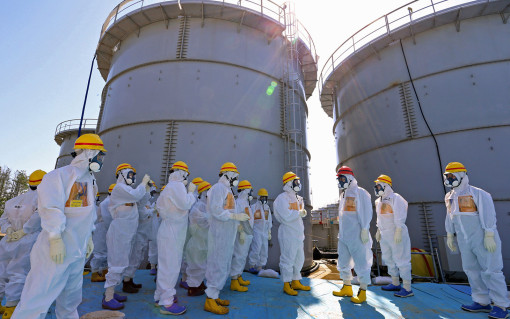
Japanese Prime Minister Shinzo Abe was briefed on the situation at the Fukushima Dai-ichi nuclear power plant as he toured the facility back on Sept. 19, 2013. chief Akira Ono (4th L) in front of two tanks (back) which are being dismantled after leaking contaminated water, during his tour to the tsunami-crippled plant in Okuma, Fukushima Prefecture, northeastern Japan on September 19, 2013. Abe told Fukushima’s operator to fix radioactive water leaks as he toured the crippled nuclear plant on September 19, less than two weeks after assuring the world the situation was under control.
Japan’s Abe government claims portions of Fukushima Prefecture (original population 2 million) are safe for habitation, radioactivity is acceptable; whereas scientific data by third-party NGOs indicates otherwise, stay away!
PM Abe’s specific maneuvers towards rehabilitation give the appearance that the Fukushima full-blown nuclear meltdown is relatively minimal in comparison to Chernobyl’s disastrous explosion of 1986. After all, to this day, Chernobyl after 30 years is still a 30km “exclusion zone” where nobody is allowed due to excessive levels of radiation.
Meanwhile, back in Japan, PM Abe is moving people back into former restricted zones four years after the fact.
It remains an open question as to whether the Fukushima aftermath will be worse than Chernobyl. After all, the China Syndrome may be actively at work at Fukushima and as such could last over many lifetimes.
Still, the immediate direct exposure of radiation over population centers at Chernobyl was significantly more than Fukushima of which 80% drifted out into the Pacific Ocean.
But, that may be slight solace because, horrifyingly, nobody knows where the Fukushima melted cores are located, nobody knows; it’s absolutely true, nobody knows whether the molten cores are within the containment vessels, outside of the vessels, deep in the ground, or cataclysmically traversing towards the water table.
Regardless, PM Abe’s directive appears to be: “No problem, we’ve cleaned up a whole lot of the mess outside of the immediate meltdown… so, move back into former restricted areas.”
Still, it’s nearly impossible to give an all-clear signal at this stage, especially with the Fukushima Daiichi Nuclear Power Station containment vessels completely out of control with wild atom-splitting rogue radionuclides spewing into the Pacific Ocean, and who knows where else (Einstein must be spinning in his grave).
The China Syndrome Worry
“While a molten reactor core wouldn’t burn ‘all the way through to China’ it could enter the soil and water table and cause huge contamination in the crops and drinking water around the power plant. It’s a nightmare scenario, the stuff of movies. And it might just have happened at Fukushima,” Eben Harrell, Was Fukushima a China Syndrome? Time Magazine, May 16, 2011.
If Chernobyl is a leading indicator of Fukushima’s future, “Chernobyl offers many lessons about what Princeton University engineering professor Robert Socolow calls the ‘afterheat’ of a nuclear disaster, but it’s the generational lesson that’s most important. Because some of the isotopes released during a nuclear accident remain radioactive for tens of thousands of years, cleanup is the work not just of first responders but also of their descendants and their descendants’ descendants. Asked when the reactor site would again become inhabitable, Ihor Gramotkin, director of the Chernobyl power plant, replies, ‘At least 20,000 years,” Eben Harrell, Apocalypse Today: Visiting Chernobyl, 25 Years Later, Time Magazine, April 26, 2011.
As of June 12th, 2015, the Abe government is returning residents to the Iitate village in Fukushima’s Prefecture four short years post the nuclear plant meltdowns, and by the upcoming 2018 year, the prime minister is eliminating state compensation to victims.
Not only that, but since August 2015, PM Abe is reopening nuclear facilities, the Sendai No. 1 reactor has already resumed full-scale commercial operations.
Contrariwise, according to former PM Naoto Kan, who was prime minister during the Fukushima disaster: “I now consider nuclear energy to be the most dangerous form of energy, and the risks associated with it are too great for us to continue generating atomic power,” Former Japanese PM Naoto Kan: Fukushima Radically Changed my Perspective, Deutsche Welle, Feb. 25, 2015.
One of the issues in trying to assess the dangers, as well as timing of recovery, for Fukushima is believability. Who can be trusted? In that regard, the Abe government’s enactment of strict extraordinarily broad secrecy laws, similar to WWII, with the threat of prison sentences up to 10 years for any violators of indeterminately wide-open secrecy laws undermines confidence in believability of the Japanese government, by definition.
On the other hand, respected third-party NGOs seem more reliable, if only because they do not have an axe to grind, no broad open-ended secrecy laws, no threats of prison sentences, no scare tactics, no public demonstrations in opposition, no lost revenues, no cleanup costs, no threats to human health, no threats to marine life, and no connections to the upcoming 2020 Tokyo Olympics.
Greenpeace/Japan Exposes Failure of Fukushima Decontamination (July 21, 2015)
Greenpeace Japan presumably takes issue with Prime Minister Abe’s declaration that people can safely move back to parts of Fukushima Prefecture.
Greenpeace Japan conducted a radiation survey and sampling program in Iitate, a village in Fukushima Prefecture. Even after decontamination, radiation dose rates measured ten times (10xs) the maximum allowed to the general public.
According to Greenpeace Japan: “The Japanese government plans to lift restrictions in all of Area 2 [2], including Iitate, where people could receive radiation doses of up to 20mSV each year and in subsequent years. International radiation protection standards recommend public exposure should be 1mSv/year or less in non-post accident situations. The radiation limit that excluded people from living in the 30km zone around the Chernobyl nuclear plant exclusion zone was set at 5mSV/year, five years after the nuclear accident. Over 100,000 people were evacuated from within the zone and will never return.” (Greenpeace Press Release, July 21, 2015).
So, Chernobyl’s 5mSV/year radiation limit morphs into the possibility of 20mSV radiation each year for some areas of Fukushima, subjecting residents to what?
According to Green Cross International, founded in 1993 by Mikhail Gorbachev, who was president of the Soviet Union when Chernobyl exploded: Both Chernobyl and the Fukushima Daiichi nuclear power plant disasters are categorized as Level 7 events defined as a major release of radioactive material.
“However, the number of people affected by radiation in Japan has tripled when compared to Chernobyl, says Nathalie Gysi of Green Cross Switzerland… water leakage at the Fukushima Daiichi power plant remains a problem four years after… There continue to be rising doubts over the safety of seafood, such as radioactivity levels in tuna and other fish.” (Green Cross Int’l March 11, 2015).
The Green Cross International 2015 Fukushima Report was prepared under direction of Jonathan M. Samet, MD, University of Southern California professor Keck School of Medicine and chair Department of Preventive Medicine, using the same standards as a similar 2012 study of Chernobyl.
According to the report: “Continued exposure to low-level radiation, entering the human body on a daily basis through food intake, is of particular consequence.”
Morphologically Defective Fir Trees
According to the National Institute of Radiological Science/Japan (“NIRS” est. 1957 as Japan’s only institute of radiology science) fir trees in Fukushima are exhibiting “strange growth patterns,” meaning the trees are stunted and showing morphological defects, in particular bifurcation or the splitting of a tree body into two parts at the tip. Thus, further normal tree growth is stopped dead.
Fir trees normally extend upward in growth patterns with two or more branches each year. However, 98% of inspected fir trees within a 3.5km area of the Fukushima damaged nuclear plants have severe defects. NIRS believes radiation causes abnormalities of fir trees “without a top bud,” hence no more normalized growth. Results of inspected trees found 125 out of 128 abnormal.
Thus, begging the question: If tree growth is stunted/deformed within 3.5km of the damaged nuclear plants, what’s the analogous impact on people?
Missing Birds
According to CBS News (April 16, 2015): “Birds are becoming a rarity around the damaged nuclear site… dramatic reductions… in terms of swallows in Fukushima, there had been hundreds if not thousands in many of these towns where we were working. Now we are seeing a few dozen… It’s just an enormous decline,” (Dr. Tim Mousseau, biologist, University of South Carolina, Dwindling Bird Populations in Fukushima, sc.edu, 4/14/15).
Fukushima Myths
Chris Harris, a former senior nuclear reactor operator for over three decades and currently a nuclear consultant, claims Fukushima is an extinction level event: Containment is a myth, there isn’t any; cold shutdown is a myth; cooling is a myth because there is no way to measure cooling when nobody knows where the nuclear fuel is located; waste processing is a myth; cleanup is a myth because it’s a “waste generation facility” that won’t stop.
Voices Within Japan
According to Yauemon Sato, the ninth-generation head of a sake brewery, since 1790, and the president of Aizu Denryok, an electric utility: “You know the caldron of hell? You will be sent to hell and will be boiled in that caldron if you do evil. And there are four such caldrons in Fukushima… And the disaster has yet to end. It continues to recur every day. More than 300 tons of water, contaminated with intense levels of radioactive substances, are being generated every day,” The Asahi Shimbun, May 1, 2015.
Hiroaki Koide, professor (retired) at Kyoto University Research Reactor Institute reacts to PM Abe, as of April 24, 2015:
“The Prime Minister [said Fukushima] had been brought to a close. My reaction on hearing his words was, ‘Stop kidding.’ Reality is, though 4 years have passed, the accident has not yet been brought to a close at all… The Japanese government has issued a declaration that this is an emergency situation. As a result, normal laws do not have to be followed. What they are saying is that, in these very high radiation exposure level areas, they have basically abandoned people to live there. They’ve actually thrown them away to live there… The Cs-137 that’s fallen onto Japanese land in the Tohoku and Kanto regions, so much so that this area should all be put under the radiation control area designation [the Kanto region includes Tokyo and is home to over 40 million people].”
Footnote on Cs-137: Cesium-137 is one of the most problematic fission isotopes as it easily moves and spreads in nature and has a half-life of 30 years. It is deadly dangerous, for example: The Kramatorsk Radiological Incident of 1989 in Ukraine a small capsule of Cs-137 was discovered inside concrete walls of an apartment building, probably part of a measurement device, lost and accidentally mixed with gravel used to make concrete. For over 9 years two families lived in the apartment. By the time the capsule was discovered, 6 residents had already died from leukemia.
Fortunately for PM Abe, unfortunately for radiation victims, radiation is a silent destroyer that slowly progresses over time. In fact, it takes 5-40 years for the incubation period to take hold. Next year is the 5th year.
Nevertheless, when hit by powerful rapid radiation exposure, too much too soon, physical damage occurs relatively quickly, now experienced by sailors of the USS Reagan that served in Japan in 2011.
U.S. Sailors File Lawsuit
Two hundred U.S. sailors of the USS Reagan have a pending lawsuit filed in San Diego against TEPCO, General Electric, EBASCO, Toshiba and Hitachi through the law offices of Bonner & Bonner, Sausalito, CA. The plaintiffs won a crucial battle in the U.S. District Court/San Diego last year, allowing the case to move forward.
“The lawsuit is based on the sailors’ participation in Operation Tomodachi (meaning “Friends”), providing humanitarian relief after the March 11, 2011 devastation caused by the Earthquake and Tsunami. The lawsuit includes claims for illnesses such as leukemia, ulcers, gall bladder removals, brain cancer, brain tumors, testicular cancer, dysfunctional uterine bleeding, thyroid illnesses, stomach ailments and a host of other complaints unusual in such young adults. The injured servicemen and women will require treatment for their deteriorating health, medical monitoring, payment of their medical bills, appropriate health monitoring for their children, and monitoring for possible radiation-induced genetic mutations,” Press Release, The Law Offices of Bonner & Bonner, Sausalito, CA.
According to the press release, up to 70,000 U.S. citizens were potentially affected by the radiation and will be able to join the class action suit, which alleges that TEPCO deliberately lied to the public and the U.S. Navy about radiation levels at the time the Japanese government was requesting help.
Therein lies a prime example, although only alleged, of why official sources in Japan cannot be trusted. Moreover, as far as convincing evidence goes: How is it that a disproportionately high number of very young naval personnel, all from the same ship, have severe medical problems like leukemia and brain cancer?
Furthermore, according to Charles Bonner, Esq.: Additional plaintiffs with serious aliments from radiation are continuing to come forward.
The Fukushima nuclear disaster is a grim tragedy that is extremely difficult to fully understand or gain trustworthy information, in large measure because the Japanese government instituted a new secrecy law, Act on the Protection of Specially Designated Secrets, Act No. 108 that is extraordinarily broad and provides up to 10 years in prison for release of “state secrets,” which may be subjectively, not objectively, defined by government bureaucrats… oh, isn’t that just grand!
Essentially, Japan surreptitiously institutes news blackouts of any information that government employees don’t like, carte blanche.
“On Dec. 10, Prime Minister Shinzo Abe’s new special secrets law took effect despite overwhelming public opposition. The new law gives bureaucrats enormous powers to withhold information produced in the course of their public duties that they deem a secret — entirely at their own discretion — and with no effective oversight mechanism to question or overturn such designations. The law also grants the government powers to imprison whistle-blowers, and prohibits disclosure of classified material even if its intention is to protect the public interest. This Draconian law also gives the government power to imprison journalists merely for soliciting information that is classified a secret,” Abe’s Secrets Law Undermines Japan’s Democracy, The Japan Times, Dec. 13, 2014.
Once again: “This Draconian law gives the government power to imprison journalists merely for soliciting information.” For merely soliciting information, for merely soliciting information, gives the government power to imprison journalists for merely soliciting info…. some footprints should never stop.
“Susumu Murakoshi, president of the Japan Federation of Bar Associations, says the law should be abolished because it jeopardizes democracy and the people’s right to know. Meiji University legal scholar Lawrence Repeta agrees with Murakoshi,” Ibid.
What democracy?
Thus, on the surface, by all appearances, the government of Japan has something to hide. It must be really big. Why else adopt a hard-hitting secrecy law on the heels of the worst disaster to hit Japan since America dropped A-bombs on Hiroshima and Nagasaki in 1945. Japan’s citizenry really should expect consolation rather than aggravation, intimidation, and terrorizing by their own government.
At the end of the day, George Orwell’s 1984 has captivated a radiantly glowing ancient country.
Source: Counterpunch
Radioactive rain releases can’t be curbed due to lack of laws: NRA
Tokyo Electric Power Co.’s stricken Fukushima No. 1 power plant has released rainwater tainted with radioactive substances into the Pacific Ocean at least seven times since April.
The Fukushima Prefectural Government, pressured by worried residents and fishermen, has pressed the Nuclear Regulation Authority to set maximum radiation limits for rainwater releases, but the regulator hasn’t acted yet, citing the lack of specific laws on radioactive rainwater.
The plant’s K channel, a gutter that was built to drain rainwater accumulated around the six reactors, leads directly to the sea. After rainwater was found tainted with radiation in April, Tepco, as a temporary fix, installed eight pumps and a special underwater curtain in its artificial bay to segregate the water from the open ocean.
With the pumps and the curtain, Tepco claims it can keep radioactive runoff within the bay as long as the rainfall stays at 14 mm per hour or less. But on Aug. 17, rainfall at the plant exceeded 18 mm per hour, and some untreated rainwater overflowed the K channel and got into the ocean. The same thing happened again on Sept. 9 and 11, amid flooding in the Kanto and Tohoku regions triggered by Typhoon Etau.
When the drainage system is overwhelmed by heavy rain, it is difficult to measure the tainted water and its radiation level, the utility said.
In May 2014, when Tepco succeeded in measuring rainwater on the premises, the cesium-137 level was gauged at 770 becquerels per liter, or over eight times the 90-becquerel limit for water the plant can release into the sea.
To rectify the situation, Tepco has been trying to change the K gutter’s path so it will flow into the artificial bay instead. But the rerouting work will take until March 2016.
While Tepco says the problem will be solved in six months, prefectural officials are demanding Tepco resolve the problem as soon as possible, because if the leaks are allowed to continue throughout the typhoon season, public distrust in the government will deepen, making the decommissioning process even more difficult.
Fishery officials are meanwhile worried that their industry could be damaged further if the unregulated rainwater releases continue.
The prefecture is specifically asking that a new pump be installed close to the source of the tainted rainwater, but Tepco has been reluctant, saying such a pump is structurally impossible to install because the part of the drainage system where tainted water is leaking from is underground.
Tepco has been cleaning the drainage gutters on a regular basis to reduce the radiation levels, but to no avail.
Kiyoshi Takasaka, a prefectural expert on atomic power, wants the NRA to place radiation limits on rainwater immediately.
However, the NRA’s position is that there are no laws that regulate radiation-tainted rainwater and therefore it cannot set numerical limits. One industry source said doing so would require revisions to existing laws, which will take a lot of time.
“I’m worried because we don’t know how much radiation-tainted rainwater has leaked out,” said Tomomitsu Konno, a 56-year-old fisherman in Soma, Fukushima Prefecture. “Tepco should fully investigate the problem and show the results to the fishermen.”
Source: Japan Times
The highest I-131 density of this year detected in 2 Fukushima sewage plants
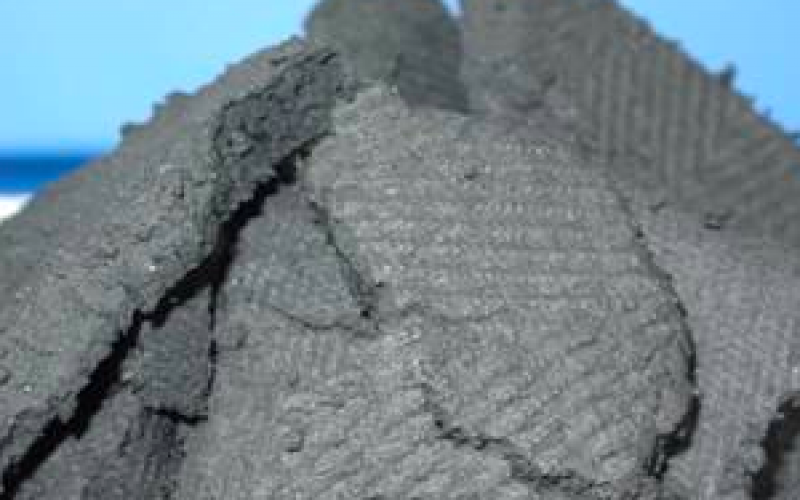
According to Fukushima sewage public corporation, this July over 1,000 Bq/Kg of Iodine-131 was detected in dry sewage sludge. The sewage plant is located in Da-te District of Fukushima prefecture.
High level of I-131 was measured this May, however this reading of July is the highest density of this year. (cf, Significant level of I-131 detected from dry sludge of Fukushima sewage plant after rain in May [URL])
I-131 was detected from the samples collected from 7/9/2015 to 7/29/2015.
The highest reading was 1,038.4 Bq/Kg of 7/11/2015. The highest density of Cs-134 was also detected, which was 44 Bq/Kg the same day. It rained on 7/8/2015 but the precipitation was only 10.5 mm.
Also in another sewage plant in Koriyama city, 889 Bq/Kg of I-131 was detected from dry sewage sludge. This is also the highest reading of this plant. I-131 kept on being detected for 15 days of this July.
http://www.pref.fukushima.lg.jp/uploaded/attachment/129631.pdf
http://www.pref.fukushima.lg.jp/uploaded/attachment/129632.pdf
Source: Fukushima Diary
The highest I-131 density of this year detected in 2 Fukushima sewage plants
Fisherman debunks radiation as cause of giant woffish
 The Guy Who Caught the Internet’s Favorite Giant Fish Is Bummed No One Gets It, Motherboard by EMIKO JOZUKA September 18, 2015 Earlier this week, an odd-looking gargantuan fish from Japan became a minor celebrity on Twitter. But the tide soon turned as curious reactions gave way to harmful rumors that its strange appearance is the result of the effects of radiationfrom the Fukushima disaster.
The fish, however, was no radioactive specimen. It was a Bering wolffish (Anarhichas orientalis)—a species found off the coast of Hokkaido, the northernmost island of Japan. It also just happens to look like a cross between a grumpy grandpa and a monster.
When rumors broke of the fish’s supposed contamination, no one was more disappointed than the man who captured the creature: Hiroshi Hirasaka, a reporter and researcher who “lives life in pursuit of odd-looking creatures.”
“The wolffish I caught was given write-ups on the internet as ‘monster as a result of nuclear accident,’” Hiroshi Hirasaka, the man who caught the fish, told me. Hirasaka initially tweeted the photo because he was proud of his catch, but he soon became devastated by the rapid-fire spread of false internet buzz around the fish.
“That fish has been in [Hokkaido] for a long time, so it’s not feasible for it to be affected by radiation. It’s rude to the fish to say that, and it’s not cool to blame everything on radiation,” Hirasaka said. “Creatures only become big in the world of science fiction, and we’re not living in the world of Hulk or Godzilla.”………
“I find slightly odd, grotesque or scary fish interesting,” Hirasaka told me. “There will always be other writers who report on the beautiful creatures of this world, but I want other people to understand the allure of more ugly specimens.”
As for the internet rumour—he tried debunking it on Twitter, but admitted that the misunderstanding was probably still developing out of his sight and control.
“People in Japan are used to seeing that fish in aquariums, but I guess other people don’t know it. I’m not sure if it was a joke or not, but I was sad to think that they thought it was like that because of nuclear radiation,” said Hirasaka. “I just want them to have the correct information.” http://motherboard.vice.com/read/the-fish-that-was-wrongly-accused-of-being-affected-by-radiation
Fukushima’s radioactive overflowing toilet
As the government of Japan continues to declare that the ocean impact from contaminated storm runoff from the Daiichi site is minimal, attention has been completely diverted from the more serious questions concerning the redistribution of toxic radiation and contaminated groundwater through massive rainfall and flooding into previously pristine locations inhabited by innocent people.
Inland impacts are considerable. Typhoon Etau likely washed more radiation from the mountains surrounding the Daiichi disaster than from the nuclear site itself, yet TEPCO and the Japanese government ignore the health impact of these huge, unmonitored releases. Without the government of Japan accepting responsibility for all the contamination caused by the nuclear disaster, the health of the public on both sides of the Pacific Ocean will continue to be jeopardized.
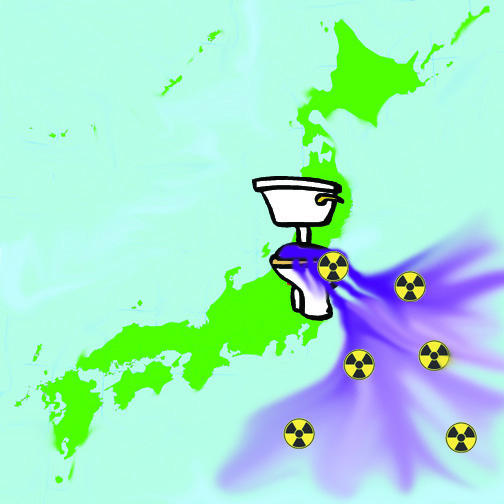
Demystifying Nuclear Power: The Fukushima Toilet Overflows http://www.fairewinds.org/nuclear-energy-education/demystifying-nuclear-power-the-fukushima-toilet-overflows by Sue Prent
Japan just can’t seem to catch a break as extreme forces in nature repeatedly buffet the island.
Efforts are currently underway to coax former Nahara residents, evacuated during the wake of the Fukushima Daiichi triple meltdown, to return to their abandoned homes in the desolated city. Despite assurance that radiation levels in Nahara are now within a ‘safe’ margin, the relatively few who chose immediate return when it officially reopened on September 11, are being issued dosimeters; a reminder that life in this city can never hope to be the same. Continue reading
-
Archives
- October 2026 (112)
- September 2026 (339)
- August 2026 (330)
- July 2026 (355)
- June 2026 (287)
- May 2026 (306)
- April 2026 (356)
- March 2026 (251)
- February 2026 (267)
- January 2026 (308)
- December 2025 (358)
- November 2025 (359)
-
Categories
- 1
- 1 NUCLEAR ISSUES
- business and costs
- climate change
- culture and arts
- ENERGY
- environment
- health
- history
- indigenous issues
- Legal
- marketing of nuclear
- media
- opposition to nuclear
- PERSONAL STORIES
- politics
- politics international
- Religion and ethics
- safety
- secrets,lies and civil liberties
- spinbuster
- technology
- Uranium
- wastes
- weapons and war
- Women
- 2 WORLD
- ACTION
- AFRICA
- Atrocities
- AUSTRALIA
- Christina's notes
- Christina's themes
- culture and arts
- Events
- Fuk 2022
- Fuk 2023
- Fukushima 2017
- Fukushima 2018
- fukushima 2019
- Fukushima 2020
- Fukushima 2021
- general
- global warming
- Humour (God we need it)
- Nuclear
- RARE EARTHS
- Reference
- resources – print
- Resources -audiovicual
- Weekly Newsletter
- World
- World Nuclear
- YouTube
-
RSS
Entries RSS
Comments RSS

