The Tragedy of Countless Unreported Nuclear Worker Deaths

 Fukushima – Deep Trouble, CounterPunch, FEBRUARY 22, 2016 by ROBERT HUNZIKER “………Indeed, the question of whether Fukushima can ever be adequately, safely decontaminated is wide-open, which logically segues to question who does the dirty work, how workers are hired, and what’s their health status? According to mainstream news sources in Japan, workers are doing just fine, estimates range up to 45,000 workers all-in, no major problems.
As far as the world is concerned, the following headline sums up radiation-related issues for workers, First Fukushima Worker Diagnosed With Radiation-linked Cancer, The Telegraph, Oct. 20, 2015. All things considered, that’s not so bad. But, who’s counting?
Trustworthy sources outside of mainstream news claim otherwise, none more so than Mako Oshidori, a Japanese freelance journalist and a director of Free Press Corporation/Japan, and a former student of School of Life Sciences at Tottori University Faculty of Medicine, in a lecture entitled “The Hidden Truth about Fukushima” delivered at the international conference “Effects of Nuclear Disasters on Natural Environment and Human Health” held in Germany in 2014 co-organized by International Physicians for Prevention of Nuclear War.
Free Press Corporation/Japan was formed after the 2011 Great Sendai Earthquake as a counterbalance to Japan’s mainstream government influenced media, described by Mako as journalists who do not report truth, journalists afraid of the truth!
“There is one thing that really surprised me here in Europe. It’s the fact that people here think Japan is a very democratic and free country.” (Mako Oshidori)
According to Mako, TEPCO and the government deliberately cover-up deaths of Fukushima workers, and not only do they cover-up deaths, but once she investigated stories of unreported deaths, government agents started following her: “When I would talk to someone, a surveillance agent from the central government’s public police force would come very close, trying to eavesdrop on the conversation,” Exposed: Death of Fukushima Workers Covered-Up by TEPCO and Government, NSNBC International, March 21, 2014.
Mako Oshidori: “I would like to talk about my interview of a nurse who used to work at the Fukushima Daiichi Nuclear Power Plant (NPP) after the accident… He quit his job with TEPCO in 2013, and that’s when I interviewed him… As of now, there are multiple NPP workers that have died, but only the ones who died on the job are reported publicly. Some of them have died suddenly while off work, for instance, during the weekend or in their sleep, but none of their deaths are reported.”
“Not only that, they are not included in the worker death count. For example, there are some workers who quit the job after a lot of radiation exposure, such as 50, 60 to 70 mili Sieverts, and end up dying a month later, but none of these deaths are either reported, or included in the death toll. This is the reality of the NPP workers.”
The “reality of the NPP workers… dying a month later” does not correspond very well with Abe administration insistence that nuke plants reopen, even though the country has continued to function for five years without nuclear power, hmm.
In her speech, Mako talks about problems for journalists because of government interference: “An ex-agent who is knowledgeable about the work of the Public Security Intelligence Agency (“PSIA”) said that when you are visibly followed, that was meant to intimidate you. If there was one person visible, then there would be ten more. I think that is analogous to cockroaches. So, when you do a little serious investigation about the nuclear accident, you are under various pressure and it makes it more difficult to interview people.”
Still, she interviewed Fukushima mothers, e.g., “Next, I would like to talk about mothers in Fukushima. These mothers (and fathers) live in Iwaki City, Fukushima. They are active on school lunch issues. Currently, Fukushima produce isn’t selling well due to suspected contamination. So the prefectural policy is to encourage the use of Fukushima produce in school lunches, in an attempt to appeal to its safety… the mothers claim that currently in Japan only cesium is measured and they have no idea if there is any strontium-90. They oppose the use of Fukushima produce in school lunches for fear of finding out, ten-plus years down the road, that there was actually plutonium in the food that children ate.”
Mothers who oppose the prefecture’s luncheon policy are told to leave Fukushima Prefecture, move out if they worry about contamination, pull up stakes and move on.
Mako’s full interview is found here.
All of which begs the question of who does the dirty work? According to Michel Chossudovsky, director of Centre for Research on Globalization (Canada), Japan’s organized crime syndicate Yakusa is actively involved in recruitment. Personnel who qualify for radioactive cleanup work include underemployed, impoverished, indigent, unemployed, homeless, hard up, down-and-out, and poverty-stricken individuals, as well as non-destitute people willing to undertake under-paid, high-risk work. The nameless are shoe-ins…….. http://www.counterpunch.org/2016/02/22/fukushima-deep-trouble/
Secrecy laws and intimidation cloud information on effects of nuclear meltdowns at Fukuhsima
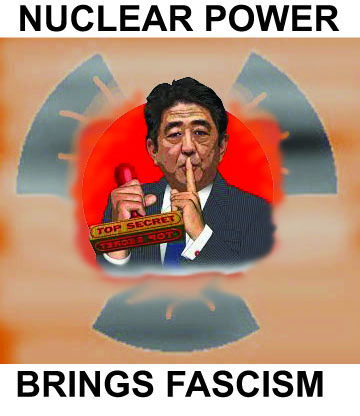 Fukushima – Deep Trouble CounterPunch, FEBRUARY 22, 2016 by ROBERT HUNZIKER “………As intimated by Mako Oshidori, governmental secrecy laws and intimidation techniques vastly overshadow the tragedy of the disaster, an oppressive black cloud that won’t go away. People are scared to say anything for fear of reprisal, jail, and blacklisting. Mako Oshidori’s name is prominently secretly blacklisted. A government mole told her.
Accordingly, it is instructive to look at Japan’s new state secrecy law Act on the Protection of Specially Designated Secrets (SDS) Act No. 108 of 2013 passed on the heels of the Fukushima meltdown, very similar to Japan’s harsh Public Peace and Order Controls of WWII. According to Act No. 108, the “act of leaking itself” is bad enough for prosecution, regardless of what, how, or why.
Thereupon, Susumu Murakoshi, president of the Japan Federation of Bar Associations says: “The law should be abolished because it jeopardizes democracy and the people’s right to know,” Abe’s Secrets Law Undermines Japan’s Democracy, The Japan Times, Dec. 13, 2014.
Public opinion is shaped by public knowledge of events, but the Abe government’s enactment of an extraordinarily broad dastardly secrecy law (almost anyone can be arrested) that threatens prison sentences up to 10 years undermines confidence in believability of the Japanese government.
But categorically, Japan needs to nurture confidence. Robert Hunziker lives in Los Angeles and can be reached at roberthunziker@icloud.com http://www.counterpunch.org/2016/02/22/fukushima-deep-trouble/
NRA suggests Tepco to give up removing molten fuel from Fukushima plant

On 2/19/2016, Fuketa, a committee member of NRA (Nuclear Regulation Authority) visited Fukushima plant and commented it needs to be considered if it is the best option to remove the molten fuel or not. He also suggested to remove a part of molten fuel to solidify the rest.
He added it depends on the research result.
The government of Japan and Tepco had been planning to remove the molten fuel at least from Reactor 1, 2 and 3 however it has not even been known where the molten fuel is accumulated.
http://www.logsoku.com/r/open2ch.net/newsplus/1455960843/
NRA suggests Tepco to give up removing molten fuel from Fukushima plant
For some Fukushima mothers, protecting children from radiation comes at heavy price

Residents who were evacuated from Okuma and three other towns in Fukushima Prefecture attend an event at a public housing facility in Iwaki to help them assimilate into the community on Feb. 19.
Three-and-a-half years after fleeing to central Japan, a mother received a package from her husband who had opted to remain at their home in Fukushima Prefecture despite the nuclear disaster.
From Tamura, about 35 kilometers west of the stricken Fukushima No. 1 nuclear plant, the father sent snacks for the couple’s two children. The cardboard box also contained divorce papers.
“I cannot send money to my family whom I cannot see,” the husband told his wife.
She still refused to return home.
Thanks to decontamination work, radiation levels have fallen around the nuclear plant since the triple meltdown caused by the Great East Japan Earthquake and tsunami in March 2011. And families are returning to their hometowns, trying to resume normal lives.
But many mothers, distrustful of the government’s safety assurances, still harbor fears that radiation will affect the health of their children. As a result of these concerns, families are being torn apart, friendships have ended, and a social divide remains wide in Fukushima communities.
Around 70,000 people are still not allowed to return to their homes located in evacuation zones designated by the central government. And an estimated 18,000 people from Fukushima Prefecture whose homes were outside those zones remain living in evacuation.
The government is pushing for Fukushima residents to return home and trying to counter false rumors about the nuclear disaster.
More families in Fukushima Prefecture are willing to buy food produced in the prefecture–but not all.
A 40-year-old mother who once lived on the coast of Fukushima Prefecture and moved farther inland to Koriyama said she still fears for the health of her 11-year-old daughter.
Her classmates started serving “kyushoku” school lunches containing Fukushima rice and vegetables that passed the screening for radioactive materials. But the fifth-grader has instead eaten from a bento lunch box prepared by her mother.
The daughter says that eating her own lunch led to teasing from her classmates. She heard one of them say behind her back: “You aren’t eating kyushoku. Are you neurotic?”
She does not talk to that classmate anymore, although they used to be friends.
“I now feel a bit more at ease even when I am different from other students,” the daughter said.
Her mother expressed concerns about her daughter’s social life, but protecting her child’s health takes precedence.
“My daughter may fall ill sometime,” the mother said. “I feel almost overwhelmed by such a fear.”
An official of the Fukushima prefectural board of education said a certain number of students act differently from other students because of health concerns over radiation.
“Although the number is limited, some students bring bento to their schools,” the official said. “Some students wear surgical masks when they participate in footraces during outdoor school athletic meets.
“The feelings toward radiation vary from person to person, so we cannot force them (to behave in the same way as other students).”
Sung Woncheol, a professor of sociology at Chukyo University, and others have conducted surveys on mothers whose children were 1 to 2 years old when the nuclear disaster started. The mothers live in Fukushima city and eight other municipalities in Fukushima Prefecture.
Of the 1,200 mothers who responded to the survey in 2015, 50 percent said they had concerns about child-rearing in Fukushima Prefecture.
Nearly 30 percent said they avoid or try to avoid using food products from Fukushima Prefecture, compared with more than 80 percent six months after the disaster.
But for some mothers, the passage of nearly five years since the disaster unfolded has not erased their fears of radiation.
The 36-year-old mother who received the divorce papers from her husband in autumn 2014 continues to live with her children in the central Japan city to which she had no previous connection.
A month after the nuclear disaster, she fled with her then 1-year-old son and her daughter, 10, from their home, even though it was not located in an evacuation zone.
She said she left Fukushima Prefecture because she “could not trust the data released by the central government.”
The mother still has not told her children that their parents are divorced.
“I believe I could protect the health of my children,” the woman said. “But my family has collapsed.”
http://ajw.asahi.com/article/0311disaster/fukushima/AJ201602230068
Wasteful spending in Tohoku
Along the beaches of Kesennuma, Miyagi Prefecture, which used to boast popular resorts, a colossal seawall is nearing completion, measuring 14.7 meters high, 9 meters thick at the base and 5 km long. This is but one of many wasteful construction projects being carried out under the pretext of rebuilding the areas in northern Japan devastated by the March 2011 earthquake and tsunami.
Almost five years after the disasters, there are many projects under way that waste huge sums of taxpayer money and benefit only a handful of construction firms and individuals who have sold their land to make way for such ventures. As if by coincidence, law enforcement authorities have taken action over bid rigging among paving companies involved in expressway construction.
Why is such a huge seawall being built in an area of Kesennuma that is mostly rice paddies? A local source confides it is because municipal assembly members, local powerful figures and those close to them sold the land to the central government at a high price. An estimated ¥2.5 billion is said to have been paid by the government to the property owners for the otherwise worthless land on which the seawall is being built.
The total cost for building the 5-km seawall was initially set at ¥23 billion but has now ballooned to ¥36 billion. This is but a small portion of an overall coastal seawall construction project stretching over 400 km in Iwate, Miyagi and Fukushima prefectures, the total cost of which is budgeted at ¥1 trillion.
As of last fall, only 17 percent of the project had been completed. Even though more than 80 percent of it can still be canceled, neither the central government nor the prefectural and municipal governments have any intention of suspending the project.
Another wasteful reconstruction scheme relates to relocating tsunami victims to higher ground. One such project being pushed by the city of Higashi-Matsushima, Miyagi Prefecture, envisages developing a hillside area to accommodate 450 houses. But the cost for the land redevelopment alone is ¥40 billion, or some ¥100 million per house — a figure that befits only the most luxurious residential area.
Even if this project is completed, there are many people who initially welcomed the plan but have found it impossible to build their own house in the area. This is because, according to a member of an association of tsunami victims, the cost to build a house has gone up 50 percent from the initial estimate of ¥15 million.
The Miyagi Prefectural Government, meanwhile, is building 15,000 houses under a seven-year, ¥180 billion plan. As of the end of last year, about half had been completed. But 16 of the 21 municipalities where those houses were built are plagued with vacancies since many of the more than 20,0000 quake victims currently living in rent-free temporary housing facilities are refusing to move into these permanent houses. As construction work continues on the remaining 7,000-plus houses, the vacancy rate is bound to increase, rendering it foolish to put any more money into the project.
A total of ¥3.5 trillion in public money is to be poured into areas devastated by the quake and tsunami to build housing facilities or to move people to higher ground. But the results of this spending spree are characterized by huge seawalls resembling prison walls, redeveloped highland areas where only a small number of houses have been built and housing with high vacancy rates.
Another sector in which public money is being wasted is road construction. Many plans for new roads, which had been submitted before the 2011 disasters, are now resurfacing as if to ride on the coattails of the massive reconstruction projects.
One example is a 100-km road to connect the inland city of Morioka and the coastal city of Miyako, both in Iwate Prefecture. Local residents had clamored in vain for the new road for more than two decades. After the disasters, however, money was suddenly allocated for the road, ostensibly for the purpose of securing emergency transport.
Similarly, the Ministry of Land, Infrastructure, Transport and Tourism is pushing a new coastal “reconstruction highway” linking Miyagi and Aomori prefectures.
Such reconstruction projects have brought big benefits to many players in the construction industry — and not just major general contractors but also smaller regional firms. Hashimototen Co., for one, has grown rapidly in the post-earthquake years to become the second-largest contractor in Miyagi Prefecture in terms of completed construction projects, thanks to its close connection with a powerful Liberal Democratic Party Lower House member — Akihiro Nishumura, a former vice minister of reconstruction — and other LDP lawmakers.
A suspicion has reportedly arisen that Hashimototen conspired with third-ranking Maruhon Gumi Corp. to split a pair of tunnel contracts so that each could build one for about ¥1 billion.
Major general contractors are also suspected of collusion. In the immediate aftermath of the earthquake, Hazama Corp. and Maeda Corp., both of which have footholds in the Tohoku region, won many contracts for debris removal. According to a local construction industry insider, this prompted leading general contractors to ask LDP lawmakers to coordinate construction orders for reconstruction projects.
As if to prove that notion, contracts for huge reconstruction projects have all been won by majors like Kajima Corp., Shimizu Corp. and Taisei Corp. Local firms that have been chosen as subcontractors by the majors have prospered so much that their executives are buying expensive cars like Mercedes to reduce their tax payments, says an insider close to a major general contractor.
The very root of this and other unethical conduct in the tsunami-hit areas appears to lie in the staggering ¥26 trillion to be spent by the central government in the first five years following the disasters. If the local governments are not required to bear any cost, it is logical that they won’t worry if the money is going to waste.
Last year, the Reconstruction Agency sought to oblige the prefectures and municipalities to bear part of the cost but faced bitter opposition and was criticized for “bullying the disaster victims.” In the end, it was decided that they will shoulder no more than 3 percent of the total spending. For example, the construction cost of the Sanriku Expressway linking Sendai with Miyako will be wholly shouldered by the central government. A member of the Miyagi Prefectural Assembly, speaking on condition of anonymity, said that the ¥26 trillion has “spoiled” the three prefectures hit hardest by the disasters — Fukushima, Miyagi and Iwate.
The situation in Fukushima Prefecture is complicated by the nuclear crisis, which forced residents near the affected power plant to flee. Even though the evacuation order was lifted last September for the town of Naraha, more than 2,000 former residents had not returned as of Jan. 14, choosing instead to remain in the city of Iwaki.
Currently they are receiving monthly compensation of ¥100,000. A local newspaper reporter said that many of those continuing to remain in temporary housing units are likely to become public welfare recipients after they have used up the compensation money.
It is true that there are local residents who are still suffering from the effects of the March 2011 disasters. But now that five years will soon have passed, attention should not be turned away from the reality of the devastated areas. Continuing to lavish funds on the victimized areas will only result in money collected from taxpayers from all over the country disappearing into the dark — a world that has nothing to do with reconstruction in the true sense of the word.
http://www.japantimes.co.jp/opinion/2016/02/22/commentary/japan-commentary/wasteful-spending-tohoku/#.VszRrebzN_n
Labor shortage hampering Japan’s post tsunami recovery
Tokyo, Feb 24 (EFE).- A growing labor shortage in northeastern Japan, which was struck by the 2011 tsunami, is hampering the economic recovery of the region five years after the tragedy, said an academic from a leading university of the region.
More than 45 percent of the companies in the area that were surveyed, reported a shortage of personnel, said Satoru Masuda, Professor of Regional Planning at the Tohoku University and President of the Research Center for Earthquake Restoration, at a press conference in Tokyo.
This is a 2.2 percent jump over 2014 and 66 percent higher than that reflected in the 2012 survey, a year after the earthquake and subsequent tsunami, which struck the northeastern coast of the archipelago and left over 18,000 people dead and missing.
The sectors most affected by this include fishing, which was decimated by the catastrophe, and the retail sector.
According to Masuda, the retail sector has been greatly affected by the progressive decline in population in the three worst-affected prefectures (Iwate, Miyagi and Fukushima), from where almost 90,000 people (more than 6 percent of the population) have fled since 2011.
Almost all the people who fled the region immediately after the tsunami and accident at the Fukushima nuclear plant decided not to return and this has hugely affected the retail sector, Masuda explained.
The problem, he added, is that many traders staying in temporary facilities the government allocated them to keep this sector alive, are not being able to get funding to reopen their businesses.
If they leave, many residents’ well-being will be affected and they will end up following their footsteps, he concluded.
The data provided by Masuda also shows the construction sector, which led the region’s recovery, peaked in 2013, and even though it is still better off than other sectors, has already begun to decline.
http://noticias.alianzanews.com/309_hispanic-world/3645372_labor-shortage-hampering-japan-s-post-tsunami-recovery.html
Less protective gear at Fukushima Daiichi
The operator of the Fukushima Daiichi nuclear plant plans to make it easier for workers engaged in decommissioning efforts nearly 5 years after the accident. They will gradually be able to work without wearing protective gear or gloves in areas with low radiation.
NHK has learned that Tokyo Electric Power Company is to introduce the new measure early next month for about 90 percent of the facility.
Radiation readings near the ground in these areas were 5 microsieverts per hour or less as of December. The figures went down after the operator removed contaminated soil and paved the surface.
TEPCO will increase in stages the number of workers wearing only regular work clothing.
The utility now requires each worker to wear protective gear and 2 pairs of gloves. This is preventing them from moving around smoothly and from carrying out precision work.
The policy will continue for people working near the reactor buildings and around tanks that contain highly radioactive water.
TEPCO plans to notify workers and tighten controls so that they do not approach these areas without wearing protective gear.
http://www3.nhk.or.jp/nhkworld/en/news/20160225_02/
TEPCO failed to follow manual on meltdown
A new finding on the 2011 Fukushima Daiichi nuclear accident has raised questions about the way the plant’s operator initially explained the catastrophe taking place in the reactors.
Nuclear fuel in 3 of the plant’s reactors melted down following the earthquake and tsunami on March 11th of that year.
Tokyo Electric Power Company did not admit there had been meltdowns for 2 more months.
The utility previously said it could find no grounds to conclude the reactors had melted down.
But it has been revealed that the firm’s in-house manual noted that damage of more than 5 percent to a reactor core should be called a meltdown. A core houses nuclear fuel.
TEPCO found the description in the manual in a probe following a request from an investigative panel of the Niigata prefectural government.
If the utility had followed the manual, it should have assessed the damage was a meltdown 3 days after the accident, when the reactors’ sensors were restored.
Engineers learned at that time that fuel in the No.1 reactor was 55 percent damaged, and 30 percent in the No.3 reactor. Both clearly meet the criteria of a meltdown.
TEPCO revised its manual after the accident. It now says it will assess and disclose when a meltdown has occurred before nuclear fuel is damaged 5 percent.
Tepco admits it should have declared meltdowns at Fukushima plant much earlier
Nearly five years after the nation’s worst nuclear accident, Tokyo Electric Power Co. has admitted that its staff failed to follow damage assessment guidelines, according to which they should have reported the meltdowns almost immediately.
A Tepco spokesman on Wednesday said the company’s Disaster Management Manual requires a reactor to be declared “in meltdown” if 5 percent or more of its fuel rods are determined to be “damaged.”
Tepco knew the extent of the damage early on. As of March 14, 2011, it estimated that 55 percent of the fuel rod assemblies of the reactor No. 1 and 25 percent of those at reactor No. 3 were “damaged,” based on the levels of radiation detected, Tepco spokesperson Yukako Handa told The Japan Times by phone.
Yet, despite widespread public skepticism at that time, the company refused to use the word “meltdown” for a period of about two months.
This led to widespread public speculation about a cover-up and failure to admit the extent of the damage. The sudden removal of a nuclear regulator spokesman fueled this.
Handa said a meltdown would have been declared if the guidelines had been followed correctly. But she said Tepco reported its estimates of damage to the government immediately — as required by law — and its failure to describe the situation as one of meltdown did not break regulations.
“Executives in charge of public relations at the time of the accident were not aware of the assessment criteria written in the Disaster Management Manual,” Handa said.
“They believed there was no clear definition of a ‘meltdown,’ so they didn’t make any clear remarks about one,’ ” she said.
Handa said Tepco will investigate why it failed to follow the assessment manual.
Wednesday’s announcement by Tepco was the first confirmation that such a manual even exists. NHK broke the news earlier in the day.
Whether to admit a “meltdown” was taking place at the plant was a sensitive topic for both the central government and Tepco from the start.
On March 12, one day after the tsunami knocked out power and cooling facilities, Koichiro Nakamura, a senior official at the now-defunct Nuclear and Industry Safety Agency, told a news conference that a “meltdown of a reactor’s core” may be taking place at the Fukushima plant, given the radiation levels detected.
Nakamura was promptly removed from a PR position at the agency, sparking speculation of a government cover-up of something critical underway at the site.
http://www.japantimes.co.jp/news/2016/02/24/national/tepco-admits-initial-assessments-fukushima-meltdowns-wrong/#.Vs33_ebzN_n
TEPCO’s understanding of ‘meltdown’ questioned
A new finding is raising questions about the explanation first offered for what was happening inside damaged reactors at the Fukushima Daiichi nuclear plant in 2011.
Nuclear fuel in 3 reactor cores melted following the earthquake and tsunami that March.
But Tokyo Electric Power Company officials failed to describe these as meltdowns.
They said there were no grounds for reaching that conclusion.
But 2 months later the utility formally admitted all 3 had melted down.
NHK has learned that the firm’s own manual says a meltdown has occurred if at least 5 percent of a core has melted. Nuclear fuel is housed in the core.
The operator told NHK it discovered this definition in the course of responding to a request from a Niigata Prefectural Government panel investigating the accident.
An NHK reporter says this would suggest TEPCO did not understand the precise definition of a meltdown until nearly 5 years after the accident.
The utility says it will continue to investigate why it didn’t use the word meltdown soon after the crisis began.
http://www3.nhk.or.jp/nhkworld/en/news/20160224_27/
Fukushima ice wall shown to media
An incinerator in Fukushima Daiichi means more incineration, which add more radioaticle nanoparticles dispersed into the air and into the environment.
The operator of the damaged Fukushima nuclear power plant has shown media outlets the site where work has been completed for an underground ice wall. The wall is designed to stop underground water from flowing into the plant’s reactor buildings.
Tokyo Electric Power Company, or TEPCO, began construction of the wall in 2014. Its work was completed earlier this month.
The wall is designed to freeze the soil around the Number 1 to Number 4 reactor buildings in order to keep groundwater from seeping into the structures.
TEPCO has driven about 1,500 pipes carrying refrigerant liquid into the ground around the buildings. The pipes and cooling devices were shown to the media on Tuesday.
But workers have not yet injected a freezing agent into the pipes. This is due to concerns that a sudden drop in groundwater levels may result in the release of radioactive water. TEPCO officials are examining the situation with the Nuclear Regulation Authority, or NRA.
Masato Kino of the Agency for Natural Resources and Energy is in charge of dealing with the contaminated water. He says now that the ice wall is completed, his agency is consulting with the NRA to reduce the volume of radioactive water at the plant.
TEPCO officials also showed the media an incinerator that will burn contaminated waste such as used protective suits.
Officials plan to start testing the incinerator on Thursday.
They hope it will help reduce about 66,000 cubic meters of waste that has accumulated at the plant.
http://www3.nhk.or.jp/nhkworld/en/news/20160223_32/
Nuclear watchdog gives nod on safety to two aging reactors for first time

The No. 1 reactor, in the background on the right, and the No. 2 reactor beside it are seen at Takahama nuclear power plant in the town of Takahama, Fukui Prefecture. The No. 3 reactor, in the foreground on the right, restarted its operation in January this year while the No. 4 reactor next to it is expected to restart its operation Feb. 26 at the earliest.
For the first time, Japan’s nuclear watchdog has disclosed that two aging nuclear reactors in operation for more than their basic lifespan of 40 years have passed the new safety standards set after the 2011 Fukushima disaster.
The No. 1 and No. 2 reactors of the Takahama nuclear power plant in Fukui Prefecture could now have their operations extended for a further 20 years as the Nuclear Regulation Authority made the announcement on Feb. 24.
To extend the operational lives of the two reactors, operator Kansai Electric Power Co. must receive NRA approval by July on three outstanding items–safety measures, detailed designs and extension of operations.
This is the fourth time the NRA has acknowledged that nuclear reactors are meeting the new safety standards, but the first time for those that are at least 40 years old.
The other three cases were the No. 1 and the No. 2 reactors at the Sendai nuclear power plant in Kagoshima Prefecture, operated by Kyushu Electric Power Co.; the No. 3 and the No. 4 reactors at the Takahama plant; and the No. 3 rector at Ikata nuclear power plant in Ehime Prefecture, operated by Shikoku Electric Power Co.
After the triple meltdown at the Fukushima No. 1 nuclear power plant in March 2011, laws on nuclear safety were revised. As a result, it was stipulated that the operation period of nuclear reactors is a basic 40 years but that can be extended by up to 20 years–but just one time–with NRA approval.
Although the No. 1 and the No. 2 reactors at the Takahama plant have been operating for more than 40 years, it is a transitional measure until July as Kansai Electric Power has yet to obtain NRA approval for a 20-year extension.
In March 2015, the utility asked to be screened by the NRA to ensure it was meeting the new safety standards. In April 2015, it applied for an additional 20 years for each reactor.
The NRA has been conducting intensive screenings on the reactors because if Kansai Electric Power cannot obtain approval on safety measures, detailed designs and extension of operations by the July deadline, it will have to decommission the two reactors.
In the safety screenings, the main focus was on fire-prevention measures with regard to electric cables. The No. 1 and No. 2 reactors were using cables totaling 1,300 kilometers in length, but they were not fire-retardant.
The utility responded by replacing 60 percent of them with fire-retardant cables, and wrapping the remaining 40 percent with fire-retardant sheets. This met with NRA approval.
With regard to earthquake and tsunami resistance, the utility used the same levels as those for the No. 3 and the No. 4 reactors at Takahama plant, both of which had already been approved by the NRA as meeting the new safety standards.
The NRA devoted 389 pages of the screening paper to its opinion that the No. 1 and the No. 2 reactors at Takahama are meeting the new safety standards. The NRA will collect opinions from the public about its conclusions for 30 days from Feb. 25 and then formally decide whether the two reactors are meeting the new standards on safety measures.
At the same time, it will go ahead with screenings on the remaining two items–detailed designs and the extension of operations. The screening on the detailed designs will focus on quake-resistant capabilities of important facilities. The screening on the extension of operation will check on the deterioration of facilities.
Even if Kansai Electric Power obtains approval on all of the three items, it will take about three years for the utility to finish work on safety measures. Because of that, the operations of Takahama’s No. 1 and No. 2 reactors are not expected to be restarted before autumn 2019.
http://ajw.asahi.com/article/behind_news/social_affairs/AJ201602240072
How banned “Mislabeled” Fukushima food products are making it onto international store shelves.

by Robert Harrington
It is being reported that tainted food from Fukushima, Ibaraki, Gumma, and Chiba is making its way into local supermarkets in Taiwan due to the irresponsibility of mislabeling. What’s more, these food products were banned in Taiwan since March of 2011.
The first question is: Why are food products from the concerned Japanese prefectures surrounding Fukushima mislabelled?
The second question is: Why is Japan attempting to foist its unsafe and inferior radioactive foods on Taiwan?
Instead of humbly acquiescing to Taiwan’s wishes, Japan takes an aggressive approach even threatening WTO arbitration.
Taiwan’s Food and Drug Administration said the latest enforcement was in line with radiation safety management practices that other countries have put in place on Japanese food imports following the 2011 Fukushima nuclear disaster.
It said it “is necessary to protect the safety of food consumption” for Taiwanese.
But Japan is protesting the move, with the government warning that it may escalate the matter to the World Trade Organization, potentially deepening the conflict between Taipei and Tokyo.
Japan Created Their Predicament by Building All of Their Nuclear Reactors on Their Island Coastlines
Rather than own the problem which successive Japanese governments are fully responsible for, they appear to be taking advantage of their neighbors. No one ever forced Japan to locate their entire nuclear power generation industry on the shoreline.
Even after 4 plus years beyond the Fukushima nuclear disaster, Japan has still failed to satisfactorily address the fallout from the meltdown(s) that occurred after the March 11, 2011 earthquake-generated tsunami.
Report: 20,000 Square Miles Contaminated by Japan’s Fukushima Daiichi
Even more inexplicably, the Japanese government has voted to continue the operation of their nuclear power plants in spite of their vulnerability to both frequent earthquakes and potential tsunamis. Being located in one of the most seismically active earthquake zones in the Ring of Fire, such an ill-advised decision can only set up another nuclear catastrophe. Which begs the question:
“Does anyone in their right mind believe that nuclear power plants can ever be designed, engineered or constructed to withstand 9.0 earthquakes followed by 15 meter high tsunamis?
The obvious answer is as follows:
“Japan should never have sited 55 nuclear reactors (plus 12 others) on its coastlines.”
Therefore, why are countries like Taiwan paying a serious price for Japan’s extraordinarily bad judgment and serious mistakes? They have known for centuries that they reside on one of the most earthquake-prone pieces of real estate in the entire world. To continue with the same nuclear energy model despite the obvious lessons of Fukushima seems to defy common sense.
Conclusion
Japan made some extremely fateful decisions post World War II concerning the ways it would satisfy the nation’s energy needs. In light of their direct experience with atomic energy during WWII, it would seem that they would have opted for non-nuclear energy alternatives. Instead, they went full bore constructing nuclear power plants as quickly as they could convince the prefectures with the targeted coastlines.
Here they are now still dealing with the Fukushima meltdown(s) — a set of intractable nuclear challenges which may have no practical solutions. That means that those prefectures surrounding Fukushima may always have an environment suffering from a proliferation of radionuclides. What exactly are radionuclides?
A radionuclide or radioactive nuclide is a nuclide that is radioactive. Also referred to as a radioisotope or radioactive isotope, it is an isotope with an unstable nucleus, characterized by excess energy available to be imparted either to a newly created radiation particle within the nucleus or via internal conversion. During this process, the radionuclide is said to undergo radioactive decay, resulting in the emission of gamma ray(s) and/or subatomic particles such as alpha or beta particles.These emissions constitute ionizing radiation. (Source: Wikipedia — Radionuclide)
Radionuclides, and especially the ionizing radiation which they emit, are certainly not something that anyone would want in their back yard, much less in their food. Nevertheless, Japan feels it can maintain the same policies that got them into this calamitous predicament. Hopefully, Taiwan will not relent to demands so unreasonable they strain credulity. After all, Japan needs to learn some critical lessons for their own benefit as well as for their trading partners.
http://naturalsociety.com/how-fukushima-produce-is-making-its-way-into-international-stores/

Japan Olympic teams to train in nuclear clean-up zone

Piles of used protective clothing worn by workers inside the contaminated ‘exclusion zone’, seen in 2011 at J-Village, a football training complex serving as an operation base for those battling Japan’s nuclear disaster in Fukushima
Tokyo (AFP) – Japan’s Olympic football teams will train for the Tokyo 2020 Games at a complex currently being used as a base for thousands of workers cleaning up the crippled Fukushima nuclear plant.
The Japan Football Association (JFA) said Monday that the Japanese men’s and women’s teams would hold their training camps at J-Village, once the country’s centre of excellence until it was taken over by plant operators following the 2011 nuclear disaster.
“The teams will use the J-Village facility as a training base,” JFA communications chief Takato Maruyama told AFP.
“It is something the JFA had been talking about but a timeline hadn’t been formally approved by the executive board, until now,” Maruyama said.
J-Village is on the fringes of the old 12-mile (20-kilometre) exclusion zone around the stricken plant, which suffered a triple reactor meltdown after a giant tsunami slammed into it in March, 2011, causing massive radiation leaks and forcing the evacuation of more than 150,000 people.
As the nuclear crisis raged, J-Village became the front line in the fight to control the situation, with helipads, medical centre and dormitories hastily erected for workers filing in and out of the plant in their protective suits and masks.

Workers queue for a bowl of soup at J-Village, a football training complex serving as an operation base for those battling Japan’s nuclear disaster in Fukushima prefecture, in 2011
Following the removal of the no-entry zone last September, the sprawling site located in the sleepy town of Naraha will undergo large-scale reconstruction with a view to a partial reopening by July 2018.
“Obviously the complex will need some refurbishment but that is the time frame we have heard from TEPCO (Tokyo Electric Power Company) and J-Village,” said Maruyama.
Japanese officials plan to reopen the facility — originally constructed by TEPCO and donated to the regional government in 1997 — to serve as a symbol of recovery for the Tokyo Olympics.
Venues in the tsunami-ravaged northeastern Tohoku region also hoping to be involved in the Games.
“J-Village has always been an important venue and it has a large role to play in the recovering of Fukushima,” JFA director Eiji Ueda told local media.
Despite the symbolic value of training at the complex, the JFA insisted that safety was of utmost importance.
“We can’t make any specific comment on radiation but clearly you can’t play football in places where it isn’t safe for people to go,” said Maruyama, referring to the proposal to reopen J-Village in 2018.
“Obviously it will be opened on condition that all decontamination work has been completed safely,” he added.
“We can’t say (at this point) if that decontamination will have been fully carried out and whether there will be zero effect from radiation by that time.”
Fukushima governor disappointed over Seoul event cancellation
He says he is dismayed, what a f@%king hypocrite! Shameless and criminal, contaminated food should not be eaten, sold and how much more exported to other countries. Do not push your contaminated foods to other people!

Fukushima Gov. Masao Uchibori expressed regret Monday over cancellation of an event that the Foreign Ministry had planned to hold in Seoul over the weekend to promote the recovery of the Tohoku region from the March 2011 earthquake and tsunami.
“I know that it will take time to eliminate the unfavorable reputation in other countries,” given the nuclear crisis, he said at a news conference in Tokyo.
The Foreign Ministry canceled the event after failing to secure necessary approval from authorities in Seoul amid lingering concern over the safety of food from Tohoku.
The event was to fun Saturday and Sunday, promoting specialties from the disaster-hit areas, including sweets and sake.
“I’m dismayed by this (cancellation),” Uchibori said, adding that he thought the event would provide a good opportunity for people in South Korea to deepen their understanding of Fukushima and the rest of Tohoku.
http://www.japantimes.co.jp/news/2016/02/22/national/fukushima-governor-disappointed-seoul-event-cancellation/#.VstQzebzN_k
1 This Month





PLEASE OPPOSE HR 8255 AND S.3639 – bills would accelerate satellite deployment, with no environmental review or safeguards – https://ncstd5li.quorum.us/campaign/169331/
To see nuclear-related stories in greater depth and intensity – go to https://nuclearinformation.wordpress.com
-
Archives
- October 2026 (81)
- September 2026 (339)
- August 2026 (330)
- July 2026 (355)
- June 2026 (287)
- May 2026 (306)
- April 2026 (356)
- March 2026 (251)
- February 2026 (267)
- January 2026 (308)
- December 2025 (358)
- November 2025 (359)
-
Categories
- 1
- 1 NUCLEAR ISSUES
- business and costs
- climate change
- culture and arts
- ENERGY
- environment
- health
- history
- indigenous issues
- Legal
- marketing of nuclear
- media
- opposition to nuclear
- PERSONAL STORIES
- politics
- politics international
- Religion and ethics
- safety
- secrets,lies and civil liberties
- spinbuster
- technology
- Uranium
- wastes
- weapons and war
- Women
- 2 WORLD
- ACTION
- AFRICA
- Atrocities
- AUSTRALIA
- Christina's notes
- Christina's themes
- culture and arts
- Events
- Fuk 2022
- Fuk 2023
- Fukushima 2017
- Fukushima 2018
- fukushima 2019
- Fukushima 2020
- Fukushima 2021
- general
- global warming
- Humour (God we need it)
- Nuclear
- RARE EARTHS
- Reference
- resources – print
- Resources -audiovicual
- Weekly Newsletter
- World
- World Nuclear
- YouTube
-
RSS
Entries RSS
Comments RSS

