Retired Pakistani diplomat recalls shady nuclear deals
 Pakistan veteran recalls shopping trips to nuclear grey markets, http://www.thehindu.com/news/international/pakistan-diplomat-jamsheed-marker-recalls-shopping-trips-to-nuclear-grey-markets/article8456193.ece THE HINDU, KALLOL BHATTACHERJEE , 10 Apr 16 Retired diplomat Jamsheed Marker talks about “meeting characters, genuine and shady, in tiny cafes tucked away in obscure villages deep in the beautiful Swiss and German countryside”.
One of Pakistan’s best-known diplomats has given an unprecedented account of how his country clandestinely built its nuclear arsenal using its diplomatic network in Europe.
In Cover Point: Impressions of Leadership in Pakistan, an autobiographical account of Pakistan’s politicians, retired diplomat Jamsheed Marker, 94, says: “This exercise involved a bit of James Bond stuff, and I remember Ikram and myself meeting characters, genuine and shady, in tiny cafes tucked away in obscure villages deep in the beautiful Swiss and German countryside.”
Mr. Marker served as Pakistan’s Ambassador to the Federal Republic of Germany between 1980 and 1982, when the meetings took place, which led to Pakistan acquiring sensitive technology from European firms for its nuclear weapons programme.
“The Embassy had a Procurement Department [the nomenclature really fooled nobody] headed by a most able officer of Minister rank named Ikram Khan, who was seconded from our nuclear establishment headed by Dr A.Q. Khan. Ikram was a superb officer, knowledgeable, low-key and efficient, and went about his sensitive job with the combination of initiative and discretion that were its primary requirements,” writes Mr. Marker , revealing how Pakistan sourced technology for its nuclear programme from western markets.
Mr. Marker’s disclosure sheds light on a wide array of willing partners from among firms in Europe which were willing to partner Pakistan’s quest for nuclear weapons, for a price. Mr. Marker, who worked directly under the supervision of General Zia-ul-Haq, played a peripheral role as the “Procurement Department” operated under a cloak of secrecy.
Mr. Marker, served for three decades in various important embassies of Pakistan, but reached the most successful phase of his career with his back-to-back appointments as Pakistani Ambassador to Bonn, Paris and Washington DC during the tenure of Gen Zia (1977-1988). Mr. Marker said that he admired the way Gen Zia (who became civilian President in 1985) diverted the West’s attention while going all out for giving Pakistan its nuclear weapon. “I maintain a mild, amused contempt for the enthusiasm with which western industrial enterprises, in their pecuniary pursuits, conspired with us to evade their own governments’ law prohibiting all nuclear transfers to Pakistan,” he writes in what is the first account from one of Gen. Zia’s key diplomats on the modus operandi adopted to build the nuclear bomb in Pakistan.
Mr. Marker says the U.S. spy services were aware of Pakistan’s determination to go nuclear and were unable to prevent Gen. Zia.
Autoradiograph: radioactivity after the 3/11 quake
By Masamichi Kagaya (Photographer) and Dr. Satoshi Mori (University of Tokyo)
As a consequence of the Great East Japan Earthquake and ensuing tsunami on March 11, 2011, the cores of the first to third nuclear reactors at the Fukushima Daiichi Nuclear Plant underwent meltdowns as external power for the cooling pumps was lost. As a result, a huge amount of radioactive particles was released into the air. These particles were carried by southeasterly winds to Iitate Village, Fukushima City, and Nakadori, a central region of Fukushima Prefecture, leaving high levels of radioactive contamination in their wake. The particles were further carried along multiple routes creating radioactively contaminated areas in regions from Ibaraki to Tokyo and Kanagawa Prefecture, as well as in Northern Kanto and the Tohoku Region (Northeastern Japan).
Whether we are in Tokyo, Fukushima, or even in front of the damaged nuclear reactor buildings, we are exposed to radiation that we are unaware of. It is too small to see, it cannot be heard and it is odorless. Therefore, despite living in a region contaminated with radioactive particles, to this day, we are not consciously aware of the radiation. NaI (TI) scintillation detectors and germanium semiconductor detectors are used to measure the amount of radioactive contamination in soil, food, and water in units called Becquerels (Bq). Radioactivity is further measured in Sieverts (Sv), which is an index of the effects of radioactive levels in the air, doses of exposure, and so on. Nevertheless, from such values, it is impossible to know how the radioactive particles are distributed or where they are concentrating in our cities, lakes, forests, and in living creatures. These values do not enable us to “see” the radioactivity. Thus, radioactive contamination has to be perceived visibly, something that can be done with the cooperation of Satoshi Mori, Professor emeritus at Tokyo University. Professor Mori is using autoradiography to make radioactive contamination visible.
Today, dozens of radiographic images of plants created by Professor emeritus Mori since 2011 are on display together with radiographic images of everyday items and animals. This collection of radiographic images (autoradiographs) is the first in history to be created for objects exposed to radiation resulting from a nuclear accident. I hope that visitors will come away with a sense of the extent of contamination in all regions subject to the fallout — not just those in and around Fukushima. At the same time, I hope that this exhibition will remind visitors of the large region extending from the Fukushima Daiichi Nuclear Power Plant to Namie Town, Iitate Village and the dense forests of the Abukuma Mountain Area that, to this day, remain restricted areas. The radiation affects animals that continue to live in these areas and be exposed to heavy radiation, as well as the 140,000 people that had to evacuate and who lost personal assets (homes, property, work, interpersonal relationships). These people are in addition to the victims who directly breathed in the radioactive materials, subjecting them to internal exposure — victims that include anyone from the residents near the plant to people in Tokyo and the Kanto Region.
Although what can be done is limited, new progress has made it possible to record the otherwise invisible radioactivity and make it visible. The history of needless nuclear accidents occurring in the United States, the Soviet Union (Russia) and Japan over the last several decades may still potentially be repeated elsewhere in the world, but hopefully future generations will see the cycle be broken. Through exhibitions and other means of disseminating knowledge about radioactivity, future generations may learn to leave behind dependence on nuclear power and be free from the dangers of nuclear accidents and nuclear waste.
http://www.chinapost.com.tw/asia/japan/2016/04/10/463030/Autoradiograph-radioactivity.htm
Tell World Leaders: No Fukushima 2020 Olympics
ON BECQUEREL AWARENESS DAY, SUNDAY, APRIL 10, 2016, FUKUSHIMA FALLOUT AWARENESS NETWORK (FFAN) LAUNCHES ITS PETITION/CAMPAIGN TO URGE WORLD LEADERS TO SAY NO TO HOSTING THE 2020 JAPAN OLYMPICS/PARALYMPICS IN FUKUSHIMA PREFECTURE!
Children are now in training to compete at the 2020 Japan Olympics in close proximity to the most devastating and ongoing nuclear and industrial disaster in world history. Our children are our most beloved and cherished gift; and as such, we know they are the most vulnerable to the generational damaging effects of man-made radiation in air, soil, food and water. On March 11, 2016, on the occasion of fifth anniversary of the Fukushima triple nuclear meltdowns, Japan’s 2020 Olympic Minister, Toshiaki Endo, stated to the Associated Press that preliminary softball, baseball and possibly other games like soccer, would very possibly be moved from the host city of Tokyo to Fukushima Prefecture!
FACTS:
1) The International Commission on Radiological Protection (ICRP) guideline for the public is 1mSV/year compared to Japan’s at 20mSv/year due to the disaster. By hosting the 2020 Olympics, Japan is willing to expose not only their own citizens but also children, their families and coaches worldwide to higher than publicly acceptable levels of radiation per the ICRP.
2) There is no safe dose. The Biological Effects of Ionizing Radiation 7 (BEIR 7) Report unequivocally states that there is no threshold of exposure below which solid cancers are not induced.
3) Even after thirty years, the 30km area around Chernobyl remains an exclusion zone. This fact makes holding the 2020 Olympics in Fukushima even more shocking. There is no possible way to return Japan to normal in 2020 after the triple nuclear meltdowns, as explosions and ongoing ensuing leaks and incineration of radioactive waste are still happening in the wake of Fukushima Daiichi.
FFAN stands in solidarity with the children and families of Japan and is committed to educating the public about the dangers of man-made radiation. In our effort to raise awareness worldwide, FFAN is asking people everywhere to SIGN and SHARE this PETITION to Japanese Ambassador Caroline Kennedy, the State Department, UNICEF and other world leaders HERE: http://chn.ge/22j0Xko
Holding the Olympics and Paralympics in Fukushima, or in fact anywhere in Japan, will not make the problems of radioactive contamination go away. To the contrary, it will only spread cancer and other diseases farther afield worldwide. Let them know the whole world is watching this most dangerous game.
(Please RSVP here and join us on our EVENT PAGE: https://www.facebook.com/events

Japan’s poor nuclear security is a global danger

 Japan Nuclear Plants Are Vulnerable to Terror Attacks, The Daily Beast, JAKE ADELSTEIN MARI YAMAMOTO, 8 Apr 16,
Poor nuclear security is endemic at Japanese power stations. It’s a ludicrous risk, not only for the Japanese, but for the world.
TOKYO — Given the febrile global security atmosphere, recent revelations that those responsible for the Brussels attacks also scoped out Belgium’s nuclear facilities have, understandably, caused great consternation in many countries.
In Japan, however, the issue of nuclear security is treated with a strangely insouciant attitude by the authorities; unarmed guards keep watch outside of nuclear facilities, there is poor surveillance of sites and, incredibly, there are no mandated background checks on workers, allowing members of organized crime gangs access to radioactive material.
There is growing awareness that this is a problem not just for this island country, but for the world.
There is every reason to believe Japan is a target of the so-called Islamic State, which was behind the horrific slaughter in Parisin November and in Brussels in March.
Early last year, amid worldwide outrage about the Charlie Hebdo attacks in France, Prime Minister Shinzo Abe made a speech in the Middle East vowing assistance to states “contending” with ISIS. That led to a de facto declaration of war against Japan by the jihadists and may have contributed to the death of a journalist they held captive.
Yet there is no serious effort to rethink the nuclear security issue. National Police Agency told The Daily Beast, on condition of anonymity, “The game has changed. We are not keeping up. We can’t trust the utility companies to deal with internal threats by themselves—they have neither the willpower nor the capability. We don’t have to worry so much about terrorists breaking down doors and blowing up nuclear power plants—we have to worry about them filling out job applications and just walking in.”
Japan has a large number of nuclear facilities staffed by guards who carry no weapons and who are otherwise poorly equipped to handle a terrorist attack. Past U.S. State Department cables note police officers who are asleep, express shock that Japanese guards are unarmed, and criticize the government for staging unrealistic training exercises while essentially outsourcing nuclear security to the utility companies.
Meanwhile there have been companies with ties to the yakuza crime organizations dispatching workers—in some cases, active yakuza members—to the plants. “Generally speaking, you don’t want sociopathic criminals around nuclear materials. Not a good idea,” deadpanned a Japan Nuclear Regulation Authority official, speaking on background, of course.
The guards do not carry weapons because Japan’s incredibly stringent gun laws make it almost impossible for civilians, including private security guards, to have them. This is good in that it keeps Japan’s annual gun-related deaths down to single digits. It’s bad in that unarmed men are probably unlikely to stop armed terrorists from storming the facilities. Some plants have armed police cars parked outside them at regular intervals, but few plants are fully guarded.
what is most disturbing to Japan’s law enforcement community is that long-debated plans to mandate background checks on nuclear facility workers in conjunction with the police have been effectively scrapped since the accident—even though they may be needed now more than ever.
Japan’s Nuclear Reprocessing Center at Rokkasho, in Aomori Prefecture, which is supposed to restart operations this year, is designed to produce eight tons of plutonium annually—enough to fuel more than 2,600 warheads. The International Atomic Energy Agency is supposed to ensure that plutonium cannot be removed or leak from the Rokkasho plant without detection. But the system it has installed there is only 99 percent accurate, meaning that, theoretically, enough plutonium for over 20 nuclear bombs a year could still be spirited away without a trace………http://www.thedailybeast.com/articles/2016/04/07/when-will-nuclear-terror-hit-japan.html
A future of litigation doesn’t augur well for Japan’s nuclear industry
 Japan’s nuclear restart stymied by courts Reactors switched on and off in campaign of litigation launched by activists Ft.com APRIL 6, 2016 by: Robin Harding in Tokyo
A welter of conflicting legal decisions has left Japan’s nuclear reactors in a state of limbo as national energy strategy clashes with the courts.
The reactors are being turned on and off like light switches as activists file lawsuits, highlighting the tension between safety fears and energy supply, and raising questions about the role of courts in nuclear regulation………The Takahama shutdown was a particular blow to the industry because a court in the district that hosts the reactor had lifted its injunction against the plant. That showed how plaintiffs can try different judges, given the wide areas potentially affected by an accident.
The stop-start court decisions are a huge frustration to government policymakers, who last year set a goal of restoring nuclear power to 20-22 per cent of Japan’s energy mix……..
“We tried leaving everything to the experts and what we got is Fukushima,” he says, arguing that one way or another, Japan’s nuclear experts are tied to the industry.
“The courts don’t consider energy strategy, they just consider whether a reactor should start or stop,” Mr Kawai says. “Thinking too much about energy strategy and government policy is what leads courts to error.”
Kenichi Ido, a former judge who issued an injunction against a nuclear power station in 2006 — well before the Fukushima disaster — said it was not surprising Japan’s courts kept coming to different opinions given the widely different views in society………That leaves Japan’s reactors facing a future of constant litigation — and Mr Kawai is revelling in it. “We’ll aim to get injunctions against any reactor that tries to restart,” he says.
With the Sendai plant operating, he recognises his alliance of lawyers may not stop them all. But, he promises: “There’s no chance of all Japan’s reactors starting up again.” https://next.ft.com/content/1c92b5ac-fbbb-11e5-b3f6-11d5706b613b
Nuclear competition between India and Pakistan is now a global threat
Nuclear Winter on a Planetary Scale: The Biggest Threat to Mankind Virtually No One Is Talking About, ALTERNET, By Dilip Hiro / TomDispatch April 8, 2016 A war between India and Pakistan could produce human suffering the likes of which the world has never seen before…….

When it comes to Pakistan’s strategic nuclear weapons, their parts are stored in different locations to be assembled only upon an order from the country’s leader. By contrast, tactical nukes are pre-assembled at a nuclear facility and shipped to a forward base for instant use. In addition to the perils inherent in this policy, such weapons would be vulnerable to misuse by a rogue base commander or theft by one of the many militant groups in the country.
In the nuclear standoff between the two neighbors, the stakes are constantly rising as Aizaz Chaudhry, the highest bureaucrat in Pakistan’s foreign ministry, recently made clear. The deployment of tactical nukes, he explained, was meant to act as a form of “deterrence,” given India’s “Cold Start” military doctrine — a reputed contingency plan aimed at punishing Pakistan in a major way for any unacceptable provocations like a mass-casualty terrorist strike against India.
New Delhi refuses to acknowledge the existence of Cold Start. Its denials are hollow. As early as 2004, it was discussing this doctrine, which involved the formation of eight division-size Integrated Battle Groups (IBGs). These were to consist of infantry, artillery, armor, and air support, and each would be able to operate independently on the battlefield. In the case of major terrorist attacks by any Pakistan-based group, these IBGs would evidently respond by rapidly penetrating Pakistani territory at unexpected points along the border and advancing no more than 30 miles inland, disrupting military command and control networks while endeavoring to stay away from locations likely to trigger nuclear retaliation. In other words, India has long been planning to respond to major terror attacks with a swift and devastating conventional military action that would inflict only limited damage and so — in a best-case scenario — deny Pakistan justification for a nuclear response.
Islamabad, in turn, has been planning ways to deter the Indians from implementing a Cold-Start-style blitzkrieg on their territory. After much internal debate, its top officials opted for tactical nukes. In 2011, the Pakistanis tested one successfully. Since then, according to Rajesh Rajagopalan, the New Delhi-based co-author of Nuclear South Asia: Keywords and Concepts, Pakistan seems to have been assembling four to five of these annually.
All of this has been happening in the context of populations that view each other unfavorably. ……….
India’s Two Secret Nuclear Sites
On the nuclear front in India, there was more to come. Last December, an investigation by the Washington-based Center for Public Integrity revealed that the Indian government was investing $100 million to build a top secret nuclear city spread over 13 square miles near the village of Challakere, 160 miles north of the southern city of Mysore. When completed, possibly as early as 2017, it will be “the subcontinent’s largest military-run complex of nuclear centrifuges, atomic-research laboratories, and weapons- and aircraft-testing facilities.” Among the project’s aims is to expand the government’s nuclear research, to produce fuel for the country’s nuclear reactors, and to help power its expanding fleet of nuclear submarines. It will be protected by a ring of garrisons, making the site a virtual military facility.
Another secret project, the Indian Rare Materials Plant, near Mysore is already in operation. It is a new nuclear enrichment complex that is feeding the country’s nuclear weapons programs, while laying the foundation for an ambitious project to create an arsenal of hydrogen (thermonuclear) bombs.
The overarching aim of these projects is to give India an extra stockpile of enriched uranium fuel that could be used in such future bombs. As a military site, the project at Challakere will not be open to inspection by the International Atomic Energy Agency or by Washington, since India’s 2008 nuclear agreement with the U.S. excludes access to military-related facilities. These enterprises are directed by the office of the prime minister, who is charged with overseeing all atomic energy projects. India’s Atomic Energy Act and its Official Secrets Act place everything connected to the country’s nuclear program under wraps. In the past, those who tried to obtain a fuller picture of the Indian arsenal and the facilities that feed it have been bludgeoned to silence.
Little wonder then that a senior White House official was recently quoted as saying, “Even for us, details of the Indian program are always sketchy and hard facts thin on the ground.” He added, “Mysore is being constantly monitored, and we are constantly monitoring progress in Challakere.” However, according to Gary Samore, a former Obama administration coordinator for arms control and weapons of mass destruction, “India intends to build thermonuclear weapons as part of its strategic deterrent against China. It is unclear, when India will realize this goal of a larger and more powerful arsenal, but they will.”
Once manufactured, there is nothing to stop India from deploying such weapons against Pakistan. “India is now developing very big bombs, hydrogen bombs that are city-busters,” said Pervez Hoodbhoy, a leading Pakistani nuclear and national security analyst. “It is not interested in… nuclear weapons for use on the battlefield; it is developing nuclear weapons for eliminating population centers.”
In other words, as the Kashmir dispute continues to fester, inducing periodic terrorist attacks on India and fueling the competition between New Delhi and Islamabad to outpace each other in the variety and size of their nuclear arsenals, the peril to South Asia in particular and the world at large only grows.
Fishermen suing Japanese govt over radiation from 1950s atomic tests
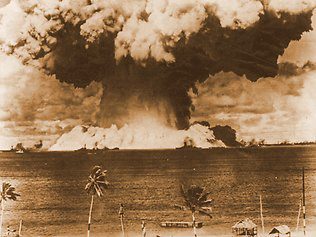 Japanese fishermen to sue over fallout from Bikini Atoll nuclear tests in 1950s Julian Ryall 8 APRIL 2016 http://www.telegraph.co.uk/news/2016/04/08/japanese-fishermen-to-sue-over-fallout-from-bikini-atoll-nuclear/
Agroup of fishermen is to sue the Japanese government for failing to release records detailing their exposure to radiation from US nuclear tests in the Pacific in the 1950s.
Some 20 people, including relatives of fishermen who have since died, are to file their case with the Kochi District Court in May, each demanding Y2 million (£13,088) in compensation.
The men have been particularly angered by the actions of the Ministry of Health, Labour and Welfare, which in September 2014 admitted it had data on the radioactive fallout that around 500 fishing vessels and their crews were exposed to in the Castle Bravo nuclear tests.
The ministry had previously claimed the documents no longer existed, the Asahi newspaper reported.
The first of the Castle Bravo tests, on March 1, 1954, was three times more powerful than scientists had initially predicted, producing a fireball around 4.5 miles across within a second.
The mushroom cloud reached a height of nearly 9 miles in around one minute and eventually climbed to an altitude of 25 miles. The blast was estimated to be 1,000 times more powerful than the atomic bombs that devastated Hiroshima and Nagasaki. As well as producing a larger blast, strong winds took the fallout far greater distances than the scientists had expected.
The Daigo Fukuryu Maru was approximately 800 miles east of Bikini Atoll, one of the Marshall Islands in the central Pacific, and more than 80 miles outside the US government’s 92,000 square mile exclusion zone around the island, when the first bomb was detonated.
Fallout began to coat the tuna fishing boat – and its 23 crew – about two hours later. Unaware of the danger, they scooped the radioactive ash off the deck with their bare hands, while one of the fishermen, Matashichi Oishi, said he licked the dust, reporting that it was gritty but had no taste.
By the time the ship docked in Japan two weeks later, the men were suffering from nausea, headaches, burns, pain in their eyes and bleeding from their gums and were diagnosed with acute radiation poisoning.
In September, 40-year-old Aikichi Kuboyama died as a result of his exposure. In 1955, the US paid Japan $2 million in “consolation money” and concluded the issue at the political level. The Japanese government paid each of the crew of the Lucky Dragon Y2 million (£13,088 at present day exchange rates), but provided nothing to fishermen aboard other ships.
The health ministry in Tokyo maintains that crew members of 10 ships were exposed to radiation, but it insists that their doses “did not reach levels that could damage their health”.
Tests conducted on enamel on the teeth of the fishermen by a professor at Okayama University of Science revealed radiation measuring up to 414 millisieverts, equivalent to people standing about 1 mile from the hypocenter of the atomic bomb that was dropped on Hiroshima in 1945.
Under Japanese law, anyone who was within 2.2 miles of the Hiroshima or Nagasaki atomic bomb detonation points is eligible for medical allowances for a range of illnesses, including cancer.
Lawyer Hiroyuki Kawai continues his lifelong fight to stop the nuclear industry
Lawyer continues 20-year campaign against nuclear power, Japan Today, By YURI KAGEYAMA and MARI YAMAGUCHI
NATIONAL APR. 08, 2016 TOKYO —
Lawyer Hiroyuki Kawai stands out in Japan, a nation dominated by somber dark suits: When not in a courtroom, he often wears colorful shirts and crystal-covered animal pins. He is a Noh dancer, a tenor and, of late, a filmmaker. His motorbike is a Harley.
Some of it is just for fun, but much of the flamboyance is meant to draw attention to his cause: shutting down all nuclear plants in Japan. His more than two-decade-long legal battle is gaining momentum after the multiple meltdowns in Fukushima five years ago led to all plants being idled for safety checks.
In March, Kawai helped set up an organization to support Fukushima residents whose children have developed thyroid cancer since the 2011 disaster — 166 among 380,000 people 18 years and under who were tested, including suspected cases. That’s up to 50 times higher than on average, according to Toshihide Tsuda, a professor at Okayama University.
The Japanese government denies any link, saying the increase reflects more rigorous screening. Thyroid cancer, rare among children at two or three in a million, soared after the 1986 Chernobyl nuclear disaster.
Also last month, Kawai’s team won a court injunction to stop two nuclear reactors in western Japan that had recently restarted. The district court cited concerns about safety, emergency planning and environmental contamination. One of the reactors was shut down shortly after its restart because of glitches. Both had met stricter standards upgraded after the 2011 disaster.
Kawai’s team is pursuing damage compensation for those evacuated from Fukushima, and criminal charges against former executives of Tokyo Electric Power Co., which operates the Fukushima plant. His ultimate goal is to banish nuclear power.
“If another nuclear accident ever happens in Japan, everything will be destroyed — turning upside down our politics, our economy, our education, our culture, our love, our law,” Kawai told The Associated Press, sitting at a desk overflowing with files and papers in his Tokyo office.
Born in 1944 in Manchuria, northeastern China, Kawaii has built a reputation as a champion of humanitarian causes, helping out Japanese abandoned as children in China after World War II, and Filipinos of Japanese descent in the Philippines. His compassion is driven partly by his own experience: A baby brother died of starvation during his family’s perilous journey back to Japan.
After graduating from prestigious Tokyo University, Kawai represented major corporations as a lawyer during the “bubble era” of the 1980s. In the mid-1990s he began taking on lawsuits against nuclear power.
Until 2011, he was fighting a losing battle………
“I think he is fantastic,” said Yurika Ayukawa, a professor of policy at Chiba University of Commerce. She attended at a recent screening where Kawai spoke and surprised the crowd by breaking into a song on Iitate, one of rural Fukushima’s most radiated areas.
Radiation is a sensitive issue in Japan, the only country to suffer atomic bomb attacks, and the Fukushima thyroid cancer patients and their families mostly have kept silent, fearing a social backlash. They face pressure from the hospital treating their children not to speak to media or to question the official view that the illnesses are unrelated to radiation.
Two of the patients’ families appeared recently with Kawai before reporters, although in a video-call with their faces not shown. They said they felt doubtful, afraid and isolated. Kawai believes they are entitled to compensation, though they have not yet filed a lawsuit.
George Fujita, an attorney who specializes in environmental issues, says Kawai is Japan’s top lawyer on nuclear lawsuits.
“It’s unusual for judges to watch a whole movie entered as evidence. It’s because the people are putting pressure on the courts,” he said.
Kawai admits that at times he been tempted to give up.
“I should never walk away. I must fight it out,” he said………..Online site for Kawai’s movie: http://www.nihontogenpatsu.com/english http://www.japantoday.com/category/national/view/lawyer-continues-20-year-campaign-against-nuclear-power
Massive amounts of radiation continue daily to enter Japan’s water and air, and the Pacific Ocean
Nuclear engineer Arnie Gundersen on Fukushima@5, Mar 7, 2016 (emphasis added): Massive amounts of radiation continue to enter Japan’s water and air, and the Pacific Ocean, daily… Due to its triple meltdowns and the unmitigable radioactive releases, Fukushima Daiichi will continue to bleed radiation into the Pacific Ocean for more than a century… There is no road map to follow with directions to stop the ongoing debacle…
Nuclear engineer Arnie Gundersen on KPFA, Mar 30, 2016: [Univ. of California] Berkeley’s nuclear program has been in the forefront of the pro-nuclear propaganda for decades, and since Fukushima has been aggressively downplaying the significance of it. So, whatever comes out of Berkeley, I just attribute to a very pro-nuclear faculty… [Woods Hole Oceanographic Institution is] measuring 1,000 miles offshore [of the US West Coast] and… picking up 10 becquerels per cubic meter [Bq/m3]. At my point, that’s when my alarm bells go off is 10 [Bq/m3]… That plume is still coming, the Pacific is a huge place and to think that a disaster on the opposite side of the world can be detected and begin to contaminate California, I think that the monumental shattering conclusion [is] radiation knows no borders… So this ‘dilution is the solution to pollution’ is what I think Berkeley believes in. What you can be sure of is that somebody’s going to die from the radiation that’s in the Pacific, but you just won’t know who it is – and they’re counting on that. The nuclear establishment is saying, ‘Well, we can smear that out in a broader epidemiological study.’
Nuclear engineer Arnie Gundersen on CCTV, Apr 5, 2016: We’re looking at newspaper coverage from the last couple of weeks and it’s clear that the plant continues to hemorrhage.
Fairewinds Japan Speaking Tour Series No. 1, Feb 12, 2016:
- Nuclear engineer Arnie Gundersen: [T]he Fukushima power plants… continues to bleed into the Pacific every day. But what no one is paying any attention to is that the entire mountain range that runs 100 miles up and down this coast is also contaminated. And as much radiation is pouring out… into the Pacific from the mountain range because it’s so contaminated, as from the Fukushima site… in fact, they’ve got an entire state pouring radiation into the Pacific. So what’s in the Pacific? Off of California, they’re finding radiation at what I would consider significant levels… in a cubic meter of ocean water, they’re finding 10 radioactive decays every second… So a cubic meter of water, if you’re in a dark room, would have 10 flashes of light every second, and that’s going to go on for 300 years. So we have contaminated the biggest source of water on the planet, and there’s no way to stop it.
- Maggie Gundersen, founder of Fairewinds: So are you saying that the contaminated water problem is hopeless? Is there nothing we can do to slow it down?
- Arnie Gundersen: It used to be that scientists believed dilution is the solution to pollution. But I think we’re finding with the biggest body of water on the planet, that you can’t dilute this stuff. And we’re going to begin to see this bio-accumulation, which is all the fish that are in the ocean are going to uptake the cesium and the strontium and become more and more and more radioactive…
Radioactivity at buried tank up in Daiichi plant

The operator of the crippled Fukushima Daiichi nuclear plant says the level of radioactivity near one underground wastewater tank at the plant is more than 100 times earlier readings.
Tokyo Electric Power Company says the tanks were built 3 years ago to store highly radioactive wastewater produced within the crippled plant. But all of the tanks soon went out of use due to repeated leaks of contaminated water.
The utility pumped most of the water out of them, but has been checking radioactivity levels of groundwater near the tanks.
On Wednesday, equipment detected 8,100 becquerels of beta-ray-emitting radioactive substances per liter of water. On Thursday, it went up to 9,300 becquerels.
A week ago, the level was only 87 becquerels.
TEPCO says it doesn’t know why the sharp rise took place. It says some highly radioactive water remains in the tank, but it is isolated with waterproof measures.
TEPCO says it will continue to analyze groundwater samples around the tank, and also compare them with data on the contaminated water left in part of the tank.
http://www3.nhk.or.jp/nhkworld/en/news/20160408_03/
Very pertinent comments and photos from Ray Masalas regarding the said “buried tank”:
I see the Japanese media is once again lying to protect Tepco. These were not tanks. They were in ground pools with sloped sides that were dug on site, lined with thin poly and filled with highly radioactive water. {See pic below} With a lining as thick as 2 garbage bags they leaked into the ground fast. Whether they transfered these tons of radioactive water to steel tanks or not, I’ll leave up to you to believe or not believe. At the same time they were building enclosed concrete ditches running down the west hill to sea. From the flyover footage I’d guess that there were about a dozen of these pits up on the west hill.

Sept 013. One of the “tanks” they spoke of.
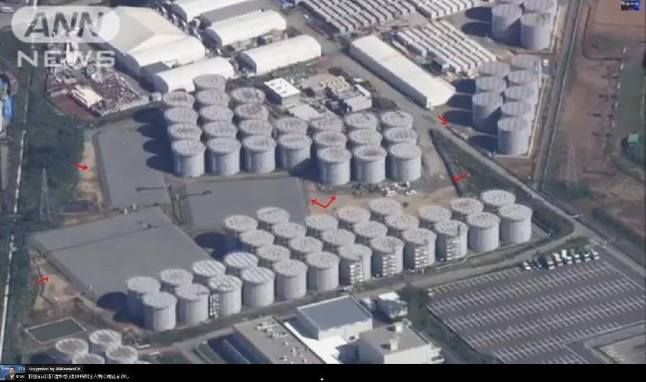
After they said that the transferred the radioactive water to steel tanks these empty pits magically got lids. My guess is that they dumped then refilled.

The enclosed concrete ditches running down to the sea were built at the same time. Dec 013
Children’s book connects stories of Fukushima and Chernobyl

A page from Shoko Nakazawa’s latest work depicts Natsuko about to part
with her pet piglet Momo.
Inspired by a letter sent to her by a young reader, author Shoko Nakazawa revived a past work and penned an entirely new illustrated children’s book on nuclear disasters in Fukushima and Chernobyl.
In 1988, Nakazawa’s “Ashita wa Hareta Sora no Shita de Bokutachi no Chernobyl” (Tomorrow, under a fair sky, our Chernobyl) was released by Choubunsha Publishing Co.
In the letter, a junior high school student in Yokohama who read the book after the triple meltdown at the Fukushima No. 1 nuclear power plant wanted to know how such an incident occurred when humans had surely learned of nuclear horrors from the Chernobyl accident in Ukraine in 1986.
The student asked what adults had done to prevent the Fukushima disaster. Because her 1988 book had long been out of print, Nakazawa, 63, first went about having it republished in summer 2011.
She also wrote a new work, recently published by Iwasaki Publishing Co., titled “Kobuta Monogatari Chernobyl kara Fukushima e” (A tale of piglets, from Chernobyl to Fukushima). The book sells for 1,300 yen, tax exclusive.
The two parts of the book involve little girls living in Chernobyl and Fukushima. Tanya lives in Chernobyl and has a pet piglet named Marumaru. Their peaceful life is turned upside down by the nuclear accident that forces all residents to evacuate.
Marumaru is left behind on the farm and time passes as the piglet waits for Tanya and her family to return. They never do.
The Fukushima portion involves a girl named Natsuko and her pet piglet Momo. They are also separated by the Fukushima nuclear accident.
A temporary lifting of the evacuation order allows Natsuko and her mother to return home. However, the mother does not recognize Momo, who is now filthy because no one was around to take care of the animal. The mother shooes the piglet away in a harsh voice.
The two parts of the book are connected because Natsuko’s mother had come to know Tanya when she visited Japan more than 20 years ago. Tanya even sent a letter to Natsuko’s mother in which she wrote, “Please do not forget us.”
During their short stay at home, the mother comes across that letter again and breaks down crying.
“I forgot everything.”
A key turning point in Nakazawa’s life was moving to Hiroshima from Nagoya before she entered junior high school. Most of her friends had parents who were hibakusha. Nakazawa herself was shocked when she saw the exhibit about the horrors of the atomic bombing at the Hiroshima Peace Memorial Museum.
She is concerned about recent moves to resume operations at nuclear power plants around Japan.
“We are once again trying to forget,” she said. “I hope the book becomes a catalyst to rethink a civilization that exists upon something like ‘nuclear power’ that simply cannot co-exist with humans and nature.”
Reactor ruling ignores lessons, anxiety from Fukushima crisis
A court ruling concerning nuclear reactor operations raises serious doubts about whether the court rightly recognized the gravity of the damage and the harsh realities caused by the 2011 accident at the Fukushima No. 1 nuclear plant.
The Miyazaki branch of the Fukuoka High Court on April 6 rejected an appeal by Kyushu residents seeking an injunction to shut down the No. 1 and No. 2 reactors of the Sendai nuclear plant run by Kyushu Electric Power Co. in Satsuma-Sendai, Kagoshima Prefecture. They are the only two reactors currently operating in Japan.
The ruling in essence said the Nuclear Regulation Authority’s (NRA) new safety standards, established after the disaster at the Fukushima plant, reflect the lessons learned from the triple meltdown and cannot be described as unreasonable. It also dismissed the plaintiffs’ argument that the design of the Sendai plant underestimates the safety risks posed by possible major earthquakes.
This ruling stands in sharp contrast with the Otsu District Court’s decision in March that raised doubts about the NRA’s safety standards and ordered the suspension of operations of two reactors at Kansai Electric Power Co.’s Takahama nuclear plant in Fukui Prefecture.
What happened in Fukushima has created strong anxiety among Japanese about the safety of nuclear power generation. From this point of view, it is obvious which of the two rulings really echoed the public sentiment about nuclear safety.
Symptomatic of the two courts’ different stances toward public concerns are their views about evacuation plans.
The new nuclear safety standards do not address issues related to evacuation plans.
The Otsu District Court raised questions about this fact and contended that the government is obliged to develop new regulatory standards based on a broader perspective that also address evacuation plans.
The Miyazaki branch acknowledged there are legitimate concerns about the existing plan for emergency evacuations.
The plaintiffs argued that the plan would be unable to deal with a situation that requires an immediate and massive evacuation. They also said the number of buses available to transport local residents during nuclear crises would be insufficient.
But the court nevertheless dismissed the plaintiffs’claim that operating the Sendai reactors violates their personal rights. The court pointed out that at least an emergency evacuation plan was in place.
Following the accident in Fukushima, many residents could not smoothly flee for their safety, leading to serious confusion.
The high court’s decision did not give due consideration to this fact.
Volcanoes, including the highly active Sakurajima, are located around the Sendai nuclear plant.
The NRA has established guidelines concerning the risks to nuclear plants posed by volcanic eruptions.
The high court judged the guidelines, based on the assumption that the timing and scale of eruptions can be accurately predicted, to be “irrational.”
Yet the court said the probability of an eruption triggering a catastrophic nuclear accident was so low that the risk can be ignored unless solid grounds for thinking otherwise are shown.
The court acknowledged the NRA’s flawed approach to dealing with the safety risk posed by volcanic eruptions. But it said the widely accepted view in society is that the risk can be ignored because of the low probability of such eruptions actually occurring.
Can this be described as an opinion based on serious reflection on the fact that unforeseen circumstances occurred at the Fukushima plant?
The exact causes of the nuclear disaster are not yet clear, and around 100,000 people are still living as evacuees.
That explains why various opinion polls show a majority of respondents expressing negative views about plans to restart reactors.
The court ruling that endorses the NRA’s new safety standards does not translate into public support of the government’s policy to bring idled reactors back on stream.
The sharply different court rulings on reactor operations should be regarded as a sign that the knotty question of how to secure safety at nuclear plants remains unsolved.
Japan lawyer wants no-nukes after Fukushima
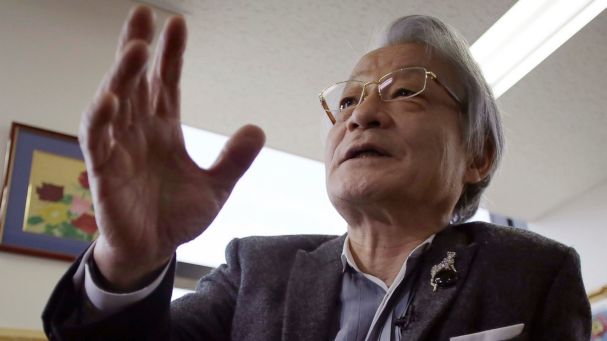
Lawyer Hiroyuki Kawai stands out in Japan, a nation dominated by somber dark suits: When not in a courtroom, he often wears colorful shirts and crystal-covered animal pins. He is a Noh dancer, a tenor and, of late, a filmmaker. His ride is a Harley.
Some of it is just for fun, but much of the flamboyance is meant to draw attention to his cause: shutting down all nuclear plants in Japan. His more than two-decade-long legal battle is gaining momentum after the multiple meltdowns in Fukushima five years ago led to all plants being idled for safety checks.
In March, Kawai helped set up an organization to support Fukushima residents whose children have developed thyroid cancer since the 2011 disaster — 166 among 380,000 people 18 years and under who were tested, including suspected cases. That’s up to 50 times higher than on average, according to Toshihide Tsuda, a professor at Okayama University.
The Japanese government denies any link, saying the increase reflects more rigorous screening. Thyroid cancer, rare among children at two or three in a million, soared after the 1986 Chernobyl nuclear disaster.
Also last month, Kawai’s won a court injunction to stop two nuclear reactors in western Japan that had recently restarted. The district court cited concerns about safety, emergency planning and environmental contamination. One of the reactors was shut down shortly after its restart because of glitches. Both had met stricter standards upgraded after the 2011 disaster.
Kawai’s team is pursuing damage compensation for those evacuated from Fukushima, and criminal charges against former executives of Tokyo Electric Power Co., which operates the Fukushima plant. His ultimate goal is to banish nuclear power.
“If another nuclear accident ever happens in Japan, everything will be destroyed — turning upside down our politics, our economy, our education, our culture, our love, our law,” Kawai told The Associated Press, sitting at a desk overflowing with files and papers in his Tokyo office.
Born in 1944 in Manchuria, northeastern China, Kawaii has built a reputation as a champion of humanitarian causes, helping out Japanese abandoned as children in China after World War II, and Filipinos of Japanese descent in the Philippines. His compassion is driven partly by his own experience: A baby brother died of starvation during his family’s perilous journey back to Japan.
After graduating from prestigious Tokyo University, Kawai represented major corporations as a lawyer during the “bubble era” of the 1980s. In the mid-1990s he began taking on lawsuits against nuclear power.
Until 2011, he was fighting a losing battle.
To win over regular people after the Fukushima accident Kawai started making movies, which are sometimes entered as evidence for his court cases. In “Nuclear Japan,” he points out how precariously quake- and tsunami-prone Japan is, and how densely populated. He interviews scientists, former Fukushima residents, a fire fighter who could not go back to save lives because of radiation.
“Imagine remembering this film in an evacuation center after the next nuclear disaster,” Kawai narrates in the movie.
Since Japan imports almost all its energy, many in government and business view nuclear power as the cheapest option, and the best way to curb pollution and counter global warming.
Kawai’s stance angers many in the powerful business community. Hiroshi Sato, a senior adviser at Kobe Steel, lambasted Kawai’s position as “emotional” and “unscientific.”
“What I’m really worried about is the idea of similar lawsuits being filed one after another. That would lead to uncertainty about a stable electricity supply,” he told reporters recently.
Even those who insist nuclear power is safe — including top government regulator Shunichi Tanaka and Gerry Thomas, a professor at the Imperial College of London who advises Japan — say the choice of whether to keep or abandon nuclear energy should be left to the Japanese people.
Kawai believes policy shifts, like the turn against nuclear in Germany, begin in the courtroom.
“For 50 years, Japan had a campaign that we need nuclear power, and how it is reliable and safe, and 99 percent of Japanese believed this,” he said.
“But we thought we could finally win, and about 300 lawyers came together to start a new fight against nuclear power,” he said with a zeal making him appear younger than his 71 years.
Financially independent thanks to his corporate law days, Kawai invested 35 million yen ($350,000) in his first movie, which turned a profit from screenings and DVD sales. He is now working on his third film.
“I think he is fantastic,” said Yurika Ayukawa, a professor of policy at Chiba University of Commerce. She attended at a recent screening where Kawai spoke and surprised the crowd by breaking into a song on Iitate, one of rural Fukushima’s most radiated areas.
Radiation is a sensitive issue in Japan, the only country to suffer atomic bomb attacks, and the Fukushima thyroid cancer patients and their families mostly have kept silent, fearing a social backlash. They face pressure from the hospital treating their children not to speak to media or to question the official view that the illnesses are unrelated to radiation.
Two of the patients’ families appeared recently with Kawai before reporters, although in a video-call with their faces not shown. They said they felt doubtful, afraid and isolated. Kawai believes they are entitled to compensation, though they have not yet filed a lawsuit.
George Fujita, an attorney who specializes in environmental issues, says Kawai is Japan’s top lawyer on nuclear lawsuits.
“It’s unusual for judges to watch a whole movie entered as evidence. It’s because the people are putting pressure on the courts,” he said.
Kawai admits that at times he been tempted to give up.
“I should never walk away. I must fight it out,” he said.
His business card is three times the usual size to include his artistic activities and his motto: “If you really mean it, you get most anything done. If you really mean it, everything becomes fun. If you really mean it, someone will come and help.”
Who Decides Level of Risk?
Nuclear power’s popularity has waned significantly in post-Fukushima Japan. Japanese citizens near nuclear power plants have used the court system to challenge efforts by the national government and nuclear industry to resume nuclear power plant operations.
Recently a judge ruled that nuclear power constituted an acceptable level of risk:
Court rejects appeal to halt operations of Sendai reactors April 6, 2016 THE ASAHI SHIMBUN http://www.asahi.com/ajw/articles/AJ201604060045.html
MIYAZAKI–A high court here rejected an appeal by Kyushu residents seeking to shut down the only two nuclear reactors operating in Japan, ruling that it is impossible to secure absolute safety with nuclear energy. Presiding Judge Tomoichiro Nishikawa of the Miyazaki branch of the Fukuoka High Court said April 6 that current science and technology standards cannot reach a level of safety in which no radioactive materials are emitted regardless of the severity of the accident at a nuclear plant.
“A judgment has to be made based on the standard of what level of danger a society would be willing to live with,” Nishikawa said.
The judge’s decision is not necessarily representative of majority public opinion in Japan given polling results conducted by Japan’s mainstream news media.
Japan’s political and legal bureaucracies may give judges the authority to make this type of decision, counter to public will.
This may be legally sound, but still morally inconsistent with democratic ideals, including human rights.
Who decides when the potential consequences of a decision are catastrophic?
This question about who decides is illustrated in another recent news story, wherein we were causally informed that workers at the Daiichi plant’s new exposure level is 1,000 millisieverts, or a full sievert:
Fukushima No. 1 workers who got maximum radiation dose at start of crisis can now return to plant Kyodo Apr 1, 2016 http://www.japantimes.co.jp/news/2016/04/01/national/150-fukushima-no-1-workers-got-maximum-radiation-dose-start-crisis-can-now-return-plant/#.VwFGsnqYJmz
But Tepco said it will not push them to return and said those who wish to go back will be managed under a new exposure regime designed to limit a worker’s lifetime radiation dosage to 1,000 millisieverts in line with recommendations made by the International Commission on Radiological Protection. In 2015, the exposure level had been raised to 250 millisieverts a year. Now its 1000? Who made that decision?
Hiromi Kumia, “Nuclear Watchdog Proposes Raising Maximum Radiation Dose to 250 Millisieverts,” The Asahi Shimbun, July 31, 2015, accessed August 1, 2015, http://ajw.asahi.com/article/0311disaster/fukushima/AJ201507310057.
“Gov’t to Raise Maximum Annual Radiation Exposure Ahead of Restart of Nuclear Reactors,” The Mainichi, June 30, 2015, accessed July1, 2015,
http://mainichi.jp/english/english/newsselect/news/20150630p2a00m0na018000c.html.
Source! Majia’s Blog
http://majiasblog.blogspot.fr/2016/04/who-decides-level-of-risk.html
South Korean Gov’t opts not to disclose radiation test result of Japanese fishery goods
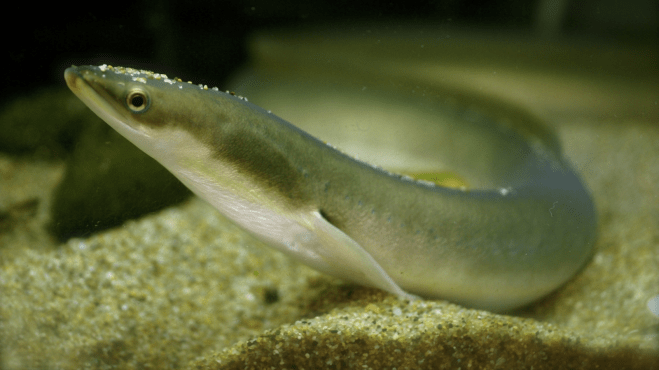
Japanese eel
Gov’t opts not to disclose radiation test result of Japanese fishery goods
The government has rejected calls to disclose the results of radiation level checks conducted on fishery goods caught near Japan, a civic group said Wednesday.
The Ministry of Food and Drug Safety on Tuesday dismissed the information disclosure request filed by the Lawyers for a Democratic Society, the group said.
“As the information is related to a case pending at the World Trade Organization, (the disclosure) could lead to a leakage of our strategy to Japan,” the ministry was quoted by the group as saying.
The lawyers association, however, countered that the reason provided by the authorities was groundless since the government has to submit its findings to the WTO and Japan anyways.
Tokyo filed a formal complaint with the World Trade Organization against Seoul’s import ban of its fishery goods.
South Korea has banned imports of all fishery products from eight Japanese prefectures, including Fukushima, where the 2011 earthquake and tsunami caused the meltdown of a nuclear reactor, marking the worst nuclear accident since the Chernobyl disaster.
The import ban was imposed in September 2013 after reports that massive amounts of radioactive materials and contaminated water from the Fukushima reactor were being dumped in waters surrounding Japan. This caused serious safety concerns here, that not only affected Japanese imports but the local fishery sector as a whole. (Yonhap)
http://www.koreaherald.com/view.php?ud=20160406000394
S. Korea Will Not Share Fukushima Fish Tests
South Korea’s Ministry of Food and Drug Safety has rejected a petition from a civil society group to release the results of radiation testing on fish caught near Japan following the Fukushima Daiichi reactor meltdown.
In 2013, South Korea imposed a ban on the importation of fisheries products from eight Japanese prefectures near Fukushima. Tokyo objected, and petitioned the World Trade Organization for relief, claiming that the ban was unfair to Japanese exporters. The Ministry of Food and Drug Safety has already submitted the results of its testing to the WTO and to Japan as part of the dispute, and advocates claimed that it should be made public as well.
The ministry disagreed. “As the information is related to a case pending at the World Trade Organization (WTO), [it] could lead to a leakage of our strategy to Japan,” it said in a statement on Tuesday.
A study of radioactive cesium levels in fish off of Fukushima in 2011 by Pavel Povinec and Katsumi Hirose found that consuming 100 kg of the affected seafood per year (four times the Japanese annual average) would result in approximately the same radiation dose as the world average for background exposure – and roughly the same as the level of exposure from consuming the naturally occuring radioactive polonium in 100 kg of any other seafood.
“Radiation doses from ingestion of marine food are under control, and they will be negligible,” the authors concluded.
However, a study published in February by Hiroshi Okamuraa and Shiro Ikedab found that while radioactive cesium levels were overall quite low among most species in Japan, they were unequally distrubuted, with some much more likely to be contaminated than others, especially larger predators towards the top of the food chain. Additionally, effects are regional and vary between freshwater and marine species, the authors said: areas nearer and to the south of the reactor are more affected, and freshwater fish – notably whitespotted char and Japanese eel – are more likely to show higher levels of contamination.
http://maritime-executive.com/article/s-korea-will-not-share-fukushima-fish-tests
1 This Month





PLEASE OPPOSE HR 8255 AND S.3639 – bills would accelerate satellite deployment, with no environmental review or safeguards – https://ncstd5li.quorum.us/campaign/169331/
To see nuclear-related stories in greater depth and intensity – go to https://nuclearinformation.wordpress.com
-
Archives
- October 2026 (74)
- September 2026 (339)
- August 2026 (330)
- July 2026 (355)
- June 2026 (287)
- May 2026 (306)
- April 2026 (356)
- March 2026 (251)
- February 2026 (267)
- January 2026 (308)
- December 2025 (358)
- November 2025 (359)
-
Categories
- 1
- 1 NUCLEAR ISSUES
- business and costs
- climate change
- culture and arts
- ENERGY
- environment
- health
- history
- indigenous issues
- Legal
- marketing of nuclear
- media
- opposition to nuclear
- PERSONAL STORIES
- politics
- politics international
- Religion and ethics
- safety
- secrets,lies and civil liberties
- spinbuster
- technology
- Uranium
- wastes
- weapons and war
- Women
- 2 WORLD
- ACTION
- AFRICA
- Atrocities
- AUSTRALIA
- Christina's notes
- Christina's themes
- culture and arts
- Events
- Fuk 2022
- Fuk 2023
- Fukushima 2017
- Fukushima 2018
- fukushima 2019
- Fukushima 2020
- Fukushima 2021
- general
- global warming
- Humour (God we need it)
- Nuclear
- RARE EARTHS
- Reference
- resources – print
- Resources -audiovicual
- Weekly Newsletter
- World
- World Nuclear
- YouTube
-
RSS
Entries RSS
Comments RSS

