the level of recyclable contaminated waste,
80 times more than the current norm.


Landslides sever National Route No. 57 in Minami-Aso, Kumamoto Prefecture, on April 16. Aso-ohashi bridge also collapsed.
The number of earthquakes that could be felt by people reached 410 by 10 a.m. on April 17 following the start of seismic activity in Kumamoto Prefecture on April 14, the Japan Meteorological Agency said.
Quakes with magnitudes of 3.5 or larger accounted for 162 of the total by 8:30 a.m. on April 17, the largest among inland and coastal earthquakes since 1995. The previous high was set after the Chuetsu Earthquake in Niigata Prefecture in 2004.
“After the magnitude-7.3 earthquake that struck at 1:25 a.m. on April 16, the number of earthquakes increased sharply,” said Gen Aoki, director of the agency’s earthquake and tsunami monitoring division.
He urged people in the affected areas to remain alert amid the ongoing aftershocks.
“Earthquake movements are actively continuing in areas from Kumamoto Prefecture to Oita Prefecture,” Aoki said. “The soil could have become loose due to the rain that started to fall on April 16, so I want people to exercise caution against strong tremors or rain.”
http://www.asahi.com/ajw/articles/AJ201604170042.html

The No. 1 and No. 2 reactors at the Sendai nuclear power plant in Kagoshima Prefecture
The government on April 16 said there is no need to shut down two nuclear reactors in Kagoshima Prefecture, citing relatively low seismic movements around the nuclear plant.
Cabinet ministers met on April 16 to respond to the Kyushu earthquakes and discuss what to do with the No. 1 and No. 2 reactors of the Sendai nuclear power plant located in Satsuma-Sendai, Kagoshima Prefecture.
Environment Minister Tamayo Marukawa, who serves concurrently as state minister for nuclear emergency preparedness, mentioned the stricter safety standards implemented by the Nuclear Regulation Authority on nuclear power plant operations. Under the NRA’s standards, adopted after the Fukushima nuclear disaster in 2011, 620 gal is the maximum seismic acceleration allowed for reactors to continue running.
Marukawa said the maximum shaking recorded on the Sendai plant grounds was 12.6 gal.
“The NRA has judged there is no need to stop the Sendai plant,” she said.
The two reactors are the only ones currently operating in Japan.
The series of earthquakes that began in Kumamoto Prefecture on April 14 have spread eastward to Oita Prefecture. Kagoshima Prefecture lies at the southern end of Kyushu.
“Under the current circumstances, there is no need to stop the plant because (the shaking) is sufficiently low,” Chief Cabinet Secretary Yoshihide Suga said after the April 16 meeting.
The Japanese Communist Party on April 16 called on the government to shut down the Sendai plant as a preventive measure because the quake activity was spreading through Kyushu.
The party said major problems would arise in evacuations if a nuclear accident arose at the Sendai plant because quake damage has rendered the Shinkansen bullet train line and expressways unusable.
http://www.asahi.com/ajw/articles/AJ201604170031.html

The earthquake that struck Kumamoto Prefecture early Saturday had a magnitude of 7.3, the same as the Great Hanshin Earthquake in 1995, in which more than 6,400 people died or remain missing.
The Saturday quake had more than 10 times the energy of the magnitude-6.5 earthquake that occurred Thursday evening, which caused strong shaking in limited areas. On Saturday, violent tremors measuring as high as upper 6 on the Japanese intensity scale of 7 were felt over a wide area.
Experts said the earthquake occurred as multiple faults moved in conjunction with each other, and warned that earthquakes will continue over a wide area.
According to the Japan Meteorological Agency, this is the first magnitude-7 class earthquake with a shallow focus since a magnitude-7 quake in the Hamadori area in Fukushima Prefecture, that is believed to have been an aftershock of the Great East Japan Earthquake in 2011. In the Kyushu region it was the first of that size and type in 11 years, since the magnitude-7 earthquake with its focus in the Genkainada sea in western Fukuoka Prefecture in 2005.
According to the agency’s analysis, Saturday’s quake was a “strike-slip” type, in which the fault involved moved horizontally due to its being pulled to the northwest and southeast. Thursday’s quake and the 1995 Hanshin earthquake involved the same “strike-slip” mechanism.
Yuji Yagi, an associate professor of geodynamics at University of Tsukuba, analyzed the seismic waves from the Saturday quake and said the fault appeared to have moved over an area about 50 kilometers long and 20 kilometers wide.
The underground destruction stretched northeast from the quake’s focus and continued for about 20 seconds.
The focus of Saturday’s quake was located on the northern side of the Futagawa fault zone, which cuts east to west across Kumamoto Prefecture and is at least about 64 kilometers long in its entirety.
The government’s Earthquake Research Committee had deemed there to be “an almost zero to 0.9 percent chance” of a magnitude-7 earthquake occurring in the northeast part of the Futagawa fault zone within 30 years.
The Hinagu fault zone lies to the south of the focus of Saturday’s quake, stretching at least about 81 kilometers. Part of the Hinagu fault zone is believed to have moved in the Thursday earthquake.
Yasuhiro Suzuki, a professor of tectonic geomorphology at Nagoya University, said part of the Futagawa fault zone moved in the Saturday morning earthquake. “It’s appropriate to think of the Hinagu and Futagawa fault zones as connected active faults. The earthquake on Saturday occurred in conjunction with the quakes that have happened from Thursday on, so it appears that part of a very large fault moved,” Suzuki said.
According to Takeshi Matsushima, an associate professor at Kyushu University of solid-state geophysics, the ground in the Kyushu region is subject to forces that pull it north-south. This creates the Beppu-Shimabara rift zone, in which the ground is subsided from Oita to Kumamoto. It contains the Hinagu and Futagawa fault zones, as well as the Beppu-Haneyama fault zone.
Seismic activity has intensified from the southwest to the northeast of the rift zone.
Regarding this fact, the Japan Meteorological Agency said at a Saturday press conference that “large earthquakes have occurred in three locations: Kumamoto, Aso and the central areas of Oita Prefecture.”
The government’s Earthquake Research Committee has decided to hold an emergency meeting on Sunday regarding the quakes. It will examine the causes of the seismic activity and prospects for the future.Speech
http://the-japan-news.com/news/article/0002881595

Seismologists fear that the series of earthquakes rattling Kyushu could trigger temblors in other active faults in the southwestern island, which extend eastward into central Japan.
A number of active faults dot the so-called Beppu-Shimabara Rift, which traverses Kyushu island from east to west, extending to the Median Tectonic Line. This is the nation’s longest tectonic line, and it spans about 1,000 kilometers from the Kanto Plain through Gunma, Nagano, Wakayama, and Tokushima prefectures to Kyushu island in southern Japan.
Ichiro Kawasaki, professor emeritus of seismology at Kyoto University, said: “The epicenter (in the latest series of quakes that began April 14) is gradually moving eastward. When a fault moves, it tends to move other faults that run on an extended line.”
He explained that when an earthquake occurs, other faults around it are exerted to different pressure, which could trigger other quakes.
That view was echoed by Kazuro Hirahara, a Kyoto University professor of seismology and head of the Coordinating Committee for Earthquake Prediction.
“The epicenter of the earthquake in Oita Prefecture, (which occurred early on April 16) is about 100 kilometers from that of the Kumamoto quakes, and therefore it is hard to think that the quake was an aftershock,” he said, adding that there was a possibility the Beppu-Haneyama fault zone in the prefecture may have been stimulated.
“Quite frankly, there is no telling what may happen in the days ahead,” he said. “If some part in the Median Tectonic Line moves, there is a chance it could have an impact on the predicted Nankai Trough Earthquake in the long run.”
Shinji Toda, a Tohoku University professor of earthquake geology, pointed out that the seismic activity could also move southward.

Fukushima, Reactors 3 and 4
By Vincent Di Stefano
The meltdown of three nuclear reactors at Fukushima in the wake of the earthquake and tsunami of 11th March 2011 seems to have quietly slipped out of our collective awareness – as quietly as the cauldrons of radioactive elements that were once within the active cores of the reactors invisibly bleed into the groundwaters and seawaters of the region. This event has become yet another minor detail in the distorted mosaic of ruin that mirrors the latter days of a civilisation in free-fall.
Arnie Gundersen is looking a little weathered these days. He has just returned from a five-week long speaking tour of Japan. He spent much of that time in the company of many whose lives have been indelibly seared by the Fukushima catastrophe. What he reports is unlikely to appear in the mainstream media, but such has ever been the case when it comes to the hidden machinations of big government and big business.
What Gundersen has to say is worth closely attending to. As a nuclear engineer, he has been deeply involved in the American nuclear industry for over four decades. He has a special interest in the design and safety of containment structures and holds a patent for a nuclear safety device. He has also managed and coordinated nuclear projects at 70 nuclear power plants in the US and is a former nuclear industry senior vice-president. He knows the industry well, particularly its toxic underbelly.
Arnie Gundersen served as an expert witness in the investigation of the 1979 Three Mile Island accident, and found that releases of radioactivity from that particular event were 15 times higher than the figures published subsequently in a government report. He is no stranger to the prevarication and deceit that have too often accompanied statements made by the nuclear industry and its government supporters.
Gundersen has been an active critic of the nuclear industry for over two decades. More recently, he has co-authored a Greenpeace International report on Fukushima. He was among the first North American commentators to speak publicly and forcefully on the implications of Fukushima in the days and weeks after the meltdowns. And since that time, he has been tireless in his efforts to provide an informed narrative of developments at Fukushima and their consequences for both the inhabitants of Japan and on the global community.
Arnie Gunderson reports that the Japanese Government continues to put the interests of Japanese banks and power companies ahead of the safety of its people. Within a short time of the Fukushima meltdowns in 2011, the Democratic Party of Japan (DPJ) who were in power at that time arbitrarily raised the “acceptable” limits of radiation exposure twenty-fold: from 1 millisievert (mSv)/year – the maximum dose recommended by the International Commission on Radiological Protection – to 20 mSv/year. In 1998, over a decade beforehand, Rosalie Bertell presented the findings of a number of independent studies published in peer-reviewed journals, including the British Medical Journal and the Journal of the American Medical Association that showed unequivocally that radiation doses as low as 2.5 mSv/year were associated with significant increases in the incidence of leukaemias and myelomas, and cancers of the pancreas, lungs and female reproductive organs in nuclear industry workers.
As Japanese medical practitioners begin to encounter the effects of radiation exposure in their patients – particularly children – the government now refuses to pay doctors who record a diagnosis of radiation-induced sickness in their patients. This will come as no surprise to those who followed the actions of the Soviet government and later, the Russian, Ukraine and Belarus governments in their concerted suppression of medical reports dealing with the consequences of radiation exposure on the lives of their citizens after the Chernobyl meltdown.
Rearranging the Deck Chairs

Temporary housing for Fukushima evacuees
Over 100,000 people are still not able to return to their homes in Fukushima prefecture since the meltdowns. In a disturbing disclosure, Gundersen reveals that many of the evacuees have received virtually no information regarding the issue of radiation exposure either from the Japanese government or from TEPCO, the operators of the Fukushima power plant. The subsistence stipend that they have received since being evacuated will cease in March 2017. Considerable pressure is being put on former residents by the government that they now return to Fukushima and tough it out regardless of the ongoing contamination. Many have grave concerns regarding the effects of such a move on the future health of their families.

30 Million Bags of Radioactive Debris
Another remarkable aspect of the present situation concerns the manner in which highly contaminated materials – which include radioactive soil, leaves and other debris – have been dealt with. Thirty million tons of such debris has so far been gathered from throughout the Fukushima prefecture. Much of this is now stored in over 9 million large plastic bags scattered throughout the affected areas. Three years after being filled, the bags have started to disintegrate and nobody seems to know what to do next since their contents need to be kept isolated for at least another 30 years. One favoured option is to incinerate them. This would certainly decrease their number, but would inevitably result in the further dispersion of radioactive elements in aerosol form around Japan.
There are clearly some who still hold to the old but ultimately banal adage that, the solution to pollution is dilution.

Contaminated Water Storage Tanks at Fukushima
Dwarfing the problem of solid wastes is the ongoing leaching of radioactive elements from the melted reactor cores into groundwater and seawater. For the past five years, between 200 and 500 tons of groundwater flow through the reactors every day as a result of multiple cracks in the containment structures. Some of this water has recently been diverted away from the reactors, but an estimated 150 tons of groundwater continue to flow through the reactors daily. This irradiated water inexorably flows on, steadily bleeding into the northern Pacific. Furthermore, 700,000 tons of highly radioactive water salvaged from cooling operations since the meltdown is presently stored in massive tanks that now pepper the reactor site. More are being built as contaminated water continues to accumulate.
The Tragic Absurdity
It is common knowledge that engineers will be busy for the next 30 to 40 years in their efforts to put the lid on the cauldron of radioactivity that seethes in the reactor basements at Fukushima. Meanwhile, the Pacific tectonic plate continues its own inexorable movement beneath the continental Okhotsk plate on which Japan sits creating the conditions for future mega-thrust events like that which shook the region on 11th March 2011. The unspoken terror is that it could all turn again in the blink of an eye.
Despite what has happened at Fukushima, the Abe Government is determined to restart Japan’s nuclear reactors that were all shut down after the 2011 earthquake. Widespread anti-nuclear protests throughout Japan have been ignored and three nuclear power plants in Kagoshima and Fukui prefectures have been restarted since August 2015. Over the next year, a further six to twelve reactors are slated to resume operations. Business reigns as usual.
There are many who proudly insist on riding the nuclear beast regardless of the human and environmental consequences. They insist that this is the way of the future and a “necessary” solution to the problems of rising atmospheric carbon dioxide levels and an ever-accelerating movement towards numerous tipping points which include ocean acidification, loss of polar albedo effects due to melting of polar ice, and the bubbling up of vast new wells of methane gas from the melting of northern permafrost and sea-floor deposits. In the immortal words of Edwin Arlington Robinson, what folly is here that has not yet a name?
Arnie Gundersen’s Report
The video clip below presents an interview between Arnie Gundersen and Margaret Harrington recorded soon after he returned from a recent speaking tour of Japan. The first 25 minutes of the interview offers deep insight into how the worst industrial accident in the history of humanity has affected the people of Japan, and how the Japanese government now increasingly serves the interests of power companies and their financial backers rather than those of its own people. Arnie Gundersen is unambiguously clear regarding the nature of what has gone down in Fukushima in this presentation. And the moral abandonment of both the Japanese government and TEPCO in the downplaying of the present and future consequences of the meltdown are not lost on him.
The second half of this clip offers a detailed review by Gundersen of the developments at Fukushima over the past five years. A separate high-definition version of the second segment can be accessed here.
http://www.countercurrents.org/stefano150416.htm

 Japan’s Kumamoto rocked by magnitude 7.3 earthquake 24 hours after first shock, SMH April 16, 2016 Tokyo: A magnitude 7.3 earthquake struck southern Japan early on Saturday, killing at least 11 people, injuring many more and bringing down buildings, media reported, just over a day after a quake killed nine people in the same region.
Authorities warned of damage over a wide area, as reports came in of scores of people trapped in collapsed buildings, fires and power outages.
Residents living near a dam were told to leave because of fears it might crumble, broadcaster NHK said…….
People still reeling from a magnitude 6.5 quake on Thursday poured onto the streets after the Saturday quake struck at 1.25 am……….
M7.0 earthquake in Japan – same area as yesterday’s foreshocks. https://t.co/eSYh0m7VMI. Hearts out to them pic.twitter.com/41M2BGRmRR……..
Japan is on the seismically active “ring of fire” around the Pacific Ocean and has building codes aimed at helping structures withstand earthquakes.
http://www.smh.com.au/world/japans-kumamoto-rocked-by-magnitude-74-earthquake-just-24-hours-after-first-shock-20160415-go7ucs.html#ixzz45xKID5Fc
Young Athletes, Women, More Susceptible to Radiation Dangers Washington, DC — Apr 14, 2016 / (http://www.myprgenie.com) — On March 11, 2016, the fifth anniversary of the Fukushima triple nuclear meltdowns, the Japanese Olympic Minister Toshiaki Endo stated that preliminary softball, baseball and possibly other games would likely be moved from the host city of Tokyo to Fukushima Prefecture. In fact, organizers are already far into the process of developing J Village, located 19 km (12 mi) from the devastated Fukushima Daiichi nuclear reactors, into a training facility for Japan’s soccer team and possibly more uses. J Village was used as a disaster staging and support facility during the early days of the ongoing catastrophic Fukushima Daiichi nuclear disaster.
In a stunning development in 2013, Japan’s Olympic bid was won by Prime Minister Shinzo Abe when he promised the International Olympic Committee (IOC) that it (Fukushima Daiichi) “has never done, and will never do, any damage in Tokyo”. Now, according to the Olympic Minister’s recent statements and credible news reports in Japan, the IOC and IPC will be required to use venues not only in Tokyo as originally agreed upon, but also in Fukushima Prefecture, not far from the Fukushima Daiichi nuclear disaster site. “The Abe administration’s willingness to expose both their own population and the world’s to lethal particles in order to deny the horrendous contamination of their land, is morally reprehensible”, says Mary Beth Brangan, Co-Director of Ecological Options Network.

The person in charge of decommissioning at Fukushima Daiichi has publicly stated that there is no solution in sight to the massive radioactive releases at there and appealed to the international community for assistance. Radiation has been documented well beyond Fukushima to several areas around Japan that have been used for the past 5 years for the open storage and subsequent incineration of toxic and radioactive tsunami rubble, garbage, and more. Cesium 134, 137 and other cancer causing radionuclides from the disaster have been found in tap water and vacuum cleaner bags sampled at different locations around Japan. Hundreds of radioisotopes are released in nuclear accidents, many of which are long-lived and remain hazardous for millions of years. Once inhaled, they pose a significant health risk to everyone in affected environments and to athletes during strenuous competition. Women and children are the most vulnerable as stated in the Biological Effects of Ionizing Radiation (BEIR 7) report issued by the National Academy of Sciences.
“Instead of spending money on the Olympics, Japan should spend it ensuring that citizens of its country are not forced to live in contaminated areas in the same prefecture where Japan now wants to host some of these games”, states Cindy Folkers, Radiation and Health Specialist at Beyond Nuclear. “In 2012, the UN Commissioner on Human Rights traveled to Japan and concluded that the government should “reduce the radiation dose to less than 1mSv/year” in accordance with recommended international standards. Instead, Japan is forcing some evacuees to be exposed to up to 20 times this amount, while telling the world, and the Olympic committee, everything is fine.”
Presidential candidate and US Senator Bernie Sanders has called for the immediate closure of the aging and leaking Indian Point nuclear reactors near New York City. Fukushima Fallout Awareness Network (FFAN) is asking other leaders to also make an informed decision where nuclear hazards are concerned by calling for an immediate halt to the 2020 Summer Olympics and Paralympics games planned in Fukushima Prefecture. Petition recipients include UN Secretary General Ban ki-Moon, Secretary of State John Kerry, Ambassador to Japan Caroline Kennedy, UNICEF, the World Health Organization and others.
Contact: Continue reading
North Korea fails to launch Musudan missile, US defence official says, ABC News, 15 Apr 16 North Korea’s attempt to launch what appears to be a medium-range Musudan missile has failed on the birthday of founding leader Kim Il-sung, a high-profile misstep after Pyongyang claimed a series of breakthroughs in its nuclear weapons program.
Key points:
There had been widespread intelligence reports in recent days that the North was preparing a first-ever flight test of the Musudan, believed to be capable of striking US bases in the Pacific island of Guam.
The US and South Korean militaries both detected and tracked the early morning test.
“We assess that the launch failed,” a US defence official said, adding that it was “presumably” a Musudan.
The April 15 birthday of Kim Il-sung — the grandfather of current ruler Kim Jong-un — is a major public holiday in North Korea, where key political anniversaries are often marked with displays of military muscle.
A Pentagon spokesman described the attempted launch as a catastrophic failure………
Failed launch heightens possibility of further nuclear tests
South Korean officials and international experts said the failed launch heightened the possibility of North Korea conducting another nuclear test, possibly within weeks.
“North Korea is capable of conducting an additional nuclear test at any time if there is a decision by Kim Jong-un,” said a senior South Korean official involved in national security policies involving the North……. http://www.abc.net.au/news/2016-04-15/north-korea-missile-launch-fails/7329968

 U.S. Conspiracy Charges Spotlights China Nuclear Champion http://www.bloomberg.com/news/articles/2016-04-15/u-s-conspiracy-charges-put-spotlight-on-china-nuclear-champion Stephen Stapczynski sstapczynski
A U.S. indictment on charges against China General Nuclear Power Corp. for conspiracy to illegally produce nuclear material is shining a light on one of the Asian country’s leading atomic energy companies and a key player in its effort to export nuclear technology.
The state-owned company, part of a venture designing the country’s first homegrown reactor, was named as conspirator in an indictment unsealed by the U.S. government Thursday. The reactor, known as Hualong One, is the centerpiece of China’s efforts to compete globally against more-established nuclear developers including Toshiba Corp.’s Westinghouse Electric Co. and Paris-based Areva SA.
Related: U.S. Charges Chinese Nuclear Firm, Engineer With Conspiracy
“We have noted the announcement from the Department of Justice of the U.S. We cannot comment at this stage,” CGN said in an e-mail.
The U.S. accused CGN of directing Szuhsiung Ho, a nuclear engineer in the U.S. also known as Allen Ho, to obtain technical assistance from U.S.-based experts related to the development and production of special nuclear material without required authorization from the U.S. Department of Energy. The indictment said the assistance was related to CGN activities including its Small Modular Reactor and advanced fuel assembly program, as well as “verification and validation of nuclear reactor-related computer codes,” according to the indictment.
CGN signed a memorandum of understanding with the Kenyan government in September to build Hualong One reactors and agreed with Romania in November to build two reactors. CNNC has its own projects in Argentina and Pakistan.
The CGN indictment isn’t the first time the U.S. accused China of illegal activity in the nuclear industry. The U.S. charged five Chinese military hackers in 2014 of cyber espionage against U.S. corporations, including Westinghouse.
Between 2010 and 2012, Chinese hackers stole confidential designs and internal communications from Westinghouse’s computer systems while it was engaged in negotiations with an unidentified state-owned company about building four of the American company’s AP1000 reactors, the Justice Department said at the time. The hackers stole internal e-mails in which Westinghouse executives discussed talks with the Chinese company, it said.
The attackers also sought to acquire pipe specifications that “would enable a competitor to build a plant similar to the AP1000 without incurring significant research and development costs,” the 2014 indictment said.
“The notion of stealing U.S. civil nuclear technology is bizarre, given the close technical R&D relationships between China and the U.S.,” Ian Hore-Lacy, senior research analyst at World Nuclear Association, said by e-mail Friday. “Chinese nuclear engineers have been helping to build the AP1000 reactors in the U.S.”
 Bulgaria Seeks Chinese Investors into Nuclear Power, Novinite.com, April 15, 2016, Bulgaria is looking for a strategic investor into an expansion of nuclear capacities, Energy Minister Temenuzhka Petkova has told a committee in Parliament…….
She has explained there is certain interest from China in getting involved in Bulgaria‘s nuclear sector.
http://www.novinite.com/articles/174043/Bulgaria+Seeks+Chinese+Investors+into+Nuclear+Power#sthash.cy7Y2ZJE.dpuf
 Russia and Laos plan nuclear cooperation, World Nuclear News, 15 April 2016
A memorandum of cooperation in the field of nuclear energy for peaceful purposes has been signed by Russian state nuclear corporation Rosatom and the ministry of energy and mines of Laos……
In August 2015, it was reported that Rosatom and Laos were in negotiations to set up the Southeast Asian country’s first nuclear power plant. The talks concerned Russia building two 1000 MWe nuclear power reactors in Laos on a build-operate-transfer basis. http://www.world-nuclear-news.org/NP-Russia-and-Laos-plan-nuclear-cooperation-1504164.html
the level of recyclable contaminated waste,
80 times more than the current norm.
汚染土壌の再生利用は世界に前例の無い一大ナショナル・プロジェクト(おしどりポータルサイト)http://oshidori-makoken.com/?p=2059
最終処分、9割減量も=福島の汚染土、技術開発で-環境省(時事通信 2016/03/30-10:09)
http://www.jiji.com/jc/article?k=2016033000226&g=eqa
山本太郎議員の国会質疑(2016.4.13復興特別委員会)
https://www.taro-yamamoto.jp/national-diet/5801
(満田夏花/FoE Japan)

Cattlemen dedicate a monument to livestock that died as result of the 2011 nuclear disaster on April 15, in Tomioka, Fukushima Prefecture.
TOMIOKA, Fukushima Prefecture–About 170 cattlemen gathered here on April 15 to dedicate a monument to beef cattle that died from starvation or had to be euthanized as a result of the Fukushima nuclear disaster.
According to a local livestock cooperative, cattle farming was thriving in the coastal area of Fukushima Prefecture before the disaster unfolded at the Fukushima No. 1 nuclear power plant on March 11, 2011.
Nobuo Nemoto, head of the cooperative, which is based in Futaba, a town that co-hosts the stricken nuclear plant, said he and other cattle farmers will work hard to revive the industry.
“We are facing enormous difficulties, including the aging of farmers and a dent in morale in resuming the industry,” he said. “Despite that, we are hoping to make a fresh start with the ceremony to unveil the monument.”
Although many cattlemen were forced to evacuate and leave their livestock behind, many returned to their farms on occasion to feed and take care of their animals.
But after the government set up a 20-kilometer no-entry zone around the plant on April 22, 2011, the number of cattle that died of starvation on farms near the plant increased dramatically.
The no-entry zone was established to prohibit evacuees and others from entering the area due to high levels of radioactive substances.
The government then instructed the cattle ranchers to have their starving animals euthanized after gaining their consent. By February 2014, about 1,700 head of beef cattle–primarily cows and their calves–were put out of their misery.
 Strong earthquake quake hits southern Japan THE AUSTRALIAN APRIL 15, 2016
At least two people were killed and 45 injured by a magnitude-6.5 earthquake that knocked down houses and buckled roads in southern Japan on Thursday night.
Both victims are from the hardest-hit town of Mashiki, about 15 kilometres (9 miles) east of Kumamoto city on the island of Kyushu, said Kumamoto prefecture disaster management official Takayuki Matsushita.
Earlier, Japanese Red Cross Kumamoto Hospital said it had admitted or treated 45 people, including five with serious injuries.
The quake struck at 9:26pm at a depth of 11 kilometres near Kumamoto city on the island of Kyushu, the Japan Meteorological Agency said. There was no tsunami risk……
Saga said there no abnormalities at nearby nuclear facilities. The epicentre was 120 kilometres (74 miles) northeast of Kyushu Electric Power Co.’s Sendai nuclear plant, the only one operating in the country.
Most of Japan’s nuclear reactors remain offline following the meltdowns at the Tokyo Electric Power Co.’s Fukushima plant in 2011 after a magnitude 9.0 earthquake triggered a huge tsunami…….
The U.S. Geological Survey measured the initial quake’s preliminary magnitude at 6.2. It upgraded its damage assessment to red, meaning extensive damage is probable and the disaster likely widespread…….http://www.theaustralian.com.au/news/world/strong-earthquake-quake-hits-southern-japan/news-story/758290acc35b609538c3ff285e89d2a8
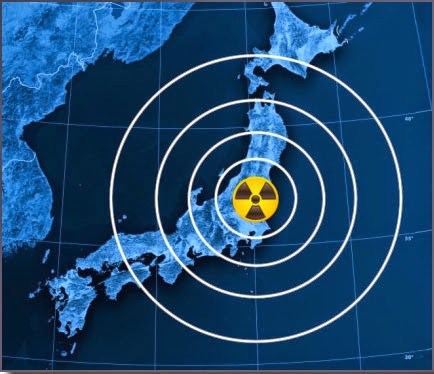 Top Official: Over 60 million Japanese irradiated by Fukushima — Nuclear Expert: 50,000 sq. miles of Japan highly contaminated… Many millions need to be evacuated… Gov’t has decided to sacrifice them, it’s a serious crime — TV: More than 70% of country contaminated by radiation (VIDEOS) http://enenews.com/top-official-60-million-japanese-irradiated-fukushima-nuclear-expert-50000-square-miles-country-highly-contaminated-many-millions-be-evacuated-govt-decided-sacrifice-serious-crime-professor-70-l?utm_source=feedburner&utm_medium=email&utm_campaign=Feed%3A+ENENews+%28Energy+News%29
Interview with nuclear engineer Hiroaki Koide (translation by Prof. Robert Stolz, transcription by Akiko Anson), published Mar 8, 2016 (emphasis added): [Radioactive] material has been dispersed, contaminating Tohoku, Kanto [Tokyo area], and western Japan… [The law says] that absolutely nothing may be removed from a radioactive management area in which the levels exceed 40,000 Becquerels per square meter… [H]ow much area has been contaminated beyond 40,000 Bq/m2… that answer is 140,000 km^2 [54,054 square miles]… Indeed, while centered on Fukushima, parts of Chiba and Tokyo have also been contaminated. The number of people living in what must be called a radiation-controlled area is in the millions, and could exceed ten million… I believe the government has the responsibility to evacuate these entire communities… the government decided to leave them exposed to the real danger of radiation. In my view, Fukushima should be declared inhabitable… but if that were to be done, it would likely bankrupt the country… They’ve decided to sacrifice people… In my view, this is a serious crime committed by Japan’s ruling elite… [F]undamentally, people must not be forced to live in contaminated areas… First must come complete evacuation… [W]hen it comes to radiation… “removal of contaminants” is impossible… This stuff contaminates everything.
Naoto Kan, former Prime Minister of Japan, Apr 11, 2016 (at 2:15 in): The molten material broke through the pressure vessel and accumulated low down in the containment. Now what would have happened if this molten material had escaped from the containment?… A radius of 250 kilometers — which includes the city of Tokyo — anyone living in this area, if you count them up it comes to 50 million or 40% of the Japanese population, and they would all have had to be evacuated. As we know from Chernobyl, not just a couple of weeks, but 30 years or 40 years — it would have virtually meant the end of Japan. [Note: Many nuclear experts believe the molten fuel did in fact escape from the containment] Half the population was subject to radiation [Japan Population: 127 million]. That’s something that could just be imagined, for instance the event of losing a major war.
Arirang (Gov’t-funded Korean TV network), ‘Fukushima and Its Aftermath’, Mar 16, 2016 (at 6:45 in) —Prof. Kim Ik-Jung, Medical College at Dongguk Univ.: “When you look at the contamination map, about 70% of Japan is contaminated by radiation. That means that 70% of Japan’s agricultural and marine products are contaminated.”… According to PNAS, one of the five major scientific journals, over 70% of the land in Japan is contaminated by radiation.
Asia Pacific at the heart of global renewables boom Investments in clean energy reached record highs last year, spelling an optimistic outlook but new sources of competition for industry players. Eco Business, By Vaidehi Shah, 7 Apr 16, The global clean energy sector continued its breakneck development with a record US$329 billion of new investments last year, and Asia Pacific is at the heart of this boom, according to a new report by professional services firm EY.
The London-headquartered consultancy’s Renewable Energy Country Attractiveness Index 2016 report, released in late February, showed that Asia Pacific secured almost US$180 million in clean energy investments last year – more than half of the global total.
China topped the index with US$110.5 billion in investments, followed by the United States, Japan, the United Kingdom and India.
Wind and solar are the key energy sources driving the spike in global renewable energy investment, found EY. Together, the two sectors snapped up US$270 billion in clean energy investments last year, more than 80 percent of the US$329 billion total.
They also accounted for half of all new power generation capacity installed last year, contributing 120 gigawatts of new energy projects.
Asia Pacific saw more clean power going online than any other region, with 36 GW of solar and 31.5 GW of wind capacity added. This capacity was significantly higher than 8.9 GW in North America for solar energy, and 15 GW for Europe last year.
Matthew Rennie, managing partner, power and utilities, EY Australia, noted that India, Indonesia and Singapore are some of Asia’s most exciting markets.
With US$10.9 billion in clean energy investments last year, “India is the rising star of the Asia Pacific renewables market, and is starting to challenge China as the present index leader,” he said.
The rapid growth of investments in India is thanks to the government’s ambitious target to install 175 gigawatts of renewable energy capacity by 2022, announced last year. The country has also allocated US$400 million to finance this goal in its 2015 budget.
Indonesia, too, plans to scale up renewable energy………http://www.eco-business.com/news/asia-pacific-at-the-heart-of-global-renewables-boom/
Amid rampant waste, Fukushima’s frozen wall up in smoke http://america.aljazeera.com/blogs/scrutineer/2015/3/24/rampant-waste-fukushima-frozen-wall-up-in-smoke.html
Japan’s Board of Audit reported that TEPCO, the company nominally in charge of the crippled facility, along with other construction and utility giants, had operated an insular and insufficiently transparent process that resulted in a lengthy list of massive expenditures on untested tactics and shoddy equipment.
The biggest ticket failure was apparently a $270 million water decontamination system from French nuclear behemoth Areva. Designed to remove radioactive cesium from water gushing from Fukushima Daiichi’s three destroyed reactors, the machine was never fully operational, functioned only three months and processed only 77,000 tons of liquid — in total — a minute fraction of the 300,000 tons of contaminated water flowing from the site (and into the sea) each day.
An attempt to contain at least some of that water, a series of pipes and trenches filled with coolant that was to form an “ice wall,” turned out to be another of the cleanup’s dramatically costly and utterly ineffective schemes.
As detailed last summer, the freezing technique was borrowed from tunnel excavation, but had never been tried under such circumstances or on such a large scale. After a year of planning and months of construction, authorities couldn’t get even the small first stage of the project to freeze. Even after adding ten tons of ice and a ton of dry ice on top of the piped coolant every day, TEPCO could not get within 10 degrees (F) of the temperature needed to form a barrier.
By late 2014, 400 tons of ice and somewhere between $840,000 (audited waste) and $300 million (projected cost) later, TEPCO conceded failure.
Other attempts to contain the radioactive water have also come at immense cost. TEPCO spent $134 million on rubber-gasketed tanks that quickly began leaking into the surrounding ground and ocean. And $18 million was spent to build large underground pools that failed within weeks.
Another costly boondoggle detailed in the audit is the $150 million blown on desalination equipment that was supposed to purify the seawater poured over the overheating reactor cores. (All of Fukushima’s cooling systems failed during the 2011 earthquake and tsunami, resulting in reactor meltdowns, melt-throughs, hydrogen explosions and containment breaches.) One machine worked for just five days; the best of them survived only six weeks.
Fukushima’s disaster mitigation is four years into what is projected, by the very best estimates, to be a 30- to 40-year cleanup — and even then, there will be many long-term logistical, safety and health concerns. No serious models forecast the project can be accomplished with just the $1.6 billion (190 billion yen) currently allocated, but by that math, waste alone will outstrip the budget three- or four-times over before cleanup is “complete.”
Climate Change Is Melting Everest Research shows that higher temperatures around the world’s tallest peak are thawing its glaciers, which could spell doom for villages in the Khumbu Valley, Outside, By: Anna Callaghan Apr 12, 2016 “As a colorful circus of tents pops up at Everest Base Camp this spring, a pair of Ph.D. students will set up camp 1,000 feet downvalley, on the Khumbu Glacier, resuming a research project they started last year. Their goal: to determine just how quickly the world’s highest glacier is melting.From the Alps to the Andes, ice at high elevations is disappearing rapidly. On Everest, the effects of a warming planet are likely to manifest in two ways that affect climbers. First, the Khumbu Glacier will shrink, and parts of it could possibly become impassable for climbers. Someday, even Base Camp may have to be moved from its current location on the glacier to another spot nearby.
Second, the Khumbu Icefall between Base Camp and Camp I may see a higher frequency of rock and ice avalanches—like the one that killed 16 Sherpas in 2014. The Icefall naturally migrates downhill between three and four feet per day, but that could accelerate as temperatures rise. Earth’s average surface temperature has gone up by more than 1.5 degrees since the late 1800s, and two-thirds of that warming has taken place since 1975
“It doesn’t take a rocket scientist to work out that if you increase the temperature where ice is normally frozen to the bedrock, the hold is going to be weakened and become increasingly unstable and the ice is more likely to detach from the bedrock,” says Duncan Quincey, professor of geomorphology at the University of Leeds, in the UK. He is supervising the research of Owen King and Scott Watson, the Ph.D. students who will spend a few weeks on the glacier this spring. “In places like the Icefall we’ve seen these tragic accidents, and I think it’s fair to say it’s symptomatic of high-elevation warming.”……http://www.outsideonline.com/2067651/climate-change-melting-everest





PLEASE OPPOSE HR 8255 AND S.3639 – bills would accelerate satellite deployment, with no environmental review or safeguards – https://ncstd5li.quorum.us/campaign/169331/
To see nuclear-related stories in greater depth and intensity – go to https://nuclearinformation.wordpress.com

