Russians call US nuclear reactors a “white elephant” for India
 US Nuclear Reactors to Prove White Elephant for India. Sputnik News 13 June 16
  India’s latest move in the direction of implementing a nuclear energy pact with the US is gaining strong resentment as the US reactors are most likely to cost three times more than that of Russian reactors already well operational.
Evacuation lifted for Fukushima village; only 10% preparing return
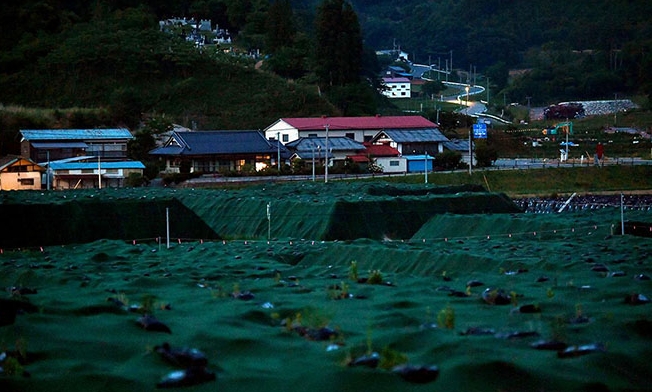
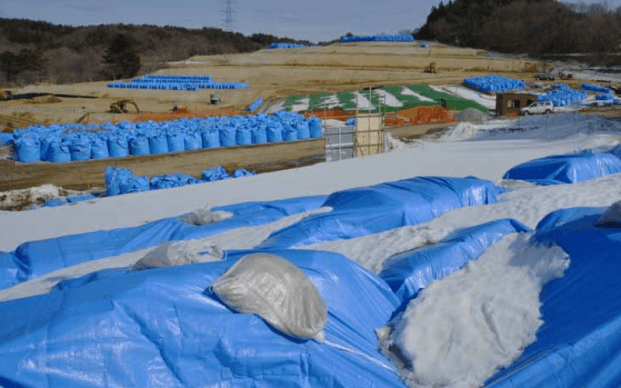
Lights appears at only a few houses in Katsurao, Fukushima Prefecture, on June 11, the eve of the government’s lifting of the evacuation order following the 2011 nuclear accident. Waste from decontamination operations is covered with sheets in the foreground. (Yosuke Fukudome)
The government on June 12 lifted the evacuation order for Katsurao, a village northwest of the crippled Fukushima No. 1 nuclear power plant, but most of the residents appear reluctant to return home.
The lifting of the order covers more than 90 percent of the households in Katsurao. The entire village was ordered to evacuate after the crisis at the Fukushima plant started to unfold on March 11, 2011.
Katsurao is the fourth municipality in Fukushima Prefecture that had the evacuation order lifted, following the Miyakoji district in Tamura, the eastern area of Kawauchi village and Naraha.
Government officials said cleanup and other efforts have reduced radiation levels in Katsurao to a point that poses little problem. The lifting of the evacuation order means that 1,347 people from 418 households, out of 1,466 people from 451 households in Katsurao, can return to their homes to live in the village.
But only 126 people from 53 households, or 10 percent of those eligible to return, have signed up for a program for extended stays in the village to prepare for their return, according to Katsurao officials.
The officials said they believe that many evacuees would rather go back and forth between temporary housing and their homes in Katsurao for the time being, given the situation in the village.
Medical institutions and shops have yet to resume operations in Katsurao. And nearly half of the rice paddies there are being used for the temporary storage of radioactive waste produced in the cleanup operation.
Local officials say they have no idea when the waste can be moved out of the village for permanent storage.
Among the Katsurao residents eligible to return are those with homes in the government-designated “residence restricted zone,” where the annual radiation dose was projected at more than 20 millisieverts and up to 50 millisieverts as of March 2012.
This was the first time evacuees from such a zone have been permitted to return home.
Only the “difficult-to-return zone” carries a higher annual radiation dose.
The government plans to lift evacuation orders for other parts of the prefecture by the end of March 2017, except for the “difficult-to-return zone,” where the annual radiation dose was estimated at 50 millisieverts or higher as of March 2012.
The additional lifting of the evacuation orders would allow 46,000 of 70,000 displaced residents to return to their homes to live.
Demolition work delay hinders Fukushima villagers’ homecoming
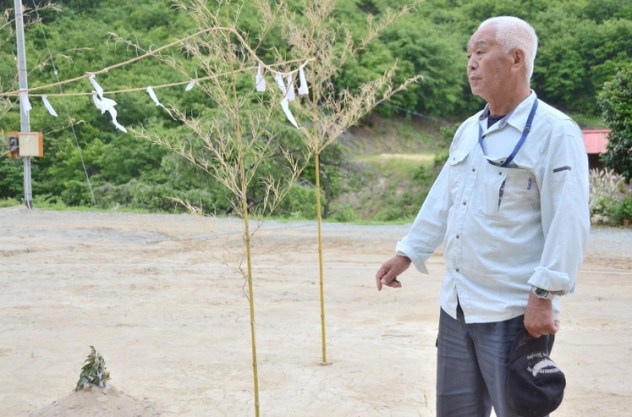
Farmer Hidenori Endo is seen at the empty lot where his home used to stand in Katsurao, Fukushima Prefecture, on June 6, 2016.
FUKUSHIMA — Though the nuclear disaster evacuation order for the Fukushima Prefecture village of Katsurao is set to be lifted on June 12, just 14 percent of demolition work needed before homes can be rebuilt has been completed.
The village currently comprises three evacuation statuses: “areas preparing for the lifting of evacuation orders” with annual accumulated radiation doses of 20 millisieverts or less; “restricted residency zones” with annual accumulated radiation doses from over 20 millisieverts to 50 millisieverts; and “difficult-to-return zones.” As of June 12, the 1,347 residents from 418 households in the former two categories will be allowed to move back home. A return schedule for the 119 residents from 33 households with homes in areas in the last category has yet to be determined as radiation levels remain high.
A survey by the village government showed that nearly 50 percent of residents wished to return home. However, as of June 8 only 126 people, or less than 10 percent of residents, had registered to stay overnight in preparation for their complete return.
The Environment Ministry began demolishing houses in 2012 for those who wanted to rebuild their homes in 11 Fukushima Prefecture municipalities subject to nuclear disaster evacuation orders. Of 347 demolition requests in Katsurao, only 14 percent have been completed. Officials say that field research and paperwork are taking time. Overall, a little less than 40 percent of requested work has been done in all 11 municipalities.
Eight municipalities — including Katsurao and the city of Minamisoma, where evacuation orders are to be lifted on July 12 — are requesting the central government to speed up demolition work as the delay is hindering residents’ return to their hometowns. A senior Katsurao village official says locals have been complaining about the demolition work not advancing as planned.
The Environment Ministry hopes to complete about 90 percent of demolition work by March 2017 by streamlining paperwork, but many residents are expected to be unable to return home even after evacuation orders are lifted, as it will take time to rebuild houses after the demolition is completed.
A ministry official explained that there are people who will be able to return home immediately after the evacuation order is lifted, and that it would be inappropriate to keep the orders in place until all the demolition work is done. At the same time, the official said that the ministry will give those who wish to return priority in the demolition work schedule.
Fukushima University social welfare professor Fuminori Tamba, who helped map out disaster recovery plans for municipalities under evacuation orders, pointed out that the lack of progress in demolitions is problematic, since securing housing is the minimum requirement for residents to return. He added that the availability of housing should be considered when lifting evacuation orders.
Katsurao farmer and cattle rancher Hidenori Endo, 74, applied for demolition of his decaying home and barn last summer. Tired of waiting, Endo paid a private firm nearly 10 million yen to tear down the buildings in May.
“I wanted to go home as soon as possible,” Endo said.
He now lives in a temporary housing unit in the town of Miharu, about 30 kilometers from his Katsurao home. Endo travels an hour by car daily to his property to restart his farming business, but taking good care of his cattle is difficult to do going back and forth. To reboot his business, Endo first needs to rebuild his home. Construction work is to begin this summer, but he does not yet know when the work will be completed, and will have to live in the temporary housing for at least another year.
The central government has set prerequisites, such as infrastructure development and operation of everyday services, for lifting nuclear crisis evacuation orders. However, housing is not included in these criteria.
“Even if I could go shopping, there isn’t much I could do if there was no place to live. It’s not right to be unable to return to home even with the evacuation order gone,” Endo lamented.
http://mainichi.jp/english/articles/20160611/p2a/00m/0na/016000c
Tepco to inject cement instead of frozen water wall

On 6/2/2016, Tepco reported to NRA (Nuclear Regulation Authority) that they need to inject cement to “frozen” water wall and NRA admitted it.
The feasibility of frozen water wall project was questioned since before the beginning. In the meeting of NRA, Tepco admitted the temperature remains nearly 10 ℃ at 4 “freezing” points to cause no improvement to stop contaminated groundwater. It has been in freezing operation for over 2 months.
These 4 points are situated between the reactor buildings and the sea. The volume of contaminated water to be pumped up has not been decreased regardless of the frozen water wall.
Tepco states the temperature remains over 0 ℃ because of the high speed of groundwater. They inject cement to slower the water.
Click to access handouts_160602_06-j.pdf
http://photo.tepco.co.jp/date/2016/201606-j/160606-01j.html
Another evacuation order lifted in Fukushima
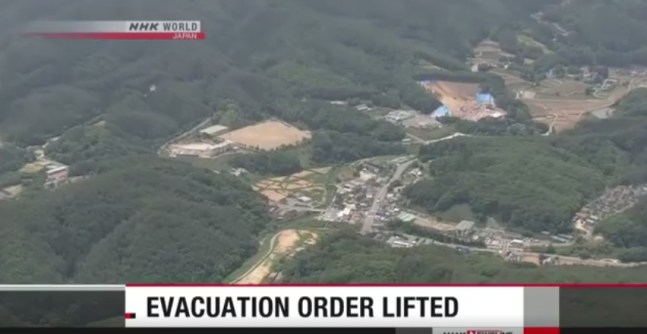
The Japanese government has lifted its evacuation order for most parts of a village near the crippled nuclear plant in Fukushima. Katsurao Village became the 4th such municipality after the 2011 nuclear disaster.
Officials lifted the restriction on Saturday midnight except some areas where the radiation level remains high. All of over 1,400 residents there were forced to evacuate. Now most of them are allowed to return home.
According to a survey the village conducted last year, nearly half of the respondents said all or at least parts of their family want to return home when the order is lifted.
Local authorities say they will work to ease concerns over radiation and provide medical services. They will also ask shops to reopen there to sell foods and everyday essentials.
The evacuation order remains in 9 municipalities in Fukushima. This is forcing more than 90,000 people to continue living away from home.
http://www3.nhk.or.jp/nhkworld/en/news/20160612_04/
Villagers divided over lifting of order
People from Katsurao have had mixed responses to the lifting of the evacuation order.
Residents who have decided to return to the village include Rinko Matsumoto and her husband.
Matsumoto planted corn seedlings on Sunday in front of her home. She used to eat home-grown corn with her children and grandchildren when they were all living together before the accident.
She says she is happy to be returning home, but that she will miss family members who have no plans of coming back anytime soon.
Akira Miyamoto and his wife spent the day tending roses in their garden and playing with their dog.
Miyamoto says this is the day Katsurao Village has come back to life. He says he wants to enjoy living there surrounded by nature.
Yoshio Matsumoto is one of the former residents who have decided not to return.
Matsumoto lives in temporary housing in another municipality. He says he is not going back home because he is worried about radiation and few of his neighbors are returning.
He says his home has been decontaminated many times, but windy or rainy weather causes radiation levels to rise.
New technologies using zeolite composite fibers to prevent radioactive cesium pollution in Fukushima rivers

The authors have developed and applied new technologies using zeolite composite fibers to prevent radioactive Cs pollution of water in Fukushima, Japan.
During approximately four years in the area, decontamination has been conducted to reduce radioactive cesium (Cs) in the field. However, water contaminated with extra-diluted radioactive Cs has prevented residence within about 30 km of the damaged nuclear facilities. Great efforts at decontamination work should be undertaken to alleviate social anxiety and to produce a safe society in Fukushima.
Decontamination using fiber-like decontamination adsorbents was examined in actual use for radioactive Cs in water in Date city in 2013 and in Okuma town in 2015.
This report describes preparation and properties of the fiber-like decontamination adsorbents. Furthermore, this report is the first describing results of radioactive Cs decontamination using a fiber-like adsorbent for water with extra-low-level concentrations of radionuclides.
Even four years after the accident, results strongly suggest the decontamination still distributed in Fukushima area, depending on the distance of the nuclear power plant. Evidence indicates the importance of preventing extension of radioactive Cs further downstream to human residential areas.
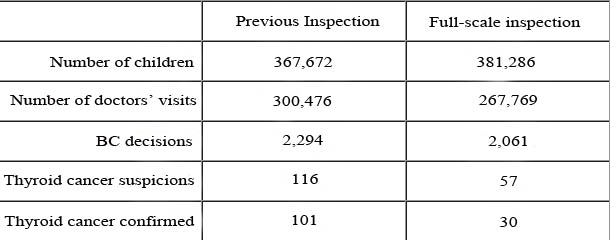
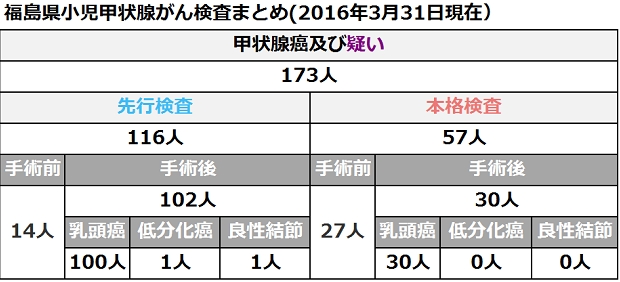
173 Children Thyroid Cancers in Fukushima Prefecture
As a reminder, elsewhere, children thyroid cancer occurs in only about one or two of every million children per year by some estimates. This shows an incidence of thyroid cancer multiplied by more than a hundred.
According to the latest Fukushima prefectural survey report, published on June 6, 2016, the number of childhood thyroid cancers increased from 163 three months and a half ago to 169 now, as 6 persons more were found affected with thyroid cancer.
Then the Fukushima Medical University professor Akira Ozuru verbally reported 3 additional cases, making now the number of thyroid cancers 172.
Therefore in the last 3 months and half, 9 additional cases have been further detected, which brings now the total number of children affected with thyroid cancer up to 172.
Here below in this first picture you may see the evolution of the number of children thyroid cancers and its evolving ratio to the Fukushima population from December 31, 2013 to March 31, 2016.

We can see that they are become higher at every announcement.
This time March 31, 2016 it became one in 1746 children.
In the next picture we see the male-to-female ratio of Fukushima Prefecture childhood thyroid cancer and suspicion of thyroid cancer. The stats proving that girls (women) are indeed getting more affected than the boys (men) by radiation, as well expected.
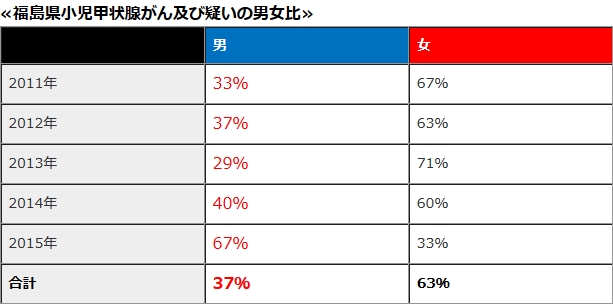
As you may see in the next picture the thyroid cancer ratio to population differs depending on each municipality.
Red color – 1 in 999
Orange color – 1 in 1000 to 1999
Yellow color – 1 in 2000 to 2999
Green color – 1 in 3000 to 3999
Blue color – 1 in 4000 to 6999

Source: http://www.sting-wl.com/fukushima-children9.html
Translated by D’un Renard
Upper House Election 2016 / ‘Stagnant recovery’ hangs over Fukushima

From The Yomiuri Shimbun, a pro-government Japanese newspaper
Large black bags piled up like stone walls are a common sight in Fukushima Prefecture.
The bags are filled with contaminated soil left over from the decontamination work carried out in the wake of the 2011 disaster at the Fukushima No. 1 nuclear power plant.
The bags of soil are being provisionally stored at about 130,000 spots throughout the prefecture, including in schoolyards and parks.
It has been more than five years since the Great East Japan Earthquake, yet these “temporary” storage sites can even be found in the city of Fukushima.
On May 28, Justice Minister Mitsuhide Iwaki, 66, of the Liberal Democratic Party held a meeting for his supporters at a hotel in the city center. Iwaki represents them in the House of Councillors.
“I want to tell the whole world how safe and secure Fukushima is. The Tokyo Olympics and Paralympics in four years are a big chance. I want to show how Fukushima has recovered from the major damage it received,” he said at the meeting, drawing applause from about 250 supporters.
Posters hung around the venue read, “Running flat out toward a true recovery.”
There were about 10.3 million cubic meters of contaminated soil as of the end of last year, enough to fill eight Tokyo Domes. The government wants to move as much as 60 percent of this to interim storage facilities being built in Okuma and Futaba by the time the Olympics are held in Tokyo in fiscal 2020, to give an impression the recovery is making progress.
However, only about 2 percent of the land needed for the sites has been acquired. House of Councillors member Teruhiko Mashiko, 68, of the Democratic Party criticized the delay in moving the contaminated soil at the opening of a campaign office in Koriyama, also on May 28.
“Is the way the LDP is handling things acceptable? Contaminated soil is just being left to sit in schoolyards and parks and beside private houses,” he said.
Mashiko does not dispute the need for interim storage facilities, but since negotiations with about 2,000 landowners are moving slowly, he has proposed nearly doubling the current number of staff from 110 to at least 200 workers.
The number of House of Councillors seats to be contested in the Fukushima constituency this time was cut from two to one in 2013, pitting Iwaki and Mashiko, who currently each hold a seat, against each other. In the 2010 upper house election, Iwaki won a seat but finished second, about 2,700 votes behind Mashiko. This time, Mashiko is set to run as “a joint candidate” backed by opposition parties, so there is a much stronger sense of crisis among Iwaki’s campaign team.
At a meeting on June 5 of the LDP’s prefectural election committee, the chairman of the Election Strategy Committee, Toshimitsu Motegi, urged members of the prefectural assembly and others to join the fray.
“When two sitting lawmakers go up against each other, one must lose his seat. Treat this campaign like it is your own election,” he said.
The Cabinet of Prime Minister Shinzo Abe has said the recovery from the disaster is one of its highest priorities. Abe himself visited Fukushima on June 3. If one of his Cabinet members were to be defeated in such a key electoral district, “It would be seen as a rejection of the recovery policies the government has promoted,” a veteran member of the prefectural assembly said.
The DP has its burdens as well. When the disaster struck, the DP’s predecessor, the Democratic Party of Japan, was in power, and the administration’s scattershot response confused operations on the ground. At the launch of his campaign, Mashiko apologized for the party’s track record.
“We put everything we had into the recovery, but the path was steep. I’m terribly sorry,” he said.
In a survey of 200 Fukushima Prefecture residents who were evacuated, conducted in March by The Yomiuri Shimbun, 80 percent said the recovery was behind schedule. “Even if decontamination is completed, the mountains of contaminated soil remain. Many residents say they don’t want to return,” said Norio Kanno, mayor of Iitate, which had to be fully evacuated after the nuclear disaster.
Will either party be able to accelerate the recovery that is still not being felt in many areas hit by the disaster? Voters will likely view both the LDP and the DP with a critical eye.
Final disposal within 30 years
Decontamination has been completed for almost 90 percent of the about 420,000 houses and other buildings targeted for clean-up in Fukushima Prefecture. The evacuation orders for most of the city of Minami-Soma and two villages in the prefecture are expected to be lifted in June or July. However, it has yet to be decided when the evacuation orders will be lifted for Okuma and Futaba, where the damaged nuclear plant is located, and other municipalities with high radiation levels. Storage facilities for the contaminated soil generated by the decontamination effort are intended to be only an interim solution. Legislation has been passed demanding that a final solution outside the prefecture be found within 30 years.
Numerous other issues also need to be dealt with, including decommissioning the damaged nuclear reactors.
Work on developing robots that can collect the melted nuclear fuel in the reactors has only just begun, meaning the decommissioning process could take as long as 40 years. Work on building an “ice wall” by freezing the ground around the reactor buildings is almost completed. This is expected to stop the inflow of groundwater into the site, which should reduce the amount of contaminated water that is generated.
Decontamination worker’s dead body found full of scars
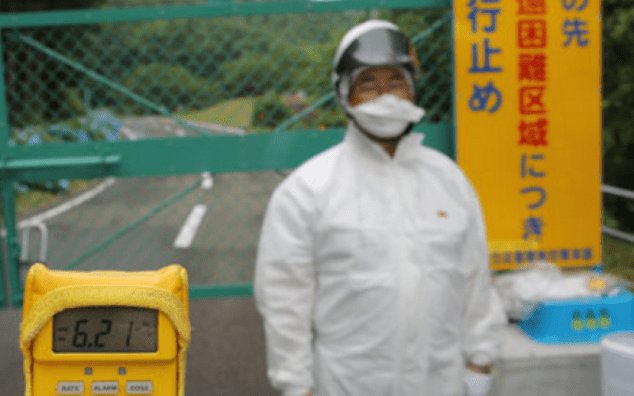
According to Fukushima prefecture police, a decontamination worker’s dead body was found in the company area that he was working for on 5/16/2016.
The body is assumed to be the man in 40s, who had been missing since last Autumn.
Police found it in the gravel pit of the company area. The company undertakes decontamination works in Iwaki city. From juridical autopsy, intracranial injury was possibly the cause of death. There were several scars on the face and body.
The company president and 5 other employees and former employees were arrested for suspicion of abandonment of dead body.
No more details are reported.
http://irresponsibility.seesaa.net/archives/20160517-1.html
http://matomejapan.doorblog.jp/archives/60130534.html
USA not yet able to get India into the Nuclear Suppliers Group
Nuclear Suppliers Group Meeting On India’s Membership Ends Inconclusive http://www.ndtv.com/india-news/nuclear-suppliers-group-meeting-on-indias-membership-ends-inconclusive-1417783 Agencies | June 10, 2016 VIENNA:
HIGHLIGHTS
- No decision on India’s application to enter NSG in Vienna meeting
- Application to be taken up in meeting in Seoul on June 20
- Countries led by US support India’s bid, others led by China oppose
India’s application is now expected to be taken up in a meeting in Seoul on June 20.
The US-led push for India to join the club of countriescontrolling access to sensitive nuclear technology had made some headway on Thursday as several opponents appeared more willing to work towards a compromise, but China has consistently remained defiant.
The Nuclear Suppliers Group or NSG aims to prevent the proliferation of nuclear weapons by restricting the sale of items that can be used to make those arms. It was set up in response to India’s first nuclear test in 1974.
India already enjoys most of the benefits of membership under a 2008 exemption to NSG rules granted to support its nuclear cooperation deal with Washington, even though India has developed atomic weapons and never signed the nuclear Non-Proliferation Treaty, the main global arms control pact.
After meeting with Prime Minister Narendra Modi at the White House on Thursday, President Barack Obama pledged America’s backing for India to be given a seat in the NSG.
But China on Thursday maintained its position that the Non-Proliferation Treaty is central to the NSG, diplomats said.
Residents near Sendai nuclear plant agonize over future power supplies
SATSUMASENDAI, Kagoshima — Residents here are agonizing over whether they will be able to do away with nuclear power and shift to renewable energy.
The No. 1 and 2 reactors at the Sendai Nuclear Power Plant in this Kagoshima Prefecture city of Satsumasendai were put back online in the summer of 2015.
There had been a common view that the suspension of operations at the Sendai nuclear power complex in the wake of the Fukushima nuclear disaster was having a grave impact on the local economy. But there were unexpected responses to a questionnaire survey of local businesses conducted by the city’s chamber of commerce and industry in 2014. On a question about the impact of the suspension of nuclear reactors, 50.3 percent of the 358 companies that responded to the survey said that there was “no” impact, surpassing 48.9 percent of the companies that said “yes.”
Hiroshi Tanaka, 58-year-old president of local electronics parts manufacturer Okano Electronics Co., said, “There was no impact.” At the request of the municipal government two years ago, he played a mediator role in ensuring cooperation among 18 local companies to put street lights using solar power to practical use. The city is currently making a strong effort to introduce renewable energy such as solar and wind power. The municipal government withheld approval of a plan to build a third reactor at the Sendai nuclear power station after the outbreak of the Fukushima nuclear crisis in 2011. The total output of renewable energy in the city stood at 250 kilowatts generated by only one windmill before the Fukushima nuclear disaster, but it rose to a total of 134,000 kilowatts as of the end of March 2016, enough to cover the needs of all 46,000 households in the city.
Satsumasendai Mayor Hideo Iwakiri has been saying, “The No. 1 and 2 reactors will eventually be decommissioned. We want to gear up for the next generation of energy.” Tanaka also said, “We will take the next step while the reactors are running.” Obviously, it is difficult for the renewable energy industry to create the same amount of jobs as the nuclear power industry. The city is planning to build a major conference hall by using government subsidies of 2.5 billion yen it is to receive for allowing the two reactors to resume operations. The city government, therefore, has been criticized for its policy focusing on the construction of public structures. But there are still calls within the construction industry to build another reactor at the Sendai nuclear power station.
Still, there are signs of the city becoming keen to fully break away from nuclear power. A 71-year-old former head of a neighborhood community association in the city’s Takae district, about 6 kilometers from the Sendai Nuclear Power Plant, said, “We cannot relieve our anxiety because of the accident in Fukushima. We want the existing reactors to keep running until they are decommissioned, but we want new ones to be installed somewhere else. I think that’s what everyone thinks.”
The central government is planning to have nuclear power make up 20 to 22 percent of the nation’s electric power needs in the future. The city is not able to do away with nuclear power so easily, so it is agonizing over the future of its energy program while putting up a two-front strategy — nuclear power and renewable energy.
I got on a boat to visit an islander, hoping to hear his real opinion. The Koshikijima Islands, about 30 kilometers west of the Sendai nuclear plant, merged into the city of Satsumasendai in 2004. Single-seat electric vehicles for tourists are lined up at a harbor on Kamikoshiki-jima island, the central part of islanders’ activities. In the yard of an shutdown school, a private-public project was under way to conduct a demonstration experiment on a power storage system that combines solar panels and used batteries for electric vehicles.
Kyushu Electric Power Co. built the country’s first commercial wind power plant on the island in 1989. After the outbreak of the Fukushima nuclear crisis, the city called the Koshikijima Islands “Eco Islands.”
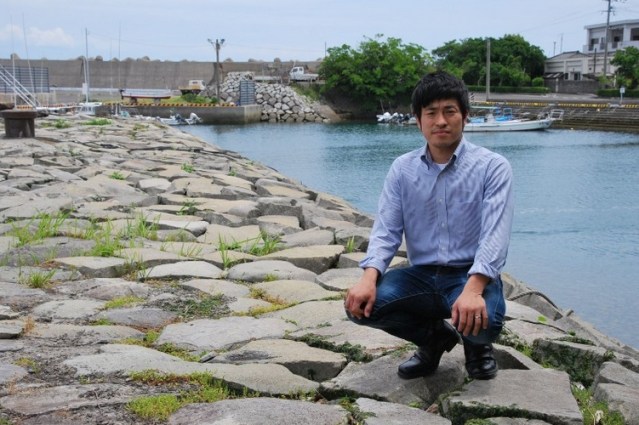
The man I went to see is Kenta Yamashita, 30, who runs a company called “Higashishinakai no Chiisanashima Burando” (Small Island Brand in East China Sea). He studied architecture at a Kyoto university and worked for a while after graduating from college. He returned to his home six years ago to start his own business. His company, which has 13 employees, is engaged in projects to show the attractive points of the island such as “minshuku” (private homes that provide lodgings for travelers) and tour guides.
The Fukushima nuclear accident occurred one year after he returned to the island. No matter how much he is proud of the island’s beautiful nature, he can see the Sendai Nuclear Power Plant far away on a sunny day.
I sat face to face with him in his office that was converted from a house that was more than 100 years old, and asked him unashamedly about what he thinks of nuclear power. He lowered his eyes and thought for a while before saying with a stern face, “There is no electricity generated by nuclear power not even one kilowatt on this island. I don’t care about whether the reactors are running or not.”
Yamashita told me about a fishing port that has a breakwater, a stone wall built by islanders. So, I asked him to take me there. It was a place where fishermen sat on the stone wall and repaired fishing nets over small talk. Yamashita said, “This is an affluent island if you live idyllically. I think the distinct character of this island is the landscapes that cannot be measured by economics.” He said that he had an incisive memory of the stone wall.
This was from around a time when Yamashita moved away from the island to go to high school on the Japanese mainland. When he came back to the island on holidays, his father, who was working for a construction company, was destroying part of the stone wall at the fishing port as part of work to widen a road. He thought, “Who needs such construction work? What is the point of construction work to destroy a place that everyone has been caring about?” On that night, he rebuked his father in anger. His father replied, “It was for the sake of you.”
It requires money to go to school on the mainland. Yamashita was plagued by the irrational fact that he was able to live by having someone destroy the landscape that he had been familiar with since his infancy. He could not say anything to respond to what his father said.
“If you think about the economy alone, this is the worst island,” Yamashita said. He went on to say, “I want to do my best to create work which I can proudly tell the generation of our children ‘this is for the sake of you’. I believe that is the role for me to play.”
Yamashita then told me, “It is true that there are many people who rely on the nuclear power plant for their living. I can’t flatly say this and that.” He feels that nuclear power is equal to a public works project to destroy the stone wall. “It is better not to have nuclear reactors. But once they start moving, they will move closer to decommissioning. I even think that it was good to restart the reactors.”
http://mainichi.jp/english/articles/20160608/p2a/00m/0na/016000c
Ministry of the environment to decide to reuse contaminated soil for road and coastal levee nationwide
On 6/7/2016, the experts study group of MOE (Ministry of the Environment) admitted to reuse the contaminated soil to public works.
The contaminated soil is from decontamination. Cesium density is supposed to be 5,000 ~ 8,000 Bq/Kg to be recycled. It will be reused for road and coastal levee all around Japan.
The government of Japan decontaminated the ground and spreads it to the entire country.
The ministry is planned to make an official announcement soon.
This March, MOE was stating they would reduce the radiation level with the technology that they didn’t have yet. It is not clear if they developed the technology already.
Japan Fish Fukushima Contaminated
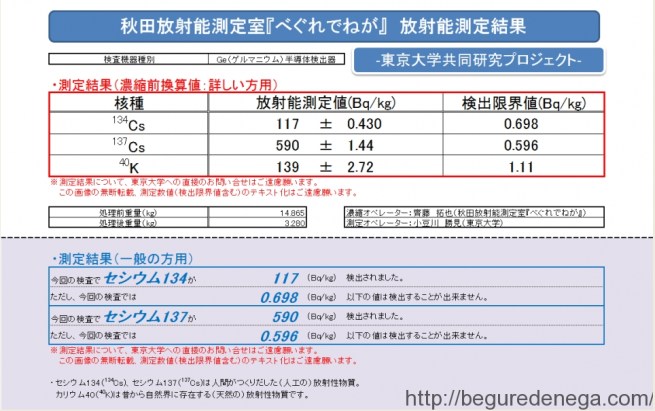
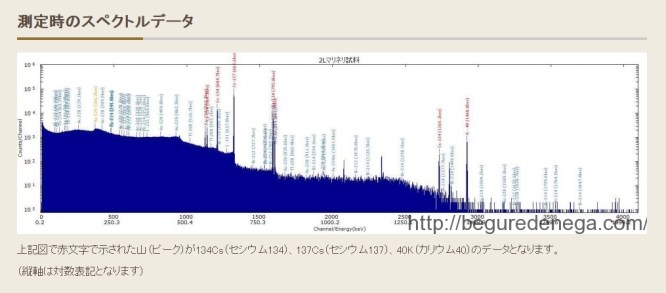
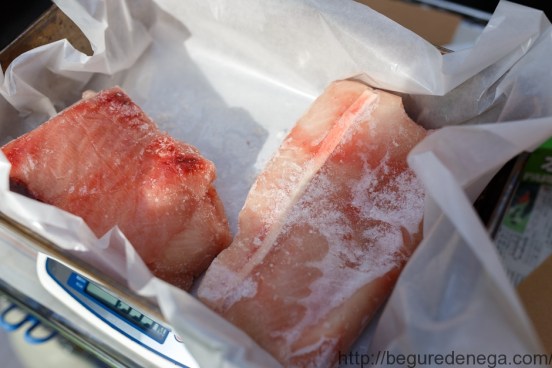
Shortfin mako shark steaks, commonly consumed in Japan, caught off Shizuoka prefecture, more than 500 kms south of Fukushima : 707 becquerels / kg of Cesium 134 + 137
Cesium 134Cs: 117 Bq / kg
Cesium 137Cs: 590 Bq / kg
Thank you Tepco!
The release of radioactive water from the Fukushima Daiichi nuclear plant into the sea continues (300 Tons per day), and its bioaccumulation in living organisms continues as well, especially at the top of the food chain…
Bon appetit!

Source http://beguredenega.com/archives/9498
In the meantime Japanese Ministry of Environment decides to lift shipment restrictions on Fukushima flounder and conger and other types of fish, 18 species:
Shipment Restrictions on Fukushima Flounder, Conger Lifted
Tokyo, June 9 (Jiji Press)–The Japanese government lifted shipment restrictions on Thursday on flounder and whitespotted conger caught off the nuclear disaster-hit northeastern Japan prefecture of Fukushima.
The lifting came after the government confirmed that the samples stably contain less than the government-set standard of 100 becquerels of radioactive substances per kilogram.
The government introduced the shipment restrictions following the March 2011 meltdowns at Tokyo Electric Power Company Holdings Inc.’s Fukushima No. 1 nuclear power plant.
Including flounder and whitespotted conger, 18 species have seen a shipment ban lifted, while shipments of 26 others, including Japanese black porgy and masu salmon, have yet to be approved.
In 2010, flounder and whitespotted conger ranked third and ninth, respectively, in terms of the value of landings off Fukushima.
http://jen.jiji.com/jc/i?g=eco&k=2016060900848
Stumbling block prevents Toshiba Westingouse selling nuclear technology to India
Nisha Desai Biswal, assistant secretary of State for South Asian affairs, told a Senate committee on May 24 that a commercial deal was “quite close.”
The stumbling block, however, has been one article in a 2010 piece of Indian legislation that would make Westinghouse — and its suppliers — potentially vulnerable to crippling litigation under local Indian laws in the event of an accident. India has offered to establish insurance pools, but companies have not accepted that plan. There was no indication Tuesday that this issue had been resolved.
“They’ve painted themselves into a corner,” Omer F. Brown, a lawyer and nuclear liability expert, said of the Indian government. “I don’t know how they get out of it given that they wrote the law the way they did.”
Westinghouse and General Electric’s nuclear arm have been striving to reach a deal with India for more than a decade, and in 2008 Congress approved an agreement to promote nuclear cooperation with India, which critics said undermined half a century of U.S. nonproliferation efforts.
Daryl Kimball, director of the Arms Control Association, said the U.S. push for India’s membership in the NSG “would compound the damage in my view of Bush administration’s exemption” for India. He and 16 other non-proliferation experts, including from the Obama administration, have written a letter urging the administration to drop its support for India’s membership……..http://www.ndtv.com/india-news/6-nuclear-power-reactors-for-andhra-deal-on-but-foreign-media-1416685
Radioactive soil to be used to build roads set to spark uproar

A public outcry is expected when radioactive earth from the 2011 Fukushima nuclear disaster is recycled and used to construct roads and in other building projects.
“Fierce resistance would likely arise if the contaminated earth were used in prefectures other than Fukushima Prefecture,” said an official at an Environment Ministry study meeting on June 7.
But Shinji Inoue, senior vice environment minister, said the ministry will proceed with recycling despite expected opposition.
“We are set to promote the reuse (of contaminated earth) by endeavoring to gain public understanding across the country, including Fukushima Prefecture,” he said after the meeting.
Polluted earth will be covered by either clean earth, concrete, asphalt or other material to minimize radiation exposure to construction workers and residents living near the facilities built using radioactive soil.
Twenty-two million cubic meters, the equivalent of 18 Tokyo Dome stadiums, is the amount of contaminated soil expected to be produced in total from the cleanup work in areas around the crippled Fukushima No. 1 nuclear power plant and elsewhere in the prefecture. It is unclear how much of the polluted soil will be used in building projects.
Ministry officials decided at the meeting that the soil to be recycled will be restricted to that in which radioactivity measures 8,000 becquerels or less per kilogram.
The recycling is aimed to cut the amount of radioactive soil to be shipped to other prefectures for final disposal.
If the soil has more than 8,000 becquerels of radioactivity per kilogram, the central government is obliged under law to safely dispose of it.
The ministry envisages the use of contaminated earth for raising the ground level in the construction of roads, seawalls, railways and other public works projects.
It can also be used to cover waste at disposal sites.
The 22 million cubic meters of soil is to be kept at the interim storage site to be built near the crippled nuclear plant in Fukushima Prefecture. After being kept there for about 30 years, it is scheduled under law to be dumped outside the prefecture.
1 This Month





PLEASE OPPOSE HR 8255 AND S.3639 – bills would accelerate satellite deployment, with no environmental review or safeguards – https://ncstd5li.quorum.us/campaign/169331/
To see nuclear-related stories in greater depth and intensity – go to https://nuclearinformation.wordpress.com
-
Archives
- October 2026 (49)
- September 2026 (339)
- August 2026 (330)
- July 2026 (355)
- June 2026 (287)
- May 2026 (306)
- April 2026 (356)
- March 2026 (251)
- February 2026 (267)
- January 2026 (308)
- December 2025 (358)
- November 2025 (359)
-
Categories
- 1
- 1 NUCLEAR ISSUES
- business and costs
- climate change
- culture and arts
- ENERGY
- environment
- health
- history
- indigenous issues
- Legal
- marketing of nuclear
- media
- opposition to nuclear
- PERSONAL STORIES
- politics
- politics international
- Religion and ethics
- safety
- secrets,lies and civil liberties
- spinbuster
- technology
- Uranium
- wastes
- weapons and war
- Women
- 2 WORLD
- ACTION
- AFRICA
- Atrocities
- AUSTRALIA
- Christina's notes
- Christina's themes
- culture and arts
- Events
- Fuk 2022
- Fuk 2023
- Fukushima 2017
- Fukushima 2018
- fukushima 2019
- Fukushima 2020
- Fukushima 2021
- general
- global warming
- Humour (God we need it)
- Nuclear
- RARE EARTHS
- Reference
- resources – print
- Resources -audiovicual
- Weekly Newsletter
- World
- World Nuclear
- YouTube
-
RSS
Entries RSS
Comments RSS

