Report: U.S. Transfers Nukes From Turkish Airbase to Romania
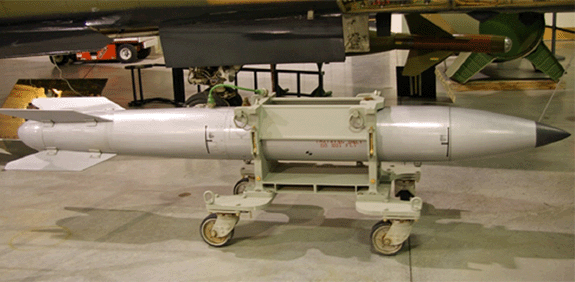
We can’t solve the problem of a nuclear-armed North Korea without talking to them

 To Address Nuclear Threat, We Must Talk To North Korea http://www.huffingtonpost.com/lee-h-hamilton/to-address-nuclear-threat_b_11572840.html Isolated and secretive, North Korea presents the United States with a unique challenge we cannot ignore. The North Korean nuclear arsenal is becoming steadily more alarming, and it is past time for the United States to get serious about the threat.
The Obama administration has pursued a policy of “strategic patience,” which includes applying international sanctions and waiting for North Korea to move away from its nuclear program or for the government to collapse. It hasn’t been enough.
The good news is that the region has been relatively stable. But our policy has not changed North Korea’s behavior. Economic sanctions imposed in response to nuclear tests and missile launches are hurting, but they have not threatened the regime’s survival.
Meanwhile, North Korea’s nuclear arsenal continues to grow in defiance of United Nations resolutions; and so does its capacity to threaten its neighbors and even the U.S. It is time to revise our strategy.
For North Korea, its nuclear program is essential to its identity as a nation. It has an estimated 10 to 20 nuclear devices and is developing a new nuclear weapon every six weeks or so. It has both short- and long-range missiles and is constantly trying to improve their effectiveness. It hopes to be able to target the U.S. mainland. An underground nuclear test and unsuccessful satellite launch early this year suggest it is seriously pursuing that goal.
North Korea is the weakest power in Northeast Asia, but it has played its limited hand fairly well. With no real allies, it may well be the most isolated nation on Earth. Life for most of its citizens is unrelentingly harsh. Poverty is widespread, and the country’s per-capita GDP is among the lowest outside of Africa, according to the CIA.
Little is known about its young ruler, 32-year-old Kim Jong Un. He is mysterious, unpredictable and dangerous. He has consolidated power, purging many government officials and promoting others. He obviously wants to keep control and has continued to maintain a rigidly nationalistic and repressive state.
China has more influence with North Korea than any other country, in part because up to 90 percent of North Korea’s international trade is with China. In the U.S., we are continually urging China to get tougher with North Korea.
But while China is no fan of North Korea’s nuclear program, it does not see the country as an imminent threat. China benefits from its neighbor’s stability, fearing a collapse there would create chaos and violence on the Korean peninsula and send refugees surging across the border into China.
For the United States, North Korea’s nuclear program should be cause for alarm but not panic. We can’t do much to influence such an isolated country, but we should not ignore the options we do have. We urgently need to pursue a political process aimed at freezing North Korea’s nuclear weapons program.
And like it or not, we can’t solve the problem of a nuclear-armed North Korea without talking to them. Talking with North Korea will not be popular, but it has become necessary.
Previous multi-party talks addressing North Korea’s nuclear program fell apart in the face of North Korean intransigence. Since then, the U.S. has said we will return to the negotiating table only if North Korea moves away from its nuclear weapons program, a precondition that has ensured no talks.
To continue that stance would be a mistake. We should be prepared to resume talks without preconditions. It may be that the Obama administration is moving away from such preconditions. But we have not yet sat down to talk.
None of this is to suggest that talks with North Korea would be easy or would yield prompt results. We should continue using sanctions and attempting to hold government leaders responsible for their decisions. But along with pressure, we need to add a strong political and diplomatic component to our efforts.
At the same time, the U.S. and its partners must be prepared in the event North Korea collapses. The immediate challenge for the international community would be to seize or destroy North Korea’s nuclear arsenal to prevent it from falling into the wrong hands.
In all of these efforts, we need to work closely with other Asian nations – especially China. We must find a way to persuade North Korea that the path to security and stability lies in moving away from isolation and secrecy, not in pursuing nuclear strength.
Lee H. Hamilton is a Distinguished Scholar, Indiana University School of Global and International Studies; Professor of Practice, IU School of Public and Environmental Affairs; and Senior Advisor, IU Center on Representative Government. He served as U.S. Representative from Indiana’s 9th Congressional District from 1965-1999.
Britain’s Hinkley fiasco should give Pakistan pause to reconsider its nuclear power plans
It would make sense therefore not to invest in projects that are destined to be overtaken by superior alternatives. The funds going into nuclear power stations would be better spent on making use of wind and solar power for which Pakistan has substantial potential.
No one can predict what the energy scene would look like in 2050, when all of the planned nuclear power stations are to become operational. What is clear is that they won’t remain competitive as new technologies come along to elbow out some of the old ones.
 A case for reviewing nuclear power plants http://aaj.tv/2016/08/a-case-for-reviewing-nuclear-power-plants/ August 18, 2016 by Farah Jamil Last month, something interesting and unusual happened in Britain that should give a pause to Islamabad as it walks in a certain direction without thinking what lies in store. Continue reading
The Mysterious Case Of The Missing Fukushima Fuel
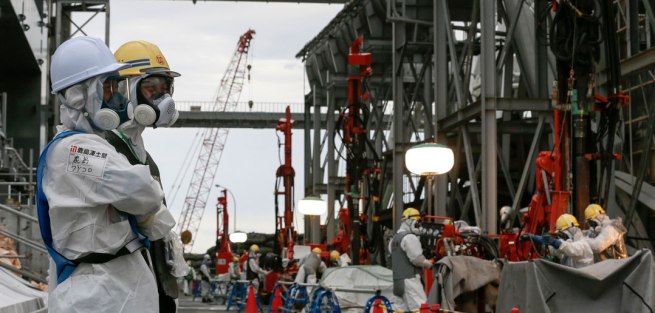
By Richard Wilcox, PhD
As the world forever hurtles toward Armageddon, the Fukushima nuclear disaster has largely faded from the front pages. But the issue is far from resolved. Radiation from nuclear accidents is not easily dispelled with estimates of clean-up time at Fukushima ranging from 40 to 500 years, and nearly six years have already passed. Even safely stored nuclear material is dangerous for 100,000 years (1).
Elvis Has Left The Building
The major question regarding the situation at Japan’s Fukushima Dai-ichi (no.1 nuclear power plant) regards the location of the melted fuel at reactor units 1, 2 and 3.
Recent evidence of the location of the fuel in unit 2 was disputed, with Tokyo Electric Co. (Tepco) and the mainstream media taking one view and independent scientists taking another. Is the melted fuel still inside the container in the reactor building, or has it leaked out and is now penetrating in scattered areas laterally and vertically into the ground?
Large amounts of melted fuel could reach the ground water, and even the aquifer which is ultimately connected to the Tokyo water supply.
Let’s compare two assessments on this important issue based on the use of “Muon tomography”:
According to the Asahi Shimbun (newspaper) version of reality which relies solely on the Tepco report:
Most of the nuclear fuel inside the No. 2 reactor at the Fukushima No. 1 nuclear power plant apparently did not melt through the pressure vessel (2).
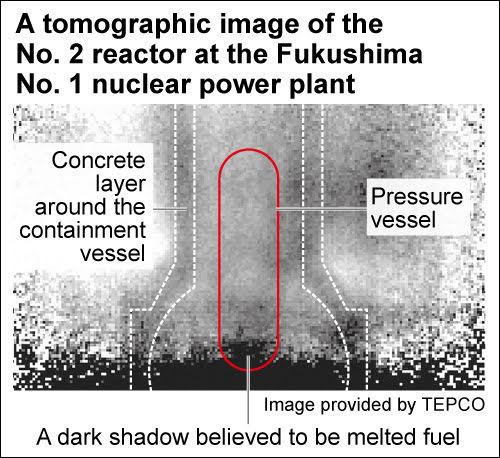
Is it that simple? Tepco’s record of reliability has become rather tarnished over the years.
Note that in the graphic image above, the word “believed” is used, which reinforces the word “apparently” used in the text of the article referring to the uncertainty of the location of the melted fuel. However, the title of the article is more confident, stating that “most fuel was contained.” The title is blatantly misleading and since most readers just skim the news, that will be what they take away from the report.
On the other hand, the independent scientists at the Simply Info website differ about the location of the fuel in relation to the container, the “Reactor Pressure Vessel” (RPV):
Tepco’s superimposed mask demarcates the bottom head too low including fuel inside the rpv which according to the refined image is clearly shown below the bottom head….”there is no fuel in the bottom of the RPV in any significant amount” (3).

This graphic indicates that a different method was used by these scientists to view the location of the melted fuel.
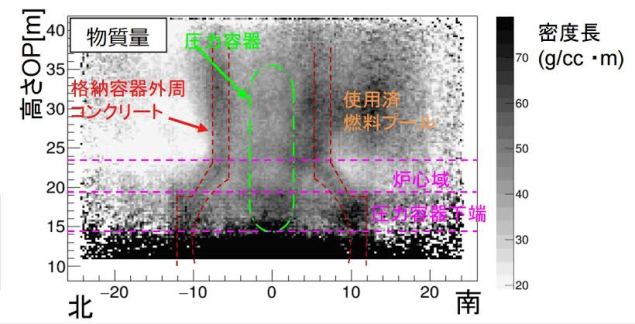
In this graphic the Simply Info scientists argue that the container drawing was placed too low in the Tepco version, whereas in their version, it is higher, making it less obvious that the fuel is in the container.
Careful reading of this article reveals that Tepco’s analysis, as so glibly presented by the mainstream media, was based on technological smoke and mirrors, clearly intended to deceive. Tepco and the media should report on the range of plausible possibilities, not only the small slice of reality they wish the public to see (4; 5).
So will the Asahi Shimbun correct their fallacious reporting? Both the Japan Times and the Asahi Shimbunare heavily owned and controlled by foreign investors and media. TheAsahi shares offices with the New York Times in Tokyo and many Japanese English dailies rely on Western news wires such as the agenda driven, oligarchic news sources, Reutersand the Associated Press (6).
Decommissioning Or Out Of Commission?
In fact, in over five years much progress has been made to control the situation at the destroyed Fukushima nuclear plant. Much of the rubble has been cleaned up and fresh coats of paints are on the buildings, but the place is still intensely radioactive, and no human can approach the specific reactor meltdown sites.
The second major issue at Dai-ichi concerns the future plans for the decommissioning of the plant. All along Tepco has said they will retrieve the melted fuel and complete decommissioning within 40 years. In fact the technology to retrieve the fuel has not yet been invented. Not only is it impossible for human workers to approach the area, but even robots break down due to the radiation short circuiting their wires.
It was recently revealed that Japan is still considering an option that many people feel would be very dangerous in the long term, and that is the “sarcophagus” solution (7). The only time this has been tried is at Chernobyl — it looks like a high-tech barn placed over the site (8). Unlike Chernobyl where the ground is rock hard, at Fukushima the ground is akin to a wet sponge with soft topsoil, so while covering it will reduce radioactive atmospheric fallout, the radiation will continue to leak downwards to the aquifer and outwards to the ocean unless appropriate engineering measures are taken.
Nevertheless, progress is slow with efforts “underway to develop the equipment needed to retrieve corium (melted fuel) samples from inside the containment structures of units 1-3 at the plant. No solid time frame” has yet been was mentioned (9).
The Nuclear Story
In an interesting aside, the best documentary film on Fukushima I have see so far, Fukushima: A Nuclear Story was released in 2015 (10). It is an Italian production but with English narration and subtitles. The plot follows journalist Pio d’Emilio during the nuclear crisis as he tries to uncover the real situation in Fukushima. The film is engaging and educational at the same time, covering new ground and combining dramatic events as they unfold at the time with scientific explanations done in an entertaining, “manga” comic book style.
The film emphasizes the near catastrophe of Tepco’s panic during the accident, and the courage and wisdom of then prime minister Naoto Kan, and the Fukushima 50, led by the plant manager Masao Yoshida whose snap judgement literally “saved the world.”
The film raises one very interesting piece of information that I did not know about which is that it was only the luck of the pool fuel gate at unit 4 not closing, in other words, malfunctioning, which allowed water in to cool the scorching fuel rods. Had that not occurred, the fuel rods could have caught fire spreading massive radiation for hundreds of miles.
Note that had the Fukushima accident happened at night or on the weekend there would have been far fewer workers at the plant to tackle the problem, possibly leading to a completely out-of-control situation.
The Ice Wall Cometh…
The “ice wall” that Tepco built in order to freeze the ground around the plant to block water flow in and out of the plant, continues to have problems. It is a very expensive operation to build and maintain, prone to technical problems and no one really knows when or if it will ever be fully implemented (i.e., taxpayer boondoggle) (11; 12). Even if the ice wall operates as intended it will not stop all of the water flow allowing some to be contaminated (13).
Is this why the sarcophagus option is still on the table? Critics have argued that the ice wall was poorly conceived from the start because it did not address dealing with the source of water flow which is at the water shed above the plant in the nearby mountains (Tepco balked at the project due to the high cost).
Japan Nuke News
Various nuclear related issues pop up from time to time around country. Since the nuclear accident in 2011, the overwhelming public sentiment has been strongly anti nuclear, despite efforts by the Abe administration to downplay the accident and restart as many of the reactors around the country as possible. The logic of the restarts against public opinion is in order to satisfy the big banks who have financed Japanese utility company operations while reactors have remained idle (expensive but not profit producing) over the past years.
Ever since the hugely destructive earthquakes earlier in 2016 on the island of Kyushu, nuclear plant restarts along the path of the fault line, which basically travels through the middle of the entire country, have been in doubt. Still we see for example in Shikoku that nuclear reactors are restarting despite local opposition (14).
Although prime minister Abe keeps pushing for resumption of nuclear operations, he probably would not want to work at the Fukushima nuclear disaster clean up site himself. It was recently reported by Japanese scientists that insoluble radioactive cesium has been detected in workers exposed to high levels of radiation at the plant (15).
Indeed, the wildlife in Fukushima prefecture has long been reported to be contaminated with radiation, recently a wild boar was detected with massive levels of radiation in its body (16). This is an indication of the general contamination of the environment there.
This doesn’t stop the Fukushima tourist board from advertising how safe and wonderful life is there. In order to drum up tourist dollars the national government has carried out a massive public relations campaign despite the lingering possibility of numerous radioactive hotspots in the area (17; 18).
Trump Threatens Nuclear Cartel
Maybe things will change a bit if Donald Trump can be elected president in the United States. Trump has promised to reduce US military presence in Japan and let them sort out their own military affairs. This does not bode well for the US-Japan military racket which siphons off billions of dollars in tax revenue to satisfy the greed of both country’s military industrial complexes, which are intensely tied up with the nuclear weapons and power industries (20).
Isn’t it ironic that the bogeyman of North Korea which is constantly conjured by Japan to justify its own growth in militarism, obtained its original nuclear weapon technology from Britain, a supposed Japan ally (21).
Funny old world ain’t it.
* Special thanks to the Simply Info website for their continuous work on the Fukushima issue; and to Activist Post for their continued reporting.
Richard Wilcox is a contributing editor and writer for the book: Fukushima: Dispossession or Denuclearization? (2014) and a Tokyo-based teacher and writer who holds a PhD in environmental studies. He is a regular contributor to Activist Post. His radio interviews and articles are archived athttp://wilcoxrb99.wordpress.com and he can be reached at wilcoxrb2013@gmail.com.
References
1 – Nuclear waste: keep out for 100,000 years
http://www.ft.com/cms/s/2/db87c16c-4947-11e6-b387-64ab0a67014c.html#axzz4EtlF3Xds
2 – New study on Fukushima reactor shows most fuel was contained
http://www.asahi.com/ajw/articles/AJ201607290050.html
3 – Something Incredible Found In Fukushima Muon Scan
http://www.fukuleaks.org/web/?p=15666
4 – First Fukushima Unit 2 Muon Scans Dispute New Scan Results
http://www.fukuleaks.org/web/?p=15650
5 – Fukushima Unit 2 Muon Scan Not So Conclusive
http://www.fukuleaks.org/web/?p=15637
6 – Democracy in Peril: Twenty Years of Media Consolidation Under the Telecommunications Act
http://www.truth-out.org/news/item/34789-democracy-in-peril-twenty-years-of-media-consolidation-under-the-telecommunications-act;
7 – NDF Tries To Walk Back Fukushima Daiichi Sarcophagus Admission
http://www.fukuleaks.org/web/?p=15607
8 – The Chernobyl Gallery: Sarcophagus
http://chernobylgallery.com/chernobyl-disaster/sarcophagus/
9 – Melted Fuel To Be Sampled From Fukushima Reactors Containment
http://www.fukuleaks.org/web/?p=15608
10 – Fukushima: A Nuclear Story
http://www.nuclearstory.com
11 – Fukushima Frozen Wall Sees Small Progress From Concrete Addition
http://www.fukuleaks.org/web/?p=15659
12 – Fukushima Frozen Wall Report For June 23 2016
http://www.fukuleaks.org/web/?p=15569
13 – Fukushima No. 1 plant’s ice wall won’t be watertight, says chief architect
http://www.japantimes.co.jp/news/2016/04/29/national/fukushima-plants-new-ice-wall-will-not-be-watertight-says-chief-architect/#.V7JtD-lMaRk
14 – Shikoku MOX plant restarts amid outcry over fresh quake fears
http://www.japantimes.co.jp/news/2016/08/12/national/shikoku-electric-poised-fire-ehime-plant-mox-reactor-amid-protests/#.V66L_ulMaRk
15 – THREE-YEAR RETENTION OF RADIOACTIVE CAESIUM IN THE BODY OF TEPCO WORKERS INVOLVED IN THE FUKUSHIMA DAIICHI NUCLEAR POWER STATION ACCIDENT
http://rpd.oxfordjournals.org/content/early/2016/03/14/rpd.ncw036
16 – 960 Bq/kg of Cs-134/137 detected from wild boar in Fukushima
http://fukushima-diary.com/2016/07/960-bqkg-of-cs-134137-detected-from-wild-boar-in-fukushima/
17 – Tokyo to Fukushima: Route to enjoy modern, old Japan
http://showcase.japantimes.co.jp/tokyo/news/?key=tokyo1
18 – Fukushima tourism making strong progress on recovery
http://www.japantimes.co.jp/news/2016/08/14/national/fukushima-tourism-making-strong-progress-recovery/#.V7Eoo-lMaRk
19 – Trump rips U.S. defense of Japan as one-sided, too expensive
http://www.japantimes.co.jp/news/2016/08/06/national/politics-diplomacy/trump-rips-u-s-defense-japan-one-sided-expensive/#.V6bc2elMaRk
20 – North Korea used British technology to build its nuclear bombs
http://www.theecologist.org/News/news_analysis/2987935/what_theresa_may_forgot_north_korea_used_british_technology_to_build_its_nuclear_bombs.htm
Source:
http://www.wakingtimes.com/2016/08/16/the-mysteriously-case-of-the-missing-fukushima-fuel/
Kansai Electric starts removing fuel from Takahama reactor No. 4
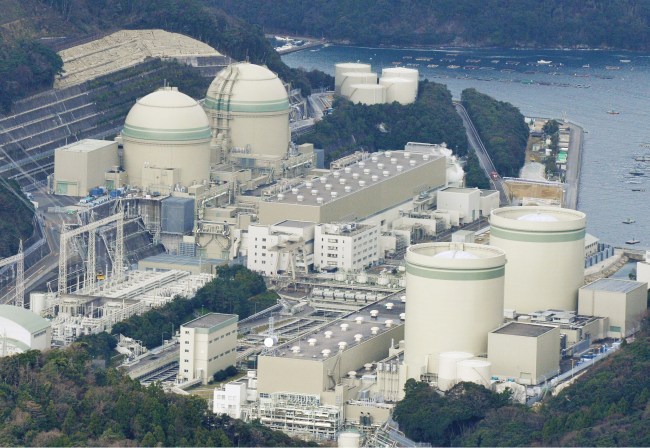
FUKUI – Kansai Electric Power Co. on Wednesday began removing fuel assemblies from the No. 4 reactor at its Takahama nuclear plant in Fukui Prefecture.
The removal is the result of a preliminary injunction issued in early March by the Otsu District Court in neighboring Shiga Prefecture ordering the power utility to halt operations of the No. 3 and No. 4 reactors at the plant. The court upheld a petition filed by a group of residents who live near the plant in Shiga and are concerned over safety.
The work to remove 157 nuclear fuel assemblies from the No. 4 reactor started at noon and is slated to end around 7 p.m. Friday. The fuel assemblies will be transferred to a spent fuel storage pool.
Kansai Electric will begin to remove fuel from the No. 3 reactor on Sept. 5.
The No. 3 reactor, which was brought back online on Jan. 29, was shut down following the injunction. The No. 4 unit was reactivated on Feb. 26, but it automatically shut down on its own three days later due to a technical glitch.
Kansai Electric filed an appeal against the injunction but was turned down by the Otsu court in June.
The utility then filed an appeal with the Osaka High Court in July requesting the cancellation of the district court’s injunction.
Nuclear power a poor deal for India, despite aggressive marketing by USA, France Russia
India is better advised to put money instead into its abundant solar energy, which will definitely be less expensive and less risky. “Investing in new solar photovoltaic capacity would be a much lower-cost, significantly less environmentally harmful and far more sustainable alternative to the Mithi Virdi and Kovvada projects,”

Nuclear power costly, inefficient, SANKAR RAY | Fri, 12 Aug 2016- , Mumbai , dna Reactors reduced to status of old furniture as no new ones are being made With Prime Minister Narendra Modi and US President Barrack Obama, finalising the import of 12 AP1000 nuclear reactors plants – six from the Westinghouse Electric — for Mithi Virdi, Gujarat, and another six from the GE-Hitachi’s Economic Simplified Boiling Water Reactor for Kovvada, Andhra Pradesh, nuclear hawks have become super-active. The US Export-Import Bank is about to complete a financing package for the  project. The Nuclear Power Corporation of India and Toshiba Corp’s (6502.T) Westinghouse Electric too confirmed that engineering and site design work would begin shortly. Small wonder, anti–US hawks too have swung into action to nail the very concept of importing nuclear power reactors from the US, arguing that the cost from the US reactors is very high, estimated provisionally at $7.5 million per megawatt in stark contrast to $ 2.9 million of the Russian ones that are installed at Kudankulam.
Prof Sujay Basu, a doyen among energy experts and former — the first too – director, School of Energy Studies, Jadavpur University, expressed his chagrin against import of reactors. “First, the Kudankulam reactors were sold by Russia at distressed price. Second, reactor manufacture, from the very beginning of the new century, ceased to be a profitable business. American nuclear industry is worried for want of buyers and escalation of cost.
France tried to sell one or two reactors to Finland but backed out. Nowhere in the world, except Japan, are new reactors marketable without political lobbying. Energy gap cannot be narrowed by setting up more nuclear plants. In India, the more pressing problem is how to retire several ageing with effective disposal of nuclear hazards.” Indeed, almost all the components of the reactor were manufactured during the 1980s and were rendered surplus due to post-Chernobyl cancellation of over two dozen reactors after the mega-catastrophe in the twilight years of Soviet Union.
V T Padmanabhan, noted analyst and member of the Nuclear Consultancy Group, considered as a crusader for nuclear safety and health effects (genetic and somatic) of ionising radiation, divulged in countercurrents.org about six months ago that the Kudankulam reactor tripped 20 times and was off-grid for 468 days.
Kudankulam Nuclear Power Plant (KKNPP-1), the first reactor, built jointly by the NPCIL and Russia’s Atomstroyexport (ASE), is the only operating Generation-III pressurised water reactor (VVER-1000) the world over. During the 840 days of its grid connection since 22 October 2013, the reactor worked for 372 days, although this so-called brand new Russian machine, commissioned a year ago, underwent a seven-month-long overhaul since 24 June 2015 and achieved criticality in the afternoon of 21 Jan 2016.
Following a series of experiments, the generator was connected to the grid in the morning of 30 Jan 2016. According to the database of Power Reactor Information systems of the International Atomic Energy Agency, the KKNPP-1 operated for only 4,212 hours in 2014, less than half the time-schedule. Mentioning this, Prof M V Ramana, a nuclear physicist and currently associated with the Programme on Science and Global Security at Princeton University, a good fraction of those operations evidently involved the reactor generate below the corresponding rated power capacity. “In all, the reactor generated less than a third of the electricity that it could have if it had operated at full power, 24 hours a day, 365 days a year.” Things worsened in the following year. The NPCIL website admitted that between April 2015 and January 2016, the plant had an abysmally load factor of 20 per cent.
There is no denying that the KKNPP-1 is a congenitally sick baby, a junk reactor. Maybe, the sickly state of KKNPP-1, prompted the NDA government (if not an alibi) to opt for the US plants. But in end-March this year, the Institute for Energy Economics and Financial Analysis, which is engaged in research and analysis on financial and economic issues related to energy, in order to quicken the transition to a diverse, sustainable and profitable energy economy, released a report, Bad Choice: The Risks, Costs and Viability of Proposed US Nuclear Reactors in India, which negates the economic viability of Indian plan to build 12 new nuclear-powered plants using untested technology. The lead author of it, IEEFA’s director of resource planning analysis, David Schlissel, stated that these nuclear plants are “first-of-kind” designs by Toshiba-Westinghouse and General Electric-Hitachi planned for the Mithi Virdi and Kovvada complexes, are neither economically nor financially viable.“They would take much longer than expected to build, they would result in higher bills for ratepayers, and, if they are built, they might not work as advertised.”
The IEEFA pointed out that it would take 11 to 15 years to build, if approved, the first new reactors at Mithi Virdi and Kovvada, provided there is no time lag. These reactors can’t start generation for the electric grid before 2029.
Furthermore, stated Schlissel, even if there is zero time-and-cost overruns, “both projects would require massive investment over the next two decades, ranging from Rs 6.3 lakh crores (US $95 billion) to 11.3 lakh crore rupees (US $170 billion).” The IEEFA warned against slowdown in project implementation due to lengthy land-acquisition and complicated nuclear liability issues. India is better advised to put money instead into its abundant solar energy, which will definitely be less expensive and less risky. “Investing in new solar photovoltaic capacity would be a much lower-cost, significantly less environmentally harmful and far more sustainable alternative to the Mithi Virdi and Kovvada projects,” quipped Schlissel…….http://www.dnaindia.com/analysis/column-nuclear-power-costly-inefficient-2244012
More delay hampers India-Japan nuclear deal
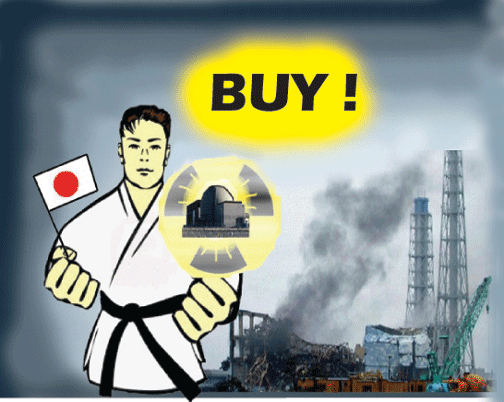
 Ratification of India, Japan civil nuclear deal may face further delay THE HINDU Business Line,
 NAYANIMA BASU NEW DELHI, 16 AUGUST: The ratification of India-Japan Civil Nuclear deal is likely to be delayed further.
“It is unlikely that the Diet (wich is likely to meet for a special session end of next month) will take up the India-Japan Civil Nuclear deal for ratification. There are still some issues that need to be discussed,” a top official, involved in the talks, told BusinessLine.
The Diet had its session last in June. However, this year it will be meeting once again, which is also known as an extraordinary session from September 26.
However, like last time, it seems even in this session the nuclear deal with India will not go through due to “domestic pressure and compulsions”, according to the official. Once the Diet ratifies the deal, the deal will be officially signed.
According to sources, Japan has not been able to build a support for the deal within its political sections, as there are apprehensions that export of Japanese nuclear technology might get routed for military purposes.
There are also “strong concerns” on the Japanese side regarding nuclear cooperation because India is still not a signatory to nuclear Non-Proliferation Treaty (NPT).
The India-Japan Civil Nuclear deal had been under discussion for over six years now………
Meanwhile, India is also concerned with the fact that technical negotiations on the deal might take a backseat as the Japanese Cabinet has undergone a major reshuffle. Japan now has a new Defence Minister Tomomi Inada, who is known to be having anti-nuclear agenda……http://www.thehindubusinessline.com/economy/ratification-of-india-japan-civil-nuclear-deal-may-face-further-delay/article8995337.ece
Fukushima Disaster’s Victims
I decided to translate this particular article because this article for a change talks about the Fukushima disaster victims and in details how their everyday lives have been affected.
In most of the Fukushima related articles from websites and mainstream media, the writers usually focus on the Fukushima Daiichi nuclear power plant and its technical failures, about its continuous leaking into the Pacific ocean etc. but somehow they almost always forget to talk about the plight of the victims, the victims who are at the forefront of this tragedy.
August 12, 2016
Article written by Evelyne Genoulaz, from a lecture given by Kurumi Sugita,
translated by Dun Renard.
Source : Fukushima Blog de Pierre Fetet http://www.fukushima-blog.com/2016/08/fukushima-les-vies-sinistrees.html
March 11, 2016, Kurumi Sugita, social anthropologist researcher and founding president of the association “Our Far Neighbors 3.11”, gave a lecture entitled “Fukushima disaster’s lives” in the Nature and Environment House (MNEI) in Grenoble, Isere, an inaugural lecture for the commemoration of the “Chernobyl, Fukushima disasters”.
The speaker outlined the concrete and current situation of the victims of the Fukushima disaster, particularly on health issues. Attached to Japan, committed, Kurumi monitored the situation of 60 affected people, for several years, visiting each once a year to collect field data for her associative actions. It is the project “DILEM”, “Displaced and Undecided Left to Themselves”, from the nuclear accident in Japan – the life course and geographical trajectory of the victims outside of the official evacuation zone.
I offer a written return of this conference, courtesy of Kurumi who also was kind enough to add data to date on her return from Japan in June 2016.
Evelyne Genoulaz
I. The contaminated territories
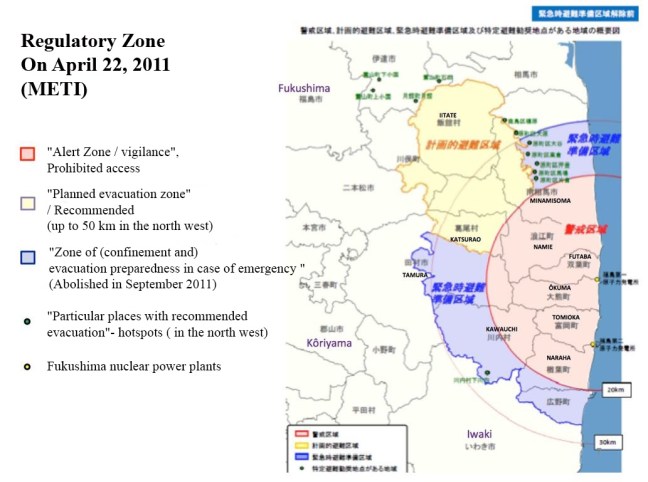
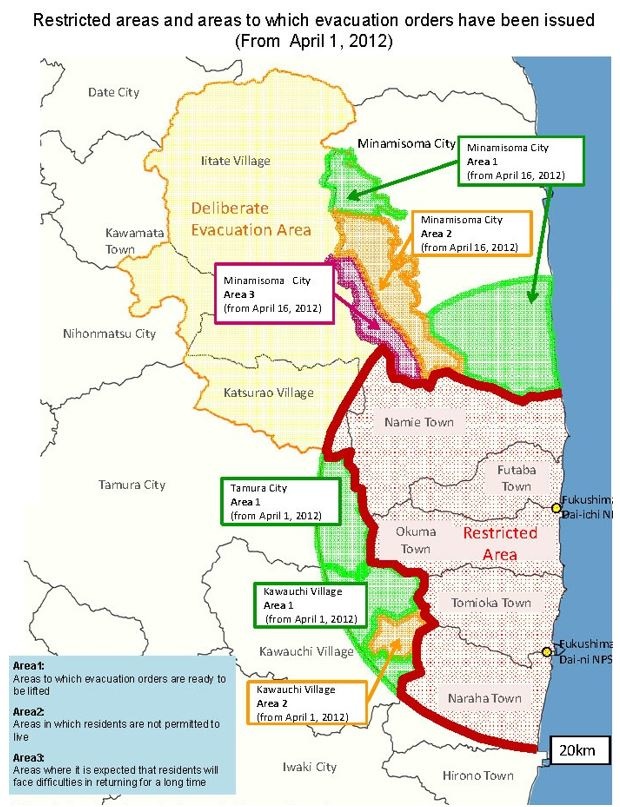
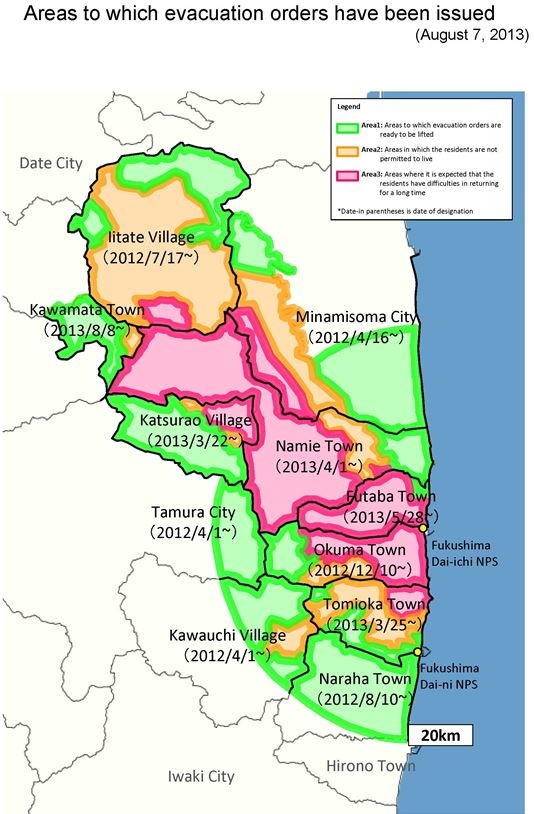
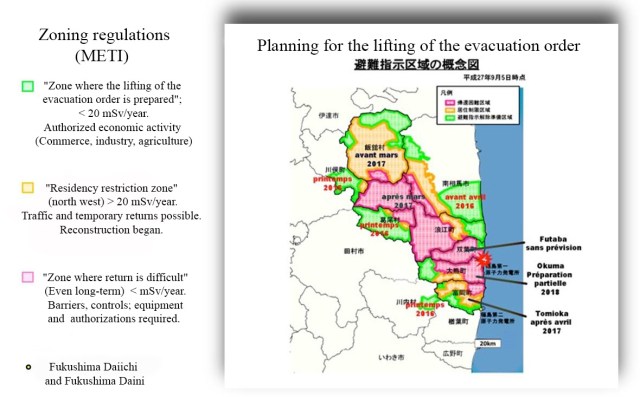
After the disaster the authorities declared a state of emergency and to this day Japan is still “under that declaration of a nuclear emergency state (genshiryoku kinkyu Jitai sengen).” But over time, the zoning of the contaminated territories has been increasingly reduced by the authorities, as shows the chronological overview on these maps (METI).
II. The return policy
Starting this month of March 2016, in fact, many areas were “open”. The return to TOMIOKA is programmed by authorities after April 2017; OKUMA partially in 2018. Only FUTABA is labeled “no projection”. Do note that zoning maps were delineated at the beginning of the disaster zoning by concentric circles, while the radioactivity is deposited in “leopard spots” and today, programmed to be returned to areas are gradually getting geographically closer to the Fukushima Daiichi nuclear plant even though these areas are dangerous!
The government is preparing to lift the evacuation order at 20 mSv / year, and areas from 20 to 50 mSv / year will enter the opening schedule after spring 2017 establishing strategic points for reconstruction ( fukkô Kyoten).
To speak only of Iitate, which was the most beautiful village in Japan, its mayor is in favor of return, but today the situation there is poignant: it was decontaminated up to 20 meters of the houses, but as it is surrounded by mountains and forests, the radioactivity will remain dangerous …
Measures delegated to individuals
The control measurement of environmental radioactivity will now be based on the individual rather than on space. Thus, everyone is invited to measure himself or herself, to measure what is consumed, so that if the individual is contaminated it will only be blamed upon his or her own negligence!
The absurd and arbitrary at work in the calculation of dose rates
Official figures on the geographical contamination, dose rates displayed, are using a biased calculation.
Usually to measure in the field a dose rate, we get a figure in mSv / h then multiply it by 24 (hours) x 365 (days) to obtain the annual rate. But this is not the calculation undertaken by the authorities.
The authorities makes first a difference between the level of contamination on one hand inside the housing, and on the other hand on the outside. They decided to consider that an individual spends only 8 hours outside. It is also estimated (official rules) that “the radiation inside a building is reduced to 40% of the radiation reading outside.”
Yet, in Minamisoma for example, studies have shown that the contamination inside was at best 10% lower than the outside, sometimes even worse inside!
That is to say that the authorities uses a biased calculation that ultimately determines if we take an example, a dose rate of 20 mSv / year whereas the actually measured dose rate is 33 mSv / year!
Residents who did not evacuate are distressed because they now know fear, for example those of Naraha who no longer recognize their city because it has changed since the disaster: vandalism, insecurity soon as night falls, since it is now black in the streets, some girls were abused …
Furthermore, Naraha is a coastal town with a seaside road and all night – especially at night – they hear the noise of the incessant and disturbing road traffic of the trucks loaded with radioactive waste, without knowing precisely what is carried …
What motivates the return policy? According to Kurumi Sugita, in view of the Olympic Games coming to Japan in 2020, the government pursues a staistics dependent objective: it comes to lowering the numbers! If the evacuees or the self-evacuees leave the “assisted housing”, they are no longer counted as “evacuees”….
III. Works and Waste
The whole territory of Fukushima Prefecture today is littered with waste bags. Everywhere, at the turn of any road you’ll encounters mountains of waste bags, sometimes piled up so high! It is a sorry sight for the residents. And space lacks where to store them, so much that the authorities have even created dumps that they call “temporary intermediary storage areas! “
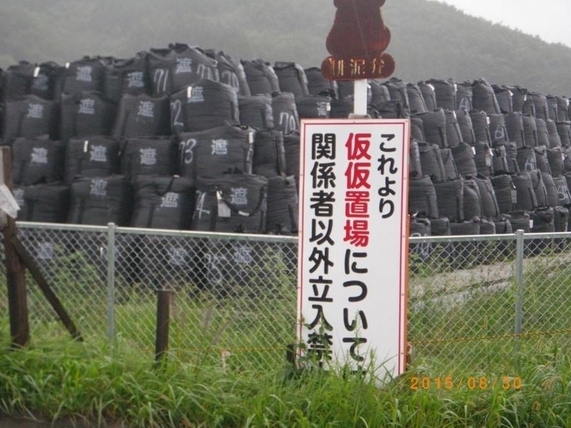
A “temporary intermediary storage area” in Iitate
A row of uncontaminated sandbags is added around the perimeter of the “square” of the most contaminated bags, so as to reduce the number of the dose rate!
As of March 2016, there were no less than 10 million bags and 128,000 temporary dumpsites in Fukushima Prefecture. Waste bags are omnipresent, despite the residents’ distress; near schools, and even in people’s gardens.
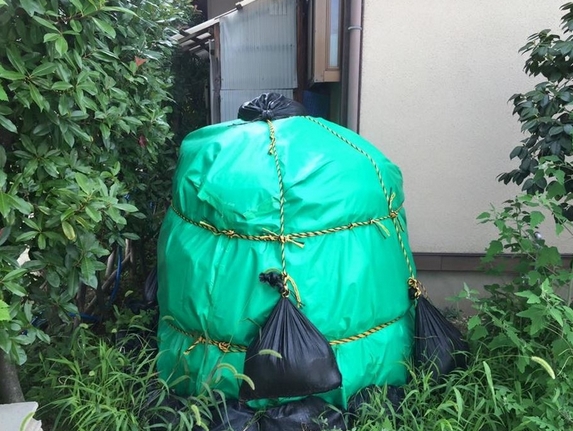
Contaminated waste bags at someone’s house
Short of sufficient storage space, the authorities are forcing residents to an intolerable alternative: if the resident does not want to store the waste on his property, it is his right. But in this case it will not be decontaminated! The resident requesting “decontamination intervention” must keep the waste on his property! This is why we see here and there, everywhere in fact, bags near buildings or in private homes.
According to the “Nuclear Reactor Regulation Law” (Genshiro tô kiseihô), the recycling threshold of “nuclear waste” is 100 Bq / kg. However, on June 30, 2016, the Ministry of Environment has officially decided to “reuse” waste below 8000 Bq / kg (1).
In practical terms, this waste will be used in public works, covered by cement and land in order to lower the ambient radioactivity.
In order to “reduce the volume” of waste, “temporary incinerators” were built to incinerate nuclear waste and to “vaporize” cesium.
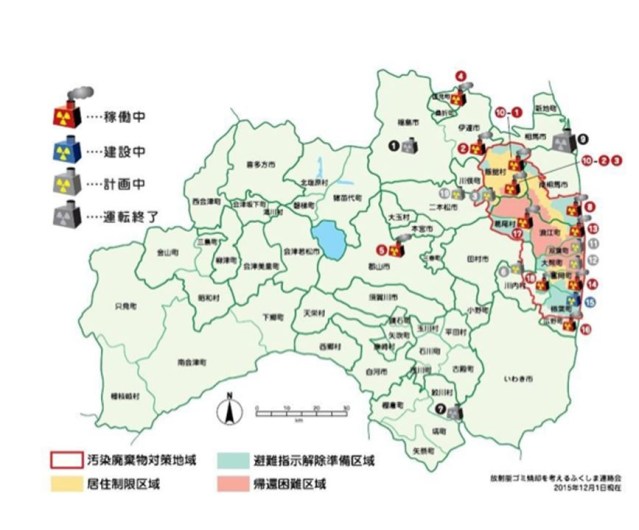
Map of Fukushima prefecture showing the nuclear waste processing establishments locations (shizai-ka center) – Legend: the icons differentiate the various incinerators; red = in operation – blue = under construction – gray / yellow = planned – gray = operation completed
Everywhere on village outskirts there are incinerators of which people know nothing! They often operate at night for two to three months and then everything stops. People wonder what is being burned… Not to mention a rumor about a secret experimentation center where much more contaminated waste would be burned…
Even more frightening, waste processing plants …
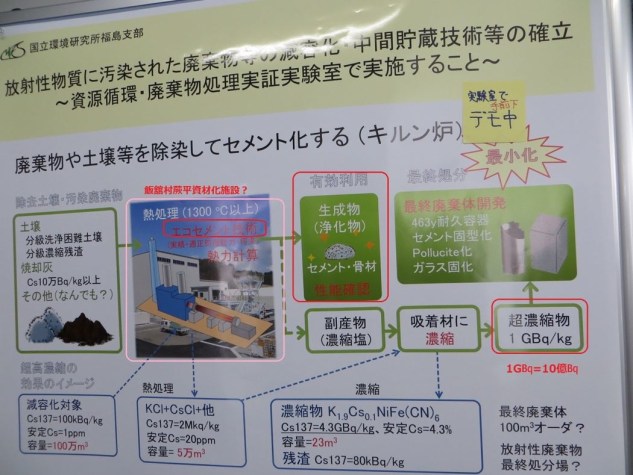
At the “Environmental Design Centre”, a poster about the revolving furnace” which decontaminates waste, debris, soil, etc, transforming them into cement”.
For example, the Warabidaira waste processing plant located in the village of Iitate or the Environment Creation Center (Kankyô Sôzô Center) opened in July 2016 in the town of Miharu, treat contaminated waste (ashes above 100 000 Bq/kg) and contaminated soil coming from land decontamination work.
Now these last two categories are not covered by the Waste Management Law (1) so they have no constraints associated with their treatment… To reduce their volume and to make them … “recyclable”!
In addition, these establishments are registered as “research institutes” and, as such, they are exempt from the building permit application commonly mandated in the framework of the waste management law!
We see inconsistencies and even contradictions between laws. We have already seen the contradiction between the limit of 100 Bq / kg set by the Nuclear Reactor Regulation Law and the 8000 Bq / kg recently adopted by the Ministry of Environment.
IV. Residents, displaced and returned
Citizen radiation measuring. Mothers, and also dads, explore the everyday environment to identify hot spots so as to modify if necessary the route recommended for children, for example “the way to school” (as in Japan all children walk single file).
For that purpose associations use “hot spot finders”. Well aware of the health risk to which children are exposed, they attach sensors connected to GPS on their strollers to walk routes and the way to school or to explore parks.
That system is well thought out: it is a vertical rod 1 meter long that leaves the ground and consists of a measuring device at 10 cm from the ground, another one at 50 cm, and a third at 1 meter to take into account the different sizes of children. If a hot spot is located, others are warned of its location and the children are required to change their route, and authorities are asked to decontaminate. For parents, this work is endless …
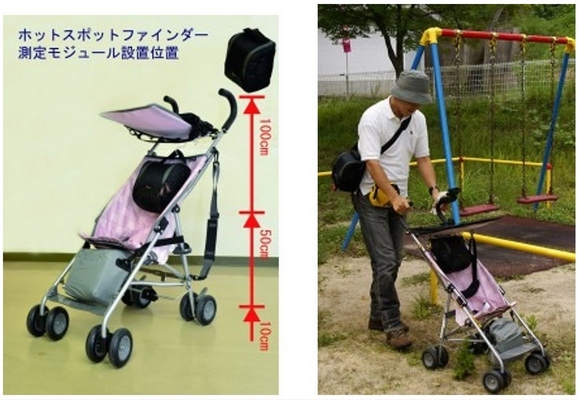
Hot spot finders
People organize citizen actions thru Internet. These independent citizen online databases are many,
and one of them is even translated into English since November 2014. It is the “Minna no Data”: ambient radioactivity measures, soil measurements, food analyzes (2).
Some associations’ logos:


V. Protest actions
The trial against the three former TEPCO executives which began in spring 2016 is the first criminal trial to take place; it could last ten years …
However, in Fukushima Prefecture, there are many other trials at different levels also taking place. For example, in March 2016, a lawsuit was initiated by 200 parents brought against the Fukushima Prefecture, to “get children out of contaminated areas.” People protest to have the “thresholds” lowered. In their opinion the issue of “thresholds” go beyond the strict framework of Japan. They fear that the thresholds of Japan will end up being generalized overseas, which is highlighted in some of the maps captions eg “against the generalization and the externalization of the 20 mSv / year threshold”. Some victims require, as after Hiroshima, “an irradiation book” (personal records) to be used for their access to treatment.
Radiation free health holiday
To send children on a health holiday is now more and more difficult, because people tend to believe that the disaster is already over therefore requests for help have become complicated.
In the city of Fukushima, for example, referring to the nuclear disaster is now taboo …
VI. Social and family catastrophe
It causes “conflicts” among neighbors (one example, one person’s place is decontaminated while its adjoining neighbor’s place is not), between beneficiaries and others, between the displaced and the residents of the hosting location (there are misunderstandings on the issue of compensations; the self-evacuated are not receiving any compensation, but the hosting city locals think they are).
So today many prefer to return their evacuated Fukushima resident card and acquire the resident card of their hosting town (in Japon you are résident of the village from which you keep the residence card) so as to “turn the page” because they can no longer bear to be called “evacuees”. They want to integrate into the community where they moved. Only older people remain unswervingly committed to their original residence; it is mostly the elderly who intend to return.
In many families of the Fukushima Prefecture men stayed by necessity to keep their jobs to provide for their families, while mothers with children evacuated to put them out of danger; but as time has passed, more than five years already, many families have disintegrated… The father visiting the family rarely, often for lack of resources, the marriage falling apart, resulting in many divorces and suicides.
Women are showing remarkable energy, they are on all fronts, openly, and even heavily involved in actions and trials, so that even the articles of the so-called “feminine” press today are often dealing with topics related to the nuclear disaster. Young women in particular are very active in the protests and rallies. This is a significant change in Japanese society.
(1) Waste Management and Public Cleansing Law, Haikibutsu no shori oyobi seisô ni kansuru hôritsu, law N°137 from 1970, last amendment in 2001 https://www.env.go.jp/en/laws/recycle/01.pdf
Nuclear Reactor Regulation Law (Genshiro tô kiseihô).
“Act on the Regulation of Nuclear Source Material, Nuclear Fuel Material and Reactors” (kakugenryô busshitsu,kakunenryô busshitsu oyobi genshiro no kisei ni kansuru hôritsu)
law N°166 from 1957(2) –
English translation of Nuclear Reactor Regulation Law.
http://www.japaneselawtranslation.go.jp/law/detail/?id=1941&vm=03&re=01
(2) – Minna no Data Site (MDS) : http://en.minnanods.net/
_____________________
After his lecture, I asked a simple question to Kurumi Sugita:
Why has she founded the association « Nos Voisins Lointains 3.11 » (“Our Distant Neighbors 3.11”)? …
In France, where lives Kurumi, several Japanese associations exchange about the disaster.
But Kurumi Sugita founded on January 8, 2013 in Lyon, the association « Nos voisins lointains 3-11 » also to inform the French and francophones who do not read Japanese.
The website of the association publishes valuable and moving testimonies, translated into French.
Thanks to donations, the association helps concretely, as much as possible, some affected families in Japan.
To know more
The website of Kurumi Sugita’s association:
http://nosvoisins311.wix.com/voisins311-france
You may find the victims testimonies on her Facebook page:
And general informations on the Fukushima nuclear disaster:
https://www.facebook.com/Nos-Voisins-Lointains-311-555557711144167/
Fukushima tourism making strong progress on “recovery”
This is an article from the Fukushima Minpo News, the Fukushima local newspaper which is the propaganda organ of the Japanese central government. Therefore everything announced in this article should be taken with a grain of salt. Or maybe those tourists are the ones who enjoy sightseeing the numerous contaminated soil bags dump sites.

Tourism in Fukushima Prefecture approached a milestone in fiscal 2015 after recovering to nearly 90 percent of where it was before the nuclear disaster unfolded in March 2011, the prefectural government said in a recent tourism report.
In the year ended March 31, the prefecture saw 50.31 million tourists visit its resorts, sightseeing spots and leisure facilities, data compiled by the Fukushima Prefectural Government showed earlier this month.
That’s an increase of 3.42 million on the year before and nearly 90 percent of its tourism tally in fiscal 2010, when 57.17 million tourists visited, the report said.
It is also the first time the annual threshold of 50 million has been achieved since 2011, when the Great East Japan Earthquake tipped the Fukushima No. 1 power plant into a triple core meltdown on March 11.
Fukushima officials praised their promotion drive, dubbed the “Fukushima Destination Campaign,” for bearing fruit. The campaign allows its municipalities to tap the transport resources of the Japan Railway group across the country.
“We will work to draw more tourists by analyzing the effect of the Destination Campaign,” said a Fukushima prefectural official in charge of tourism promotion.
In a surprise, the Soma-Futaba region in eastern Fukushima, along the Pacific coast, drew 2.65 million tourists in fiscal 2015, up 59.9 percent from last year, the report said. Officials say the opening of a key part of the Joban Expressway between the Tomioka and Namie interchanges in March 2015 facilitated the surge. Indeed, the number of people who used drive-in facilities was 33.4 percent higher than last year, the report said.
The opening of new leisure facilities and the resumption of some onsen (hot spring) spas that suspended business in the wake of the disasters also contributed, the officials said.
Tourists were most attracted by the grand nature of Fukushima Prefecture, the data showed. The top spot in fiscal 2015 remained the Bandai Kogen highlands in the north, which drew 2.18 million visitors, up 4.6 percent from the year before.
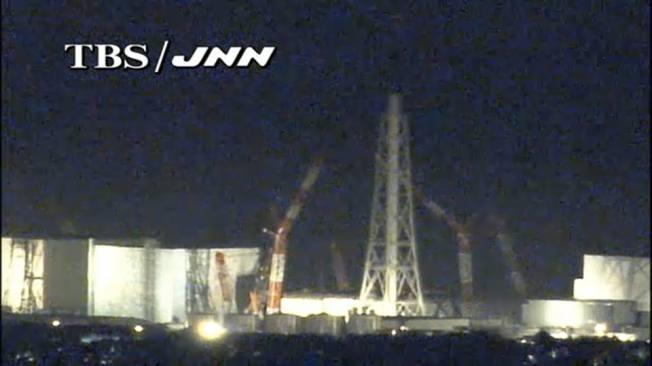
Fukushima Daiichi Still Outgassing Radionuclides
It’s still steaming away 5 1/2 years later and with the tent roof removed from Reactor 1 its poison continues to be widely dispersed.
Unit 1 side : 2016.08.14_00.00-03.00
Unit 4 side : 2016.08.14_15.00-18.00
North Korea claims that it is ready for a nuclear strike on USA
North Korea says it is preparing for nuclear strike against United States http://www.bignewsnetwork.com/news/246711889/north-korea-says-it-is-preparing-for-nuclear-strike-against-united-states Big News Network.comSunday 14th August, 2016 SEOUL, South Korea – North Korea says it is preparing for a preemptive nuclear strike against the United States.The country says it has switched the status of its military from defense mode to attack mode.
The deployment by the United States of three B-52 stealth bombers to Andersen Air Force Base at Guam earlier this week has unnerved the North Korean regime which said Saturday the deployment was preparation for a planned nuclear strike on North Korea.
The government said if it it sees any sign an invasion underway it will launch a nuclear strike against the U.S.
The Yonhap news agency based in Seoul in South Korea confirmed the Nortth Korean government statement which it picked up from the Korean Central News Agency (KCNA), the North Korean official news agency.
“The U.S. attempt to invade the DPRK (Democratic Peoples Republic of Korea) is getting evermore reckless,” KCNA said in a signed commentary.
The U.S. Air Force says it deployed the 3 B-52 to Guam on Tuesday, largely because of the recent rhetoric coming out of North Korea. Pyongyang however believes the United States is preparing for a pre-emptive nuclear strike. “The U.S. evermore undisguised reinforcement of the nuclear force goes to clearly prove that it is trying to make a preemptive nuclear strike at the DPRK a fait accompli,” said the commentary.
Warning that it could strike first, North Korea said: “The right to make a preemptive nuclear strike is not the monopoly of the U.S.” “The DPRK revolutionary armed forces switched from their existing mode of military counter-action to the mode of a preemptive strike to cope with the enemy’s ridiculous military hysteria to undermine its sovereignty and right to existence,” the KCNA statement said. “All their operational groups are fully ready to deal a merciless and annihilating blow to the enemy if they make even the slightest provocation,” it added.
Saturday’s developments coincide with an acceleration of conscription in North Korea. The government has introduced a new recruitment regulation which requires all men aged up to their mid-30s, who have dodged military service in the past, to now join up. University students, factory workers, and men with families have been exempted in the past. They are now getting call-up notices to report for physical examinations. Source: Big News Network
Doubts that Russia can actually deliver on all its much touted nuclear sales deals
 False nuclear hope, HIMAL South Asian BY M V RAMANA AND ZIA MIAN14 AUGUST 2016

“……Can Russia deliver?
The Russian deal for Rooppur has its specific set of challenges. There are at least two reasons to question Russia’s ability to deliver on its commitments. First, Russia has made so many nuclear deals in recent years that it may not be able to deliver on all of them. The Russian State Atomic Energy Corporation (Rosatom) claims to have orders for 30 nuclear power plant units in 12 different countries at a total value of over USD 300 billion.
The Russian Parliament’s independent Audit Chamber has documented delays and cost increases in reactors that Rosatom is building within Russia. It is likely that Russian reactor projects abroad will also experience delays and cost escalations. A second reason Russia may not be able to deliver on Rooppur is the collapse of its currency, the ruble. In the case of the reactor for Belarus, the Russians made a fixed price deal that was denominated in dollars. Because the ruble has fallen relative to the dollar, costs to Rosatom have reportedly gone up by 71 percent and Belarus has been asked to provide additional financial support to keep the project going.
Since the Rooppur contract, like most nuclear contracts, is not publicly available, one cannot be sure about the specifics of the deal. However, according to media reports, the contract with Bangladesh is not a “fixed price” but a “cost plus” one where “the vendor has the right to come up with any cost escalation (plus their profit margin) to be incorporated into the contract amount”. Russia seems to have prepared for the possibility that the Rooppur project will cost more than expected and to protect its profits.
Bottom line: the Rooppur reactors may be good for status-seeking project for Bangladeshi politicians; for the bureaucrats and technocrats of the Bangladesh Atomic Energy Commission; and for the Russian nuclear complex and the middlemen who will likely profit from the many subcontracts that would be signed. But it does not look like a good bargain for the people of Bangladesh.
~ M V Ramana is with the Nuclear Futures Laboratory and the Program on Science and Global Security at Princeton University, and the author of The Power of Promise: Examining Nuclear Energy in India. http://himalmag.com/false-nuclear-hope-bangladesh-russia/
Taiwan organising to dump its nuclear wastes on Orchid Island
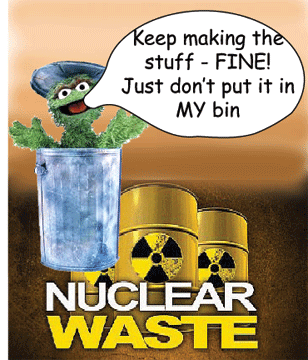
 Tsai to visit Orchid Island to discuss nuclear waste storage, Focus Taiwan, Taipei, Aug. 14 (CNA) President Tsai Ing-wen (蔡英文) is scheduled to visit Taiwan’s offshore Orchid Island on Monday to discuss the issue of nuclear waste storage with the local people, the Presidential Office said Sunday.
The president will meet with a senior member of the indigenous Tao tribe and visit a kindergarten. She will also attend a forum during which she will address such issues as nuclear waste storage and garbage disposal on the island, the office said……..
Before finding a permanent solution for the nuclear waste, Tsai said her government will provide the Tao tribe with appropriate compensation.
Local residents had received over NT$2.1 billion (US$66.9 million) in payments as of the end of May 2016 from state-run utility Taiwan Power Co. and the Atomic Energy Council since a low-level nuclear waste storage facility was built on Orchard Island in 1982.
Russia’s rush to sell nuclear reactors to Bangladesh may not succeed
 False nuclear hope, HIMAL South Asian BY M V RAMANA AND ZIA MIAN14 AUGUST 2016 Plans to construct Bangladesh’s first nuclear power plant are moving forward fast. On 26 July 2016, Mohammad Mejbahuddin, Senior Secretary of the Economic Relations Department of Bangladesh, and Russia’s deputy finance minister, Sergei Anatolievich Storchak, signed an inter-governmental agreement in Moscow for the construction and commissioning of two 1200 megawatt (MW) VVER-1200 nuclear reactors at Rooppur (also spelt Ruppur) at an estimated cost of USD 12.65 billion, with Russia committing to loan 90 percent of the costs to Bangladesh. Earlier, in December 2015, when the two government Cabinet committees approved the proposal, the Bangladeshi Minister for Science and Technology Yeafesh Osman said, “I believe USD 12.65 billion is a good bargain”. But the question is: For whom?
Bangladesh’s first nuclear power plant is not a good way to meet its energy needs. A brief history
The idea of building nuclear reactors at Rooppur is very old. It goes back to a 1963 plan by the Pakistan Atomic Energy Commission to build one reactor in West Pakistan and one in East Pakistan. This fifty-year quest for constructing a reactor is blind to what has been learned over the same period about nuclear energy. This history suggests there are now good reasons to believe the people of Bangladesh will end up waiting a long time for nuclear electricity from Rooppur, be stuck with big bills, and be forced to live with the constant worry of a nuclear plant accident.
The main player in this quest to build a nuclear plant is the Bangladesh Atomic Energy Commission (BAEC), which was created in 1973. As spelt out by a senior official in the organisation, “BAEC has, since then, been trying to do the needful so as to make the country embark on NP [Nuclear Power] program”. Successive Bangladeshi governments have been attracted to the idea of a nuclear plant as a modern technological solution to energy shortages in the country, with officials thinking of the possession of a nuclear plant as an exclusive privilege. As Finance Minister Abdul Muhit put it in December 2015, “Now, we are on the verge of entering the elite club of the countries who have nuclear power plants.” Prime Minister Sheikh Hasina even termed Rooppur “the nation’s dream”.
Encouraging the BAEC in this quest are the International Atomic Energy Agency (IAEA), whose mandate calls for the agency to “seek to accelerate and enlarge the contribution of atomic energy to peace, health and prosperity throughout the world”, and various nuclear reactor vendors who hope to profit from the sales of nuclear power plants. The IAEA began work in Bangladesh a while back. It carried out a planning study in 1974-75 and projected between approximately1200 and 3000 MW of nuclear capacity in Bangladesh by 1995, with nuclear power constituting 47 percent of the country’s electricity capacity; a high projection that emphasised nuclear power as single biggest source to meet energy needs.
Finally, there are countries like the US, Germany, France and China which have, over the decades, supported their nuclear industries’ efforts to sell reactors. France, for example, signed an agreement with Bangladesh for the “peaceful use of nuclear energy” in 1980 and offered to sell 125 and 300 MW reactors in the 1980s. But in the last few years, Russia has taken the lead, edging out other countries that could have sold Bangladesh a reactor.
Misleading promises
What can we expect for the Russian reactors coming to Rooppur? The pace of contract signing and government approvals should not mislead one into thinking that the reactors will be ready anytime soon. At the time of signing of the general contract between the two countries in December 2015, the claim was that the two Rooppur reactors would start generating electricity within five or six years, by 2021 and 2022. Evidence suggests that it could be twice as long before the reactors actually start producing electricity.
Establishing nuclear power plants is a slow process. In developing countries that have just one or two reactors, the average construction time – between the first pouring of concrete and the reactor starting commercial operation – were 19, 16, 8.5, and 38 years respectively in the cases of Brazil, Mexico, South Africa, and Iran, as can be calculated from the dates given in the IAEA’s Power Reactor Information System (PRIS). These time periods do not include the lengthy preparation period before the actual commencement of construction…….
A better alternative
The purported reason for Bangladesh to embark on this project is to meet its increasing energy demand. But a sustainable strategy for meeting the energy demand would prioritise economical sources of electricity generation that can be brought online quickly. Renewable sources such as solar energy meet the twin goals of lower cost and timeliness far better than nuclear power. Globally, there is already little doubt that solar energy and wind energy are more attractive investments than nuclear power plants. As the 2016 World Nuclear Industry Status Report points out, “global investment decisions on new nuclear power plants remained an order of magnitude below investments in renewables.”…….
Finally, unlike nuclear power plants, solar energy installations can be commissioned relatively quickly, in typically one to two years. This means that by choosing to put money into solar power, Bangladesh could start getting electricity many years earlier than if it built the Rooppur plant. Bangladesh is beginning the process of significant investment in renewables, setting a target of 3168 MW of electricity from renewable energy sources by 2021. The technical potential of solar energy in Bangladesh has been estimated at 50,174 MW…..http://himalmag.com/false-nuclear-hope-bangladesh-russia/
Japn to market nuclear reactors to India?
Abe, Modi to confer on nuclear deal / Meeting eyed for mid-Nov. in Tokyo The Yomiuri Shimbun, 14 Aug 16 The government is considering hosting India Prime Minister Narendra Modi for a meeting with Prime Minister Shinzo Abe in Tokyo in mid-November, according to sources, with nuclear cooperation on the agenda.
During the meeting, Abe and Modi intend to sign a nuclear cooperation accord that allows for trade in equipment and technology related to nuclear power plants. In preparation, both sides will soon start full-fledged talks to decide on wording in the accord, the sources said. Also likely to be discussed in the meeting will be the strengthening of security cooperation.
In recent years, the leaders of both nations have made mutual annual visits. In the summit meeting in December 2015, Abe and Modi reached a basic agreement on the signing of a nuclear cooperation accord. Should the accord be signed in November, it will allow Japanese companies to receive orders for nuclear power plant construction projects in India, which will lead to a possible solution for India’s serious electricity shortage.
As India is not a signatory to the Nuclear Nonproliferation Treaty, the Japanese and Indian governments are coordinating to decide on wording in the accord regarding nonproliferation and prohibition of nuclear tests…….http://www.the-japan-news.com/news/article/0003148491
1 This Month





PLEASE OPPOSE HR 8255 AND S.3639 – bills would accelerate satellite deployment, with no environmental review or safeguards – https://ncstd5li.quorum.us/campaign/169331/
To see nuclear-related stories in greater depth and intensity – go to https://nuclearinformation.wordpress.com
-
Archives
- October 2026 (39)
- September 2026 (339)
- August 2026 (330)
- July 2026 (355)
- June 2026 (287)
- May 2026 (306)
- April 2026 (356)
- March 2026 (251)
- February 2026 (267)
- January 2026 (308)
- December 2025 (358)
- November 2025 (359)
-
Categories
- 1
- 1 NUCLEAR ISSUES
- business and costs
- climate change
- culture and arts
- ENERGY
- environment
- health
- history
- indigenous issues
- Legal
- marketing of nuclear
- media
- opposition to nuclear
- PERSONAL STORIES
- politics
- politics international
- Religion and ethics
- safety
- secrets,lies and civil liberties
- spinbuster
- technology
- Uranium
- wastes
- weapons and war
- Women
- 2 WORLD
- ACTION
- AFRICA
- Atrocities
- AUSTRALIA
- Christina's notes
- Christina's themes
- culture and arts
- Events
- Fuk 2022
- Fuk 2023
- Fukushima 2017
- Fukushima 2018
- fukushima 2019
- Fukushima 2020
- Fukushima 2021
- general
- global warming
- Humour (God we need it)
- Nuclear
- RARE EARTHS
- Reference
- resources – print
- Resources -audiovicual
- Weekly Newsletter
- World
- World Nuclear
- YouTube
-
RSS
Entries RSS
Comments RSS

