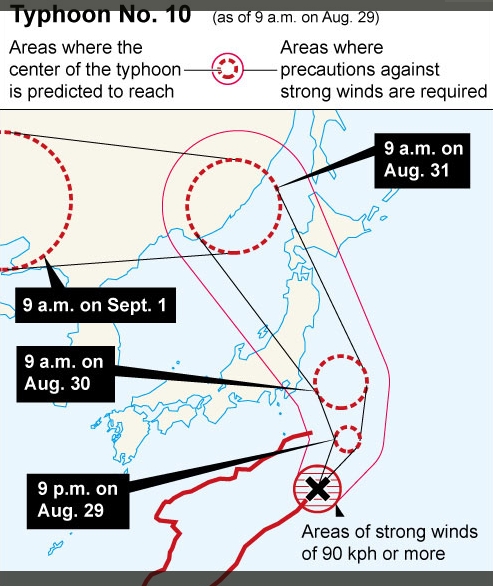
Powerful Typhoon No. 10 is expected to be the first typhoon in at least 65 years to make landfall in the Tohoku region from the Pacific Ocean side on the evening of Aug. 30.
The Japan Meteorological Agency is warning that heavy rains of 80 millimeters or more per hour are expected to fall in some parts of northern Japan, including Tohoku.
The agency is also advising commuters in the Kanto region to take precautions against strong winds and heavy rain on the morning of Aug. 30.
As of noon on Aug. 29, Typhoon No. 10 was advancing in the waters about 340 kilometers southeast of Hachijojima island at a speed of 25 kph. The atmospheric pressure at the center of the typhoon was 945 hectopascals. The maximum wind speed near the center was 162 kph. The maximum momentary wind speed was 216 kph.
Typhoon No. 10 is expected to reach waters about 360 km southeast of Choshi, Chiba Prefecture, in the morning on Aug. 30, although it is expected to slightly weaken by that time.
The typhoon is forecast to make landfall on the Tohoku region later that day and move to the Sea of Japan before dawn on Aug. 31, the agency said.
According to the agency, no typhoons have landed on the Tohoku region from the Pacific Ocean side since statistics became available in 1951.
In the period from Aug. 29 to Aug. 30, the maximum wind speed is expected to be 126 kph in the Tohoku region and 82.8 kph in the Hokkaido and Kanto regions.
The amount of rainfall during the 24-hour period until the morning of Aug. 30 is predicted to be up to 200 mm in the Tohoku and Kanto regions and Yamanashi and Nagano prefectures.
http://www.asahi.com/ajw/articles/AJ201608290030.html
Fukushima nuclear plant prepares for typhoon
The operator of the troubled Fukushima Daiichi nuclear power plant is preparing for the powerful Typhoon Lionrock.
Tokyo Electric Power Company says on Monday workers secured electric cables and hoses.
TEPCO says on Tuesday it will suspend work with cranes and other operations at the plant’s port, which could bear the brunt of strong winds and waves. Depending on weather conditions, the firm may also call off outdoor work in other areas.
It says when the most recent typhoon approached last week, heavy rain caused underground water levels to rise and threatened to flush contaminated water into the harbor.
Workers are arranging pumps to draw up more ground water, and setting up additional pumps at wells used to observe water levels.
There were concerns in the past that a downpour brought by a typhoon could cause contaminated rain water to flow through a drainage channel into the ocean.
To address these fears, TEPCO rerouted the drainage system into the plant’s inside port. It also raised the levels of barriers around tanks that store tainted water.
http://www3.nhk.or.jp/nhkworld/en/news/20160829_22/
Nearing typhoon halts work at Fukushima Daiichi
Workers at the troubled Fukushima Daiichi nuclear plant have suspended some of the decommissioning work and are bracing for rain and winds from a powerful typhoon.
Typhoon Lionrock is expected to make landfall along Japan’s northeastern coast on Tuesday afternoon, passing off Fukushima Prefecture.
Tokyo Electric Power Company says workers secured electric cables and hoses on the plant compound on Monday.
On Tuesday, the operator suspended work at the plant’s port. It also stopped the operation of a crane being used to demolish a temporary cover over one of the reactor buildings. Officials say they are closely watching to make sure the cover is not blown off by the typhoon.
TEPCO says it has also taken measures to prevent contaminated rain water and groundwater from leaking into the ocean.
In past typhoons, it was thought that contaminated rainwater flowed into the ocean through a drainage system. There were also concerns that radioactive groundwater might leak into the ocean as rain could increase the groundwater in the compound.
This time the operator has installed stronger pumps and increased their number.
The utility says as of 11 AM Tuesday, there were no changes in groundwater levels at the plant’s site.
Other measures taken earlier include rerouting the drainage system into the plant’s port instead of directly into the ocean. TEPCO also raised the barriers around tanks that store tainted water.
http://www3.nhk.or.jp/nhkworld/en/news/20160830_26/
August 30, 2016
Posted by dunrenard |
Fukushima 2016 | Fukushima continuing, Fukushima Daiichi, Typhoon |
Leave a comment
Five years after the second-worst nuclear accident in history, contaminated water is still hampering efforts to gain control of the site. Local residents are reluctant to return to their homes. Julian Ryall reports.
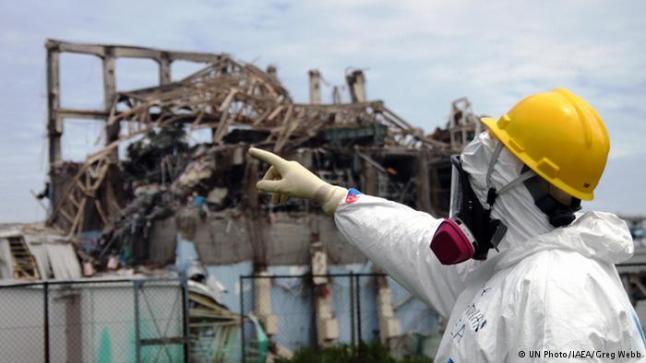
Five years after the second-worst nuclear accident in history, contaminated water is still hampering efforts to gain control of the site. Local residents are reluctant to return to their homes. Julian Ryall reports.
It has been five years and five months since three of the reactors at the Fukushima Dai-ichi nuclear plant were crippled by the biggest earthquake and tsunami to strike Japan in living memory. Work continues at the site to clean up the radioactivity that escaped into the atmosphere and to regain control of the reactors.
In its press releases, the Tokyo Electric Power Co. (TEPCO) insists that steps taken since the accident are slowly but surely having an effect. But not everyone accepts their assurances – or those of the wider nuclear industry as it seeks public support to restart reactors across the country that have been mothballed since March 2011.
“There are numerous problems that are all interconnected, but one of the biggest that we are facing at the moment is the highly contaminated water that is being stored in huge steel tanks at the site,” Aileen Mioko-Smith, an anti-nuclear activist with Kyoto-based Green Action Japan, told DW.
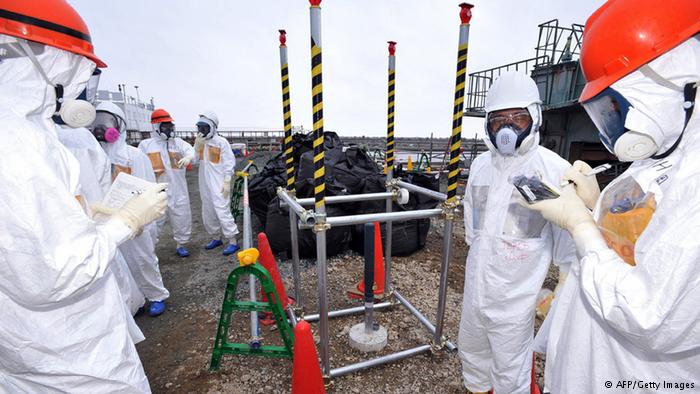
TEPCO insists that steps taken since the accident are slowly but surely having an effect
“They are running out of space at the site to put these tanks, the water that is being generated on a daily basis means they have to keep constructing more, and the ones that are not welded have a history of leaking,” she said.
‘Ticking time bomb’
“The situation with contaminated water at the site is a ticking time bomb and they don’t seem to know what they can do – other than to construct more tanks,” said Mioko-Smith.
Environmental groups are calling for TEPCO and Japan’s Nuclear Regulation Authority (NRA), which oversees the industry here, to come up with a clear plan of action so that they do not simply run out of space and believe there is no option but to release contaminated water into the Pacific Ocean.
TEPCO confirmed earlier this month that an estimated 10,000 tons of radioactive water had collected in underground trenches around the buildings that house reactors one, two, three and four. That was in addition to about 60,000 tons of water that had flooded the basement of the reactor and turbine buildings, according to an official at TEPCO.
“It is accumulating because around 100 tons of water are injected every day in order to keep the reactors in units one, two and three cool,” the official told DW. “But we are also seeing about 150 tons of ground water seeping into those same areas each day.”
While a portion of this water is being treated to remove the radioactivity, the sheer amount of water at the site makes it impossible to keep up with what is required, hence the need for storage tanks.
A panel of experts that is advising the NRA has also declared the effort to construct a frozen wall of earth around the four reactors to stop additional ground water leaking into the site to be a failure.
Frozen wall plan ‘failing’
“The plan to block ground water with a frozen wall of earth is failing,” Yoshinori Kitsuaka, a professor of engineering at Tokyo Metropolitan University and a member of the panel, said in a report. “They need to come up with another solution.”
The TEPCO spokesperson disputes the suggestion that the 34.5 billion yen (307 million euros) ice wall scheme has failed.
“We are still in the process of freezing the entire length of the wall,” the official said. “We started on the side closest to the ocean and now we are moving to the rest of the perimeter on the landward side, but we have to make sure that water levels remain constant so that contaminated water does not flow out from the area around the reactors. There are seven sections of the ice wall that are not frozen yet and we believe we will see the effects after we have completed the whole process.”
These developments have largely failed to arouse the interest of the Japanese media or the public, who have been living with the consequences of the disaster since 2011, although one recent announcement did make the news.
On August 20, the Ministry of Health, Labor and Welfare confirmed that it would provide compensation to a man who developed leukemia after taking part in emergency decontamination efforts at Fukushima immediately after the disaster struck.
The ministry recognized that the man, who is in his 50s but who has not been named, developed cancer due to exposure to radiation at the site, where he worked between April 2011 and January 2015.
The ministry is considering the cases of five additional workers who have applied for compensation to cover their health costs, while a former worker at the site was granted financial assistance in October of last year after contracting leukemia.
‘Making best efforts’
The TEPCO spokesperson says the company is “making its best efforts” to move the recovery process forward to the point at which the final procedure – removing the melted fuel debris from within the reactors – can be achieved. The scale of that problem remains huge, however, as it has never been attempted before.
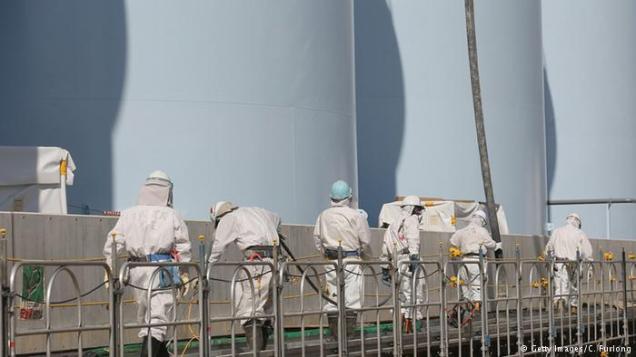
Work continues at the site to clean up the radioactivity
“We anticipate that it will take 30 to 40 years to reach that point as we are trying to do all the clean-up work at the same time as developing the technology to remove the fuel debris,” the official said.
Yet at the same time, the national government is effectively forcing people who were evacuated from their homes close to the plant to return, saying that radioactivity levels are within permissible limits and that housing subsidies and other payments that they have been receiving while unable to work will be terminated.
“Many of these people – especially those with children – do not want to go back to areas that they have been told are safe,” said Mioko-Smith, adding that there was a lack of trust in the government’s promises.
“They feel that everything is being driven by the upcoming Olympic Games and that the government has to live up to its promise to the world that everything will be back to normal by 2020 and the Tokyo Games,” she said.
http://m.dw.com/en/problems-persist-at-japans-crippled-fukushima-nuclear-reactors/a-19510555
August 30, 2016
Posted by dunrenard |
Fukushima 2016 | Catastrophe, Fukushima Daiichi, Problems |
Leave a comment
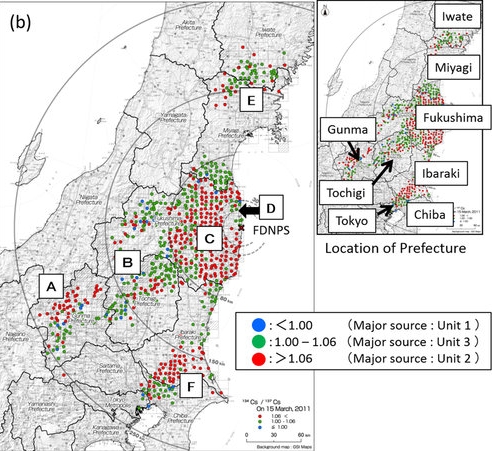
Published on 22 August 2016
Abstract
The Fukushima Daiichi nuclear power reactor units that generated large amounts of airborne discharges during the period of March 12–21, 2011 were identified individually by analyzing the combination of measured 134Cs/137Cs depositions on ground surfaces and atmospheric transport and deposition simulations. Because the values of 134Cs/137Cs are different in reactor units owing to fuel burnup differences, the 134Cs/137Cs ratio measured in the environment was used to determine which reactor unit ultimately contaminated a specific area. Atmospheric dispersion model simulations were used for predicting specific areas contaminated by each dominant release. Finally, by comparing the results from both sources, the specific reactor units that yielded the most dominant atmospheric release quantities could be determined. The major source reactor units were Unit 1 in the afternoon of March 12, 2011, Unit 2 during the period from the late night of March 14 to the morning of March 15, 2011. These results corresponded to those assumed in our previous source term estimation studies. Furthermore, new findings suggested that the major source reactors from the evening of March 15, 2011 were Units 2 and 3 and that the dominant source reactor on March 20, 2011 temporally changed from Unit 3 to Unit 2.
Introduction
Since 2011, we have been estimating the source term—temporal changes in atmospheric release rates (Bq/h) of radionuclides—caused by the Fukushima Daiichi nuclear power station (FDNPS) accident using a reverse estimation method that combines atmospheric dispersion simulation and environmental monitoring data1,2,3,4,5. Many international researchers have also tried the source term estimation and model simulation of atmospheric dispersion of radionuclides during the accident. The United Nations Scientific Committee on the Effects of Atomic Radiation (UNSCEAR) summarized sixteen results on source term estimation (Table B2 of UNSCEAR 2013 Report6). It described that the source term estimated by Terada et al.3 (which is the one from our previous study) provided a sound basis for estimation of the levels of radioactive material in the terrestrial environment where prior measurements did not exist and actually the dispersion and deposition of released material modeled by the World Meteorological Organization (WMO) based on the source term by Terada et al.3 could replicate the broad pattern of deposition density of 137Cs over the Japanese land mass. We also summarized a number of international papers lately that have carried out the source term estimation and numerical analysis of atmospheric dispersion process of radionuclides released during the accidents (Table 1 of Katata et al.5).
The accuracy of our previous study’s latest source term increased with gradual increases in the number of monitoring data after the accident and improvement of our team’s numerical simulation model that included a sophisticated atmospheric deposition scheme5. The calculated ground-shine due to the large deposition event of March 15–16, 2011 agreed with observed data within a factor of 2 at most of the monitoring points, and the model also reproduced the spatial distribution of the airborne survey’s air dose rate and 137Cs surface deposition within a factor of 5. Therefore, the simulation results of the spatiotemporal patterns of 137Cs surface deposition have enough accuracy to compare with the observed 134Cs/137Cs ratio, though some discrepancies between simulation and observation occurred because of model simulation uncertainties. Using the latest source term in Katata et al.5, several atmospheric dispersion simulations by the National Oceanic and Atmospheric Administration (NOAA), USA, Canadian Meteorological Centre (CMC), and Met Office, UK, were successfully able to reproduce the measured surface contamination distribution and time series in air concentrations of radionuclides regardless of model structure and meteorological input data5. UNSCEAR also reported for Katata et al.5 that in any further or updated assessment, the committee would recommend the use of the latest estimate as “preferential”7.
While the timing and quantities of major atmospheric releases during the FDNPS accident had been estimated, the relationships between these releases and their specifically correlated reactor units have still not been clarified. During the period of March 12–15, 2011, the temporal rises in air-dose rates measured by a monitoring car at the FDNPS boundary were partially connected to the events that occurred in the reactors8. However, after March 15, 2011, although only a few studies investigated the potential reasons why the atmospheric releases continued for such a long period afterward9,10, the precise rationale behind the event still has not been verified definitively.
Therefore, this paper focuses on the reactor units that generated large 137Cs atmospheric releases during the period of March 12–21, 2011.
To read more :
http://www.nature.com/articles/srep31376
August 30, 2016
Posted by dunrenard |
Fukushima 2016 | Atmospheric Releases, Fukushima Daiichi, March 2011, reactors |
Leave a comment
 The snow-covered Himalaya-Hindu Kush mountains and the Tibetan Plateau, spanning a broad area in Central and East Asia, together contain the largest ice mass on the planet outside of the polar regions. In fact, it’s earned itself the nickname of the “Third Pole.” But as in Greenland and Antarctica, there’s trouble afoot: Glaciers in the Third Pole are also shrinking.
According to remote sensing data collected and analyzed by the Chinese Academy of Sciences, about 18 percent of China’s glaciers alone have disappeared over the past 50 years. And that’s a big problem because meltwater from these glaciers feeds a network of rivers that supply water, directly or indirectly, to more than a billion people downstream.
Rising temperatures, the product of global warming, are certainly one threat facing the glaciers, said Shichang Kang, a professor at the Chinese Academy of Sciences’ Institute of Tibetan Plateau Research. But air pollution in the region is also helping to accelerate the melting. And now, Kang and a group of colleagues have helped shed some new light on where all this pollution is coming from and how it could be stopped.
In a new study, published Tuesday in the journal Nature Communications, the researchers collected samples of black carbon — a particulate matter created through the burning of fossil fuels and biomass — throughout the Third Pole and analyzed them using a special chemical “fingerprinting” process that identifies what kind of burning produced them and where they originated.
Black carbon might be most famous for the range of adverse health effects it’s believed to cause, including respiratory and cardiovascular problems and even premature death. But in terms of its effects on glaciers, it’s known to cause snow and ice melt in a number of different ways. First, black carbon floating in the atmosphere is able to absorb sunlight and cause at least temporary regional warming as a result, Kang noted. Additionally, when black carbon deposits itself on snow and ice masses, it tends to darken their surfaces, causing them to absorb more sunlight and melt faster.
Until now, scientists have had trouble pinpointing which places are contributing pollution to which regions of the Himalayas and the Tibetan Plateau and which types of sources are causing the most damage. That’s important information, not only for constructing accurate ice models to predict how the glaciers might change in the future, but also for writing new policies aimed at cutting pollution in the places that need it most.
In their new study, the researchers found evidence that both the burning of fossil fuels and the burning of biomass — materials such as plant matter and animal dung — have contributed to the black carbon that ended up in the Third Pole. In the Himalayas, it was split about evenly between the two sources, with most of it coming from the Indo-Gangetic Plain in northern India, while in the northern part of the Tibetan Plateau, most of the black carbon came from fossil fuel burning in China.
But in the inner, central part of the plateau, about two thirds of the sampled black carbon came from biomass burning rather than fossil fuels — a finding that Kang noted is “very surprising.” This suggests that internal Tibetan fuel-burning practices, such as burning yak dung for daily cooking and heating, are contributing more pollutants to certain parts of the Third Pole than experts previously suspected.
This is valuable data that can better inform the models used to simulate ice melt in the Third Pole and make predictions about what the region’s future might look like. But according to Kang, “the most important thing is that we can provide mitigation [advice] to policymakers.”
Because most biomass burning on the Tibetan Plateau is used for home energy, including cooking and heating, government investments in improving the efficiency of stoves and expanding the availability of cleaner energy sources to households in the region could make a big difference, Kang noted.
This advice isn’t meant to overshadow efforts to reduce fossil fuel burning, which also has big implications for the fight against global climate change. And wider efforts to address the burning of fossil fuels in Central and East Asia are already under way in some places. In China, for instance, coal-burning still remains the country’s dominant power source — but reports suggest that coal consumption hasn’t grown since 2013 and may have even declined in the last year, while the government has also placed a moratorium on new coal mine approvals for at least the next three years.
The study’s results may have helped reveal some new ways governments can add to or prioritize their current efforts to cut down on black carbon production. In the meantime, careful monitoring of the Third Pole’s glaciers will be critical, Kang said, especially when it comes to keeping an eye on the region’s water resources and making projections for the future.
“In the future, we’re definitely going to see glaciers shrink, but different regions with different climate regimes have different responses,” Kang said. “This is what we want to try to figure out.”
August 29, 2016
Posted by Christina Macpherson |
China, climate change |
Leave a comment
 Indian Scientists Design Solar Tree to Save Space for Solar Power Generation VOA, 26 Aug 16 NEW DELHI— Indian scientists have designed a “solar tree” that they hope will help overcome one of the key challenges the country faces in the generation of solar power.
With photovoltaic panels placed at different levels on branches made of steel, “solar trees” could dramatically reduce the amount of land needed to develop solar parks.
“It takes about four-square meters of space to produce energy which otherwise would have required 400 square meters of space. So almost 100 times the space is saved, which as you know is very valuable,” said Daljit Singh Bedi, chief scientist at the Council of Scientific and Industrial Research (CSIR) in New Delhi, whose laboratory in Kolkata developed the tree.
A scarce resource in India, acquisition of land to develop roads, factories and other infrastructure is a sensitive issue that has led to frequent and sometimes violent protests from displaced people.
Scientists estimate the energy generated by a solar tree would be sufficient to light up five homes. They say the space-saving tree would not only make it easier to increase solar power generation to light up homes and streets in cities, but also in rural areas where farmers are unwilling to give up large tracts of land for solar panel installations.
The solar tree will also harness more energy compared to rooftop panels. “This design, it facilitates placement of solar panels in a way that they are exposed more towards sun and that way they are able to harness 10 to 15 per cent more energy, which is more or less equivalent to one hour more than the conventional format,” said Bedi……http://www.voanews.com/a/indian-scientists-design-solar-tree-to-save-space-for-solar-power-generation/3481641.html
August 29, 2016
Posted by Christina Macpherson |
India, renewable |
Leave a comment
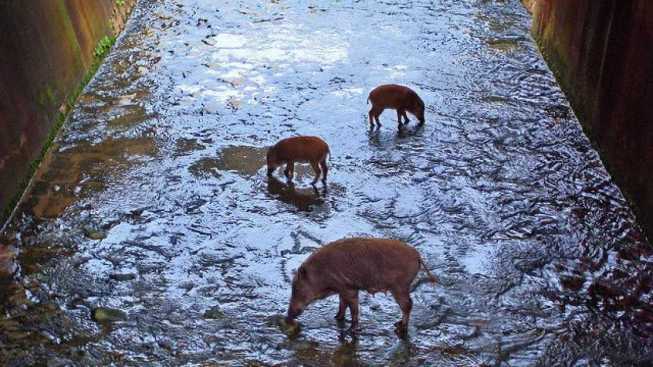
It’s been over five years since tsunami waves crashed into the Fukushima Daiichi power plant and led to its nuclear meltdown. While 20 kilometers (12 miles) of the land around the plant remains a dangerous exclusion zone, the area’s wildlife is taking full advantage of the peace.
Since the nuclear disaster, the population of wild boars has rocketed, much to the dismay of surrounding communities, The Times has reported. In the four years following the disaster, the population of boars is thought to have boomed from 3,000 to 13,000. You might think this ancient Japanese symbol of prosperity and fertility might be welcomed, but it’s estimated they have caused $15 million worth of damage to local agriculture.
Assistant ecology professor Okuda Keitokunin told the Japanese Mainichi newspaper that wild boar, along with racoons, have been using the abandoned houses and emptied buildings in the evacuation zone as a place to breed and shelter.
However, this post-nuclear meltdown town isn’t exactly a safe haven for the boars. It’s thought their diet of roots, nuts, berries and water all contain particularly high concentrations of radiation. The animals show no immediate signs of harm from the radiation, however samples from Fukushima’s wild boar meat has shown they contain 300 times the safe amount of the radioactive element caesium-137. Another study on the area’s fir trees showed evidence of growth mutations.
Hunters have been offered rewards to cull the boars by local authorities. However, the animals are breeding so quickly they can’t keep up. The city of Nihonmatsu, around 56 kilometers (35 miles) from the Fukushima plant, has dug three mass graves capable of holding 1,800 dead boars. Recently, these have become overfilled and authorities are now struggling to cope with the influx of culled beasts.
The boom in boars is a similar story to Chernobyl’s post-meltdown wildlife. A study from late last year showed that the populations of deer and wild boar are thriving in the area surrounding the Ukrainian nuclear power plant.
In a statement Jim Smith, one of the authors of the Chernobyl study, explained, “It’s very likely that wildlife numbers at Chernobyl are much higher than they were before the accident. This doesn’t mean radiation is good for wildlife, just that the effects of human habitation, including hunting, farming, and forestry, are a lot worse.”
http://www.iflscience.com/plants-and-animals/wild-boar-are-thriving-and-causing-havoc-near-fukushima-power-plant/
August 28, 2016
Posted by dunrenard |
Fukushima 2016 | Fukushima continuing, radiation, Wild Boar, Wildlife |
Leave a comment
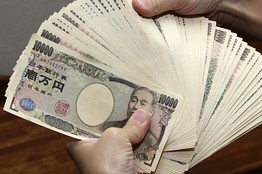
Electric Power Company Holdings Inc.’s stricken Fukushima No. 1 plant topped ¥4.2 trillion by the end of fiscal 2015, it was learned Sunday.
The cumulative total at the end of last March, including costs for radioactive decontamination, reactor decommissioning and compensation payments to affected people and organizations, translate into about ¥33,000 per capita.
The public financial burden is expected to increase, with Tepco seeking further government assistance.
Jiji Press scrutinized the government’s special-account budgets through fiscal 2015 for the reconstruction of areas affected by the March 2011 earthquake and tsunami. It summed up the amounts of executed budgets related to the nuclear disaster and additional electricity rates consumers and businesses were charged by Tepco and seven other regional power utilities to help finance compensation payments, among other costs.
According to the study, a total of ¥2.34 trillion was disbursed for decontamination of affected areas, disposal of contaminated waste and an interim storage facility for tainted soil. The expense was shouldered by the government, mainly through affiliated Nuclear Damage Compensation and Decommissioning Facilitation Corp.
The costs for decontamination and tainted waste disposal will eventually be financed by the proceeds from the sale of Tepco shares held by the government-backed organization. The government guaranteed the loans provided by banks for the acquisition of Tepco shares, and if the lending becomes irrecoverable due to weakness of the Tepco stock price, tax revenue will be used to repay the loans.
The government estimates the proceeds from Tepco share sale at ¥2.5 trillion, but to generate the estimated gain, the Tepco stock price needs to trade at around ¥1,050, up sharply from current market levels of some ¥360.
In addition, the Environment Ministry expects that the cumulative total of decontamination and related costs could surpass the estimated share proceeds by the March 2017 end of the current fiscal year.
A total of ¥1.1 trillion will be used from the energy special account to finance the costs related to the interim storage facility for contaminated soil. The account mostly consists of revenue of the tax for the promotion of power resources development, which is included in electricity bills.
Elsewhere, the government spent ¥1.38 trillion on projects including the decommissioning of reactors at the disaster-crippled Fukushima No. 1 plant, checks on food for radioactive contamination and building a research and development facility.
Tepco and six other power utilities charged their customers at least ¥327 billion in electricity rate hikes after Japan’s worst-ever nuclear accident. Moreover, consumers paid ¥219.3 billion or more for Tepco, chiefly to finance the maintenance of equipment to clean up radioactive water at the plant and the operation of call centers to deal with inquiries about compensation payments.
http://www.japantimes.co.jp/news/2016/08/28/national/public-cost-fukushima-nuclear-accident-cleanup-topped-%C2%A54-2-trillion-end-march/#.V8MWHTXKO-c
August 28, 2016
Posted by dunrenard |
Fukushima 2016 | Catastrophe, Clean-up, Cost, Fukushima continuing |
1 Comment
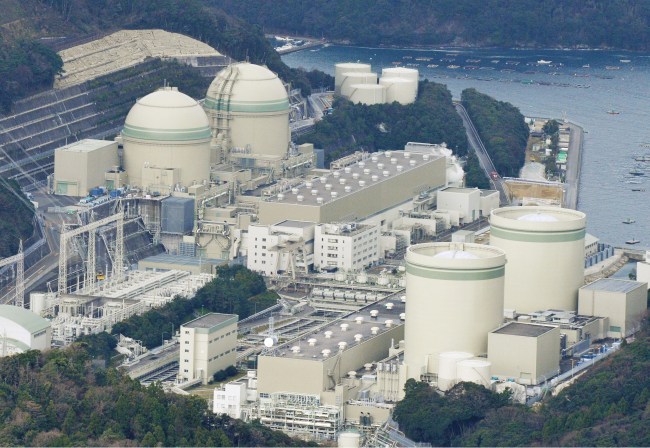
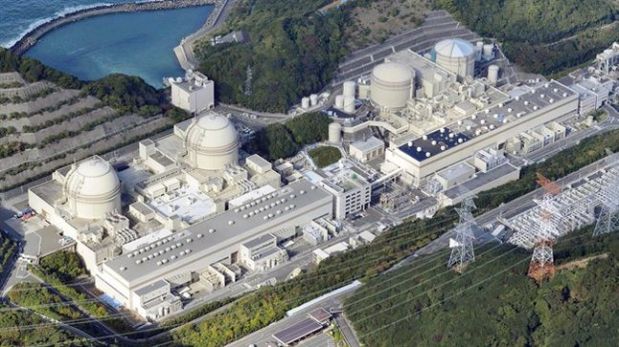
TAKAHAMA, FUKUI PREF. – Some 11,000 residents of Fukui and Kyoto prefectures participated in two major disaster drills on Saturday and Sunday centered on hypothetical nuclear accidents at Kansai Electric Power Co.’s Takahama and Oi nuclear power stations.
The exercises were jointly organized by the central government and the prefectural governments of Fukui, Shiga and Kyoto.
Saturday’s drill at Takahama involved about 9,000 residents. It was intended to examine the workability of evacuation plans approved by the national government last December.
The scenario was a strong earthquake off Wakasa Bay, near the plant. The tremor measured a lower 6 on the Japanese seismic intensity scale of 0 to 7.
The facility’s No. 3 reactor was assumed to have lost all power, leading to the release of radioactive substances — as happened at the Fukushima No. 1 plant in 2011.
Evacuation plans require residents within 5 km of plants to evacuate immediately upon an accident occurring. Those living up to 30 km away are meant to stay indoors until radiation alarms detect fallout in the air.
Some experts have cast doubt on whether it is a good idea to order people to stay indoors when reactors are spewing radiation.
For example, when quakes pummeled Kyushu this spring, about 160,000 houses and buildings collapsed. If that were to occur in Fukui, many residents would find it difficult to shelter indoors.
In the Kumamoto earthquake, there were cases where people returned to their homes after the initial quake, only to be hit when houses collapsed in the second quake, said Hirotada Hirose, a professor emeritus at Tokyo Woman’s Christian University, a specialist in disaster risk management.
“If a severe nuclear disaster occurs, evacuating in phases isn’t likely to go well,” he said. “The evacuation plan should assume many scenarios.”
These could include cases where an earthquake cuts traffic, jamming the roads with panicking residents who ignore advice and are trying to flee in large numbers.
Nonetheless, Saturday’s exercise finished without any major hiccups.
“By doing the drills with local governments and residents over and over again, disaster-prevention skills will improve,” said Fukui Gov. Issei Nishikawa.
As part of the exercise, at the town hall of Mihama, Fukui Prefecture, Kansai Electric workers screened evacuees for radiation exposure. They also checked the buses for contamination.
One of the would-be evacuees was Masatoshi Nose, 46, a city government employee from Obama, Fukui Prefecture.
“As this is a drill, I was able to come here smoothly,” Nose said. “But in a real disaster situation, it may take an entire day.”
Also, poor visibility scrubbed plans to use a Ground Self-Defense Force helicopter to extract 20 residents from near Takahama.About 180,000 people live within 30 km of the plant whose No. 3 and No. 4 reactors were restarted in January and February, only to be halted again after the Otsu District Court in Shiga in March issued a provisional injunction following a petition by residents.
Meanwhile, on Sunday about 2,000 local residents participated in an evacuation drill under a scenario where Kansai Electric’s Oi nuclear power plant in Fukui Prefecture experiences a catastrophic accident.
The drill was organized by the Fukui Prefectural Government.
The residents took shelter in their homes or evacuated to elsewhere in the prefecture as part of an effort to test response times to an accident.
The evacuation drill was only carried out within Fukui Prefecture itself as no evacuation plan covering a wider area has been drawn up for the plant, located in the town of Oi.
Residents within 5 km of the plant fled to the city of Tsuruga, and Oi residents within 30 km of the plant moved to the city of Ono, about 100 km away.
For the evacuees from Oi, a facility was set up for the distribution of iodine tablets to mitigate radiation exposure and to check for contamination.
http://www.japantimes.co.jp/news/2016/08/28/national/fukushima-scenarios-used-evacuation-drills-two-japanese-nuclear-plants/#.V8MWOTXKO-c
August 28, 2016
Posted by dunrenard |
Japan | Evacuation Drill, Oi NPP, Takahama NPP |
Leave a comment
“I put on sunscreen against the sun, but I haven’t found anything against radiation,” said one surfer. “We will only know the true consequences of our time in the water 20 years from now.”
Fukushima, Japan – On 11 March 2011, at 2:46 pm, Japan was hit by a magnitude 9.0 earthquake which generated a tsunami along the coast. The casualties of the disaster included 18,500 dead, 90 percent of whom drowned in the tsunami wave. The bodies of 2,561 people were never recovered.
The tsunami hit the Daaichi nuclear power plant as well, a level-7 catastrophe that was the equivalent of the Chernobyl nuclear power plant meltdown disaster.
Over the course of five years, nearly 50,000 people have worked to decontaminate the plant and stop leaks according to government press releases. They remove between 5 and 30 cm of contaminated soil every day and place them in plastic bags, which are stored on the outskirts of town, pending a better solution.
In Tairatoyoma beach, a prefecture of Fukushima and some 50km from the nuclear plant, was among the most popular areas for Japanese surfers prior to the nuclear accident.
Surprisingly, despite the presence of radiation in the sand and water, some dedicated surfers continue to come here to catch some waves. They are aware of the risks, and the hundreds of bags of contaminated sand piled up on the beach serve as a constant reminder of the health risks to them.
“I put on sunscreen against the sun, but I haven’t found anything against radiation,” said one surfer. “We will only know the true consequences of our time in the water 20 years from now.”
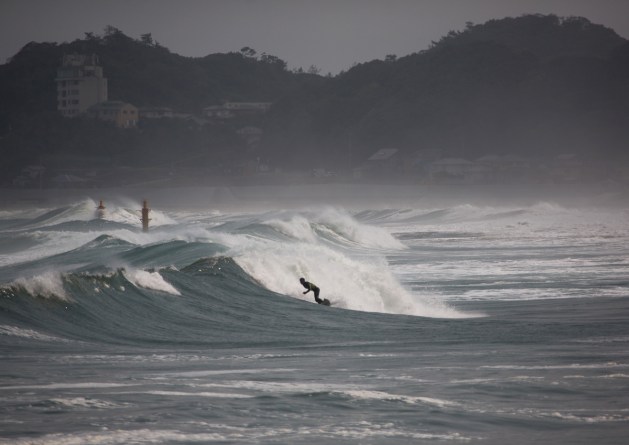
Tairatoyoma beach, in the prefecture of Fukushima, 50km from the nuclear plant, was among the most popular areas with Japanese surfers before the accident.

“I come to Tairatoyoma beach and surf several times a week. it is my passion, I can’t stop surfinhg”, says this surfer. The sign next to him in Japanese indicates that the area is restricted area.
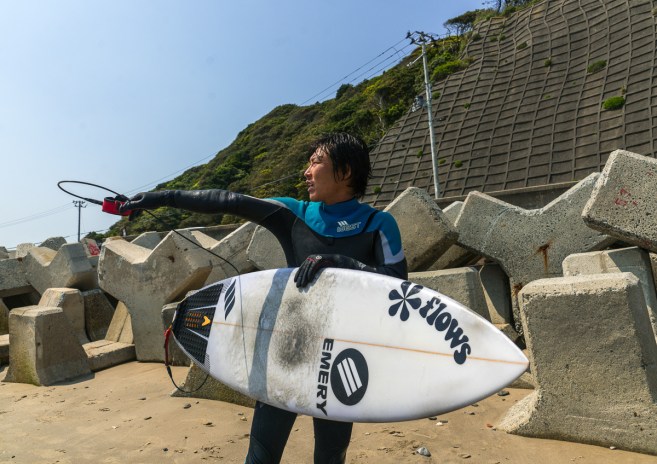
Some surfers were on the beach when the tsunami struck. ‘The earth shook, we came back on Tairatoyoma beach, and a few minutes later, the tsunami wave arrived,’ recalls one surfer. ‘None of the surfers who were on the beach died, as we had time to escape. Those who were in their homes were taken by the waves by surprise and they died.’
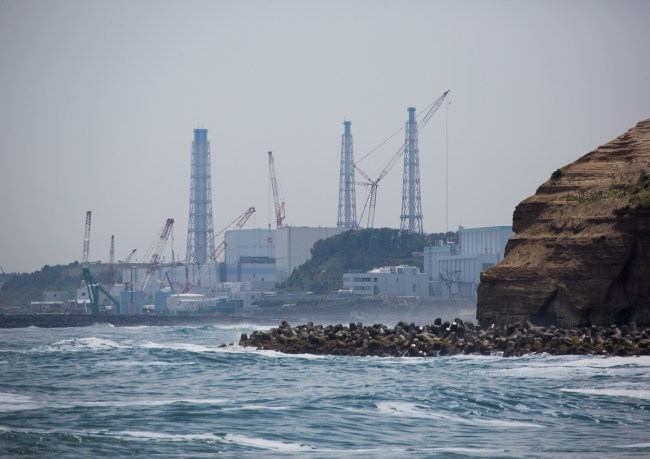
Over the course of five years, nearly 50,000 people have worked to decontaminate the plant and stop leaks. Nearly 500,000 people were evacuated because of the tsunami and the nuclear accident.
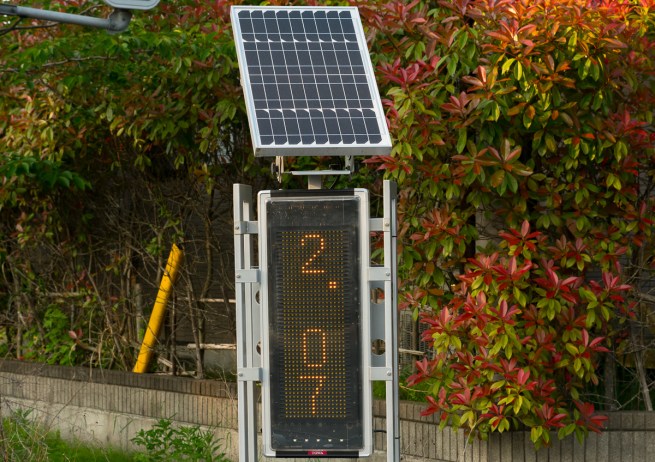
A radiation dosimeter placed in the difficult-to-return zone after the Daiichi nuclear power plant irradiation, Fukushima prefecture, Tomioka, Japan
Radiation sensors indicate the level of radioactivity. But no one is present to read the sensors in the red zones, classified as ‘difficult to return to zones’ by the government.

Roadblock in the difficult-to-return zone after the daiichi nuclear power plant irradiation, Fukushima prefecture, Tomioka, Japan
Residents receive compensation from Tepco company based on the degree of contamination of their homes. In the red zone they receive 1,000$ a month per person. That has created tensions in the population because those who live on the other side of the barrier, like here in Tomioka, do not receive as much.
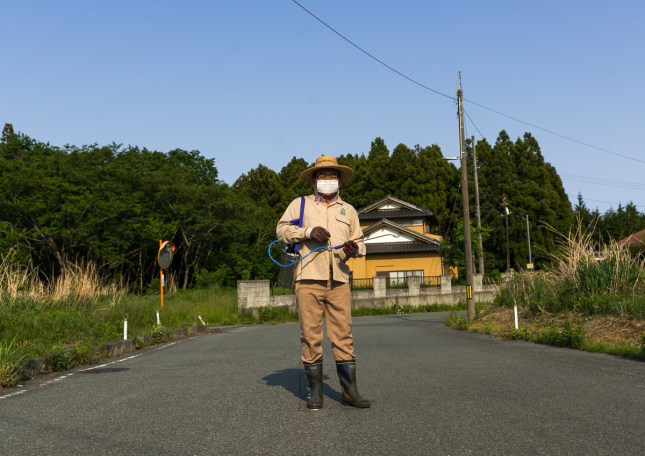
In the ‘orange zone’, residents have the right to visit their home if they wish to take care of it. In the town of Naraha. This man has come to weed his garden. His wife refuses to come back, and he will not bring his children. He never sleeps in his contaminated home. He knows the dangers well as he has worked at the nuclear plant.
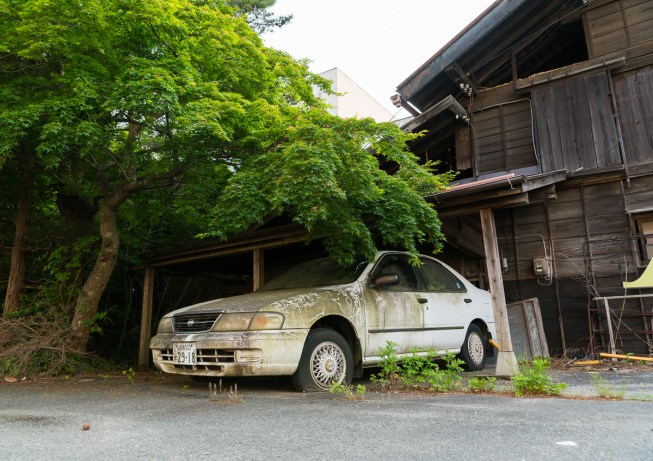
Abandoned car after the 2011 earthquake and tsunami five years after in the difficult-to-return zone, Fukushima prefecture, Tomioka, Japan
Cities distant from the sea, like Tomioka, were only affected by the earthquake and the radiation, not by the tsunami. They have now turned into ghost towns.
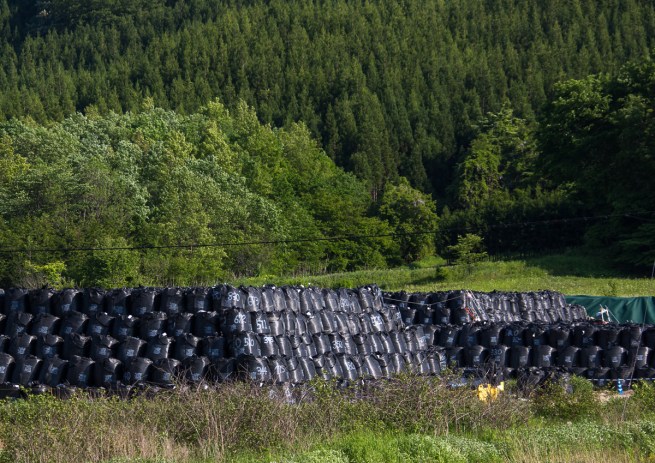
Thirty million tonnes of contaminated soil are stocked in open-air sites.

The Tairatoyoma beach was popular for its sand, but the tsunami washed this sand away. Now, a concrete wall offers protection against the waves. A few rare foreigners venture here to surf according to the Japanese surfers.
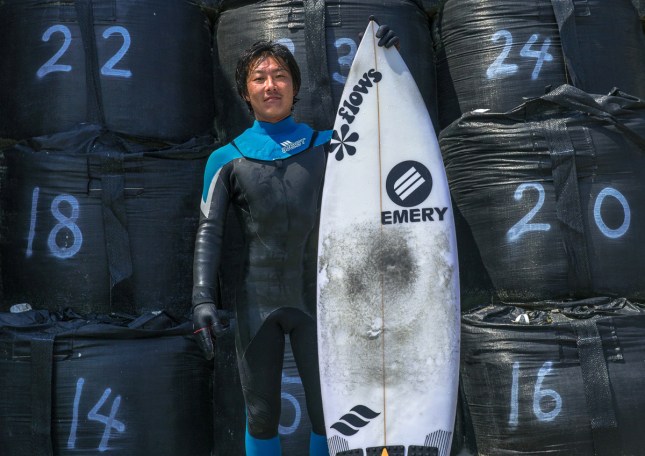
The surfers cannot ignore the riskS. There are hundreds of bags of contaminated sand piled up on the beach. ‘The government keeps telling us that things are back to normal in the region. But we can see that few people have come back. There are only elderly people. Children are kept away,’ said one surfer.
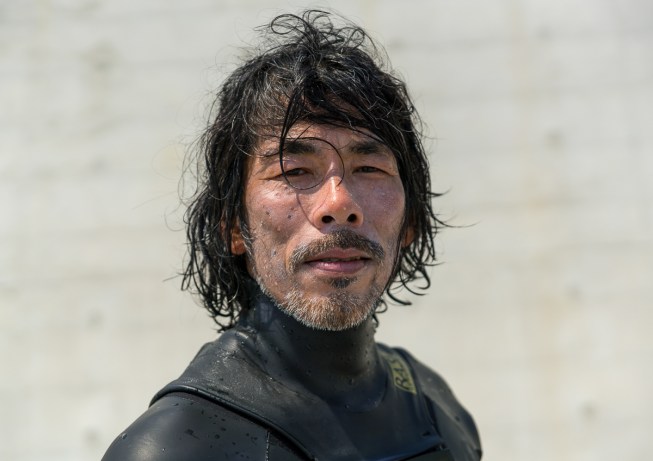
Despite knowing the risks, surfers are undeterred and willing to take the risk to surf in these waters. ‘I put on sunscreen against the sun, but I haven’t found anything against radiation. We will only know the true consequences of our time in the water 20 years from now,’said one surfer.
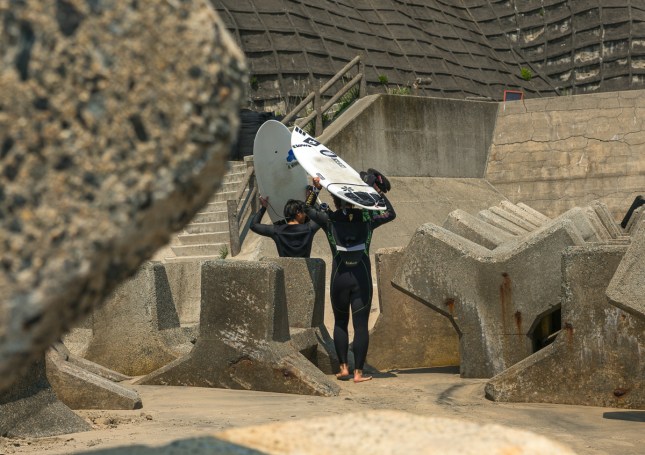
The people from the Fukushima prefecture had supported the construction of the nuclear power plants in the region because this brought jobs and prosperity to this rural area.
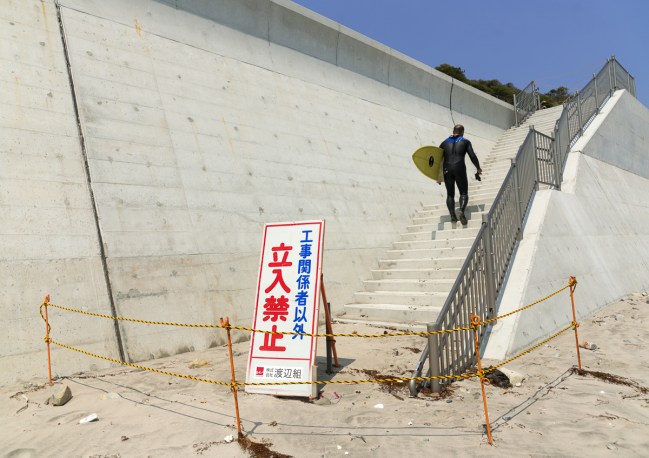
An employee of the nuclear plant said that he would never swim there as the water is too contaminated. Five of his friends who worked at the plant have now brain damage.
http://www.aljazeera.com/indepth/inpictures/2016/08/fukushima-surfers-riding-radioactive-waves-160826095748798.html
August 28, 2016
Posted by dunrenard |
Fukushima 2016 | Contamination, Fukushima continuing, radiation |
1 Comment

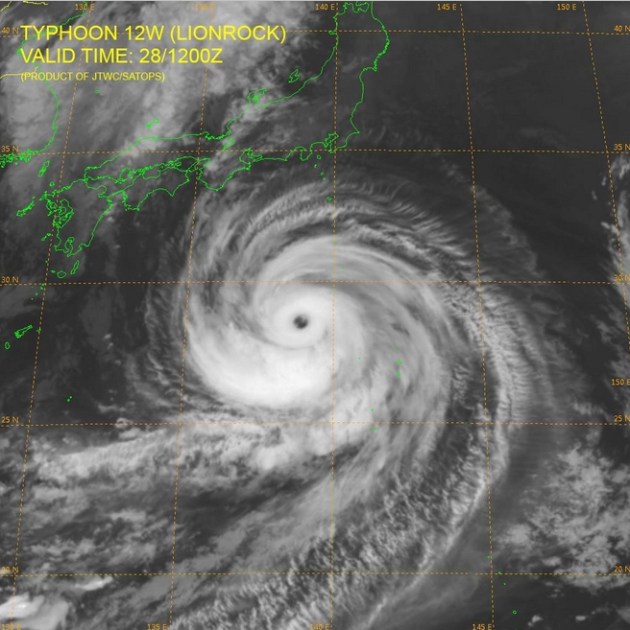
It might land in north east Japan for the first time since the beginning of meteorological records. We are very very worried about the Fukushima Daiichi NPP and the local population.
Typhoon Lionrock has strengthened and changed course. Current predictions as of today shows it hitting the Tohoku coast as a category 1 typhoon. The center of the predicted path is around Sendai, Miyagi Prefecture. Fukushima Prefecture and Fukushima Daiichi are within the predicted path zone.
Even if it doesn’t directly hit Fukushima Daiichi, outer bands could still cause significant problems. High winds could damage contaminated water tanks in the process of being disassembled or assembled on site. These tanks are highly radioactive and some may still contain highly radioactive water or sludge. Cranes and other outdoor structures that could be damaged by high winds are a concern.
The “K” drainage system connected to the roofs of the reactor buildings before the disaster. Post disaster we still see spikes in contamination in this drainage system. There are multiple other locations where this system could be fed contaminated run off. This drainage system has been redirected to the port but the port still exchanges water with the sea, so it isn’t a reliable solution. There is a pumping system to pump contaminated groundwater out of the area near the reactor buildings then to contaminated water storage.
It is not clear if it can keep up with both the ongoing groundwater intrusion and influx from a typhoon.
August 28, 2016
Posted by dunrenard |
Fukushima 2016 | Fukushima continuing, Fukushima Daiichi, Typhoon |
Leave a comment
Just one in five Japanese is optimistic about the country’s future and less than half the population believes that Japan is a functioning democracy, according to a survey that canvassed views on these issues in India and Indonesia as well.
The figure of 20 percent of Japanese who are optimistic about the future contrasted with more than 60 percent in India and Indonesia who felt the same.
The survey was carried out by private institutions in the three countries and the results were released Aug. 19.
Many respondents in Japan cited an aging population and a sluggish economy as reasons for being pessimistic. The survey results also highlighted a general distrust of the current state of party politics.
Genron NPO of Japan, the Center for Strategic and International Studies of Indonesia and the Observer Research Foundation of India contacted 1,000 people each in the three respective countries in June or later for the survey.
Only 20.7 percent of the respondents in Japan said they were either “optimistic” or “slightly optimistic” about the future of their country, whereas the corresponding ratios stood at 65.3 percent in Indonesia and 75.9 percent in India.
Among the various reasons for being pessimistic about the future, the commonest in Japan, cited by 84.7 percent of the respondents, was a lack of effective measures being presented to cope with the rapidly aging and shrinking population.
In Japan, 46.7 percent of the respondents answered in the affirmative when they were asked if they believe democracy is functioning. The corresponding figures for Indonesia and India were 47.1 percent and 65 percent, respectively.
When asked their reasons for believing that democracy is dysfunctional, the largest portion of the respondents who said so in Japan, at 60.2 percent, said that politicians are not confronting the challenges facing society because they are more intent on winning elections.
Only 15.5 percent of the Japanese respondents answered in the affirmative when they were asked if they had positive expectations for political parties, a figure that indicated a deep distrust of party politics.
http://www.asahi.com/ajw/articles/AJ201608270008.html
August 28, 2016
Posted by dunrenard |
Japan | Democracy, Public Survey |
Leave a comment
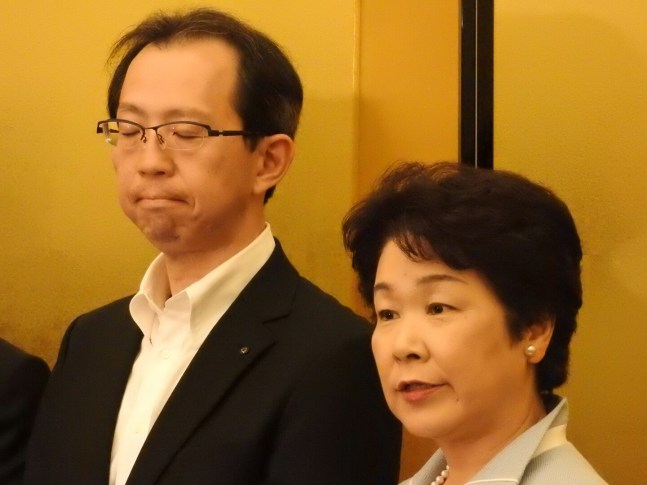
Yamagata and Niigata prefectural governors strongly request that FUKUSHIMA prefecture should extend the housing support for Nuclear disaster voluntary evacuees.But Fukushima governor, Uchibori Masao did not answer anything to their request. Why?
Yamagata Prefecture governor Mieko Yoshimura has requested an extension of the house support provided asking for the “special consideration“.
Niigata Prefecture governor Hirohiko Izumida also pointed out that “further burden in the problems of housing is increasing“, which the Fukushima Governor Uchibori Masao should well consider.
The Fukushima Prefecture governor to enforce central government order to terminate free housing support for evacuees by March 2017.
IfYoshimura and Izumida were Fukushima Prefecture governor, their treatment of “voluntary evacuees“ might have been quite different.
http://taminokoeshimbun.blog.fc2.com/blog-entry-38.html
August 28, 2016
Posted by dunrenard |
Fukushima 2016 | Evacuees, Free Housing Suspension, Fukushima continuing |
Leave a comment
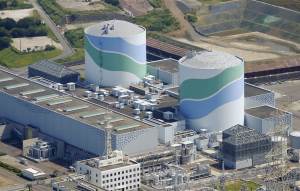 Governor asks utility to halt nuclear reactors in Kagoshima THE ASAHI SHIMBUN August 26, 2016 KAGOSHIMA–New Kagoshima Governor Satoshi Mitazono on Aug. 26 asked Kyushu Electric Power Co. to immediately shut down its Sendai nuclear power plant for a fresh safety inspection following the earthquakes that rocked neighboring Kumamoto Prefecture.
“We will consider your request and discuss it with many people,” Michiaki Uryu, president of Kyushu Electric, told Mitazono at the Kagoshima prefectural government building.
The utility plans to make an official response by early next month, but it is set to reject the governor’s request, sources said.
The two reactors at the Sendai plant in Satsuma-Sendai, Kagoshima Prefecture, on the southern main island of Kyushu, are the only ones online in Japan.
A governor does not have the legal authority to order a shutdown of a nuclear power plant. But under safety agreements, a prefectural government can call for measures deemed necessary to ensure the safety of the plant based on an inspection of the site…….http://www.asahi.com/ajw/articles/photo/AS20160826003329.html
August 27, 2016
Posted by Christina Macpherson |
Japan, safety |
Leave a comment