Major city bucks the South Korean pro nuclear trend, with Seoul’s success in renewable energy
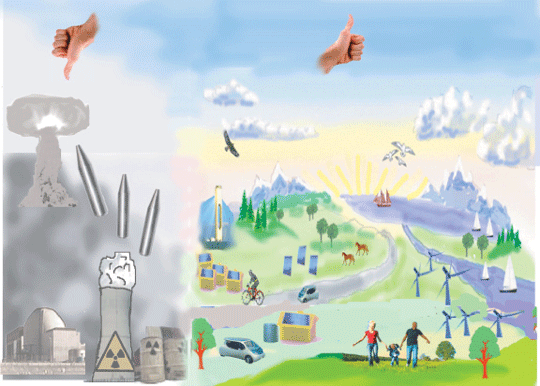
 How Japan’s Nuclear Disaster Still Haunts South Korea’s Biggest City, Seoul is trying to go green — but not the shade associated with plutonium. Huffington Post, Alexander C. Kaufman 10/09/2016 NEW YORK ― In 2010, South Korea seemed to be all-in on nuclear power. The country had won a landmark bid a year earlier to build nuclear reactors across the Middle East, including a $20.4 billion deal to build four power plants in the United Arab Emirates. A top-ranking minister called for a “renaissance of nuclear energy.” Some 66 percent of South Koreans said they supported building new nuclear plants, more than any other country in a 2010 report from the Organization for Economic Cooperation and Development’s Nuclear Energy Agency.
That presented a problem for Park Won-soon, the eco-minded human rights lawyer elected mayor of Seoul eight months after the disaster……..
Nearly a year after the Fukushima disaster, Park unveiled the city’s flagship energy policy, dubbed the “One Less Nuclear Power Plant” initiative. It aimed to reduce overall energy consumption and became the cornerstone of Seoul’s plan to overhaul its power production, in part by encouraging more people to install solar panels on rooftops. Park set a goal of cutting energy use by one nuclear power plant’s output, the equivalent of 2 million tons of burning oil.
It worked. Seoul reached its target in June 2014 ― six months ahead of schedule, according to a government report. Now, as part of the second phase of the plan, Seoul is working to cut greenhouse gas emissions by 10 million tons.
But the plan also highlighted a fissure between the national government and the local leaders of Korea’s capital, a megacity where over half the country’s population lives. The national government has plans to build 11 more plants by 2024.
Seoul also continues to issue feed-in tariffs ― payments to customers who produce their own energy and sell it back to the grid ― to households in hopes of spurring more rooftop solar production, a policy the central government scrapped in 2011.
“We cannot eliminate at once the whole nuclear power [industry],” Park said. “But as an experiment of Seoul, we can, step by step, eliminate [the need for] nuclear power.”
That experiment has yielded some significant progress. A core component of Seoul’s second-phase clean energy plan is electrical “self-reliance.” As part of the plan, the city has invested heavily in solar energy, granting five-year subsidies to small solar plants producing less than 100 kilowatt-hours of energy, according to areport by the consulting giant KPMG.
Just as South Korea has exported its nuclear reactor technology, the country is now becoming a major source of solar energy hardware. Sales of solar panels and other equipment reached $2.01 billion in the first half of this year, a 46.7 percent jump from the same period last year, Seoul-based Yonhap News Agency reported on Friday.
For the past two years, Seoul has hosted a three-day fair for investors to showcase upcoming clean energy projects. This year’s fair took place last week. http://www.huffingtonpost.com.au/entry/seoul-nuclear-energy_us_57d03babe4b03d2d4597b38e
Closure of Japan’s nuclear reactors in 2011 did not result in a boom for fossil fuels
Japan’s lurch away from nuclear hasn’t caused fossil fuels to boom http://arstechnica.com/science/2016/09/japans-lurch-away-from-nuclear-hasnt-caused-fossil-fuels-to-boom/
The emergency shutdown of nuclear reactors hasn’t been an emissions disaster. JOHN TIMMER –
9/10/2016, In the wake of the meltdown of the Fukushima Daiichi nuclear reactors, Japan shut down its entire nuclear fleet in order to develop more rigorous safety standards and inspect the remaining plants. As of now, plants are only beginning to come back online.
Given that Japan had recently relied on nuclear for over a quarter of its electricity, the expectation is that emissions would rise dramatically. But that hasn’t turned out to be the case. While coal use has gone up, it hasn’t risen by more than 10 percent. And a heavy dose of conservation has cut Japan’s total electricity use to below where it was at the end of last decade The data indicates that nuclear was playing a decreasing role in Japan’s energy mix even prior to Fukushima, being displaced in part by natural gas and in part by petroleum. By 2012, however, nuclear was mostly gone. Conservation had already dropped Japan’s electricity use below a PetaWatt-hour, and further efforts have turned the drop in electricity use into an ongoing trend.
Fossil fuel use has gone up, but not by as much as might be expected. Coal rose by eight percent, and natural gas (transported in its liquefied form) rose by nine percent. These have largely reversed the expansion of petroleum use that began prior to the meltdown at Fukushima. Non-hydro renewables have also more than doubled their electrical production since that time. Combined with hydroelectric plants, they now provide more electricity than petroleum.
The net result of all of this? Carbon emissions have been relatively flat and have not exceeded the nation’s record year back in 2007
Five remarkable facts on China’s solar and wind energy
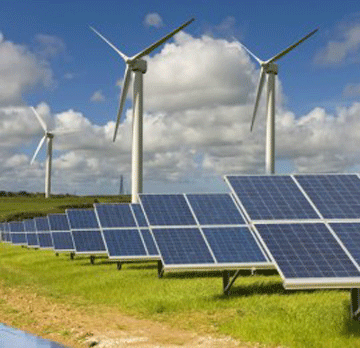
 China Five little known facts about the country’s solar and wind boom http://energydesk.greenpeace.org/2016/09/08/china-six-little-known-facts-countrys-solar-wind-boom/ [good graphs] September 8, 2016 by Lauri Myllyvirta @laurimyllyvirta China is installing one wind turbine an hour – according to a new analysis of the latest data on the country’s startling state-backed renewables boom.
The analysis comes as China – alongside the US – moved to ratify the Paris climate treaty.
China’s coal use fell for the second year in a row in 2015, with 2016 on track to be the third – though it remains the largest source of energy; causing an estimated 370,000 premature deaths from air pollution in 2013.
But it’s China’s use of renewable energy that is really changing.
1. Power generation from wind and solar increased more than China’s total electricity demand in 2015.
So yes, energy demand in the world’s largest economy is growing but this new data means that all new demand was covered from these sources.
In detail that means:
Electricity consumption in China rose 0.5% from 2014 to 2015, from 5522 TWh (terawatt-hours) to 5550 TWh.
At the same time, electricity generated from wind and solar sources increased by 21% and 64%, respectively, covering off the rise almost twice over.
2. China’s increase in power generation from wind and solar in 2015 (48 TWh) alone was twice as large as Ireland’s entire electricity demand the previous year (24 TWh).
3. Half of all wind power capacity and almost one third of all solar PV capacity installed globally in 2015 was in China.
4. The surface area of solar panels installed in China in 2015 is equal to over 10,000 football pitches. That’s more than one football pitch per hour, every hour of the year.
5. China’s targets a similar pace of wind and solar growth in its 2020 renewable energy targets.This will mean adding approximately the entire electricity demand of UK from wind and solar in just five years. See the full dataset here.
China’s new power demand being met in full by wind and solar
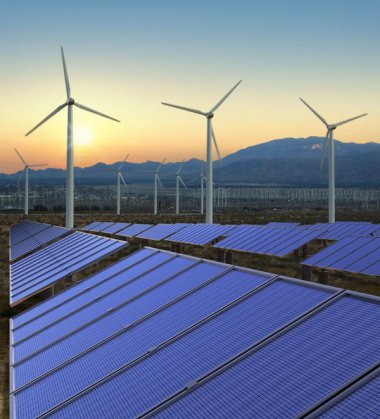 Data: All China’s new power demand met by wind and solar last year http://energydesk.greenpeace.org/2016/09/08/data-chinas-new-power-demand-met-wind-solar-last-year/ [good graphs] September 8, 2016 by Joe Sandler Clarke @JSandlerClarke China dramatically increased the portion of its electricity generated from wind and solar in 2015, with the growth in the two forms of power alone exceeding the rise in the country’s total electricity demand.
Wind and solar comfortably met this new demand, producing 186.3 TWh and 38.3 TWh of electricity in 2015, compared to 153.4 TWh and 23.3 TWh the year before. That’s a dramatic increase: 21% and 64%, respectively.
To give those numbers more context, China’s increase in power generation from wind and solar in 2015 (48 TWh) alone was twice Ireland’s entire electricity demand the previous year (24 TWh).
Half UK energy needs In fact, Chinese wind alone could have met more than half the UK’s entire energy needs in 2015 (304 TWh).
The expansion of renewable energy generation was made possible by China vastly increasing its wind and solar capacity in 2015, up 28% and 54% respectively on 12 months previously. In total, the country made up nearly half of the world’s new solar and wind capacity last year.
Coal use falls The increased use of renewable energy, together with a marked economic shift away from heavy industry sectors, has meant that coal use in the country has dropped for a third year in a row, though it is still the biggest source of global CO2 emissions.
Last week, China announced that it was ratifying the Paris climate agreement, alongside the United States, in a move widely hailed as historic.
With the American presidential election now just two months away, it remains to be seen whether the States will be able to catch up in the race to lead the post-fossil fuels global economy. See the full dataset here.
Fund started to help Fukushima thyroid cancer patients cover expenses

A group comprising medical and legal experts announced Friday it has launched a fund to provide financial support to children who were diagnosed with thyroid cancer after the 2011 nuclear meltdowns in Fukushima Prefecture.
The group, named 3/11 Children’s Fund for Thyroid Cancer, will start accepting donations from Sept. 20, aiming to raise at least ¥20 million. The amount could provide at least ¥50,000 each for 200 to 400 people, it said.
Donated funds will be used primarily to cover medical expenses for thyroid cancer patients in Fukushima and neighboring prefectures, it said. The group will announce more details in November on the criteria that will be used to determine who is eligible to receive the aid before it starts accepting applications.
“They are struggling to pay medical bills,” Hiroyuki Kawai, a lawyer and one of the founding members of the group, said at a news conference in Tokyo. “I don’t think ¥50,000 will be enough for them, but they are impoverished and are struggling, and even that amount will be of help.”
Currently, the medical expenses of children diagnosed with thyroid cancer in Fukushima Prefecture are covered by the prefectural government.
Patients, however, have to initially pay their medical expenses out of pocket until they start receiving refunds from the prefecture, placing great financial strain on many families, another member of the group said.
In addition to that, some parents often have to take leave from work to accompany their children during hospital visits, which also includes paying for travel expenses, they said.
According to the group, although medical treatment for thyroid cancer is covered by public health insurance, the patients still have to pay about ¥10,000 per examination and roughly ¥150,000 for surgical procedures. And if patients have to undergo endoscopic surgery, it would cost them an additional ¥300,000, it said.
Since October 2011, the Fukushima government has conducted thyroid screenings for some 380,000 children who were aged 18 or younger.
By the end of March, a total of 173 children were diagnosed with suspected thyroid cancer. Of those, 131 were confirmed to have the cancer after undergoing surgery.
A panel of experts under the prefectural government said in an interim report released in March that those thyroid cancer cases were unlikely to be radiation-induced.
The panel said the amount of radiation released was lower than in the 1986 Chernobyl accident, where more than 6,000 children were diagnosed with the cancer by 2005, and noted that no cancer was found among children aged under 5 at the time of the disaster who are more vulnerable to radiation exposure.
Iwaki mayor makes formal request for city to host baseball, softball games during 2020 Olympics

Iwaki Mayor Toshio Shimizu on Friday presented a request to 2020 Tokyo Olympic organizers, seeking to host a baseball game and a softball game in the city in Fukushima Prefecture.
Shimizu submitted the request to Yoshiro Mori, president of the Tokyo Olympic and Paralympic organizing committee, and Toshiei Mizuochi, senior vice minister of both the sports ministry and the Cabinet Office.
The request comes as Tokyo Olympic organizers are arranging to stage one first-round game each for baseball and softball in Fukushima Prefecture, one of the areas hardest hit by the 2011 earthquake and tsunami disaster, as part of reconstruction efforts.
They are said to be considering Iwaki, Fukushima and Koriyama cities as candidate sites.
The Iwaki municipal government wants the games played at Iwaki Green Stadium, which is occasionally used for Japanese professional baseball games and was the venue of the Under-15 World Cup baseball competition in July and August.
Shimizu expressed hope that the stadium will be chosen as an Olympic venue as that would “give hope and courage” to survivors of the quake and tsunami which also triggered a nuclear accident in the prefecture.
The main ballpark for the 2020 Summer Games is set to be Yokohama Stadium in Kanagawa Prefecture.
In the request, Shimizu and the mayors of eight nearby towns and villages are also requesting that the Olympic torch relay run on National Route 6 in the coastal area of Fukushima Prefecture.
Anti-nuclear Power Protest Tents in Tokyo Removed
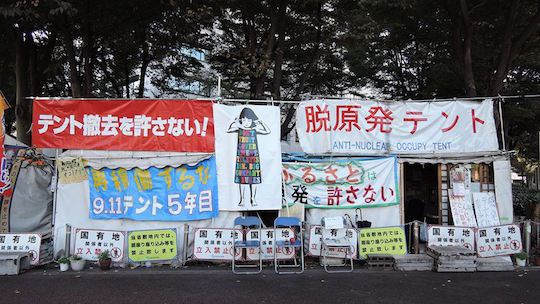
Japanese officials led a predawn raid on August 21st to forcibly remove the protracted anti-nuclear power sit-in protest in front of the Ministry of Economy, Trade and Industry (METI) headquarters in central Tokyo. At around 3.30 a.m., some 100 security guards and court officials descended on the so-called “No Nukes Plaza,” a collection of tents that had occupied a corner of land in front of METI in government district of Kasumigaseki since September 11th, 2011.
It had been the longest surviving example of Japan’s post-Fukushima protest movement. The weekly Friday night vigils outside the nearby prime minister’s residence have also continued, albeit with far fewer participant numbers than their peak in 2012, when tens of thousands were gathering in Kasumigaseki.
The protest tents were started by veteran left-wing activists from Japan’s postwar period, though it was supported by a younger generation of activists. It soon achieved a significant level of international attention and mainstream press coverage. The “plaza” evolved into a polestar for the movement, hosting talks, film screenings, and other events that strove to keep the debate over nuclear power in the public eye. One of the tents was even turned into a de facto art museum with Fukushima-inspired exhibits.
The administration of Yoshihiko Noda of the Democratic Party of Japan (now the Democratic Party) left the tents alone, but following the return to power of Shinzo Abe and the Liberal Democratic Party in late 2012, the government made it a priority to remove the protesters. In 2013, the government filed for the removal of the tents, which were manned 24 hours a day by activists. After this was approved by the courts, the activists appealed, claiming it was tantamount to suppressing freedom of speech and the right to free assembly, which is protected by the Constitution of Japan. The court also ordered the protesters to pay a daily fee of over \20,000 (approx. $200) for using government land.
In addition to the authorities, the protesters also attracted enemies from Japan’s ultra-nationalists. Beginning soon after they were erected, the tents were subject to regular attacks by right-wing activists and groups, including one as recently as the weekend before the eviction.
In July, the Supreme Court upheld the earlier ruling that the tents could be removed, meaning the protestors were out of legal options and effectively on borrowed time. METI officials no doubt deliberately chose the early morning to enforce the eviction so as to circumvent any resistance: the protesters were supported by a number of leftist activists known for aggressive hate speech counter-protests and who could be mobilized quickly.
When officials came to dismantle the tents, five activists were reportedly inside but were powerless to stop the proceedings, which took around 90 minutes. By Sunday morning, the tents were completely removed and the area where they previously stood was fenced off. Erecting any new tents was now impossible, but activists have vowed to continue their protest by sitting on chairs and standing at the same corner. Police initially blockaded even the sidewalks for some of Sunday, in fear of a backlash from the activists, though did relent and allow demonstrators to return to the site of their protest. One activist was arrested following a confrontation with police but was later released.
The anti-nuclear protest tents came to be seen as one of the pivotal aspects of the post-Fukushima movement, which blamed METI and the government for the crisis. Occupying the site was arguably just a symbolic gesture, but nonetheless an important one for Japan, where public land is strictly controlled and police and private security are quick to pounce on people who squat. No one else dared to do this kind of protest: the Friday night vigils pack up and go home at 8 p.m., and likewise the student group SEALDs, which generated much press coverage last year for its protests against the government’s controversial security legislation, was orderly and even praised for picking up trash after its demonstrations at Kasumigaseki.
As such, the tents were a renegade and unrepentant presence in the protest culture of Japan, and a constant reminder that the problems of Fukushima have still not been resolved even more than five years after the disaster.
The timing of the removal is also significant. It came shortly before the fifth anniversary of the sit-in, as well as during protests over the restarting of a reactor at Ikata Nuclear Power Plant. Unrest currently continues in Okinawa, too, as demonstrators clash daily with hundreds of riot police protecting the construction of new United States military helipads in the jungle near Takae.
http://www.counterpunch.org/2016/09/09/anti-nuclear-power-protest-tents-in-tokyo-removed/
Japanese dried mushroom sample detected with trace level of radioactivity
Hong Kong (HKSAR) – The Centre for Food Safety (CFS) of the Food and Environmental Hygiene Department said today (September 8) that a loose-packed dried mushroom sample, imported from Japan, was detected with a low level of radioactivity. Follow-up is in progress.
Japanese dried mushroom sample detected with trace level of radioactivity
Hong Kong (HKSAR) – The Centre for Food Safety (CFS) of the Food and Environmental Hygiene Department said today (September 8) that a loose-packed dried mushroom sample, imported from Japan, was detected with a low level of radioactivity. Follow-up is in progress.
“The CFS collected the dried mushroom sample from a retail outlet in Sheung Wan for radiation testing under its routine Food Surveillance Programme. According to the information provided by the retail outlet, the product concerned was imported from Japan. The test result showed that the sample was detected with Caesium-137 at a level of 24 becquerels per kilogram (Bq/kg).
The standard laid down by the Codex Alimentarius Commission in the guideline levels for radionuclides in foods contaminated following a nuclear or radiological emergency is 1 000 Bq/kg for Caesium-137. The radiation level detected does not exceed the Codex guideline level,” a spokesman for the CFS said.
The CFS has informed the vendor concerned of the test result. The vendor has voluntarily stopped sale and removed from shelves the affected product.
In the wake of the Fukushima nuclear power plant incident, the CFS has enhanced radiation testing on food imported from Japan at import, wholesale and retail levels since March 12, 2011.
The CFS updates the results and figures of food surveillance on imported Japanese food on its website every working day (including those cases detected with low levels of radioactivity).
The CFS will continue to closely monitor information from Japan as well as the radiation test results of Japanese food products in Hong Kong and elsewhere. It will review and adjust, if necessary, the surveillance strategy on food products imported from Japan in a timely manner, making reference to the recommendations of international authorities, to safeguard food safety.
Please refer to the CFS website for results of the food surveillance on Japanese food: http://www.cfs.gov.hk/english/programme/programme_rafs/programme_rafs_fc_01_30_Nuclear_Event_and_Food_Safety.html” target=”_blank”>www.cfs.gov.hk/english/programme/programme_rafs/programme_rafs_fc_01_30_Nuclear_Event_and_Food_Safety.html.
Kagoshima governor once again requests nuclear reactor halt
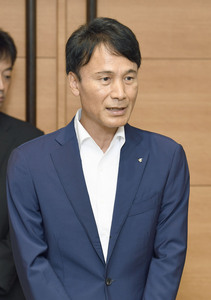
Governor again requests reactor suspension
Satoshi Mitazono, governor of the southwestern Japan prefecture of Kagoshima, meets with reporters on Sept. 7, 2016, in the city of Fukuoka after issuing a second request to Kyushu Electric Power Co. to suspend operations of two reactors at its Sendai nuclear plant. The utility rejected the initial request issued on Aug. 26.
Kagoshima Gov. Satoshi Mitazono once again requested Wednesday that Kyushu Electric Power Co. immediately suspend the operation of two reactors at its nuclear power plant in the southwestern prefecture after the utility rejected his earlier call.
Following a meeting with Mitazono in Fukuoka, Kyushu Electric President Michiaki Uriu indicated to the press that the operator is likely to reject the request, saying he wants the company to be “spared of” the suspension as it will conduct “special safety checkups” thoroughly on the Sendai nuclear plant reactors — two of only three nuclear reactors currently operating in Japan.
The latest request came after the new governor demanded on Aug. 26 that the utility halt the plant’s Nos. 1 and 2 reactors to verify their safety, citing local worries about the plant’s safety after major earthquakes rocked neighboring Kumamoto Prefecture and its vicinity in April.
Gov’t may shift nuke accident, reactor decommissioning costs onto new power suppliers

The government is moving to bill new electricity suppliers for a portion of nuclear reactor decommissioning costs and compensation payments related to the Fukushima nuclear disaster, it was learned on Sept. 7.
After decades under regional utility monopolies, the electricity supply market was opened to competition in April this year. The government apparently fears that the old monopolies such as Tokyo Electric Power Co. (TEPCO) lose too many customers to new suppliers and they may no longer be able to cover the high costs of decommissioning old reactors or compensate the victims of nuclear accidents, hence the move to shift some of the financial burden onto new market entrants.
However, these costs were originally supposed to be covered by the nine big utilities, and the government’s moves would essentially transfer that burden onto the Japanese people, making a clash more than likely.
Under the current system, large utilities must cover nuclear reactor operating expenses — including eventual decommissioning — from electricity bill income. Also, TEPCO receives monies to cover Fukushima nuclear disaster compensation claims from the government-licensed Nuclear Damage Compensation and Decommissioning Facilitation Corp. (NDF), which is in turn funded by all the large utility companies.
The new system being considered by the government would spread the financial burden of nuclear accident compensation and reactor decommissioning to new electricity suppliers, lightening the load on the big utilities. The government estimates the total cost for reactor decommissioning plus Fukushima nuclear disaster compensation paid before the NDF was established at some 8 trillion yen. The new power suppliers would likely pass on their share of these costs to their customers, resulting in monthly power bills up to about 200 yen higher than at present for an average three-person household.
However, forcing customers of the new electricity firms to pay for the old utilities to decommission their reactors and for TEPCO’s nuclear disaster liabilities runs counter to the goals of liberalizing the electricity market, which was intended to push down prices through competition. It would also in essence be corporate welfare for the big utilities operating nuclear plants.
A sub-committee to debate the new system will be established under the Advisory Committee for Natural Resources and Energy reporting to the minister of economy, trade and industry. The committee will decide on what direction to take by the end of this year, with an eye to submitting a bill to revise the Electricity Business Act to the ordinary Diet session next year.
http://mainichi.jp/english/articles/20160908/p2a/00m/0na/006000c
Ex-PM Koizumi backs sick U.S. sailors who blame radiation

Former Prime Minister Junichiro Koizumi is raising money for the hundreds of American sailors who say they got sick from radiation after taking part in relief operations for the 2011 tsunami that set off the Fukushima nuclear disaster.
Koizumi, prime minister from 2001 to 2006, told reporters Wednesday he recently visited San Diego to meet with former military service members, who have begun a class-action lawsuit against Tokyo Electric Power Co., the utility that operates the Fukushima No. 1 nuclear power plant.
Some 70,000 sailors and Marines took part in “Operation Tomodachi,” flying in aid from an aircraft carrier and other warships off the coast of northeastern Japan.
Some got seriously sick with cancer and leukemia and blame radiation. TEPCO denies any link between the illness and radiation.
To secure 2020 Olympics Japan’s PM Abe lied about Fukushima nuclear plant being ‘under control’
 Abe’s Fukushima ‘under control’ pledge to secure Olympics was a lie – former PM
http://www.channelnewsasia.com/news/asiapacific/abe-s-fukushima-under-control-pledge-to-secure-olympics-was-a/3108276.html07 Sep 2016 TOKYO: Japanese Prime Minister Shinzo Abe’s promise that the crippled Fukushima nuclear plant was “under control” in his successful pitch three years ago for Tokyo to host the 2020 Olympic Games “was a lie”, former premier Junichiro Koizumi said on Wednesday.
Koizumi, one of Japan’s most popular premiers during his 2001-2006 term, became an outspoken critic of nuclear energy after a March 2011 earthquake and tsunami triggered meltdowns at Tokyo Electric Power Co’s (Tepco) Fukushima Daiichi plant, the worst nuclear disaster since Chernobyl in 1986.
Abe gave the assurances about safety at the Fukushima plant in his September 2013 speech to the International Olympic Committee to allay concerns about awarding the Games to Tokyo. The comment met with considerable criticism at the time.
“Mr. Abe’s ‘under control’ remark, that was a lie,” Koizumi, now 74 and his unruly mane of hair turned white, told a news conference where he repeated his opposition to nuclear power.
“It is not under control,” Koizumi added, citing as an example Tepco’s widely questioned efforts to build the world’s biggest “ice wall” to keep groundwater from flowing into the basements of the damaged reactors and getting contaminated.
“They keep saying they can do it, but they can’t,” Koizumi said. Experts say handling the nearly million tonnes of radioactive water stored in tanks on the Fukushima site is one of the biggest challenges.
Koizumi also said he was “ashamed” that he had believed experts who assured him that nuclear power was cheap, clean and safe and that resource-poor Japan had to rely on nuclear energy.
After the Fukushima crisis, Koizumi said, “I studied the process, reality and history of the introduction of nuclear power and became ashamed of myself for believing such lies.”
All Japan’s nuclear plants – which had supplied about 30 percent of its electricity – were closed after the Fukushima disaster and utilities have struggled to get running again in the face of a sceptical public. Only three are operating now.
Abe’s government has set a target for nuclear power to supply a fifth of energy generation by 2030.
The meltdowns in three Fukushima reactors spewed radiation over a wide area of the countryside, contaminating water, food and air. More than 160,000 people were evacuated from nearby towns.
(Reporting by Linda Sieg and Megumi Lim; Editing by Nick Macfie)
Nuclear terrorism fears: Japan to check background of nuclear workers
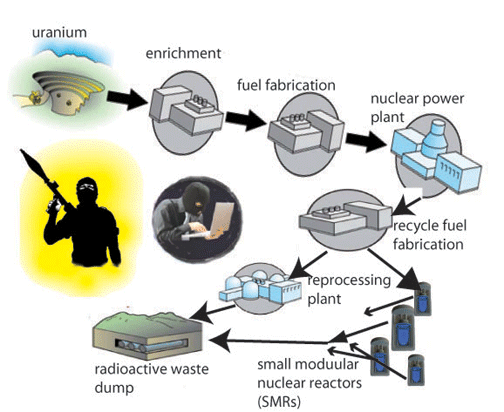 Japan to check background of nuclear workers to prevent terrorism, Kyodo News, TOKYO, Sept. 7, Kyodo Japan’s nuclear watchdog decided Wednesday to make operators of nuclear power plants and other nuclear facilities check the background of their workers to prevent terror attacks.
Following the recommendation of the International Atomic Energy Agency, the Nuclear Regulation Authority will introduce the new regulation in late September, although the actual implementation is expected to be from next year or later due to necessary procedures, such a revision of the rules regarding the handling of nuclear materials.
It is also unclear how the new measure will be effective in preventing terrorism as the operators will conduct the background checks based on information workers provide themselves, rather than by referrals to police or other law enforcement authorities….. (subscribers only) http://english.kyodonews.jp/news/2016/09/432517.html
Push for South Korea to get nuclear-powered submarines
South Korea think tank proposes acquiring nuclear-powered submarines, UPI. By Elizabeth Shim  | Sept. 8, 2016 SEOUL, — A South Korean think tank is proposing Seoul retain nuclear-powered submarines in response to North Korea‘s sub-launched ballistic missile provocations.
The Yeouido Research Institute, an organization affiliated with South Korea’s ruling Saenuri party, stated nuclear submarines could be used to deter Pyongyang’s submarine-launched ballistic missiles, local newspaper JoongAng Ilbo reported Thursday.
The think tank’s recommendation of “strengthening anti-submarine warfare capabilities” follows a North Korea SLBM launch, most recently on Aug. 24.
“So far surveillance of North Korea submarines has been conducted by reconnaissance satellite, but because real-time tracking is difficult, in order to detect and destroy [North Korean incursions] a careful review of the need for nuclear submarine ownership is necessary,” the think tank said in its statement.
The nuclear submarine issue was previously raised by ruling party majority leader Chung Jin-suk.
There is worry in Seoul, however, that the acquisition of the subs could raise concerns in the United States.
A defense ministry official who spoke on the condition of anonymity told the JoongAng there is “no evidence” the United States could prevent South Korea from maintaining nuclear-powered submarines but Washington could place “pressure” on Seoul if South Korea chose to acquire the submarines……..http://www.upi.com/Top_News/World-News/2016/09/08/South-Korea-think-tank-proposes-acquiring-nuclear-powered-submarines/1251473348269/
North Korea is urged by East Asia Summit to abandon nuclear program
East Asia Summit urges NK to abandon nuclear program , Korea Times
|
1 This Month





PLEASE OPPOSE HR 8255 AND S.3639 – bills would accelerate satellite deployment, with no environmental review or safeguards – https://ncstd5li.quorum.us/campaign/169331/
To see nuclear-related stories in greater depth and intensity – go to https://nuclearinformation.wordpress.com
-
Archives
- October 2026 (29)
- September 2026 (339)
- August 2026 (330)
- July 2026 (355)
- June 2026 (287)
- May 2026 (306)
- April 2026 (356)
- March 2026 (251)
- February 2026 (267)
- January 2026 (308)
- December 2025 (358)
- November 2025 (359)
-
Categories
- 1
- 1 NUCLEAR ISSUES
- business and costs
- climate change
- culture and arts
- ENERGY
- environment
- health
- history
- indigenous issues
- Legal
- marketing of nuclear
- media
- opposition to nuclear
- PERSONAL STORIES
- politics
- politics international
- Religion and ethics
- safety
- secrets,lies and civil liberties
- spinbuster
- technology
- Uranium
- wastes
- weapons and war
- Women
- 2 WORLD
- ACTION
- AFRICA
- Atrocities
- AUSTRALIA
- Christina's notes
- Christina's themes
- culture and arts
- Events
- Fuk 2022
- Fuk 2023
- Fukushima 2017
- Fukushima 2018
- fukushima 2019
- Fukushima 2020
- Fukushima 2021
- general
- global warming
- Humour (God we need it)
- Nuclear
- RARE EARTHS
- Reference
- resources – print
- Resources -audiovicual
- Weekly Newsletter
- World
- World Nuclear
- YouTube
-
RSS
Entries RSS
Comments RSS

