 Indian cabinet approves plans to build 10 nuclear reactors, Reuters, 18 May 17,
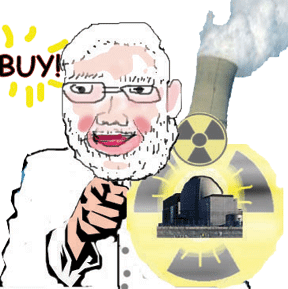
 India’s cabinet approved plans on Wednesday to build 10 nuclear reactors with a combined capacity of 7,000 megawatts (MW), more than the country’s entire current capacity, to try fast-track its domestic nuclear power program.
The decision by Prime Minister Narendra Modi’s government marks the first strategic response to the near collapse of Westinghouse, the U.S. reactor maker that had been in talks to build six of its AP1000 reactors in India.
Westinghouse, owned by Japan’s Toshiba, filed for Chapter 11 bankruptcy in March after revealing billions of dollars in cost overruns at its U.S. projects, raising doubts about whether it can complete the India deal.
India has installed nuclear capacity of 6,780 MW from 22 plants and plans to add another 6,700 MW by 2021-22 through projects currently under construction. The 10 additional reactors would be the latest design of India’s Pressurised Heavy Water Reactor.
“This project will bring about substantial economies of scale and maximize cost and time efficiencies by adopting fleet mode for execution,” the government said in a statement……..http://www.reuters.com/article/us-india-nuclear-idUSKCN18D21X
May 19, 2017
Posted by Christina Macpherson |
India, politics |
Leave a comment

TOKYO: A Japanese utility Wednesday switched on a nuclear reactor, the latest to come back in service despite deep public opposition in the aftermath of the Fukushima crisis.
Japan shut down all of its dozens of reactors after a powerful earthquake in March 2011 spawned a huge tsunami that led to meltdowns at the Fukushima nuclear plant, causing the world’s worst such accident since Chernobyl in 1986.
But only a handful of reactors have come back online due to public opposition and as legal cases work their way through the courts.
On Wednesday, Kansai Electric Power (KEPCO) restarted the No 4 reactor at the Takahama nuclear plant after a court in March cleared the move.
The latest restart at the plant in Fukui prefecture, some 350 kilometers (215 miles) west of Tokyo, came after court battles that lasted more than a year during which a district court near Fukui ordered KEPCO to suspend operations.
The Fukui government, where the nuclear industry is a major employer, approved the reactor’s restart but concerned residents in neighboring Shiga prefecture asked their local court to stop the move.
The region’s appeals court in Osaka finally ruled in March that KEPCO could restart two of the four reactors at Takahama.
Shigeki Iwane, KEPCO president, announced the restart in a statement.
“We will… carefully continue our work with discipline and regard safety as the priority,” he said.
Shiga governor Taizo Mikazuki voiced frustration and urged the national government to reduce its reliance on nuclear power, saying his prefecture would be greatly impacted in the event of an accident.
He said the environment was not right for a restart.
“Local residents hold profound anxiety about nuclear plants,” he said in a written statement.
“The government should change the current energy policy that relies on nuclear plants at the earliest possible time,” he said.
Prime Minister Shinzo Abe has steadily promoted nuclear energy, calling it essential to powering the world’s third-largest economy.
https://www.dailystar.com.lb/News/World/2017/May-17/406167-japan-restarts-another-reactor.ashx
May 17, 2017
Posted by dunrenard |
Japan | Restart, Takahama N°4 |
Leave a comment

The Hamaoka Nuclear Power Plant, idled for five years and now guarded by a 22-meter-tall tsunami wall, is seen on May 12, 2016. Omaezaki, Shizuoka Prefecture, is seen in the background.
Seven heads of 11 Shizuoka Prefecture municipalities located within a 30-kilometer radius of Chubu Electric Power Co.’s Hamaoka Nuclear Power Plant said in a recent Mainichi Shimbun survey that they believe restarting the currently idled nuclear reactors requires agreement from not only the host prefecture and host city but also other municipalities around the plant.
As May 14 marks the sixth year after the Hamaoka nuclear plant suspended operations upon a request from the then government of Prime Minister Naoto Kan, the Mainichi Shimbun surveyed the Shizuoka Prefecture governor and mayors of 11 prefectural municipalities in the “Urgent Protective Action Planning Zone” (UPZ) around the plant. UPZs cover areas within a radius of 30 kilometers of a nuclear plant.
While no legal framework has been set up regarding the scope of municipal consensus necessary to restart operations at a nuclear station, requests have been growing for a broader agreement among municipalities — not just the host prefecture and host municipality — in the wake of the Fukushima nuclear disaster.
Shizuoka Gov. Heita Kawakatsu, who is running for re-election in the gubernatorial race scheduled for June, has argued for the need to hold a referendum over the restart of the Hamaoka plant and has expressed a positive view of involving the 11 mayors in decisions regarding the matter. Consequently, the issue could become a key point in the upcoming gubernatorial election.
The Mainichi asked Gov. Kawakatsu and 11 municipal mayors in a multiple-choice form about the scope of local consensus over the Hamaoka plant restart. Five mayors said agreement from all 11 municipalities in the UPZ was necessary, one favored gaining consensus from four municipalities located within a 10-kilometer radius of the plant and another mayor wanted agreement from all municipalities in Shizuoka Prefecture. The mayor of Omaezaki, the host city of the Hamaoka plant, said restarting the idled nuclear plant only required the city’s agreement.
Shigeki Nishihara, the mayor of Makinohara, neighboring Omaezaki, said consensus from municipalities in the UPZ was necessary. He commented that local governments (in that area) “have a responsibility to secure their residents’ safety.” Meanwhile, Yasuo Ota, the mayor of the town of Mori, who picked “agreement from all municipalities in Shizuoka Prefecture” to restart the Hamaoka plant, told the Mainichi, “It is necessary to hear broad opinions when it comes to gaining consensus over nuclear power as a national energy policy.”
While the remaining four mayors checked “other” in the survey, most of them expressed their view of involving the national government in deciding the scope of local consensus.
Gov. Kawakatsu stressed that it is not an appropriate time to make a decision over the scope of local consensus and repeated that a referendum over the issue of the Hamaoka plant is necessary from the standpoint of popular sovereignty.
No local government heads surveyed were actually in favor of restarting the Hamaoka nuclear plant, even under right conditions such as with approved safety measures. Three city mayors said they were against restarting the plant. Seven local government chiefs chose “other” in the question, while the remaining two said they “cannot judge at the moment.”
The Nuclear Regulation Authority’s screening process of the Hamaoka nuclear plant has been prolonged as the No. 3 and No. 4 reactors being screened are the same “boiling-water type” reactors as the ones at the devastated Fukushima No. 1 Nuclear Power Plant. Furthermore, the estimated maximum ground motion at the Hamaoka nuclear station is likely to be raised because it is located directly above the hypocenter of a potential Nankai Trough megaquake.
https://mainichi.jp/english/articles/20170513/p2a/00m/0na/013000c
May 17, 2017
Posted by dunrenard |
Japan | Consensus, Hamaoka NPP, Restart |
Leave a comment

Tokyo Electric and Power Company, owner of the Fukushima Daiichi generating station that suffered a triple-reactor meltdown after the March 2011 Great East Japan Earthquake, said Thursday that is was seeking partners to help re-establish itself in the nuclear power business.
The partnership would focus on building two light-water nuclear reactors at the Higashidori nuclear power station in the Aomori Prefecture, the Japan Times reported.
Tepco, while facing massive expenses on Fukushima Daiichi clean up and decommissioning, is hoping to increase revenues through partnerships in both electricity generation and power grid operations, the Times said.
Tepco is currently supported by the Nuclear Damage Compensation and Decommissioning Facilitation Corp., a government-sponsored organization that is a significant shareholder in Tepco. Tepco and the Nuclear Damage Compensation and Decommissioning Facilitation Corp. together submitted Tepco’s plan for partnerships for a state review.
The Higashidori plant is already the site of one reactor, owned by the Tohuku Electric Power Company. Tepco has plans to build two more reactors at the same site.
http://nuclearstreet.com/nuclear_power_industry_news/b/nuclear_power_news/archive/2017/05/11/tepco-looks-beyond-fukushima-daiichi_2c00_-seeks-build-partners-051102
May 17, 2017
Posted by dunrenard |
Japan | Partners, Tepco |
Leave a comment

 New South Korean President Seen Hindering Nuclear Ambitions, Bloomberg by Stephen Stapczynski
May 16, 2017,
“… South Korea’s Moon Jae-in promised during his successful presidential campaign to scrap or suspend new atomic plants.
Now that Moon is president, that anti-nuclear stance is seen as a threat to South Korea’s ambitions to become a bigger exporter of nuclear equipment and technology — a market valued at as much as $740 billion over the next 10 years.
“If the new government withdraws its support for nuclear development in South Korea, this could send a negative signal to foreign countries looking to purchase reactors,” Kerry-Anne Shanks, a Singapore-based analyst at Wood Mackenzie Ltd., said by email. “An anti-nuclear stance could challenge Korea’s ambitions to export nuclear technology to other countries.”………
Besides the curbs on new nuclear facilities, Moon also campaigned to cancel any lifetime extensions for existing nuclear plants and to develop a roadmap to eventually rid the nation of atomic power altogether. In nuclear’s place, Moon would place greater emphasis on natural gas and renewables. On Monday, the new president ordered the shutdown for the month of June of 10 coal-fired power plants that have been operating for more than 30 years to cut pollution…..
“Exporting nuclear power plants requires substantial up-front financial support from the vendor and its home government,” said Rod Adams, publisher of Atomic Insights, an industry news website. “There is already some evidence suggesting that the anti-nuclear stance of President Moon Jae-in will make it more difficult for South Korea to export nuclear reactors.”…..
May 17, 2017
Posted by Christina Macpherson |
business and costs, politics international, South Korea |
Leave a comment
 South Korean Catholics rally against use of nuclear power, http://www.catholicnewsagency.com/news/south-korean-catholics-rally-against-use-of-nuclear-power-11670/ Seoul, South Korea, May 15, 2017 / 08:02 pm (CNA/EWTN News).- South Korean Catholics are opposing both the country’s reliance on nuclear power and the U.S. missile defense system recently established to pressure the North out of future weapon tests.
A major leader of the anti-nuclear movement, Father Moon Paul Kyu-Hyn, said “getting rid of nuclear power is the only way to survive, to save ourselves, and save the world,” according to Public Radio International.
A missile defense system has caused tensions between the U.S. and China as well as between China and South Korea. The country’s new president, Moon Jae-in, has emphasized his goal to solve the issues in the Korean Peninsula.
Father Moon expressed his disappointed in the new Terminal High Altitude Area Defense or THAAD, which became operational on May 2 in the Korean Peninsula. An agreement to install the system was established between the United States and South Korea’s former president, recently incarcerated for political corruption.
“THAAD is a weapon of war. You can’t be for peace if you’re preparing for war,” said Father Moon, an activist who spent three years in jail for illegally crossing over into North Korea in 1989.
He is now leading the charge on the anti-nuclear demonstrations participated by the clergy and lay people, who are opposed the expansion of nuclear power in all of Korea and the rest of the world. The group recently gathered in downtown Seoul to collect a million signatures for support against nuclear energy.
Nearly a third of the country’s electrical consumption relies on nuclear power from over 20 nuclear reactors. Moon Jae-in, who was confirmed president this week, promised to halt expansion of nuclear power and focus on clean energy during a campaign speech in April.
The push to remove nuclear power has increased in South Korea since three plants in Fukushima had a meltdown in 2011 caused by a Tsunami along the shores of Japan. The meltdown forced over 100,000 people to be evacuated from their homes, and the government is still cautious to allow everyone to return due to fears of radiation poison.
In an interview with Public Radio International, Father Cho Hyun-chul, a theology professor at Sogang University in Seoul, said if there is a similar accident revolving South Korea’s power plants then there would be “no room for us to live here. There is no more safe land.”
He continued to say that the destruction nuclear power can cause is “directly against God’s intention,” and the movement is stressing the need to care for the environment – a need heavily emphasized by Pope Francis especially in his encyclical Laudato Si.
The Pope recognized the “tremendous power” nuclear energy has gifted to humanity, but he also spoke against its dangers to the environment and the risk of being used improperly. He said a global consensus to focus on clean and renewable energy is essential for sustaining the earth.
“Such a consensus could lead, for example, to planning a sustainable and diversified agriculture, developing renewable and less polluting forms of energy,” Pope Francis wrote in Laudato Si.
According to Reuters, President Moon promised to ease away from nuclear energy in a campaign speech in April. The head for the president’s team on energy policy said South Korea “should move away from coal and nuclear power, and shift to clean or renewable energy-based platforms,” and that he would stop the plans to construct two new reactors in the south of the country.
May 17, 2017
Posted by Christina Macpherson |
opposition to nuclear, Religion and ethics, South Korea |
1 Comment
 The Terrible Things Happening To Children In India’s ‘Nuclear Graveyard’ Will Scar You For Life [PHOTOGRAPHS] scoopwhoop.com, by Era Tangar, 16 May 17 “…….Jadugoda, a town of 19,500 people about 1,370km from New Delhi, is a four-hour drive from Ranchi, Jharkhand. In 1967, this tribal town became the site for India’s first nuclear mine. It is often called India’s best kept secret. The government-owned Uranium Corporation of India (UCIL) mines for uranium in the region. The small township is home to the world’s finest uranium ore, magnesium diuranate,
Locals were initially ecstatic because this would increase employment opportunities. Over the past 40 years, the UCIL has conducted indiscriminate and unchecked uranium mining. This has destroyed local environment and the health of the tribal population. The toxic emission has caused facial tumours, mascular dystrophy, deformed skeletons, lung cancer and curved spines, to name a few.
The crimes of the UCIL have been under-reported in the media. There are articles and documentaries portraying the state of the town and the areas nearby but not much has been done as a follow up while people of Jadugoda continue to suffer for 50 years now. India’s nuclear dream has costed the well-being of Jharkhand’s tribals and made them suffer in silence. …….. Share the word about Jadugoda till it reaches someone who can help these innocent souls.
These photos were featured at the 3rd International Uranium Film Festival, Rio De Janeiro, Brazil, World Uranium Symposium in Quebec City, Canada 2015, World Nuclear Victims Forum, 2015 in Hiroshima, Japan and at UCCJ International Youth Conference in Kyoto, Japan 2017. https://www.scoopwhoop.com/the-dark-truth-about-nuclear-graveyard-jadugoda/#T.t2a4psvnq
May 17, 2017
Posted by Christina Macpherson |
environment, health, India, secrets,lies and civil liberties |
Leave a comment
the cleanup extends to only 20 meters around each house, and three-quarters of the village is forested mountains. In windy weather, radioactive elements are blown back onto the fields and homes.
The government is forcing people to go back, some argued, employing a form of economic blackmail, or worse, kimin seisaku — abandoning them to their fate.
The evacuation orders for most of the village of Iitate have been lifted. But where are the people?, Japan Times, BY DAVID MCNEILL AND CHIE MATSUMOTO, 14 May 17
“…….A cluster of 20 small hamlets spread over 230 square kilometers, Iitate was undone by a quirk of the weather in the days that followed the nuclear accident in March 2011. Wind carried radioactive particles from the Fukushima No. 1 nuclear power plant, which is located about 45 kilometers away, that fell in rain and snow on the night of March 15, 2011. After more than a month of indecision, during which the villagers lived with some of the highest radiation recorded in the disaster (the reading outside the village office on the evening of March 15 was a startling 44.7 microsieverts per hour), the government ordered them to leave.
Now, the government says it is safe to go back. With great fanfare, all but the still heavily contaminated south of Iitate, Nagadoro, was reopened on March 31.
The reopening fulfills a pledge made by Mayor Norio Kanno: Iitate was the first local authority in Fukushima Prefecture to set a date for ending evacuation in 2012, when the mayor promised to reboot the village in five years. The village has a new sports ground, convenience store and udon restaurant. A clinic sees patients twice a week. All that’s missing is people.
Waiting to meet Kanno in the government offices of Iitate, the eye falls on a book displayed in the reception: “The Most Beautiful Villages in Japan.” Listed at No. 12 is the beloved rolling patchwork of forests, hills and fields the mayor has governed for more than two decades — population 6,300, famous for its neat terraces of rice and vegetables, its industrious organic farmers, its wild mushrooms and the black wagyu cow that has taken the name of the area.
The description in the book is mocked by reality outside. The fields are mostly bald, shorn of vegetation in a Promethean attempt to decontaminate it of the radiation that fell six years ago. There is not a cow or a farmer in sight. Tractors sit idle in the fields. The local schools are empty. As for the population, the only part of the village that looks busy is the home for the elderly across the road from Kanno’s office…….
There has been no official talk of abandoning it. Indeed, any suggestion otherwise could be controversial: When industry minister Yoshio Hachiro called the abandoned communities “towns of death” in September 2011, the subsequent outrage forced him to quit a week later.
Instead, the area was divided into three zones with awkward euphemisms to suggest just the opposite: Communities with annual radiation measuring 20 millisieverts or less (the typical worldwide limit for workers in nuclear plants) are “being prepared for lifting of evacuation order,” districts of 20-50 millisieverts per year are “no-residence zones” and the most heavily contaminated areas of 50 millisieverts or more per year, such as Nagadoro, are “difficult-to-return.”…..
the cleanup extends to only 20 meters around each house, and three-quarters of the village is forested mountains. In windy weather, radioactive elements are blown back onto the fields and homes.
“All that money, and for what?” asks Nobuyoshi Itoh, a farmer and critic of the mayor. “Would you bring children here and let them roam in the fields and forests?”…..
Though nobody knows the true figure, the local talk is that perhaps half of the villagers have permanently left. Surveys suggest fewer than 30 percent want to return, and even less in the case of Nagadoro.
Yoshitomo Shigihara, head of the Nagadoro hamlet, says many families made their decision some time ago. His grandchildren, he says, should not have to live in such a place.
“It’s our job to protect them,” Shigihara says. …….
The government is forcing people to go back, some argued, employing a form of economic blackmail, or worse, kimin seisaku — abandoning them to their fate.
Itoh is angry at the resettlement. For him, politics drives the haste to put the disaster behind.
“It’s inhuman to make people go back to this,” he says. Like the physical damage of radiation, he says, the psychological damage is also invisible: “A lot of people are suffering in silence.”
Itoh believes the government wants to show that the problems of nuclear power can be overcome so it can switch the nation’s idling nuclear reactors back on. Just four are in operation while the fate of 42 others remains in political and legal limbo. Public opinion remains opposed to their restart.
Many people began with high hopes in Iitate but have gradually grown distrustful of the village government, says Kenichi Hasegawa, a farmer who wrote a book titled “Genpatsu ni Furusato o Ubawarete” (“Fukushima’s Stolen Lives”) in 2012. Right from the start, he says, the mayor desperately tried to hide the shocking radiation outside his office……. http://www.japantimes.co.jp/news/2017/05/13/national/social-issues/fukushima-land-return/#.WRkB8UWGPGh
May 15, 2017
Posted by Christina Macpherson |
Fukushima continuing |
Leave a comment

 Russia’s Putin says ready to help resolve North Korea nuclear issue – South Korea, http://in.reuters.com/article/southkorea-russia-idINKBN1881MQ By Christine Kim | SEOUL, 12 May 17
Russia’s President Vladimir Putin told his newly elected South Korean counterpart, Moon Jae-in, in a phone call on Friday that he is ready to play a “constructive role” in resolving North Korea’s nuclear threat, the South’s presidential office said.
Putin made the comment after Moon said the foremost task to boost cooperation between the two countries was to strengthen strategic bilateral communication to find a solution to curb North Korea’s nuclear threat, the Blue House said in a statement.
“We hope for Russia to play a constructive role in order for North Korea to stop with its nuclear provocations and go the way of denuclearisation,” Moon was citing as saying to Putin in the 20-minute conversation.
“I, too, aim to find a way to begin talks quickly between North and South Korea as well as the six-party talks,” Moon said, referring to talks aimed at denuclearising North Korea involving the United States, China, Japan, Russia and the two Koreas.
The talks collapsed in 2008 after North Korea launched a rocket.
Tension has been high for months on the Korean peninsula over North Korea’s nuclear and missile development and fears it will conduct a sixth nuclear test or test another ballistic missile in defiance of U.N. Security Council resolutions.
Moon is a liberal who advocates a more conciliatory approach to North Korea compared with his conservative predecessor.Moon also expressed hopes the two countries would be able to cooperate in developing East Asia, including extending a natural gas pipeline from Siberia to South Korea, the Blue House said. Putin said he was ready to help in all of the matters they discussed and the two leaders invited each other for state visits, the Blue House added.
Moon said he would send a special envoy to Russia soon and Putin said he would welcome the envoy.The two leaders said they looked forward to meeting at the Group of 20 summit meeting in Germany in July.
Earlier in the day, Moon spoke with British Prime Minister Theresa May and German Chancellor Angela Merkel, the Blue House said. He asked them to help in curbing North Korea’s nuclear programme and both promised to.
(Reporting by Christine Kim; Additional reporting by Se Young Lee; Editing by Robert Birsel)
May 13, 2017
Posted by Christina Macpherson |
politics international, Russia, South Korea |
Leave a comment
Chinese expert says North Korea could conduct nuclear test in May, Tass, May 10, 2017 In April, North Korea carried out several missile tests the latest of which took place on April 28, only a few hours after the UN SC held a meeting to discuss the situation on the Korean Peninsula. SHANGHAI, May 10. /TASS/. There is a strong possibility that North Korea will conduct a new nuclear test in May, Executive Director of the Institute of International Relations at Shanghai Academy of Social Sciences Liu Ming said in an interview with TASS.
“In April, North Korea launched several missiles but they all failed,” he said. “There was no nuclear test in April but it does not mean that North Korea will not conduct one in May. I believe there is a strong possibility that the country will hold the next nuclear test this month,” the Chinese expert noted saying that these plans were the main reason for the current tensions on the Korean Peninsula.
“According to my estimates, tensions on the Korean Peninsula will remain in May and June for Pyongyang is highly likely to conduct another nuclear test during this period,” Professor Liu Ming pointed out. He added that “North Korea is playing for time choosing the right moment, because all the preparations for the sixth nuclear test have been completed.”
The Chinese expert also expressed his opinion on the possible consequences of a new nuclear test. “I think, after the sixth nuclear test, the window of possibilities to solve the North Korea issue will almost completely close. Only a few chances will remain to solve the issue using diplomatic methods,” Professor Liu Ming said. He noted that “if Pyongyang conducts another nuclear test, then China will have to reduce its economic aid to North Korea.”
…….“The US and South Korea are not ready to discuss arms controls within the framework of six-nation negotiations, unless their aim is to rid the Korean peninsula of nuclear weapons. And this is the barrier that now impedes the revival of the talks,” the expert stated.
He said one of the main obstacles was because of the US and the DPRK. “Pyongyang is firmly committed to continuing its military nuclear program. The US comes out against it and intends to take concrete measures. The Trump administration is in a serious mood for concrete action. That is why the main contradictions at the moment are those between the US and the DPRK,” Liu Ming said.
“Everything now is revolving around the nuclear issue and the contradictions existing between the US and the DPRK. Restarting the six-party negotiations makes no particular sense under the current conditions,” he resumed. “First of all, direct negotiations are needed between the US and the DPRK,” the Chinese expert noted, adding that only progress at such talks could make the restoration of the six-nation format talks worthwhile. http://tass.com/world/945236
May 12, 2017
Posted by Christina Macpherson |
North Korea, politics international, weapons and war |
Leave a comment
Xi, new South Korean leader talk nuclear, THE AUSTRALIAN, 11 May 17 Chinese President Xi Jinping and new South Korean President Moon Jae-in have discussed nuclear tensions, with the latter addressing the raft of problems posed by the North’s defiance.
Xi told Moon China had always upheld the denuclearisation of the Korean peninsula and that the nuclear issue should be resolved through talks, which were in everyone’s interests, according to a state television report.
China was willing to keep working hard with all parties, including South Korea, for the peace and prosperity of the Korean peninsula, he said.
Despite its anger at North Korea’s repeated nuclear and missile tests, China remains the isolated state’s most important economic and diplomatic backer even with Beijing signing up for tough UN sanctions against Pyongyang.
Beijing also has its own issues with Seoul. China has vigorously opposed the deployment of a US anti-missile system in South Korea, saying it threatens Chinese security and will do nothing to resolve tensions with North Korea……..
Moon said in his first speech as president on Wednesday he would immediately begin efforts to defuse security fears on the Korean peninsula and would negotiate with Washington and Beijing to ease tensions over the deployment of the Terminal High Altitude Area Defense anti-missile system in the South…..http://www.theaustralian.com.au/news/latest-news/xi-new-south-korean-leader-talk-nuclear/news-story/3ba4f6e5585d7cf577d29f2505a1e332
May 12, 2017
Posted by Christina Macpherson |
China, politics international, South Korea |
Leave a comment

 North Korean Diplomat: Pyongyang ‘Not Afraid’ to Continue Nuclear Tests, Sputnik News, 11.05.2017 North Korea’s ambassador to the UK has said his country is “not afraid” to continue its missile and nuclear weapons activity, and that Pyongyang intends to conduct its sixth nuclear test as soon as the leadership deems it necessary.
Choe Il said that United Nations sanctions, international calls for denuclearization and the US’ aggressive posturing won’t deter the North from persisting with its nuclear and ballistic missile program, telling Sky News, “In regards to the sixth nuclear test, I do not know the scheduled time for it, as I am here in the UK, not in my home country … However, I can say that the nuclear test will be conducted at the place and time as decided by our supreme leader, Kim Jong-un.”
In his first televised interview as ambassador, Choe said that the Democratic People’s Republic of Korea (DPRK) was unmoved by US President Trump’s threats of military action, stating that, “If we were afraid of it, we probably would not have started conducting nuclear tests or launching ballistic missiles.”
“We are developing our nuclear strength to respond to that kind of attack by the US. If the US attacks us, our military and people are fully ready to respond to any kind of attack.” …….https://sputniknews.com/asia/201705101053479209-dprk-not-afraid-continue-tests/
May 12, 2017
Posted by Christina Macpherson |
North Korea, weapons and war |
Leave a comment

South Korean Catholics take the lead in protesting against nuclear power, PRI, May 11, 2017, By Matthew Bell Standing up to his own government is nothing new for Moon Kyu-hyun. The 70-year-old Jesuit priest from South Korea made international news back in 1989, when he crossed the border into North Korea illegally.
The Catholic priest’s unsanctioned trip was a political act of defiance against South Korea’s strict National Security Law, which prohibited people in the South from almost any contact with North Korea.
The Rev. Moon was promptly arrested when he returned to the South. And he ended up spending three and a half years in prison.
“Peace and hope is what life is all about,” Moon says, reflecting on lessons learned during his time in jail.
In that same spirit, Moon — whose Christian name is Paul — is part of a group of Catholic clergy taking the lead in a growing anti-nuclear movement in South Korea. Moon says he is opposed to nuclear weapons, including the North Korean nuclear program that’s been a big part of rising tensions in northeast Asia. But he’s also against recent US actions on the Korean peninsula.
“THAAD is a weapon of war. You can’t be for peace if you’re preparing for war,” Moon says, referring to the anti-missile system recently deployed by the US military in South Korea.
Beyond the nuclear security issue though, Moon and other Catholic leaders are pressuring the South Korean government to rethink the country’s dependence on nuclear power. That is no small order, as this is a country that relies on more than two dozen nuclear power plants for about a third of its electricity.
“Getting rid of nuclear power is the only way to survive, to save ourselves, and save the world,” Moon says during a recent anti-nuclear demonstration in downtown Seoul, where Catholic priests and nuns announced an effort to collect a million signatures in support of their campaign…….
“It’s directly against God’s intention,” Cho says. All Christians, he adds, “believe that God created the universe, and there is the divine order.” Cho says the threat posed by nuclear energy goes against that divine order……..
Catholics here have also forged a somewhat surprising alliance. Japan and Korea have a long and troubled history, to put it mildly. But every year since 2012, Kim Hyun-joo has been part of a group of Korean Catholics who meet up with Japanese Catholics to work together on anti-nuclear protest activities. Kim is an anti-nuclear activist with the Society of Jesus in Seoul……..
Catholic leaders in Korea are following the example of Pope Francis. They say the environment is now a top priority, although they acknowledge the campaign against nuclear power is a going to be a long, uphill struggle……..
the best news for Catholic anti-nuclear activists came when Moon, during the campaign, pledged to cut back drastically on the government’s plans to expand the nuclear power industry. https://www.pri.org/stories/2017-05-11/south-korean-catholics-take-lead-protesting-against-nuclear-power
May 12, 2017
Posted by Christina Macpherson |
opposition to nuclear, Religion and ethics, South Korea |
Leave a comment
 China, South Korea seek to steer North from nuclear path, DW 11 May 17 The presidents of China and South Korea have agreed they want North Korea to move away from its agenda of atomic antagonism. A US missile-defense system deployed on the peninsula was also a topic of conversation. In his first talk with Chinese President Xi Jinping since being sworn in as South Korea’s president, South Korea’s Moon Jae-in sought common ground with China on North Korea’s nuclear program.
“The resolution of the North Korean nuclear issue must be comprehensive and sequential, with pressure and sanctions used in parallel with negotiations,” Moon’s spokesman, Yoon Young-chan, said the president had told Xi. “Sanctions against North Korea are also a means to bring the North to the negotiating table.”
The presidents also discussed the contentious Terminal High Altitude Area Defense (THAAD) anti-missile system the United States installed in South Korea to Beijing’s chagrin…….http://www.dw.com/en/china-south-korea-seek-to-steer-north-from-nuclear-path/a-38794619
May 12, 2017
Posted by Christina Macpherson |
China, politics international, South Korea |
Leave a comment