Deutsche Welle 12th June 2017, Japan’s nuclear energy sector is riven by poor management, is overly
bureaucratic and staffed by people who no longer have any pride in their
jobs. So accidents are inevitable, say critics.
The Japan Atomic Energy Agency (JAEA) issued a statement on Saturday, June 10, claiming that none
of the five workers at a nuclear research facility that it had previously
reported had suffered serious internal radiation exposure after an accident
on June 7 have plutonium in their lungs.
The agency’s report contradicts the initial claim that one of the workers had suffered internal exposure to
22,000 Becquerels of plutonium after a canister that had been in a storage
unit at the Oarai Research and Development Center for 26 years was opened
and bags holding the material burst.
Japan’s Asahi Shimbun newspaper has described the JAEA as “an organization that has been accused of gross
bungling in the past” and said the confusion over the workers’ exposure was
caused by high levels of plutonium on the men’s skin, not in their lungs.
“It’s just another example of poor management in these organizations,” said
Aileen Mioko Smith, an anti-nuclear campaigner with Kyoto-based Green
Action Japan, an NGO.
“I think these organizations have become overly
bureaucratic, there is no longer any pride among the workforce in what they
are doing – either at these sites or in management – and far too much work
is subcontracted out because that is the easiest way for them to save
money,” she told DW. http://www.dw.com/en/japans-nuclear-mishap-underlines-industry-malaise/a-39209569
June 14, 2017
Posted by Christina Macpherson |
business and costs, Japan |
Leave a comment

The leader of the Diet investigation into the 2011 Fukushima nuclear disaster blasted the Abe administration’s policies on restarting reactors, noting that proper evacuation plans are not in place.
“What are you going to do if a tsunami comes?” Kiyoshi Kurokawa, former chairman of the Fukushima Nuclear Accident Independent Investigation Commission, said at a June 12 meeting of the Lower House ad hoc committee for research of nuclear power issues. “How can you go (there) to rescue people if cars cannot move forward on roads?”
Kurokawa was referring to the restarts of the No. 4 and No. 3 reactors of the Takahama nuclear power plant in Fukui Prefecture in May and June.
The reactors cleared the Nuclear Regulation Authority’s safety standards that were established after the accident unfolded at the Fukushima No. 1 nuclear power plant in March 2011.
Prime Minister Shinzo Abe has said these standards are the strictest in the world.
But Kurokawa said, “I cannot accept such rhetoric.”
Kurokawa, also a professor emeritus of medical science at the National Graduate Institute for Policy Studies, was selected as chairman of a third-party advisory body established by the ad hoc committee in May.
He and other experts of the advisory body responded to questions at the meeting of the ad hoc committee on June 12.
Kurokawa also raised questions about the rules for personnel at the NRA, the country’s nuclear watchdog.
In January, Masaya Yasui, an official of the Ministry of the Economy, Trade and Industry, assumed the post of secretary-general of the NRA’s secretariat
Kurokawa said he was concerned that an official of the economy ministry, which has promoted nuclear power generation, is now at the top of the secretariat.
Previously, a “no-return rule” was in place that prohibited employees of the NRA secretariat from returning to the economy ministry.
However, the Abe administration changed the rule to allow them to return to the ministry at bureaus not directly related to nuclear power generation.
Regarding the change, Kurokawa said, “The most important thing is to protect the no-return rule.”
http://www.asahi.com/ajw/articles/AJ201706130017.html
June 13, 2017
Posted by dunrenard |
Japan | Reactors Restart |
Leave a comment
 The government of Shinzo Abe has been vocal about ‘unfair reporting’.
Japan accused of eroding press freedom by UN special rapporteur
Investigation prompted by concern over government pressure on country’s media over issues such as Fukushima and WW2
The UN’s special rapporteur on freedom of expression has accused Japan of eroding media freedoms and stifling public debate of issues such as the Fukushima nuclear meltdown and the country’s actions during the second world war.
In a report submitted to the UN human rights council, David Kaye said he had identified “significant worrying signals” about Japan’s record on freedom of expression.
His investigation – the first into freedom of the press in Japan – was prompted by concern over mounting government pressure on the country’s media.
Critics have cited the domestic media’s delay in reporting that the March 2011 accident at Fukushima had caused a nuclear meltdown – a decision believed to reflect official attempts to play down the severity of the disaster.
In 2014, the Asahi Shimbun, under pressure from the administration of the prime minister, Shinzo Abe, retracted an article claiming 650 workers had fled the Fukushima Daiichi plant soon after the disaster, defying an order by its then manager, Masao Yoshida, to stay and make a last-ditch effort to regain control of the reactors.
The paper later admitted its account, based on the newspaper’s interpretation of leaked testimony by Yoshida, was mistaken. Significantly, however, the report’s retraction led to the breakup of an Asahi investigative team that had produced several scoops critical of the government’s handling of the crisis.
While Kaye did not refer to specific reports on the Fukushima meltdown, he did voice concern over the removal from school textbooks of references to Japan’s wartime use of sex slaves.
Kaye noted the gradual disappearance of references to “comfort women” – tens of thousands of women, mostly from the Korean peninsula, who were forced to work in Japanese military brothels before and during the war.
In 1997, all seven history textbooks approved for use in junior high schools addressed wartime sexual slavery, yet none referred to the issue between 2012-15, and only one mentioned it last year.
Kaye said the lack of public debate over Japan’s wartime role, restrictions on access to information, and government pressure that has led the media to practise self-censorship “require attention lest they undermine Japan’s democratic foundations”.
Japan responded angrily to claims that media freedoms were at risk under Abe.
Its ambassador to the UN, Junichi Ihara, accused Kaye of peddling “inaccuracies” about the government’s commitment to a free press. In a statement to the UN human rights council on Monday, he said: “It is regrettable that some parts of [Kaye’s] report are written without accurate understanding of the government’s explanation and its positions.”
Ihara rebutted Kaye’s claim that a law permitting the government to suspend broadcast licences for TV and radio networks for “unfair reporting” was being used to pressure senior editors into underplaying or ignoring sensitive political stories.
Last year, the internal affairs minister, Sanae Takaichi, prompted an outcry after saying that broadcasters that repeatedly failed to show fairness in their political coverage, despite official warnings, could be taken off the air.
Soon after, three veteran news anchors – all with a reputation for grilling government politicians – left their jobs almost simultaneously, sparking allegations that they had been pressured to quit after Abe and his colleagues complained about them during private dinners with media executives.
Ihara noted that no minister had ever suspended a broadcasting licence, adding that the law “does not give rise to any pressure on the media”.
Kaye’s report was similarly critical of the 2014 state secrets law, under which journalists can be imprisoned for up to five years for reporting classified information passed on by whistleblowers. He said the law was “overly broad” and risked being applied arbitrarily, adding that the government “should not be in the position of determining what is fair”.
Ihara countered: “Information designed as specially designated secrets is limited under strict conditions,” adding that “information-gathering activities performed by journalists are not punishable under the act”.
The rift between Japan and the UN widened after Joseph Cannataci, special rapporteur on the right to privacy, said an anti-conspiracy bill being debated in parliament could “lead to undue restrictions to the rights to privacy and to freedom of expression”.
The government insists the new law is necessary for Japan to fulfil its international obligation to deter acts of terrorism. Abe denounced Cannataci’s assessment as “extremely unbalanced” and said his conduct was “hardly that of an objective expert”.
Confrontations between Japanese and UN representatives have grown more heated in recent years. In 2015, Tokyo suspended payments to Unesco after it included disputed Chinese documents about the Nanjing massacre in its World Memory List.
Yoshihiko Noda, the secretary general of Japan’s biggest opposition party, accused Abe’s government of “slamming the door” in the faces of UN special rapporteurs, according to the Mainichi Shimbun.
Earlier this year, Reporters Without Borders ranked Japan 72nd in its global press freedom index – the lowest among the G7. The country has slid down the rankings since 2010, when it was placed 11th.
https://www.theguardian.com/world/2017/jun/13/japan-accused-of-eroding-press-freedom-by-un-special-rapporteur
June 13, 2017
Posted by dunrenard |
Japan | Anti-Conspiracy Law, Censorship, Secrecy Law |
Leave a comment
 Radiation levels exceeding the state safety limit have been detected on the grounds of five schools in Kashiwa, Chiba Prefecture.
Radiation levels exceeding the government-set safety limit of 0.23 microsieverts per hour have been detected on the grounds of five schools in the city of Kashiwa, Chiba Prefecture, the prefectural board of education said Monday.
Between late April and mid-May, the board officials detected radiation levels of up to 0.72 microsieverts per hour in certain areas of the schools, including Kashiwa High School and Kashiwa Chuo High School. The areas — including soil near a school swimming pool and drainage gutters — are not frequented by students, but the board closed them off and will work to quickly decontaminate them, the officials said.
Kashiwa has been one of the areas with high radiation readings since the 2011 nuclear disaster at Tokyo Electric Power Company Holdings Inc.’s Fukushima No. 1 power plant.
According to NHK, the board of education had been checking the soil on the school premises in Kashiwa after radiation levels beyond the state limit were detected in shrubbery near the city’s public gymnasium. The board will announce the results of radiation tests at other schools in the prefecture around the end of July, NHK reported.
http://www.japantimes.co.jp/news/2017/06/13/national/science-health/radiation-levels-exceeding-state-set-safety-limit-found-grounds-five-chiba-schools/#.WUAPbjekLrc
June 13, 2017
Posted by dunrenard |
Japan | Chiba Prefecture, Fukushima Radiation, Kashiwa City, Schools |
Leave a comment
The facility handled plutonium but was unaware that a major accident could happen.

As the facts surrounding the June 6 incident where five workers were exposed to radioactive materials following an accident at a nuclear research facility in Ibaraki Prefecture continue to emerge, it has become clear that the facility’s stance concerning safety management has been simply too soft — especially considering that it handles materials used for nuclear fuel.
The accident in question happened at around 11:15 a.m. on June 6 at the Japan Atomic Energy Agency (JAEA)’s Oarai Research & Development Center in the coastal town of Oarai in Ibaraki Prefecture. Uranium oxide and plutonium oxide powder that had been stored in double-wrapped plastic bags inside a sealed stainless steel container were accidentally released across the research laboratory after the bags suddenly burst, thereby exposing all five workers nearby to the radioactive compounds. Prior to the leak, one of the workers — a man in his 50s — was opening the container for inspection.
The check was carried out at an unsealed work station referred to as the “hood.” The radioactive materials had been stored at a pressure level lower than the surrounding area, in an attempt to prevent them from leaking. However, this proved to be ineffective. The compounds flew across the room, in powder form, immediately after the bags burst open.
In addition to the hood, there is also a “glove box” inside the facility, which can be used to handle dangerous materials. However, the facility has no specific rules determining which work station should be used for which purpose, and it has become normal practice at the site for workers to handle sealed nuclear materials — such as those kept inside containers — at the hood work station.
Apparently, during the check of the stainless steel container at the Oarai facility, there was no intention of opening the plastic bags, and therefore, it was judged that, “There was no danger of being exposed to radiation.”
However, the contents of the stainless steel container had not been checked once in 26 years. Commenting on this issue, an executive from the Nuclear Regulation Authority (NRA) has criticized the JAEA, stating, “How could they even be sure that the contents were kept sealed?” Meanwhile, an executive from the JAEA has said, “It was not anticipated that the plastic bags would burst. It seems that working at the hood work station may have been inappropriate.”
In addition, it has become clear that the five workers were not wearing full-face masks at the time of the accident. Instead, they were wearing masks that only covered their noses and mouths. Also, despite the fact there was a surveillance camera in the room, no footage was recorded, and no one was video monitoring the situation at the time of the accident.
Furthermore, an official from the NRA points out that, “It seems the facility was unaware that a major accident could happen.”
https://mainichi.jp/english/articles/20170613/p2a/00m/0na/016000c
June 13, 2017
Posted by dunrenard |
Japan | Oarai Research & Development, plutonium |
Leave a comment

In January 2017, the Chiba Prefectural Board of Education was notified that radiation above the national standard level was measured at the Kashiwa city central gymnasium.
Following that report the Chiba Prefectural Board of Education conducted an investigation in Kashiwa city from late April to the middle of May 2017.
A radiation level exceeding the national standard of 0.23 microsievert per hour was detected on the premises of five schools in Kashiwa City, The radiation measured at 1 meter above ground level ranged from 0.24 to 0.72 microsievert.
At Kashiwa High School, Higashi Tsukuba High School and Middle School, Kashiwa Chuo High School, Kashiwanami High School and Kusanami Takayanagi High School, at places where usually no one enters: near a pool, at the back of a bicycle parking lot, etc..
The prefectural Board of Education decided to cordon those hot spots, to prohibit the entry and to decontaminate those places by soil removal.
They are also planning to conduct a radiation levels survey to the schools outside of Kashiwa city.
http://www3.nhk.or.jp/news/html/20170612/k10011015111000.html

Kashiwa city, 47.1km from Tokyo
June 12, 2017
Posted by dunrenard |
Japan | Chiba Prefecture, Fukushima Radiation, Hotspots, Kashiwa City |
Leave a comment
 Activity around N. Korean test site may foretell 6th nuclear test, Asahi Shimbun, By YOSHIHIRO MAKINO/ Correspondent, June 11, 2017 SEOUL–Activity has intensified in the area around a North Korean nuclear test site, indicating Pyongyang may be preparing a sixth nuclear test, which it warned last month was “imminent.”
The preparations near the Punggyeri site match those of past occasions before North Korea conducted a nuclear test.
According to sources knowledgeable about what is occurring in North Korea, scientists who oversee nuclear materials as well as evaluate the nuclear tests have gathered at the Punggyeri site.
In addition, traffic to the site has been apparently shut down at the checkpoints leading to the area in northeastern North Korea.
However, movement of vehicles and humans within the test site continues to be active.
It is unclear if that flurry of activity is a precursor to a nuclear test or simply an exercise to prepare or inspect the site.
With the international community continuing to exert strong pressure on Pyongyang, a South Korean government source said, “there is a low possibility of North Korea going ahead with a nuclear test, which could end up being an act of suicide.”
There is the possibility of even further economic sanctions, such as suspension of petroleum imports, should North Korea continue with military provocations.
According to sources knowledgeable about China-South Korea ties, similar activity around the Punggyeri site was observed in April.
China took those preparations to be a sign that North Korea was about to conduct a nuclear test. Chinese officials explained to their counterparts in the United States and South Korea that pressure was applied at that time on North Korea in the form of a temporary suspension of Air China flights between Beijing and Pyongyang.
Meanwhile, North Korea has shown little sign of being cowed by the sanctions…….http://www.asahi.com/ajw/articles/AJ201706110023.html
June 12, 2017
Posted by Christina Macpherson |
North Korea, weapons and war |
Leave a comment
 Increase in Cancer Risk for Japanese Workers Accidentally Exposed to Plutonium http://allthingsnuclear.org/elyman/cancer-risk-for-japanese-exposed-to-plutonium#.WTxxNdgMNK8.twitter, ED LYMAN, SENIOR SCIENTIST | JUNE 9, 2017,
We wish to express our sympathy for the victims of this accident.
This incident is a reminder of the extremely hazardous nature of these materials, especially when they are inhaled, and illustrates why they require such stringent procedures when they are stored and processed.
According to the earliest reports, it was estimated that one worker had inhaled 22,000 becquerels (Bq) of plutonium-239, and 220 Bq of americium-241. (One becquerel of a radioactive substance undergoes one radioactive decay per second.) The others inhaled between 2,200 and 14,000 Bq of plutonium-239 and quantities of americium-241 similar to that of the first worker.
More recent reports have stated that the amount of plutonium inhaled by the most highly exposed worker is now estimated to be 360,000 Bq, and that the 22,000 Bq measurement in the lungs was made 10 hours after the event occurred. Apparently, the plutonium that remains in the body decreases rapidly during the first hours after exposure, as a fraction of the quantity initially inhaled is expelled through respiration. But there are large uncertainties.
The mass equivalent of 360,000 Bq of Pu-239 is about 150 micrograms. It is commonly heard that plutonium is so radiotoxic that inhaling only one microgram will cause cancer with essentially one hundred percent certainty. This is not far off the mark for certain isotopes of plutonium, like Pu-238, but Pu-239 decays more slowly, so it is less toxic per gram. The actual level of harm also depends on a number of other factors. Estimating the health impacts of these exposures in the absence of more information is tricky, because those impacts depend on the exact composition of the radioactive materials, their chemical forms, and the sizes of the particles that were inhaled. Smaller particles become more deeply lodged in the lungs and are harder to clear by coughing. And more soluble compounds will dissolve more readily in the bloodstream and be transported from the lungs to other organs, resulting in exposure of more of the body to radiation. However, it is possible to make a rough estimate.
Using Department of Energy data, the inhalation of 360,000 Bq of Pu-239 would result in a whole-body radiation dose to an average adult over a 50-year period between 580 rem and nearly 4300 rem, depending on the solubility of the compounds inhaled. The material was most likely an oxide, which is relatively insoluble, corresponding to the lower bound of the estimate. But without further information on the material form, the best estimate would be around 1800 rem.
What is the health impact of such a dose? For isotopes such as plutonium-239 or americium-241, which emit relatively large, heavy charged particles known as alpha particles, there is a high likelihood that a dose of around 1000 rem will cause a fatal cancer. This is well below the radiation dose that the most highly exposed worker will receive over a 50-year period. This shows how costly a mistake can be when working with plutonium.
The workers are receiving chelation therapy to try to remove some plutonium from their bloodstream. However, the effectiveness of this therapy is limited at best, especially for insoluble forms, like oxides, that tend to be retained in the lungs.
The workers were exposed when they opened up an old storage can that held materials related to production of fuel from fast reactors. The plutonium facilities at Tokai-mura have been used to produce plutonium-uranium mixed-oxide (MOX) fuel for experimental test reactors, including the Joyo fast reactor, as well as the now-shutdown Monju fast reactor. Americium-241 was present as the result of the decay of the isotope plutonium-241.
I had the opportunity to tour some of these facilities about twenty years ago. MOX fuel fabrication at these facilities was primarily done in gloveboxes through manual means, and we were able to stand next to gloveboxes containing MOX pellets. The gloveboxes represented the only barrier between us and the plutonium they contained. In light of the incident this week, that is a sobering memory.
June 12, 2017
Posted by Christina Macpherson |
- plutonium, health, Japan, radiation, Reference |
Leave a comment

 Takahama’s problematic restart http://www.japantimes.co.jp/opinion/2016/02/10/editorials/takahamas-problematic-restart/#.WTy9t5KGPGh, FEB 10, 2016
 The No. 3 reactor of Kansai Electric Power Co.’s Takahama nuclear power plant in Fukui Prefecture, which was restarted in late January, is expected to start commercial operations in late February. Its No. 4 reactor is also set to be restarted around the same time. Although the Takahama Municipal Government and Fukui Prefecture gave their consent to the restart, there are serious concerns, including those expressed by nearby municipalities and their residents.
Following the restart of the No. 1 and No. 2 reactors at Kyushu Electric Power Co.’s Sendai nuclear power plant in Kagoshima Prefecture, Takahama unit 3 is the third reactor to come back online under the safety regulations introduced by the Nuclear Regulation Authority following the shutdown of the nation’s nuclear plants in the wake of the March 2011 disaster at Tokyo Electric Power Co.’s Fukushima No. 1 plant. But it is the first to run on mixed oxide (MOX) fuel, which contains not only uranium but also plutonium extracted from spent nuclear fuel. The No. 4 reactor at Takahama will also use MOX fuel.
Japan has accumulated 48 tons of plutonium — enough to make an estimated 6,000 nuclear bombs — as a result of the government’s nuclear fuel cycle policy, which aims to reprocess spent fuel to extract uranium and plutonium to be used again as fuel. The Takahama restart may help the government show its resolve to cut its plutonium stockpile to address U.S. concerns over nuclear proliferation. But the restart will pose a problem in the not-too-distant future. The spent fuel storage facilities for reactors 3 and 4 are expected to become filled in seven or eight years after they are reactivated. Spent uranium fuel from nuclear power plants is to be sent to a fuel reprocessing facility in Rokkasho, Aomori Prefecture, still on a trial run, but the plant cannot reprocess used MOX fuel — meaning that there will be no place to store overflowing spent fuel from the Takahama reactors. Although Kansai Electric aims to choose a site for a medium-term storage facility outside Fukui by around 2020, no prefectures seem willing to host it.
In the wake of the 2011 Fukushima disaster, local governments within 30 km of a nuclear power plant are now required to devise plans to evacuate their residents in the event of a major accident. In the case of Takahama, nearly 180,000 residents in 12 municipalities in Fukui, Kyoto and Shiga prefectures live in the 30-km zone. Part of the city of Maizuru, Kyoto Prefecture, is within 5 km of the Takahama plant. Despite this, Kansai Electric stuck to the position that to restart the reactors it only needs consent from the host town of Takahama and Fukui Prefecture, and it ignored calls from Kyoto and Shiga prefectures and many other municipalities within the 30-km zone that it should also gain their consent. The same situation happened when Kyushu Electric Power Co. pushed to restart the Sendai reactors. The power companies should address the concerns harbored by municipalities and residents that do not host plants but lie close enough to be affected by a nuclear disaster.
Despite the requirement for compiling evacuation plans, no evacuation drills with local residents have been carried out in the municipalities around Takahama and many residents have received no instructions on where they should evacuate to in the event of a severe accident. Maizuru, for example, won’t release a new evacuation plan for its residents until March. While there are plans to evacuate some Fukui residents to Hyogo, Kyoto and Tokushima prefectures, many municipalities are not ready to receive them. In addition, evacuations may not proceed as planned in extreme weather conditions such as heavy snow or when roads are congested. The Fukushima disaster also exposed the evacuation difficulties faced by inpatients at hospitals and elderly people in nursing care facilities. And as there are few access roads to the Takahama facility, the evacuation of plant workers and dispatch of emergency teams may be hindered. The Takahama facility is among 14 nuclear power plants concentrated by Wakasa Bay in Fukui Prefecture. If a major disaster hits the plants simultaneously, the area will be highly vulnerable.
In December, the Fukui District Court quashed an injunction issued by the same court in April against restarting the Takahama reactors, paving the way for Kansai Electric to put them back online. Although the ruling upheld the NRA’s new safety standards for restarting reactors as rational and endorsed the authority’s decision that the Takahama reactors met the standards, both Kansai Electric and the NRA should not forget that the ruling also stated that the NRA’s decision does not rule out the possibility of a severe accident and that high-level efforts for safety must be constantly maintained because there is no such thing as absolute safety. Since it is believed that controlling a reactor that burns MOX fuel is more difficult than one that uses uranium, Kansai Electric cannot be too cautious in operating the Takahama plant.
June 12, 2017
Posted by Christina Macpherson |
Japan, safety |
Leave a comment
 Hitachi scrambles to divest UK nuclear risks after Toshiba fiasco.
Nikkei Asian Review 9th June 2017 Hitachi will curtail its financial risk in the construction of two nuclear power plants in the U.K. by divesting itself of the local subsidiary that will build and operate them, the Japanese conglomerate announced Thursday.
The news came at an event held here to draw partners to invest in Horizon Nuclear Power, which Hitachi acquired in 2012 as a wholly owned subsidiary. If Hitachi fails to do so before construction starts in 2019, forcing it to bear practically all the financial risk of the project, it will suspend its plans for the 2 trillion yen ($18.1 billion) project.
Hitachi is proceeding cautiously with its own nuclear energy business studying Toshiba’s troubles in the U.S. with Westinghouse Electric. Hitachi now is appealing to energy companies and others to invest in Horizon so it can turn the company into an unconsolidated subsidiary and is prepared to reduce its stake to as low as zero. Operation of the power plants would be entrusted to Horizon. http://asia.nikkei.com/Business/Companies/Hitachi-scrambles-to-divest-UK-nuclear-risks-after-Toshiba-fiasco
June 12, 2017
Posted by Christina Macpherson |
business and costs, Japan, UK |
Leave a comment
World Nuclear News 9th June 2017, The permanent shutdown of unit 1 of the Kori nuclear power plant has been approved by the South Korea’s nuclear safety regulator. The unit – the country’s oldest operating reactor unit – will be taken offline on 19 June.
Kori 1 is a 576 MWe pressurized water reactor that started commercial operation in 1978. A six-month upgrading and inspection outage at Kori 1 in the second half of 2007 concluded a major refurbishment program and enabled its relicensing for a further ten years. A subsequent relicensing process could have taken Kori 1 to 2027, but Korea Hydro & Nuclear Power (KHNP) announced in August 2015 that it had withdrawn its application to extend the unit’s operating licence. In June last year, the company applied to decommission the reactor. http://www.world-nuclear-news.org/C-Final-shutdown-approaches-for-Koreas-oldest-reactor-0906175.html
June 12, 2017
Posted by Christina Macpherson |
decommission reactor, South Korea |
Leave a comment
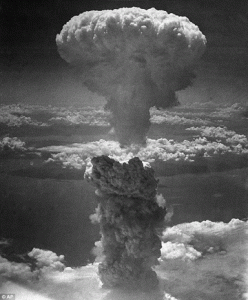 NORTH KOREA CLAIMS U.S. WAR AND NUCLEAR WEAPONS CAUSED CLIMATE CHANGE, NewsWeek, BY TOM O’CONNOR ON 6/10/17 North Korea has accused U.S. military and environmental policies of causing climate change and producing pollution around the world.
In a scathing report cited Friday by North Korea’s official Korean Central News Agency (KCNA), the state-run Institute for International Studies of the DPRK (an acronym for the country’s official title: the People’s Democratic Republic of Korea), asserted that the U.S.’s use of nuclear weapons, involvement in foreign conflicts and style of production had most harmed the environment since the Cold War. The study, attributed to researcher Kim Kum Hui and titled “The U.S. Is Chiefly to Blame for Global Environmental Pollution,” advised the U.S. to change course and safeguard the environment…..
North Korea’s report claimed that since the Cold War, the U.S. has forced other nations to adopt its model of “American-style development” under the guise of economic globalization. It said the U.S. alone accounted for 22.1 percent of the world’s carbon emissions in 2004. The figure appears to relatively coincide with conclusions established the following year by Washington-based think tank the World Research Institute. Research by the same organization says the U.S. contributed 14.4 percent in 2012, second only to China’s 25.36 percent. That same year, North Korea, an underdeveloped nation of around 25 million, was listed at .17 percent.
The report also laid into the military practices of the U.S., with which North Korea fought a war in the 1950s. The piece condemned the U.S.’s dropping of atomic bombs on the Japanese cities of Hiroshima and Nagasaki at the end of World War Two in 1945, as well as the government’s nuclear tests, which numbered 1,054 between 1945 and 1992, according to the Department of Energy…….
Despite North Korea’s traditionally dismissive nature toward international treaties, Pyongyang has at times been a vocal advocate of global cooperation on environmental issues. It signed the 2015 Paris Climate Agreement, which is geared toward reducing global greenhouse gas emissions, and deeply criticized Trump for pledging to withdraw from the non-binding, landmark treaty last week. North Korea has suffered from a number of deadly famines and floods that experts and international agencies have said indicate its vulnerability to climate change. http://www.newsweek.com/north-korea-us-war-nuclear-weapons-climate-change-623825
June 12, 2017
Posted by Christina Macpherson |
climate change, North Korea, USA |
1 Comment
GE, Westinghouse keen to take nuclear insurance from Rs 1,500-crore pool BY SHILPY SINHA, ET BUREAU JUN 12, 2017 MUMBAI:After years of stonewalling, India is poised to open up its nuclear liability cover to equipment suppliers, with GE and Westinghouse showing interest in taking insurance from the pool.
“We are seeing interest from global nuclear suppliers to buy the policy to cover their liabilities,” said Alice Vaidyan, chairman and managing director, General Insurance Corporation of India.
The move to cover suppliers has long been hanging fire. he Rs 1,500-crore nuclear insurance pool — put in place by the department of atomic energy in June 2015 and set up by GIC and other insurance companies- provides insurance coverage to operators and suppliers for any nuclear liability towards the third party under the Civil Liability of Nuclear Damage Act, ……
GIC has put in the bulk of the capacity, followed by New India Assurance, which administers the policy. New India Assurance Company issued a policy to National Power Corporation of India and covers all its plants for liability to the public in the event of accidents specified in the policy.
June 12, 2017
Posted by Christina Macpherson |
business and costs, India, USA |
Leave a comment

The operator of a nuclear research facility north of Tokyo has detected contaminants scattered in the same room in which workers were exposed to radioactive substances from a nuclear fuel container.
Five workers were inspecting the container at the facility in Ibaraki Prefecture on Tuesday. A bag inside the canister suddenly burst, expelling radioactive powder.
The operator, Japan Atomic Energy Agency, says it has detected radioactive substances from 14 sections of the room’s floor. It says measurements reached a maximum of 55 becquerels per square centimeter.
Photos taken a day after the accident show black flecks scattered on the floor. The agency says they could be plutonium and uranium.
After the accident, the 5 workers were kept in the contaminated room for 3 hours. Agency officials said they did not anticipate an incident of this kind, and needed time to set up a tent outside the room to decontaminate the workers.
The agency earlier said one of the workers had 22,000 becquerels of radioactive substances in his lungs. This level of exposure can cause major damage to health. But it now says the actual figure could be lower. Officials say the testing device may have also measured contaminants on the surface of the man’s body.
The worker has been transferred to the National Institute of Radiological Sciences. The officials say plutonium was not detected in an initial test there.
https://www3.nhk.or.jp/nhkworld/en/news/20170610_04/
June 11, 2017
Posted by dunrenard |
Japan | Exposure, Oarai Research & Development, plutonium, Workers |
Leave a comment

According to news reports, five workers were accidentally exposed to high levels of radiation at the Oarai nuclear research and development center in Tokai-mura, Japan on June 6th. The Japan Atomic Energy Agency, the operator of the facility, reported that five workers inhaled plutonium and americium that was released from a storage container that the workers had opened. The radioactive materials were contained in two plastic bags, but they had apparently ripped.
We wish to express our sympathy for the victims of this accident.
This incident is a reminder of the extremely hazardous nature of these materials, especially when they are inhaled, and illustrates why they require such stringent procedures when they are stored and processed.
According to the earliest reports, it was estimated that one worker had inhaled 22,000 becquerels (Bq) of plutonium-239, and 220 Bq of americium-241. (One becquerel of a radioactive substance undergoes one radioactive decay per second.) The others inhaled between 2,200 and 14,000 Bq of plutonium-239 and quantities of americium-241 similar to that of the first worker.
More recent reports have stated that the amount of plutonium inhaled by the most highly exposed worker is now estimated to be 360,000 Bq, and that the 22,000 Bq measurement in the lungs was made 10 hours after the event occurred. Apparently, the plutonium that remains in the body decreases rapidly during the first hours after exposure, as a fraction of the quantity initially inhaled is expelled through respiration. But there are large uncertainties.
The mass equivalent of 360,000 Bq of Pu-239 is about 150 micrograms. It is commonly heard that plutonium is so radiotoxic that inhaling only one microgram will cause cancer with essentially one hundred percent certainty. This is not far off the mark for certain isotopes of plutonium, like Pu-238, but Pu-239 decays more slowly, so it is less toxic per gram. The actual level of harm also depends on a number of other factors. Estimating the health impacts of these exposures in the absence of more information is tricky, because those impacts depend on the exact composition of the radioactive materials, their chemical forms, and the sizes of the particles that were inhaled. Smaller particles become more deeply lodged in the lungs and are harder to clear by coughing. And more soluble compounds will dissolve more readily in the bloodstream and be transported from the lungs to other organs, resulting in exposure of more of the body to radiation. However, it is possible to make a rough estimate.
Using Department of Energy data, the inhalation of 360,000 Bq of Pu-239 would result in a whole-body radiation dose to an average adult over a 50-year period between 580 rem and nearly 4300 rem, depending on the solubility of the compounds inhaled. The material was most likely an oxide, which is relatively insoluble, corresponding to the lower bound of the estimate. But without further information on the material form, the best estimate would be around 1800 rem.
What is the health impact of such a dose? For isotopes such as plutonium-239 or americium-241, which emit relatively large, heavy charged particles known as alpha particles, there is a high likelihood that a dose of around 1000 rem will cause a fatal cancer. This is well below the radiation dose that the most highly exposed worker will receive over a 50-year period. This shows how costly a mistake can be when working with plutonium.
The workers are receiving chelation therapy to try to remove some plutonium from their bloodstream. However, the effectiveness of this therapy is limited at best, especially for insoluble forms, like oxides, that tend to be retained in the lungs.
The workers were exposed when they opened up an old storage can that held materials related to production of fuel from fast reactors. The plutonium facilities at Tokai-mura have been used to produce plutonium-uranium mixed-oxide (MOX) fuel for experimental test reactors, including the Joyo fast reactor, as well as the now-shutdown Monju fast reactor. Americium-241 was present as the result of the decay of the isotope plutonium-241.
I had the opportunity to tour some of these facilities about twenty years ago. MOX fuel fabrication at these facilities was primarily done in gloveboxes through manual means, and we were able to stand next to gloveboxes containing MOX pellets. The gloveboxes represented the only barrier between us and the plutonium they contained. In light of the incident this week, that is a sobering memory.
http://allthingsnuclear.org/elyman/cancer-risk-for-japanese-exposed-to-plutonium#.WTxxfxv-nM0.facebook
June 11, 2017
Posted by dunrenard |
Japan | Exposure, Oarai Research & Development, plutonium, Workers |
Leave a comment





 nuclear-news