The escalating nuclear crisis of North Korea: time to abandon coercive diplomacy
Overcoming Nuclear Crises: North Korea and Beyond http://www.globalresearch.ca/overcoming-nuclear-crises-north-korea-and-beyond/5594878, By Richard Falk and David Krieger Global Research, June 17, 2017
Security fears for Fukushima residents returning to deserted towns
For Fukushima returnees, security a growing concern in deserted towns, Japan Times, FUKUSHIMA MINPO, 18 June 17 “….. According to town officials, only about 300 residents have come back so far.
Many of the houses in Sato’s neighborhood remain uninhabited. So when he spots a car parked in the dark, it frightens him.
“If safety and security aren’t ensured, there won’t be more people coming back,” Sato said.
Sparked by returnees’ concerns about security, many recovering municipalities have set up neighborhood watch groups, installed security cameras and taken other measures to increase safety…..
The number of police officers brought in from outside Fukushima to help patrol the no-go zone has been reduced to 192, or about 150 fewer than five years ago. The police presence is expected to decline further as decontamination progresses, raising concerns on how to ensure security there in the future.
Many municipalities have been funding security costs with central government subsidies, but it is unclear whether that will continue after fiscal 2020, when the state-designated reconstruction and revitalization period is scheduled to end. The Reconstruction Agency is also slated to be dissolved by then.
A top Reconstruction Agency official would only say it will “consider the issue in the future.”
For its part, the town of Namie is expected to spend about ¥700 million in fiscal 2017 to fund the neighborhood watch teams and surveillance systems. But town officials are worried whether they’ll be able to afford the systems once the subsidies dry up.
Reconstruction minister Masayoshi Yoshino, a Lower House politician representing the Fukushima No. 5 district, said in April that he will consider creating a new government entity to take over the work of the Reconstruction Agency.
“I want the government to tell us that it will continue to fund” such projects, said Namie Deputy Mayor Katsumi Miyaguchi. http://www.japantimes.co.jp/news/2017/06/18/national/fukushima-returnees-security-growing-concern-deserted-towns/#.WUb79JKGPGg
South Korea’s Kori No. 1 nuclear reactor shut down
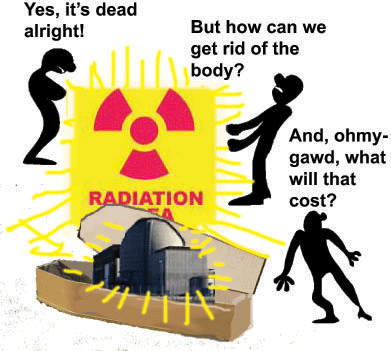
 Korea’s oldest nuclear reactor ceases operation, http://www.koreaherald.com/view.php?ud=20170618000190 By Kim Da-sol (ddd@heraldcorp.com), Kori No. 1, South Korea’s oldest nuclear reactor located in Busan, ceased operation Sunday at midnight after four decades.
Its operator Korea Hydro and Nuclear Power Co. said that it cut the power supply Saturday and began the cooling-down process of the reactor. It was officially decommissioned, with the temperature of the reactor gradually dropping to 90 degrees Celsius, from its normal operation at 300 degree Celsius, the KHNP said. Officials will then relocate the spent nuclear fuel stored inside the rector to a liquid sodium-cooled reactor for reprocessing.
The actual dismantling of the facilities is expected to start no later than 2022. The KHNP expects that at least 634 billion won ($559 million) is required for the dismantling. They also need to submit a dismantlement plan within five years for the NCCS’ approval.
The state-run Nuclear Safety and Security Commission, which approved earlier this month the permanent shutdown of Kori No. 1, said it will continue to check the safety management of the suspended reactor on a regular basis until the dismantlement.
Following the government’s approval in 2007, Kori No. 1’s operation was extended by 10 years after a 30-year run.
Some experts oppose the planned reprocessing of nuclear waste, saying the technology, though effective in reducing the volume of waste, could complicate waste disposal by creating different types of radioactive waste.
Under President Moon Jae-in, the South Korean government aims to close all nuclear power plants by shutting down aged facilities and eventually phasing out the rest over the next 40 years.
China sets up 3 nuclear companies in Britain, hopes to market its nukes worldwide

 China Daily 15th June 2017, China’s CGN a step closer to bringing its nuclear technology to UK: China’s
goal of boosting its nuclear technology sector took a big step forward on Wednesday with the creation of three new companies in the UK by China General Nuclear Power Corporation. The new entities are: Bradwell Power
Corp, which will be responsible for the 100 percent Chinese-built Bradwell B nuclear plant; General Nuclear System Ltd, which will shepherd China’s Hualong technology through the exacting five-year UK approval process; and General Nuclear International, which will manage CGN’s projects in the UK.
He Yu, CGN chairman, said: The unveiling of three companies is a solid step forward for CGN to expand its operation in the UK. With its new subsidiaries unfolding, the company is confident that it will grow steadily in the field of nuclear technology in Britain.”
The United Kingdom will formally assess the Hualong One technology as part of a deal reached last year, in which Chinese investment will help build the Hinkley Point C nuclear plant, in which France’s EDF is a major participant, and which will
feature French technology. CGN and EDF have been working together for more than 30 years on nuclear development and construction in China.
Under last year’s agreement, CGN and EDF will collaborate on three UK nuclear plants: Hinkley Point C, in Somerset; Sizewell C, in Suffolk; and Bradwell, in Essex.
CGN intends to use Hualong One technology at Bradwell, which could be the first nuclear plant in a developed economy to use Chinese technology. The companies will seek to get the Hualong One technology approved in the UK via an assessment known as the Generic Design Assessment process. It usually takes about five years to complete.
China hopes that UK approval of its technology will open the door to its use in other countries because the UK’s appraisal regime is considered by industry experts to be the strictest in the world. The proposed Bradwell project is in an early
pre-planning stage, something that is likely to continue for many years, via investigative work and public consultation, before detailed proposals will be produced, allowing a planning application to be made.
http://europe.chinadaily.com.cn/world/2017-06/15/content_29748140.htm
Incoming Tepco chief vows decision on whether to scrap Fukushima No. 2

The incoming president of Tokyo Electric Power Company Holdings Inc. has expressed eagerness to accelerate moves for tie-ups with other companies in an effort to revive its business following the meltdowns at its Fukushima No. 1 nuclear complex in 2011.
“Capital strength is important to seriously embark on growth businesses,” Tomoaki Kobayakawa, the head of Tokyo Energy Partner Inc., Tepco’s electricity retail arm, said in a recent interview. The 53-year-old is set to assume the post of president on June 23.
His remarks were in line with Tepco’s new business turnaround plan announced on March 22, in which it said it aims to realign and integrate its nuclear and power transmission and distribution businesses with other utilities to improve profitability.
The company, burdened with massive costs stemming from the Fukushima disaster, was placed under effective state control in exchange for a ¥1 trillion ($9 billion) capital injection in 2012.
Compensation and disaster cleanup costs have continued to rise, with the latest estimate reaching ¥22 trillion — twice the sum expected earlier.
Kobayakawa said JERA Co., a joint venture of a Tepco unit and Chubu Electric Power Co. in the area of coal power generation, is a “good example” of a tie-up, as enlarged capital has allowed it “to move powerfully.”
He said the power transmission and distribution businesses will also “produce outcomes if we can (align with other companies) and cover a wide network.”
“I want to make more and more proposals,” he said, pointing to the possibility of forming alliances with businesses overseas, given that domestic demand for electricity is on the decline.
On the resumption of nuclear power generation, Kobayakawa expressed his intention to respect the view of local municipalities in restarting reactors 6 and 7 at the Kashiwazaki-Kariwa plant in Niigata Prefecture on the Sea of Japan coast.
Masahiro Sakurai, the mayor of Kashiwazaki, the city that hosts the nuclear plant along with the neighboring town of Kariwa, has said that the decommissioning of one of reactors 1 to 5 at the Kashiwazaki-Kariwa plant would be a condition for the restart of reactors 6 and 7.
“I haven’t met (the mayor) in person. I would like to confirm his intention,” Kobayakawa said.
Kobayakawa also reiterated the company’s position that it will decide “comprehensively” on whether the Fukushima No. 2 nuclear power plant, located around 12 km south of the crippled Fukushima No. 1, would be scrapped as the prefectural government has urged the decommissioning of the plant.
Court dismisses request to halt restart of Saga reactors

People stage a protest rally in front of Kyushu Electric Power Co.’s office in the city of Saga on Tuesday after a district court rejected an injunction request to halt the restart of two reactors at the utility’s Genkai power plant.
SAGA – A district court on Tuesday dismissed a request from about 230 local residents for an injunction to stop the restart of two reactors at Kyushu Electric Power Co.’s Genkai nuclear power plant in Saga Prefecture over safety concerns.
The Saga District Court handed down the ruling concerning reactors 3 and 4 at the complex as the utility prepares for their restart this summer or later, having secured the necessary consent of the governor of Saga and the mayor of Genkai. The town hosts the four-reactor power station.
Reactors 3 and 4 have cleared Nuclear Regulation Authority screenings that were based on safety standards revamped after the Fukushima nuclear disaster triggered by the March 2011 earthquake and tsunami.
In Tuesday’s decision, presiding Judge Takeshi Tachikawa said the new safety standards are “reasonable.” The court has found no issues with earthquake resistance or steps taken against serious accidents and does not see any specific danger of radiation exposure at the plant, he added.
The focus of the lawsuit, filed by the residents in July 2011, was whether the operator has adequate measures in place against earthquakes. The plaintiffs argued that serious accidents could occur due to degradation in piping.
“The court is supposed to help the weak, but the ruling is based on economics and politics,” said Hatsumi Ishimaru, 65, who leads the group of residents. “We will continue to fight until we stop the nuclear plant.”
The plaintiffs said they will immediately appeal the decision to the Fukuoka High Court.
Kyushu Electric said in a statement it considers the latest decision “appropriate” and will continue to try to ensure safety at the plant.
The ruling may inject momentum into the government’s policy to restart nuclear plants that have fulfilled the new safety standards.
While declining to comment on the court decision itself, Chief Cabinet Secretary Yoshihide Suga said the government respects the Nuclear Regulation Authority’s judgment that the reactors meet the new safety standards.
Tuesday’s ruling followed a series of court decisions rejecting similar suits seeking to halt the operations of nuclear power plants.
In March, the Osaka High Court overturned a lower court order to halt two nuclear reactors at the Takahama plant in Fukui Prefecture, while in the same month the Hiroshima District Court dismissed a request by local residents to order the halt of a nuclear reactor that was restarted last year at the Ikata plant in Ehime Prefecture.
Of the more than 40 commercial reactors nationwide, five are currently in operation. At the Genkai plant, the No. 1 unit is set to be decommissioned due to aging.
http://www.japantimes.co.jp/news/2017/06/13/national/crime-legal/court-nixes-request-halt-restart-saga-reactors/#.WUDy_jekLrc
Underwater robot to probe damage at Fukushima Dai-Ichi nuclear plant
Swimming robot to probe damage at Japan nuclear plant, abc news, By MARI YAMAGUCHI, ASSOCIATED PRESS A Japanese industrial group unveiled Thursday a robot designed for underwater probes of damage from meltdowns at the Fukushima Dai-Ichi nuclear plant after the March 2011 earthquake and tsunami.
Ship at Bangladesh found to have illegal levels of radioactive material: too dangerous to scrap
High level radioactivity detected on North Sea Producer, report says https://www.energyvoice.com/oilandgas/142087/high-level-radioactivity-detected-north-sea-producer-report-says/Written by Reporter 14 June 17 Illegal levels of radioactive material have been detected on the North Sea Producer vessel, which was to be scrapped on a beach in Bangladesh, a news report said.
Work to dismantle the North Sea Producer started in October, but the process was halted in November amid fears that the ship may still contain hazardous substances.
An inspection has since confirmed the presence of unsafe levels of radioactivity, and the Supreme Court has ordered environmental agencies to explain why they gave permission for the vessel to be scrapped at Chittagong, according to independent media research centre Danwatch.
The vessel, which was docked near Middlesbrough FC’s Riverside Stadium early in 2016, had been expected to sail to Nigeria.
But in October it emerged that the North Sea Producer, originally owned by Maersk, had been taken to Bangladesh instead.
Workers on the beach yards of Bangladesh lack basic safety equipment and routinely work in flip-flops and shorts. – 15/06/2017

Turkey to go into big debt to Russia for $20 billion Akkuyu nuclear power plan
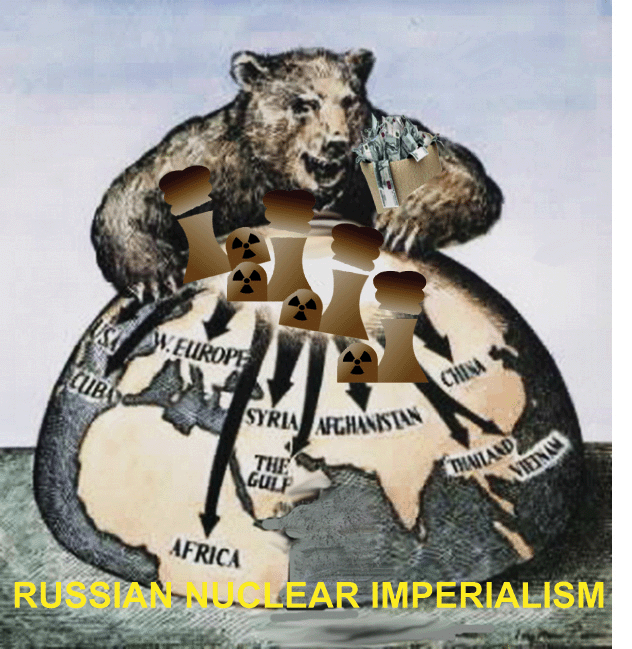 Turkey gives Rosatom go ahead to build nuclear plant, Reuters, 15 June 17,
Russia’s State Atomic Energy Corporation (Rosatom) won approval from Turkey’s energy watchdog on Thursday to go ahead with building its $20 billion Akkuyu nuclear power plant in southern Turkey.
The project to construct four nuclear reactors has repeatedly run into delays, including being briefly halted after Turkey downed a Russian jet near the Syrian border in November 2015. Ties have since normalised between the two countries and work on the plant has resumed……
Rosatom has sold several nuclear reactors to developing countries under a model by which Russia finances, builds and operates the nuclear plant and sells power to its customer – a model that has also raised questions about Russia using energy policy as a means to political ends.
EPDK said it had given Rosatom’s project company Akkuyu Nukleer AS a 49-year production license.
Dependant on imports for almost all of its energy, Turkey has embarked on an ambitious nuclear programme, commissioning Rosatom in 2013 to build the four 1,200 megawatt (MW) reactors…..https://www.reuters.com/article/turkey-energy-nuclear-idUSL8N1JC3FL
Review of safety of Kashiwazaki-Kariwa nuclear plant will mean along delay in restart
 Reuters 14th June 2017, Tokyo Electric Power Co will work with local government to review the
safety of its Kashiwazaki-Kariwa nuclear plant, which could mean a later
restart date than planned originally, the company’s incoming CEO said.
The Kashiwazaki-Kariwa plant, the world’s biggest nuclear power plant, has been
completely offline since 2012 while its safety procedures are reviewed.
Ryuichi Yoneyama, the governor of Niigata prefecture in north west Japan
where the plant is located, has said he will not discuss the restart until
the review is completed. This includes a review of the plant’s safety,
evacuation plans, plus the impact on health of the radiation released from
Fukushima, which could take until 2020 at the earliest. https://www.reuters.com/article/us-japan-tepco-idUSKBN1952HU
India joins the renewable energy revolution, accelerates targets
Two days after President Trump announced that the United States would withdraw from the Paris climate accord, Modi and Macron pledged to achieve emissions reductions beyond their nations’ commitments.
http://reneweconomy.com.au/india-joins-renewable-energy-revolution-accelerates-targets-13206/
North Korea moving surprisingly fast towards launching long-range, nuclear-capable missile

 North Korea edging closer to launch a nuclear ICBM http://www.dw.com/en/north-korea-edging-closer-to-launch-a-nuclear-icbm/a-39230508, 13 June 17 Kim Jong Un’s scientists have surprised many with the speed at which they have overcome the technical obstacles to having a credible and effective long-range, nuclear-capable missile. Julian Ryall reports.
When North Korea’s dictator Kim Jong Un delivered his annual address in Pyongyang on January 1 and declared that his country was in the final stages of developing an intercontinental ballistic missile (ICBM) that would be capable of delivering a nuclear warhead to targets in the continental United States, many viewed the regime’s claim with skepticism.
But on June 4, North Korea’s state-run Rodong Sinmun newspaper reported that the military would be ready to test-fire an ICBM in the near future. This has left governments and analysts in the region more concerned that Pyongyang’s scientists have made far more rapid progress than anyone had anticipated.
“The great success of test-firing an intercontinental ballistic missile, which we are sure to achieve, will mark a historic watershed moment in the failure of the US hostile policy against us,” an editorial in the newspaper stated.
“Historically speaking, the US has never dared to go to war with a country that possesses nuclear weapons or ICBMs.”
Targeting US
It added that recent missile tests have “proved” that “anywhere in the US” is within the range of North Korean missiles.
On June 8, North Korea fired a salvo of what appeared to be anti-ship cruise missiles at targets off its east coast. The launches were the fifth since Moon Jae-in was sworn in as South Korea’s president on May 10.
The most significant of the North’s recent tests, however, came just four days after Moon’s inauguration and demonstrated the strides that Kim’s scientists have made in a remarkably short space of time.
Defense officials in South Korea and the US confirmed that the launch of the liquid-fuel Hwasong-12 missile was a success. North Korea claimed the weapon reached an altitude of 2,111.5 kilometers and travelled a distance of 787 kilometers before splashing down in the Sea of Japan.
The missile took a steep parabolic route that tested its ability to survive re-entry into the atmosphere.
North Korea’s state media reported that the missile – capable of carrying a “large-size, heavy nuclear warhead” – had come through “the worst re-entry situation” and struck its intended target.
That claim was confirmed by South Korean government sources, who told the JoongAng Daily newspaper that analysis of data communication from North Korea’s missile control center confirmed the warhead survived the 5,000 degrees Celsius and severe vibration it experienced on re-entry.
Mastered guidance and control
After numerous test launches, North Korean scientists have already mastered long-range guidance and control capabilities, while a series of underground tests have demonstrated that the regime of Kim Jong Un has acquired nuclear weapons.
Analysts say the last remaining hurdle that North Korean missiles have to overcome is consistently surviving re-entry, which will probably be the reason for the ICBM launch that the North is planning.
“The speed at which they have developed the ability to deliver a nuclear warhead over a long distance is extremely concerning,” said Kim Jae-chang, a former general in the South Korean Army and joint chairman of The Council on Korea-US Security Studies.
“The exact technical developments that they have made are only estimates, but many experts now believe they will be able to launch an ICBM by the end of this year,” he told DW. “And that is a very serious concern to the South.
“We estimate that the military purpose of North Korea developing an ICBM capability is to prevent the US from augmenting or relieving its forces in South Korea in the event of an emergency,” he said.
The belief is that the North can threaten the US mainland as well as its military bases in the Asia-Pacific region, such as those in Japan, Hawaii or the Pacific island of Guam, and interdict naval forces heading for the Korean peninsula.
In tandem with the threat of an ICBM launch, there are indications that North Korea is preparing to carry out a new underground nuclear test at its Punngye-ri proving grounds.
Media reports have suggested that satellite reconnaissance has picked up renewed activity at the site, with scientists gathering at the facility, more vehicles in the vicinity and roads in surrounding areas closed to non-military traffic. 10 kiloton test
North Korea conducted its last nuclear test in September, with experts suggesting the blast was 10 kilotons, the largest the North has ever carried out.
“Pyongyang’s actions and demands have been surprisingly consistent for many years,” said Garren Mulloy, an associate professor of international relations at Daito Bunkyo University. “They want one-on-one dialogue with the US, because they want to be respected and hope to extract concessions from the rest of the world.
“And they have concluded that the most likely way of succeeding with those aims is to threaten the US to the highest degree possible,” he said.
Read: North Korea crisis: Which country has the strongest military in the region?
The most effective way of threatening the US is through the development of multiple weapons systems, including nuclear warheads, submarine-launched ballistic missiles and ICBMs, Mulloy said.
And recent test launches with long-range missiles surviving re-entry and accurately descending on a target would be cause for serious concern in Seoul, Tokyo and Washington, he said, as the speed at which they travelled would mean that any anti-missile defensive system “would struggle to cope.”
“It is clear that they have put an enormous amount of resources into these weapons development programs and made advances that were far more rapid than I and most other analysts believed were possible,” Mulloy added. “They may have invested so heavily in nuclear weapons and ICBMs because they do not think that they have anything else to bargain with.”
Court rejects citizen group submission, allows restart of Genkai nuclear plant
Court rejects citizens’ plea to delay restart of Genkai plant http://www.asahi.com/ajw/articles/AJ201706130012.html, THE ASAHI SHIMBUN June 13, 2017 SAGA–The Saga District Court on June 13 rejected a class action request for an injunction to delay the restart of the Genkai nuclear power plant.
A citizens group had submitted the request for the temporary injunction on the No. 3 and No. 4 reactors at the Genkai plant, operated by Kyushu Electric Power Co., in Saga Prefecture. The group will appeal the decision to the Fukuoka High Court.
Concerns about the safety of the plant led a total of 202 plaintiffs living in 17 prefectures, including Saga and Fukuoka, to join the court action.
With the Saga prefectural governor and Genkai mayor already giving the green light to resume operations, the plant could be restarted as early as this autumn.
North Korea hints that it could test a long range missile, that could hit New York
North Korea threatens to drop nuclear bomb on New York to prove Donald Trump tweet wrong
‘The DPRK is about 10,400 km far away from New York, but this is just not a long distance for a strike today’ Independent Gabriel Samuels @gabs_samuels 14 June 17 Korea has hinted that it could test a long range missile capable of hitting New York, months after President Donald Trump insisted: “It won’t happen”.
Accusing the US leader of underestimating the secretive Communist state’s capabilities, an article last week in state-run newspaper Rodong Sinmun, suggested that it was close to developing an intercontinental ballistic missile (ICBM).
“Trump blustered early this year that the DPRK’s final access to a nuclear weapon that can reach the US mainland will never happen,” the editorial said, using an abbreviation for the country’s official name, the Democratic People’s Republic of Korea. …..http://www.independent.co.uk/news/world/asia/north-korea-nuclear-bomb-new-york-donald-trump-tweet-mocking-missile-capabilities-a7787686.html
Japan’s struggle to decommission Fukushima nuclear reactors
The passage route to the first reactor was flanked by gigantic storage tanks that hold contaminated water.
Reactors still showing skeletal steel frames and roof debris remind a 17-meter-high tsunami which flooded the facility on March 11 in 2011 and caused a hydrogen explosion, bringing the plant to a complete standstill.
Tokyo Electric Power Co. (Tepco), the operator of the plant, has deployed 7,000 workers including its own staff to the site. Their first priority is to tackle the influx of contaminated groundwater. Workers erected a cutoff wall and pumped out upstream groundwater, but still, about 100 to 150 tons of contaminated water is generated every day, according to Tepco. The amount of the contaminated water in storage tanks reaches nearly 1 million tons. It has not yet been decided how to treat the water.
The operation for complete decommissioning is a long way to go. It will take 30 years to finish the job, including the treatment of contaminated water, said Yuichi Okamura, Tepco communication manager.
The Japanese government is going all out to develop advanced robot and drone technology to accurately grasp the internal situation of the reactors to support decommissioning.
1 This Month
26 April – Chernobyl: Inside the Meltdown airs on National Geographic on Sunday 26th April from 4pm

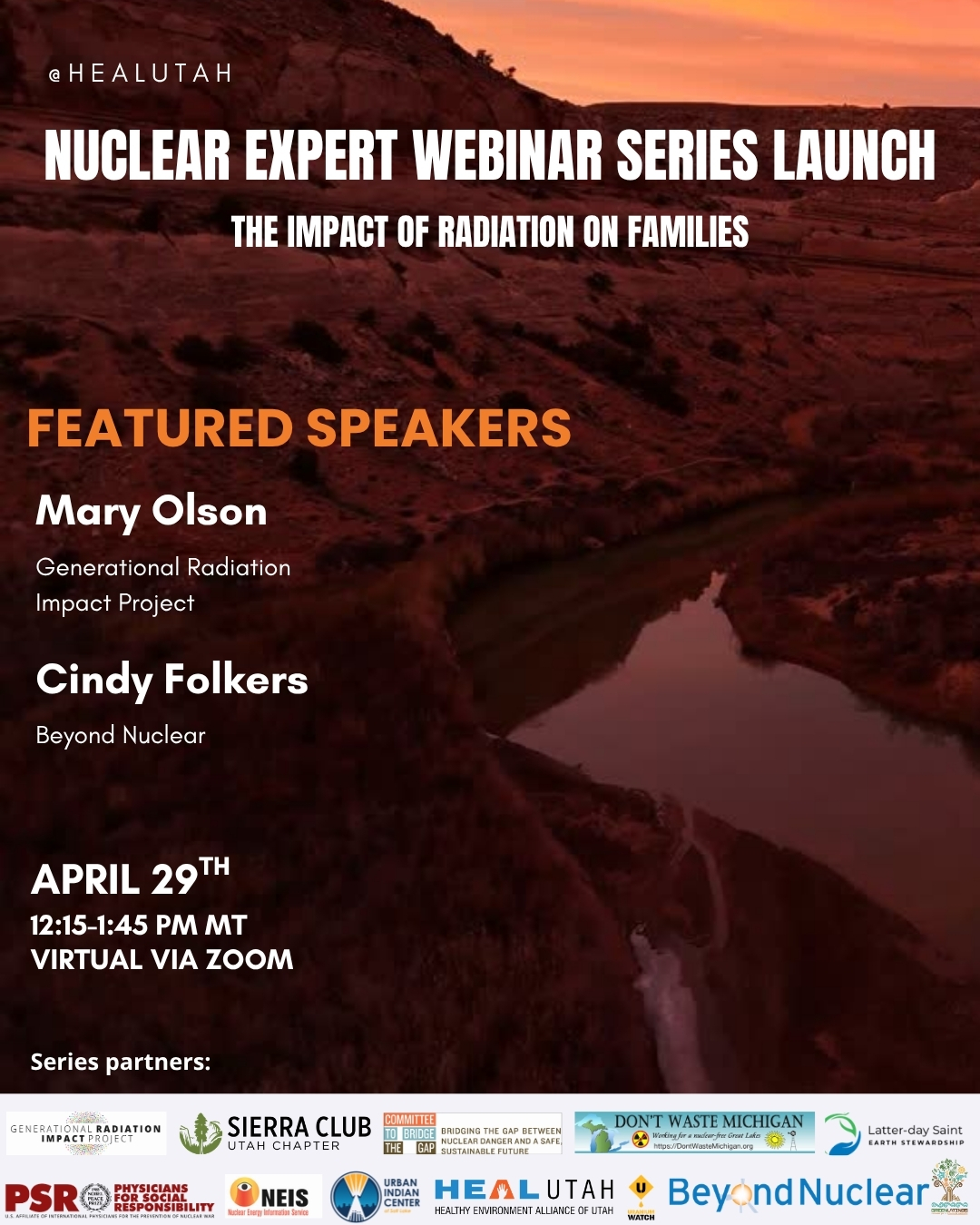
29 April – Nuclear Expert Webinar #1 – Radiation Impacts on Families with Mary Olson and Cindy Folkers
- 12:15 PM MT – 1:45 PM MT
- Location: Virtual – REGISTER TODAY

4 May -West Suburban Peace Coalition to discuss Iran war at May Educational Forum
Monday, May 4, 7:00 – 8:00 PM Central Standard Time
Title: : How Trump’s Narrative Tries to Shape the Reality of the War on Iran.
Contact Walt Zlotow, zlotow@hotmail.com 630 442 3045 for further information
14 May – online event From Bombs to Data Centres: the Face of Nuclear Colonialism

Pine Ridge Uranium is the real threat, not Tehran- Tell Burgum: Stop the Extraction.
Chernobyl: The Lost Tapes – A good documentary on Chernobyl on SBS available On Demand for the next 3 weeks– https://www.sbs.com.au/ondemand/tv-program/chernobyl-the-lost-tapes/2352741955560
To see nuclear-related stories in greater depth and intensity – go to https://nuclearinformation.wordpress.com
-
Archives
- April 2026 (317)
- March 2026 (251)
- February 2026 (268)
- January 2026 (308)
- December 2025 (358)
- November 2025 (359)
- October 2025 (376)
- September 2025 (257)
- August 2025 (319)
- July 2025 (230)
- June 2025 (348)
- May 2025 (261)
-
Categories
- 1
- 1 NUCLEAR ISSUES
- business and costs
- climate change
- culture and arts
- ENERGY
- environment
- health
- history
- indigenous issues
- Legal
- marketing of nuclear
- media
- opposition to nuclear
- PERSONAL STORIES
- politics
- politics international
- Religion and ethics
- safety
- secrets,lies and civil liberties
- spinbuster
- technology
- Uranium
- wastes
- weapons and war
- Women
- 2 WORLD
- ACTION
- AFRICA
- Atrocities
- AUSTRALIA
- Christina's notes
- Christina's themes
- culture and arts
- Events
- Fuk 2022
- Fuk 2023
- Fukushima 2017
- Fukushima 2018
- fukushima 2019
- Fukushima 2020
- Fukushima 2021
- general
- global warming
- Humour (God we need it)
- Nuclear
- RARE EARTHS
- Reference
- resources – print
- Resources -audiovicual
- Weekly Newsletter
- World
- World Nuclear
- YouTube
-
RSS
Entries RSS
Comments RSS
 nuclear-news