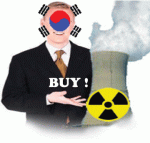
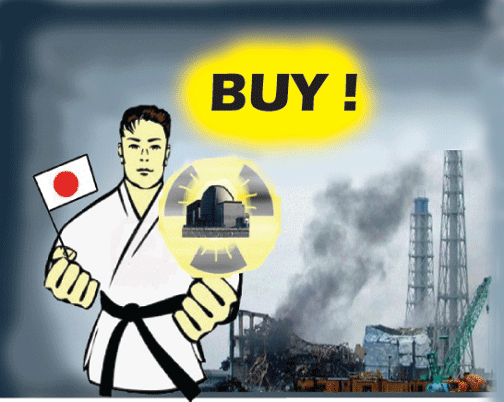
 Koreans target £10bn Welsh nuclear plant, John Collingridge July 23 2017, The Sunday Times A Korean state-owned power giant is drawing up plans to buy a slice of a new £10bn nuclear plant in north Wales.
July 24, 2017
Posted by Christina Macpherson |
marketing, South Korea, UK |
Leave a comment
The Total Fukushima Cost is now estimated at $21.5 trillion Yen ($192.5 Billion Dollars) by the Japanese Government, https://www.linkedin.com/pulse/total-fukushima-cost-now-estimated-215-trillion-yen-1925-maxwell July 22, 2017, Keith Jason Maxwell
The Japanese government said in December that it expects total costs including compensation, decommissioning and decontamination to reach 21.5 trillion yen ($192.5 billion) in a process likely to take at least four decades as highradiation levels slow operations.
The new CEO of TEPCO has recently stated that unless TEPCO can increase its cash flow and profit margin (e.g. rate increases) the company will not be able to continue, or ultimately finish the recovery. In this scenario, the Japanese government will then be responsible for the cost of the recovery.
July 24, 2017
Posted by Christina Macpherson |
Fukushima continuing |
Leave a comment
 Urgent Messages from Murata-San http://www.opensourcetruth.com/urgent-messages-from-murata-san/ JULY 22, 2017 RALPH FUCETOLA, As has been our practice, we are providing here to the public the recent urgent messages from “The Conscience of Fukushima” — M. Murata, former Japanese Ambassador to Switzerland, and one of the most prominent of the Japanese to be calling for “honorable retreat” from the 2020 Olympics, currently scheduled to be held in Japan near the Fukushima disaster zone.
Murata-san has these messages for us:
[1] Message to International Olympic Committee [20 July 2017]
[2] Fukushima Radiation Water Dumping into the Pacific Ocean [16 July 2017]
[3] Retreating from the Tokyo Olympic Games [17 June 2017]
———-
Subject: Message to International Olympic Committee President Bach
Date: 08:56 AM EDT, 07/20/17
From: “mitsu”
Dear Friends,
I am sending you my message addressed to President Thomas Bach of the IOC.
With warmest and highest regards,

From: mitsu
Sent: Thursday, July 20, 2017 9:44 PM
Dear President Thomas Bach,
Please allow me to transmit this extremely alarming mail that may interest you.
It has been sent to me from an American friend.
The widening gap between the promoters and the opponents of the of the Tokyo Olympic Games could not be left unattended.
“Former nuclear industry senior vice president Arnie Gunderson, who managed and coordinated projects at 70 U.S. atomic power plants, is appalled at how the Japanese government is handling the Fukushima nuclear crisis.
“The inhumanity of the Japanese government toward the Fukushima disaster refugees is appalling,” Gunderson, a licensed reactor operator with 45 years of nuclear power engineering experience and the author of a bestselling book in Japan about the Fukushima Daiichi disaster, told Truthout.”
He explains that both the Japanese government and the atomic power industry are trying to force almost all of the people who evacuated their homes in the wake of the Fukushima nuclear disaster to return “home” before the 2020 Tokyo Olympics.
https://www.ecowatch.com/tokyo-olympics-fukushima-2460798164.html?utm_source=EcoWatch+List&utm_campaign=e61916ad29-EMAIL_CAMPAIGN&utm_medium=email&utm_term=0_49c7d43dc9-e61916ad29-85979265
With highest regards,
Received: 09:20 PM EDT, 07/16/2017
From: “mitsu”
Subject: Fukushima Radiation Water and the Pacific Ocean
Dear Friends,
At the Fukushima Daiichi, the volume of contaminated water amounts to one million tons contained in 1000 tanks.
On July13, the new Chairman of TEPCO announced in an interview that the massive radioactive contaminated water containing unremovable tritium would be released into the sea, as recommended by the Nuclear Regulatory Authority. It is well known that tritium is a deadly poison. 2 milligram of it is lethal.
The future of the Pacific Ocean is threatened. The reaction of the international community can easily be foreseen.
Recent publications containing anti-Tokyo Olympic Games assertions are noteworthy. Mr.Takao Saito, renowned journalist, published last month a book entitled “How to educate the people” in which he reviews all the violations of the initial official commitments of the Tokyo Olympic Games. Mr.Makoto Sadaka, famous critic, has recently published an article in which he criticizes Dentsu as playing a central role in suspected corruption cases regarding nuclear reactors and the Tokyo Olympic Games.
Fukushima and the 2020 Tokyo Olympic Games are closely related.
The former helps to play down the consequences of the latter, preventing Japan from consecrating maximum efforts to bring Fukushima under control. It is simply scandelous to organize Olympic baseball and football games in Fukushima without reassuring its safety as required by civil society. The IOC is increasingly criticized for this.
The Olympic Games seems to stand at crossroads. Rome, Boston Hamburg and Bulgaria have withdrawn candidature for the 2024 Olympic Games. Paris and Los Angeles are retained for 2024 and 2028.In addition to enormous financial burden, immigrants and terrorism remain serious discouraging problems for the two cities.
The large scale cyber attack that took place in Europe on June 27 damaged the automatic radiation surveillance system of Chernobyl nuclear reactors in Ukraine. The world is thus seriously warned against the vulnerability of nuclear reactors.
The world is yet to learn the destructive power of nuclear energy in all directions (states,companies,organizations, individuals).
The pitiful downfall of TOSHIBA undeniably symbolizes the beginning of the end of the peaceful use of nuclear energy. The mainstream of the world still permits and promotes the existence of more than 440 nuclear reactors, now considered as the most serious threat to security.
This mainstream undeniably needs a change.
It is the law of history.
—————————————
Subject: Retreating from the Tokyo Olympic Games
Date: 05:23 AM EDT, 06/17/17
From: “mitsu”
Dear Friends,
The results of the nation-wide referendum among the listeners
conducted on 17 June by the Hiroshi Kume’s wide-show program entitled
“Should we retreat from the the Tokyo Olympic Games 2010 ?”
are extremely impressive.
All age categories except “under 19 years old” have overwhelmingly
supported the retreat from the 2020 Olympic Games.
The results could not but have a far reaching impact on this vital issue.
The future of Fukushima depends on it.
This development coincides with another significant one.
In a surprise move, the International Olympic Committee announced on 16 June
that it was ending its Olympic sponsorship deal with McDonald.
The fast-food giant pulled out of its current, estimated £40-million-a-year, deal with
the International Olympic Committee more than three years early,
citing a “focus on different priorities”,severing a relationship that dated to 1976.
A new page is being opened as regards the Olympic Games 2020.
July 24, 2017
Posted by Christina Macpherson |
Japan, politics |
Leave a comment
Accept that North Korea has nuclear weapons
The precondition, though, should be no preconditions. As unpalatable as it sounds, it’s time humankind accepted that Pyongyang has nuclear weapons, that it won’t give them up, and to work from there.
 World Leaders Must Accept The Reality Of A Nuclear North Korea And Work From There, https://www.forbes.com/sites/insideasia/2017/07/20/world-leaders-must-accept-the-reality-of-a-nuclear-north-korea-and-work-from-there/#491264ed3c2b, Inside Asia , CONTRIBUTOR, William Pesek Mr. Pesek is a Tokyo-based journalist and the author of “Japanization: What the World Can Learn from Japan’s Lost Decades.”
Some national leaders surround themselves with “yes-men,” toadies who agree with anything they do. Wiser leaders choose advisors who speak up when needed. And then there’s South Korea’s Moon Jae-in, who wants to be his own “no-man.”
In recent speeches aimed at calming tensions with North Korea, Moon laid out a “four no’s” doctrine: No hostile steps toward Pyongyang, no military dramas, no regime-change ulterior motives and no forced “artificial” reunification. With all these assurances, Moon is trying to get Kim Jong-un to say “yes” to fresh dialogue and cooperation on the peninsula.
But there’s also a fifth “no” Moon needs to keep in mind — the near-certain answer to whether his gambit, however well-intentioned, will succeed.
Kim’s survival depends on his military Consider, first, what Kim is up to with at least 11 missile tests this year: building deterrence abroad and energizing his base at home. The recent attempted test of an intercontinental ballistic missile was aimed, symbolically at least, at a Donald Trump White House pushing a more confrontational line on Pyongyang. It also targeted the trigger-happy generals peering over his shoulder. Kim needs to looks as strong and antagonistic as his father and granddad, if not more.
The influence of these Cold War relics is arguably greater than that of Trump, Moon or China’s Xi Jinping, traditionally North Korea’s main benefactor. Kim can take out foes, kill his uncle and order, allegedly, the assassination of his half-brother.
But his survival, and that of the dynasty, depends on preserving the loyalty of his generals and admirals. Trump has an “America first” policy. Kim’s manta is “military first,” and the volume is rising. Continue reading →
July 22, 2017
Posted by Christina Macpherson |
North Korea, politics international |
Leave a comment
The objects look like icicles hanging around a control rod drive attached to the bottom of the pressure vessel, which holds the core, Tokyo Electric Power Company Holdings Inc. said at an evening news conference.
Enclosed by the huge primary containment vessel, the pressure vessel originally contained the fuel rod assemblies. But the rods melted into a puddle and pierced the bottom of the pressure vessel once the plant lost power after being swamped by the monstrous tsunami of March 11, 2011.
The robot also captured images of lumps of material that appear to have melted and resolidified near the wall of the pedestal, a concrete structure that supports the pressure vessel.
“From the pictures taken today, it is obvious that some melted objects came out of the reactor. This means something of high temperature melted some structural objects and came out. So it is natural to think that melted fuel rods are mixed with them,” said Takahiro Kimoto, a Tepco spokesman.
“In that sense, it is possible that the melted objects found this time are melted fuel debris or probably around it,” he said, saying the utility will think about how they can be analyzed to determine if they are the former fuel rods.
This is the first time Tepco has found something likely to be melted fuel. When the utility sent a different robot into reactor 2 in January, it found black lumps sticking to the grating in the primary containment vessel but said they were difficult to identify.
The utility began probing reactor 3 on Wednesday. Since the PCV has 6 meters of water in it, which is higher than in reactors 1 and 2, the 30-cm robot will have to go deep under water.
The robot has two cameras — one on the front that can pivot 180 degrees vertically, and another on its back.
Tepco will continue the probe on Saturday.
July 22, 2017
Posted by Christina Macpherson |
Fukushima continuing |
Leave a comment
Residents fail in court battle to halt Ehime nuclear reactor http://www.asahi.com/ajw/articles/AJ201707210051.html, THE ASAHI SHIMBUN, July 21, 2017 MATSUYAMA–Eleven local residents have lost their court bid to shut down the Ikata nuclear power plant’s No. 3 reactor, which was restarted in August 2016.
The Matsuyama District Court on July 21 turned down the request for a temporary injunction to halt operations.
The court said there is nothing unreasonable in the new safety standards introduced by the Nuclear Regulation Authority (NRA) after the 2011 Fukushima nuclear disaster and in the safety measures taken by the plant’s operator, Shikoku Electric Power Co.
The residents intend to appeal to a higher court.
The nuclear power plant in Ikata, Ehime Prefecture, is located near the “median tectonic line fault zone,” one of the largest active fault lines in Japan.
It is also at risk if a large tsunami is caused by a powerful earthquake along the Nankai Trough off the coast of western Japan.
After the powerful quakes that hit Kumamoto Prefecture in April 2016, the Ehime residents filed an injunction with the court in May the same year, three months before the restart of the No. 3 reactor.
They said that as earthquakes could also occur around Ikata, it was necessary to continue the suspension of operations.
Since then, the residents have battled with Shikoku Electric Power at five hearings and through the exchange of documents.
The points of dispute were whether the NRA’s new safety standards are reasonable and whether the biggest tremors assumed by Shikoku Electric Power are of the appropriate level.
As for injunctions against nuclear power plants, the Fukui District Court decided in April 2015 to suspend operations of the No. 3 and the No. 4 reactors at the Takahama nuclear power plant in Fukui Prefecture. The Otsu District Court in the neighboring prefecture of Shiga also made a similar decision about the reactors in March 2016.
However, those decisions were nullified in subsequent rulings.
(This article was written by Yosuke Okawa and Yoshitaka Unezawa.)
July 22, 2017
Posted by Christina Macpherson |
Japan, Legal |
Leave a comment
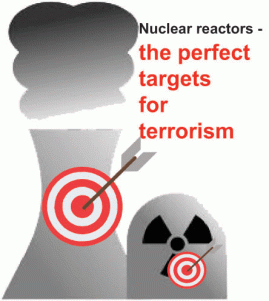 Fukui governor and mayors ask Inada for added protection for reactors against North Korea attacks, Japan Times BY ERIC JOHNSTON OSAKA – Fukui Gov. Issei Nishikawa and the mayors of six towns and villages in the prefecture hosting nuclear power plants have called on Defense Minister Tomomi Inada to dispatch Self-Defense Forces personnel to the prefecture to guard Fukui’s 15 reactors (including those being decommissioned) against a possible attack by North Korea…….
“In order to deter a missile attack, and in order to secure peace of mind of local residents, we ask that Self-Defense Forces be dispatched to the southern part of the prefecture,” the request stated.
In a 2013 report on the nation’s mid-term defense posture for 2014-2018, the Defense Ministry said it will strengthen cooperation with local governments hosting nuclear power plants and take necessary measures to protect them.
Nishikawa also called on the ministry to establish a landing area for helicopters that could be used if a large-scale evacuation of residents in towns near the nuclear power plants would be necessary in the event of damage at a reactor……http://www.japantimes.co.jp/news/2017/07/20/national/politics-diplomacy/fukui-governor-mayors-ask-inada-added-protection-reactors-north-korea-attacks/#.WXE0fRWGPGg
July 21, 2017
Posted by Christina Macpherson |
Japan, safety |
Leave a comment
 North Korea Wants to Deter a U.S. Attack. That’s Why It Has Nukes. Truth Dig Jul 17, 2017 By Col. Ann Wright / Consortiumnews Despite the rhetoric from the Trump administration about military confrontation with North Korea, the common theme of many U.S. experts on North Korea is that the U.S. presidential administration must conduct a dialogue with North Korea—and quickly. Military confrontation is not an option, according to the experts.
And most importantly, the new president of South Korea, Moon Jae-in, was elected in May 2017 on a pledge to engage in talks with North Korea and pursue diplomacy to finally officially end the Korean conflict. Nearly 80 percent of South Koreans support a resumption of long-suspended inter-Korean dialogue, according to a survey by a presidential advisory panel showed in late June.
On June 28, 2017, six former high-level experienced U.S. government officials from both Republican and Democratic administrations over the past 30 years sent a letter to President Trump stating that “Kim Jong Un is not irrational and highly values preserving his regime. … Talking is not a reward or a concession to Pyongyang and should not be construed as signaling acceptance of a nuclear-armed North Korea. It is a necessary step to establishing communication to avoid a nuclear catastrophe. The key danger today is not that North Korea would launch a surprise nuclear attack. Instead the primary danger is a miscalculation or mistake that could lead to war.”
The experts:
–William J. Perry, 19th U.S. Secretary of Defense under the Clinton administration,
–George P. Shultz, 60th Secretary of State under the Reagan administration and now Distinguished Fellow, Hoover institution, Stanford University,
–Former Gov. Bill Richardson, U.S. Secretary of Energy and U.S. Ambassador to the United Nations under the Clinton administration,
–Robert L. Gallucci, former negotiator in the Clinton administration and now with Georgetown University,
–Sigfrid S. Hecker, nuclear weapons expert and the last U.S. official to visit the North Korea nuclear facilities and now with the Center for International Security and Cooperation, Stanford University,
— Retired U.S. Sen. Richard G. Lugar, R-Indiana, now President of the Lugar Center,
They wrote: “There are no good military options, and a North Korean response to a U.S. attack would devastate South Korea and Japan. Tightening sanctions can be useful in increasing pressure on North Korea, but sanctions alone will not solve the problem. Pyongyang has shown that it can make progress on missile and nuclear technology despite its isolation. Without a diplomatic effort to stop its progress, there is little doubt that it will develop a long-range missile capable of carrying a nuclear warhead to the United States.”
The experts ended their letter to President Trump calling for quick action: “Today, there is a window of opportunity to stop these programs, and it may be the last chance before North Korea acquires long-range capability. Time is not on our side. We urge you to put diplomacy at the top of the list of options on the table.”…….http://www.truthdig.com/report/item/the_united_states_double_standard_with_north_korea_20170717
July 21, 2017
Posted by Christina Macpherson |
North Korea, weapons and war |
Leave a comment
 All approvals in place, Japan nuclear deal comes into force http://economictimes.indiatimes.com/news/economy/policy/all-approvals-in-place-japan-nuclear-deal-comes-into-force/articleshow/59690053.cms, By Dipanjan Roy Chaudhury, ET Bureau| Jul 21, 2017 NEW DELHI: The landmark Indo-Japanese civil nuclear deal signed in November 2016 came into force from Thursday that would enable Japan to export nuclear power plant technology as well as provide finance for nuclear power plants in India.
Japan would also assist India in nuclear waste management and could undertake joint manufacture of nuclear power plant components under the Make in India initiative, persons familiar with the development told ET.
Japanese PM Shinzo Abe is expected to visit India this September and growing civil nuclear ties will be highlighted as one of the key elements of Indo-Japan strategic partnership.
Japanese industrial conglomerate Toshiba — which owns Westinghouse — will have a major role when US nuclear major supplies technology for the pair of six reactors in Andhra Pradesh. Since June, this will be the third major development in India’s civil nuclear outreach beginning with pacts with Russia for Units 5 & 6 for Kudankulam Nuclear Power Plant an
d first uranium shipment from Australia.
Last November India and Japan signed a landmark civil nuclear cooperation deal — upgrading MoU at the 2015 Annual summit. Subsequently, the Japanese government got approval from the Diet for the nuclear deal with India. The two countries had reached a broad agreement for cooperation in civil nuclear energy sector during Abe’s visit to India in December 2015. Hitachi, also from Japan, has stakes in GE, which has also proposed to set reactors in India.
India is the only non-NPT signatory with which Japan has entered into a civil nuclear deal in what can be described as a recognition for Delhi’s impeccable non-proliferation record, said a person familiar with the matter. American nuclear major
July 21, 2017
Posted by Christina Macpherson |
India, Japan, marketing |
Leave a comment
Gas may have ruptured bag at nuclear facility https://www3.nhk.or.jp/nhkworld/en/news/20170721_01/NHK has learned the operator of a nuclear research facility northeast of Tokyo believes a bag containing nuclear fuel materials ruptured last month due to a buildup of gas in it.
The rupture occurred on June 6th at the facility run by the Japan Atomic Energy Agency in Ibaraki Prefecture. Five workers were exposed to plutonium and other radioactive materials.
In the bag was a plastic container that stored nuclear fuel materials. The materials were held together by an adhesive agent to make it easier to use in experiments.
A report compiled by the agency says gas is believed to have been generated when radioactive rays disintegrated the adhesive agent, the polyethylene container, and the molecules of water in the bag.
The agency plans to submit a report to the Nuclear Regulation Authority as early as Friday. It will also conduct further analyses to determine the amount of the adhesive agent and the condition of the nuclear fuel materials when they were inside the container.
July 21, 2017
Posted by Christina Macpherson |
incidents, Japan |
Leave a comment
Minister of Economy, Trade and Industry Hiroshige Seko on July 18 announced the forthcoming release of a map showing the most appropriate areas in Japan to bury high-level radioactive waste from nuclear power plants.
Speaking to reporters following a Cabinet meeting on July 18, Seko said the “scientific property map” would be released as early as this month.
“Providing the map is the first step in the long path toward achieving final disposal,” Seko said. He added that an informal decision had been made to hold explanatory meetings across Japan after the release of the map.
The map will divide Japan into four colors designating the suitability of various areas for permanently storing highly radioactive waste.
Areas that are within 15 kilometers of a volcano, that are near an active fault, or that are bountiful in mineral resources, will be “presumed to have undesirable properties” and be excluded from the list of possible sites.
July 19, 2017
Posted by dunrenard |
Japan | Disposal Sites, METI, nuclear waste |
Leave a comment
 Japan taps tech to foil nuclear terrorism ahead of Tokyo Olympics, Japan Times, KYODO
At a meeting of the Education, Culture, Sports, Science and Technology Ministry in December, Mitsuru Uesaka, president of the Atomic Energy Society of Japan and a professor at the University of Tokyo, said it was important to “enhance nuclear security” ahead of the games.
There have been numerous incidents overseas involving attempts to smuggle nuclear materials……
There are also fears that the radical militant group Islamic State might have made a “dirty bomb” capable of scattering radioactive materials. Unlike nuclear weapons, such devices can be made relatively cheaply without advanced skills.
To stop nuclear materials from entering Japan through airports, the agency developed a device to detect very small amounts of uranium concealed in luggage by irradiating luggage with a beam of neutrons. The result is available in less than a second.
Baggage screening at domestic airports usually uses X-rays, but an expert at the agency said conventional screening is not effective in detecting nuclear materials…..
As of the end of 2015, there were 454 confirmed incidents around the world involving unauthorized possession of nuclear materials and related criminal activities, 762 incidents involving reported theft or loss of such materials, and 1,622 incidents involving other unauthorized activities and events related to such materials, according to an International Atomic Energy Agency report. http://www.japantimes.co.jp/news/2017/07/19/national/japan-taps-tech-foil-nuclear-terrorism-ahead-tokyo-olympics/#.WW8OgBWGPGg
July 19, 2017
Posted by Christina Macpherson |
Japan, safety |
Leave a comment
Warnings of a ‘chance of war’ between India and China as nuclear rivals face off Benedict Brooknews.com.au JULY 17, 2017 ASK most people to name a current crisis between nuclear armed states and North Korea and the US’ rapidly worsening relations would come to mind.
July 17, 2017
Posted by Christina Macpherson |
China, India, politics international, weapons and war |
2 Comments

 Drilling work for proposed nuclear power plant Chutka stopped after villagers protest, Villagers in tribal dominated Mandla district’s Chutka staged a protest on Saturday, refusing to allow drilling for soil samples for the proposed nuclear power plant in the area BHOPAL Hindustan Times, Jul 16, 2017 17 Villagers in tribal dominated Mandla district’s Chutka staged a protest on Saturday, refusing to allow drilling for soil samples for the proposed nuclear power plant in the area. They said their demands and concerns have not been addressed by the authorities. Mandla is 382 kms from Bhopal.
Union environment ministry’s forest advisory committee (FAC) recommended forest clearance for Chutka nuclear project in Mandla after discussing the diversion of 119.46 hectares of forest land in Mandla in its meeting on May 16 this year. In 2015 the state cabinet had approved allotment of 41 acres of land for the Chutka project.
The 1,400 megawatt project being set up by Nuclear Power Corporation of India in collaboration with the Madhya Pradesh Power Generation Company will come up at village Chutka in Narayan Ganj tehsil of Mandla district. Over 400 families will be displaced by the project.
People of the four villages in Mandla district, predominantly tribals, have been protesting against the project since it was cleared by Centre in 2009. Most of them were displaced by the Bargi Dam in 1984……
Environmental expert Soumya Dutta who has visited Chutka many times, told HT that there was no rationale for the proposed nuclear power plant as MP was already a power surplus state.
“Given the scenario of power generation and power demand at present, there is no need for nuclear power plant in MP. Besides, if a village Gram Sabha (of Kunda) has not approved the project, the government has to constitutionally accept it…
July 17, 2017
Posted by Christina Macpherson |
India, opposition to nuclear |
Leave a comment
Tepco wants to restart reactors in Niigata to help pay for USD190 billion needed for Fukushima follies
 Employees work in the central control room for the No.7 reactor at Tokyo Electric Power Holdings’ Kashiwazaki-Kariwa nuclear plant in Niigata Prefecture in 2009.
On July 16, 2007, a 6.8 magnitude earthquake rattled the world’s largest nuclear power complex at Kashiwazaki-Kariwa in Niigata Prefecture. This was on a site that the government and Tokyo Electric Power Co. had insisted was seismically safe.
Two years earlier, the Tokyo High Court had ruled against local plaintiffs backed by scientists who insisted the authorities were wrong and that there was an active fault line adjacent to the site. In 2007, Mother Nature overruled the judge, raising questions about relying on old evaluations by institutions favoring nuclear energy in assessing site safety, particularly given subsequent advancements in seismic science.
The good news is that the reactors shut down automatically and the plant withstood tectonic shocks way beyond what anyone had anticipated when designing the structures. The bad news trickled slowly out of Tepco, but an NHK special shortly afterwards aired a startling revelation. The plant manager told NHK that it was very lucky that everything worked as planned and that there was no serious accident — especially considering that the door of the control center had been jammed and nobody could get in. This meant that if there had been a crisis, nobody would have been able to manage it because the emergency controls were inaccessible.
The door was stuck because the land subsided due to the earthquake. It is hard to anticipate every contingency, and that is precisely why accidents happen. If the safety systems had not functioned as planned, Kashiwazaki might have spun out of control, but luckily it was just a close call.
Also worrisome was the transformer fire that took an age to put out because the water pipes had ruptured due to the earthquake. And why was there a nine-hour delay in informing local authorities about the situation, including some radiation leaks? Apparently the plant workers were preoccupied with setting up whiteboards in the parking lot as an improvised control center and using their mobile phones to communicate with each other. Tepco also downplayed how much radioactive water had leaked, a spill that Asahi reporters spotted workers mopping up with paper towels.
At Kashiwazaki-Kariwa there are seven reactors with an 8,200 megawatt capacity, enough for 16 million households. This clustering of reactors means that if there was an accident, it could cascade into a major disaster.
The reactors went online between 1985 and 1997 and generated $2 billion in subsidies for the hosting towns, on top of tax revenues and many high-paying jobs. But local enthusiasm has dimmed considerably since then. Back in 2001 Tepco was caught falsifying repair and maintenance data at all of its 17 reactors, suggesting that management did not nurture a culture of safety. Then, in 2005, the International Atomic Energy Agency warned that fire prevention measures at the Niigata plant were inadequate.
Niigata voters have since elected nuclear skeptics for mayor and prefectural governor. In a nationwide poll conducted by the Asahi Shimbun last October, 57 percent of the public opposed restarting nuclear reactors while only 29 percent were in favor. Earlier in 2016, a poll conducted by the pro-nuclear Japan Atomic Energy Relations Organization found that 12 percent of respondents favored maintaining or increasing Japan’s nuclear energy output while nearly 63 percent wanted to end nuclear power in Japan, either by phasing it out (48 percent) or immediately pulling the plug (15 percent).
Public opposition to nuclear power is not only driven by safety concerns and the tragic fate of tens of thousands of nuclear refugees displaced from ancestral homes in Tohoku. The Fukushima disaster is also a financial black hole that will burden taxpayers and ratepayers for decades to come. And there are the high costs of decommissioning many aging reactors and the expense involved in building a site to permanently store radioactive waste.
Niigata Gov. Ryuichi Yoneyama has slowed plans to restart any reactors, calling for a comprehensive safety review, development of an evacuation plan and an assessment of the Fukushima disaster’s public health impact, all of which could take three years. Tepco’s latest rehabilitation plan includes restarting two of the reactors by March 2020, saying the profits would help it pay off the staggering ¥21.5 trillion ($190 billion) bill for Fukushima, an estimate that is likely to keep rising over the next few decades.
The mayor of Kashiwazaki has also weighed in, requesting that Tepco begin decommissioning one reactor before agreeing to restart the two reactors Tepco wants to bring back online. The Nuclear Regulation Authority is currently conducting safety inspections at two of the reactors. The mayor thinks that seven reactors is too much and is worried about the safety of the control center, wondering if it is sufficiently strong to withstand a powerful quake, possibly because Tepco admitted to misleading the NRA in February about just how strong the structure is. He is hopeful that decommissioning will generate jobs and revitalize the local community.
The mayor also expressed concern about the threat of nuclear missiles from North Korea, prompting NRA Chairman Shunichi Tanaka to joke that Tokyo would make a better target. Funny guy.
The Fukushima debacle has already cost in excess of $100 billion and the government estimates that total will skyrocket in coming years. If only Tepco had heeded internal warnings in 2009 about the possibility of a monster tsunami striking the Fukushima No. 1 plant and built a bigger tsunami wall. That would have cost $1 billion, a bargain in retrospect. Will the ongoing trial of three Tepco executives find them responsible for this and other instances of negligence? Probably not.
And now there are five nuclear reactors operating in Japan, and soon two more in Kyushu, due to court rulings favorable to the utilities. The fate of an additional 35 operable reactors is uncertain, but the staggering costs of decommissioning many of these — so far the NRA has approved five decommissioning proposals that will cost about $10 billion — raise questions about the viability of nuclear energy in Japan.
Toshiba, which is selling off its key assets to pay for its purchase of Westinghouse Electric, knows just how risky the nuclear business is, and hopefully Tepco now understands that cutting corners to save money was abysmal risk management.
Many Japanese must envy South Korea, where newly elected Prime Minister Moon Jae-in has vowed to phase out nuclear energy and cancel plans to build new plants and extend the operating life of its 25 aging reactors. In contrast, Prime Minister Shinzo Abe has reinstated nuclear power into the national energy strategy, targeting 20 to 22 percent of the overall mix, demonstrating the resilient influence of Japan’s “nuclear village.”
http://www.japantimes.co.jp/opinion/2017/07/15/commentary/decade-niigatas-nuclear-close-call/#.WWqb53WlXQY.facebook
July 16, 2017
Posted by dunrenard |
Japan | Kashiwazaki-Kariwa NPP, Niigata Prefecture |
Leave a comment






 nuclear-news