China’s display of conventional and nuclear weapons might
Chinese military displays conventional, nuclear missiles at parade, Economic Times, Jul 30, 2017, BEIJING: Chinese military today showcased five models of its homemade conventional and nuclear missiles in a massive military parade, marking the 2.3-million strong People’s Liberation Army’s 90th founding anniversary.
Also on display were two types of solid-fuel inter- continental strategic nuclear missiles, which rumbled on top of long-bed missile launchers, state-run Xinhua news agency reported.
The equipment and soldiers driving the mobile launch vehicles came from the PLA’s Rocket Force, which was established in December 2015 as part of the PLA’s extensive military structural reform. …
Besides Doklam, China is also concerned by the situation in North Korea and the deployment of Terminal High Altitude Area Defence (THAAD) missile by the US in South Korea much to the opposition of Beijing. http://economictimes.indiatimes.com/news/defence/chinese-military-displays-conventional-nuclear-missiles-at-parade/articleshow/59831588.cms
Japan’s government selects hundreds of coastal sites as potentially suitable for radioactive trash dumps
 METI maps out suitable nuclear waste disposal sites, Japan Times, 28 July 17 KYODO The government on Friday unveiled a nationwide map of potential disposal sites for high-level nuclear waste that identifies coastal areas as “favorable” and those near active faults as unsuitable.
Based on the map, the government is expected to ask the municipalities involved to let researchers study whether sites on their land can host atomic waste disposal sites.
The map, illustrated in four colors indicating the suitability of geological conditions, was posted on the website of the Ministry of Economy, Trade and Industry…..
To permanently dispose of high-level nuclear waste, it must be stored at a repository more than 300 meters underground so it cannot harm human life or the environment.
The map identifies about 70 percent of Japan as suitable for hosting nuclear dumps. Up to 900 municipalities, or half of the nation’s total, encompass coastal areas deemed favorable for permanent waste storage.
Areas near active faults, volcanoes and oil fields, which are potential drilling sites, are deemed unsuitable because of “presumed unfavorable characteristics,” and hence colored in orange and silver on the map.
The other areas are classified as possessing “relatively high potential” and colored in light green.
Among the potential areas, zones that are within 20 km (12 miles) of the coastline are deemed especially favorable in terms of waste transportation and colored in green. The ministry formulated the classification standards in April.

Parts of giant Fukushima Prefecture, where decontamination and recovery efforts remain underway from the mega-quake, tsunami and triple core meltdown of March 2011, are also suitable, according to the map. But Seko said the government has no plans at this stage to impose an additional burden on the prefecture.
Seko also signaled that Aomori Prefecture, which hosts a nuclear fuel reprocessing facility, is exempt from the hunt because the prefectural government and the state have agreed not to build a nuclear waste disposal facility there.
Japan, like many other countries with nuclear power plants, is struggling to find a permanent geological site suitable for hosting a disposal repository. Finland and Sweden are the only countries worldwide to have picked final disposal sites. http://www.japantimes.co.jp/news/2017/07/28/national/meti-posts-map-potential-nuclear-waste-disposal-sites/#.WXuyKhWGPGg
North Korea challenges USA with another intercontinental ballistic missile test

 North Korea throws down gauntlet to Trump with second ICBM test, US, South Korean and Japanese monitors detect an unusual late-night missile test carried out by North Korea. SBS World News, 29 July 17 North Korea on Friday carried out what appeared to be its second test this month of an intercontinental ballistic missile, doubling down on its threat to develop a nuclear strike capability against the US mainland in the face of severe warnings from President Donald Trump.
South Korean, US and Japanese monitors all detected the unusual late-night test, with Japanese Prime Minister Shinzo Abe saying the missile may have landed within Japan’s maritime exclusive economic zone.
“We assess that this missile was an intercontinental ballistic missile,” Pentagon spokesman Navy Captain Jeff Davis said, adding that the projectile travelled about 1,000 kilometers (620 miles) before splashing down in the Sea of Japan.
However, the Russian military said the launch appeared to be a “medium-range” ballistic missile.
The launch came a day after North Korea celebrated what it calls “Victory Day” – the anniversary of the end of the 1950-53 Korean War. Pyongyang regularly times its missile tests to coincide with symbolic dates.
Condemnation was swift with Japan’s top government spokesman, calling Friday’s test another clear violation of UN resolutions.
“Our country will never tolerate it and made a severe protest to North Korea, condemning it in the strongest words,” Suga said.
In Seoul and Tokyo, the governments convened meetings of their national security councils.
South Korean President Moon Jae-In said Seoul would respond with a “strong military show of force,” including joint South Korea-US missile tests, according to a statement from the presidential Blue House.
Further sanctions
US military and South Korean intelligence officials had in recent days warned that North Korea appeared to be prepping another missile test — likely of an ICBM.
The ICBM test on July 4 had triggered global alarm, with experts saying the missile had a theoretical range to reach Alaska.
North Korean leader Kim Jong-Un, who personally oversaw that launch on America’s Independence Day, described it as a gift to the “American bastards.”
It sent tensions soaring in the region, pitting Washington, Tokyo and Seoul against China, Pyongyang’s last remaining major ally.
The United States instigated a push at the United Nations for tougher measures against Pyongyang, with US President Donald Trump saying he was considering a “pretty severe” response.
Joel Wit, a senior fellow at the US-Korea Institute at Johns Hopkins University and an expert on the North’s nuclear weapons programme, said Friday’s launch confirmed time was running out for Washington to find a way out of a pressing security crisis.
“Another North Korean test of what appears to be a missile that can reach the United States further emphasises the need for the Trump administration to focus like a laser on this increasingly dangerous situation,” Wit said on the institute’s 38 North website.
Friday’s launch came just hours after the US Senate passed bipartisan sanctions on Pyongyang, and Japan slapped its own sanctions on two Chinese firms, including a bank accused of laundering North Korean cash…….
There remain doubts whether the North can miniaturise a nuclear weapon to fit a missile nose cone, or if it has mastered the technology needed for the projectile to survive re-entry into the Earth’s atmosphere…..
Reacting to Friday’s launch, United Nations spokesman Farhad Haq said it was “frustrating” that the UN secretary general’s calls for all sides to de-escalate tensions on the Korean peninsula had gone unheeded……
Meanwhile, the US military is preparing to conduct another test of a missile-intercept system in Alaska, perhaps as soon as Saturday. http://www.sbs.com.au/news/article/2017/07/29/north-korea-throws-down-gauntlet-trump-second-icbm-test
Inevitable that North Korea will be a nuclear weapons state
 The inevitability of North Korea’s nuclear weapons, WP, July 28 17, “…..North Korea appeared to launch another missile just after 11 p.m. local time on Friday, South Korea’s joint chiefs of staff said.
The exact details of the launch are still coming out, and it remains unclear if the missile was capable of reaching the continental United States. However, the launch itself is not a shock. Advancements in North Korea’s weapons program have become a fact of life. The debate about when Pyongyang would theoretically be able to hit the U.S. mainland with a nuclear-tipped ballistic missile has shifted from “if” to “when.”…..
First, North Korea has nuclear weapons — perhaps as many as 30, according to a former U.N. weapons inspector — and it’s not going to willingly give them up. Kim Jong Un knows what happened to leaders such as Libya’s Moammar Gaddafi and Iraq’s Saddam Hussein after they gave up their own weapons programs. The ship for denuclearization has almost certainly sailed.
Meanwhile, North Korea may soon be able to put a nuclear weapon on a missile that could hit the United States. Pyongyang keeps testing missiles, dramatically improving its weapons technology in the process.
Then there’s the catch: Any attempt to use force to destroy North Korea’s weapons systems probably would be catastrophic….. In the event of a military strike on North Korea’s nuclear sites, Seoul could ……it is unclear what the Trump administration’s plan for North Korea is — even whether a military strike is off the table…..
Then there is the president himself, a man who seems to prize his own unpredictability and rashness. …..If Trump is resigned to a North Korea with nuclear weapons, it may not be a bad thing…..
In the past, Trump has suggested he might be open to talks with Kim or other inventive options. Although there’s no guarantee these efforts will work, they seem to be less risky than military actions. ….https://www.washingtonpost.com/news/worldviews/wp/2017/07/28/the-inevitability-of-north-koreas-nuclear-weapons/?utm_term=.db9780d66790
Toshiba to pay $2.2 billion to get out of SCANA’s troubled South Carolina nuclear project
 Toshiba reaches $2.2 billion deal over SCANA’s South Carolina nuclear project http://www.reuters.com/article/us-toshiba-accounting-westinghouse-scana-idUSKBN1AC3DN (Reuters) – Toshiba Corp has agreed to pay $2.168 billion to walk away from two unfinished nuclear reactors in South Carolina being built by its Westinghouse subsidiary, according to a statement by the owners of project.
SCANA Corp (SCG.N) and its partner, state-owned utility Santee Cooper, said Toshiba will make the payments in installments beginning in October and ending in September 2022.
Toshiba’s Westinghouse Electric Co filed for bankruptcy in March, overwhelmed by the cost overruns at the VC Summer plant in South Carolina and a similar unfinished nuclear project known as Vogtle in Georgia. The projects are years behind schedule.
The agreement allows Toshiba and its Westinghouse unit to exit the nuclear construction business and caps Toshiba’s liability for guaranteeing that Westinghouse complete the VC Summer contract.
Toshiba reached a similar agreement for $3.7 billion in June with the utilities, led by a unit of Southern Co (SO.N), that own the Vogtle project.
Toshiba has warned that losses from Westinghouse threaten its future and it is considering bids for its flash memory chip unit, worth around $18 billion, to raise capital.
The owners of the VC Summer project said on Thursday they expect the cost of completing the project will “materially exceed” Westinghouse’s estimates and the payments due from Toshiba. They said they hope to decide soon whether they will continue with the two projects, modify them or abandon them.
Westinghouse is expected to deliver this week a five-year business plan to its lender, an affiliate of Apollo Global Management (APO.N). That plan will help shape bids for Westinghouse, which has attracted the interest of U.S. private equity firms.
As part of that plan, Westinghouse is expected to reach an agreement with SCANA under which it will continue to provide engineering and other services. Westinghouse has a similar agreement in place with the owners of the Vogtle plant.
Westinghouse asked the U.S. Bankruptcy Court in Manhattan, New York, on Wednesday to give it until Dec. 6 to file a plan of reorganization. The company said it needed more time in part due to talks with SCANA.
The request will be heard by the court on Sept. 7.
The Georgia and South Carolina plants were the first new nuclear power projects in the United States in three decades.
However, the projects have been dogged by design problems, disagreements with regulators and poor quality work by Westinghouse’s partners.
Thousands homeless, hundreds die in East India floods
Rescue and relief operations were in full swing which is why thousands were sent to safer places. Not only this, PM Modi announced that the injured are entitled to compensation of Rs 50,000, while the family of deceased will get Rs 2 lakh.
The two weather systems which developed over either side of the country, one being over South Rajasthan and Gujarat and another over Gangetic West Bengal as well as Jharkhand were responsible for bringing torrential rains. Heavy rains were witnessed over many parts of the country.
Parts of Odisha, Gangetic West Bengal and Jharkhand witnessed extremely heavy rains between July 21 and 25. These weather conditions were attributed to the low over Gangetic West Bengal and adjoining Jharkhand intensified into a low pressure area and now the system is lying over Southeast Uttar Pradesh as a depression…..
many parts of Gujarat and South Rajasthan have been reeling under flood conditions which escalated to being severe due to non stop rains.
Since the second week of July, back to back weather systems have been affecting Gujarat and South Rajasthan. Initially, the low which formed over Southeast Uttar Pradesh travelled over Gujarat and gave heavy rains over the region.
China’s marketing strategy – Poland and Britain as springboards for China’s nuclear marketing
 CGN eyes Poland for China’s nuclear exports By Zheng Xin | China Daily : 2017-07-26 China General Nuclear Power Corp is eyeing Poland as a potential destination for nuclear exports, as part of its expansion in Europe apart from the United Kingdom, the Czech Republic and Romania.
Polish authorities have been consulting with CGN, China’s largest nuclear operator, on cooperating and building the country’s first nuclear power station, according to a statement on the CGN website on Monday.
“CGN attaches substantial significance to the Polish nuclear power market and is willing to become a long-term strategic partner of the country,” said Shu Guogang, vice-president of CGN.
The two parties signed a Memorandum Of Understanding on cooperation on civil nuclear energy use earlier this month, which Shu said would bring mutual benefits to both countries.
According to Poland’s Energy Ministry, the visit to China earlier this month was to explore the possibility of cooperation between the Polish and Chinese nuclear sectors……..
The Memorandum Of Understanding is yet more evidence that the drive by Chinese electric power industry to diversify abroad is gradually expanding, said Joseph Jacobelli, a senior analyst of Asian utilities and infrastructure at Bloomberg Intelligence.
“CGN’s experience and financing capability and capacity means the company should be able to lock in one or more overseas deals in the next few quarters, despite the fact that whether the company can nail more deals in Eastern Europe is difficult to say at this stage because of the complex nature,” said Jacobelli.
“Nuclear investments take a long time to complete as they are more complex, while projects may also create local social backlashes and have security considerations.”
According to Jacobelli, CGN’s cooperation with the British government is more of a springboard for the company to reach other destinations in the European continent.
CGN signed an agreement on the Hinkley Point C power plant with French utility EDF and the British government last September, which has been hailed as a gateway to promote Chinese nuclear technology.
“The UK is the perfect base from a logistics perspective. It is a perfect springboard for development,” he said. http://www.chinadaily.com.cn/business/2017-07/26/content_30248171.htm
Indian State Government hands over land for nuclear development, displacing 2,200 families
Nuclear plant: 473 acres handed over toNPCIL, The Hindu, STAFF REPORTER, SRIKAKULAM,JULY 27, 2017 Remaining 1,500 acres to be given in three months
Mayor: TEPCO’s Niigata plant must close 5 reactors
 Kashiwazaki Mayor Masahiro Sakurai, left, explains the city’s conditions for the restart of the Kashiwazaki-Kariwa nuclear plant at a meeting with Tokyo Electric Power Company Holdings Inc. President Tomoaki Kobayakawa at the city hall in Kashiwazaki, Niigata Prefecture, on July 25.
KASHIWAZAKI, Niigata Prefecture–Tokyo Electric Power Company Holdings Inc.’s hopes of a phased restart of all of the reactors at its nuclear power plant here to save on fuel costs faces a new obstacle in the form of the local mayor.
Mayor Masahiro Sakurai said July 25 he will agree to the restart of two reactors at the Kashiwazaki-Kariwa nuclear plant, but on the condition that TEPCO “presents a plan to decommission the remaining five in two years.”
The demand was made in the mayor’s first meeting with TEPCO’s new president, Tomoaki Kobayakawa. Sakurai handed over a document listing the city’s conditions for a restart.
In response, Kobayakawa merely said, “We should exchange opinions further.”
The plant, which is located in Kashiwazaki and neighboring Kariwa, is one of the world’s largest nuclear power stations, with seven nuclear reactors.
All the reactors are offline now.
But TEPCO plans to reactivate the No. 6 and No. 7 reactors, the two newest units, as early as fiscal 2019 after they are certified by the Nuclear Regulation Authority as meeting more stringent safety regulations put in place after the 2011 Fukushima disaster. The company wants to restart the rest in stages.
Restarting the facility is crucial to the company’s bottom line as it needs to secure a treasure chest to finance the enormous cost of decommissioning the crippled Fukushima No. 1 nuclear plant and paying compensation to victims.
At the meeting, Sakurai expressed “strong doubts about the corporate culture that governs TEPCO.”
He referred to revelations that surfaced in February about the poor quake-resistance of an emergency response center at the Kashiwazaki-Kariwa plant. It emerged that the center was capable of withstanding less than half of the strongest shaking of a very major earthquake projected to strike the facility.
The company became aware of the startling finding when it reassessed the fitness of the emergency response center in 2014, but it did not report the matter to the NRA.
The emergency response center was completed in 2009 after the Niigata Chuetsu-oki Earthquake of 2007, in which the Kashiwazaki-Kariwa plant was damaged.
“Considering the risks, operating seven reactors in one place is too many,” Sakurai said.
Sakurai was elected mayor for the first time in November 2016 after running on a platform of agreeing to restarts with conditions.
He envisages that the decommissioning of even one of the oldest five reactors will lead to job opportunities for local workers and promotion of local industry.
The No. 1 through No. 5 reactors went into service between 1985 and 1994.
After the meeting, the mayor told reporters that his demand for closing down the old reactors is reasonable.
“The No. 1 to No. 5 reactors are old, and some of them have remained offline since the Niigata Chuetsu-oki Earthquake,” he said. “The utility will need sufficient funds to safeguard such reactors if they are reactivated. I believe it can show us a plan for decommissioning within two years.”
Niigata Governor Ryuichi Yoneyama could prove a more formidable obstacle to the plant operator.
The governor met with Kobayakawa and TEPCO’s new chairman, Takashi Kawamura, on the same day for the first time, reiterating his strong opposition to restarts.
“We cannot start discussing the restart of the plant unless a review of the safety of the plant is completed,” Yoneyama said.
Although governors do not have the legal authority to stop reactor restarts, it has been a protocol to reactivate a plant after gaining their consent.
South Korea’s process on the Suspension of 2 Nuclear Reactors
Gov’t Begins Process to Decide on Suspension of 2 Nuclear Reactors http://world.kbs.co.kr/english/news/news_Po_detail.htm?No=128915 2017-07-24 Former Supreme Court justice Kim Ji-hyung has been appointed as the head of a state committee tasked with gauging public sentiment on the permanent suspension of construction of two nuclear reactors.
The Office for Government Policy Coordination on Monday announced the list of the nine-member committee, consisting of Kim, now a lawyer, and eight experts of humanities and social sciences, science and technology, polling and statistics, and conflict management.
After receiving the certificates of appointment from Prime Minister Lee Nak-yon, the committee members held their first meeting.
The committee will form a civil jury, who will decide on whether or not to permanently suspend the construction of the Shin-Kori 5 and 6 reactors in Ulsan.
Late last month, the government decided to temporarily suspend the construction of the two reactors, saying it will let the public decide on whether to move forward with the reactors’ construction through an up to three-month-long public discussion.
Pentagon says North Korea capable of nuclear missile strike on Australia, USA in 2018
Why it’s time to fear North Korea, The Australian July 26, 2017, CAMERON STEWART North Korea will be able to reliably launch a nuclear-armed long range missile at Australia and the United States as early as next year, according to a stunning new assessment by the Pentagon.
The prediction brings forward by around two years previous US intelligence assessments of the progress of North Korea’s nuclear and missile programs.
It follows an analysis of recent missile tests by the hermit kingdom which found that scientists in Pyongyang have advanced their technology on the country’s missile testing program faster and more efficiently that was predicted by the west.
Senior US officials have told the Washington Post that the Pentagon’s Defense Intelligence Agency has concluded that North Korea’s leader Kim Jong-un will be able to make a ‘reliable, nuclear-capable Intercontinental Ballistic Missile’ sometime in 2018.
In July 4, Mr Kim launched his country’s first missile with the range to strike the US state of Alaska and northern Australia.
The US intelligence assessment shows that the US now believes North Korea is closer than previously thought to having the know-how to miniaturise its nuclear weapons to arm its new ICBM……http://www.theaustralian.com.au/news/world/north-korea-able-to-launch-nuclear-strike-on-australia-as-early-as-2018/news-story/6602ff2c8575b1cd5d7c8dcb93577096
Nuclear power: not compatible with human rights in Japan’s Constitution
Is nuclear power compatible with human rights in Constitution? Asahi Shimbun July 24, 2017 One year has passed since an evacuation order was lifted on July 12, 2016, for most parts of the Odaka district of Minami-Soma, Fukushima Prefecture, which lies within a 20-kilometer radius of the crippled Fukushima No. 1 nuclear power plant.
Stores and schools in the district are gradually being reopened. Voices of high school students are heard echoing through the streets at times of the day when they go to school and return home. At the same time, though, many stores remain shuttered and grass is running wild in the yards of many houses.
City government figures show that Odaka was home to only 2,046 residents as of July 12, less than one-sixth of the corresponding figure at the time of the 2011 disaster at the nuclear plant, which is operated by Tokyo Electric Power Co. (TEPCO).
The nuclear disaster, triggered by the Great East Japan Earthquake and tsunami, deprived many people of their “lives as usual,” which should have been guaranteed under the Constitution of Japan.
DISASTER HIGHLIGHTED ESSENTIALS OF CONSTITUTION
Katsuaki Shiga, a 68-year-old fisherman, has given up hope of returning to Odaka.
His home, which he had just built near the coastline, was inundated by the tsunami. The home went dilapidated while he was banned entry to the premises in the wake of the nuclear disaster, and Shiga had no choice but to have it dismantled.
“(The disaster) changed not just my life but also the lives of all people in our community,” Shiga said. “That made me think about the essentials of the Constitution, such as the right to life and fundamental human rights.”
The government of Minami-Soma in May last year distributed a brochure containing the entire text of the Constitution to all households in the city.
Yasuzo Suzuki (1904-1983), a scholar of constitutional law who hailed from Odaka, included an explicit mention of the right to life in a draft outline of Japan’s Constitution, which he worked out immediately after World War II ended in 1945.
“The people shall have the right to maintain wholesome and cultured living standards,” the draft said, in a prelude to Article 25 of the current Constitution.
Katsunobu Sakurai, mayor of Minami-Soma, wanted the city’s residents to cast their minds back to a starting point at a time when life had taken a sudden turn for the worse for many of them.
Several tens of thousands of inhabitants of Fukushima Prefecture remain evacuated either within or outside the prefecture’s borders. Countless people have lost their longtime livelihoods or dwellings, which means their freedom to choose and change their residences and to choose their occupations (Article 22), along with their right to own or hold property (Article 29), were severely violated.
Many children were no longer able to attend schools in their hometowns, which means their right to an education (Article 26) was also compromised.
And most importantly, the tragedy drove many people into “disaster-related deaths.”
“The nuclear disaster has made it impossible to maintain the sort of life that is described in the Constitution,” Sakurai said emphatically. “That is unconstitutional, isn’t it?”
CONSTITUTION AS PILLAR AND POST
The Fukui District Court in May 2014 issued an injunction against the planned restart of reactors at Kansai Electric Power Co.’s Oi nuclear plant in a lawsuit filed by residents living near the power-generating facility in Fukui Prefecture.
“The use of nuclear energy is meant to fulfill the socially important functions of generating electric power, but that is inferior in standing to the core part of personal rights in light of the Constitution,” the court said in its decision.
Akiko Morimatsu said she was given hope by that court decision, which based itself on the Constitution. The 43-year-old heads a group of plaintiffs from the Kansai region in a group lawsuit filed by evacuees from the nuclear disaster, who are demanding compensation from the central government and TEPCO.
Worried about her two young children’s exposure to radiation, Morimatsu fled to Osaka from Koriyama, Fukushima Prefecture, although the area she was from was not under an evacuation order.
Voluntary evacuees like her, who constitute a minority, have had to face unfriendly eyes both in and outside of Fukushima Prefecture, and have received little help from administrative organs and scanty damage payments from TEPCO.
She said she wondered if she had made the right choice, and she took a fresh look at the Constitution, which she had studied in her student years. She thereupon found such statements as “all peoples of the world have the right to live in peace, free from fear and want” (preamble) and “all of the people shall be respected as individuals” (Article 13).
“This should be the pillar and post for me,” Morimatsu said she thought.
She argued that it is up to individual freedom to choose between evacuating and staying, and that all individuals, no matter which option they have chosen, should be granted assistance that allows them to realize the sort of life that is guaranteed under the Constitution.
Seventy years after the Constitution came into force, people are still turning to the supreme law of Japan as a weapon in their fight to win back their “lives as usual.” That reality should not be forgotten and should be taken seriously…… http://www.asahi.com/ajw/articles/AJ201707240022.html
South Korea to move away from nuclear power – but still wants to sell nukes overseas!
 Reuters 24th July 2017, South Korea’s new energy minister on Monday said he plans to support the
country’s push to sell nuclear reactors overseas, even as the nation curbs
nuclear power at home. State-run Korea Electric Power Corp (KEPCO) is
building the first of four nuclear plants in the United Arab Emirates in an
$18.6 billion deal, and is scouting for more business in Britain and other
countries.
But that comes as South Korea, Asia’ fourth-largest economy, has
been looking to steer its domestic energy policy away from its current
heavy dependence on coal and nuclear, with large chunks of the public
skeptical about the safety of atomic power. http://www.reuters.com/article/us-southkorea-nuclear-minister-idUSKBN1A90N6
The enormity of decommissioning of the Fukushima Reactor No.1 shown by images of melted nuclear fuel
 Melted nuke fuel images show struggle facing Fukushima plant http://www.asahi.com/ajw/articles/AJ201707230012.html, By KOHEI TOMIDA/ Staff Writer, July 23, 2017 Images captured on July 22 of solidified nuclear fuel debris at the bottom of a containment vessel of the crippled Fukushima No. 1 nuclear power plant show the enormity of decommissioning of the facility.
Plant operator Tokyo Electric Power Co. said it will closely study the images from the No. 3 reactor’s containment vessel to determine the spread and amount of nuclear fuel debris.
After analysis, TEPCO will decide on a policy to retrieve the fuel debris. The government and TEPCO plan to start the retrieval process in one of the three crippled reactors at the plant from 2021. It will be a formidable task, given that a method of recovering debris that is stuck to the floor has yet to be considered.
The recent images were taken by a submersible robot, which was sent into the containment vessel on July 19, 21 and 22.The No. 3 reactor’s containment vessel is filled with water to a depth of 6.4 meters. On the final day, the remote-controlled robot was dispatched to the deepest part of the containment vessel.
The images showed that pieces that fell from the structure and deposited material accumulated to a height of about 1 meters at the bottom of the containment vessel.
In particular, what is believed to be nuclear fuel debris is scattered in the form of rocks in the area directly beneath the pressure vessel.
The latest investigation has confirmed TEPCO’s assumption made through analyses that most of the reactor’s nuclear fuel melted through the pressure vessel and accumulated at the bottom of the containment vessel. It also discovered that the nuclear fuel debris has spread throughout the containment vessel. The images marked the first confirmation through a robot probe of a large amount of nuclear debris in any of the embattled No. 1 through No. 3 reactors.
Memoirs of 1945 photographer of the devastated city of Hiroshima
FULL VERSION OF HIROSHIMA AND NAGASAKI FILM THEY DIDN’T WANT US TO SEE 34962,
(this is not the same as the film discussed below)
Memos found from man who shot Hiroshima ‘phantom film’, Asahi Shimbun , By GEN OKAMOTO/ Staff Writer, July 23, 2017 SAGAMIHARA, Kanagawa Prefecture--Memos written by a photographer who documented the damage inflicted on Hiroshima after the atomic bombing and his personal feelings have been discovered by his grandson and will be displayed in Tokyo next month.
Kiyoji Suzuki took the notes with sketches when a documentary team, in which he was a member, roamed the flattened city between September and October 1945.
The documentary, “Effects of the Atomic Bomb on Hiroshima and Nagasaki,” was undertaken by a Japanese film company to scientifically record the extent of the damage done to both cities, including footage of destroyed cityscapes, injured people and the existence of vegetation.
The shooting of Nagasaki ran into difficulties as the U.S. military meddled in the project. But the crew managed to continue with their work after being commissioned by the U.S. military.
Although the documentary was completed in 1946, the U.S. military confiscated the film and didn’t return it to Japan until 1967. The footage became known as the “phantom film” on the atomic bombings.
Hiroshi Nose, also a photographer who lives in Sagamihara, found his grandfather’s memos at his home in 2013.
Suzuki’s entries began on Sept. 18, 1945, when he was living in Tokyo and assigned to the film project in Hiroshima.
His memos show sketches of a “shadow” of a person or object etched on a nearby building by the bomb’s thermal flash and of a deformed leaf of a plant.
Suzuki also mentioned which lenses he used for filming and the weather that day.
Although many of the memos concern objective data, others appeared to reveal his personal feelings in the midst of the devastation…….
Nose completed a 28-minute documentary film last fall, titled “Hiroshima Bomb, Illusive Photography Memos,” after visiting places in Hiroshima that were associated with Suzuki’s memos.
The documentary compared footage of Hiroshima today and that of the city 72 years ago shot by his grandfather.
The memos will be displayed for the first time to the public at Art Gallery 884 in Tokyo’s Bunkyo Ward on Aug. 5-9. http://www.asahi.com/ajw/articles/AJ201707230019.html
1 This Month
26 April – Chernobyl: Inside the Meltdown airs on National Geographic on Sunday 26th April from 4pm
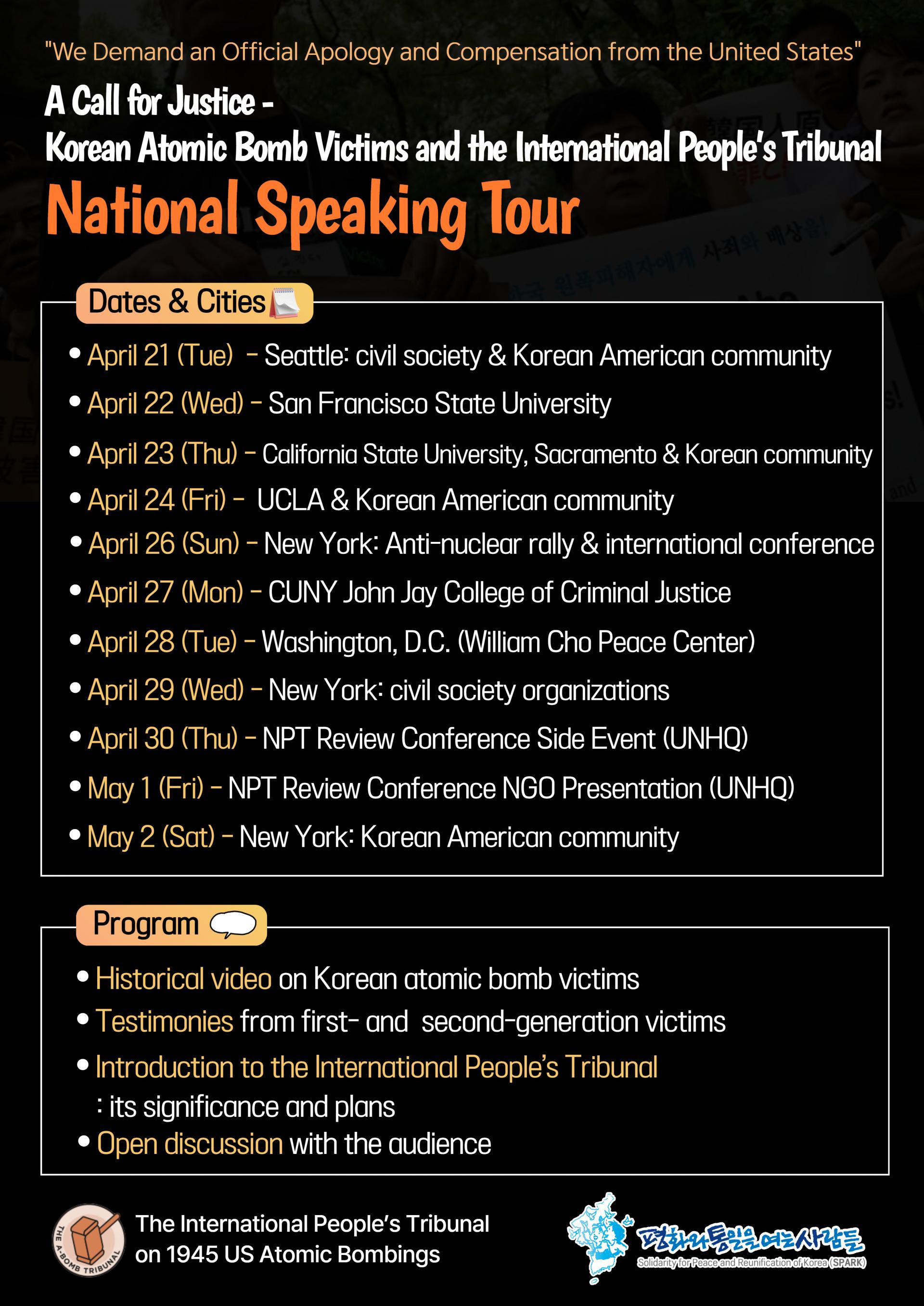
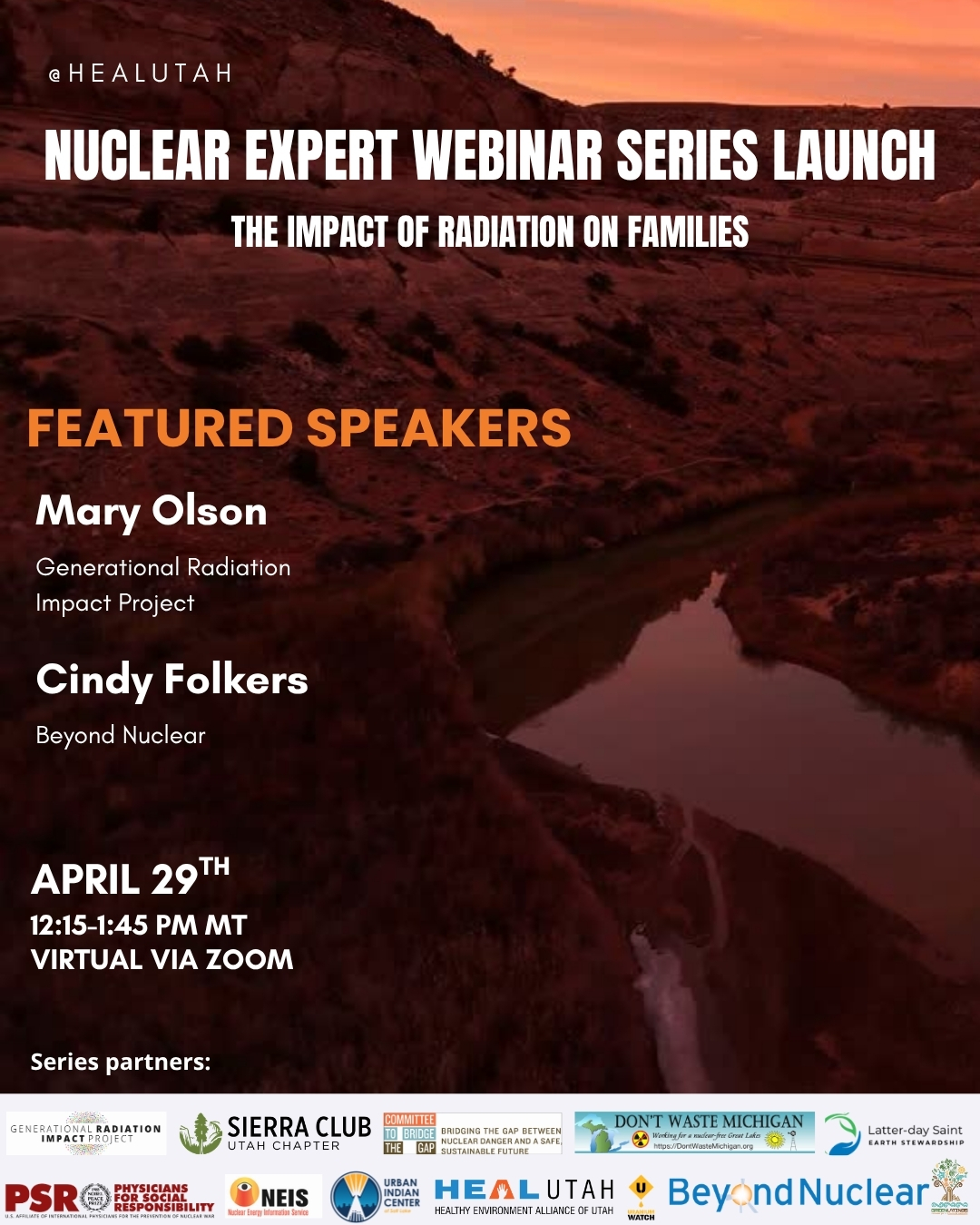
29 April – Nuclear Expert Webinar #1 – Radiation Impacts on Families with Mary Olson and Cindy Folkers
- 12:15 PM MT – 1:45 PM MT
- Location: Virtual – REGISTER TODAY

4 May -West Suburban Peace Coalition to discuss Iran war at May Educational Forum
Monday, May 4, 7:00 – 8:00 PM Central Standard Time
Title: : How Trump’s Narrative Tries to Shape the Reality of the War on Iran.
Contact Walt Zlotow, zlotow@hotmail.com 630 442 3045 for further information
14 May – online event From Bombs to Data Centres: the Face of Nuclear Colonialism

Pine Ridge Uranium is the real threat, not Tehran- Tell Burgum: Stop the Extraction.
Chernobyl: The Lost Tapes – A good documentary on Chernobyl on SBS available On Demand for the next 3 weeks– https://www.sbs.com.au/ondemand/tv-program/chernobyl-the-lost-tapes/2352741955560
To see nuclear-related stories in greater depth and intensity – go to https://nuclearinformation.wordpress.com
-
Archives
- April 2026 (317)
- March 2026 (251)
- February 2026 (268)
- January 2026 (308)
- December 2025 (358)
- November 2025 (359)
- October 2025 (376)
- September 2025 (257)
- August 2025 (319)
- July 2025 (230)
- June 2025 (348)
- May 2025 (261)
-
Categories
- 1
- 1 NUCLEAR ISSUES
- business and costs
- climate change
- culture and arts
- ENERGY
- environment
- health
- history
- indigenous issues
- Legal
- marketing of nuclear
- media
- opposition to nuclear
- PERSONAL STORIES
- politics
- politics international
- Religion and ethics
- safety
- secrets,lies and civil liberties
- spinbuster
- technology
- Uranium
- wastes
- weapons and war
- Women
- 2 WORLD
- ACTION
- AFRICA
- Atrocities
- AUSTRALIA
- Christina's notes
- Christina's themes
- culture and arts
- Events
- Fuk 2022
- Fuk 2023
- Fukushima 2017
- Fukushima 2018
- fukushima 2019
- Fukushima 2020
- Fukushima 2021
- general
- global warming
- Humour (God we need it)
- Nuclear
- RARE EARTHS
- Reference
- resources – print
- Resources -audiovicual
- Weekly Newsletter
- World
- World Nuclear
- YouTube
-
RSS
Entries RSS
Comments RSS
 nuclear-news