Beijing’s foreign ministry spokeswoman Hua Chunying made the statement before reporters at a regular press briefing, following reports Washington and Seoul are planning to begin drills on the Korean peninsula on Aug. 21, South Korean news agency Yonhap reported.
“Many countries including the United States have expressed their desire to resolve the North Korea nuclear issue peacefully through diplomatic means,” Hua said. “The most feasible and reasonable way to do this in the tense and complex situation at present is a dual suspension” on both sides.
The Chinese spokeswoman added although “the recent situation on the Korean peninsula is showing signs of easing tensions, it is still highly complex and fragile.”
“North Korea, the United States, and other parties directly concerned with the nuclear issue should do more,” Hua said. “The essence of the Korean peninsula issue can be found in the security problem, and the door to resolving the North Korean nuclear issue can really be opened when the concerns of each country are resolved in a balanced way. The most pressing issue now is to stop North Korea’s nuclear and missile development, and end the vicious cycle of increasing tensions on the Korean peninsula.”
Hua also said if the United States has a better plan that “involves the peaceful resolution of the North Korea nuclear issue and the restoration of peaceful dialogue, China will support it with a positive and open attitude.”
Hua added she welcomed an earlier suggestion from United Nations Secretary-General Antonio Guterres to dial down the rhetoric and “dial up diplomacy.”
“This is the same as China’s solution to the North Korea nuclear issue,” Hua said.
South Korean President Moon Jae-in previously defended the joint exercises as legitimate drills of a defensive nature, while condemning North Korea’s nuclear and missile provocations as illegal.
China and the North Korean nuclear challenge, In Beijing’s eyes, the status quo is preferable to the upheaval that would result from action to topple Kim, Japan Times, BY RAMESH THAKUR, 17 Aug 17 GUANGZHOU, CHINA– .ON A SUPERFICIAL READING, CHINA IS FEELING THE SQUEEZE TO TAKE EFFECTIVE ACTION TO BRING NORTH KOREA TO HEEL OVER ITS ROGUE NUCLEAR PROGRAM. ON A DEEPER READING, CHINA’S GAINS FROM THE CRISIS EXCEED THE COSTS. ON A WIDER READING, WASHINGTON DAILY VINDICATES PYONGYANG’S NUCLEAR CHOICES……..
Stability and conflict-avoidance in its immediate region remains a vital national interest for China’s development and peaceful rise. Heightened tensions over North Korea’s nuclear antics risk an uncontrolled armed conflict, strengthened U.S.-Japan-South Korea alliances and enhanced prospects of nuclear breakouts by Japan, South Korea and Taiwan.
But China’s leverage over Pyongyang, although greater than that of others, is limited. Pyongyang has proven indifferent to what others think and impervious to external pressure. With 80 percent of trade with China, more U.N. sanctions amount to more sanctions on China. It is cost-free for Washington and Western countries to engage in virtue signaling by enacting still tougher international sanctions whose costs have to be borne by China.
If the sanctions succeed in destroying North Korea’s economy and engineer a collapse, millions of desperate refugees will flood into China and a crucial geographical buffer against U.S. forces will disappear.
By what right does Washington tolerate nuclear weapons in the hands of its ally Israel but demand that China force a rollback of North Korea’s? In Beijing’s eyes, the U.S. provokes a crisis but holds China responsible for solving it. U.S. threats also stir memories among elderly Chinese of how they were treated in the early year’s of China’s own nuclear program.
Any further weakening of Pyongyang’s links with Beijing and Moscow will feed North Korea leader Kim Jong Un’s siege paranoia and solidify reliance on nuclear weapons as the only assured guarantee of regime and personal survival. The U.S. record of infidelity to political package deals — the 1954 Geneva accords on Indochina, understandings with Russia on Eastern Europe on ending the Cold War, Libyan leader Moammar Gadhafi’s abandonment of his nuclear program — inspires distrust. Every fresh bellicose threat from Washington deepens Pyongyang’s dependence on and attachment to a nuclear deterrent that can strike the U.S. mainland.
On balance, therefore, in China’s calculation the status quo of a nuclearized North Korea, however unpalatable, is preferable to the upheaval that would result from military strikes or regime collapse. This is consistent with the sober conclusion of The Economist that all options for dealing with North Korea are bad but blundering into a war would be the worst………
Chinese President Xi Jinping is the very model of a circumspect, calm and statesmanlike leader urging restraint in rhetoric and action by both sides and calling for a phased program (freeze-for-freeze) to reduce tensions. Each new step on the escalation ladder does further damage to the U.S. reputation for responsible leadership while boosting China’s profile and prestige. It also obscures China’s own past culpability in enabling North Korea’s nuclear program while underlining the history of U.S. forcible regime change as the main driver of Pyongyang’s nuclear pursuit.
This, in turn, this amplifies the larger narrative of the diminishing U.S. presence in Asia…..
Japan and South Korea have managed to live for years with the reality of vulnerability to North Korea’s nukes. There is no reason why the U.S. cannot learn to do the same. Kim should be left in no doubt that an attack on any of the three allies would bring instant military strikes and elimination of the regime. But there will be no preventive strikes. Instead a policy of containment — which requires credible threats, not bluster — will be instituted along with risk avoidance and crisis stability measures that served all sides well during the Cold War.
The only genuine progress on eliminating nuclear threats will be a universal ban treaty followed by a verifiable and enforceable plan for destroying and dismantling nuclear weapons programs in all countries.
Japan owns nearly 50 tons of separated plutonium. That is enough for over 5,000 nuclear weapons. Yet Japan has no feasible peaceful use for most of this material.
This raises an obvious question: How did a country that forswears nuclear arms come to possess more weapons-usable plutonium than most countries that do have nuclear arsenals?
Some argue it is the unforeseen consequence of unexpected events, such as the failure of Japan’s experimental Monju breeder reactor, or the Fukushima accident that compelled Japan to shut down traditional nuclear power plants.
Indeed, Kyodo News quoted a former U.S. government official last year making such a claim. He asserted that “The accumulation of plutonium by Japan was not anticipated by Congress or any agency of the U.S. government,” when Washington in 1988 gave Japan 30-year approval to separate plutonium from spent fuel originally supplied by the United States or irradiated in U.S.-technology reactors.
But that is false.
Japan’s massive accumulation of nuclear weapons-usable plutonium was foreseen three decades ago.
In testimony submitted to the U.S. Congress in March 1988, and published that year, Dr. Milton Hoenig of the Nuclear Control Institute — where I worked at the time — documented how Japan’s planned separation of plutonium from spent fuel greatly exceeded its planned recycling of such plutonium in fresh fuel. The inevitable result, he predicted, was that Japan would accumulate enormous amounts of separated plutonium.
As his testimony detailed: “By the end of the year 2017…according to present plans, about 255 metric tons of Japanese-produced plutonium will have been separated in reprocessing plants in Japan and Europe. The announced plans of Japan demand the use of some 130 metric tons of separated plutonium as reactor fuel through the year 2017, mainly in light-water reactors in a commercial program to begin in 1997.”
Thus, he concluded, Japan’s declared plans would yield 125 tons of surplus plutonium by 2017.
Subsequent unforeseen events did not cause Japan’s huge plutonium stockpile, as the U.S. official claimed, but actually reduced it somewhat. Notably, Japan has postponed the commercial operation of its huge Rokkasho reprocessing plant, which could separate another eight tons of plutonium each year.
The hard truth is that creation of a plutonium surplus was not an accident but the inevitable consequence of Japanese nuclear policy that the U.S. government acquiesced to in 1988.
Why did Japan intentionally acquire a stockpile of plutonium sufficient for thousands of nuclear weapons? Neighboring countries suspect it is to provide Japan the option of quickly assembling a large nuclear arsenal. Not surprisingly, both China and South Korea are now pursuing options to separate more plutonium from their own spent nuclear fuel.
Three urgent steps are necessary to avert this latent regional arms race. First, Japan should terminate its Rokkasho plant, which is an economic, environmental, and security disaster. The last thing Japan needs is more surplus plutonium.
Second, the United States and Japan should seize the opportunity of their expiring 1988 deal to renegotiate new terms restricting plutonium separation, which could also serve as a model for ongoing U.S.-South Korea nuclear negotiations.
Finally, innovative thinking is needed to shrink Japan’s plutonium stockpile. In light of the worldwide failure of breeder reactors, and post-Fukushima constraints on traditional reactors, most of Japan’s plutonium will never become fuel. Instead, it should be disposed of as waste. The U.S. government has recently made a similar decision, abandoning plans to use recovered weapons plutonium in fuel and instead intending to bury it.
U.S.-Japan collaboration to dispose of surplus plutonium in a safe, secure and economical manner could help make up for the misguided bilateral decisions that created this problem 30 years ago.
(Alan J. Kuperman is associate professor and coordinator of the Nuclear Proliferation Prevention Project — www.NPPP.org — at the Lyndon B. Johnson School of Public Affairs, University of Texas at Austin.)
US Talks to China about North Korea, But Does Not Listen, UCS, GREGORY KULACKI, CHINA PROJECT MANAGER AND SENIOR ANALYST | AUGUST 16, 2017, The United States and China both want North Korea to abandon its nuclear weapons program. The North Korean leadership continues to defy them both. The United States says it is willing to risk a war to stop them. China is not.
China’s top priority is preserving the peace, however uneasy that peace might be. A credible North Korean capability to launch a nuclear-armed ICBM may make US officials psychologically uncomfortable. But the Chinese leadership does not feel that increased US anxiety is a sufficient justification for starting a war that could conceivably kill hundreds of thousands of people and collapse Asia’s economy, even if no nuclear weapons were used.
China has made its priorities clear to both the United States and North Korea. An August 10 editorial published in China’s Global Times warned both sides against striking first. The editorial was not an official statement of Chinese government policy but it almost certainly was reviewed and approved at the highest level. It suggested to the leadership in Pyongyang that, “If North Korea launches missiles that threaten US soil first and the US retaliates, China will stay neutral”. It also suggested to Washington that, “If the US and South Korea carry out strikes and try to overthrow the North Korean regime and change the political pattern of the Korean Peninsula, China will prevent them from doing so.”
China has also made it clear that it will not agree to sanctions that strangle North Korea’s economy. China supports economic penalties that punish North Korea for defying the United Nations and continuing its testing programs. And China is willing to work with the United States and the international community to deny North Korea access to critical technologies. But on August 5th, in an official statement made at the time of the vote on the latest round of UN sanctions, China emphasized, as it has many times in the past, that China “did not intend to negatively impact such non-military goods as food and humanitarian aid.”
US Refusal to Listen
Though China’s position on North Korea is clear and consistent, US policy is based on the assumption that China’s position will change. On August 13th, US Secretary of Defense James Mattis and Secretary of State Rex Tillerson penned an editorial in which they repeated the claim, believed by most US policy makers and analysts, that China has “decisive diplomatic and economic leverage over North Korea.” The implication is that China can force the North Korean leadership to abandon its nuclear weapons program. The joint editorial reiterated a US policy announced earlier this year by Secretary Tillerson, who said the Trump administration was engaged in an unprecedented effort to “lean hard into China” in order to pressure its leaders to change their policy.
Presumably this means trying to compel China to take steps to strangle the North Korean economy. The United States reportedly attempted to include a crude oil embargo in the latest round of UN sanctions. But China refused, as it has in the past, to agree to sanctions that would have the kind of suffocating economic impact the United States believes would force North Korea to surrender its nuclear ambitions. In their editorial Tillerson and Mattis told their Chinese counterparts they expect China to “do more” than enforce the current round of UN sanctions. They want China to cut off North Korea’s “economic lifelines.”…..
History may well record that in this particular moment of high tension, China’s president acted with greater patience, skill and prudence than the president of the United States.
On August 14th, as tensions began to subside, an editorial in the overseas edition of China’s People’s Daily chastised both the United States and North Korea for “playing a game of chicken on the Korean peninsula.” That’s not the language of a country that lacks confidence in its current position or is overly concerned about upsetting the United States. http://allthingsnuclear.org/gkulacki/us-talks-to-china-about-north-korea-but-does-not-listen
Tokyo and Washington Have Another Nuclear Problem, Foreign Policy, BY HENRY SOKOLSKI, WILLIAM TOBEY, AUGUST 17, This week, Japanese Foreign Minister Taro Kono and Defense Minister Itsunori Onodera are meeting in Washington with their U.S. counterparts, Rex Tillerson and James Mattis, to discuss how the United States and Japan should respond to the latest North Korean provocations. This is wise; only through close cooperation with Japan and South Korea, and by working with China, will we be able to address effectively the nuclear threat Pyongyang poses.
That said, these officials ought to contemplate another longer-term and yet potentially grave nuclear threat — the growth of plutonium production capacity in Japan, China, and, perhaps South Korea. Although this problem is complicated, its solution, if we act cooperatively now, is not. The trick is to move soon.Japan is planning to open a massive spent reactor fuel reprocessing plant at Rokkasho in the fall of 2018. It is designed to produce 8,000 kilograms of weapons-usable plutonium, enough to make more than 1,000 nuclear weapons a year. The ostensible reason for operating this plant is recycling spent fuel to supply power reactors and a fast reactor. There is only one problem: Japan only has five reactors on line and just terminated its only fast reactor project. In short, there is no way Japan can operate Rokkasho without piling up tons of plutonium for years on end.
China, meanwhile, has just agreed to purchase a similarly sized plant from France, although a massive protest against the first site chosen forced Beijing to defer construction. Still, China wants to have the plant operating by 2030 to fuel a fast reactor it plans to operate sometime between 2040 and 2050. Here, again, the problem is that for a decade or more,
China will be producing about 8,000 kilograms of nuclear-explosive plutonium annually.
China will be producing about 8,000 kilograms of nuclear-explosive plutonium annually. By 2040, it would have enough plutonium stockpiled to make more than 10,000 nuclear weapons……
….Finally, there is South Korea, which has long complained that Washington has prohibited Seoul from reprocessing U.S.-origin spent reactor fuel, although Japan is permitted to do so. South Korea’s new president, Moon Jae-in, is an opponent of nuclear power plants and may not continue to push for such rights under the U.S.-ROK civilian nuclear cooperative agreement. His political opponents (Moon won his election with only a 40 percent plurality), however, are eager to secure such an option. Indeed, some opposition party figures have spoken openly of a South Korean nuclear weapons option.
Not surprisingly, all of this plutonium production planning has raised regional fears and antipathy……..
Fortunately, there is a simple fix. The Trump administration, which has zeroed funding for a U.S. capacity to make plutonium-based reactor fuel, should encourage Japan along with China and South Korea to defer proceeding with their own planned programs……
North Korea is an important problem, but it is not the only nuclear issue in Northeast Asia. If the United States, China, Japan, and South Korea can head-off a plutonium production capacity race, they will not only make joint action on Pyongyang’s nukes easier, they will prevent a potentially deeper crisis in the future. This too should be on the agenda for Secretaries Tillerson and Mattis. http://foreignpolicy.com/2017/08/17/tokyo-and-washington-have-another-nuclear-problem-china-korea/
North Korea’s nuclear weapons ‘aren’t going away’, says former US intelligence boss,ABC News Breakfast, 17 Aug 17,
The world will need to get used to North Korea having nuclear weapons for now, according to a former top US intelligence advisor currently visiting Australia.
Gregory Treverton was the chairman of the powerful US National Intelligence Council until he stood down in January, and today said the US may need to back down a bit to avoid conflict.
“We have got to find a way to avoid [war] … That means climbing down on our side,” he told News Breakfast.
“It means, over time, I think [it will be] very, very hard for us, but to recognise those North Korean nuclear weapons aren’t going to go away.
“The best thing we can try and do is cap them, contain them.”
After a week of rising tensions and threats, US President Donald Trump this week praised North Korean leader Kim Jong-un for a “wise and well reasoned” decision not to fire missiles towards Guam. However, Mr Treverton said the threat of war had by no means passed…….
The plain fact is there is no good military option.”
According to Mr Treverton a pre-emptive attack by the US against North Korea was not a feasible option.
He said North Korea had been building hidden facilities and moving its missiles around. And even if the US could target its nuclear facilities, it would still have non-nuclear options that could devastate South Korean targets.
Trump’s diplomacy is ‘erratic’
Mr Treverton said Mr Trump had “painted himself into a corner” after ramping up his threats towards North Korea and that his approach to foreign policy was “really quite erratic”.
“I came to realise that almost nothing he says has any content,” Mr Treverton said.
China urges all sides to put out fire, not add to flames, in North Korea standoff, https://www.reuters.com/article/us-northkorea-missiles-china-idUSKCN1AV0N5?il=0, Reporting by Ben Blanchard; Writing by Philip Wen; Editing by Nick Macfie, BEIJING (Reuters) AUGUST 15, 2017– China on Tuesday reiterated calls for restraint on the Korean peninsula, saying it hoped all sides could put out the flames, not add oil to the fire, with their words and actions.
Speaking at a daily press briefing in Beijing, Foreign Ministry spokeswoman Hua Chunying urged a peaceful resolution of the standoff.
North Korean leader Kim Jong Un has delayed a decision on firing missiles towards Guam while he waits to see what the United States does next, the North’s state media said on Tuesday, as South Korea’s president said Seoul would seek to prevent war by all means.
If true, one effect of the alleged scheme would have been to move vast sums of money from the Adani Group’s domestic accounts into offshore bank accounts where it could no longer be taxed or accounted for.
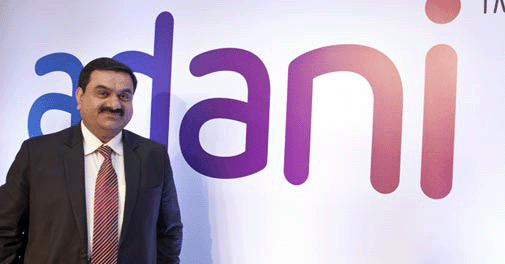
Adani mining giant faces financial fraud claims as it bids for Australian coal loan, Exclusive: Allegations by Indian customs of huge sums being siphoned off to tax havens from projects are contained in legal documents but denied by company, Guardian, Michael Safi in Delhi, 16 Aug 17, A global mining giant seeking public funds to develop one of the world’s largest coal mines in Australia has been accused of fraudulently siphoning hundreds of millions of dollars of borrowed money into overseas tax havens.
Indian conglomerate the Adani Group is expecting a legal decision in the “near future” in connection with allegations it inflated invoices for an electricity project in India to shift huge sums of money into offshore bank accounts.
The directorate of revenue intelligence (DRI) file, compiled in 2014, maps out a complex money trail from India through South Korea and Dubai, and eventually to an offshore company in Mauritius allegedly controlled by Vinod Shantilal Adani, the older brother of the billionaire Adani Group chief executive, Gautam Adani.
Vinod Adani is the director of four companies proposing to build a railway line and expand a coal port attached to Queensland’s vast Carmichael mine project.
The proposed mine, which would be Australia’s largest, has been the source of years of intense controversy, legal challenges and protests over its possible environmental impact.
Expanding the coal port to accommodate the mine will require dredging an estimated 1.1m cubic metres of spoil near the Great Barrier Reef marine park. Coal from the mine will also produce annual emissions equivalent to those of Malaysia or Austria according to one study.
One of the few remaining hurdles for the Adani Group is to raise finance to build the mine as well as a railway line to transport coal from the site to a port at Abbot Point on the Queensland coast.
To finance the railway Adani hopes to persuade the Northern Australia Infrastructure Facility (Naif), an Australian government-backed investment fund, to loan the Adani Group or a related entity about US$700m (A$900m) in public money.
While it awaits the decision on the loan, in Delhi the company is also expecting the judgment of a legal authority appointed under Indian financial crime laws in connection to allegations it siphoned borrowed money overseas.
The Adani Group fully denies the accusations, which it has challenged in submissions to the authority.
The investigation
News of the investigation was first reported in India three years ago, but the full customs intelligence document reveals forensic details of the workings of the alleged fraud which have not been publicly revealed.
The 97-page file accuses the Adani Group of ordering hundreds of millions of dollars’ worth of equipment for an electricity project in western India’s Maharashtra state using a front company in Dubai.
The Dubai company allegedly sold the exact same equipment back to Adani Group-controlled businesses in India at massively inflated prices, in some instances said to be eight times the sale price.
According to the allegations in the file, the effect of these transactions was that the Adani Group spent an average 400% more for the materials. That money was allegedly paid to a company Indian authorities allege was owned through a series of shell companies leading to a Mauritius trust controlled by Vinod Adani.
If true, one effect of the alleged scheme would have been to move vast sums of money from the Adani Group’s domestic accounts into offshore bank accounts where it could no longer be taxed or accounted for.
Because tariffs for using electricity transmission networks are determined partly by what they cost to build, if the DRI’s accusations are correct, the overvaluation of capital goods would have been likely to have led to higher power prices for Indian consumers……
The Australian loan
The Adani Group, or a linked entity, has reportedly been granted “conditional approval” for the US$700m (AU$900m) concessional loan from Naif, the Australian government investment fund.
But due to secrecy around the operation of the investment fund, it is not clear whether the loan application discloses the existence of the DRI notice or the ongoing legal proceedings, or whether the applicant is required to do so under the Naif’s anti-money laundering provisions……
The Guardian is publishing excerpts from the DRI file in the interests of ensuring Naif, as well as the public, have access to as much relevant information as possible in assessing whether Adani or linked companies would be suitable recipients of public money.
In a separate case last year, six Adani subsidiaries were listed among 40 other companies being investigated for allegedly running a similar price-inflation scheme. The companies are accused of inflating the price of coal imports from Indonesia to hide profits in overseas tax havens.
The DRI and the ED did not respond to a request to clarify the status of the investigations.
US AND KOREAN NUCLEAR PLANT CANCELLATIONS: IMPLICATIONS FOR UK NEW NUCLEAR BUILD, Prospec t Law August 10, 2017 The US currently has 100 nuclear power plants in operation supplying about 20% of its power needs. A further four were under construction, two each in Georgia and South Carolina, until the owners of the South Carolina plants recently announced the cancellation of construction of its two Westinghouse AP1000 units, Summer 2 and 3.
Summer 2 and 3 had been under construction since 2013, with original operational dates of late 2019 and late 2020. However, due to construction delays and cost overruns, these were later revised to December 2022 for Summer 2 and March 2024 for Summer 3. The finances were a key factor in the decision to cancel construction, with the original estimate of $11.5 bn having more than doubling to $25 bn. The reasons behind this are no doubt complex, but as the US has not constructed a new reactor since the 1970s, the loss of nuclear expertise must be a factor.
Summer 2 and 3 were intended to showcase advanced nuclear technology and pave the way, along with the Georgia plants – also Westinghouse AP1000s, for a nuclear renaissance in the US. A further four AP1000s and 12 SMRs (Small Modular Reactors) are currently proposed and several more are in the early stages of planning. The fate of these and the two Georgia plants remains to be seen…….
The Westinghouse bankruptcy has also complicated the picture in the US, with its AP1000 design being used for the South Carolina and Georgia projects and its role being reduced to a vendor supporting the EPC. Their situation has also had an effect in the UK, with Toshiba’s stake in Nu-Gen now being considered by KEPCO. Rather than utilise the Westinghouse design, which was approved by the UK nuclear regulator, ONR, in March this year, KEPCO wants to use its own technology, which will cause a delay in construction of the Moorside plant while the necessary regulatory design assessment is undertaken.
The South Korean nuclear industry is also in difficulty, with the new anti-nuclear government suspending construction of the Shin Kori 5 and 6 nuclear plants for several months while it undertakes a public consultation on their future. This decision has generated much debate in the country and is seen as a threat to its nuclear exports, and KEPCO’s future Nu-Gen.
Where will Trump and Kim’s nuclear brinkmanship lead?CBS News, 13 Aug 17, President Trump says the U.S. military is “locked and loaded” in its confrontation with North Korea. But how exactly would all that firepower be used? Here’s David Martin at the Pentagon:Behind the “fire and fury” rhetoric, there is one very hard fact: If the U.S. were to unleash its military power against North Korea, it would result — in Secretary of Defense James Mattis’ words — in “the end of its regime and the destruction of its people.”
Before he retired, Admiral James Winnefeld was the vice chairman of the Joint Chiefs of Staff, the number two man in uniform, during the Obama Administration. He knows that one submarine like the USS Kentucky can by itself carry enough nuclear weapons to annihilate North Korea.
When asked to compare America’s nuclear forces to Korean nuclear forces, Adm. Winnefeld replied, “Well, there’s just no comparison whatsoever.”
Martin asked, “Were Kim Jong Un, for whatever reason, to launch a nuclear weapon against the United States, would he, in essence, be committing suicide?”
“Absolutely. Yeah, I mean, there is just no question that we would undertake a proportional response,” Adm. Winnefeld replied. “But in the case of a nuclear weapon, that proportional response would be overwhelming and would probably mean the end of the Kim regime — and he knows it.”…..
“The North Korean regime has hundreds of artillery cannons and rocket launchers within range of one of the most densely-populated cities on Earth, which is the capital of South Korea,” said Mattis.
Kim — like his father and grandfather before him — has lived under what he believes to be the constant threat of an attack from the south. That fear (some would call it paranoia) is what is driving his quest for a nuclear weapon.
“He wants to have what we would view as a credible nuclear threat so we won’t attack him,” WInnefeld said, …. he could not be certain a nuclear armed missile would get through the missile defense system, but he could be certain that if he tried, it would be the end of his regime.
“I think At the end of the day,” said Adm. Winnefeld, “two essential facts stand out: The first is, it’s very unlikely that he will ever willingly give up his program. But it’s also very, very unlikely that he will ever use it, as long as we don’t try to overthrow his regime.”
A Preemptive Strike on North Korea Would Be Catastrophic and Illegal TruthOut , August 12, 2017, By Marjorie Cohn, As Special Counsel Robert Mueller impanels two grand juries to investigate Donald Trump and his associates, and former Trump campaign manager Paul Manafort’s home is searched, Trump needs to distract attention from the investigation into his alleged wrongdoing.
North Korea has provided just such a distraction — albeit a potentially catastrophic one.
On Tuesday, Trump stated, “North Korea best not make any more threats to the United States. They will be met with fire and fury like the world has never seen.” Friday morning, Trump warned North Korea that the US military is “locked and loaded.”
Trump has learned that bombing other countries enhances a president’s popularity. In April, with 59 Tomahawk cruise missiles, each armed with over 1,000 pounds of explosives, he went from scoundrel-in-chief to national hero virtually overnight. The corporate media, the neoconservatives and most of Congress hailed Trump as strong and presidential for lobbing the missiles into Syria, reportedly killing nine civilians, including four children.
Several hours after Trump’s recent “fire and fury” statement, Pyongyang warned it was “carefully examining” a strike that would create “an enveloping fire” around Guam, the site of an important US military base and home to more than 160,000 people.
North Korea has accused the United States of planning a “preventive war,” saying that plans to mount one would be met with an “all-out war, wiping out all the strongholds of enemies, including the US mainland.” A spokesman for the General Staff of the Korean People’s Army promised, “the tragic end of the American empire will be hastened.”
In an attempt to tamp down fears of all-out war, Secretary of State Rex Tillerson said there is not “any imminent threat” from North Korea.
But Defense Secretary James Mattis cautioned that Pyongyang “should cease any consideration of actions that would lead to the end of its regime and the destruction of its people.” And National Security Adviser H.R. McMaster said that the White House is considering all options, including “preventative war.”…….
An Attack on North Korea Would Be Dangerous
The Intercept reports that “even a conventional war between the US and [North Korea] could kill more than 1 million people; a nuclear exchange, therefore, might result in tens of millions of casualties.”……
A Preemptive Strike on North Korea Would Violate the UN Charter
A preemptive strike on North Korea would be illegal. It would violate the United Nations Charter, which forbids the use of military force unless conducted in self-defense or when approved by the Security Council…..
Sign a Peace Treaty, End the Korean War
Moreover, North Korea cannot forget the 1950-1953 Korean War, which reduced North Korea’s population of 10 million by approximately one-third. Sixty-four years ago, the United States and North Korea signed an armistice agreement, but the US never permitted the creation of a peace treaty……..
Far from being an intractable foe, North Korea has repeatedly asked the United States to sign a peace treaty that would bring the unresolved Korean War to a long-overdue end.”
A month ago, China and Russia proposed a “freeze-for-freeze” strategy, which would entail North Korea freezing its nuclear and missile testing, and in return, the US and South Korea would end their annual joint military exercises. This proposal, issued in a joint statement by the Chinese and Russian Foreign Ministries after meetings between Russian President Vladimir Putin and Chinese President Xi Jinping, is a diplomatic solution that should be pursued……..
As we stand on the precipice of a disastrous war, these are the right circumstances for Trump to meet with Kim Jong-un. If Trump were to successfully negotiate a peace treaty with North Korea, he would receive plaudits for being a real diplomat. The unthinkable alternative is military action that would cause the deaths of untold numbers of Koreans, Japanese people and Americans. http://www.truth-out.org/news/item/41598-a-preemptive-strike-on-north-korea-would-be-catastrophic-and-illegal
Kim Jong-un views nuclear weapons as a way to escape fate of Saddam and Gadhafi North Korea’s nuclear weapons unnerve the world, but are a security blanket for the regime, By Mark Gollom, CBC News Aug 13, 2017 William Tobey, a nuclear non-proliferation expert who has taken part in past Six Party Talks with North Korea, says anyone who claims to perfectly understand the motivations of the North Korean government, and does not live in Pyongyang, is probably blowing smoke.
But Tobey and most experts agree that North Korean leader Kim Jong-un’s No. 1 goal is self-preservation. For Kim, the pursuit of nuclear weapons and a missile program is a rational way to stave off attempts by the U.S. to overthrow his regime.
“I think most people ascribe a motivation of regime preservation to their nuclear programs,” Tobey said. “So it would be used to deter any attacks that would be aimed at dislodging the government.”
Nuclear ‘treasure sword’
The North Korean government has said as much in its public statements, Tobey said, and those should be taken “at face value.”
A commentary published by North Korea’s state KCNA news agency in January last year stated that “history proves that powerful nuclear deterrence serves as the strongest treasure sword for frustrating outsider’s aggression.”
The piece suggested North Korea fears suffering the same demise as Saddam Hussein’s Iraq and Moammar Gadhafi’s Libya, that neither could “escape the fate of destruction after being deprived of their foundations of nuclear development and giving up undeclared programs of their own accord.”
Philip Yun, a former senior adviser to two U.S. co-ordinators for North Korea at the Department of State, said that he has been in hundreds of hours of negotiations with the North Koreans. “Every single time during that period, they talked about [Slobodan] Milosevic and they talked about Saddam Hussein and subsequently talked about Gadhafi — if they had nuclear weapons they’d still be there.”…….
Preserving the dynasty
If North Korea truly believes an attack is imminent, it would launch its own strike, believing it has nothing to lose, said Tom Collina, director of policy at Ploughshares Fund, a think-tank dedicated to reducing the dangers of nuclear weapons.
But North Korea would not attack “out of the blue,” because it knows that would be suicidal, the end of the regime, he said…….
Tobey said he believes the “no viable options” view is a myth and that the U.S., South Korea and Japan need to step back and take a deep breath. North Korea, he reminded, is a tiny country, with a tiny economy, and it knows the regime would end if it deployed any serious weapons.
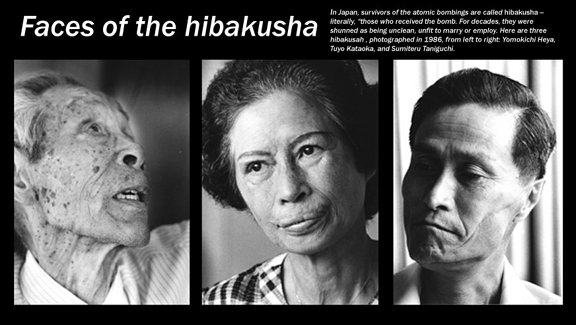
New head of A-bomb sufferers’ group strives for a world with no new hibakusha https://mainichi.jp/english/articles/20170812/p2a/00m/0na/025000c, August 13, 2017 (Mainichi Japan) “The dropping of an atomic bomb is an act decided by humans. Likewise, if humans decide to work together, we can eliminate nuclear weapons.” These were the words uttered by 77-year-old Sueichi Kido, who took over from Terumi Tanaka, 85, in June, as secretary-general of the Japan Confederation of A- and H-Bomb Sufferers Organizations after Tanaka had served in the role for 20 years.
Kido, himself an atomic bomb survivor (hibakusha), was just 5 years old when the atomic bomb was dropped on the city of Nagasaki. He was about 2 kilometers away from the hypocenter, and suffered burns to his face and upper body as a result.
The existence of hibakusha such as Kido became widely known once the press code that was in place during the Allied Occupation after World War II was lifted. He soon began to realize that he himself was a hibakusha. However, fearing discrimination, he decided not to tell people around him.
Twenty-five years after the atomic bomb was dropped on Nagasaki, Kido’s father died after bleeding from his eyes, nose and gums. Before Kido got married, he told his wife that he was a hibakusha. His wife’s older brother opposed the marriage and refused to attend the wedding.
In 1990, he attended a meeting in Gifu Prefecture aimed toward providing consultations for hibakusha, and the following year, he decided to set up a hibakusha group in the same prefecture. He came to feel that it was his duty as a hibakusha “to put his life on the line and strive toward making sure there are no more hibakusha in the future.”
In July this year, a historic treaty banning nuclear weapons was adopted — something hibakusha had wanted to see for many years. Nuclear nations and Japan are critical of the treaty, but Kido says, “There is no justice in the theory of nuclear deterrence. Nuclear nations and Japan are obviously being driven into a corner.”
To date, the Japan Confederation of A- and H-Bomb Sufferers Organizations has demanded that a clause on government compensation to people who have suffered from atomic bombs be inserted in the Atomic Bomb Survivors’ Assistance Act. As the new secretary-general of the confederation, Kido is striving toward achieving this goal.
“This clause isn’t just about atonement for the past. It is necessary in order to ensure that there are no more wars or damage involving nuclear weapons in the future,” Kido says.
Donald Trump says US military solutions ‘locked and loaded’ against North. Korea.news.com.au , AUGUST 12, 2017US PRESIDENT Donald Trump says North Korean leader Kim Jong-un will “regret it and regret it fast” if he attacks the US air bases in Guam or any of America’s allies.
Mr Trump’s latest threat comes after he declared on Friday via Twitter that the US military was “locked and loaded”, and ready to act against the rogue regime……..
While Mr Trump talks up the US’s military might, his lieutenants have been attempting to diffuse the situation via diplomatic backchannels, but the President declined to discuss these tactics.
“We don’t want to talk about progress, we don’t want to talk about backchannels, we want to talk about a country that has misbehaved for many, many years — decades actually — through numerous administrations and they didn’t want to take on the issue and I have no choice but to take it on and I’m taking it on,” Mr Trump said.
“We’ll either be very, very successful quickly or we’re going to be very, very successful in a different way quickly.”
German Chancellor Angela Merkel has criticised Mr Trump’s inflammatory language towards North Korea, saying “I consider an escalation of rhetoric the wrong answer”.
“I do not see a military solution to this conflict,” she added.
“Let her speak for Germany,” Mr Trump said in response.
Politicians from both sides of American politics have criticised Mr Trump’s approach to the conflict — especially his threat to rain down “fire and fury” on North Korea — saying his comments have raised the tension.
“My critics are only saying that because it’s me,” he said.
“If somebody else uttered the exact same words that I uttered they’d say, ‘What a great statement, what a wonderful statement’……
Also on Friday, Mr Trump retweeted a US Pacific Command message that said US planes stand ready to “fulfill a #FightTonight mission”.
The threats follow a week of escalating rhetoric between the two countries after the US threatened “fire and fury” against the rogue state.
North Korea retaliated by releasing potential plans to strike the US territory of Guam in the Western Pacific, however US diplomats say a dialogue is being pursued and Americans should “sleep well” at night.
The country’s official Korean Central News Agency reported on a mass rally held in Pyongyang’s Kim Il-sung Square and cited the secretary of the Pyongyang City Youth League Committee as saying “the young people in the country would become five million human bullets and bombs and nuclear warheads to blow the US from this planet”.
Meanwhile Australian Prime Minister Malcolm Turnbull said Australia would come to the aid of the United States if North Korea attacks America……
Despite the rhetoric, US officials said there was no major movement of U.S. military assets to the region, nor were there signs Pyongyang was actively preparing for war.
Military officials will move ahead with planned drills between the US and South Korea. Called Ulchi-Freedom Guardian, the exercises are expected to run from August 21-31 and involve tens of thousands of American and South Korean troops on the ground and in the sea and air.
Washington and Seoul say the exercises are defensive in nature and crucial to maintaining a deterrent against North Korean aggression…..
The streets of Pyongyang also reportedly remain calm amid rising tension in the region.
German Chancellor Angela Merkel says she doesn’t see a military solution to rising tensions between the United States and North Korea and called for a de- escalation of the rhetoric.
August 10th, 2017
By ENENewsMainichi, Aug 10, 2017 (emphasis added): Suspected bomb found on premises of Fukushima power plant: TEPCO — What appears to be an undetonated bomb has been discovered on the premises of the Fukushima No. 1 Nuclear Power Plant, Tokyo Electric Power Co. (TEPCO) announced on Aug. 10. The device was discovered buried in the ground at a parking lot currently undergoing maintenance in the western corner of the premises… Police have cordoned off the surrounding area
Kyodo, Aug 10, 2017: Unexploded ordnance found at Fukushima No. 1 nuclear power plant
NHK, Aug 10, 2017: Unexploded bomb found near Fukushima plant — Police are checking what appears to be an unexploded bomb found near the crippled Fukushima Daiichi nuclear power plant… Police were sending the pictures of the object to the Self-Defense Forces to determine whether it could explode…
BBC, Aug 10, 2017: Fukushima disaster: ‘WW2 bomb’ found at Japan nuclear site — A suspected unexploded bomb has been found at the site of the Fukushima nuclear plant… Tepco said construction work was immediately suspended after the object was found and a temporary exclusion zone put in place while bomb disposal experts were deployed…
AP, Aug 10, 2017: Officials say the rusty object is about 85 centimeters (33 inches) long and 15 centimeters (6 inches) wide. A military unit is headed to the site…
AFP, Aug 10, 2017: Japan’s Jiji Press reported that under such circumstances police call in bomb disposal experts from Japan’s military.
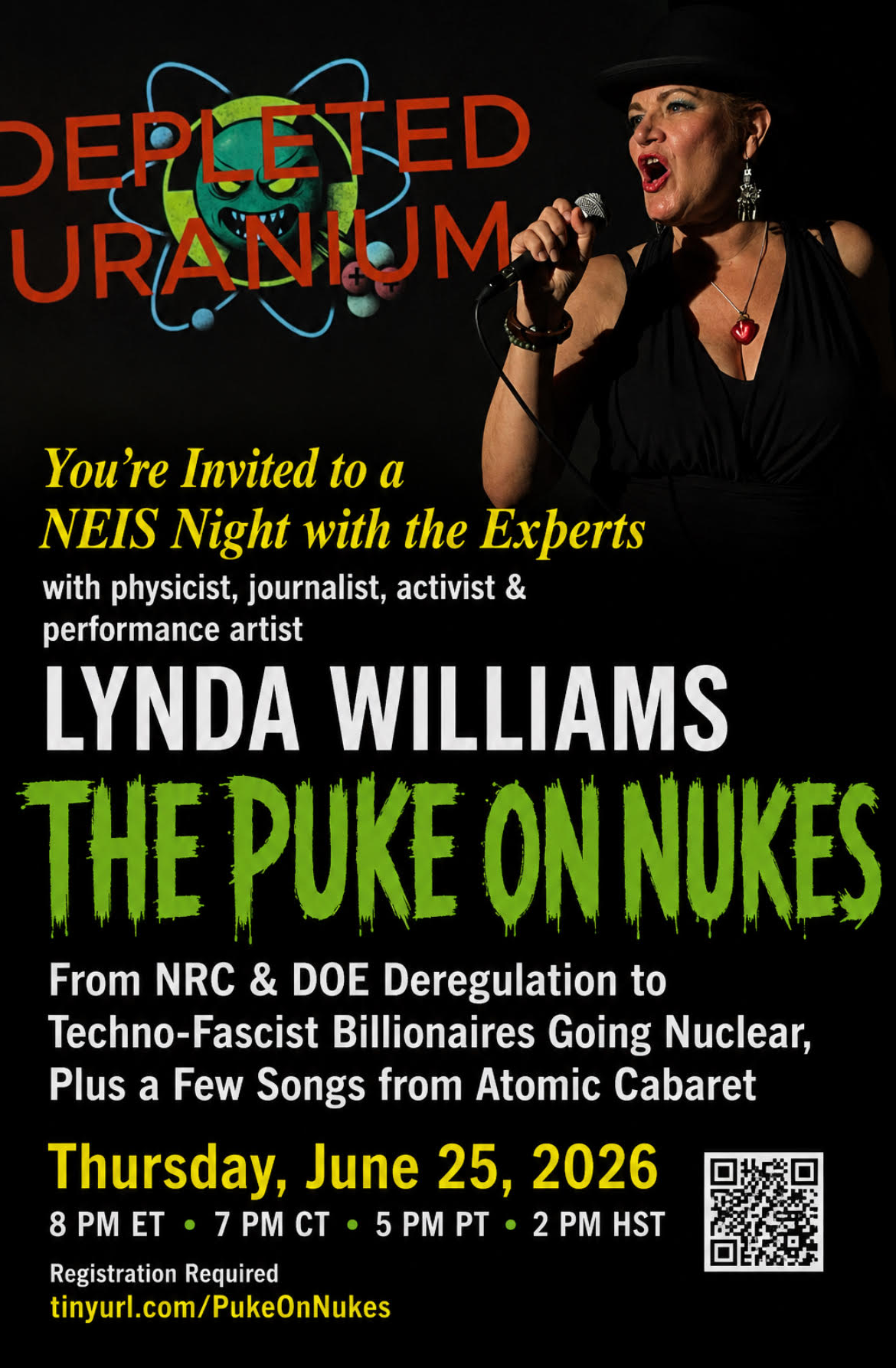
7pm Central Time (8pm ET, 6pm MT, 5pm PT) UTC – 5 From NRC & DOE Deregulation to Techno-Fascist Billionaires Going Nuclear, Plus a Few Songs from Atomic Cabaret REGISTER


 | Aug. 17, 2017











 nuclear-news