Nuclear energy policy emerges as key difference between Abe and Koike, Japan Times, 30 Sept 17
JIJI Nuclear power is emerging as a key policy issue ahead of the Oct. 22 Lower House election, with Tokyo Gov. Yuriko Koike saying her new party will aim to phase it out.
Prime Minister Shinzo Abe and his ruling Liberal Democratic Party view nuclear power as a stable source of energy and want to put more of the nation’s idled reactors back online.
But Koike’s Kibo no To (Party of Hope) is exploring a policy that would eventually eliminate the use of nuclear energy.
“We’ll examine how to bring down the reliance to zero by 2030,” Koike told a news conference on Thursday.
Chinese firm behind Essex nuclear plant refuses to reveal security information,Guardian, Adam Vaughan, 2 Oct 17 ,State-owned company refused disclosure of security arrangements for Chinese plant the Bradwell nuclear station could be modelled on. The Chinese state-owned company planning a nuclear power station in Essex refused to share the security arrangements for a Chinese nuclear plant with the British authorities, it has been revealed.
A green light from the Office for Nuclear Regulation (ONR) would be a huge boost for China’s aspirations for exporting nuclear technology and Bradwell would be the first Chinese reactor to be built in a developed country.
Overall the ONR welcomed the “high level of expertise and commitment” shown by the Chinese, according to a report of the visit on 13-16 March, released to the Guardian under freedom of information rules.
However, CGN said it could not share material about security measures to protect its nuclear plant in Fangchenggang, China, which Bradwell could be modelled on.
“With regard to the sharing of information, such as the security plans for FCG [Fangchenggang] Unit 3, CGN stated that these were protected documents under Chinese regulations,” the UK authorities wrote, in a glimpse of UK nuclear regulation rubbing up against Chinese state secrecy.
But the ONR insisted that it was commonplace for foreign nuclear companies not to share sensitive documents around national security during the UK nuclear approval process, known as the Generic Design Assessment (GDA). It added that it was the arrangements for Bradwell that were relevant, not Fangchenggang………
CGN put up a third of £18bn cost towards EDF’s project to build French-designed reactors at Hinkley Point C in Somerset, in return for developing its own plant at Bradwell in Essex. The Bradwell B project is two thirds owned by CGN and one third EDF.
The Cleanup At Japan’s Fukushima Nuclear Plant Has Been Delayed Yet Again https://www.gizmodo.com.au/2017/09/the-cleanup-at-japans-fukushima-nuclear-plant-has-been-delayed-yet-again/George Dvorsky, With the backing of Japan’s government, Tokyo Electric Power Company Holdings (TEPCO) has decided to revise its plan to remove highly radioactive spent fuel from the damaged Fukushima nuclear power plant. It’s the fourth re-think made by the utility since the plant suffered a meltdown following the 2011 earthquake and tsunami — and yet another delay to a plan that’s expected to take anywhere from 30 to 40 years.
TEPCO, the company responsible for cleaning up the beleaguered Fukushima plant, has sketched out a revised roadmap for the decommissioning process, which was approved by Japan’s government yesterday, reportsThe Japan Times. The new plan calls for the extraction of the highly radioactive spent fuel from the cooling pools of reactors one and two starting in 2023 instead of 2020. Work on reactor three will go ahead as planned next year, having already been delayed earlier this year. All three reactors experienced core meltdowns following the 2011 earthquake and tsunami.
The decision to delay the decommissioning process was informed by recent robotic surveys and the identification of new technical and safety issues. In February of this year, soaring radiation levels fried a robot that was sent in to inspect and clean reactor two. Then in July, an aquatic robot managed to send back photos of what appeared to be melted nuclear fuelat the bottom of reactor three. The precise location of the melted fuel still needs to be confirmed, however, and more work needs to be done to create robots that can withstand the intense levels of radiation near the core. The new delays announced by TEPCO today were prompted by these realities, along with the discovery of previously unknown damage in the storage pool areas and the need for further radioactive decontamination.
Naohiro Masuda, head of TEPCO’s decommissioning efforts, said the three to four decade plan “may not sound convincing because of all the unknowns and [because] we haven’t found most of the melted fuel” within the reactor cores. But what’s needed, he said, is a target for developing the technologies required to accomplish this goal.
Under the revised plan, the cleanup process will require the removal of the fuel rod assemblies from the spent fuel pools before any of the melted fuel debris can be removed. An extraction plan for the removal of the radioactive debris won’t even be considered until 2019. At this point, the best case scenario sees the extraction of the melted nuclear fuel starting in 2021.
But TEPCO has also delayed choosing the specific method for the debris extraction, which is considered the most challenging phase of the decommissioning process. The favoured method at this point would involve removing the debris from the sides of the reactors after partially filling them up with water. That said, TEPCO still needs to produce an estimate showing how long it will take to remove the melted fuel, and a plan showing how and where the radioactive waste will be stored. It also has to decide what to do with the Fukushima plant itself.
If all this isn’t enough, there’s all that contaminated water to consider as well. TEPCO’s updated roadmap establishes new goals to reduce the amount of underground water at the plant. Currently, clean water underneath the plant is getting mixed together with water that’s being used to cool the damaged reactors, which subsequently becomes contaminated with radiation. TEPCO has made some progress in this regard, but it would now like to cut the amount of water used to 150 tonnes per day from the current 200 tonnes.
As this unfortunate episode makes painfully clear, when nuclear power goes wrong, it really goes wrong. Should all go according to plan, the plant won’t be fully decommissioned until the mid 2050s, and possibly even later given the many technical challenges that await.
Nuclear bomb shelter sales are soaring due to North Korean threats, Yahoo Finance Daniel Howley Technology Editor, the saber rattling, coupled with North Korea’s stated objective of developing a nuclear-tipped missile capable of reaching the U.S. mainland, have plenty of people on edge.
And nowhere is that clearer than in the number of nuclear fallout shelters being purchased here in the U.S.
“We’re probably upwards of 1,000% from this time last year,” Gary Lynch, general manager of Rising S Company said of the number of bunkers his company has sold in 2017.
A size for everyone (sort of)
Texas-based Rising S Company, whose tagline is “Safe until the rising sun,” a nod to the Christian belief that the Second Coming of Christ will precede the end of the world, offers bunkers in a variety of price ranges. The base model is an 8 x 12-foot mini bunker for $39,500 while the top-of-the-line “The Aristocrat” luxury bunker, which features a bowling alley, gym, gun range, green house, pool and garage, goes for $8,350,000.
Sharon Packer, CEO of Utah-based Underground Shelters USA, says her company has seen sales of bunkers triple this year, with a significant increase taking place in the last six months. Packer, a nuclear engineer, says her company’s shelters can survive being within 1/4 of a mile from the blast crater of a 1-megaton nuclear bomb.
Underground’s best-selling shelter costs about $70,000 and gets you about 32 x 10 feet of space. Packer says you’d be able to stay in one of her company’s shelters for as long as you have access to clean water.
Brian Duvaul, sales manager with American Safe Room, a bunker company based in Oregon, explained that sales generally slow down around fall and winter as the ground becomes difficult to dig, but that so far this fall, sales are looking up…….
Indo-US Nuclear Agreement Is An Arms Deal: Ex-US Senator Larry Pressler https://www.ndtv.com/india-news/indo-us-nuclear-agreement-is-an-arms-deal-ex-us-senator-larry-pressler-1756557 Former US Senator Larry Pressler said the focus of Indo-US bilateral partnership should be on ‘agriculture, technology and health care’ All India | Press Trust of India September 29, 2017 NEW DELHI: The civil nuclear cooperation agreement between India and the US is more of an “arms deal”, but the focus of the bilateral partnership should be on “agriculture, technology and health care”, former US Senator Larry Pressler said today. Mr Pressler, who has served as chairman of the US Senate’s Arms Control Subcommittee, also had a word of caution for Pakistan.
He said if Pakistan did not act on terrorism, the Trump administration could declare it “a terror state”. “I would love to see peaceful use of nuclear energy, but I am worried that so far it (nuclear agreement) has mostly been an arms deal. It seems to me that much of the new agreement is a large arms sale to Indians,” Mr Pressler said.
The former US Senator was speaking during the launch of his book.
India and the US signed the nuclear cooperation agreement in October 2008, ending India’s isolation by the West in the nuclear and space arena. The deal has given a significant boost to India’s nuclear energy production.
Mr Pressler said former US President Barack Obama’s visit to New Delhi was “largely an arms sale trip”. On whether the US could declare Pakistan a “terror state”, he said, “Unless Pakistan does not change certain things, it may happen. Moreover, the Trump administration is making sounds that they are getting near this. And I hope they do.”
Mr Pressler is known for advocating amendments in the 1990s which banned most of the economic and military assistance to Pakistan, unless the US President certified on an annual basis that Islamabad did not possess nuclear explosive devices.
NAGAON (HAIBORGAON), Sept 25:Sensation prevailed in Nagaon as well as in the State on Monday morning soon after sleuths of Army Red Horn Division along with Nagaon Police seized a large quantity of suspected materials related to IED or bomb from a household at Dakhinpat Borkula village under Nagaon Sadar Police station and also apprehended three persons, including a woman.
Interestingly, the weight of the seized suspected materials is around 35 kg. According to sources, the nabbed persons have been identified as Jatin Bora of Baksa, Apurba Das of Tihu in Nalbari district and Mamoni Kour of Borkula village. The suspected materials were hidden inside a big hole behind her house. Army as well as police later seized a Chevrolet car bearing registration number AS 01BZ 4775 from their possession.
The sources further added that the materials although earlier suspected as bomb-related materials, were later suspected to be uranium. But till filing of this report it had not been confirmed.
The sleuths called for a special unit of NDRF from Kolkata and the unit reached Borkula village by Monday evening. The sources added that the sleuths of Army Red Horn Division on Sunday followed both the youth, Jatin Das and Apurba Das along with the Chevrolet car from Guwahati and reached Nagaon. Later the suspected materials were recovered from the household.
Nikkei Asian Review 25th Sept 2017,Japan and the U.S. will likely let their existing nuclear cooperation
agreement renew automatically when the pact expires next July, enabling
Tokyo to continue reprocessing spent nuclear fuel.
President Donald Trump’s administration has no intention of ending or renegotiating the deal, a
spokesperson at the U.S. State Department told The Nikkei Saturday. Since
the Japanese government has been seeking the pact’s renewal, there is now a
good chance that the treaty will simply remain in force without any
modifications. https://asia.nikkei.com/Politics-Economy/International-Relations/US-to-renew-nuclear-pact-with-Japan
Will North Korea sell its nuclear technology? The Conversation, Daniel Salisbury
Earlier this month CIA Director Mike Pompeo suggested “the North Koreans have a long history of being proliferators and sharing their knowledge, their technology, their capacities around the world.”
My research has shown that North Korea is more than willing to breach sanctions to earn cash.
A checkered history
Over the years North Korea has earned millions of dollars from the export of arms and missiles, and its involvement in other illicit activitiessuch as smuggling drugs, endangered wildlife products and counterfeit goods.
http://www.enn.com/ecosystems/article/52701 From: University of Victoria September 29, 2017, For the first time since 2011, peak contamination levels in Pacific Canadian waters from Japan’s Fukushima Daiichi nuclear disaster are known, says a University of Victoria scientist who has been monitoring levels since the meltdown of three reactors at the plant.
Releases of radioactive elements from the Fukushima Daiichi Nuclear Power Plant accident in 2011 were the largest unplanned discharges of radioactivity into the ocean. The disaster, triggered by a 15-metre tsunami caused by a magnitude-9 earthquake, created widespread concern over the potential impact on marine life and human health.
“Contamination from Fukushima never reached a level where it was a significant threat to either marine or human life in our neighborhood of the North Pacific,” says UVic chemical oceanographer Jay Cullen.
But it’s not the fear of a deliberate nuclear attack that has scholars and experts in East Asia most worried, but something totally accidental.
Recent sanctions against North Korea have been designed not only to cripple the country’s economy, but to stop them gaining the equipment needed to make more nuclear weapons.
But those same sanctions could prevent North Korea getting the supplies they need to maintain their existing nuclear facilities.
“There could be a nuclear accident, and that could be a nuclear weapon exploding and releasing radiation, or it could be the nuclear facilities breaking down and causing a Fukushima-style radiation leak,” Stephen Nagy of Tokyo’s International Christian University told nine.com.au.
“If you think about where North Korea is, that radiation would spread into northeast China, probably go to South Korea, and it would affect parts of Japan as well.”
Most experts agree that North Korea simply wants a nuclear bomb as a deterrent to prevent other nations bombing or invading them. And the purpose of their various weapons tests is a demonstration not of what they will do, but of what they can do.
Dr Nagy said most people in Tokyo are “not so concerned about an actual attack”. “They worry about a launch over Japan, and what happens if it falls into Japan accidentally?” he said. “What happens if that weapon does carry a nuclear weapon and there’s an accident?”
It’s not an unreasonable concern, though North Korea is unlikely to do something so provocative as firing a nuclear weapon over another country.
But Pyongyang has fired two intercontinental ballistic missiles over Japan’s northern island of Hokkaido, a literal shot across the bow as a sabre-rattling method.”If a launch falls down on Japan, does that mean that the United States goes to war?” Dr Nagy said. “Does that mean the nuclear fallout falls on Japan?”
Nuclear fallout can be far-reaching and devastating. The Chernobyl meltdown of 1986 spread a cloud of radiation stretching from Iran to Ireland.
North Korea is not as geographically isolated as many people think. The sprawling metropolis of Seoul has a population of 25 million and is walking distance from the border. And a serious nuclear accident in North Korea could spread radiation across the most heavily populated part of the world, with Beijing, Shanghai, Tokyo and Vladivostok certainly within range.
As with all nuclear meltdowns, the extent of the radioactive damage is based on the strength and direction of the wind.
There are already radiation fears stemming from North Korea’s detonation site, the mountain of Punggye-ri. Chinese scientist Wang Naiyan flagged the possibility the mountain could collapse, leaking radioactive material into the atmosphere.
Perhaps even more concerning is the prospect of an accidental detonation of a nuclear bomb on North Korean soil.
A 250-kiloton detonation would be so broad and destructive that it would be difficult to determine the cause.
So it is entirely possible an accidental explosion would be indistinguishable from a nuclear attack from the United States, triggering a nuclear war.
No choice for US but to accept a nuclear North Korea, ex-CIA analyst sayshttp://www.scmp.com/news/china/diplomacy-defence/article/2113296/no-choice-us-accept-nuclear-north-korea-and-more 28 Sept 17,US acceptance of a nuclear North Korea might include a nuclear-armed South Korea, said Su Mi Terry, who served under former US president George W. Bush. The US has no choice but to accept the nuclearisation of North Korea and China may need to live with a South Korea that is nuclear-armed or at least more heavily weaponised than the US’s ally is now, said a northeast Asia analyst formerly with the CIA.
US acceptance of a nuclear North Korea would need to come with military measures that include at minimum a robust missile defence system in South Korea regardless of how China might react to such a scenario, Su Mi Terry, who served as a senior North Korea analyst in the CIA under former President George W. Bush, told the South China Morning Post.
“We can be creative about containment and deterrence,” Terry, now a senior adviser at Bower Group Asia, a consultancy specialising in Asia-Pacific issues, said in an interview.
A containment and deterrence policy “doesn’t have to mean that we just sit around and say ‘that’s OK’. It may mean missile defence. It may mean ultimately after North Korea acquires its capability to attack the United States with a nuclear-tipped ICBM, it may mean that South Korea will have to go nuclear”.
Terry’s remarks reflect what some analysts are saying about realistic outcomes for the stand-off on the Korean Peninsula, but run counter to the official line in Washington and Beijing.
While the US and China have cooperated on passing unanimously a series of sanctions against Pyongyang and condemnations of the country’s nuclear weapons programme, the deployment of a US missile defence system in South Korea has stirred China’s anger.
In addition to her role at Bower Group, Terry is also a senior research scholar at the Columbia University’s Weatherhead East Asian Institute
China has consistently opposed the deployment of the US’s Terminal High Altitude Defense (THAAD) system in South Korea, saying it would do little to deter the missile threat from North Korea while allowing the US military to use its radar to look deep into China’s territory and at its missile systems.
The US and South Korea have resisted such calls, arguing that THAAD is a defensive system only. Yet, an effective missile defence for South Korea would likely require even more than the existing THAAD deployment.
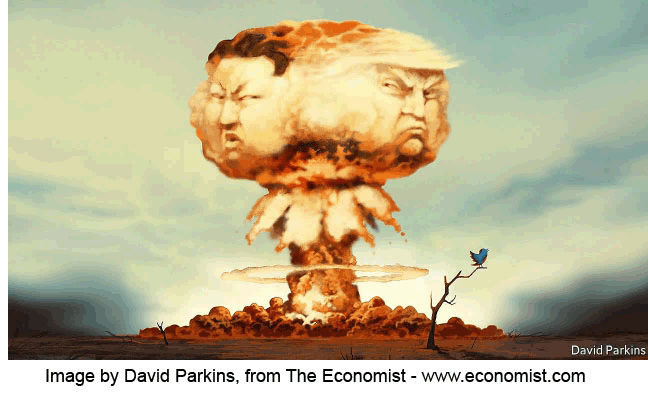
The likelihood that the US and China will clash over containment and deterrence options has risen following a volley of militaristic threats between US President Donald Trump and Kim.
North Korea “will have to continue with the provocations, they will have to continue and complete their [nuclear] programme because Kim Jong-un has made it personal and Trump has made it personal”, Terry said.
“You see Kim Jong-un’s statement which came out after Trump made his UN speech. I’ve never seen anything like that, where he says he takes it personally, writing in the first person on the front page of Rodong Shimbun (an official North Korean government newspaper) and putting his name to it. There’s no way Kim Jong-un is going to back down from that. If he was going to back down he would not have made it so personal.”
Terry was referring to Kim’s response to a threat Trump made in his speech to the United Nations General Assembly last week to “totally destroy” North Korea. Kim said in his response carried by state media: “I will surely and definitely tame the mentally deranged US dotard with fire.”
China and the US remain engaged in finding a solution to their concerns around North Korea, with both sides aiming for denuclearisation.
US Secretary of State Rex Tillerson left Washington for Beijing on Thursday and will be there until October 1 for talks that will include Pyongyang’s nuclear and missile programmes.
Tillerson and his Chinese counterparts “will discuss a range of issues, including [President Donald Trump’s] planned travel to the region, the denuclearisation of the Korean Peninsula and trade and investment”, the US State Department said in an announcement earlier this week.
Former NATO military chief: there’s a 10% chance of nuclear war with North Korea
And a 20-30% chance of a conventional one. Vox by Yochi DreazenRetired Navy Adm. James Stavridis spent 37 years in the military, including four years as the supreme allied commander of NATO. Hillary Clinton vetted him as a possible running mate. President-elect Donald Trump considered naming him secretary of state. He is a serious man, and about as far from an armchair pundit as it’s possible to be.
And that’s precisely what makes his assessment of the escalating standoff with North Korea so jarring. Stavridis believes there’s at least a 10 percent chance of a nuclear war between the US and North Korea, and a 20 to 30 percent chance of a conventional, but still bloody, conflict.
“I think we are closer to a significant exchange of ordnance than we have been since the end of the Cold War on the Korean peninsula,” he said during a panel I moderated Tuesday at the University of Pennsylvania’s Perry World House.
His estimate of the potential death toll from even a nonnuclear war with North Korea is just as striking. North Korea has at least 11,000 artillery pieces trained on Seoul, South Korea’s capital of 25 million people, and would be certain to use them during any conflict. The US would be just as certain to mount a sustained bombing campaign to destroy those artillery pieces as quickly as possible.
The result? “It’s hard for me to see less than 500,000 to 1 million people, and I think that’s a conservative estimate,” he said.
Remember: That’s assuming North Korea doesn’t use its arsenal of nuclear weapons, which can already hit Seoul and much of Japan.
Speaking at the same event, Michèle Flournoy, formerly the No. 3 official at the Pentagon in the Obama administration, said Trump’s harsh rhetoric toward Pyongyang — which has included deriding North Korean leader Kim Jong Un as “Little Rocket Man” — created the real risk of an accidental war between the two countries.
“My worry is that all of this heated rhetoric has really charged the environment so that it’s much more likely now that one side or the other will misread what was intended as a show of commitment or a show of force,” she said. “It could be the basis of a miscalculation that actually starts a war that wasn’t intended at that moment.”…….
Here’s why the odds of war with North Korea are rising
Both Stavridis and Flournoy see Kim as a fundamentally rational leader whose overriding goals are to ensure the survival of his regime and his personal control over North Korea. Nuclear weapons, in Flournoy’s words, are “the ace that he could play if there was a conflict to say, ‘Stop, you’re not going to take me out without risking nuclear war.’”
查看繁體中文版 By RICK GLADSTONE and DAVID E. SANGER,North Korea threatened on Monday to shoot down American warplanes even if they were not in the country’s airspace, stating that President Trump’s comments suggesting he would eradicate North Korea and its leaders were “a declaration of war.”
The nuclear threat can be contained by diplomacy, These issues are manageable if they are given the right degree of priority, John Sawers Ft.com 25 Sep 17 “……… North Korea is the issue of the day. The objective of a denuclearised Korean peninsula, pursued by the previous US administrations, is no longer an achievable goal.
The best that can be hoped for is the suspension of nuclear and missile testing in return for security assurances and practical aid. Sanctions are designed to draw Kim Jong Un into a negotiation with that aim, and to pressure China to take a more active part. But it is very hard to see President Kim pulling back now. And China is more concerned about a new US-led war in Korea or the north collapsing and sending millions of refugees into China, than it is about living with a nuclear armed Pyongyang.
The US only really has two strategic options: contain and deter the threat; or destroy it, which would require regime change. There are always military options. But all who have studied the secret Pentagon plans are sobered by the scale of loss of life in South Korea these would entail. There is also a risk of China reluctantly coming to the aid of the north as it did in the 1950s.
Realistically, it seems the only practical option is containment. That requires missile defence systems to create uncertainty that nuclear-tipped missiles would ever get through to their target, and to deter any use of such weapons by being clear that North Korea would be destroyed if it ever tried to use them.
Mr Kim may be hard for us to comprehend, but he is a rational actor and he is certainly not suicidal. US concern about this isn’t exaggerated by the Trump administration: it has a serious problem on its hands.
However much we may view containment as the only sensible answer, there are still dangers of miscalculation. Mr Kim may be tempted to use his nuclear arsenal to hold others to ransom. There is also a proliferation threat. We have seen how Pyongyang has used its nuclear technology as an export earner. In 2007, the Israelis destroyed a secret nuclear reactor in the Syrian desert that had been designed and built by the North Koreans. Is it conceivable that a future terrorist organisation might be able to obtain such a device? Unlikely. But if they had the means, then Pyongyang would be the first place to go to get it. Pakistan’s ambivalent relationship with terrorist organisations adds to the dangers.
One country where our nuclear weapons concerns had eased is Iran. The nuclear agreement has its weaknesses, especially that it only applies for 10 years. But it is worth having, and Tehran is complying by its technical requirements. If Donald Trump walks from the nuclear deal — as he threatened at the UN last week — then before long he could find he has another North Korea to deal with, this one in the Gulf.
The outlook on nuclear weapons might look grim. But as we showed in the cold war, these issues are manageable with skilful diplomacy and the right investments in defence. We just have to give it the right degree of priority. When I was at MI6, and before that our negotiator with Iran on its nuclear programme, I was always mindful of the nuclear threat. The only issue that can seriously threaten our way of life must be among our top international security priorities. The writer is chairman of Macro Advisory Partners and a former chief of MI6, the British Secret Intelligence Service https://www.ft.com/content/02c58f70-9c80-11e7-8b50-0b9f565a23e1
The US President warned Pyongyang’s foreign minister that if he if ‘he echoes thoughts’ of the country’s leader Kim Jong Un they both ‘won’t be around much longer’.
He was responding after Ri Yong Ho told the United Nations General Assembly on Saturday that targeting the US mainland with its rockets was inevitable after ‘Mr Evil President’ made an ‘irreversible mistake’ by calling Mr Kim ‘rocket man’.
Describing Mr Trump as a ‘mentally deranged person full of megalomania,’ Mr Ri went on to tell the annual gathering of world leaders that the country was now ‘only a few steps away from the final gate of completion of the state’s nuclear force’.
Hitting back on Twitter, Mr Trump wrote: ‘Just heard Foreign Minister of North Korea speak at UN If he echoes thoughts of Little Rocket Man, they won’t be around much longer!’
Shortly before Mr Ri was scheduled to speak at the assembly, the Pentagon announced a fleet of US bombers and fighter jets had flown off North Korea’s coast, in what it called a ‘clear message’ to Pyongyang.
Pentagon spokeswoman Dana White said it underlined the range of military options available to the US.