The Human Cost of War on the Korean Peninsula
 A Hypothetical Nuclear Attack on Seoul and Tokyo: The Human Cost of War on the Korean Peninsula [excellent charts and aerial photographs] 38 North, BY: MICHAEL J. ZAGUREK JR., OCTOBER 4, 2017 At various times over the past few weeks, US President Donald Trump and other members of his administration have threatened to use military force to prevent North Korea from conducting additional nuclear or ballistic missile tests. The US carrying out any military option raises a significant risk of military escalation by the North, including the use of nuclear weapons against South Korea and Japan. According to the calculations presented below, if the “unthinkable” happened, nuclear detonations over Seoul and Tokyo with North Korea’s current estimated weapon yields could result in as many as 2.1 million fatalities and 7.7 million injuries……….
A Hypothetical Attack Let us assume that North Korea has 25 operational nuclear weapons and that when under attack, it decides to launch its entire arsenal against both Seoul and Tokyo. The warhead yield ranges from 15 to 250 kilotons (current and possible future capabilities) and are timed for airburst at optimal altitude. Based on these assumptions, seven scenarios were run, one for each of the seven different warhead yields.
There are dozens of variables in calculating the potential effects of nuclear detonations on population centers. One can run countless simulations with many combinations of these variables with a wide range of results [12]. For simplification purposes, the calculations in this simulation are based on traditional population vulnerability due to blast overpressure [13]. The blast areas for the seven weapon yields were calculated using the Nuclear Bomb Effects Computer [14].
Current estimated population, area, and population density for Seoul and Tokyo [chart on original]
The population density at the center of both Seoul and Tokyo is significantly higher. For example, the population density of Seoul Special City is 17,002/km2 [16], the population density of Tokyo’s Special Wards is 14,950/km2 [17]. Moreover, the population density levels of these special areas can significantly increase during the work week.
Casualty Estimates
Based on these assumptions, the number of casualties expected from a single reliable 250 kt warhead airburst over the centers of Seoul and Tokyo is as follows [18]: [chart on original – total over 6 million] ……. [excellent references] more http://www.38north.org/2017/10/mzagurek100417/
European Union struggling to continue diplomatic back channel with North Korea

 EU’s diplomatic back channel in Pyongyang goes cold, http://www.reuters.com/article/us-northkorea-missiles-eu/eus-diplomatic-back-channel-in-pyongyang-goes-cold-idUSKCN1C81SM Robin Emmott, BRUSSELS (Reuters) 4 Oct 17, – While European powers France and Britain are lobbying Washington to cool tensions since North Korea’s most powerful nuclear test a month ago, EU nations with embassies in Pyongyang are directly pressing the North Koreans.
A group of seven European Union countries – the Czech Republic, Sweden, Poland, Romania and Bulgaria, as well as Britain and Germany – held at least two formal meetings with North Korean officials in Pyongyang in September, three EU diplomats said.
But they felt frustrated because the higher-level access that they had obtained in Pyongyang last year had fallen away, with only medium-ranking foreign ministry officials now attending the meetings, the diplomats said.
“There was a sense that we weren’t really getting anywhere because they sent these department heads,” said a Brussels-based diplomat who had been briefed on the meetings, which were described as “very serious” in atmosphere and tone.
“They want to talk to the United States.”
The White House has ruled out such talks, with President Donald Trump telling Secretary of State Rex Tillerson he would be “wasting his time” negotiating with the North Koreans.
The United States has no embassy in Pyongyang and relies on Sweden, the so-called U.S. protecting power there, to do consular work, especially when Westerners get into trouble.
In contrast to recent meetings, when North Korean officials met EU envoys in the Czech Republic’s embassy in 2016 to discuss issues including cultural programs and regional security, a deputy foreign minister would attend, one EU diplomat said.
For the small club of European Union governments with embassies in North Korea, that reflects Pyongyang’s anger at the EU’s gradually expanding sanctions that go beyond those agreed by the United Nations Security Council.
It could have repercussions for broader EU efforts to help mediate in the nuclear crisis, according to the EU diplomats briefed by their colleagues in Pyongyang, as the bloc prepares more measures against North Korea.
EU foreign policy chief Federica Mogherini, who chaired talks on the historic 2015 nuclear deal with Iran, says the bloc is ready to mediate in any talks aimed at freezing North Korea’s missile and nuclear weapons programs.
But at the same time, the European Union wants an oil embargo on Pyongyang that it hopes other countries will follow.
USA nuclear weapons sales business looking good: lucrative sales of missile to Japan planned
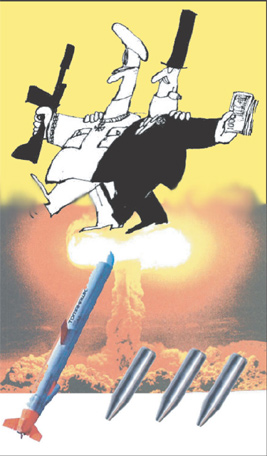 U.S. PREPARES NEW MISSILES FOR JAPAN AFTER NORTH KOREA THREATENS NUCLEAR WAR, newsweek BY The U.S. has moved closer to selling dozens of state-of-the-art missiles to Japan as part of President Donald Trump’s pledge to boost military support for Pacific allies opposed to nuclear-armed North Korea.
The State Department’s Defense Security Cooperation Agency said Wednesday it would back the Japanese government’s request for up to 56 AIM 120C-7 Advanced Medium Range Air-to-Air Missiles (AMRAAMs). The sale, which is estimated at $113 million and requires congressional approval, would also reportedly include various logistical, technical, engineering and weapons support services. It comes as Japan reconsiders its traditionally pacifist post-World War II stance on defense in the face of threats from North Korea, which has shot two missiles over Japanese territory in the past two months.
The proposed sale will provide Japan a critical air defense capability to assist in defending the Japanese homeland and U.S. personnel stationed there,” the agency said in a statement.
“Japan will have no difficulty absorbing these additional munitions into the Japan Air Self-Defense Force,” it added…….
Shortly after the nuclear test, Trump tweeted that he would “allow Japan & South Korea to buy substantially increased amount of highly sophisticated military equipment from the United States.”……http://www.newsweek.com/us-military-prepares-war-north-korea-selling-missiles-japan-678830
Watchdog’s safety clearance for Tepco reactors irks Fukushima victims
 Anti-nuclear activists protest on Wednesday near a building in Tokyo’s Minato Ward, where the Nuclear Regulation Authority held a meeting to give safety approval for two reactors at Tepco’s Kashiwazaki-Kariwa nuclear power plant in Niigata Prefecture.
Two nuclear reactors run by Tokyo Electric Power Company Holdings Inc. cleared the safety review of Japan’s nuclear watchdog on Wednesday, drawing fierce criticism from residents who remain displaced more than six years after the nuclear crisis at the utility’s Fukushima complex.
The government safety clearance of reactors 6 and 7 at the Kashiwazaki-Kariwa power station in Niigata Prefecture is a key step toward having operations resume.
“It appears that things are moving forward as if the (Fukushima nuclear) crisis is over,” said Hiroko Matsumoto, 68, who lives in a temporary shelter house in Iwaki, Fukushima Prefecture, away from her home in Tomioka, also in the prefecture, due to the triple meltdown at Tepco’s Fukushima No. 1 plant in March 2011.
“I want (Tepco) to never forget that a serious nuclear accident can cause enormous damage,” she said.
The approval by the Nuclear Regulation Authority shocked residents in Niigata and surrounding areas who are concerned about the reactors’ reactivation, but others are hoping to see economic benefits from the restart.
“I am surprised that the regulatory authority abruptly softened its stance toward Tepco. I doubt such a hasty decision can guarantee citizens’ safety,” said Nobuko Baba, 76, who lives about 23 kilometers east of the Kashiwazaki-Kariwa plant.
“Whether to resume operation (of the two reactors) should be the decision of Niigata Prefecture citizens. I am counting on Gov. Ryuichi Yoneyama, who has been wary about it,” she said.
Yoneyama ordered a local investigation into the causes and impact of the Fukushima disaster, and is not expected to decide on whether he will approve a restart until the assessment is completed around 2020.
In contrast, Yasuo Ishizaka, 53, an executive of an industrial equipment company in Kashiwazaki, was happy to hear the news.
“I am glad that the safety screening went smoothly, and it is a big step forward for the local economy,” Ishizaka said.
On Wednesday, anti-nuclear activists gathered near a building in Tokyo’s Minato Ward where the nuclear watchdog held a meeting and endorsed a draft document, which serves as certification that the two reactors have met the new, stricter safety standards introduced after the Fukushima disaster.
Amid chants of “Tepco should not be qualified” and “No reactor resumption,” a representative handed over a letter of protest to an official of the regulator.
With the authority’s safety approval, the two reactors became the first of Tepco’s idled units to pass the safety screening since the Fukushima nuclear crisis.
In a media statement on Wednesday, international environmentalist group Greenpeace criticized the regulator’s decision as reckless and said local opposition against the restarts remains strong.
“It’s the same disregard for nuclear risks that resulted in Tepco’s 2011 triple reactor meltdowns at the Fukushima No. 1 site. Approving the safety of reactors at the world’s largest nuclear plant, when it is at extreme risk from major earthquakes, completely exposes the weakness of Japan’s nuclear regulator,” said Shaun Burnie, senior nuclear specialist for Greenpeace Germany.
The World’s Biggest Nuclear Plant Approved to Be Restarted in Japan
Fukushima operator can restart nuclear reactors at world’s biggest plant
Tepco, still struggling to decommission Fukushima Daiichi, gets initial approval to start two reactors at Kashiwazaki-Kariwa
 Reactors No 6, right, and No 7 at Kashiwazaki-Kariwa nuclear power plant.
The operator of Japan’s stricken Fukushima Daiichi nuclear power plant has been given initial approval to restart reactors at another atomic facility, marking the first step towards the firm’s return to nuclear power generation more than six years after the March 2011 triple meltdown.
Japan’s nuclear regulator on Wednesday approved an application from Tokyo Electric Power (Tepco) to restart two reactors at Kashiwazaki-Kariwa – the world’s biggest nuclear power plant – even as the utility struggles to decommission Fukushima Daiichi.
The process will involve reviews and consultations with the public, and the restart is also expected to encounter strong opposition from people living near the plant on the Japan Sea coast of Niigata prefecture.
The Nuclear Regulation Authority (NRA) ruled that the No 6 and No 7 reactors, each with a capacity of 1,356 megawatts, met stringent new safety standards introduced after the Fukushima disaster. The authority’s five commissioners voted unanimously to approve the restarts at a meeting on Wednesday.
The decision drew criticism from anti-nuclear campaigners.
Shaun Burnie, a senior nuclear specialist with Greenpeace Germany, accused the NRA of being reckless.
He added: “It is the same disregard for nuclear risks that resulted in Tepco’s 2011 triple reactor meltdowns at the Fukushima Daiichi site. Approving the safety of reactors at the world’s largest nuclear plant when it is at extreme risk from major earthquakes completely exposes the weakness of Japan’s nuclear regulator.”
Greenpeace said 23 seismic faultlines ran through the Kashiwazaki-Kariwa site.
Tepco said in a statement that it took the regulatory authority’s decision seriously and would continue making safety improvements at its plants while it attempted to decommission Fukushima Daiichi and compensate evacuees.
Despite the NRA’s approval, it could take years for the Kashiwazaki-Kariwa reactors to go back into operation.
The governor of Niigata, Ryuichi Yoneyama, has said he will not decide on whether to agree to the restarts until Tepco completes its review of the Fukushima accident – a process that is expected to take at least another three years.
Fukushima evacuees voiced anger at the regulator’s decision.
“It looks like things are moving forward as if the Fukushima nuclear crisis is over,” Hiroko Matsumoto, who lives in temporary housing, told Kyodo news. Matsumoto, whose home was close to Fukushima Daiichi, said Tepco should “never forget that a serious nuclear accident can cause enormous damage”.
Tepco has been seeking permission to restart the idled reactors to help it reduce spending on fossil fuel imports, which have soared since the disaster, triggered by a huge earthquake and tsunami, forced the closure of all of Japan’s nuclear reactors. Four have since gone back online after passing safety inspections.
The utility faces huge compensation claims from people who were evacuated after three of Fukushima Daiichi’s six reactors went into meltdown on 11 March 2011, as well as a rising decommissioning bill.
Earlier this year, the Japan Centre for Economic Research said the total cost of the Fukushima cleanup – which is expected to take up to 40 years – could soar to between 50-70tn yen (£330bn-£470bn). Earlier estimates put the cost at about 22tn yen.
Nuclear power is expected to become a key issue in the election later this month.
The prime minister, Shinzo Abe, has argued that reactor restarts are necessary for economic growth and to enable Japan to meet its climate change commitments. The government wants nuclear to provide about 20% of Japan’s energy by 2030.
But the newly formed Party of Hope, which has emerged as the main opposition to Abe’s Liberal Democratic party, wants to phase out nuclear power by 2030.
Opinion polls show that most Japanese people oppose nuclear restarts.
NRA approves safety measures at TEPCO plant in Niigata
 The Kashiwazaki-Kariwa nuclear power plant in Niigata Prefecture
Japan’s nuclear watchdog on Oct. 4 approved Tokyo Electric Power Co.’s safety measures taken to restart two reactors in Niigata Prefecture, the first such approval for the company since the Fukushima nuclear disaster unfolded.
The Nuclear Regulation Authority confirmed the results of its screening on the technological aspects of the No. 6 and No. 7 reactors that TEPCO wants to bring online at its Kashiwazaki-Kariwa nuclear plant.
It was also the first time for the NRA to conclude that boiling-water reactors, the same type as those at TEPCO’s crippled Fukushima No. 1 nuclear plant, met the new safety standards adopted after the meltdowns at the plant in 2011.
The NRA plans to hear opinions from the public about its judgment for 30 days before deciding on whether to make the approval official. It will also solicit the views of the minister of economy, trade and industry.
As one condition for official approval, the NRA is requiring the industry minister to oversee the utility’s management policy concerning its initiative and responsibility for work to decommission the Fukushima No. 1 nuclear plant.
From now, the NRA will check equipment designs and security regulations, including how TEPCO will guarantee its promise that its priority is on safety, not economic benefits.
The NRA’s screening process at the Kashiwazaki-Kariwa nuclear plant went beyond checking technological aspects of TEPCO’s safety measures. Given TEPCO’s history of mistakes and blunders, NRA members also discussed whether the utility was even eligible to operate nuclear power plants.
In response to the NRA’s demands that TEPCO take full responsibility for decommissioning the Fukushima No. 1 plant, the utility in late August stressed that its stance of putting importance on safety is “a promise to the people.”
The NRA then approved TEPCO’s eligibility but attached some conditions.
In late September, however, it came to light that workers at the Fukushima No. 1 plant were erroneously setting water gauges to measure groundwater levels of wells around reactor buildings, which could cause leaks of highly contaminated water to the outside water.
Inspectors will face a formidable challenge in judging individual issues facing TEPCO based on security regulations.
However, even if TEPCO passes all of the screenings, it must win the consent of local governments to restart the reactors at the Kashiwazaki-Kariwa nuclear plant.
Niigata Governor Ryuichi Yoneyama has said that he will wait for three or four years to make decision on the restarts, until his prefectural government completes its own investigation into the cause of the 2011 nuclear disaster at the Fukushima No. 1 plant.
http://www.asahi.com/ajw/articles/AJ201710040031.html
TEPCO reactors clear safety review for 1st time after Fukushima
 From left, the No. 5, No. 6 and No. 7 reactors of the Tokyo Electric Power Co.’s Kashiwazaki-Kariwa Nuclear Power Plant in Niigata Prefecture are seen from a Mainichi Shimbun aircraft on Sept. 30, 2017.
TOKYO (Kyodo) — Two reactors in Niigata Prefecture on the Sea of Japan coast run by the operator of the crippled Fukushima nuclear plant cleared government safety standards on Wednesday, becoming the first of the utility’s idled units to pass tightened screening.
The Nuclear Regulation Authority endorsed at its meeting a draft document that serves as certification that Tokyo Electric Power Company Holdings Inc.’s Nos. 6 and 7 reactors at Kashiwazaki-Kariwa power station have met the new, stricter safety standards introduced after the Fukushima disaster.
The two reactors are the newest among the seven units at the Kashiwazaki-Kariwa plant. The complex is one of the world’s largest nuclear power plants, with a combined output capacity of 8.2 million kilowatts.
Despite the effective approval by the nuclear regulator, the actual restart of the two reactors will likely be at least a few years away as Niigata Gov. Ryuichi Yoneyama says it will take “around three to four years” for the utility to win local consent for the resumption of operation.
Formal approval of the restart by the nuclear watchdog is expected after receiving public opinions and consulting with the economy, trade and industry minister to confirm that Tepco is fit to be an operator.
The clearance of the two units is likely to be a boost for the government of Prime Minister Shinzo Abe, which is keen to retain nuclear power generation despite Japan suffering the world’s worst nuclear disaster since Chernobyl at the Fukushima Daiichi nuclear complex in March 2011, triggered by a massive earthquake and tsunami.
Tepco, facing huge compensation payments and other costs stemming from the Fukushima crisis, has been desperate to resume operation of its idled reactors so it can reduce spending on costly fossil fuel imports for non-nuclear thermal power generation.
It filed for safety assessments of the two idled reactors at Kashiwazaki-Kariwa plant in September 2013.
In addition to assessing technical requirements, the review focused on whether Tepco is qualified to once again operate a nuclear power plant as it struggles with work to scrap the Fukushima Daiichi complex, an effort expected to take until around 2051, and reduce contaminated water around the crippled plant where radiation levels remain high.
The two reactors are boiling-water reactors, the same as those that experienced meltdowns in the Fukushima crisis. No such types have previously cleared Japan’s safety standards after the Fukushima disaster, partly as they are required to conduct major refurbishment to boost safety.
Under the new safety requirements, BWRs must be equipped with filtered venting systems so that radioactive substances will be reduced when gas and steam need to be released to prevent damage to containment vessels.
The venting facilities are not an immediate requirement for pressurized water reactors as PWRs are housed in containers larger than those of BWRs, giving more time until pressure rises inside the containers.
In the review, the regulator had questioned Tepco on its posture to ensure the safety of the units. The company last month agreed to a request from the regulator to include a safety pledge as part of its legally binding reactor safety program.
Safety programs drawn up for reactors need to be approved by the regulator and if it finds a grave violation, it can demand the utility halt nuclear power operations.
http://mainichi.jp/english/articles/20171004/p2g/00m/0dm/054000c
Japan nuclear reactor operations: Shikoku shuts Ikata No.3
TOKYO, Oct 3 (Reuters) - Shikoku Electric Power Co said it shut its Ikata No. 3 reactor on Tuesday for planned maintenance. The company expects the 890-megawatt No.3 reactor to resume power generation from around Jan. 22, with commercial operations likely to resume around Feb. 20, it said. Many of Japan's reactors are still going through a relicensing process following the 2011 Fukushima disaster, the world's worst since Chernobyl in 1986, which highlighted regulatory and operational failings at nuclear utilities. The restart process has been protracted as all of the country's reactors were eventually idled. Between September 2013 and August 2015 Japan had no nuclear plants in operation. Japan's nine regional power utilities and a wholesaler, Japan Atomic Power Co, have 42 nuclear reactors for commercial use, with a total generating capacity of 41.482 gigawatts. The shutdown of the Ikata No.3 reactor will bring the number of the nation's reactors that are online down to four, with a combined capacity of 3.52 gigawatts, or 8.5 percent of the country's total nuclear capacity, according to Reuters calculations. The following table shows the status of Japan's nuclear power plants.http://af.reuters.com/article/commoditiesNews/idAFL4N1MA1OT
North Korea threatens Japan – with ‘nuclear clouds over suicidal Japan’

ENGULFED IN FLAMES’ Kim Jong-un warns of ‘nuclear clouds over suicidal Japan’ as he brands the country’s Prime Minister a ‘headless chicken’ North Korea’s state media said ‘the Japanese archipelago will be engulfed in flames in a moment’ The Sun UK, By Jon Lockett, 3rd October 2017,
Bill Gates partners with China’s government nuclear companies to develop his small nuclear reactor dream

China nuclear energy and coal company partner to make traveling wave nuclear reactor, October 2, 2017, The China National Nuclear Corp (CNNC) has signed an agreement with the Shenhua Group, China’s biggest coal producer, to promote the development of advanced “traveling wave” reactor technology, the state nuclear giant said.
The new organization will be a partnership with four Chinese energy companies and will have /A> starting capital of CNY1bn ($153.2 million).
TWR, one of several new “fourth-generation” reactor designs, uses depleted uranium and is more fuel-efficient and cheaper to run than conventional nuclear reactors.
Leading developers of TWR include the Bill Gates-backed Terrapower, which is working on large scale projects aimed at providing base-load electricity. CNNC said its chairman, Wang Shoujun, met with Gates in July to discuss cooperation.
TerraPower’s traveling wave design is a breeder reactor that produce more atomic fuel than they consume, reducing the need to add costly processed nuclear elements.
In 2006, Intellectual Ventures launched a spin-off named TerraPower to model and commercialize a working design of such a reactor, which later came to be called a “traveling-wave reactor”. TerraPower has developed TWR designs for low- to medium- (300 MWe) as well as high-power (~1000 MWe) generation facilities. Bill Gates featured TerraPower in his 2010 TED talk.
In 2010 a group from TerraPower applied for patent EP 2324480 A1 following WO2010019199A1 “Heat pipe nuclear fission deflagration wave reactor cooling”. The application was deemed withdrawn in 2014.
In September, 2015 TerraPower and China National Nuclear Corporation (CNNC) signed a memorandum of understanding to jointly develop a TWR. TerraPower plans to build a 600 MWe demonstration Plant, the TWR-P, by 2018–2022 followed by larger commercial plants of 1150 MWe in the late 2020s |.
………….Shenhua, which is in the middle of a merger with state power giant Guodian, is seeking to diversify away from coal and coal-fired power, and it has already been in talks with CNNC and CGN to invest in nuclear projects. https://www.nextbigfuture.com/2017/10/china-nuclear-energy-and-coal-company-partner-to-make-traveling-wave-nuclear-reactor.html
USA needs to negotiate, exchange some concessions for limited concessions from North Korea
 NORTH KOREA BENEFITS FROM NUCLEAR WEAPONS. GET USED TO IT. War on the Rocks, Markl S Bell, 2 Oct 17 It is often said that nuclear weapons offer little beyond the ability to deter. But if nuclear weapons deter, they also necessarily offer benefits to states that go well beyond simply deterring attack. North Korea today is in the process of reaping those benefits, and this will constrain American foreign policy in the region. As much as American policymakers might want to wish this away, it is better to adjust the sails than to hope the wind disappears. War with North Korea should now be off the table and the denuclearization of North Korea is similarly unrealistic. If the United States wants to tamp down the current crisis, it needs to get used to North Korean nuclear weapons and the constraints they impose on U.S. foreign policy.
It is true that nuclear weapons deter. But because they deter attack, they also act as a shield that reduces the risks and costs of pursuing a host of other foreign policy behaviors. My research shows that nuclear weapons can facilitate a range of objectives that states of all stripes may find attractive. Possessing nuclear weapons can allow states to act more independently of allies, engage in aggression, expand their position and influence, reinforce and strengthen alliances, or stand more firmly in defense of the status quo. States with nuclear weapons are aware of these benefits, and use nuclear weapons to pursue them. This applies as much to democratic states committed to the status quo as it does to authoritarian or revisionist states.
Consider the case of Britain. A declining, status quo state when it acquired nuclear weapons in the 1950s, Britain was increasingly dependent on the United States for its security, facing growing challenges to its role as the preeminent power in the Middle East, while its commitments to allies were becoming increasingly uncredible. What did it do when it acquired nuclear weapons? As I show in a 2015 International Security article, Britain used nuclear commitments instead of conventional military commitments (which it could no longer afford) to reassure allies that were increasingly skeptical of Britain’s ability to come to their aid. Similarly, Britain’s nuclear weapons reduced the risks of acting more independently of the United States and of using military force to resist challenges to its position in the Middle East……..
Today, North Korea is taking advantage of its nuclear weapons, just as past nuclear states have done. What’s good for the goose is good for the gander. So, if North Korean nuclear weapons are useful even if they never get used, what might Kim Jong Un’s regime want to use them for?
North Korea faces serious military threats from South Korea and the United States. South Korea is vastly more economically powerful and has the support of the most powerful state the world has ever known. Since the end of the Cold War, the United States —unconstrained by the absence of a peer competitor — has shown a repeated inclination to pursue regime change around the world, labelled North Korea as part of the “Axis of Evil”, imposed punishing sanctions on North Korea, and kept tens of thousands of forces stationed in the region……
North Korea would like to be able to stop the United States from flying military aircraft close to its territory (particularly the B-1B Lancer flights from Guam) and weaken the U.S.-South Korean alliance. It would like to show that Washington’s threats of regime change or military intervention on the Korean peninsula are empty talk, and demonstrate that the United States is unable to shoot down its missiles. And North Korea may want to be able to more credibly threaten military action against South Korea. All of these make good strategic sense for North Korea as it seeks to reduce the threats it faces and strengthen its position on the Korean peninsula in the face of massive U.S. conventional military superiority.
How do North Korean nuclear weapons help it achieve these goals? By raising the dangers of escalation, North Korea seeks to drive wedges between the United States and South Korea and raise fears of “decoupling” as well as to make it riskier for the United States to fly planes close to its airspace or engage militarily on the Korean peninsula. North Korea launches missiles, daring the United States to try (and quite likely fail) to shoot them down; it refuses to back down when challenged; and it raises the possibility of more provocative nuclear tests.
These actions are predictable, because they advance North Korean national interests. But they are also dangerous, raising the risk of escalation. This is a feature, not a bug, of North Korean strategy. Raising escalation risks is exactly how North Korea hopes to convince the United States to back off and, therefore, to improve its position on the Korean peninsula. And in the process of such escalation, North Korea might be entirely rational to use nuclear weapons first if things got bad enough.
What should the United States do?
North Korea would like to be able to stop the United States from flying military aircraft close to its territory (particularly the B-1B Lancer flights from Guam) and weaken the U.S.-South Korean alliance. It would like to show that Washington’s threats of regime change or military intervention on the Korean peninsula are empty talk, and demonstrate that the United States is unable to shoot down its missiles. And North Korea may want to be able to more credibly threaten military action against South Korea. All of these make good strategic sense for North Korea as it seeks to reduce the threats it faces and strengthen its position on the Korean peninsula in the face of massive U.S. conventional military superiority.
How do North Korean nuclear weapons help it achieve these goals? By raising the dangers of escalation, North Korea seeks to drive wedges between the United States and South Korea and raise fears of “decoupling” as well as to make it riskier for the United States to fly planes close to its airspace or engage militarily on the Korean peninsula. North Korea launches missiles, daring the United States to try (and quite likely fail) to shoot them down; it refuses to back down when challenged; and it raises the possibility of more provocative nuclear tests.
These actions are predictable, because they advance North Korean national interests. But they are also dangerous, raising the risk of escalation. This is a feature, not a bug, of North Korean strategy. Raising escalation risks is exactly how North Korea hopes to convince the United States to back off and, therefore, to improve its position on the Korean peninsula. And in the process of such escalation, North Korea might be entirely rational to use nuclear weapons first if things got bad enough.
What should the United States do?
Any serious policy demands a dose of reality. Denuclearization and regime change are no longer achievable without risking tens (and potentially hundreds) of thousands of American lives. North Korea has nuclear weapons, benefits from having them, and has no interest in giving them up. Denying this reality is not only delusional, but encourages North Korea to take more belligerent actions, accelerate its nuclear program further, and exacerbate the spiral of escalation.
A better approach would be to seek limited concessions from North Korea in exchange for limited concessions by the United States. For example, as James Acton has proposed, North Korea might agree to eschew missile tests over the territory of South Korea and Japan, if the United States limited flights of B1-B bombers close to North Korean territory. Such a deal would acknowledge that North Korea’s capabilities impose constraints on U.S. foreign policy and grant North Korea benefits. At the same time, it reduces the risks of miscalculations or accidental escalation, diminishing North Korean fears of a surprise attack by the United States, and lending some stability to U.S.-North Korean relations. And if North Korea violated the deal, the U.S. could easily resume those flights……..
Ultimately, there are no free lunches in international politics. If the United States wants North Korea to constrain its nuclear program, it will need to offer North Korea something in exchange. And if the United States tries to pursue regime change or denuclearize North Korea by force, it must accept that North Korean nuclear capabilities allow it to force the United States to pay a high price for doing so. Mark S. Bell is an assistant professor in the Political Science Department at the University of Minnesota. https://warontherocks.com/2017/10/north-korea-benefits-from-nuclear-weapons-get-used-to-it/
Health effects of uranium mining in India
Nuclear submarine accident – India’s nuclear-powered submarine, INS Chakra, damaged

 India’s Nuclear Submarine Chakra Suffers Damage In Accident https://defenceaviationpost.com/indias-nuclear-submarine-chakra-suffers-damage-accident/ New Delhi: In a setback to the Indian Navy, nuclear-powered submarine, INS Chakra, has met with an accident and being repaired to rectify “some damage” in sonar dome, media report said.
Quoting unnamed sources news portal The Print reported that the damage could be the result of either a collision at sea or accidental scraping while entering the harbour. Officials in the the Navy refused to comment on the incident.
“Repair work on the submarine is likely to be complicated given that the sonar dome is made of titanium, a difficult metal that requires both specialised machinery and manpower to work on. However, the indigenous Arihant nuclear armed submarines are also being made in Visakhapatnam and that could help,” said the report.
INS Chakra, inducted in April 2012, is on ten year lease. The vessel is belongs to Akula-II class of Russian submarine.
The submarine, having displacement of 12,000 tonnes, is powered by a 190 MW reactor with top speed of over 30 knots.
No joke: Despite the evidence, nuclear power declared safe!
 A touch-panel screen at a facility in Ikata explains that the nuclear power plant in the town was built to withstand strong earthquakes.
IKATA, Ehime Prefecture–It’s as if the 2011 nuclear disaster in Japan never happened.
A public relations facility here that was set up to publicize the safety of the Ikata nuclear power plant operated by Shikoku Electric Power Co. still insists that nuclear plants can withstand a tsunami of any height.
Like the Fukushima No. 1 nuclear power plant that went into triple meltdown, the Ikata facility faces the coast. A magnitude-9.0 earthquake on March 11, 2011, triggered tsunami that put the Fukushima facility out of action.
More than six years after that catastrophic event, the Ehime prefectural government is finally moving to revise the information designed to ease fears about a nuclear accident.
The contents on display will be updated before the end of the fiscal year because, as one prefectural government official put it, “Some of the information does not square with the current situation.”
The facility is located in the Minatoura district of Ikata about four kilometers east of the Ikata nuclear plant. It was established in 1982 by Ehime prefectural authorities to remove concerns the public may have about nuclear power generation.
It is operated by an organization that survives on funding from Shikoku Electric, the Ehime prefectural government and the Ikata town government.
In the last fiscal year, the facility had 1,761 visitors, including elementary school students who live nearby.
Near the entrance to the facility is a touch-panel screen where visitors can learn about nuclear power plants in a quiz format.
One question asks, “What would happen to a nuclear power plant if a large earthquake should strike?”
The three alternatives to choose from are: 1) Continue to generate power; 2) The reactor automatically stops to prevent any form of accident; and 3) It would be destroyed if a large earthquake struck.
The second choice is considered the correct answer.
The monitor also offers this reassurance: “(The nuclear plant) is a sturdy building that would not budge an inch in an earthquake, typhoon or tsunami.”
Another entry states that “it was designed with the largest possible quake in mind.”
Another question asks, “Would a nuclear power plant explode like a nuclear bomb?”
Again, there are three choices: 1) It would explode if used in a wrong way; 2) It would never explode; and 3) Nuclear reactors might explode once it ages.
The correct answer is again the second choice.
In fact, after the Great East Japan Earthquake and tsunami of March 2011, reactors at the Fukushima No. 1 plant were severely damaged by hydrogen explosions caused by core meltdowns after cooling functions were lost when power to the plant was lost.
About a year ago, facility operators have attached a sign to the touch-panel screen that says, “We are in the process of preparing a revision because some of the wording differs from the current situation.”
However, no explanation is offered to show what sections differ from reality.
A prefectural government official in charge of nuclear power safety measures said, “There is some accurate information so we decided it was preferable that some of it was viewed.”
But, the official added that the display would be revised along with improvements in other equipment. The cost of about 500,000 yen ($4,400) would be paid for from tax subsidies obtained through laws covering power generation.
After the Fukushima nuclear accident, a new display was added to show the safety measures being taken at the Ikata plant. There is also a video shown at the facility which explains there has been no noticeable spike in cancer rates or hereditary illness caused by radiation levels under 100 millisieverts.
Trump rules out negotiating with North Korea, contradicting his Secretary of State Rex Tillerson

 Trump says North Korea talks are ‘waste of time’ President contradicts Tillerson’s statement that lines of communication are open Ft.com by Demetri Sevastopulo in Washington, 2 Oct 17 Donald Trump dismissed the prospect of talks with Pyongyang as pointless barely a day after his secretary of state said the US was using new channels of communication to weigh the possibility of negotiations with North Korea about its nuclear programme. “I told Rex Tillerson, our wonderful Secretary of State, that he is wasting his time trying to negotiate with Little Rocket Man,” Mr Trump tweeted on Sunday morning. “Save your energy Rex, we’ll do what has to be done!”.
North Korea will inevitably be a “state nuclear force” – declares Pyongyang
North Korean leader Kim Jong Un provides guidance on a nuclear weapons program in this undated photo released by North Korea’s Korean Central News Agency (KCNA) in Pyongyang September 3, 2017. KCNA via REUTERS
North Korea vows to become a ‘state nuclear force’, Aljazeera, 1 Oct 17
Pyongyang calls sanctions and pressure ‘futile’ in halting its development of nuclear weapons. North Korea’s state news agency has called the US-led effort to impose sanctions over its weapons programme futile, vowing the country inevitably will become a “state nuclear force”.
The comments on Sunday came from the Korean Central News Agency’s website Uriminzokkiri after US Secretary of State Rex Tillerson met for talks with China’s top diplomats and President Xi Jinping in Beijing on the Korean nuclear crisis.
Tillerson has been a proponent of a campaign of “peaceful pressure”, using US and UNsanctions and working with China to turn the screw on the regime.
But his efforts have been overshadowed by an extraordinary war of words, with US President Donald Trump mocking North Korean leader Kim Jong-un as “little rocket man” and Kim branding Trump a “dotard”……. http://www.aljazeera.com/news/2017/10/north-korea-vows-state-nuclear-force-171001052823971.html
Farmers in 575 villages unite against Chutka nuclear project in Madhya Pradesh
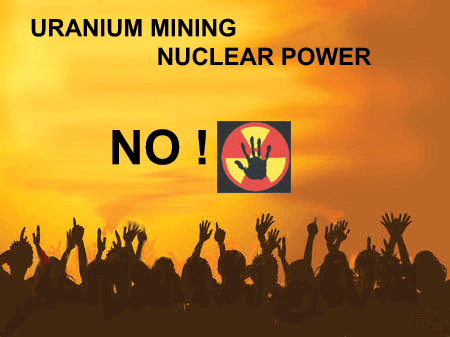 Protest intensifies against Chutka nuclear project in Madhya Pradesh http://timesofindia.indiatimes.com/city/bhopal/protest-intensifies-against-chutka-nuclear-project-in-madhya-pradesh/articleshow/60902228.cms
A major protest rally is being organised by project affected villages from Mandla, Jabalpurand Seoni districts under the banner of Chutka Parmanu Virodhi Sangarsh Samiti from October 2 to December 17. Earlier Kunda village, one of the three affected by the project on the banks of Narmada, had passed resolutions rejecting the government proposal to set up the nuclear plant.
“Villagers had made written submissions in their banks that no deposits should be allowed in their accounts, despite that the state government has deposited compensation money. All 575 villages surrounding the proposed site have decided to protest,” said Navratna Dubey, Samiti’s secretary.
Several organisations and social activists, including Medha Patkar, have raised their voice against the proposed nuclear power plant.
“Villagers had made written submissions in their banks that no deposits should be allowed in their accounts, despite that the state government has deposited compensation money. All 575 villages surrounding the proposed site have decided to protest,” said Navratna Dubey, Samiti’s secretary.
Several organisations and social activists, including Medha Patkar, have raised their voice against the proposed nuclear power plant.
1 This Month




PLEASE OPPOSE HR 8255 AND S.3639 – bills would accelerate satellite deployment, with no environmental review or safeguards – https://ncstd5li.quorum.us/campaign/169331/
To see nuclear-related stories in greater depth and intensity – go to https://nuclearinformation.wordpress.com
-
Archives
- September 2026 (323)
- August 2026 (330)
- July 2026 (355)
- June 2026 (287)
- May 2026 (306)
- April 2026 (356)
- March 2026 (251)
- February 2026 (267)
- January 2026 (308)
- December 2025 (358)
- November 2025 (359)
- October 2025 (375)
-
Categories
- 1
- 1 NUCLEAR ISSUES
- business and costs
- climate change
- culture and arts
- ENERGY
- environment
- health
- history
- indigenous issues
- Legal
- marketing of nuclear
- media
- opposition to nuclear
- PERSONAL STORIES
- politics
- politics international
- Religion and ethics
- safety
- secrets,lies and civil liberties
- spinbuster
- technology
- Uranium
- wastes
- weapons and war
- Women
- 2 WORLD
- ACTION
- AFRICA
- Atrocities
- AUSTRALIA
- Christina's notes
- Christina's themes
- culture and arts
- Events
- Fuk 2022
- Fuk 2023
- Fukushima 2017
- Fukushima 2018
- fukushima 2019
- Fukushima 2020
- Fukushima 2021
- general
- global warming
- Humour (God we need it)
- Nuclear
- RARE EARTHS
- Reference
- resources – print
- Resources -audiovicual
- Weekly Newsletter
- World
- World Nuclear
- YouTube
-
RSS
Entries RSS
Comments RSS

